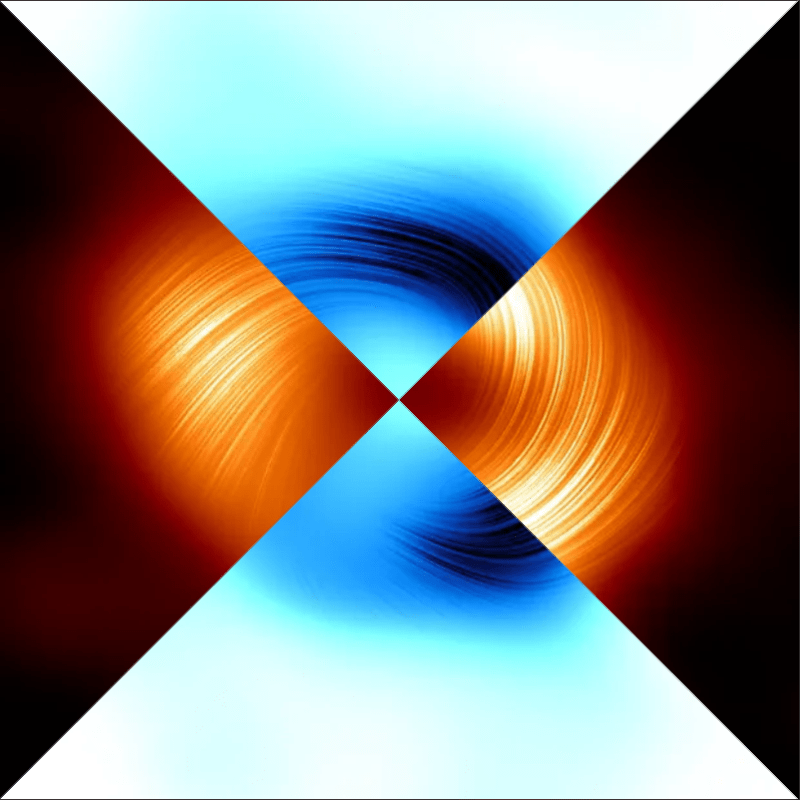
Black, White And Wormy

“Whaddaya mean, Sy, if white holes exist? You just told me how they’re in the equations just like black holes.”

“Math gives us only models of reality, Vinnie. Remarkably good models, some of them, but they’re only abstractions. Necessarily they leave out things that might skew math results away from physical results or the other way around. Einstein believed his math properly reflected how the Universe works, but even so, he doubted that black holes could exist. He didn’t think it’d be possible to collect that much mass into such a small space. Two decades after he said that, Oppenheimer figured out how that could happen.”

“Oppenheimer like the A‑bomb movie guy?”

“Same Oppenheimer. He was a major physicist even before they put him in charge of the Manhattan Project. He did a paper in 1939 showing how a star‑collapse could create the most common type of black hole we know of. Twenty‑five years after that the astronomers found proof that black holes exist.”

“Well, if Einstein was wrong about black holes, why wasn’t he wrong about white holes?”

“We need another Oppenheimer to solve that. So far, no‑one has come up with a mechanism that would create a stand‑alone white hole. That level of stress on spacetime requires an enormous amount of mass‑energy in a tiny volume. Whatever does that must somehow do it with a time‑twist opposite to how a black hole is formed. Worse yet, by definition the white hole’s Event Horizon leaks matter and energy. The thing ought to evaporate almost as soon as it’s formed.”

“I heard weaseling. You said, ‘a stand‑alone white hole,’ like there’s maybe another kind. How about that?”

“Could be, maybe not, depending on who’s talking and whether or not they’re accounting for magnetic fields, neutrinos or quantum effects. The discussion generally involves wormholes.”

“Wormholes.”

“Mm-hm. Some cosmologists think that wormholes might bridge between highly stressed points in spacetime. Black hole or white, the stress is what matters. The idea’s been around nearly as long as our modern idea of black holes. No surprise, ‘wormhole’ was coined by John Archibald Wheeler, the same guy who came up with the phrases ‘black hole’ and ‘quantum foam’.”

“Quantum—. Nope, not gonna bite. Get back to white holes.”

“I’m getting there. Anyway, the relativity theory community embraced black holes, white holes and wormholes as primary tools for studying how spacetime works.”

“How’re they gonna do that? That squib Cal showed me said we’ve never seen a white hole.”

“Fair question. Last I heard, the string theory community confidently predicted 10500 different Universes with little hope of narrowing the field. In contrast, relativity theory is firmly constrained by well‑founded math, a century of confirmation from experimental tests and a growing amount of good black hole data. Perfectly good math says that wormholes and white holes could form but only under certain unlikely conditions. Those conditions constrain white holes like Oppenheimer’s conditions constrained forming a stellar‑size black hole.”

“So how do we make one?”

We don’t. If the Universe can make the right conditions happen somewhere in spacetime, it could contain white holes and maybe a network of wormholes; otherwise, not. Maybe we don’t see them because they’ve all evaporated.”

“I remember reading one time that with quantum, anything not forbidden must happen.”

“Pretty much true, but we’re not talking quantum here. Macro‑scale, some things don’t happen even though they’re not forbidden.”

“Name one.”

“Anti‑matter. The laws of physics work equally well for atoms with positive or negative nuclear charge. We’ve yet to come up with an explanation for why all the nuclear matter we see in the Universe has the positive‑nucleus structure. The mystery’s got me considering a guess for Cathleen’s next Crazy Theories seminar.”

“Oh, yeah? Let’s have it.”

“Strictly confidential, okay?”

“Sure, sure.”

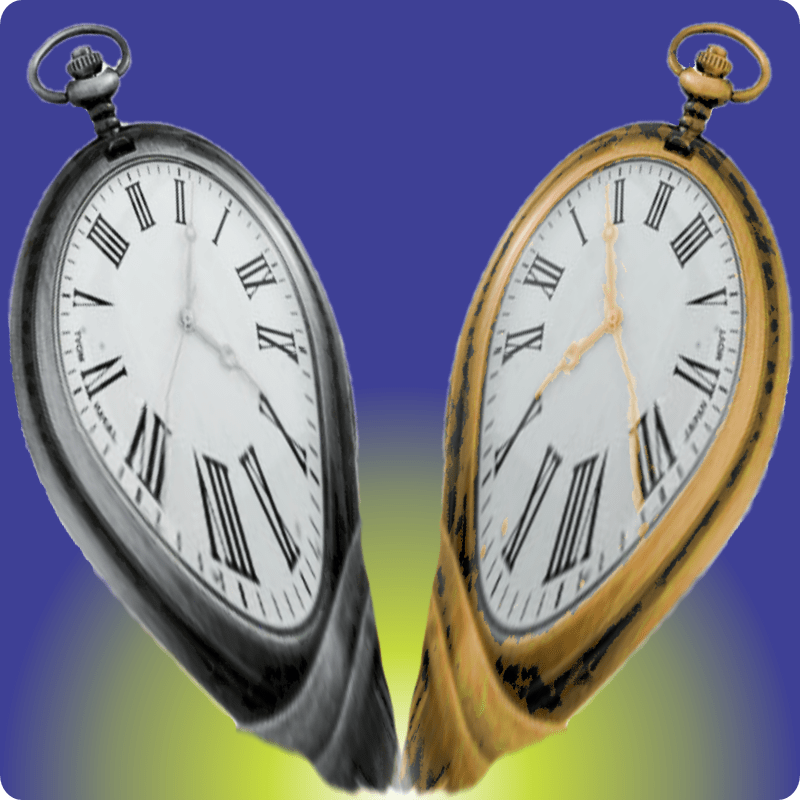
“Suppose the Big Bang’s chaos set up just the right conditions to make a pair of CPT‑twin black holes, expanding in opposite directions along spacetime’s time dimension. Suppose we’re inside one twin. Our time flows normally. If we could see into the other twin, we’d see inside‑out atoms and clocks running backwards. From our perspective the twin would be a white hole.”

“Stay outta that wormhole bridge.”

~ Rich Olcott
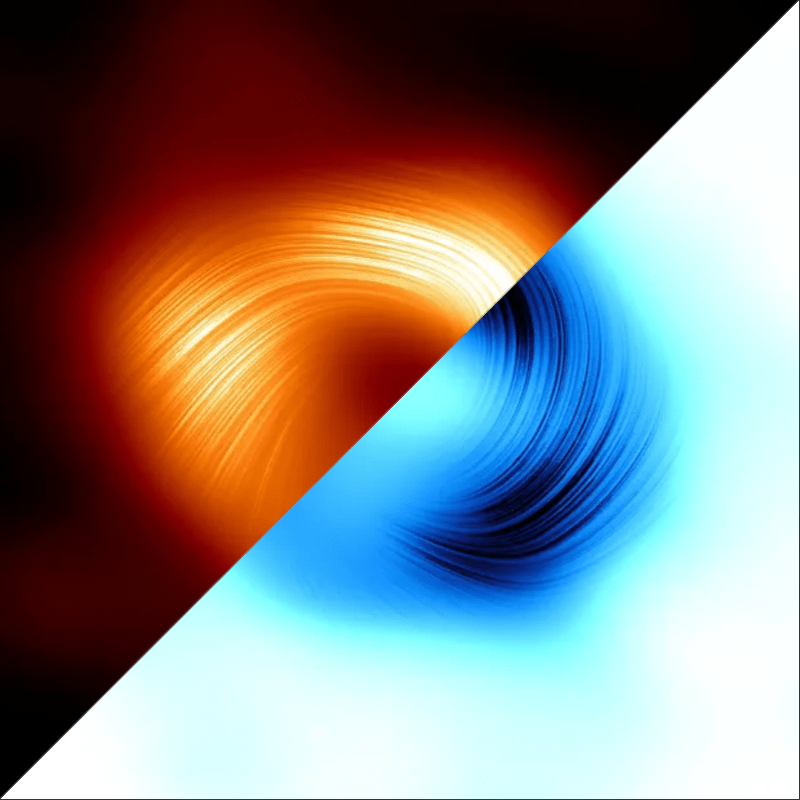
A High-contrast Image

Vinnie clomps into my office. “Morning, Sy. I knew you weren’t busy ’cause there’s music playing.”

“Well, you’re right, I am between assignments. Yesterday another client called to say they’re cancelling my contract because their Federal grant was cut off. They had to let three grad students go, too. That was a project with good prospects for generating a couple of successful businesses. These zealots are eating our seed corn, Vinnie, and they’re burning down the silo.”

“I know the feeling, Sy. There’s a lot less charter flying to do these days. Nobody wants to do meetings when they don’t know what the rules will be next week.”

<deep sigh>
 <deep sigh>

“Oh, yeah, Sy. Why I came up here — what’s with white holes? Cal asked me about ’em ’cause a little squib in one of his astronomy magazines didn’t tell us much so now I’m curious.”

“Okay, tell me something you know about black holes.”

“We can’t see one, but we can see light from its accretion disc.”

“Fair enough. Something else.”

“A black hole’s what you get when a right‑size star collapses.”

“I like that ‘right‑size’ qualification. Too small or too big doesn’t work. White holes almost certainly can’t happen from a star collapse. What else?”

“I heard that ‘almost.’ Uhh… once you pass inside the Event Horizon, you can’t get out.”

“You can’t get inside a white hole’s Event Horizon.”

“Okay, that’s weird. Like it’s got a hard crust like black holes don’t?”

“Nope. A white hole’s Event Horizon’s a mathematical abstraction just like a black hole’s. Not a hard surface, just a boundary where time starts playing games.”

“Wait, we talked about time and the Event Horizon some time ago. If I remember right, we worked out that cause‑and‑effect runs parallel to time. Outside the Event horizon time’s not locked to any specific orientation in space. We can cause things to happen in any direction. Inside the Event Horizon’s sphere, both time and cause‑and‑effect point further in. You can’t make anything happen further out than wherever you are in there which is why light can’t escape, right?”

“Mostly. Anything inside the Horizon is bound to spiral inward toward the singularity. The journey could be slow or fast. There’s some disagreement on how long it would take, though — could be forever, could be forever near enough. Some current models say the Horizon’s geometric center is the infinitely distant future. Other models say, no, for a stellar‑collapse black hole it’s only beyond the age of the Universe.”

“Why not … oh, because the real black hole was born at a definite time so it can’t have an infinite future.”

“That’s about the size of it — both directions either finite or infinite. Physicists love to propose symmetries like that but I’m not willing to bet either way.”

“Black hole/white hole sounds like symmetry.”

“In a way it isn’t, in a way it is. Both varieties are solutions for Einstein’s equation about spacetime under—”

“Hold it, no equations, you know I hate those things. Anyway, how can two different holes solve one equation?”

“Solve x=√9.”

“Gotta be x=3.”

“Or minus‑3. They’re both right answers, right?”

“Mmm, yeah. Okay, that was arithmetic, not an equation, but why’d you give it to me at all?”

“To demonstrate plus‑or‑minus symmetry. Einstein’s equation tells how mass warps spacetime. The answers relate to square‑roots of summed squares like Pythagoras’ c=√(a²+b²). If you pick positive square roots the warping describes a black hole. The negative square roots give the warping for a white hole which behaves differently. Both kinds depend on intense gravitational fields arising from a singularity but a white hole’s cause‑and‑effect arrow points outward.”

“So that’s why you’re locked out? You can’t cause anything further in than you are?”

“Exactly. But it gets deeper. A black hole’s singularity, the one you can’t avoid if you’re inside its Event Horizon, is in the distant future. A white hole’s singularity, the one you can’t get to anyway, is in the distant past.”

“That’s why you said they can’t come from star collapses — the stars died too recent.”

“Mm-hm. If white holes exist at all, they probably were born in the Big Bang.”

~ Rich Olcott
The Spaghettification Zone

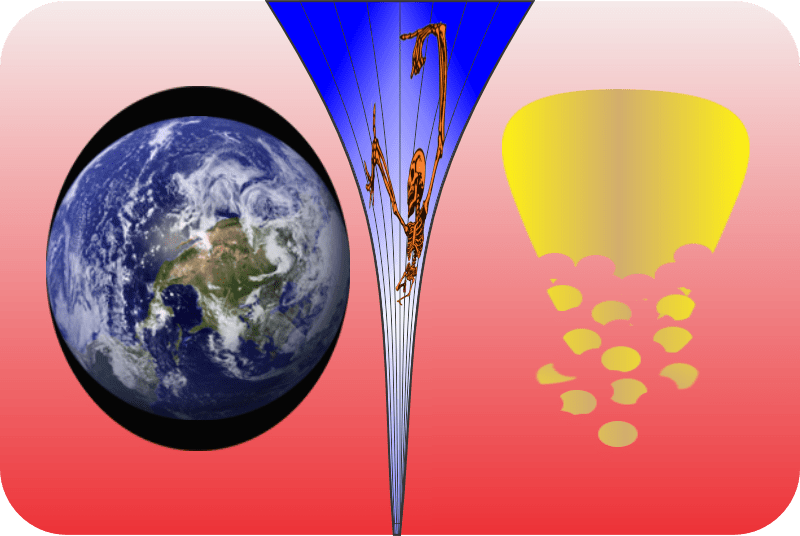
Vinnie’s still wincing. “That neutron star pulling all the guy’s joints apart — yuckhh! So that’s spaghettification? I thought that was a black hole thing.”

“Yes and no, in that order. Spaghettification’s a tidal phenomenon associated with lopsided gravity fields, black holes or otherwise. You know what causes the tides, of course.”

“Sure, Sy. The Sun pulls up on the water underneath it.”

“That’s not quite it. The Sun’s direct‑line pull on a water molecule is less than a part per million of the Earth’s. What really happens is that the Sun broadly attracts water molecules north‑south east‑west all across the Sun‑side hemisphere. There’s a general movement towards the center of attraction where molecules pile up. The pile‑up’s what we call the tide.”

“What explains the high tide on the other side of the Earth? You can’t claim the Sun pushes it over there.”

“Of course not. It goes back to our lopsided taste of the Sun’s gravitational field. If it weren’t for the Sun’s pull, sea level would be a nice round circle where centrifugal force balances Earth’s gravity. The Sun’s gravity puts its thumb on the scale for the near side, like I said. It’s weaker on the other side, though — balance over there tilts toward the centrifugal force, makes for a far‑side bulge and midnight tides. We get lopsided forces from the moon’s gravity, too. That generates lunar tides. The solar and lunar cycles combine to produce the pattern of tides we experience. But tides can get much stronger. Ever hear of the Roche effect?”

“Can’t say as I have.”

“Imagine the Earth getting closer to the Sun but ignore the heat. What happens?”

“Sun‑side tides get higher and higher until … the Sun pulls the water away altogether!”

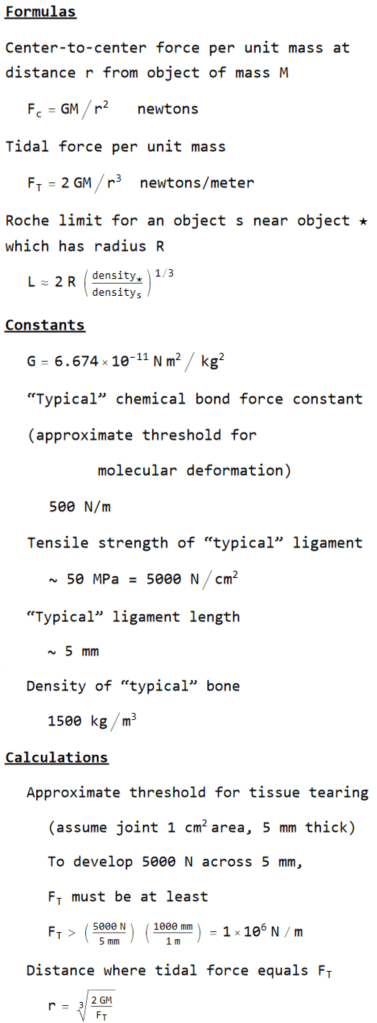
“That’s the idea. In the mid‑1800s Édouard Roche noticed the infinity buried in Newton’s F=GMm/r² equation. He realized that the forces get immense when the center‑to‑center distance, r, gets tiny. ‘Something’s got to give!’ he thought so he worked out the limits. The center‑to‑center force isn’t the critical one. The culprit is the tidal force which arises from the difference in the gravitational strength on either side of an object. When the force difference exceeds the forces holding the object together, it breaks up.”

“Only thing holding the ocean to Earth is gravity.”

“Exactly. Roche’s math applies strictly to objects where gravity’s the major force in play. Things like rubble‑pile asteroids like Bennu and Dimorphos or a black hole sipping the atmosphere off a neighboring blue supergiant star. We relate spaghettification to rubble piles but it can also compete with interatomic electronic forces which are a lot stronger.”

“You’re gonna get quantitative, right?”

“Of course, that’s how I operate.” <tapping on Old Reliable’s screen> “Okay, suppose Niven’s guy Shaffer is approaching some object from far away. I’ve set up tidal force calculations for some interesting cases. Turns out if you know or can estimate an object’s mass and size, you can calculate its density which is key to Roche’s distance where a rubble pile flies apart. You don’t need density for the other thresholds. Spagettification sets in when tidal force is enough to bend a molecule. That’s about 500 newtons per meter, give or take a factor of ten. I estimated the rip‑apart tidal force to be near the tensile strength of the ligaments that hold your bones together. Sound fair?”

“Fair but yucky.”

“Mm‑hm. So here’s the results.”

“What’s with the red numbers?”

“I knew you’d ask that first. Those locations are inside the central object so they make no sense physically. Funny how Niven picked the only object class where stretch and tear effects actually show up.”

“How come there’s blanks under whatever ‘Sgr A*’ is?”

“Astronomer‑ese for ‘Sagittarius A-star,’ the Milky Way’s super‑massive black hole. Can’t properly calculate its density because the volume’s ill‑defined even though we know the Event Horizon’s diameter. Anyhow, look at the huge difference between the Roche radii and the two thresholds that affect chemical bonds.”

“Hey, Niven’s story had Shaffer going down to like 13 miles, about 20 kilometers. He’d’ve been torn apart before he got there.”

“Roughly.”

~~ Rich Olcott

Mushy stuff

“Amanda! Amanda! Amanda!”

“All right, everyone, settle down for our final Crazy Theorist. Jim, you’re up.”

“Thanks, Cathleen. To be honest I’m a little uncomfortable because what I’ve prepared looks like a follow-on to Newt’s idea but we didn’t plan it that way. This is about something I’ve been puzzling over. Like Newt said, black holes have mass, which is what everyone pays attention to, and charge, which is mostly unimportant, and spin. Spin’s what I’ve been pondering. We’ve all got this picture of a perfect black sphere, so how do we know it’s spinning?”

Voice from the back of the room — “Maybe it’s got lumps or something on it.”

“Nope. The No-hair Theorem says the event horizon is mathematically smooth, no distinguishing marks or tattoos. Question, Jeremy?”

“Yessir. Suppose an asteroid or something falls in. Time dilation makes it look like it’s going slower and slower as it gets close to the event horizon, right? Wouldn’t the stuck asteroid be a marker to track the black hole’s rotation?”

“Excellent question.” <Several of Jeremy’s groupies go, “Oooh.”> “Two things to pay attention to here. First, if we can see the asteroid, it’s not yet inside the horizon so it wouldn’t be a direct marker. Beyond that, the hole’s rotation drags nearby spacetime around with it in the ergosphere, that pumpkin‑shaped region surrounding the event horizon except at the rotational poles. As soon as the asteroid penetrates the ergosphere it gets dragged along. From our perspective the asteroid spirals in instead of dropping straight. What with time dilation, if the hole’s spinning fast enough we could even see multiple images of the same asteroid at different levels approaching the horizon.”

Jeremy and all his groupies go, “Oooh.”

“Anyhow, astronomical observation has given us lots of evidence that black holes do spin. I’ve been pondering what’s spinning in there. Most people seem to think that once an object crosses the event horizon it becomes quantum mush. There’d be this great mass of mush spinning like a ball. In fact, that was Schwarzchild’s model for his non-rotating black hole — a simple sphere of incompressible fluid that has the same density throughout, even at the central singularity.”

VBOR — “Boring!”

“Well yeah, but it might be correct, especially if spaghettification and the Firewall act to grind everything down to subatomic particles on the way in. But I got a different idea when I started thinking about what happened to those two black holes that LIGO heard collide in 2015. It just didn’t seem reasonable that both of those objects, each dozens of solar masses in size, would get mushed in the few seconds it took to collide. Question, Vinnie?”

“Yeah, nice talk so far. Hey, Sy and me, we talked a while ago about you can’t have a black hole inside another black hole, right, Sy?”

“That’s not quite what I said, Vinnie. What I proved was that after two black holes collide they can’t both still be black holes inside the big one. That’s different and I don’t think that’s where Jim’s going with this.”

“Right, Mr Moire. I’m not claiming that our two colliders retain their black hole identities. My crazy theory is that each one persists as a high‑density nubbin in an ocean of mush and the nubbins continue to orbit in there as gravity propels them towards the singularity.”

VBOR —”Orbit? Like they just keep that dance going after the collision?”

“Sure. What we can see of their collision is an interaction between the two event horizons and all the external structures. From the outside, we’d see a large part of each object’s mass eternally inbound, locked into the time dilation just above the joined horizon. From the infalling mass perspective, though, the nubbins are still far apart. They collide farther in and farther into the future. The event horizon collision is in their past, and each nubbin still has a lot of angular momentum to stir into the mush. Spin is stirred-up mush.”

Cathleen’s back at the mic. “Well, there you have it. Amanda’s male-pattern baldness theory, Newt’s hyper‑planetary gear, Kareem’s purple snowball or Jim’s mush. Who wins the Ceremonial Broom?”

The claque responds — “Amanda! Amanda! Amanda!”

~ Rich Olcott
A Great Big Mesh

Cal has my coffee mug filled as soon as I step into his shop. “Get to the back room quick, Sy. Cathleen’s got another Crazy Theories seminar going back there.”

So I do. First thing I hear is Amanda finishing her turn at the mic. “And that’s why humans evolved male pattern baldness.”

A furor of “Amanda! Amanda! Amanda!” then Cathleen regains control. “Thank you, Amanda. Next up — Newt Barnes. What’s your Crazy Theory, Newt?”

“Crazy idea, not a theory, but I like it. Everybody’s heard of black holes, right?”

<general nodding>

“And we’ve all heard that nothing can leave a black hole, not even light.”

<more nodding>

“Well in fact that’s mostly not true. There’s so much confusion about black holes. We’ve known about a black hole’s event horizon and its internal mass since the 1920s. It took years for us to realize that the central mass could wrap a shiny accretion disk around itself, and an ergosphere, and maybe spit out jets. So, close outside the Event Horizon there’s a lot of light‑emitting structure, right?”

<A bit less nodding, but still.>

“Right. So I’ll skip in past a few controversial layers and get down to the famously black event horizon. Why’s it black?”

Voice from the back of the room — “Because photons can’t get out because escape velocity’s faster than lightspeed.”

“That’s the answer I expected, but it’s also one of the confusing parts. You’re right, the horizon marks the level where outward‑bound massy particles can’t escape. The escape velocity equation depends on trading off kinetic and gravitational potential energy. Any particle with mass would have to convert an impossible amount of kinetic energy into gravitational potential energy to get through the barrier. But zero‑mass particles, photons and such, are pure kinetic energy. They aren’t bound by a gravitational potential so escape velocity trade‑offs simply don’t apply. There’s a deeper reason photons also can’t get out.”

VBOR — “So what’s trapping them?”

“Time. It traps photons and any kind of information. The other thing about the Event Horizon is, it’s the level where spacetime is so bent around that the time‑coordinate is just on the verge of pointing inward. Once you’re inside that boundary the cause‑and‑effect arrow of time is against you. Whatever direction you point your flashlight, its beam will emerge in your future and that’s away from the horizon. Trying to send a signal outside would be like sending it into your past, which you can’t do. Nothing gets away from a black hole except…”

“Except?”

“Roger Penrose found a loophole and I may have found another one. There’s something that Wheeler called the No-Hair Theorem. It says that the Event Horizon hides everything inside it except for its mass, electric charge and angular momentum.”

“How do those get out?”

“They don’t get out so much as serve as backdrop for all the drama in the rest of the structure. If you know the mass, for instance, you can calculate its temperature and the Horizon’s diameter and a collection of other properties.”

Cathleen senses a teachable moment and breaks in. “Talk about charge and spin, Newt.”

“I was going there, Cathleen. Kerr and company’s equations take account of both of those. Turns out the attractive forces between opposite charges are so much stronger than gravity that it’s hard for an object in space to build up a significant amount of either kind of charge without getting neutralized almost immediately. Kind of ironic that the Coulomb force, far stronger than gravity, generates net energy contributions that are much smaller than the gravity‑based ones. Spin, though, that’s where the loopholes are. Penrose figured out how particles from the accretion disk could dip into the black hole’s spinning ergosphere, steal some of its energy, and stream up to power the jets.”

VBOR — “What’s your loophole then?”

“Speed contrast between layers. The black hole mass is spinning at a great rate, dragging nearby spacetime and the ergosphere and the accretion disk around with it. But the layers go slower as you move outward. Station a turbine generator like an idler gear between any two layers and you’re pulling power from the black hole’s spin.”

Silence … then, “Amanda! Amanda! Amanda!”

~ Rich Olcott
Cal’s Gallery

“Goodness, Cal, you’ve redone your interior decorations.”

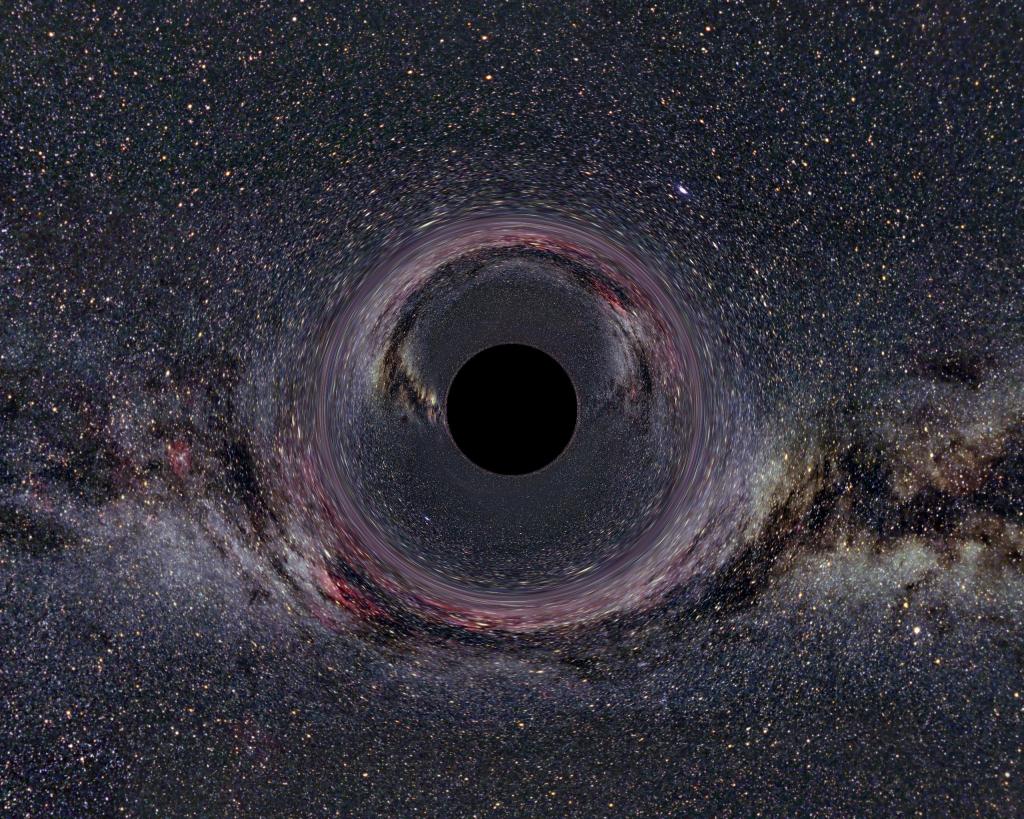
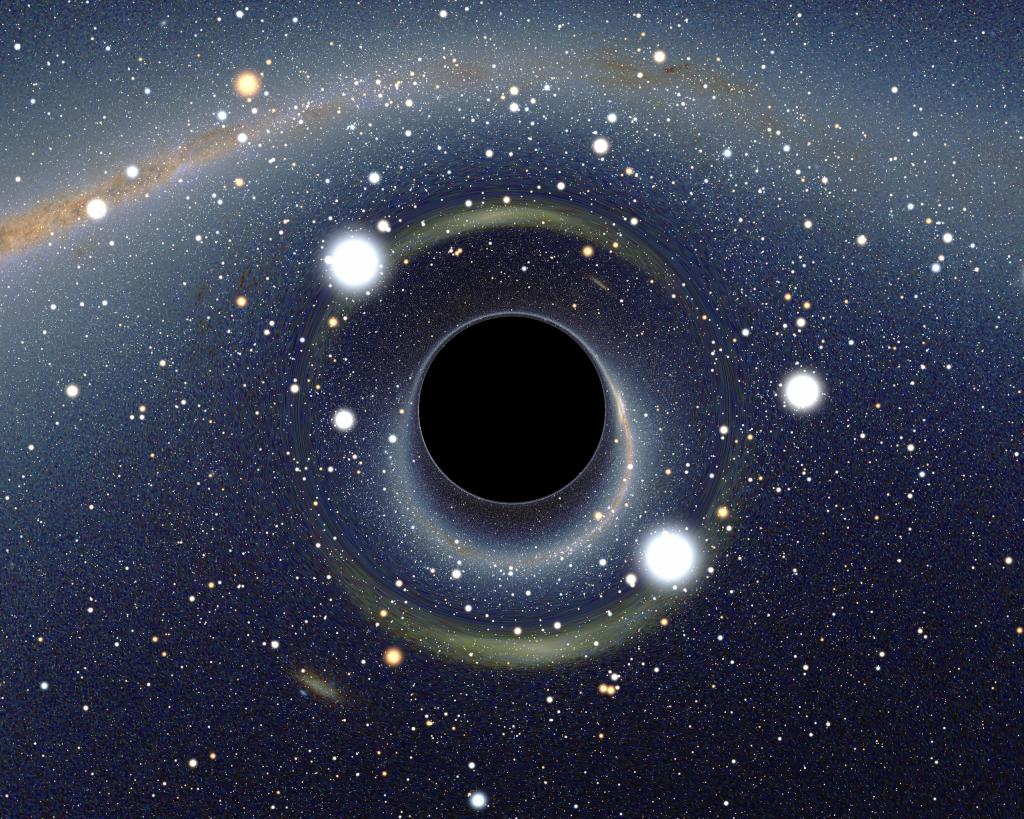
“I got tired of looking at the blank wall opposite the cash register, Sy. Check out the gallery. Way at the end here’s the earliest one I’ve got, goes back to 2005.”

“Yeah, ray-marching each background pixel as it passed through the distorting gravity field. That was heavy-duty computer graphics back then.”


“Here’s another one from a year later. I like it better because you can pair up stars and stuff that show up on both sides of the Einstein ring.”


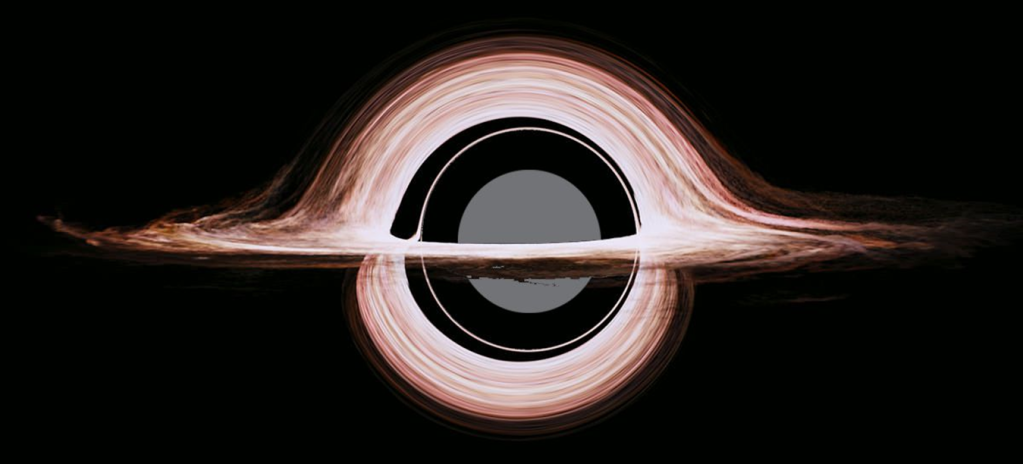
“This one’s famous, comin’ from the Interstellar movie. Funny, I can’t think of any black hole pictures before Interstellar that paid much attention to the accretion disk.”

“There certainly was a lot of that in the specialist literature, but you’re probably right for what leaked out to the pop‑sci press. Most of the published imagery was about how the gravity field distorts the figures behind it. That perpendicular handle was certainly a surprise.”


“This one’s famous, too. It shows what made the first good evidence that black holes are a thing, back in 1965. That ball to the right is a blue supergiant. See how its solar wind is feeding into X-1’s accretion disk? NASA’s picture is from 2017 so it’s not really historical or anything.”


“Now this one is historical, Cal. That image was released in 2019 from data collected in 2017.”

“I knew you’d recognize it, Sy. You’ve written about it enough.”


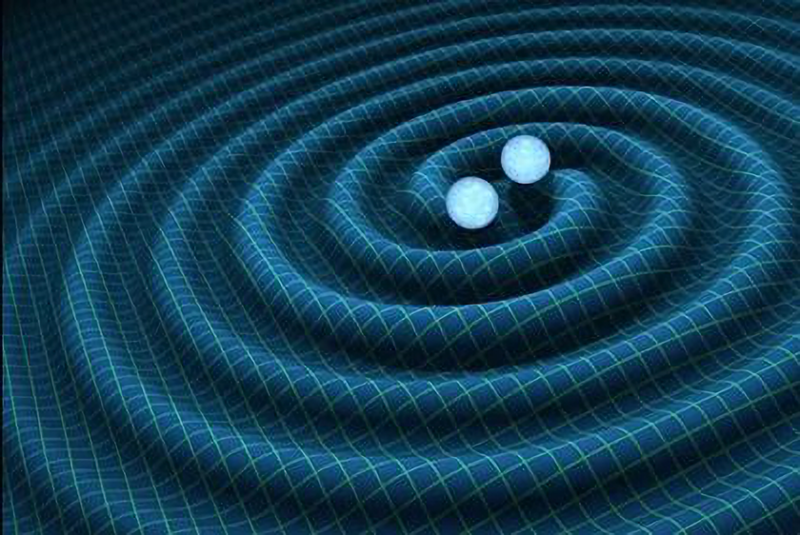
<sly grin> “Whaddya think of this one, Sy, the gravitational waves from those two black holes that LIGO told us about?”

“You knew I wouldn’t like it.”

The final waltz of two black holes” – click for video
Credit: R. Hurt – Caltech / JPL

“It’s just another trampoline picture, right?”

“No, it’s worse than that. Gravitational waves travel at lightspeed. Massive objects like people and 30‑solar‑mass black holes can’t get up to a fraction of a percent of lightspeed without expending an enormous amount of energy. The waves travel outward much faster than objects can orbit each other, even up to the end. Those waves winding outward should be nearly straight.”


“Whoa, Cal, this one isn’t a poster, it’s a monitor screen.”

“I bought a new bigger flat‑screen for home so I brought the old small one here for videos. I like how this movie shows the complicated shape flattening out when you get above the disk. The Interstellar movie made everyone think the disk is some weird double‑handled ring but the handle’s aren’t really there.”

“Mm‑hm, very nice gravity‑lens demonstration. Notice how the ring’s bright in whichever side’s coming toward us whether we’re above or below it?”

Circling over a black hole structure” — Click for video
Credit: NASA’s Goddard Space Flight Center/Jeremy Schnittman

“No, I hadn’t. Cool. How come?”

“It’s called relativistic Doppler beaming. Time distortion is significant in the close‑in parts of the ring. That affects how we see the flow. In the hole’s frame of reference the brightness and rotation speed are the same all around. In our frame the moving‑closer particles look brighter because they emit more photons per unit of our time. Another one of those unexpected phenomena where physicists say, ‘Of course!’ as soon as they see it but not before.”

~~ Rich Olcott
SPLASH Splish plink

<chirp, chirp, chirp, chirp> “Moire here. This’d better be good.”

“Hello, Mr Moire. I’m one of your readers.”

“Do you have any idea what time it is?”

“Afraid not, I don’t know what time zone you’re in.”

“It’s three o’clock in the morning! Why are you calling me at this hour?”

“Oh, sorry, it’s mid-afternoon here. Modern communications tech is such a marvel. No matter, you’re awake so here’s my question. I’ve been pondering that micro black hole you’ve featured in the last couple of posts. You convinced me it would have a hard time hitting Earth but then I started thinking about it hitting the Sun. The Sun’s diameter is 100 times Earth’s so it presents 10,000 times more target area, yes? Further, the Sun’s 300,000 times more massive than Earth so it has that much more gravity. Surely the Sun is a more effective black hole attractor than Earth is.”

“That’s a statement, not a question. Worse yet, you’re comparing negligible to extremely negligible and neither one is worth losing sleep over which is what I’m doing now.”

“Wait on, I’ve not gotten to my question yet which is, suppose a black hole did happen to collide with the Sun. What would happen then?”

<yawn> “Depends on the size of the black hole. If it’s supermassive, up in the billion‑sun range, it wouldn’t hit the Sun. Instead, the Sun would hit the black hole but there’d be no collision. The Sun would just sink quietly through the Event Horizon.”

“Wouldn’t it rip apart?”

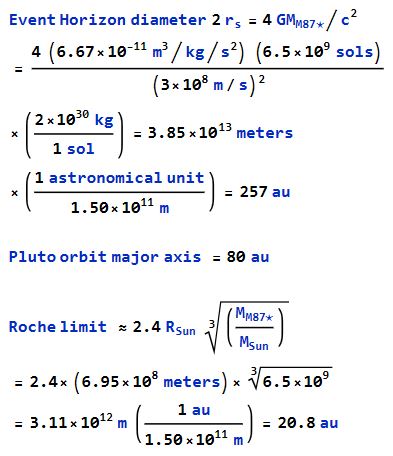
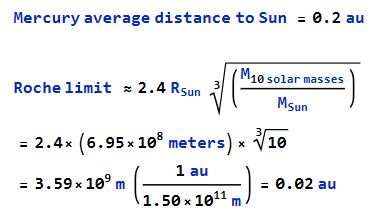
“You’re thinking of those artistic paintings showing great blobs of material being torn away by a black hole’s gravity. Doesn’t work that way, at least not at this size range.” <grabbing Old Reliable from my nightstand and key‑tapping> “Gravitational forces are distance‑dependent. Supermassives are large even by astronomical standards. The M87* black hole, the first one ESA got an image of, has the mass of 6 billion Suns and an Event Horizon three times wider than Pluto’s orbit. The tidal ripping‑apart you’re looking for only happens when the mass centers of two objects approach within Roche’s limit. Suppose a Sun‑sized star flew into M87*’s Event Horizon. Their Roche limit would be 100 astronomical units inside the Event Horizon. If any ripping happened, no evidence could escape to us.”

“Another illusion punctured.”

“Don’t give up hope. The next‑smaller size category have masses near our Sun’s. The Event Horizon of a 10‑solar‑mass black hole would be only about 60 kilometers wide. The Roche Zone for an approaching Sun is a million times wider. There’s plenty of opportunity for ferocious ripping on the way in.”

“Somehow that’s a comfort, but my question was about even smaller black holes — micro‑size flyspecks such as you wrote about. What effect would one have on the Sun?”

“You’d think it’d be a simple matter of the micro‑hole, let’s call it Mikey, diving straight to the Sun’s center while gobbling Sun‑stuff in a gluttonous frenzy, getting exponentially bigger and more voracious every second until the Sun implodes. Almost none of that would happen. The Sun’s an incredibly violent place. On initial approach Mikey’d be met with powerful, rapidly moving magnetic fields. If he’s carrying any charge at all they’d give him whip‑crack rides all around the Sun’s mostly‑vacuum outer layers. He might not ever escape down to the Convection Zone.”

“He’d dive if he escaped there or he’s electrically neutral.”

“Mostly not. The Convection Zone’s 200,000-kilometer depth takes up two‑thirds of the Sun’s volume and features hyper‑hurricane winds roaring upward, downward and occasionally sideward. Mikey would be a very small boat in a very big forever storm.”

“But surely Mikey’s density would carry him through to the core.”

“Nope, the deeper you go, the smaller the influence of gravity. Newton proved that inside a massive spherical shell, the net gravitational pull on any small object is zero. At the Sun’s core it’s all pressure, no gravity.”

“Then the pressure will force‑feed mass into Mikey.”

“Not so much. Mikey has jets and and an accretion disk. Their outward radiation pressure sets an upper limit on Mikey’s gobbling speed. The Sun will nova naturally before Mikey has any effect.”

“No worries then.”

~~ Rich Olcott

Hiding Among The Hill Spheres

Bright Spring sunlight wakes me earlier than I’d like. I get to the office before I need to, but there’s Jeremy waiting at the door. “Morning, Jeremy. What gets you here so soon after dawn?”

“Good morning, Mr Moire. I didn’t sleep well last night, still thinking about that micro black hole. Okay, I know now that terrorists or military or corporate types couldn’t bring it near Earth, but maybe it comes by itself. What if it’s one of those asteroids with a weird orbit that intersects Earth’s orbit? Could we even see it coming? Aren’t we still in danger of all those tides and quakes and maybe it’d hollow out the Earth? How would the planetary defense people handle it?”

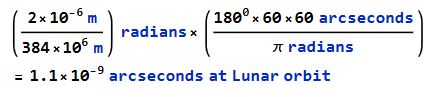
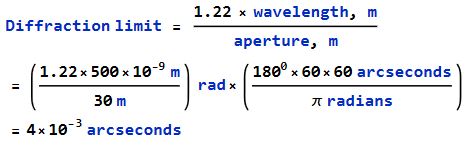
“For so early in the day you’re in fine form, Jeremy. Let’s take your barrage one topic at a time, starting with the bad news. We know this particular object would radiate very weakly and in the far infrared, which is already a challenge to detect. It’s only two micrometers wide. If it were to cross the Moon’s orbit, its image then would be about a nanoarcsecond across. Our astrometers are proud to resolve two white‑light images a few milliarcseconds apart using a 30‑meter telescope. Resolution in the far‑IR would be about 200 times worse. So, we couldn’t see it at a useful distance. But the bad news gets worse.”

“How could it get worse?”

“Suppose we could detect the beast. What would we do about it? Planetary defense people have proposed lots of strategies against a marauding asteroid — catch it in a big net, pilot it away with rocket engines mounted on the surface, even blast it with A‑bombs or H‑bombs. Black holes aren’t solid so none of those would work. The DART mission tried using kinetic energy, whacking an asteroid’s moonlet to divert the moonlet‑asteroid system. It worked better than anyone expected it to, but only because the moonlet was a rubble pile that broke up easily. The material it threw away acted as reaction mass for a poorly controlled rubble rocket. Black holes don’t break up.”

“You’re not making getting to sleep any easier for me.”

“Understood. Here’s the good news — the odds of us encountering anything like that are gazillions‑to‑one against. Consider the probabilities. If your beast exists I don’t think it would be an asteroid or even from the Kuiper Belt. Something as exotic as a primordial black hole or a mostly‑evaporated stellar black hole couldn’t have been part of the Solar System’s initial dust cloud, therefore it wouldn’t have been gathered into the Solar System’s ecliptic plane. It could have been part of the Oort cloud debris or maybe even flown in on a hyperbolic orbit from far, far away like ‘Oumuamua did. Its orbit could be along any of an infinite number of orientations away from Earth’s orbit. But it gets better.”

“I’ll take all the improvement you can give me.”

“Its orbital period is probably thousands of years long or never.”

“What difference does that make?”

“You’ve got to be in the right place at the right time to collide. Earth is 4.5 billion years old. Something with a 100‑year orbit would have had millions of chances to pass through a spot we happen to occupy. An outsider like ‘Oumuamua would have only one. We can even figure odds on that. It’s like a horseshoe game where close enough is good enough. The object doesn’t have to hit Earth right off, it only has to pierce our Hill Sphere.”

“Hill Sphere?”

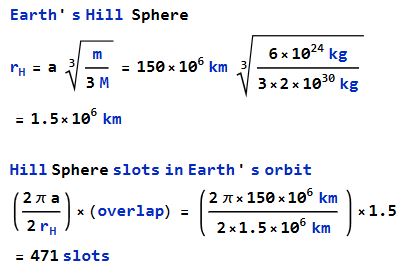
“A Hill Sphere is a mathematical abstract like an Event Horizon. Inside a planet’s Sphere any nearby object feels a greater attraction to the planet than to its star. Velocities permitting, a collision may ensue. The Sphere’s radius depends only on the average planet–star distance and the planet and star masses. Earth’s Hill Sphere radius is 1.5 million kilometers. Visualize Hill Spheres crowded all along Earth’s orbit. If the interloper traverses any Sphere other than the one we’re in, we survive. It has 1 chance out of 471 . Multiply 471 by 100 spheres sunward and an infinity outward. We’ve got a guaranteed win.”

“I’ll sleep better tonight.”

~~ Rich Olcott
A Tug at The Ol’ Gravity Strings

“Why, Jeremy, you’ve got such a stunned look on your face. What happened? Is there anything I can do to help?”

“Sorry, Mr Moire. I guess I’ve been thinking too much about this science fiction story I just read. Which gelato can I scoop for you?”

“Two dips of mint, in a cup. Eddie went heavy with the garlic on my pizza this evening. What got to you in the story?”

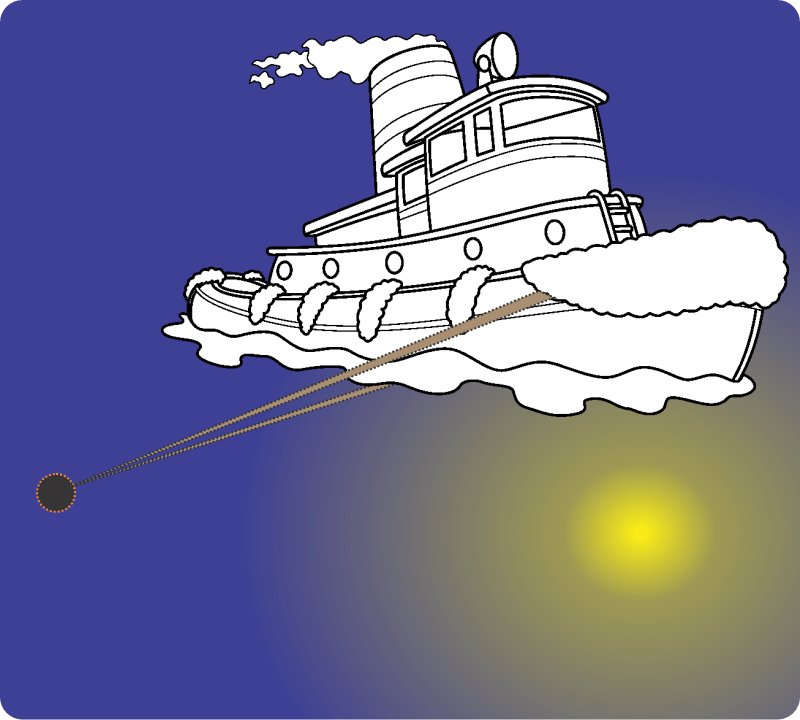
“The central plot device. Here’s your gelato. In the story, someone locates a rogue black hole hiding in the asteroid belt. Tiny, maybe a few thousandths of a millimeter across, but awful heavy. A military‑industrial combine uses a space tug to tow it to Earth orbit for some kind of energy source, but their magnetic grapple slips and the thing falls to Earth. Except it doesn’t just fall to Earth, it’s so small it falls into Earth and now it’s orbiting inside, eating away the core until everything crumbles in. I can’t stop thinking about that.”

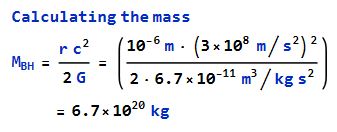
“Sounds pretty bad, but it might help if we run the numbers.” <drawing Old Reliable from its holster> “First thing — Everything about a black hole depends on its mass, so just how massive is this one?” <tapping on Old Reliable’s screen with gelato spoon> “For round numbers let’s say its diameter is 0.002 millimeter. The Schwartzschild ‘radius’ r is half that. Solve Schwartschild’s r=2GM/c² equation for the mass … plug in that r‑value … mass is 6.7×10²⁰ kilograms. That’s about 1% of the Moon’s mass. Heavy indeed. How did they find this object?”

“The story didn’t say. Probably some asteroid miner stumbled on it.”

“Darn lucky stumble, something only a few microns across. Not likely to transit the Sun or block light from any stars unless you’re right on top of it. Radiation from its accretion disk? Depends on the history — there’s a lot of open space in the asteroid belt but just maybe the beast encountered enough dust to form one. Probably not, though. Wait, how about Hawking radiation?”

“Oh, right, Stephen Hawking’s quantum magic trick that lets a black hole radiate light from just outside its Event Horizon. Does Old Reliable have the formulas for that?”

“Sure. From Hawking’s work we know the object’s temperature and that gives us its blackbody spectrum, then we’ve got the Bekenstein‑Hawking equation for the power it radiates. Mind you, the spectrum will be red‑shifted to some extent because those photons have to crawl out of a gravity well, but this’ll give us a first cut.” <more tapping> “Chilly. 170 kelvins, that’s 100⁰C below room temperature. Most of its sub‑nanowatt emission will be at far infrared wavelengths. A terrible beacon. But suppose someone did find this thing. I wonder what’ll it take to move it here.”

“Can you calculate that?”

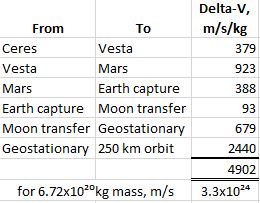
“Roughly. Suppose your space tug follows the cheapest possible flight path from somewhere near Ceres. Assuming the tug itself has negligible mass … ” <more tapping> “Whoa! That is literally an astronomical amount of delta-V. Not anything a rocket could do. Never mind. But where were they planning to put the object? What level orbit?”

“Well, it’s intended to beam power down to Earth. Ions in the Van Allen Belts would soak up a lot of the energy unless they station it below the Belts. Say 250 miles up along with the ISS.”

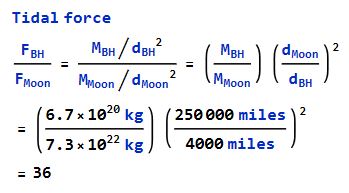
“Hoo boy! A thousand times closer than the Moon. Force is inverse to distance squared, remember. Wait, that’s distance to the center and Earth’s radius is about 4000 miles so the 250 miles is on top of that. 250,000 divided by 4250 … quotient squared … is a distance factor of almost 3500. Put 1% of the Moon that close to the Earth and you’ve got ocean tides 36 times stronger than lunar tides. Land does tides, too, so there’d be earthquakes. Um. The ISS is on a 90‑minute orbit so you’d have those quakes and ocean tides sixteen times a day. I wouldn’t worry about the black hole hollowing out the Earth, the tidal effect alone would do a great job of messing us up.”

“The whole project is such a bad idea that no-one would or could do it. I feel better now.”

~~ Rich Olcott
Time And The Egg

I unlock my office door and there’s Vinnie in the client chair flipping a coin from hand to hand. If my building ever switches to digital locks he’d take it as a challenge. “Morning, Vinnie.”

“Morning, Sy. Been reading your multiverse series and something you said bothered me.”

“What’s that?”

“Back when you wrote up your anti-Universe idea that some other group had come up with first—”

“Don’t remind me.”

“—you mentioned how time going backwards makes for negative energy, like that’s obvious. It ain’t obvious to me.”

“Okay … Ah. What word keeps coming up in our black hole discussions?”

“Geez, frames again? Universes ain’t black holes.”

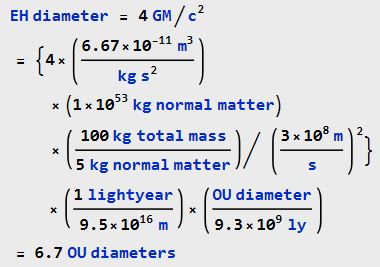
“Don’t be so sure. Suppose there’s a black hole Event Horizon that encloses our entire Observable Universe. An Event Horizon’s diameter depends on how much mass it has inside. Astronomy’s given us an estimate of how much normal matter our Observable Universe contains. I adjusted that number upward to account for the expected quantity of dark matter plus dark energy’s equivalent mass. When I plugged that grand total into Schwarzchild’s formula for the diameter of an Event Horizon, the result was about seven times wider than what we can observe. We could be inside a huge black hole but we’ll never know either way.”

“Whoa! Wouldn’t we notice a drift towards the singularity at its middle?”

“Not if we’re reasonably far out or if the drift rate is tiny compared to the slow chaos of intergalactic space. Mind you, it took us centuries to develop the technology that told us we’re inside the Milky Way and two‑thirds of the way out from the core.”

“We used frames for thinking about going really fast or being outside a black hole. Now we’re inside one or maybe not. How’s frames gonna help us with that?”

“Well, not the inertial frames where we compared relativistic observers, but the idea is similar. A traveler in an intense gravity field experiences slower time in its inertial frame than a distant partner does in theirs. Clocks appear to run weirdly if they’re compared between separate frames whose relative velocities are near lightspeed.”

“Yeah, that’s what we said.”

“Now picture two observational frames, one here in our Universe and one in the anti‑Universe if there is one. Time in the two frames flows in opposite directions away from the Big Bang between them. The two‑frames notion is a convenient way to think about consequences. Negative energy is one.”

“Now we’re getting somewhere. So give.”

“Well, what does energy do?”

“It makes things happen.”

“Negative energy does, too, considered from inside its frame. Looking from our frame, though, negative energy makes things unhappen. This spoon on our table has gravitational potential energy relative to the floor, right?”

“Yeah, you push it over the edge it’ll fall down.”

“But looking from our frame at a similar situation in the anti‑Universe running on anti‑time, an anti‑spoon on its floor has negative gravitational potential energy. We’d see it fall up to its table. Make sense?”

“Gimme a minute.” <pause> “Kinda hard to visualize but I’m starting to get there.” <longer pause> “Alright, you know I hate equations but even I know about Einstein’s E=mc². That is a square so it’s always positive so if E is negative then the mass gotta be negative, too.”

“From our frame all mass in the anti‑Universe looks negative. Negative mass would attract negative mass just like positive mass attracts positive mass here. Gravity in the anti‑Universe would work exactly the same way as our gravity does, so where’s the problem?”

“Gimme another minute.” <more pausing> “Suppose that spoon was an anti‑egg. You’re sayin’ when it goes splat over there, we’re gonna see it unsplat? Unsplatting uses up entropy. How about the ‘Entropy always increases‘ rule?”

“Right on the unsplat, wrong on the other. The full statement of Thermodynamics’ Second Law says that entropy never decreases in an isolated system. You can’t get much more isolated than being a separate Universe — no inputs of energy or matter from our Universe or anywhere else, right? From our frame, it looks like the anti‑Universe flipped the Second Law but that’s only because we’re using the wrong clock.”

~~ Rich Olcott