LIGO and lambda and photons, oh my!

I was walking my daily constitutional when Al waved me into his coffee shop.  “Sy, he’s at it again with the paper napkins.  Do something!”

I looked over.  There was Vinnie at his table, barricaded behind a pile of crumpled-up paper.  I grabbed a chair.

“Morning, Vinnie.  Having fun?”

“Greek letters.  Why’d they have to use Greek letters?”

The question was both rhetorical and derivative so I ignored it.  There were opened books under the barricade — upper-level physics texts.  “How come you’re chasing through those books?”

“I wanted to follow up on how LIGO operates with photons after we talked about all that space shuttle stuff.  But geez, Sy!”

“You’re a brave man, Vinnie.  So,  which letters are giving you trouble?”

“These two, that look kinda like each other upside down.” He pointed to one equation, λ=c.

“Ah, wavelength equals the speed of light divided by the frequency.”

“How do you do that?”

“Some of those symbols go way back.  You just get used to them.  Most of them make sense when you learn the names for the letters — lambda (λ) is the peak-to-peak length of a lightwave, and nu (ν) is the number of peaks per second.  If it makes you feel any better, I’ve yet to meet a physicist who can write a zeta (ζ) — they generally just draw a squiggle and move on.”

“And there’s this other equation,” pointing to E=h·ν.  “What’s that about?”

“Good eye.  You just picked two equations that are fundamental to LIGO’s operation.  If a lightwave has frequency ν, the equations tell us two things about it — its energy is h·ν (h is Planck’s constant, 6.6×10⁻³⁴ Joule-seconds), and its wavelength is c (c is the speed of light).  For instance, yellow light has a frequency near 520×1012/sec.  One photon carries 3.8×10-40 Joules of energy.  Not much, but it adds up when a light beam contains lots of photons.  The same photon has a wavelength near 580×10-9 meters traveling through free space.”

“So what happens when one of those photons is in a LIGO beam?  Won’t a gravitational wave’s stretch-and-squeeze action mess up its wave?”

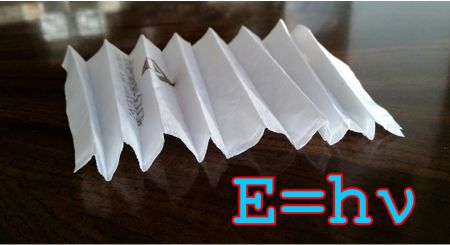
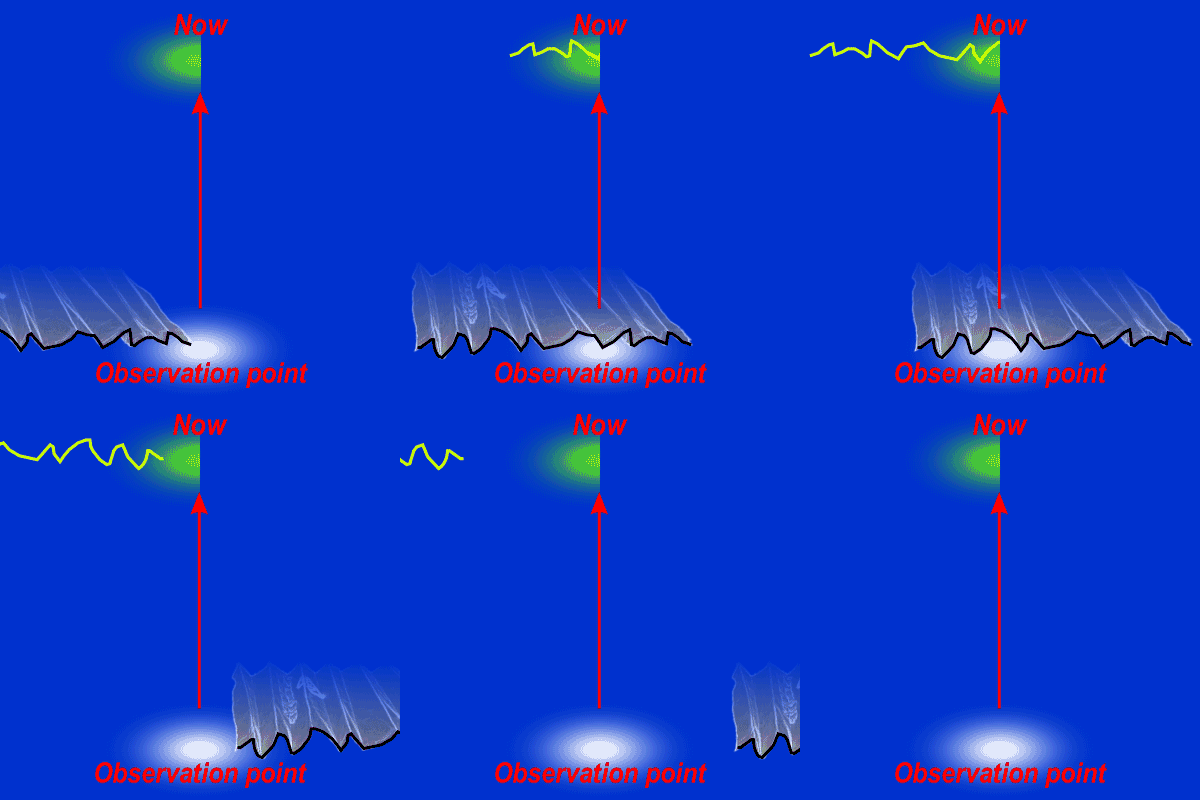
paper-napkin-waveI smoothed out one of Vinnie’s crumpled napkins. As I folded it into pleats and scooted it along the table I said, “Doesn’t mess up the wave so much as change the way we think about it.  We’re used to graphing out a spatial wave as an up-and-down pattern like this that moves through time, right?”
“That’s a lousy-looking wave.”

time-and-space-and-napkin
As the napkin moves through space,
the upper graph shows the height of its edge
above the observation point.

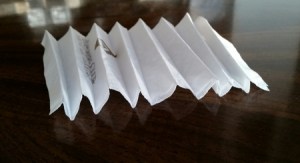
“It’s a paper napkin, f’pitysake, and I’m making a point here. Watch close.  If you monitor a particular point along the wave’s path in space and track how that point moves in time, you get the same profile except we draw it along the t-axis instead of along a space-axis.  See?”

“Hey, the time profile is the space profile going backwards.  Oh, right, it’s goin’ into the past ’cause it’s a memory.”

“That’s one of those things that people miss.  If you only draw sine waves, they’re the same in either direction.  The important point is that although timewaves and spacewaves have the same shape, they’ve got different meanings.  The timewave is directly connected to the wave’s energy by that E equation.  The spacewave is indirectly connected, because your other equation there scales it by the local speed of light.”

“Come again?  Local speed of light?  I thought it was 186,000 miles per second everywhere.”

“It is, but some of those miles are shorter than others.  Near a heavy mass, for instance, or in the compression phase of a gravitational wave, or inside a transparent material.  If you’re traveling in the lightwave’s inertial frame, you see no variation.  But if you’re watching from an independent inertial frame, you see the lightwave hit a slow patch.  Distance per cycle gets shorter.  Like that lambda-nu equation says, when c gets smaller the wavelength decreases.”

Al walked over.  “Gotcha a present, Vinnie.  Here’s a pad of yellow writing paper.  No more napkins, OK?”

“Uhh, thanks.”

“Don’t mention it.”

~~ Rich Olcott

Scone but not forgotten

Al grabbed me as I stepped into his coffee shop.  “Sy, you gotta help me!”

“What’s the trouble, Al?”

“It’s Vinnie.  He’s over there, been scribbling on paper napkins all morning.  I’m running out of napkins, Sy!”

I grabbed a cinnamon scone from the rack and a chair at Vinnie’s table.  “What’s keeping you so busy, Vinnie?”  As if I didn’t know.

LIGO, of course.  Every time I think I understand how the machine works something else occurs to me and it slips outa my hands.”

“How about you explain it to me.  Sometimes the best way to find an answer is to describe the problem to someone else.”

Interferometer 1
Vinnie’s paper napkin #1

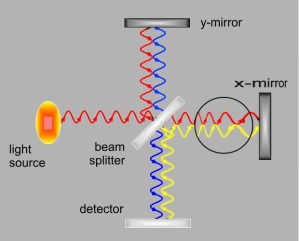
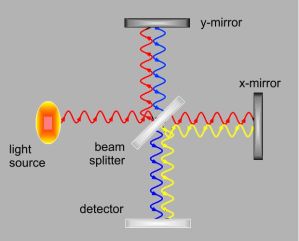
(grabbing a napkin near the bottom of one stack) “All right, Sy, I sketched the layout here.  You got these two big L-shaped machines out in the middle of two nowheres 2500 miles apart.  Each L is a pair of steel pipes 2½ miles long.  At the far end of each arm there’s a high-tech stabilized mirror.  Where the two arms meet there’s a laser rigged up to shoot beams down both arms.  There’s also a detector located where the reflected beams join up and cancel each other out unless there’s a gravity wave going past.  Am I good so far?”

“Yeah, that’s pretty much the diagram you see in the books, except it’s gravitational waveGravity waves are something else.”

interferometer-4
Paper napkin #2

“Whatever.  So, here’s a sketch of where I was at when I asked you that first question.  See, I copied my original sketch onto another napkin and stretched it a little where the black circle is to show what a gravitational wave would do in stretch phase.  Ignore the little rips.”

“What rips?”

“Uh, thanks.  Anyway, I was thinking the gravitational wave that stretches the x-beam would also stretch the x-pipe so they couldn’t use the light wave to measure the pipe it’s in.  But LIGO works so that’s wrong thinkin’.

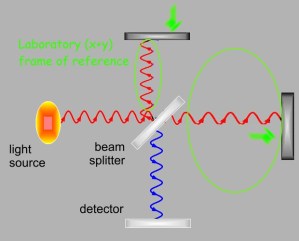
“OK, next is for after we talked about inertial frames.  Took me a few tries to get it like I want it and I wound up having to do two sketches, one for each frame.”  He grabbed a couple more napkins from different stacks.

interferometer-5lp
Paper napkins #37 and #59

“I didn’t do the yellow wiggles ’cause that got confusing and besides I don’t do wiggly lines so good.  Point is, the space-stretch only shows up in the laboratory inertial frame.  The light waves move with space so they don’t notice the difference, right?”

“Well, I wouldn’t want to put it that way in court, Vinnie, but it’s a pretty good description.”

“So the light waves bop along at 186,000 miles per second in their frame, but from the machine’s perspective those are stretched miles so the guy running the machine thinks those photons are faster than the ones in the other pipe.  And that difference in speed gets the yellow lines out of phase with the blue ones and the detector rings a bell or something, right?”

“It’s even better than that.” I reached for another napkin, caught Al’s eye on me and grabbed an envelope from my coat pocket instead. “Remember how a gravitational wave works in two directions perpendicular to the wave’s line of travel?”

interferometer-5d
On the back of an envelope

“Yeah, so?”

“So at the same moment that the wave is stretching space in the x-direction, it’s squeezing space in the y-direction.  LIGO’s detection scheme monitors the difference between the two returning beams.  As I’ve drawn it here using the detector’s inertial frame, the x-beam is going fast AND the y-beam is going slow so the detector sees twice the phase difference. A few milliseconds later they’ll switch because the x-direction will get squeezed while the y-direction gets stretched.  And yeah, a bell does ring but only after some computers munch on the data and subtract out environmental stuff like temperature swings and earthquakes and the janitor’s footsteps.”

“Uh-huh, I think I got it.” Turning in his chair, “Hey, Al, bring Sy here another scone, on me.  And put the one he’s got on my tab, too.”

“Thanks, Vinnie.”

“Don’t mention it.”

~~ Rich Olcott

Here we LIGO again…

I suddenly smelled mink musk, vintage port, and warm honey on fresh-baked strawberry scones.

“C’mon in, Ramona, the door’s open.”

She oscillated in with a multi-dimensional sinusoidal motion that took my breath away and a smile that brought it back.

“Hi, Sy.  I came right over as soon as I got the news.”

“What news is that, Sugar Lumps?”

“LEGO, Sy, they’ve switched LEGO to science mode!”

“That’s LIGO, sweetheart, Laser Interferometer Gravitational-wave Observatory.”  She means well, but she’s Ramona.  “LEGOs are designed to hurt your feet, LIGO’s designed to look at the Universe.”

“Whatever.  I knew you wrote a . whole . series . of . posts . about . it so I thought you’d want to know.”

“It’s worth chasin’ down, doll-face.  Thanks.”symoire

So I headed over to the campus coffee shop.  It just happens to be located between the Astronomy building and the Physics building so I figured it as a good source.  Al was in his usual place at the cash register.

“Hi, Sy.  Haven’t seen you in a while.”

“Been busy, Al.  Lotsa science going on these days.”

“Good, good.   Say, have you heard about LEGO goin’ live?”

“That’s LIGO, Al.  Yeah, Ramona told me.  So what’s the word?”

“OK, you know all about how when they first turned it on for engineering tests back in September, it blew everyone’s mind that they caught a signal almost immediately?”

“Yeah, that’s when I started writing about it.  Two 30-solar-mass black holes collided and jolted the gravitational field of the Universe.  When the twin LIGOs detected that jolt, it confirmed three predictions that came out of Einstein’s General Relativity theory.”

“Had you heard about the second signal they caught the day after Christmas, from a couple of smaller black holes?”

“I bet you sold a lot of coffee that week.”

“You couldn’t believe.  Those guys had so much caffeine in ’em they didn’t even notice New Years.”

“So what came out of that?”

“Like I said, these were smaller black holes, about 10 solar masses each instead of 30, and that’s really got the star-modelers scratching their heads.”

“How so?”

“Well, we pretty much know how to make a black hole that’s just a bit heavier than the Sun.  Say a star’s between 1.3 and 3 solar masses.  When it burns enough of its fuel that its heat energy can’t keep it puffed up against gravity the whole thing collapses down to a black hole.”

“What happens if it’s bigger than that?  Wouldn’t you just get a bigger black hole?”

“That’s the thing.  If it’s above that threshold, the outermost infalling matter meets the outgoing explosion and makes an even bigger explosion, a supernova.  So much matter gets blown away that what’s left is too small to be a black hole.  You just get a white dwarf star or a neutron star, depending.”

“But these signals came from black holes 3-10 times that upper limit.  Where did they come from?”

“That’s why the head-scratching, Sy.  I mean, no-one knows how to make even one and yet they seem to be so common that two pairs of ’em found each other and collided less than four months apart.  The whole theory is up for grabs now.”

“So we got all that just from the engineering test phase, eh?  What’ve they done since that?”

“Oh, the usual tinkering and tweaking.  The unit down in Livingston LA is about 25% more sensitive now, especially in the lower-frequency range.  That’s mostly because they found and plugged some light-leaks and light-scattering hot-spots here and there along its five miles of steel pipe.  LIGO doesn’t look at incoming light, but it does use laser light to detect the gravitational variation.  The Hanford WA unit boosted the power going to its laser and they’ve improved stability in its detectors, made ’em more robust against wind and low-frequency seismic activity.  You know, engineer stuff.  So now they say they’re ready to do science.”

“I can’t write that the tweaks’ll let us look deeper into the Universe, ’cause LIGO doesn’t pick up light waves.  How about I say we get a better feel for things?”

“Sounds ’bout right, Sy.”

“Oh, and give me one of those strawberry scones.  For some reason they look really good today.”

~~ Rich Olcott