Attitude Adjustment

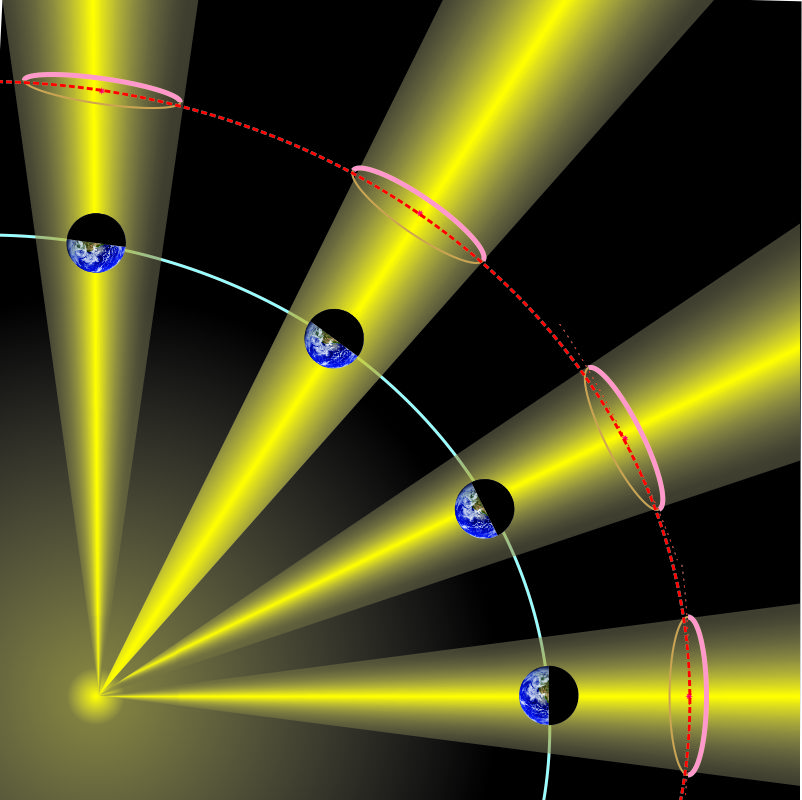
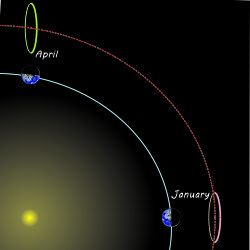
Mr Feder has a snarky grin on his face and a far‑away look in his eye. “Got another one. James Webb Space Telescope flies in this big circle crosswise to the Sun‑Earth line, right? But the Earth doesn’t stand still, it goes around the Sun, right? The circle keeps JWST the same distance from the Sun in maybe January, but it’ll fly towards the Sun three months later and get flung out of position.” <grabs a paper napkin> “Lemme show you. Like this and … like this.”

“Sorry, Mr Feder, that’s not how either JWST or L2 works. The satellite’s on a 6-month orbit around L2 — spiraling, not flinging. Your thinking would be correct for a solid gyroscope but it doesn’t apply to how JWST keeps station around L2. Show him, Sy.”

“Gimme a sec with Old Reliable, Cathleen.” <tapping> “OK, here’s an animation over a few months. What happens to JWST goes back to why L2 is a special point. The five Lagrange points are all about balance. Near L2 JWST will feel gravitational pulls towards the Sun and the Earth, but their combined attraction is opposed by the centrifugal force acting to move the satellite further out. L2 is where the three balance out radially. But JWST and anything else near the extended Sun‑Earth line are affected by an additional blended force pointing toward the line itself. If you’re close to it, sideways gravitational forces from the Sun and the Earth combine to attract you back towards the line where the sideways forces balance out. Doesn’t matter whether you’re north or south, spinward or widdershins, you’ll be drawn back to the line.”

Al’s on refill patrol, eavesdropping a little of course. He gets to our table, puts down the coffee pot and pulls up a chair. “You’re talking about the JWST. Can someone answer a question for me?”

“We can try.”
 ”What’s the question?”
  Mr Feder, not being the guy asking the question, pooches out his lower lip.

“OK, how do they get it to point in the right direction and stay there? My little backyard telescope gives me fits just centering on some star. That’s while the tripod’s standing on good, solid Earth. JWST‘s out there standing on nothing.”

JWST‘s Attitude Control System has a whole set of functions to do that. It monitors JWST‘s current orientation. It accepts targeting orders for where to point the scope. It computes scope and satellite rotations to get from here to there. Then it revises as necessary in case the first‑draft rotations would swing JWST‘s cold side into the sunlight. It picks a convenient guide star from its million‑star catalog. Finally, ACS commands its attitude control motors to swing everything into the new position. Every few milliseconds it checks the guide star’s image in a separate sensor and issues tweak commands to keep the scope in proper orientation.”

“I get the sequence, Sy, but it doesn’t answer the how. They can’t use rockets for all that maneuvering or they’d run out of fuel real fast.”

“Not to mention cluttering up the view field with exhaust gases.”

“Good point, Cathleen. You’re right, Al, they don’t use rockets, they use reaction wheels, mostly.”

“Uh-oh, didn’t broken reaction wheels kill Kepler and a few other missions?”

“That sounds familiar, Mr Feder. What’s a reaction wheel, Sy, and don’t they put JWST in jeopardy?”

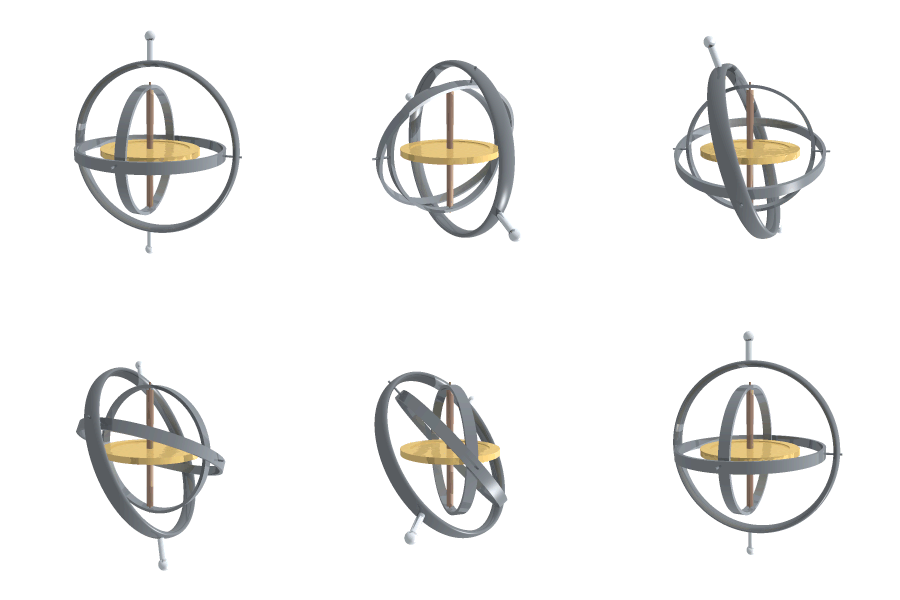
 Gyroscope, image by Lucas Vieira

“A reaction wheel is a massive doughnut that can spin at high speed, like a classical gyroscope but not on gimbals.”

“Hey, Moire, what’s a gimbal?”

“It’s a rotating frame with two pivots for something else that rotates. Two or three gimbals at mutual right angles let what’s inside orient independent of what’s outside. The difference between a classical gyroscope and a reaction wheel is that the gyroscope’s pivots rotate freely but the reaction wheel’s axis is fixed to a structure. Operationally, the difference is that you use a gyroscope’s angular inertia to detect change of orientation but you push against a reaction wheel’s angular inertia to create a change of orientation.”

“What about the jeopardy?”

Kepler‘s failing wheels used metal bearings. JWST‘s are hardened ceramic.”

<whew>

~~ Rich Olcott

It’s A Trap!

Late morning, no-one else in his coffee shop so Al pulls up a chair. “OK, Susan, so coal’s a mess for ash and air pollution but also each carbon from coal gives us less energy than a carbon from methane. So why the muttering against switching to natural gas?”

“Big-ticket reasons, Al. One, natural gas isn’t pure methane. Mostly methane, sure, but depending on the source you get a whole collection of other things in the mix — heavier hydrocarbons like propane and butane, stinky sulfides and amines, even helium and mercury. Gas from a well has to be purified before you’d want it piped to your house.”

“Piped. Oh, yeah, pipelines. Probably a lot more efficient than coal transport but I see how they get problems, too.”

“Indeed they do. Pipelines break and leak and some idiots even use them for target practice. The worst kind of waste.”

“Yeah, when the oil gets out and ruins the land or someone’s water supply.”

“That’s bad locally, all right, but it’s when methane leaks out that the global damage starts.”

“Global?”

“Mm-hm, because methane’s a gas and mixes in with the rest of the atmosphere. If a pipeline or a truck or anything springs a leak in, say, Chicago, the methane molecules can go anywhere.”

“So?”

“So a couple of things. A decade in the atmosphere oxidizes most methane molecules to, guess what, CO2, the same problematic CO2 we get from burning coal. But before it degrades, methane’s an even bigger heat‑trapper than CO2 is.”

“Whaddaya mean, heat‑trapper?”

“Do you want to take this, Sy? It’s more Physics than Chemistry and besides, my mocha latte’s getting cold.”

“Hmm, there’s a bunch of moving parts in this. Al, you owe Susan a warm-up while I think.”

“Here ya go, Susan.”

“Thanks, Al. I’ll get you guys started. Why did my coffee get cold?”

“Good one, Susan. Al, it’s a universal principle — left to itself, energy spreads out. Heat finds ways to travel from a concentrated, high‑temperature source to low‑temperature absorbers. The exceptions occur when some extra process expends energy to pump heat in the other direction. So, that coffee naturally lost heat to the table by conduction, to the air by convection and to the general environment by radiation. The only thing that can stop those processes is perfect insulation. That’s the thing about the atmosphere.”

“Whoa, that’s a jump or three too fast.”

“OK, let’s follow a sunbeam aimed in the Earth’s direction. Its photons carry a wide range of energies, ultraviolet down to far infrared. On the way in, a UV photon hits an atmospheric ozone molecule and gets absorbed. No more UV photon but now the molecule is in an excited state. It calms down by joggling its neighbor molecules, that’s heat transfer, and maybe emitting a longer wavelength photon or two. Ozone filters out incoming UV and in the process spreads out the photon’s concentrated energy. What’s left in the sunbeam is visible and infrared light that gets down to us. You with me?”

“Makes sense so far.”

“Good. Next stage is that the visible and IR light heat the Earth, which then re-radiates the energy as infrared light mostly at longer wavelengths. The problem is that not all the IR gets out. Water molecules absorb some wavelengths in that range. Every absorption event means more heat distribution into the atmosphere when the molecule relaxes. Ocean evaporation maintains a huge number of IR‑blocking water molecules in the atmosphere.”

“I heard that ‘some‘ weasel‑word. Other wavelengths still make it through, right?”

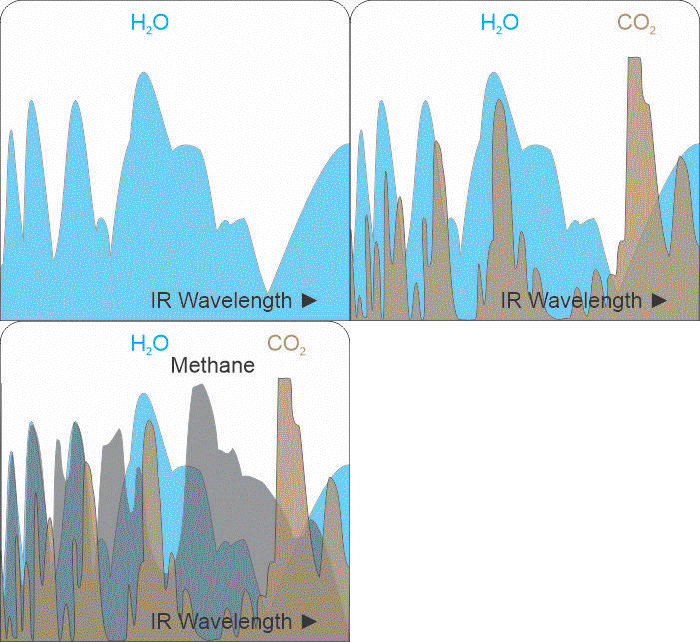
I unholster Old Reliable, tap a few keys. “Here’s water’s absorption pattern in the mid‑to‑far‑infrared. A high peak means absorption centered at that wavelength. This is scaled per molecule per unit area, so double the molecules gives you double the absorption.”

Spectrum profiles from M. Etminan, et al., doi:10.1002/2016GL071930

“Lots of blank space between the peaks, though.”

“Which is where CO2 and methane get into the game. It’s like putting green and blue filters in front of a red one. With enough of those insulating molecules up there there’s no blank space and lots of imbalance from trapped heat.”

“Methane’s worse.”

“Lots worse.”

~~ Rich Olcott

Going from Worse to Bad

Al delivers coffees to our table, then pauses. “Why methane?”

Susan Kim looks up from her mocha latte. “Sorry?”

“Why all the fuss about methane all of a sudden? I thought carbon dioxide was the baddie. Everybody’s switching from coal to natural gas which they say is just methane and now that’s a bad thing, too. I’m confused. You’re a chemist, unconfuse me.”

“You’re right, there’s mixed message out there. Here’s the bottom line. Methane’s bad, but coal’s a worse bad.”

“OK, but why?”

“Pass me a paper napkin so I can write down the chemical reactions. When we look at them in detail there’s all kinds of complicated reaction paths, but the overall processes are pretty simple. The burnable part of coal is carbon. In an efficient coal‑fired process what happens is
  C + O2 → CO2 + energy.
The C is carbon, of course and O2 is an oxygen molecule, two atoms linked together. Carbon atoms weigh 12 and each oxygen atoms weighs 16, so 12 grams of carbon produces 12+(2×16)=44 grams of CO2. Scaling up, 12 tons of carbon produces 44 tons of CO2 and so on. The energy scales up, too. and that’s what heats the boilers that make the steam that spins the turbines that make electricity.”

“I heard a couple of weasel words but go on to methane.”

“You caught them, eh? They’re important weasels and we’ll get to them. OK, methane is CH4 and its overall burn equation is
  CH4 + 2O2 → CO2 + 2H2O + energy.
Oxidizing those hydrogens releases about twice as much energy per carbon as the coal reaction does.”

“Already I see one big advantage for methane — more bang per CO2. So about those weasels…”

“Right. Well, coal isn’t just pure burnable carbon. It’s 350‑million‑year‑old trees and ferns and animal carcasses and swamp muck and mineral sediments, all pressure‑baked together. There’s sulfur and nitrogen in there, mixed in with nasty elements like mercury and arsenic.”

“The extras go up the smokestack along with the CO2, huh? Bad, for sure.”

“The good news is that coal-burning power plants are under the gun to clean up those emissions. The bad news is that effective mitigation technologies themselves cost energy. That lowers the net yield. But the inefficiency gets worse. Think coal trains.”

“Yeah, half the time I get held up on the way home by one of those hundred‑car strings, either full-up heading to the power plant or empties going back for another load.”

“Mm-hm. Transporting coal takes energy, and so does mining it and crushing it and pre‑treating to get rid of dirt and then taking care of the ashes. Even less net energy output per ton of smokestack CO2, even worse inefficiency. See why coal’s on its way out?”

“I guess all that didn’t matter when it was cheap to dig up and there wasn’t much competition.”

“You put your finger on it, Al. Coal got its foot in the door with steam engines 300 years ago when about the only other things you could burn were wood and whale oil. Crude oil got big in the mid‑1800s but it had to be refined and that made it expensive. Cheap natural gas wasn’t really a thing until fracking came along 50 years ago, but that brought a different set of issues.”

“Yeah, I’ve seen videos of people lighting their kitchen sink water on fire. And wasn’t there an earthquake thing in Oklahoma?”

“That was an interesting situation. Oklahoma’s in the middle of the continent, not a place you’d expect earthquakes, but they began experiencing flurries of shallow ones in 2011. The fracking process starts with water pumped at high pressure into gas-bearing strata to loosen things up. People suspected fracking was connected to the earthquakes. It was, but only indirectly. When fracked gas comes out of a well, water does, too. The rig operators pump that expelled water down old oil wells. Among other things, the state’s Corporation Commission is in charge of their hydrocarbon production. When the Commission ordered a 60% cut in the waste‑water down‑pumping, the earthquake rate dropped by 90%. Sometimes regulations are good things, huh?”

~~ Rich Olcott

Thinking in Spacetime

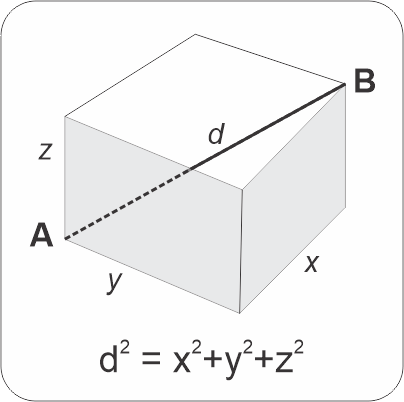
The Open Mic session in Al’s coffee shop is still going string. The crowd’s still muttering after Jeremy stuck a pin in Big Mike’s “coincidence” balloon when Jim steps up. Jim’s an Astrophysics post‑doc now so we quiet down expectantly. “Nice try, Mike. Here’s another mind expander to play with. <stepping over to the whiteboard> Folks, I give you … a hypotenuse. ‘That’s just a line,’ you say. Ah, yes, but it’s part of some right triangles like … these. Say three different observers are surveying the line from different locations. Alice finds her distance to point A is 300 meters and her distance to point B is 400. Applying Pythagoras’ Theorem, she figures the A–B distance as 500 meters. We good so far?”

A couple of Jeremy’s groupies look doubtful. Maybe‑an‑Art‑Major shyly raises a hand. “The formula they taught us is a2+b2=c2. And aren’t the x and y supposed to go horizontal and vertical?”

“Whoa, nice questions and important points. In a minute I’m going to use c for the speed of light. It’s confusing to use the same letter for two different purposes. Also, we have to pay them extra for double duty. Anyhow, I’m using d for distance here instead of c, OK? To your next point — Alice, Bob and Carl each have their own horizontal and vertical orientations, but the A–B line doesn’t care who’s looking at it. One of our fundamental principles is that the laws of Physics don’t depend on the observer’s frame of reference. In this situation that means that all three observers should measure the same length. The Pythagorean formula works for all of them, so long as we’re working on a flat plane and no-one’s doing relativistic stuff, OK?”

Tentative nods from the audience.

“Right, so much for flat pictures. Let’s up our game by a dimension. Here’s that same A–B line but it’s in a 3D box. <Maybe‑an‑Art‑Major snorts at Jim’s amateur attempt at perspective.> Fortunately, the Pythagoras formula extends quite nicely to three dimensions. It was fun figuring out why.”

Jeremy yells out. “What about time? Time’s a dimension.”

“For sure, but time’s not a length. You can’t add measurements unless they all have the same units.”

“You could fix that by multiplying time by c. Kilometers per second, times seconds, is a length.” His groupies go “Oooo.”

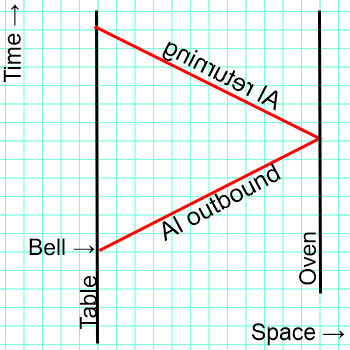
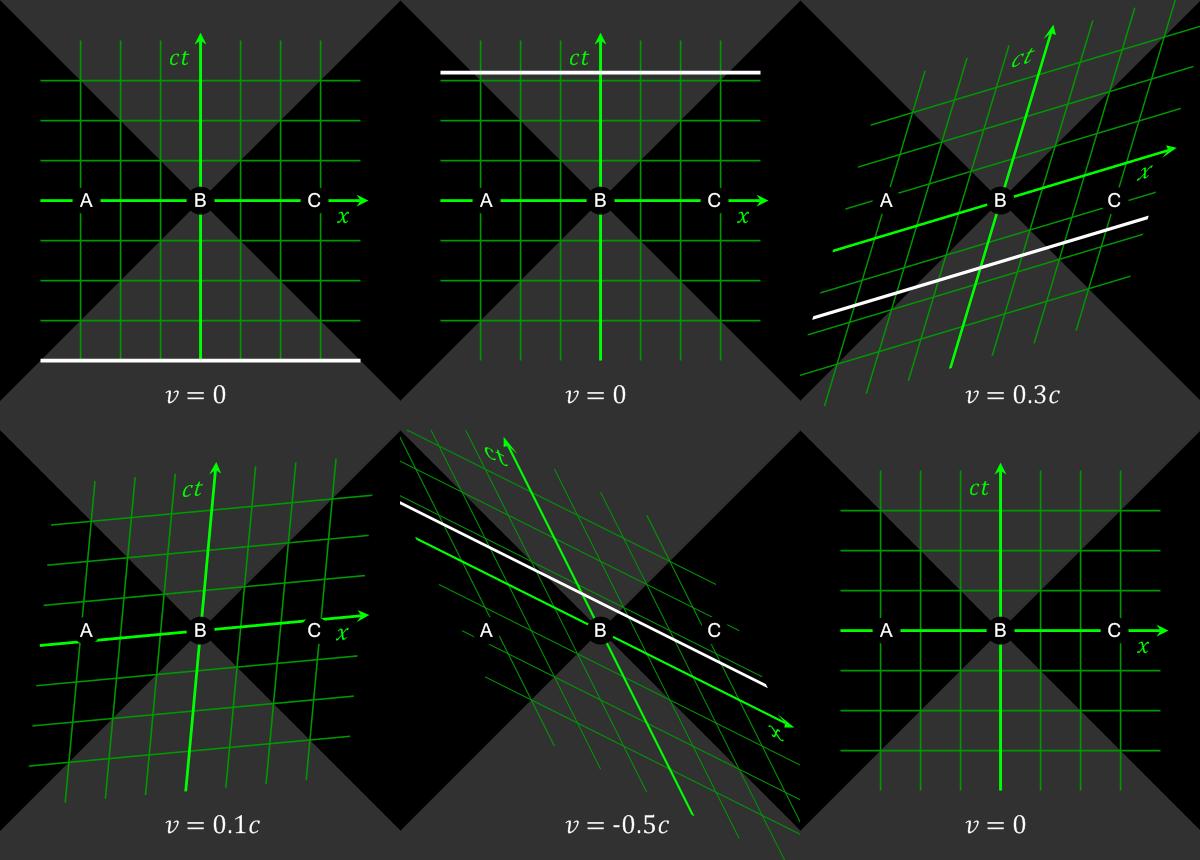
“Thanks for the bridge to spacetime where we have four coordinates — x, y, z and ct. That makes a big difference because now A and B each have both a where and a when — traveling between them is traveling in space and time. Computationally there’s two paths to follow from here. One is to stick with Pythagoras. Think of a 4D hypercube with our A–B line running between opposite vertices. We’re used to calculating area as x×y and volume as x×y×z so no surprise, the hypercube’s hypervolume is x×y×z×(ct). The square of the A–B line’s length would be b2=(ct)2+d2. Pythagoras would be happy with all of that but Einstein wasn’t. That’s where Alice and Bob and Carl come in again.”

“What do they have to do with it?”

“Carl’s sitting steady here on good green Earth, red‑shifted Alice is flying away at high speed and blue‑shifted Bob is flashing toward us. Because of Lorentz contractions and dilations, they all measure different A–B lengths and durations. Each observer would report a different value for b2. That violates the invariance principle. We need a ruggedized metric able to stand up to that sort of punishment. Einstein’s math professor Hermann Minkowski came up with a good one. First, a little nomenclature. Minkowski was OK with using the word ‘point‘ for a location in xyz space but he used ‘event‘ when time was one of the coordinates.”

“Makes sense, I put events on my calendar.”

“Good strategy. Minkowski’s next step quantified the separation between two events by defining a new metric he called the ‘interval.’ Its formula is very similar to Pythagoras’ formula, with one small change: s2=(ct)2–d2. Alice, Bob and Carl see different distances but they all see the same interval.”

Minus? Where did that come from?”

~~ Rich Olcott

Maybe It’s Just A Coincidence

Raucous laughter from the back room at Al’s coffee shop, which, remember, is situated on campus between the Physics and Astronomy buildings. It’s Open Mic night and the usual crowd is there. I take a vacant chair which just happens to be next to the one Susan Kim is in. “Oh, hi, Sy. You just missed a good pitch. Amanda told a long, hilarious story about— Oh, here comes Cap’n Mike.”

Mike’s always good for an offbeat theory. “Hey, folks, I got a zinger for you. It’s the weirdest coincidence in Physics. Are you ready?” <cheers from the physicists in the crowd> “Suppose all alone in the Universe there’s a rock and a planet and the rock is falling straight in towards the planet.” <turns to Al’s conveniently‑placed whiteboard> “We got two kinds of energy, right?”

Potential Energy    Kinetic Energy

Nods across the room except for Maybe-an-Art-major and a couple of Jeremy’s groupies. “Right. Potential energy is what you get from just being where you are with things pulling on you like the planet’s gravity pulls on the rock. Kinetic energy is what potential turns into when the pulls start you moving. For you Physics smarties, I’m gonna ignore temperature and magnetism and maybe the rock’s radioactive and like that, awright? So anyway, we know how to calculate each one of these here.”

PE = GMm/R    KE = ½mv²

“Big‑G is Newton’s gravitational constant, big‑M is the planet’s mass, little‑m is the rock’s mass, big‑R is how far apart the things are, and little‑v is how fast the rock’s going. They’re all just numbers and we’re not doing any complicated calculus or relativity stuff, OK? OK, to start with the rock is way far away so big‑R is huge. Big number on the bottom makes PE’s fraction tiny and we can call it zero. At the same time, the rock’s barely moving so little‑v and KE are both zero, close enough. Everybody with me?”

More nods, though a few of the physics students are looking impatient.

“Right, so time passes and the rock dives faster toward the planet Little‑v and kinetic energy get bigger. Where’s the energy coming from? Gotta be potential energy. But big‑R on the bottom gets smaller so the potential energy number gets, wait, bigger. That’s OK because that’s how much potential energy has been converted. What I’m gonna do is write the conversion as an equation.

GMm/R=½mv²

“So if I tell you how far the rock is from the planet, you can work the equation to tell me how fast it’s going and vice-versa. Lemme show those straight out…”

v=(2GM/R)    R=2GM/v²

Some physicist hollers out. “The first one’s escape velocity.”

“Good eye. The energetics are the same going up or coming down, just in the opposite direction. One thing, there’s no little‑m in there, right? The rock could be Jupiter or a photon, same equations apply. Suppose you’re standing on the planet and fire the rock upward. If you give it enough little‑v speed energy to get past potential energy equals zero, then the rock escapes the planet and big‑R can be whatever it feels like. Big‑R and little‑v trade off. Is there a limit?”

A couple of physicists and an astronomy student see where this is going and start to grin.

“Newton physics doesn’t have a speed limit, right? They knew about the speed of light back then but it was just a number, you could go as fast as you wanted to. How about we ask how far the rock is from the planet when it’s going at the speed of light?”

R=2GM/

Suddenly Jeremy pipes up. “Hey that’s the Event Horizon radius. I had that in my black hole term paper.” His groupies go “Oooo.”

“There you go, Jeremy. The same equation for two different objects, from two different theories of gravity, by two different derivations.”

“But it’s not valid for lightspeed.”

“How so?”

“You divided both sides of your conversion equation by little‑m. Photons have zero mass. You can’t divide by zero.”

Everyone in the room goes “Oooo.”

~~ Rich Olcott

A Diamond in The Sky with Lucy

Mid-afternoon coffee-and-scone time. As I step into his coffee shop Al’s quizzing Cathleen about something in one of his Astronomy magazines. “This Lucy space mission they just sent up, how come it looks like they’re shooting at either side of Jupiter instead of hitting it straight-on? And it’s got this crazy butterfly orbit that crosses the whole Solar System a couple of times. What sense does that make?”

Planned path of Lucy‘s mission to study Trojan asteroids (black dots).
After diagrams by NASA and Southwest Research Institute

“It shoots to either side because there’s interesting stuff out there. We think the Solar System started as a whirling disk of dust that gradually clumped together. The gravity from Jupiter’s clump scarfed up the lion’s share of the leftovers after the Sun coalesced. The good news is, not all of Jupiter’s hoard wound up in the planet. Some pieces made it to Jupiter’s orbit but then collected in the Trojan regions ahead and behind it. Looking at that material may teach us about the early Solar System.”

“Way out there? Why not just fall into Jupiter like everything else did?”

I do Physics, I can’t help but cut in. “It’s the many‑body problem in its simplest case, just the Sun, Jupiter and an asteroid in a three‑body interaction—”

Cathleen gives me a look. “Inappropriate physicsplaining, Sy, we’re talking Astronomy here. Al’s magazine is about locating and identifying objects in space. These asteroids happen to cluster in special locations roughly sixty degrees away from Jupiter.”

“But Al’s question was, ‘Why?‘ You told him why we’re sending Lucy to the Trojans, but Physics is why they exist and why that mission map looks so weird.”

“Good point, go ahead. OK with you, Al?”

“Sure.”

I unholster Old Reliable, my tricked‑out tablet, and start sketching on its screen. “OK, orange dot’s Jupiter, yellow dot’s the Sun. Calculating their motion is a two-body problem. Gravity pulls them together but centrifugal force pulls them apart. The forces balance when the two bodies orbit in ellipses around their common center of gravity. Jupiter’s ellipse is nearly a circle but it wobbles because the Sun orbits their center of gravity. Naturally, once Newton solved that problem people turned to the next harder one.”

“That’s where Lucy comes in?”

“Not yet, Al, we’ve still got those Trojan asteroids to account for. Suppose the Jupiter‑Sun system’s gravity captures an asteroid flying in from somewhere. Where will it settle down? Most places, one body dominates the gravitational field so the asteroid orbits that one. But suppose the asteroid finds a point where the two fields are equal.”

“Oh, like halfway between, right?”

“Between, Al, but not halfway.”

“Right, Cathleen. The Sun/Jupiter mass ratio and Newton’s inverse‑square law put the equal‑pull point a lot closer to Jupiter than to the Sun. If the asteroid found that point it would hang around forever or until it got nudged away. That’s Lagrange’s L1 point. There are two other balance points along the Sun‑Jupiter line. L2 is beyond Jupiter where the Sun’s gravity is even weaker. L3 is way on the other side of the Sun, a bit inside Jupiter’s orbit.”

“Hey, so those 60° points on the orbit, those are two more balances because they’re each the same distance from Jupiter and the Sun, right?”

“There you go, Al. L4 leads Jupiter and L5 runs behind. Lagrange published his 5‑point solution to the three‑body problem in 1762, just 250 years ago. The asteroids found Jupiter’s Trojan regions billions of years earlier.”

“We astronomers call the L4 cluster the Trojan camp and the L5 cluster the Greek camp, but that’s always bothered me. It’d be OK if we called the planet Zeus, but Jupiter’s a Roman god. Roman times were a millennium after classical Greece’s Trojan War so the names are just wrong.”

“I hadn’t thought about that, Cathleen, but you’re right. Anyway, back to Al’s diagram of Lucy’s journey. <activating Old Reliable’s ‘Animate’ function> Sorry, Al, but you’ve been misled. The magazine’s butterfly chart has Jupiter standing still. Here’s a stars-eye view. It’s more like the Trojans will come to Lucy than the reverse.”

~~ Rich Olcott

Galaxies Fluffy And Faint

Cathleen’s at the coffee shop’s baked goods counter. “A lemon scone, please, Al.”

I’m next in line. “Lemon sounds good to me, too. It’s a warm day.”

The Pinwheel Galaxy, NGC 5457
Credit: ESA/Hubble

“Sure thing, Sy. Hey, got a question for you, Cathleen, you bein’ an Astronomer and all. I just saw an Astronomy news item about a fluffy galaxy and they mentioned a faint galaxy. Are they the same and why the excitement?”

“Not the same, Al. It’ll be easier to show you in pictures. Sy, may I borrow Old Reliable?”

“Sure, here.”

“Thanks. OK, Al, here’s a classic ‘grand design‘ spiral galaxy, NGC 5457, also known as The Pinwheel. Gorgeous, isn’t it?”

“Sure is. Hey, I’ve wondered — what does ‘NGC‘ stand for, National Galaxy Collection or something?”

“Nope. The ‘G‘ doesn’t even stand for ‘Galaxy‘. It’s ‘New General Catalog‘. Anyway, here’s NGC 2775, one of our prettiest fluffies. Doesn’t look much like the Pinwheel or Andromeda, does it?”

NGC 2775
Credit: NASA / ESA / Hubble / J. Lee / PHANGS-HST Team / Judy Schmidt

“Nah, those guys got nice spiral arms that sort of grow out of the center. This one looks like there’s an inside edge to all the complicated stuff. And it’s got what, a hundred baby arms.”

“The blue dots in those ‘baby arms’ are young blue stars. They’re separated by dark lanes of dust just like the dark lanes in classic spirals. The difference is that these lanes are much closer together. The grand design spirals are popular photography subjects in your astronomy magazines, Al, but they’re only about 10% of all spirals. I’ll bet your news item was about 2775 because we’re just coming to see how mysterious this one is.”

“What’s mysterious about it?”

“That central region. It’s huge and smooth, barely any visible dust lanes and no blue dots. It’s bright in the infra‑red, which is what you’d expect from a population of old red stars. In the ultra‑violet, though, it’s practically empty — just a small dot at the center. UV is high‑energy light. It generally comes from a young star or a recent nova or a black hole’s accretion disk. The dot is probably a super-massive back hole. but its image is just a tiny fraction of the smooth region’s width. With a billion red stars in the way it’s hard to see how the black hole’s gravity field could have cleaned up all the dust that should be in there. Li’l Fluffy here is just begging for some Astrophysics PhD candidates to burn computer time trying to explain it.”

NGC 1052-DF2
Credit: NASA, ESA, and P. van Dokkum (Yale University)

“What about Li’l Faint?”

“That’s probably this one, NGC 1052-DF2. Looks a bit different, doesn’t it?

“I’ll say. It’s practically transparent. Is it a thing at all or just a smudge on the lens?”

“Not a smudge. We’ve got multiple images in different wavelength ranges from multiple observatories, and there’s another similar object, NGC 1052-DF4, in the same galaxy group. We even have measurements from individual stars and clusters in there. The discovery paper claimed that DF2 is so spread out because it lacks the dark matter whose gravity compacts most galaxies. That led to controversy, of course.”

“Is there anything in Science that doesn’t? What’s this argument?”

“It hinges on distance, Sy. The object is about as wide as the Milky Way but we see only 1% as many stars. Does their mass exert enough gravitational force to hold the structure together? There’s a fairly good relationship between a galaxy’s mass and its intrinsic brightness — more stars means more emitting surface and more mass. We know how quickly apparent brightness drops with distance. From other data the authors estimated DF2 is 65 lightyears away and from its apparent brightness they back‑calculated its mass to be just about what you’d expect from its stars alone. No dark matter required to prevent fly‑aways. Another group using a different technique estimated 42 lightyears. That suggested a correspondingly smaller luminous mass and therefore a significant amount of dark matter in the picture. Sort of. They’re still arguing.”

“But why does it exist at all?”

“That’s another question.”

~~ Rich Olcott

  • Thanks to Oriole for suggesting this topic.

Two Against One, And It’s Not Even Close


On a brisk walk across campus when I hear Vinnie yell from Al’s coffee shop. “Hey! Sy! Me and Al got this argument going you gotta settle.”

“Happy to be a peacemaker, but it’ll cost you a mug of Al’s coffee and a strawberry scone.”

“Coffee’s no charge, Sy, but the scone goes on Vinnie’s tab. What’s your pleasure?”

“It’s morning, Al, time for black mud. What’s the argument, Vinnie?”

“Al read in one of his astronomy magazines that the Moon’s drifting away from us. Is that true, and if it is, how’s it happen? Al thinks Jupiter’s gravity’s lifting it but I think it’s because of Solar winds pushing it. So which is it?”

“Here you go, Sy, straight from the bottom of the pot.”

“Perfect, Al, thanks. Yes, it’s true. The drift rate is about 1¼ nanometers per second, 1½ inches per year. As to your argument, you’re both wrong.”

“Huh?”
 ”Aw, c’mon!”

“Al, let’s put some numbers to your hypothesis. <pulling out Old Reliable and screen‑tapping> I’m going to compare Jupiter’s pull on the Moon to Earth’s when the two planets are closest together. OK?”

“I suppose.”

“Alright. Newton’s Law tells us the pull is proportional to the mass. Jupiter’s mass is about 320 times Earth, which is pretty impressive, right? But the attraction drops with the square of the distance. The Moon is 1¼ lightseconds from Earth. At closest approach, Jupiter is almost 2100 lightseconds away, 1680 times further than the Moon. We need to divide the 320 mass factor by a 1680‑squared distance factor and that makes <key taps> Jupiter’s pull on the Moon is only 0.011 percent of Earth’s. It’ll be <taps> half that when Jupiter’s on the other side of the Sun. Not much competition, eh?”

“Yeah, but a little bit at a time, it adds up.”

“We’re not done yet. The Moon feels the big guy’s pull on both sides of its orbit around Earth. On the side where the Moon’s moving away from Jupiter, you’re right, Jupiter’s gravity slows the Moon down, a little. But on the moving-toward-Jupiter side, the motion’s sped up. Put it all together, Jupiter’s teeny pull cancels itself out over every month’s orbiting.”

“Gotcha, Al. So what about my theory, Sy?”

“Basically the same logic, Vinnie. The Solar wind varies, thanks to the Sun’s variable activity, but satellite measurements put its pressure somewhere around a nanopascal, a nanonewton per square meter. Multiply that by the Moon’s cross‑sectional area and we get <tap, tap> a bit less than ten thousand newtons of force on the Moon. Meanwhile, Newton’s Law says the Earth’s pull on the Moon comes to <tapping>
  G×(Earth’s mass)×(Moon’s mass)/(Earth-Moon distance)²
and that comes to 2×10¹¹ newtons. Earth wins by a 107‑fold landslide. Anyway, the pressure slows the Moon for only half of each month and speeds it up the other half so we’ve got another cancellation going on.”

“So what is it then?”
 ”So what is it then?”

“Tides. Not just ocean tides, rock tides in Earth’s fluid outer mantle. Earth bulges, just a bit, toward the Moon. But Earth also rotates, so the bulge circles the planet every day.”

“Reminds me of the wave in the Interstellar movie, but why don’t we see it?”

“The movie’s wave was hundreds of times higher than ours, Al. It was water, not rock, and the wave‑raiser was a huge black hole close by the planet. The Moon’s tidal pull on Earth produces only a one‑meter variation on a 6,400,000‑meter radius. Not a big deal to us. Of course, it makes a lot of difference to the material that’s being kneaded up and down. There’s a lot of friction in those layers.”

“Friction makes heat, Sy. Rock tides oughta heat up the planet, right?”

“Sure, Vinnie, the process does generate heat. Force times distance equals energy. Raising the Moon by 1¼ nanometers per second against a force of 2×10²¹ newtons gives us <taping furiously> an energy transfer rate of 4×10‑23 joules per second per kilogram of Earth’s 6×1024‑kilogram mass. It takes about a thousand joules to heat a kilogram of rock by one kelvin so we’re looking at a temperature rise near 10‑27 kelvins per second. Not significant.”

“No blaming climate change on the Moon, huh?”

~~ Rich Olcott

The Latte Connection

An early taste of Spring’s in the air so Al’s set out tables in front of his coffee shop. I’m enjoying my usual black mud when the Chemistry Department’s Susan Kim passes by carrying her usual mocha latte. “Hi, Sy, mind if I take the socially distant chair at your table?”

“Be my guest, Susan. What’s going on in your world?”

“I’ve been enjoying your hysteresis series. It took me back to Physical Chemistry class. I’m intrigued by how you connected it to entropy.”

“How so?”

“I think of hysteresis as a process, but entropy is a fixed property of matter. If I’m holding twelve grams of carbon at room temperature, I know what its entropy is.”

“Mmm, sorta. Doesn’t it make a difference whether the carbon’s a 60‑carat diamond or just a pile of soot?”

“OK, I’ll give you that, the soot’s a lot more random than the diamond so its entropy is higher. The point remains, I could in principle measure a soot sample’s heat capacity at some convenient temperature and divide that by the temperature. I could repeat that at lower and lower temperatures down to near absolute zero. When I sum all those measurements I’ll have the entropy content of the sample at my starting temperature.”

“A classical definition, just what I’d expect from a chemist. But suppose your soot spills out of its test tube and the breeze spreads it all over the neighborhood. More randomness, higher entropy than what you measured, right?”

“Well, yes. I wouldn’t have a clue how to calculate it, but that goes way beyond Carnot’s and Clausius’ original concept.”

“So entropy has at least a thin linkage with history and hysteresis. To you chemists, though, an element or compound is timeless — lead or water have always been lead or water, and their physical constants are, well, constant.”

“Not quite true, Sy. Not with really big molecules like proteins and DNA and rubber and some plastics. Squirt a huge protein like catalase through a small orifice and its properties change drastically. It might not promote any reaction, much less the one Nature designed it for. Which makes me think — Chemistry is all about reactions and they take time and studying what makes reactions run fast or slow is a big part of the field. So we do pay attention to time.”

“Nice play, Susan! You’re saying small molecules aren’t complex enough to retain memories but big ones are. I’ll bet big molecules probably exhibit hysteresis.”

“Sure they do. Rubber molecules are long-chain polymers. Quickly stretch a rubber band to its limit, hold it there a few seconds then let go. Some of the molecular strands lock into the stretched configuration so the band won’t immediately shrink all the way down to its original size. There’s your molecular memory.”

“And a good example it is — classic linear Physics. How much force you exert, times the distance you applied it through, equals the energy you expended. Energy’s stored in the rubber’s elasticity when you stretch it, and the energy comes back out on release.”

“Mostly right, Sy. You actually have to put in more energy than you get out — Second Law of Thermodynamics, of course — and the relationship’s not linear. <rummaging into purse> Thought I had a good fat rubber band somewhere … ah‑hah! Here, stretch this out while you hold it against your forehead. Feel it heat up briefly? Now keep checking for heat while you relax the band.”

“Hey, it got cold for a second!”

“Yep. The stretched-out configuration is less random so its entropy and heat capacity are lower than the relaxed configuration’s. The stretched band had the same amount of heat energy but with less heat required per degree of temperature, that amount of energy made the band hotter. Relaxing the band let its molecules get less orderly. Heat capacity went back up. temperature went back down.”

“Mmm-HM. My hysteresis diagram’s upward branch is stretch energy input and the downward branch is elastic energy output. The energy difference is the area inside the hysteresis curve, which is what’s lost to entropy in each cycle and there we have your intriguing entropy‑hysteresis connection. Still intrigued?”

“Enough for another latte.”

~~ Rich Olcott

Diamonds in The Tough

“Excuse me, they said there’s a coffee shop over here somewhere. Could you please point me to it?”

“Sure. Al’s place is right around the next corner, behind the Physics building. I’ll walk you over there.”

“Oh, I don’t want to bother you.”

“No bother, it’s my coffee time anyway. Hi, Al, new customer for you.”

“Hi, Sy. What’ll it be, Ms … ?”

“I’m Susan, Susan Kim. A mocha latte, please, Al. And you’re Sy …?”

“Moire. Sy Moire, Consulting Physicist. Who’s the ‘they’ that told you about Al’s?”

“An office staffer in the Chemistry Department. I just joined the research faculty over there.”

Al’s ears perk up. “A chemist, at last! For some reason they don’t show up over here very much.”

“Hah, I bet it’s because they’re used to drinking lab coffee from beakers.”

“As a matter of fact, Sy, I do have a coffee beaker. A glass‑worker friend added a very nice handle to a 500‑milliliter beaker for me. It’s not unpacked yet which is why I was looking for a coffee shop. This latte is very good, Al, better than lab coffee any day.”

“Thanks. So what’s the news in Science, guys?”

“Mmm… On Mars, the Insight mission‘s ‘mole’ thermal probe has finally buried itself completely, on its way down we hope to its targeted 5‑meter depth. And the OSIRIS‑REx mission to Asteroid Bennu successfully collected maybe a little too much asteroid sample. One rock fragment blocked the sampler’s lid like a bit of souvenir sticking out of a tourist’s carry‑on bag. Fortunately the engineers figured out how to stow the stuff more neatly for the two‑year trip back home. How about in the Chemistry world, Susan?”

“Hmm… Ranga Dias and his team at the University of Rochester used a diamond anvil cell to—”

“Wait — a diamond anvil? Like the Village Blacksmith but made of diamond?”

“No, Al, nothing like that. Diamond is the hardest substance we know of, right? A DAC uses a pair of quarter‑carat gem‑quality diamonds pushing against each other to create a small volume of crazy high pressure in the space between them, up into the million‑atmosphere range. Here, I’ve got a gorgeous photo of one on my phone…

Diamond anvil cell, photo by J. Adam Fenster / University of Rochester

“To give you an idea of the scale, that square black gasket between the two diamonds is a piece of rhenium metal foil that’s a quarter of a millimeter thick. The reaction vessel itself is a hole they spark-drilled through the gasket. This is teeny, nanoliter chemistry.”

“OK, they’re small diamonds, but .. DIAMONDS! I bet they crack some of them. That’s got to be ex‑PENsive, our tax dollars going CRUNCH!.”

“Not really. You’re right, some do crack, up around the seven million atmosphere mark. But here’s the fun part — the researchers don’t pay market price for those diamonds. They come from the government’s stock of smuggled goods that Customs agents have confiscated at the border.”

“Why go to all that trouble? What’s wrong with test tubes and beakers?”

“Because not all chemistry takes place at atmospheric pressure, Sy. High pressure crams molecules closer together. They get in each other’s way, maybe deform each other enough to react in ways that they wouldn’t under conditions we’d call ‘normal.’ Even water has something like 17 different forms of ice under different pressure‑temperature conditions. The whole discipline of high‑pressure chemistry got started because the seismologists needed to know how minerals transform, melt, flow and react under stress. The thing about diamond is that it doesn’t transform, melt, flow or react.”

“Oo, oo, you can see through a diamond, sorta. I’ll betcha people pipe laser beams down them, right?”

“Absolutely, Al. Before lasers came along researchers were using regular light and optics to track events in a pressurized DAC. Lasers and fiber optics completely changed the game. Not just for observation — you can use intense light to heat things up, get them even closer to deep‑Earth conditions.”

“I suppose chemists are like physicists — once a new tool becomes available everybody dives in to play.”

“You know it. There’s thousands of papers out there detailing work that used a DAC.”

“So what did Dias report on?”

~~ Rich Olcott