The Fourth Brother’s Quest

Newt Barnes is an informed and enthusiastic speaker in Cathleen’s “IR, Spitzer and the Universe” memorial symposium. Unfortunately Al interrupts him by bustling in to refresh the coffee urn.

After the noise subsides, Newt picks up his story. “As I was saying, it’s time for the Spitzer‘s inspirational life story. Mind you, Spitzer was designed to inspect very faint infra-red sources, which means that it looks at heat, which means that its telescope and all of its instruments have to be kept cold. Very cold. At lift-off time, Spitzer was loaded with 360 liters of liquid helium coolant, enough to keep it below five Kelvins for 2½ years.”

“Kelvins?”

“Absolute temperature. That’d be -268°C or -450°F. Very cold. The good news was that clever NASA engineers managed to stretch that coolant supply an extra 2½ years so Spitzer gave us more than five years of full-spectrum IR data.”

<mild applause>

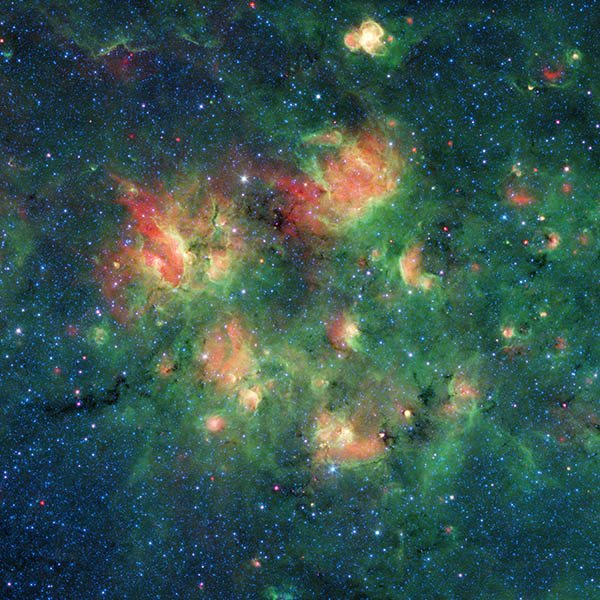
“Running out of coolant would have been the end for Spitzer, except it really marked a mid-life transition. Even without the liquid helium, Spitzer is far enough from Earth’s heat that the engineers could use the craft’s solar arrays as a built-in sunshield. That kept everything down to about 30 Kelvins. Too warm for Spitzer‘s long-wavelength instruments but not too warm for its two cameras that handle near infra-red. They chugged along just fine for another eleven years and a fraction. During its 17-year life Spitzer produced pictures like this shot of a star-forming region in the constellation Aquila…”
NASA/JPL-Caltech/Milky Way Project.

The maybe-an-Art-major goes nuts, you can’t even make out the words, but Newt barrels on. “Here’s where I let you in on a secret. The image covers an area about twice as wide as the Moon so you shouldn’t need a telescope to spot it in our Summertime sky. However, even on a good night you won’t see anything like this and there are several reasons why. First, the light’s very faint. Each of those color-dense regions represents a collection of hundreds or thousands of young stars. They give off tons of visible light but nearly all of that is blocked by their dusty environment. Our nervous system’s timescale just isn’t designed for capturing really faint images. Your eye acts on photons it collects during the past tenth of a second or so. An astronomical sensor can focus on a target for minutes or hours while it accumulates enough photons for an image of this quality.”

“But you told us that Spitzer can see through dust.”

“That it can, but not in visible colors. Spitzer‘s cameras ignored the visible range. Instead, they gathered the incoming infrared light and separated it into three wavelength bands. Let’s call them long, medium and short. In effect, Spitzer gave us three separate black-and-white photos, one for each band. Back here on Earth, the post-processing team colorcoded each of those photos — red for long, green for medium and blue for short. Then they laid the three on top of each other to produce the final image. It’s what’s called ‘a falsecolor image’ and it can be very informative if you know what to look for. Most published astronomical images are in fact enhanced or colorcoded like this in some way to highlight structure or indicate chemical composition or temperature.”

“What happened after the extra extra years?”

“Problems had just built up. Spitzer doesn’t orbit the Earth, it orbits the Sun a little bit slower than Earth does. It gets further away from us every minute. It used to be able to send us its data almost real-time, but now it’s so far away a 2hour squirt-cast drains its batteries. Recharging the batteries using Spitzer‘s solar arrays tilts the craft’s antenna away from Earth — not good. Spitzer‘s about 120° behind Earth now and there’ll come a time when it’ll be behind the Sun from us, completely out of communication. Meanwhile back on Earth, the people and resources devoted to Spitzer will be needed to run the James Webb Space Telescope. NASA decided that January 30 was time to pull the plug.”

Cathleen takes the mic. “Euge, serve bone et fidélis. Well done, thou good and faithful servant.”

~~ Rich Olcott

A Tale of Four Brothers

Jim hands the mic to Cathleen, who announces, “Bio-break time. Please be back here in 15 minutes for the next speaker. Al will have fresh coffee and scones for us.” <a quarter-hour later> “Welcome back, everyone, to the next session of our ‘IR, Spitzer and the Universe‘ memorial symposium. Our next speaker will turn our focus to the Spitzer Space Telescope itself. Newt?”

“Thanks, Cathleen. Let’s start with a portrait of Spitzer. I’m putting this up because Spitzer‘s general configuration would fit all four of NASA’s Great Observatories…

A NASA artist’s impression of Spitzer against an IR view of the Milky Way’s dust

“Each of them was designed to be carried into space by one of NASA’s space shuttles so they had to fit into a shuttle’s cargo bay — a cylinder sixty feet long and fifteen feet in diameter. Knock off a foot or so each way to allow for packing materials and loading leeway.”

<voice from the crowd> “How come they had to be in space? It’d be a lot cheaper on the ground.”

“If you’re cynical you might say that NASA had built these shuttles and they needed to have some work for them to do. But the real reasons go back to Lyman Spitzer (name sound familiar?). Right after World War II he wrote a paper listing the benefits of doing Astronomy outside of our atmosphere. We think Earth’s atmosphere is transparent, but that’s only mostly true and only at certain wavelengths. Water vapor and other gases block out great swathes of the infrared range. Hydrogen and other atoms absorb in the ultraviolet and beyond. Even in the visible range we’ve got dust and clouds. And of course there’s atmospheric turbulence that makes stars twinkle and astronomers curse.”

“So he wanted to put telescopes above all that.”

“Absolutely. He leveraged his multiple high-visibility posts at Princeton, constantly promoting government support of high-altitude Astronomy. He was one of the Big Names behind getting NASA approved in the first place. He lived to see the Hubble Space Telescope go into service, but unfortunately he died just a couple of years before its IR companion was put into orbit.”

“So they named it after him?”

“They did, indeed. The Spitzer was the fourth and final product of NASA’s ‘Great Observatories’ program designed to investigate the Universe from beyond Earth’s atmosphere. The Hubble Space Telescope was first. It was built to observe visible light but it also gave NASA experience doing unexpected inflight satellite repairs. <scattered chuckles in the audience. The maybe-an-Art-major nudges a neighbor for a whispered explanation.> The Atlantis shuttle put Hubble into orbit in 1990. Thirty years later it’s still producing great science for us.”

<The maybe-an-Art-major yells out> “And beautiful pictures!”

“Yes, indeed. OK, a year later Atlantis put Compton Gamma Ray Observatory into orbit. Its sensors covered a huge range of the spectrum, about twenty octaves as Jim would put it, from hard X-rays on upward. In its nine years of life it found nearly 300 sources for those high-energy photons that we still don’t understand. It also detected some 2700 gamma ray bursts and that’s something else we don’t understand other than that they’re way outside our intergalactic neighborhood.”

“Only nine years?”

“Sad, right? Yeah, one of its gyroscopes gave out and NASA had to bring it down. Some people fussed, ‘It’ll come down on our heads and we’re all gonna die!‘ but the descent stayed under control. Most of the satellite burned up on re-entry and the rest splashed harmlessly into the Indian Ocean.”

<quiet snuffle>

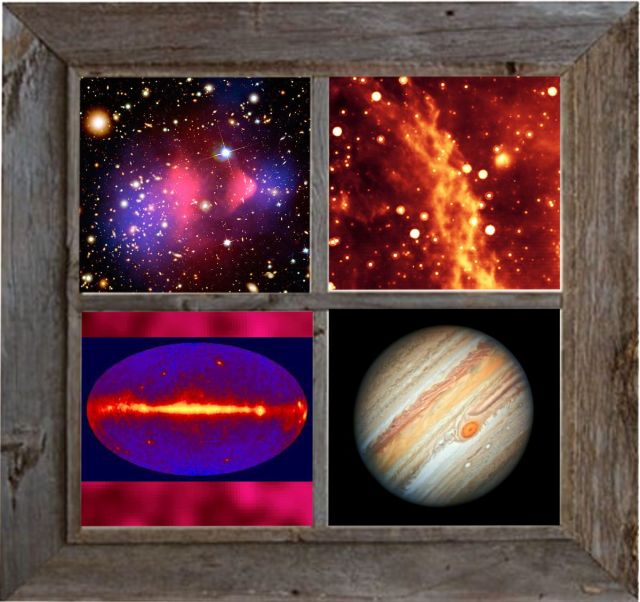
“Cheer up, it gets better. A month and a half after Compton‘s end, the Columbia shuttle put Chandra X-Ray Observatory into orbit. Like Hubble, Chandra‘s still going strong and uncovering secrets for us. Chandra was first to record X-rays coming from the huge black hole at the Milky Way’s core. Chandra data from the Bullet Cluster helped confirm the existence of dark matter. Thanks to Chandra we understand Jupiter’s X-ray emissions well enough to steer the Juno spacecraft away from them. The good stuff just keeps coming.”

“Thanks, that helps me feel better.”

“Good, because it’s time for the Spitzer‘s inspirational life story.”

~~ Rich Olcott

A Far And Dusty Traveler

Cathleen takes the mic. “Quick coffee and scone break, folks, then Jim will continue our ‘IR, Spitzer And The Universe‘ symposium.” <pause> “OK, we’re back in business. Jim?”

“Thanks, Cathleen. Well, we’ve discussed finding astronomical molecules with infra-red. Now for a couple of other IR applications. First up — looking at things that are really far away. Everyone here knows that the Universe is expanding, right?”

<general murmur of assent, although the probably-an-Art-major looks startled>

“Great. Because of the expansion, light from a far-away object gets stretched out to longer wavelengths on its way to us. Say a sodium atom shot a brilliant yellow-gold 590-nanometer photon at us, but at the time the atom was 12.5 million lightyears away. By the time that wave reaches us it’s been broadened to 3540 nanometers, comfortably into the infra-red. Distant things are redder, sometimes too red to see with an optical telescope. The Spitzer Space Telescope‘s infra-red optics let us see those reddened photons. And then there’s dust.”

<voice from the crowd> “Dust?”

Cosmic dust, pretty much all the normal matter that’s not clumped into stars and planets. Some of it is leftovers from early times in the Universe, but much of it is stellar wind. Stars continuously spew particles in their normal day-to-day operation. There’s a lot more of that when one explodes as a nova or supernova. Dust particles come in all sizes but most are smaller than the ones in tobacco smoke.”

<same voice> “If they’re so small, why do we care about them?”

“Two reasons. First, there’s a lot of them. Maybe only a thousand particles per cubic kilometer of space, but there’s a huge number of cubic kilometers in space and they add up. More important is what the dust particles are made of and where we found them. Close inspection of the dust is like doing astronomical archaeology, giving us clues about how stars and galaxies evolved.”

<Vinnie, skeptical as always> “So what’s infra-red got to do with dust?”

“Depends on what kind of astronomy you’re interested in. Dust reflects and emits IR light. Frequency patterns in the light can tell us what that dust made of. On the other hand there’s the way that dust doesn’t interact with infra-red.”

<several voices> “Wait, what?”

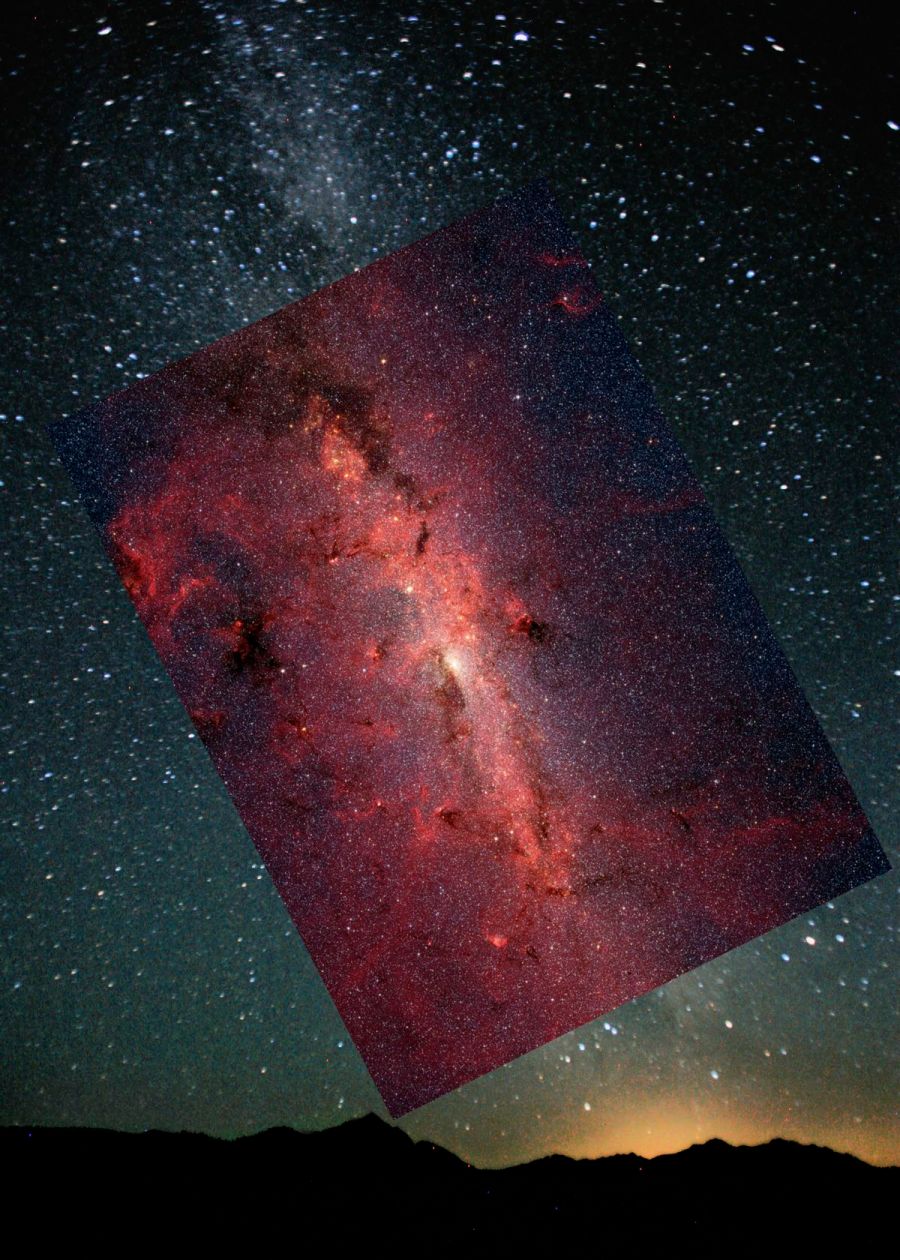
The Milky Way from Black Rock Desert NV
By Steve Jurvetson via Flickr, Wikimedia Commons, CC BY 2.0

“If Al’s gotten his video system working … ah, he has and it does. Look at this gorgeous shot of the Milky Way Galaxy. See all the dark areas? That’s dust blocking the visible light. The scattered stars in those areas are simply nearer to us than the clouds. We’d like to study what’s back beyond the clouds, especially near the galaxy’s core. That’s a really interesting region but the clouds block its visible light. Here’s the neat part — the clouds don’t block its infra-red light.”

<other voices> “Huh?” “Why wouldn’t they?”

“It’s the size of the waves versus the size of the particles. Take an extreme case — what’s the wavelength of Earth’s ocean tides?”

<Silence, so I speak up.> “Two high tides a day, so the wavelength is half the Earth’s circumference or about 12’500 miles.”

“Right. Now say you’re at the beach and you’re out there wading and the water’s calm. Would you notice the tide?”

“No, rise or fall would be too gentle to affect me.”

“Now let’s add a swell whose peak-to-peak wavelength is about human-height scale.”

“Whoa, I’d be dragged back and forth as each wave passes.”

“Just for grins, let’s replace that swell with waves the same height but only a millimeter apart. Oh, and you’re wearing SCUBA equipment.”

“Have mercy! Well, I should be able to stand in place because I wouldn’t even feel the peaks and troughs as separate waves, just a foamy massage. Thanks for the breathing assistance, though.”

“You’re welcome, and thanks for helping with the thought experiment. Most cosmic dust particles are less than 100 nanometers across. Infra-red wavelengths run 100 to 1000 times longer than that. Infra-red light from those cloud-hidden stars just curves around particles that can stop visible lightwaves cold. Spitzer Space Telescope and its IR-sensitive kin provide deeper and further views than visible light allows.”

~~ Rich Olcott

Above The Air, Below The Red

Vinnie and I walk into Al’s coffee shop just as he sets out a tray of scones. “Odd-looking topping on those, Al. What is it?”

“Dark cherry and dark chocolate, Sy. Something about looking infra-red. Cathleen special-ordered them for some Astronomy event she’s hosting in the back room. Carry this tray in there for me?”

Vinne grabs the tray and a scone. “Sure, Al. … Mmm, tasty. … Hi, Cathleen. Here’s your scones. What’s the event?”

“It’s a memorial symposium for the Spitzer Space Telescope, Vinnie. Spitzer‘s been an infra-red workhorse for almost 17 years and NASA formally retired it at the end of January.”

“What’s so special about infra-red? It’s just light, right? We got the Hubble for that.”

“A perfect cue for Jim’s talk. <to crowd> Grab a scone and settle down, everyone. Welcome to our symposium, ‘IR , Spitzer And The Universe.’ Our first presentation today is entitled ‘What’s So Special About Infra-red?‘ Jim, you’re on.”

“Thanks, Cathleen. This is an introductory talk, so I’ll keep it mostly non-technical. So, question for everybody — when you see ‘IR‘, what do you think of first?”

<shouts from the crowd> “Pizza warmer!” “Invisible light!” “Night-vision goggles!”

“Pretty much what I expected. All relevant, but IR’s much more than that. To begin with, many more colors than visible light. We can distinguish colors in the rainbow because each color’s lightwave has a different frequency. Everybody OK with that?”

<general mutter of assent>

“OK. Well, the frequency at the violet end of the visible spectrum is a bit less than double the frequency at the red end. In music when you double the frequency you go up an octave. The range of colors we see from red to violet is less than an octave, about like going from A-natural to F-sharp on the piano. The infra-red spectrum covers almost nine octaves. An 88-key piano doesn’t even do eight.”

<voice from the crowd, maybe an Art major> “Wow, if we could see infra-red think of all the colors there’d be!”

“But you’d need a whole collection of specialized eyes to see them. With light, every time you go down an octave you reduce the photon’s energy capacity by half. Visible light is visible because its photons have just enough energy to cause an electronic change in our retinas’ photoreceptor molecules. Five octaves higher than that, the photons have enough energy to knock electrons right out of a molecule like DNA. An octave lower than visible, almost nothing electronic.”

<Vinnie’s always-skeptical voice> “If there’s no connecting with electrons, how does electronic infra-red detection work?”

“Two ways. A few semiconductor configurations are sensitive to near- and mid-infra-red photons. The Spitzer‘s sensors are grids of those configurations. To handle really low-frequency IR you have to sense heat directly with bolometer techniques that track expansion and contraction.”

<another skeptical voice> “OK then, how does infra-red heating work?”

“Looks like a paradox, doesn’t it? Infra-red photons are too low-energy to make a quantum change in a molecule’s electronic arrangement, but we know that the only way photons can have an effect is by making quantum changes. So how come we feel infra-red’s heat? The key is, photons can interact with any kind of charged structure, not just electrons. If a molecule’s charges aren’t perfectly balanced a photon can vibrate or rotate part of a molecule or even the whole thing. That changes its kinetic energy because molecular motion is heat, right? Fortunately for the astronomers, gas vibrations and rotations are quantized, too. An isolated water molecule can only do stepwise changes in vibration and rotation.”

“Why’s that fortunate?”

“Because that’s how I do my research. Every kind of molecule has its own set of steps, its own set of frequencies where it can absorb light. The infra-red range lets us do for molecules what the visual range lets us do for atoms. By charting specific absorption bands we’ve located and identified interstellar clouds of water, formaldehyde and a host of other chemicals. I just recently saw a report of ‘helonium‘, a molecular ion containing helium and hydrogen, left over from when the Universe began. Infra-red is so cool.”

“No, it’s warm.”

Image suggested by Alex

~~ Rich Olcott

The Top Choice

Al grabs me as I step into his coffee shop. “Sy, ya gotta stop Vinnie, he’s using up paper napkins again, and he’s making a mess!”

Sure enough, there’s Vinnie at his usual table by the door. He’s got a kid’s top, a big one, spinning on a little stand. He’s methodically dropping crumpled-up paper wads onto it and watching them fly off onto the floor. “Hey, Vinnie, what’s the project?”

“Hi, Sy. I’m trying to figure how come these paper balls are doing a circle but when they fly off they always go in a straight line, at least at first. They got going-around momentum, right, so how come they don’t make a spiral like stars in a galaxy?”

Astronomy professor Cathleen’s standing in the scone line. She never misses an opportunity to correct a misconception. “Galaxy stars don’t spray out of the center in a spiral, Vinnie. Like planets going around a star, stars generally follow elliptical orbits around the galactic center. A star that’s between spiral arms now could be buried in one ten million years from now. The spiral arms appear because of how the orbits work. One theory is that the innermost star orbits rotate their ellipse axes more quickly than the outer ones and the spirals form where the ellipses pile up. Other theories have to do with increased star formation or increased gravitational attraction within the pile-up regions. Probably all three contribute to the structures. Anyhow, spirals don’t form from the center outward.”

My cue for some physics. “What happens in a galaxy is controlled by gravity, Vinnie, and gravity doesn’t enter into what you’re doing. Except for all that paper falling onto Al’s floor. There’s no in-plane gravitational or electromagnetic attraction in play when your paper wads leave the toy. Newton would say there’s no force acting to make them follow anything other than straight lines once they break free.”

“What about momentum? They’ve got going-around momentum, right, shouldn’t that keep them moving spirally?”

I haul out Old Reliable for a diagram. “Thing is, your ‘going-around momentum,’ also known as ‘angular momentum,’ doesn’t exist. Calm down, Vinnie, I mean it’s a ‘fictitious force‘ that depends on how you look at it.”

“Is this gonna be frames again?”

“Yup. Frames are one of our most important analytical tools in Physics. Here’s your toy and just for grins I’ve got it going around counterclockwise. That little white circle is one of your paper wads. In the room’s frame that wad in its path is constantly converting linear momentum between the x-direction and the y-direction, right?”

“East-West to North-South and back, yeah, I get that.”

“Such a mess to calculate. Let’s make it easier. Switch to the perspective of a frame locked to the toy. In that frame the wad can move in two directions. It can fly away along the radial direction I’ve called r, or it can ride along sideways in the s-direction.”

“So why hasn’t it flown away?”

“Because you put some spit on it to make it stick — don’t deny it, I saw you. While it’s stuck, does it travel in the r direction?”

“Nope, only in the s direction. Which should make it spiral like I said.”

“I’m not done yet. One of Newton’s major innovations was the idea of infinitesimal changes, also known as little-bits. The s-direction is straight, not curved, but it shifts around little-bit by little-bit as the top rotates. Newton’s Laws say force is required to alter momentum. What force influences the wad’s s-momentum?”

“Umm … that line you’ve marked c.”

“Which is the your spit’s adhesive force between the paper and the top. The wad stays stuck until the spit dries out and no more adhesion so no more c-force. Then what happens?”

“It flies off.”

“In which direction?”

“Huh! In the r-direction.”

“And in a straight line, just like Newton said. What you called ‘going-around momentum’ becomes ‘radial momentum’ and there’s no spiraling, right?”

“I guess you’re right, but I miss spirals.”

Al comes over with a broom. “Now that’s settled, Vinnie, clean up!”

~~ Rich Olcott

  • Thanks for the question, Jen Keeler. Stay tuned.

Where would you put it all?

Vinnie’s a big guy but he’s good at fading into the background. I hadn’t even noticed him standing in the back corner of Cathleen’s impromptu seminar room until he spoke up. “That’s a great theory, Professor, but I wanna see numbers for it.”

“Which part of it don’t you like, Vinnie?”

“You made it seem so easy for all those little sea thingies to scrub the carbon dioxide out of Earth’s early atmosphere and just leave the nitrogen and oxygen behind. I mean, that’d be a lot of CO2. Where’d they put it all?”

“That’s a reasonable question, Vinnie. Lenore, could you put your Chemistry background to work on it for us?”

“Oh, this’ll be fun, but I don’t want to do it in my head. Mr Moire, could you fire up Old Reliable for the calculations?”

“No problem. OK, what do you want to calculate?”

“Here’s my plan. Rather than work with the number of tons of carbon in the whole atmosphere, I’ll just look at the sky-high column of air sitting on a square meter of Earth’s surface. We’ll figure out how many moles of CO2 would have been in that column back then and then work on how thick a layer of carbon stuff it would make on the surface. Does that sound like a good attack, Professor?”

“Sure, but I see a couple of puzzled looks in the class. You’d better say something about moles first.”

“Hey, I know about moles. Sy and me talked about ’em when he was on that SI kick. They’re like a super dozen, right, Sy?”

“Right, Vinnie. A mole of anything is 6.02×10²³ of that thing. Eggs, atoms, gas molecules, even stars if that’d be useful.”

“Back to my plan. First thing is the CO2 was in that column back when. Maria, your chart showed that Venus’ atmospheric pressure is 100 times ours and Mars’ is 1/100 ours and each of them is nearly pure CO2, right? So I’m going to assume that Earth’s atmosphere was what we have now plus a dose of CO2 that’s the geometric mean of Venus and Mars. OK, Professor?”

“That’d be a good starting point, Lenore.”

“Good. Now we need the mass of that CO2, which we can get from the weight of the column, which we can get from the air pressure, which is what?”

Every car buff in the room, in chorus — “14½ pounds per square inch.”

“I need that in kilograms per square meter.”

“Strictly speaking, pressure’s in newtons per square meter. There’s a difference between weight and force, but for this analysis we can ignore that. Keep going, Lenore.”

“Thanks, Professor. Sy?”

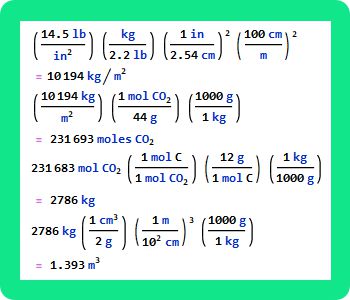
“Old Reliable says 10194 kg/m².”

“So we’ve got like ten-thousand kilograms of CO2 in that really tall meter-square column of ancient air. Now divide that by, um, 44 to get the number of moles of CO2. No, wait, then multiply by 1000 because we’ve got kilograms and it’s 44 grams per mole for CO2.”

“232 thousand moles. Still sounds like a lot.”

“I’m not done. Now we take that carbon and turn it into coal which is solid carbon mostly. One mole of carbon from each mole of CO2. Take the 232 thousand moles, multiply by 12 grams, no make that 0.012 kilogram per mole –“

“2786 kilograms”

“Right. Density of coal is about 2 grams per cc or … 2000 kilograms per cubic meter. So. Divide the kilograms by 2000 to get cubic meters.”

“1.39 meters stacked on that square-meter base.”

“About what I guessed it’d be. Vinnie, if Earth once had a carbon-heavy atmosphere log-halfway between Venus and Mars, and if the sea-plankton reduced all its CO2 down to coal, it’d make a layer all over the planet not quite as tall as I am. If it was chalk it’d be thicker because of the additional calcium and oxygen atoms. A petroleum layer would be thicker, too, with the hydrogens and all, but still.”

Jeremy’s nodding vigorously. “Yeah. We’ve dug up some of the coal and oil and put it back into the atmosphere, but there’s mountains of limestone all over the place.”

Cathleen’s gathering up her papers. “Add in the ocean-bottom carbonate ooze that plate tectonics has conveyor-belted down beneath the continents over the eons. Plenty of room, Vinnie, plenty of room.”

~~ Rich Olcott

The Moon And Chalk

Cathleen’s talking faster near the end of the class. “OK, we’ve seen how Venus, Earth and Mars all formed in the same region of the protosolar disk and have similar overall compositions. We’ve accounted for differences in their trace gasses. So how come Earth’s nitrogen-oxygen atmosphere is so different from the CO2-nitrogen environments on Venus and Mars? Let’s brainstorm — shout out non-atmospheric ways that Earth is unique. I’ll record your list on Al’s whiteboard.”

“Oceans!”

“Plate tectonics!”

“Photosynthesis!”

“Limestone!”

“The Moon!”

“Wombats!” (That suggestion gets a glare from Cathleen. She doesn’t write it down.)

“Goldilocks zone!”

“Magnetic field!”

“People!”

She registers the last one but puts parentheses around it. “This one’s literally a quickie — real-world proof that human activity affects the atmosphere. Since the 1900s gaseous halogen-carbon compounds have seen wide use as refrigerants and solvents. Lab-work shows that these halocarbons catalyze conversion of ozone to molecular oxygen. In the 1970s satellite data showed a steady decrease in the upper-atmosphere ozone that blocks dangerous solar UV light from reaching us on Earth’s surface. A 1987 international pact banned most halocarbon production. Since then we’ve seen upper-level ozone concentrations gradually recovering. That shows that things we do in quantity have an impact.”

“How about carbon dioxide and methane?”

“That’s a whole ‘nother topic we’ll get to some other day. Right now I want to stay on the Mars-Venus-Earth track. Every item on our list has been cited as a possible contributor to Earth’s atmospheric specialness. Which ones link together and how?”

Adopted from image by Immanuel Giel, CC BY-SA 3.0

Astronomer-in-training Jim volunteers. “The Moon has to come first. Moon-rock isotope data strongly implies it condensed from debris thrown out by a huge interplanetary collision that ripped away a lot of what was then Earth’s crust. Among other things that explains why the Moon’s density is in the range for silicates — only 60% of Earth’s density — and maybe even why Earth is more dense than Venus. Such a violent event would have boiled off whatever atmosphere we had at the time, so no surprise the atmosphere we have now doesn’t match our neighbors.”

Astrophysicist-in-training Newt Barnes takes it from there. “That could also account for why only Earth has plate tectonics. I ran the numbers once to see how the Moon’s volume matches up with the 70% of Earth’s surface that’s ocean. Assuming meteor impacts grew the Moon by 10% after it formed, I divided 90% of the Moon’s present volume by 70% of Earth’s surface area and got a depth of 28 miles. That’s nicely within the accepted 20-30 mile range for depth of Earth’s continental crust. It sure looks like our continental plates are what’s left of the Earth’s original crust, floating about on top of the metallic magma that Earth held onto.”

Jeremy gets excited. “And the oceans filled up what the continents couldn’t spread over.”

“That’s the general idea.”

Al’s not letting go. “But why does Earth have so much water and why is it the only one of the three with a substantial magnetic field?”

Cathleen breaks in. “The geologists are still arguing about whether Earth’s surface water was delivered by billions of incoming meteorites or was expelled from deep subterranean sources. Everyone agrees, though, that our water is liquid because we’re in the Goldilocks zone. The water didn’t steam away as it probably did on Venus, or freeze below the surface as it may have on Mars. Why the magnetic field? That’s another ‘we’re still arguing‘ issue, but we do know that magnetic fields protect Earth and only Earth from incoming solar wind.”

“So we’re down to photosynthesis and … limestone?”

“Photosynthesis was critical. Somewhere around two billion years ago, Earth’s sea-borne life-forms developed a metabolic pathway that converted CO2 to oxygen. They’ve been running that engine ever since. If Earth ever did have CO2 like Venus has, green things ate most of it. Some of the oxygen went to oxidizing iron but a lot was left over for animals to breathe.”

“But what happened to the carbon? Wouldn’t life’s molecules just become CO2 again?”

“Life captures carbon and buries it. Chalky limestone, for instance — it’s calcium carbonate formed from plankton shells.”

Jim grins. “We owe it all to the Moon.”

~~ Rich Olcott

Traces of Disparity

Cathleen’s an experienced teacher — she knows when off-topic class discussion is a good thing, and when to get back to the lesson plan. “My challenge question remains — why isn’t Earth’s atmosphere some average of the Mars and Venus ones? Thanks to Jeremy and Newt and Lenore we have reason to expect the planets to resemble each other, but in fact their atmospheres don’t. Maria, tell us what you’ve found about how Earth compares with the others.”

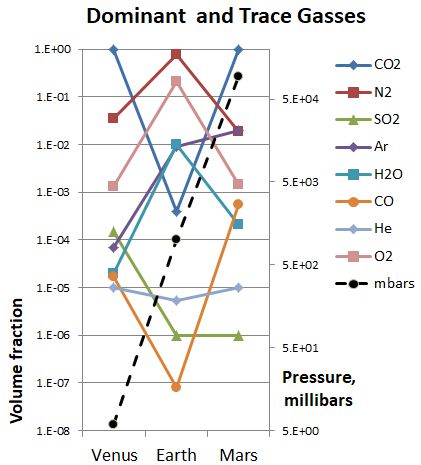
“Yes, Profesora. I found numbers for many of the gasses on each planet and put them into this chart. One thing Earth is right in the middle, most things not.”

“That’s a complicated chart. Read it out to us.”

“Of course. I had to make the vertical scales logarithmic to get the big numbers and small numbers on the same chart. First is the pressure which is the black dotted line. Venus pressure at the surface is nearly 100 times ours but Mars pressure is a bit less than 1/100th of ours. Does that count as Earth being in the middle?”

“That’d be a geometric average. It could be significant, we’ll see. Go on.”

“The gas that is almost the same everywhere is helium, the grey diamonds. That surprised me, because I thought the giant planets got all of that.”

Al’s been listening in. Nothing else going on in his coffee shop, I guess. “I’ll bet most of that helium came from radioactive rocks, not from space. Alpha particles, right, Cathleen?”

Cathleen takes unexpected interruptions in stride. “Bad bet, Al. Uranium and other heavy elements do emit alphas which pick up electrons to become helium atoms. You probably remembered Cleve and Langlet, who first isolated helium from uranium ore. However, the major source of atmospheric alphas is the solar wind. Solar wind interception and atmosphere mass are both proportional to planetary surface area so a constant concentration like this is reasonable. Continue, Maria.”

“The major gasses follow a pattern — about the same fractions on Venus and Mars but much higher or lower than on Earth. Look at carbon dioxide, nitrogen, even oxygen.”

Astronomer-in-training Jim has been doing some mental arithmetic. “Our atmosphere is 100 times denser than on Mars, and Venus is another factor of 100 beyond that. That’s a factor of 104 between them — for every molecule of CO2 on Mars there’s 10,000 on Venus. Oh, but Venus has four times Mars’ surface area so make that 40,000.”

“Good points, both of you. Jim’s approximation leads into something we can learn from Maria’s trace gas numbers. Why do you suppose the concentration of SO2 is about the same for Earth and Mars but 100 times higher on Venus, but the reverse is true for argon? Where do they each come from?”

Jeremy finally has something he can contribute. “Volcanoes! They told us in Geology class that most of our SO2 comes from volcanoes. Before the Industrial Revolution, I mean, when we started burning high-sulfur coal and fuel oils and made things worse. Venus has to be the same. Except for the industry, of course.”

“Probably correct, Jeremy. From radar mapping of Venus we know that it has over 150 large volcanoes. We don’t know how many of them are active, but the Venus Express spacecraft sent back evidence of active vulcanism. In fact, Venus’ SO2 score would probably be even higher if much of its production didn’t oxidize to SO3. That combines with water to form the clouds of sulfuric acid that hide the planet’s surface and reflect sunlight so brightly.”

Maria’s hand is up again. “I don’t understand argon’s purple diamonds, profesora. I know it’s one of the inert gasses so it doesn’t have much chemistry and can’t react into a mineral like CO2 and SO2 can. Shouldn’t argon be about the same on all three planets, like helium?”

“Mm-hm, argon does have a simple chemistry, but its radiochemistry isn’t so simple. Nearly 100% of natural argon is the argon-40 isotope created by radioactive decay of potassium-40. Potassium is tied up in the rocks, so the atmospheric load of argon-40 depends on rocky surface erosion. Not much erosion, not much argon.”

Al’s on tenterhooks. “All this is nice, but you still haven’t said why Earth’s atmosphere is so different.”

~~ Rich Olcott

The Still of The Night

Lenore raises her hand. “Maybe it’s my Chemistry background, but to me that protosolar disk model for the early Solar System looks like a distillation process. You heat up a mixture in the pot and then run the resulting vapors through a multi-stage condenser. Different components of the mixture collect at different points in the condenser depending on the local temperature or maybe something about the condenser’s surface. I got some fun correlations from data I dug up related to that idea.”

“Interesting perspective, Lenore You’re got the floor.”

“Thanks, Professor. Like Newt said, hydrogen and helium atoms are so light that even a low-energy photon or solar wind particle can give them a healthy kick away from the Sun and they wind up orbiting where the gas planets grew up. But there was more sorting than that. Check out this chart.”

“What’re the bubbles?”

“Each bubble represents one planet. I’ve scaled the bubble to show what fraction of the planet is its nickel-iron core. Mercury, for instance, is two-thirds core; the other third is its silicate crust and that’s why its overall density is up there between iron and silicates. Then you go through Venus and Earth, all apparently in the zone where gravity’s inward pull on heavy dust particles is balanced by the solar wind’s intense outward push. From the chart I’d say that outbound metallic and rocky materials are mostly gone by the asteroid belt. Big Jupiter grabs most of the the hydrogen and helium; its little brothers get the leavings. Mars looks like it’s right on the edge of the depletion zone — the numbers suggest that its core, if it has one, is only 12% of its mass.”

Jeremy’s ears prick up. “If it has one?”

“Yeah, the sources I checked couldn’t say for sure whether or not it does. That’s part of why we sent the Insight lander up there. Its seismic data should help decide the matter. With such a small iron content the planet could conceivably have cooled like silicate raisin bread. It might have isolated pockets of iron here and there instead of gathered in at the center.”

“Weird. So the giant planets are all — wait, what’s Saturn doing with a density below water’s?”

“You noticed that. Theoretically, if you could put Saturn on a really big pool of water in a gravity field it’d float.”

Meanwhile, astrophysicist-in-training Newt Barnes has been inspecting the chart. “Uranus and Neptune don’t fit the pattern, Lenore. If it’s just a matter of ‘hydrogen flees farthest,’ then those two ought to be as light as Saturn, maybe lighter.”

“Yeah, that bothered me, too. Uranus and Neptune are giant planets like Jupiter and Saturn, but they’re not ‘gas giants,’ they’re ‘ice giants.’ All four of them seem to have a junky nickel-iron-silicate core, maybe 1-to-10 times Earth’s mass, but aside from that the gas giants are mainly elemental hydrogen and helium whereas Uranus and Neptune are mostly compounds of oxygen, nitrogen and carbon with hydrogen.”

“How’d all those light atoms get so far out beyond the big guys?”

“Not a clue. Can you help, Professor?”

Cathleen draws ellipses on Al’s whiteboard. “Maybe they did, maybe they didn’t — the jury’s still out. We’re used to our nice neat modern Solar System where almost everything follows nearly circular orbits. It took a while to evolve there starting from the chaotic protosolar disk. Many of the early planetesimals probably had narrow elliptical orbits if they had an orbit at all, considering how often they collided with each other. Astromechanics modelers have burned years of computer time trying to account for what we know of the planets, asteroids, comets and the Kuiper and Oort formations we’ve barely begun to learn about. Some popular ‘Jumping Jupiter‘ models show Jupiter and Saturn migrating in towards the Sun and out again, playing hob with Uranus, Neptune and maybe a third ice giant before that one was ejected from the system altogether. It’s entirely possible that the ice giants grew up Sunward of the hydrogen-rich gas giants. We just don’t know.”

“That’s a challenge.”

“Yes, and my challenge question remains — why isn’t Earth’s atmosphere some average of the Mars and Venus ones?”

~~ Rich Olcott

Should These Three Be Alike?

“What’s all the hubbub in the back room, Al? I’m a little early for my afternoon coffee break and your shop’s usually pretty quiet about now.”

“It’s Cathleen’s Astronomy class, Sy. The department double-booked their seminar room so she asked to use my space until it’s straightened out.”

“Think I’ll eavesdrop.” I slide in just as she’s getting started.

“OK, folks, settle. Last class I challenged you with a question. Venus and Mars both have atmospheres that are dominated by carbon dioxide with a little bit of nitrogen. Earth is right in between them. How come its atmosphere is so different? I gave each of you a piece of that to research. Jeremy, you had the null question. Should we expect Earth’s atmosphere to be about the same as the other two?”

Venus coudtops image by Damia Bouic
JAXA / ISAS / DARTS / Damia Bouic

“I think so, ma’am, on the basis of the protosolar nebula hypothesis. The –“

“Wait a minute, Jeremy. Sy, I saw you sneak in. Jeremy, explain that term to him.”

“Yes’m. Uh, a nebula is a cloud of gas and dust out in space. It could be what got shot out of an exploding star or it could be just a twist in a stream of stuff drifting through the Galaxy. If the twist kinks up, gravity pulls the material on either side of the kink towards the middle and you get a rotating disk. Most of what’s in the disk falls towards its center. The accumulated mass at the center lights up to be a star. Meanwhile, what’s left in the disk keeps most of the original angular momentum but it doesn’t whirl smoothly. There’s going to be local vortices and they attract more stuff and grow up to be planets. That’s what we think happens, anyway.”

“Good summary. So what does that mean for Mars, Venus and the Earth?”

“Their orbits are pretty close together, relative to the disk’s radius, so they ought to have encountered about the same mixture of heavy particles and light ones while they were getting up to size. The light ones would be gas atoms, mostly hydrogen and helium. Half the other atoms are oxygen and they’d react to produce oxides — water, carbon monoxide, grains of silica and iron oxide. And oxygen and nitrogen molecules, of course.”

“Of course. Was gravity the only actor in play there?”

“No-o-o, once the star lit up its photons and solar wind would have pushed against gravity.”

“So three actors. Would photons and solar wind have the same effect? Anybody?”

Silence, until astrophysicist-in-training Newt Barnes speaks up. “No, they’d have different effects. The solar wind is heavy artillery — electrons, protons, alpha particles. They’ll transfer momentum to anything they hit, but they’re more likely to hit a large particle like a dust grain than a small one like an atom. On average, the big particles would be pushed away more.”

“And the photons?”

“A photon is selective — it can only transfer momentum to an atom or molecule that can absorb exactly the photon’s energy. But each kind of atom has its own set of emission and absorption energies. Most light emitted by transitions within hydrogen atoms won’t be absorbed by anything but another hydrogen atom. Same thing for helium. The Sun’s virtually all hydrogen and helium. The photons they emit would move just those disk atoms and leave the heavier stuff in place.”

“That’s only part of the photon story.”

“Oh? Oh, yeah. The Sun’s continuous spectrum. The Sun is hot. Heat jiggles whole ions. Those moving charges produce electromagnetic waves just like charge moving within an atom, but heat-generated waves can have any wavelength and interact with anything. They can bake dust particles and decompose compounds that contain volatile atoms. Then those atoms get swept away in the general rush.”

“Which has the greater effect, solar wind or photons?”

“Hard to say without doing the numbers, but I’d bet on the photons. The metal-and-silicate terrestrial planets are close to the Sun, but the mostly-hydrogen giants are further out.”

“All that said, Jeremy, what’s your conclusion?”

“It sure looks like Earth’s atmosphere should be intermediate between Mars and Venus. How come it’s not?”

~~ Rich Olcott