Prelude to A Waltz

An excited knock, but one I recognize.  In comes Vinnie, waving his fresh copy of The New York Times.

LIGO‘s done it again!  They’ve seen another black hole collision!”

“Yeah, Vinnie, I’ve read the Abbott-and-a-thousand paper.  Three catastrophic collisions detected in less than two years.  The Universe is starting to look like a pretty busy place, isn’t it?”

“And they all involve really big black holes — 15, 20, even 30 times heavier than the Sun.  Didn’t you once say black holes that size couldn’t exist?”

“Well, apparently they do.  Of course the physicists are busily theorizing how that can happen.  What do you know about how stars work, Vinnie?”

“They get energy from fusing hydrogen atoms to make helium atoms.”

“So far, so good, but then what happens when the hydrogen’s used up?”

“They go out, I guess.”

“Oh, it’s a lot more exciting than that. Does the fusion reaction happen everywhere in the star?”

“I woulda said, ‘Yes,’ but since you’re asking I’ll bet the answer is,  ‘No.'”

“Properly suspicious, and you’re right.  It takes a lot of heat and pressure to force a couple of positive nuclei close enough to fuse together despite charge repulsion.  Pressures near the outer layers are way too low for that.  For our Sun, for instance, you need to be 70% of the way to the center before fusion really kicks in.  So you’ve got radiation pressure from the fusion pushing everything outward and gravity pulling everything toward the center.  But what’s down there?  Here’s a hint — hydrogen’s atomic weight is 1, helium’s is 4.”

“You’re telling me that the heavier atoms sink to the center?”

“I am.”

“So the center builds up a lot of helium.  Oh, wait, helium atoms got two protons in there so it’s got to be harder to mash them together than mashing hydrogens, right?”Star zones
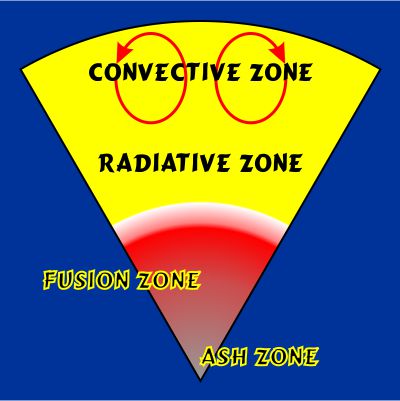
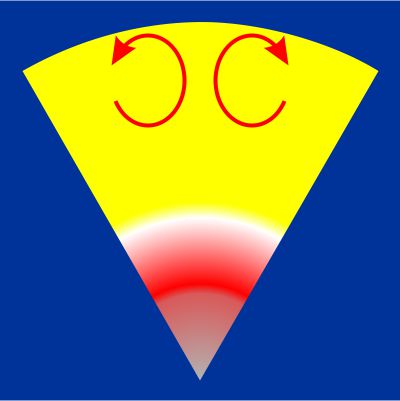
“And that’s why that region’s marked ash zone in this sketch.  Wherever conditions are right for hydrogen fusion, helium’s basically inert.  Like ash in a campfire it just sinks out of the way.  Now the fire goes out.  What would you expect next?”

“Radiation pressure’s gone but gravity’s still there … everything must slam inwards.”

Slam is an excellent word choice, even though the star’s radius is measured in thousands of miles.  What’s the slam going to do to the helium atoms?”

“Is it strong enough to start helium fusion?”

“That’s where I’m going.  The star starts fusing helium at its core.  That’s a much hotter reaction than hydrogen’s.  When convective zone hydrogen that’s still falling inward meets fresh outbound radiation pressure, most of the hydrogen gets blasted away.”

“Fusing helium – that’s a new one on me.  What’s that make?”

“Carbon and oxygen, mostly.  They’re as inert during the helium-fusion phase as helium was when hydrogen was doing its thing.”

“So will the star do another nova cycle?”

“Maybe.  Depends on the core’s mass.  Its gravity may not be intense enough to fuse helium’s ashes.  In that case you wind up with a white dwarf, which just sits there cooling off for billions of years.  That’s what the Sun will do.”

“But suppose the star’s heavy enough to burn those ashes…”

“The core’s fresh light-up blows away infalling convective zone material.  The core makes even heavier atoms.  Given enough fuel, the sequence repeats, cycling faster and faster until it gets to iron.  At each stage the star has less mass than before its explosion but the residual core is more dense and its gravity field is more intense.  The process may stop at a neutron star, but if there was enough fuel to start with, you get a black hole.”

“That’s the theory that accounts for the Sun-size black holes?”

“Pretty much.  I’ve left out lots of details, of course.  But it doesn’t account for black holes the size of 30 Suns — really big stars go supernova and throw away so much of their mass they miss the black-hole sweet spot and terminate as a neutron star or white dwarf.  That’s where the new LIGO observation comes in.  It may have clued us in on how those big guys happen.”

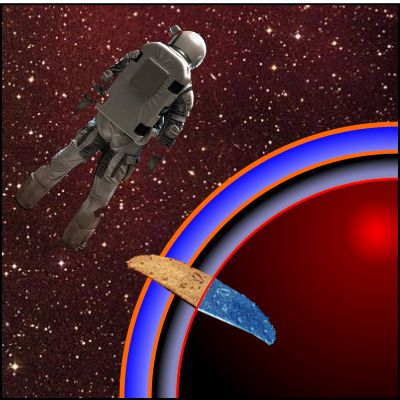
“That sketch looks like a pizza slice.”

“You’re thinking dinner, right?”

“Yeah, and it’s your turn to buy.”

~~ Rich Olcott

Three Perils for a Quest(ion), Part 3

“Things are finally slowing down.  You folks got an interesting talk going, mind if I join you?  I got biscotti.”

“Pull up a chair, Eddie.  You know everybody?”

“You and Jeremy, yeah, but the young lady’s new here.”

“I’m Jennie, visiting from England.”

“Pleased to meetcha.  So from what I overheard, we got Jeremy on some kinda Quest to a black hole’s crust.  He’s passed two Perils.  There’s a final one got something to do with a Firewall.”

“One minor correction, Eddie.  He’s not going to a crust, because a black hole doesn’t have one.  Nothing to stand on or crash into, anyway.  He’s headed to its Event Horizon, which is the next best thing.  If you’re headed inward, the Horizon marks the beginning of where it’s physically impossible to get out.”

“Hotel California, eh?”

“You could say that.  The first two Perils had to do with the black hole’s intense gravitational field.  The one ahead has to do with entangled virtual particles.”

“Entangled is the Lucy-and-Ethel thing you said where two particles coordinate instant-like no matter how far apart they are?”

“Good job of overhearing, there, Eddie.  Jeremy, tell him abut virtual particles.”

“Umm, Mr Moire and I talked about a virtual particle snapping into and out of existence in empty space so quickly that the long-time zero average energy isn’t affected.”

“What we didn’t mention then is that when a virtual pair is created, they’re entangled.  Furthermore, they’re anti-particles, which means that each is the opposite of the other — opposite charge, opposite spin, opposite several other things.  Usually they don’t last long — they just meet each other again and annihilate, which is how the average energy stays at zero.  Now think about creating a pair of virtual particles in the black hole’s intense gravitational field where the creation event sends them in opposite directions.”Astronaut and semi-biscotto
“Umm… if they’re on opposite paths then one’s probably headed into the Horizon and the other is outbound. Is the outbound one Hawking radiation?  Hey, if they’re entangled that means the inbound one still has a quantum connection with the one that escaped!”

“Wait on.  If they’re entangled and something happening to one instantaneously affects its twin, but the gravity difference gives each a different rate of time dilation, how does that work then?”

“Paradox, Jennie!  That’s part of what the Firewall is about.  But it gets worse.  You’d think that inbound particle would add mass to the black hole, right?”

“Surely.”

“But it doesn’t.  In fact, it reduces the object’s mass by exactly each particle’s mass.  That ‘long-time zero average energy‘ rule comes into play here.  If the two are separated and can’t annihilate, then one must have positive energy and the other must have negative energy.  Negative energy means negative mass, because of Einstein’s mass-energy equivalence.  The positive-mass twin escapes as Hawking radiation while the negative-mass twin joins the black hole, shrinks it, and by the way, increases its temperature.”

“Surely not, Sy.  Temperature is average kinetic energy.  Adding negative energy to something has to decrease its temperature.”

“Unless the something is a black hole, Jennie.  Hawking showed that a black hole’s temperature is inversely dependent on its mass.  Reduce the mass, raise the temperature, which is why a very small black hole radiates more intensely than a big one.  Chalk up another paradox.”

“Two paradoxes.  Negative mass makes no sense.  I can’t make a pizza with negative cheese.  People would laugh.”

“Right.  Here’s another.  Suppose you drop some highly-structured object, say a diamond, into a black hole.  Sooner or later, much later really, that diamond’s mass-energy will be radiated back out.  But there’s no relationship between the structure that went in and the randomized particles that come out.  Information loss, which is totally forbidden by thermodynamics.  Another paradox.”

“The Firewall resolves all these paradoxes then?”

“Not really, Jennie.  The notion is that there’s this thin layer of insanely intense energetic interactions, the Firewall, just outside of the Event Horizon.  That energy is supposed to break everything apart — entanglements, pre-existing structures, quantum propagators (don’t ask), everything, so what gets through the horizon is mush.  Many physicists think that’s bogus and a cop-out.”

“So no Firewall Peril?”

“Wanna take the chance?”

~~ Rich Olcott

Three Perils for a Quest(ion), Part 1

Eddie makes great pizzas but Jeremy thinks they stay in the oven just a little too long.  As he crunched an extra-crispy wedge-edge he mused, “Gravity aside, I wonder what it’d be like to land on a black hole.  I bet it’d be real slippery if it’s as smooth as Mr Moire says.”

Jennie cut in.  “Don’t be daft, lad.  Everyone’s read about the spaceman sliding through the event horizon unaware until it’s too late.  Someone far away sees the bloke’s spacetime getting all distorted but in his local frame of reference everything’s right as rain.  Right, Sy?”

“As rain, Jennie, if all you’re concerned about is relativity.  But Spaceman Jeremy has lots of other things to be concerned about on his way to the event horizon.  Which he couldn’t stand on anyway.”

“Why not, Mr Moire?  I mean, I said ‘gravity aside’ so I ought to be able to stand up.”

“Nothing to stand on, Jeremy.  It’d be like trying to stand on Earth’s orbit.”

“Pull the other one, Sy.  How can they be alike?”

“Both of them are mathematical constructs rather than physical objects.  An orbit is an imaginary line that depicts planet or satellite locations.  An event horizon is an imaginary figure enclosing a region with such intense spacetime curvature that time points inward.  They’re abstract objects, not  concrete ones.  But let’s get back to Jeremy’s black hole evaporation quest.  He’ll have to pass three perils.”

“Ooo, a Quest with Perils —  loverly.  What are the Perils then?”

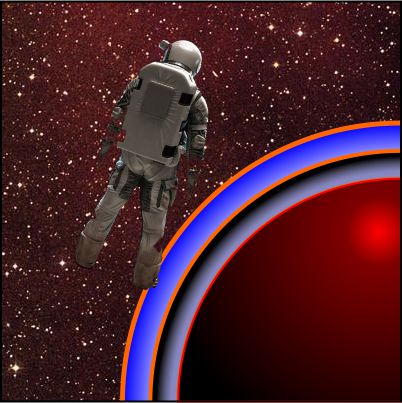
“The Roche Radius, the Photon Sphere and the Firewall.  Got your armor on, Jeremy?”Astronaut and 3xBlack hole

“Ready, Mr Moire.”

“Stand up.  The Roche effect is all about gravitational discrepancy between two points.  The two meter distance between your head and feet isn’t enough for a perceptible difference in downward pull.  However, when we deal with astronomical distances the differences can get significant.  For instance, ocean water on the day side of Earth is closer to the Sun and experiences a stronger sunward pull than water on the night side.”

“Ah, so that’s why we get tides.”

“Right.  Sit, sit, sit.  So in 1849 Édouard Roche wondered how close two objects could get until tidal forces pulled one of them apart.  He supposed the two objects were both just balls of rocks or fluid held together by gravity.  Applying Newton’s Laws and some approximations he got a formula for threshold distance in terms of the big guy’s mass and the little guy’s density.  Suppose you’re held together only by gravity and you’re nearing the Sun feet-first.  Its mass is 2×1030 kg/m³.  Even including your space armor, your average density is about 1.5 kg/m³.  According to Roche’s formula, if you got closer than 8.6×10⁶ kilometers your feet would break away and fall into the Sun before the rest of you would.  Oh, that distance is about 1/7 the radius of Mercury’s orbit so it’s pretty close in.”

“But we’re talking black holes here.  What if the Sun collapses to a black hole?”

“Surprisingly, it’s exactly the same distance.  The primary’s operative property is its mass, not its diameter.  Good thing Jeremy’s really held together by atomic and molecular electromagnetism, which is much stronger than gravity.  Which brings us to his second Peril, the dreaded Photon Sphere.”

“Should I shudder, Sy?”

“Go ahead, Jennie.  The Sphere is another mathematical object, not something physical you’d collide with, Jeremy.  It’s a zero-thickness shell representing where electromagnetic waves can orbit a massive object like a black hole or a neutron star.  Waves can penetrate the shell easily in either direction, but if one happens to fly in exactly along a tangent, it’s trapped on the Sphere.”

“That’s photons.  Why is it a peril to me?”

“Remember that electromagnetism that holds you together?  Photons carry that force.  Granted, in a molecule they’re standing waves rather than the free waves we see with.  The math is impossible, but here’s the Peril.  Suppose one of your particularly important molecules happens to lie tangent to the Sphere while you’re traversing it.  Suddenly, the forces holding that molecule together fly away from you at the speed of light.  And that disruption inexorably travels along your body as you proceed on your Quest.”

[both shudder]

~~ Rich Olcott

The Thin Edge of Infinity

Late in the day, project’s half done but it’s hungry time.  I could head home for a meal and drive back, but instead I board the elevator down to Eddie’s Pizza on the second floor.  The door opens on 8 and Jeremy gets on, with a girl.

“Oh, hi, Mr. Moire.  Didja see I hit a triple in the last game?  What if the Sun became a black hole?  This is that English girl I told you about.”

“Hello, Jennie.”

“Wotcha, Sy.”

“You know each other?”

“Ra-ther.  He wrote me into his blog a year ago.  You were going on about particles then, right, Sy?”

“Right, Jennie, but that was particles confined in atoms.  Jeremy’s interested in larger prey.”

“So I hear.”

The elevator lets us out at Eddie’s place.  We luck into a table, order and resume talking.  I open with, “What’s a particle?”

“Well, Sy, your post with Jeremy says it’s an abstract point with a minimal set of properties, like mass and charge, in a mathematical model of a real object with just that set of properties.”

“Ah, you’ve been reading my stuff.  That simplifies things.  So when can we treat a black hole like a particle?  Did you see anything about that in my archives, Jennie?”

“The nearest I can recall was Professor ‘t Hooft’s statement.  Ermm… if the Sun’s so far away that we can calculate planetary orbits accurately by treating it as a point, then we’re justified in doing so.”

“And if the Sun were to suddenly collapse to a black hole?”

“It’d be a lot smaller, even more like a point.  No change in gravity then.  But wouldn’t Earth be caught up in relativity effects like space compression?’

“Not unless you’re really close.  Space compression around a non-rotating (Schwarzchild) black hole scales by a factor that looks like Schwarzchild factor, where D is the object’s diameter and d is your distance from it.  Suppose the Sun suddenly collapsed without losing any mass to become a Schwarzchild object.  The object’s diameter would be a bit less than 4 miles.  Earth is 93 million miles from the Sun so the compression factor here would be [poking numbers into my smartphone] 1.000_000_04.  Nothing you’d notice.  It’d be 1.000_000_10 at Mercury.  You wouldn’t see even 1% compression until you got as close as 378 miles, 10% only inside of 43 miles.  Fifty percent of the effect shows up in the last 13 miles.  The edge of a black hole is sharper than this pizza knife.”Knife-edges
“How about if it’s spinning?  Ms Plenum referred me to a reading about frame-dragging.”

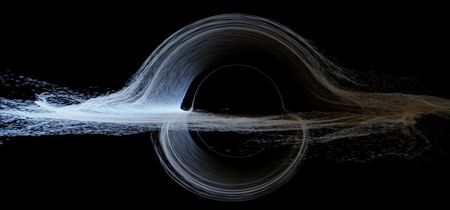
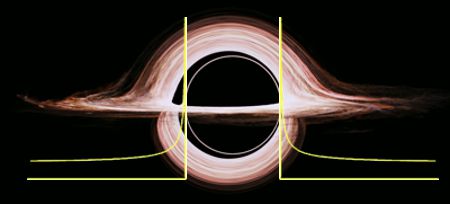
“Ah, Jeremy, you’re thinking of Gargantua, the Interstellar movie’s strangely lopsided black hole.  I just ran across this report by Robbie Gonzalez.  He goes into detail on why the image is that way, and why it should have looked more like this picture.  Check out the blueshift on the left and the shift into the infra-red on the right.”

better Gargantua
A more accurate depiction of Gargantua.  Image from
James, et al., Class. Quantum Grav. 32 (2015) 065001 (41pp),
licensed under CC BY-NC-ND 3.0

[both] “Awesome!”

“So it’s the spin making the weirdness then, Sy?”

“Yes, ma’am.  If Gargantua weren’t rotating, then the space around it would be perfectly spherical.  As Gonzalez explains, the movie’s plotline needed an even more extreme spacetime distortion than they could get from that.  Dr Kip Thorne, their physics guru, added more by spinning his mathematical model nearly up to the physical limit.”

“I’ll bite, Mr Moire.  What’s the limit?”

“Rotating so fast that points on the equator would be going at lightspeed.  Can’t do that.  Anyhow, extreme spin alters spacetime distortion, which goes from spherical to pumpkin-shaped with a twist.  The radial scaling changes form, too, from Schwarzchild factor to Kerr factorA is proportional to spin.  When A is small (not much spin) or the distance is large those A/d² terms essentially vanish relative to the others and the scaling looks just like the simple almost-a-point Schwarzchild case.  When A is large or the distance is small the A/d² terms dominate top and bottom, the factor equals 1 and there’s dragging but no compression.  In the middle, things get interesting and that’s where Dr Thorne played.”

“So no relativity jolt to Earth.”

“Yep.”

“Here’s your pizzas.”

“Thanks, Eddie.”

[sounds of disappearing pizza]

~~ Rich Olcott

A Matter of Perspective

As I stepped off the escalator by the luggage carousel a hand came down heavy on my shoulder.

“Keep movin’, I gotchur bag.”

That’s Vinnie, always the surprises.  I didn’t bother to ask how he knew which flight I came in on.  What came next was also no surprise.

“You owe me for the pizza.  Now about that kinetic energy –”

“Hold that thought ’til we get to my office where I can draw diagrams.”

We got my car out of the lot, drove to the Acme Building and took the elevator to 12.

As my computer booted up I asked, “When we talked about potential energy, did we ever mention inertial frames?”

“Come to think of it, no, we didn’t.  How come?”

“Because they’ve got nothing to do with potential energy.  Gravitational and electrical potentials are all about intensity at one location in space relative to other locations in space.  The potentials are static so long as the configuration is static.  If something in the region changes, like maybe a mass moves or the charge on one object increases, then the potential field adjusts to suit.”

“Right, kinetic energy’s got to do with things that move, like its name says.  I get that.  But how does it play into LIGO?”

“Let’s stick with our spacecraft example for a bit.  I’ve been out of town for a while, so a quick review’s in order.  Objects that travel in straight lines and constant speed with respect to each other share the same inertial frame.  Masses wrinkle the shape of space.  The paths light rays take are always the shortest possible paths, so we say a light ray shows us what a straight line is.

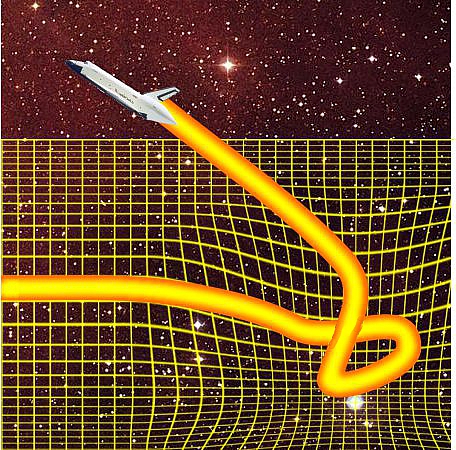
“In our story, we’re flying a pair of space shuttles using identical speed settings along different light-ray navigation beams.  Suddenly you encounter a region of space that’s compressed, maybe by a nearby mass or maybe by a passing gravitational wave.

“That compressed space separates our inertial frames.  In your inertial frame there’s no effect — you’re still following your nav beam and the miles per second you measure hasn’t changed.  However, from my inertial frame you’ve slowed down because the space you’re traveling through is compressed relative to mine.  Does all that ring a bell?”

“Pretty much the way I remember it. Now what?”shuttle-escape-framed

“Do you remember the formula for kinetic energy?”

“Give me a sec… mass times the square of the velocity.”

“Uh-huh.  Mind you, ‘velocity’ is the combination of speed and direction but velocity-squared is just a number.  So, your kinetic energy depends in a nice, simple way on speed.  What happened to your kinetic energy when you encountered that gravity well?”

“Ah, now I see where you’re going.  In my frame my speed doesn’t change so I don’t gain or lose kinetic energy.  In your frame you see me slow down so you figure me as losing kinetic energy.”

“But the Conservation of Energy rule holds across the Universe.  Where’d your kinetic energy go?”

“Does your frame see me gaining potential energy somehow that I don’t see in mine?”

“Nice try, but that’s not it.  We’ve already seen that potential energy doesn’t depend on frames.  What made our frames diverge in the first place?”

“That gravity field curving the space I’d flown into.  Hey, action-reaction!  If the curved space slowed me down, did I speed it up?”

“Now we’re getting there.  No, you didn’t speed up space, ’cause space doesn’t work that way — the miles don’t go anywhere.  But your kinetic energy (that I can see and you can’t) did act to change the spatial curvature (that I can see and you can’t).  I suspect the curvature flattened out, but the math to check that is beyond me.”

“Lemme think…  Right, so back to my original question — what I wasn’t getting was how I could lose both kinetic energy AND potential energy flying into that compressed space.  Lessee if I got this right.  We both see I lost potential energy ’cause I’ve got less than back in flat space.  But only you see that my kinetic energy changed the curvature that only you see.  Good?”

“Good.”

(sound of footsteps)

(sound of door)

“Don’t mention it.”

~~ Rich Olcott

Ya got potential, kid, but how much?

Dusk at the end of January, not my favorite time of day or year.  I was just closing up the office when I heard a familiar footstep behind me.  “Hi, Vinnie.  What’s up?”

“Energy, Sy.”

“Energy?”

“Energy and LIGO.  Back in flight school we learned all about trading off kinetic energy and potential energy.  When I climb I use up the fuel’s chemical energy to gain gravitational potential energy.  When I dive I convert gravitational potential energy into  kinetic energy ’cause I speed up.  Simple.”

“So how do you think that ties in with LIGO?”

“OK, back when we pretended we was in those two space shuttles (which you sneaky-like used to represent photons in a LIGO) and I got caught in that high-gravity area where space is compressed, we said that in my inertial frame I’m still flying at the same speed but in your inertial frame I’ve slowed down.”

“Yeah, that’s what we worked out.”

“Well, if I’m flying into higher gravity, that’s like diving, right, ’cause I’m going where gravity is stronger like closer to the Earth, so I’m losing gravitational potential energy.  But if I’m slowing down I’ve gotta be losing kinetic energy, too, right?  So how can they both happen?  And how’s it work with photons?”

“Interesting questions, Vinnie, but I’m hungry.  How about some dinner?”shuttle-escape-1

We took the elevator down to Eddie’s pizza joint on the second floor.  I felt heavier already.  We ordered, ate and got down to business.

“OK, Vinnie.  Energy with photons is different than with objects that have mass, so let’s start with the flying-objects case.  How do you calculate gravitational potential energy?”

“Like they taught us in high school, Sy, ‘little g’ times mass times the height, and ‘little g’ is some number I forget.”

“Not a problem, we’ll just suppose that ‘little g’ times your plane’s mass is some convenient number, like 1,000.  So your gravitational potential energy is 1000×height, where the height’s in feet and the unit of energy is … call it a fidget.  OK?”

“Saves having to look up that number.”

sfo-to-den
Vinnie’s route, courtesy of Google Earth

“Fine.  Let’s suppose you’re flying over San Francisco Bay and your radar altimeter reads 20,000 feet.  What’s your gravitational potential energy?”

“Uhh… twenty million fidgets.”

“Great.  You maintain level flight to Denver.  As you pass over the Rockies you notice your altimeter now reads 6,000 feet because of that 14,000-foot mountain you’re flying over.  What’s your gravitational potential energy?”

“Six million fidgets.  Or is it still twenty?”

“Well, if God forbid you were to drop out of the sky, would you hit the ground harder in California or Colorado?”

“California, of course.  I’d fall more than three times as far.”

“So what you really care about isn’t some absolute amount of potential energy, it’s the relative amount of smash you experience if you fall down this far or that far.  ‘Height’ in the formula isn’t some absolute height, it’s height above wherever your floor is.  Make sense?”

“Mm-hm.”

“That’s an essential characteristic of potential energy — electric, gravitational, chemical, you name it.   It’s only potential.  You can’t assign a value without stating the specific transition you’re interested in.  You don’t know voltages in a circuit until you put a resistance between two specific points and meter the current through it.  You don’t know gravitational potential energy until you decide what location you want to compare it with.”

“And I suppose a uranium atom’s nuclear energy is only potential until a nuke or something sets it off.”

“You got the idea.  So, when you flew into that high-gravity compressed-space sector, what happened to your gravitational potential energy?”

“Like I said, it’s like I’m in a dive so I got less, right?”

“Depends on what you’re going to fall onto, doesn’t it?”

“No, wait, it’s definitely less ’cause I gotta use energy to fly back out to flat space.”

“OK, you’re comparing here to far away.  That’s legit.  But where’s that energy go?”

“Ahh, you’re finally getting to the kinetic energy side of my question –”

“Whoa, look at the time!  Got a plane to catch.  We’ll pick this up next week.  Bye.”

“Hey, Sy, your tab! …  Phooey, stuck for it again.”

~~ Rich Olcott