Tiramisu And Gemstones

“Sis, you say there’s dessert?”

“Of course there is, Sy. Teena, please bring in the tray from the fridge.”

“Tiramisu! You did indeed go above and beyond. Thank you, Teena. Your Mom’s question must be a doozey.”

“I’ll let you enjoy a few spoonfulls before I hit you with it.” <minutes with spoon noises and yumming> “Okay. tell me about entanglement.”

“Whoa! What brought that on?”

“I’ve seen the word bandied about in the popular science press—”

“And pseudoscience—”

“Well, yes. I’m writing something where the notion might come in handy if it makes sense.”

“How can you tell what’s pseudoscience?”

“Good question, Teena. I look for gee-whiz sentences, especially ones that include weasely words like ‘might‘ and ‘could.’ Most important, does the article make or quote big claims that can’t be disproven? I’d want to see pointers to evidence strong enough to match the claims. A respectable piece would include comments from other people working in the same field. Things like that.”

“What your Mom said, and also has the author used a technical term like ‘energy‘ or ‘quantum‘ but stretched it far away from its home base? Usually when they do that and you have even an elementary idea what the term really means, it’s pretty clear that the author doesn’t understand what they’re writing about. That goes double for a lot of what you’ll see on YouTube and social media in general. It’s just so easy to put gibberish up there because there’s no‑one to contradict a claim, or if there is, it’s too late because the junk has already spread. ‘Entanglement‘ is just the latest buzzword to join the junk‑science game.”

“So what can you tell us about entanglement that’s non‑junky?”

“First thing is, it’s strictly a microscopic phenomenon, molecule‑tiny and smaller. Anything you read about people or gemstones being entangled, you can stop reading right there unless it’s for fun.”

“Weren’t Rapunzel and the prince entangled?

“They and all the movie’s other characters were tangled up in the story, yes, but that’s not the kind of entanglement your Mom’s asking about. This kind seems to involve something that Einstein called ‘spooky action at a distance‘. He didn’t like it.”

“‘Seems to‘?”

“Caught me, Sis, but it’s an important point. You make a system do something by acting on it, right? We’re used to actions where force is transmitted by direct contact, like hitting a ball with a bat. We’ve known how direct contact works with solids and fluids since Newton. We’ve extended the theory to indirect contact via electric and other fields thanks to Maxwell and Einstein and a host of other physicists. ‘Action at a distance‘ is about making something happen without either direct or indirect contact and that’s weird.”

“Can you give us an example?”

“How about an entanglement story? Suppose there’s a machine that makes coins, nicely packaged up in gift boxes. They’re for sweethearts so it always makes the coins in pairs, one gold and one silver. These are microscopic coins so quantum rules apply — every coin is half gold and half silver until its box is opened, at which point it becomes all one pure metal.”

“Like Schrödinger’s asleep‑awake kitty‑cat!”

“Exactly, Teena. So Bob buys a pair of boxes, keeps one and gives the other to Alice before he flies off in his rocket to the Moon. Quantum says both coins are both metals. When he lands, he opens his box and finds a silver coin. What kind of coin does Alice have?”

“Gold, of course.”

“For sure. Bob’s coin‑checking instantly affected Alice’s coin a quarter‑million miles away. Spooky, huh?”

“But wait a minute. Alice’s coin doesn’t move. It’s not like Bob pushed on it or anything. The only thing that changed was its composition.”

“Sis, you’ve nailed it. That’s why I said ‘seems to‘. Entanglement’s not really action at a distance. No energy or force is exerted, it’s simply an information thing about quantum properties. Which, come to think of it, is why there’s no entanglement of people or gemstones. Even a bacterium has billions and billions of quantum‑level properties. Entanglement‑tweaking one or two or even a thousand atoms won’t affect the object as a whole.”

~~ Rich Olcott

The Frame Game

A familiar footstep outside my office, “C’mon in, Vinnie, the door’s open.”

“Hi, Sy, how ya doin’?”

“Can’t complain. Yourself?”

“Fine, fine. Hey, I been thinking about something you said while Al and us were talking about rockets and orbits and such. You remember that?”

“We’ve done that in quantity. What statement in particular?”

“It was about when you’re in the ISS, you still see like 88% of Earth’s gravity. But I seen video of those astronauts just floating around in the station. Seems to me those two don’t add up.”

“Hah! We’re talking physics of motion here. What’s the magic word?”

“You’re saying it’s frames? I thought black holes did that.”

“Black holes are an extreme example, but frame‑thinking is an essential tool in analyzing any kind of relative motion. Einstein’s famous ‘happy thought‘ about a man in a free‑falling elevator—”

“Whoa, why is that a happy thought? I been nervous about elevators ever since that time we got stuck in one.”

“At least it wasn’t falling, right? Point is, the elevator and whoever’s in it agree that Newton’s First Law of Motion is valid for everything they see in there.”

“Wait, which Law is that?”

“‘Things either don’t move or else they move at a steady pace along a straight line.’ Suppose you’re that guy—”

“I’d rather not.”

“… and the elevator is in a zero‑gravity field. You take something out of your pocket, put it the air in front of you and it stays there. You give it a tap and it floats away in a straight line. Any different behavior means that your entire frame — you, the elevator and anything else in there — is being accelerated by some force. Let’s take two possibilities. Case one, you and the elevator are resting on terra firma, tightly held by the force of gravity.”

“I like that one.”

“Case two, you and the elevator are way out in space, zero‑gravity again, but you’re in a rocket under 1-g acceleration. Einstein got happy because he realized that you’d feel the same either way. You’d have no mechanical way to distinguish between the two cases.”

“What’s that mean, mechanical?”

“It excludes sneaky ways of outside influence by magnetic fields and such. Anyhow, Einstein’s insight was key to extending Newton’s First Law to figuring acceleration for an entire frame. Like, for instance, an orbiting ISS.”

“Ah, you’re saying that floating astronauts in an 88% Earth-gravity field is fine because the ISS and the guys share the frame feeling that 88% but the guys are floating relative to that frame. But down here if we could look in there we’d see how both kinds of motion literally add up.”

“Exactly. It’s just much easier to think about only one kind at a time.”

“Wait. You said the ISS is being accelerated. I thought it’s going a steady 17500 miles an hour which it’s got to do to stay 250 miles up.”

“Is it going in a straight line?”

“Well, no, it’s going in a circle, mostly, except when it has to dodge some space junk.”

“So the First Law doesn’t apply. Acceleration is change in momentum, and the ISS momentum is constantly changing.”

“But it’s moving steady.”

“But not in a straight line. Momentum is a vector that points in a specific direction. Change the direction, you change the momentum. Newton’s Second Law links momentum change with force and acceleration. Any orbiting object undergoes angular acceleration.”

“Angular acceleration, that’s a new one. It’s degrees per second per second?”

“Yup, or radians. There’s two kinds, though — orbiting and spinning. The ISS doesn’t spin because it has to keep its solar panels facing the Sun.”

“But I’ve seen sci-fi movies set in something that spins to create artificial gravity. Like that 2001 Space Odyssey where the guy does his running exercise inside the ship.”

“Sure, and people have designed space stations that spin for the same reason. You’d have a cascade of frames — the station orbiting some planet, the station spinning, maybe even a ballerina inside doing pirouettes.”

“How do you calculate all that?”

“You don’t. You work with whichever frame is useful for what you’re trying to accomplish.”

“Makes my head spin.”

~~ Rich Olcott
Making Things Simpler

“How about a pumpkin spice gelato, Mr Moire?”

“I don’t think so, Jeremy. I’m a traditionalist. A double‑dip of pistachio, please.”

“Coming right up, sir. By the way, I’ve been thinking about the Math poetry you find in the circular and hyperbolic functions. How about what you’d call Physics poetry?”

“Sure. Starting small, Physics has symmetries for rhymes. If you can pivot an experiment or system through some angle and get the same result, that’s rotational symmetry. If you can flip it right‑to‑left that’s parity symmetry. I think of a symmetry as like putting the same sound at the end of each line in rhymed verse. Physicists have identified dozens of symmetries, some extremely abstract and some fundamental to how we understand the Universe. Our quantum theory for electrons in atoms is based on the symmetries of a sphere. Without those symmetries we wouldn’t be able to use Schrodinger’s equation to understand how atoms work.”

“Symmetries as rhymes … okaaayy. What else?”

“You mentioned the importance of word choice in poetry. For the Physics equivalent I’d point to notation. You’ve heard about the battle between Newton and Leibniz about who invented calculus. In the long run the algebraic techniques that Leibniz developed prevailed over Newton’s geometric ones because Leibniz’ way of writing math was far simpler to read, write and manipulate — better word choice. Trying to read Newton’s Principia is painful, in large part because Euler hadn’t yet invented the streamlined algebraic syntax we use today. Newton’s work could have gone faster and deeper if he’d been able to communicate with Euler‑style equations instead of full sentences.”

“Oiler‑style?”

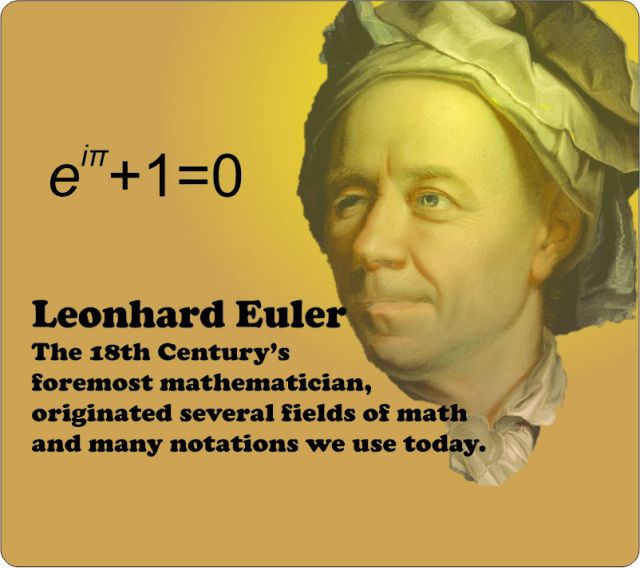
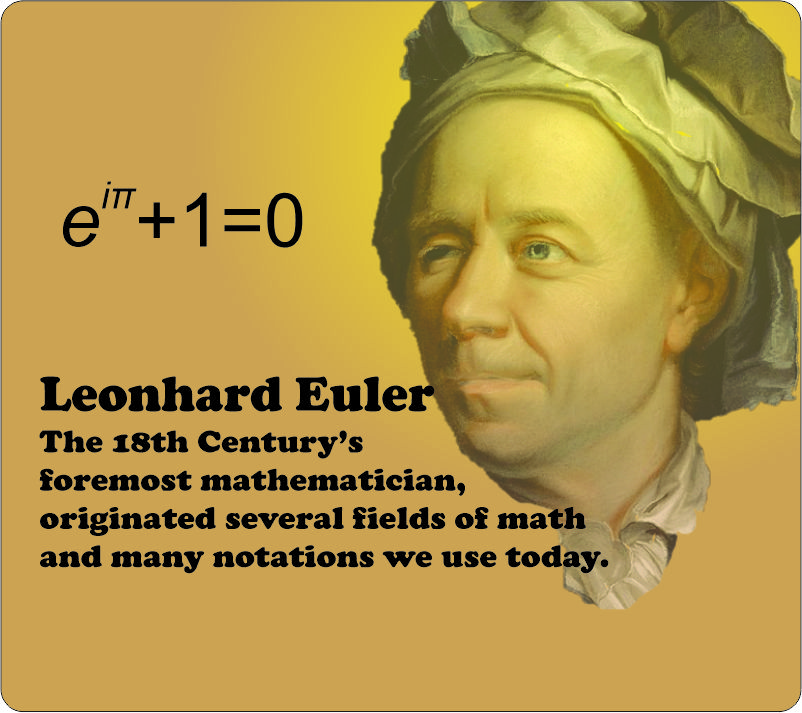
“Leonhard Euler, though it’s pronounced like ‘oiler‘. Europe’s foremost mathematician of the 18th Century. Much better at math than he was at engineering or court politics — both the Russian and Austrian royal courts supported him but they decided the best place for him was the classroom and his study. But while he was in there he worked like a fiend. There was a period when he produced more mathematics literature than all the rest of Europe. Descartes outright rejected numbers involving ‑1, labeled them ‘imaginary.’ Euler considered ‑1 a constant like any other, gave it the letter i and proceeded to build entire branches of math based upon it. Poor guy’s vision started failing in his early 30s — I’ve often wondered whether he developed efficient notational conventions as a defense so he could see more meaning at a glance.”

“He invented all those weird squiggles in Math and Physics books that aren’t even Roman or Greek letters?”

“Nowhere near all of them, but some important ones he did and he pointed the way for other innovators to follow. A good symbol has a well‑defined meaning, but it carries a load of associations just like words do. They lurk in the back of your mind when you see it. π makes you think of circles and repetitive function like sine waves, right? There’s a fancy capital‑R for ‘the set of all real numbers‘ and a fancy capital‑Z for ‘the set of all integers.’ The first set is infinitely larger than the second one. Each symbol carries implications abut what kind of logic is valid nearby and what to be suspicious of. Depends on context, of course. Little‑c could be either speed‑of‑light or a triangle’s hypotenuse so defining and using notation properly is important. Once you know a symbol’s precise meaning, reading an equation is much like reading a poem whose author used exactly the right words.”

“Those implications help squeeze a lot of meaning into not much space. That’s the compactness I like in a good poem.”

“It’s been said that a good notation can drive as much progress in Physics as a good experiment. I’m not sure that’s true but it certainly helps. Much of my Physics thinking is symbol manipulation. Give me precise and powerful symbols and I can reach precise and powerful conclusions. Einstein turned Physics upside down when he wrote the thirteen symbols his General Relativity Field Equation use. In his incredibly compact notation that string of symbols summarizes sixteen interconnected equations relating mass‑energy’s distribution to distorted spacetime and vice‑versa. Beautiful.”

“Beautiful, maybe, but cryptic.”

~~ Rich Olcott

Math Poetry

Eddie serves a good pizza. I amble over to the gelato stand for a chaser. “Evening, Jeremy. You’re looking a little distraught.”

“I am, Mr Moire. Just don’t ask me to quantify it! Math is getting me down. Why do they shove so much of it at us? You don’t put much math into your posts and they make sense mostly.”

“Thanks for the mostly. … Do you enjoy poetry?”

“Once I read some poems I liked. Except in English class. They spend too much time classifying genre and rhyme scheme instead of just looking at what the poet wrote. All that gets in the way.”

“Interesting. What is it that you like about poetry?”

“Mmm, part of it is how it can imply things without really saying them, part of it is how compact a really good one is. I like when they cram the maximum impact into the fewest possible words — take out one word and the whole thing falls apart. That’s awesome when it works.”

“Well, how does it work?”

“Oh, there’s lots of techniques. Metaphor’s a biggie — making one thing stand for something else. Word choice, too — an unexpected word or one with several meanings. Sometimes it’s a challenge finding the word that has just the right rhythm and message.”

“Ah, you write, too. When you compose something, do you use English or Navajo?”

“Whichever fits my thought better. Each language is better at some things, worse at others. A couple of times I’ve used both together even though only rez kids would understand the mix.”

“Makes sense. You realize, of course, that we’ve got a metaphor going here.”

“We do? What standing for what?”

“Science and Poetry. I’ve often said that Physics is poetry with numbers. Math is as much a language as English and Navajo. It has its own written and spoken forms just like they do and people do poetry with it. Like them, it’s precise in some domains and completely unable to handle others. Leaning math is like learning a very old language that’s had time to acquire new words and concepts. No wonder learning it is a struggle.”

“Poetry in math? That’s a stretch, Mr Moire.”

“Prettiest example I can think of quickly is rhyming between the circular and hyperbolic trigonometric systems. The circular system’s based on the sine and cosine. The tangent and such are all built from them.”

“We had those in class — I’ll remember ‘opposite over hypotenuse‘ forever and I got confused by all the formulas — but why do you call them circular and what’s ‘hyperbolic‘ about?”

“Here, let me use Ole Reliable to show you some pictures. I’m sure you recognize the wavy sine and cosine graphs in the circular system. The hyperbolic system is also based on two functions, ‘hyperbolic sine‘ and ‘hyperbolic cosine,’ known in the trade as ‘sinh‘ and ‘cosh.’ They don’t look very similar to the other set, do they?”

“Sure don’t.”

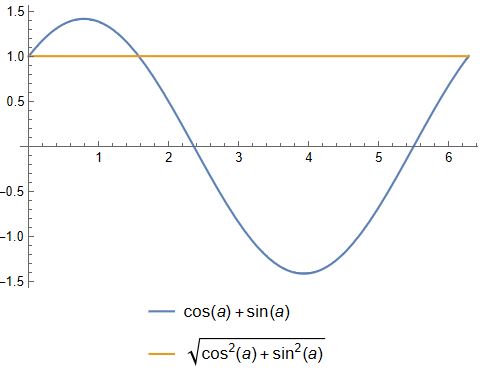
“But for every circular function and formula there’s a hyperbolic partner. Now watch what happens when we combine a sine and cosine. I’ll do it two ways, a simple sum and the Pythagorean sum.”

“Pythagorean?”

“Remember his a2+b2=c2? The orange curve comes from that, see in the legend underneath?”

“Oh, like a right triangle’s hypotenuse. But the orange curve is just a flat straight line.”

“True, as we’ve known since Euler’s day. Are you familiar with polar coordinates?”

“A little. There’s a center, one coordinate is distance from the center, and the other coordinate is the angle you’ve rotated something, right?”

“Good enough. Here’s what the same two combinations look like in polar coordinates..”

“Wow. Two circles. I never would have guessed that.”

“Mm-hm. Check the orange circle, the one that was just a level straight line on the simple graph. It’s centered on the origin. That tells us the sum of the squares is invariant, doesn’t change with the angle.”

“Do the hyperbolic thingies make hyperbolas when you add them that way?”

“Not really, just up-curving lines. The plots for their differences are interesting though. For these guys the Pythagorean difference is invariant. Einstein’s relativity is based on that property.”

“Pretty, like you say.”

~~ Rich Olcott

Imagine A Skyrocket Inside A Black Hole

Vinnie’s never been a patient man. “We’re still waiting, Sy. What’s the time-cause-effect thing got to do with black holes and information?”

“You’ve got most of the pieces, Vinnie. Put ’em together yourself.”

“Geez, I gotta think? Lessee, what do I know about black holes? Way down inside there’s a huge mass in a teeny singularity space. Gravity’s so intense that relativity theory and quantum mechanics both give up. That can’t be it. Maybe the disk and jets? No, ’cause some holes don’t have them, I think. Gotta be the Event Horizon which is where stuff can’t get out from. How’m I doing, Sy?”

“You’re on the right track. Keep going.”

“Okay, so we just talked about how mass scrambles spacetime, tilts the time axis down to point towards where mass is so axes stop being perpendicular and if you’re near a mass then time moves you even closer to it unless you push away and that’s how gravity works. That’s part of it, right?”

“As rain. So mass and gravity affect time, then what?”

“Ah, Einstein said that cause‑and‑effect runs parallel with time ’cause you can’t have an effect before what caused it. You’re saying that if gravity tilts time, it’ll tilt cause‑and‑effect?”

“So far as we know.”

“That’s a little weasel-ish.”

“Can’t help it. The time‑directed flow of causality is a basic assumption looking for counter‑examples. No‑one’s come up with a good one, though there’s a huge literature of dubious testimonials. Something called a ‘closed timelike curve‘ shows up in some solutions to Einstein’s equations for extreme conditions like near or inside a black hole. Not a practical concern at our present stage of technology — black holes are out of reach and the solutions depend on weird things like matter with negative mass. So anyhow, what happens to causality where gravity tilts time?”

“I see where you’re going. If time’s tilted toward the singularity inside a black hole, than so is cause‑and‑effect. Nothing in there can cause something to happen outside. Hey, bring up that OVR graphics app on Old Reliable, I’ll draw you a picture.”

“Sure.”

“See, way out in space here this circle’s a frame where time, that’s the red line, is perpendicular to the space dimensions, that’s the black line, but it’s way out in space so there’s no gravity and the black line ain’t pointing anywhere in particular. Red line goes from cause in the middle to effect out beyond somewhere. Then inside the black hole here’s a second frame. Its black line is pointing to where the mass is and time is tilted that way too and nothing’s getting away from there.”

“Great. Now add one more frame right on the border of your black hole. Make the black line still point toward the singularity but make the red line tangent to the circle.”

“Like this?”

“Perfect. Now why’d we put it there?”

“You’re saying that somewhere between cause-effect going wherever and cause-effect only going deeper into the black hole there’s a sweet spot where it doesn’t do either?”

“Exactly, and that somewhere is the Event Horizon. Suppose we’re in a mothership and you’re in our shuttlecraft in normal space. You fire off a skyrocket. Both spacecraft see sparks going in every direction. If you dive below an Event Horizon and fire another skyrocket, in your frame you’d see a normal starburst display. If we could check that from the mothership frame, we’d see all the sparks headed inward but we can’t because they’re all headed inward. All the sparkly effects take place closer in.”

“How about lighting a firework on the Horizon?”

“Good luck with that. Mathematically at least, the boundary is infinitely thin.”

“So bottom line, light’s trapped inside the black hole because time doesn’t let the photons have an effect further outward than they started. Do I have that right?”

“For sure. In fact, you can even think of the hole as an infinite number of concentric shells, each carrying a causality sign reading ‘Abandon hope, all ye who enter here‘. So what’s that say about information?”

“Hah, we’re finally there. Got it. Information can generate effects. If time can trap cause‑effect, then it can trap information, too.”

~~ Rich Olcott

Tilting at Black Holes

“What’s the cause-effect-time thing got to do with black holes and information?”

“We’re getting there, Al. What happens to spacetime near a black hole?”

“Everybody knows that, Sy, spacetime gets stretched and squeezed until there’s infinite time dilation at the Event Horizon.”

“As usual, Vinnie, what everybody knows isn’t quite what is. Yes, Schwarzschild’s famous solution includes that Event Horizon infinity but it’s an artifact of his coordinate system. Al, you know about coordinate systems?”

“I’m a star-watcher, Sy. Sure, I know about latitude and longitude, declination and right ascension, all that stuff no problem.”

“Good. Well, Einstein wrote his General Relativity equations using generalized coordinates, like x,y,z but with no requirement that they be straight lines or at right angles. Schwarzschild solved the equations for a non‑rotating sphere so naturally he used spherical coordinates — radius, latitude and longitude. Since then other people have solved the equations for more complicated cases using more complicated coordinate systems. Their solutions don’t have that infinity.”

“No infinity?”

“Not that one, anyhow. The singularity at the hole’s geometric center is a real thing, not an artifact. So’s a general Event Horizon, but it’s not quite where Schwarzschild said it should be and it doesn’t have quite the properties that everybody thinks they know it has. It’s still weird, though.”

“How so?”

“First thing you have to understand is that when you get close to a black hole, you don’t feel any different. Except for the spaghettification, of course.”

“It’s frames again, ain’t it?”

“With black holes it’s always frames, Vinnie. If you’re living in a distorted space you won’t notice it. Whirl a meter‑long sword around, you’d always see it as a meter long. A distant observer would see you and everything around you as being distorted right along with your space. They’ll see that sword shrink and grow as it passes through different parts of the distortion.”

“Weird.”

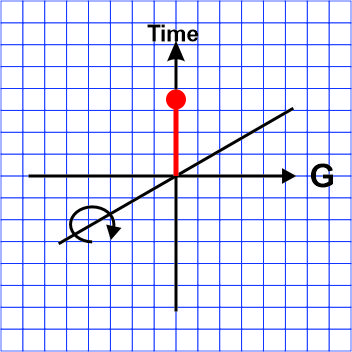
“We’re just getting started, Al. Time’s involved, too. <grabbing a paper napkin and sketching> Here’s three axes, just like x,y,z except one’s time, the G one points along a gravity field, and the third one is perpendicular to the other two. By the way, Al, great idea, getting paper napkins printed like graph paper.”

“My location’s between the Physics and Astronomy buildings, Sy. Gotta consider my clientele. Besides, I got a deal on the shipment. What’s the twirly around that third axis?”

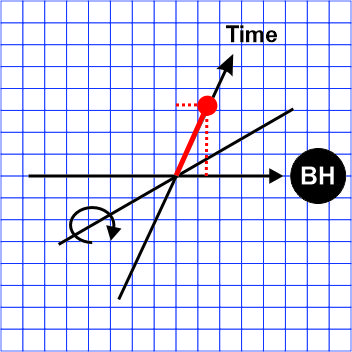
“It’s a reminder that there’s a couple of space dimensions that aren’t in the picture. Now suppose the red ball is a shuttlecraft on an exploration mission. The blue lines are its frame. The thick vertical red line shows it’s not moving because there’s no spatial extent along G. <another paper napkin, more sketching> This second drawing is the mothership’s view from a comfortable distance of the shuttlecraft near a black hole.”

“You’ve got the time axis tilted. What’s that about?”

“Spacetime being distorted by the black hole. You’ve heard Vinnie and me talk about time dilation and space compression like they’re two different phenomena. Thing is, they’re two sides of the same coin. On this graph that shows up as time tilted to mix in with the BH direction.”

“How about those twirly directions?”

“Vinnie, you had to ask. In the simple case where everything’s holding still and you’re not too close to the black hole, those two aren’t much affected. If the big guy’s spinning or if the Event Horizon spans a significant amount of your sky, all four dimensions get stressed. Let’s keep things simple, okay?”

“Fine. So the time axis is tilted, so what?”

“We in the distant mothership see the shuttlecraft moving along pure tilted time. The shuttlecraft doesn’t. The dotted red lines mark its measurements in its blue‑line personal frame. Shuttlecraft clocks run slower than the mothership’s. Worse, it’s falling toward the black hole.”

“Can’t it get away?”

“Al, it’s a shuttlecraft. It can just accelerate to the left.”

“If it’s not too close, Vinnie. The accelerative force it needs is the product of both masses, divided by the distance squared. Sound familiar?”

“That’s Newton’s Law of Gravity. This is how gravity works?”

“General Relativity cut its teeth on describing that tilt.”

~~ Rich Olcott

Cause, Effect And Time

We’re still at Vinnie’s table by the door of Al’s coffee shop. “Long as we’re talking about black holes, Sy, I read in one of my astronomy magazines that an Event Horizon traps information the same way it traps light. I understand how gravity makes escape velocity for photons go beyond lightspeed, but how does that trap information?”

“Well, to start with, Al, you understand wrong. The whole idea of escape velocity applies to massive objects like rockets that feel the force of gravity. Going up they trade kinetic energy for potential energy; given enough kinetic energy they escape. Photons have zero mass — the only way gravity influences them is by bending the spacetime they fly through.”

“Does the bending also affect information or is that something else?”

Minkowski’s spacetime diagram…

“Fair question, but it’ll take some background to answer it. Good thing I’ve got Old Reliable and my graphics files along. Let’s start with this one. Vinnie’s seen a lot of spacetime graphs like this, Al, but I don’t think you have. Time runs upward, distance runs sideward, okay? Naming a specific time and location specifies an event, just like a calendar entry. Draw a line between two events; the slope is the speed you have to go to get from one to the other.”

“Just the distance, you’re not worrying about direction?”

“Good question. You’re thinking space is 3D and this picture shows only one space dimension. Einstein’s spacetime equations take account of all four dimensions mixing together, which is one reason they’re so hard to solve except in special cases. For where we’re going, distance will be enough, okay?”

“Not gonna argue.”

… compartmentalized by Einstein’s speed limit …

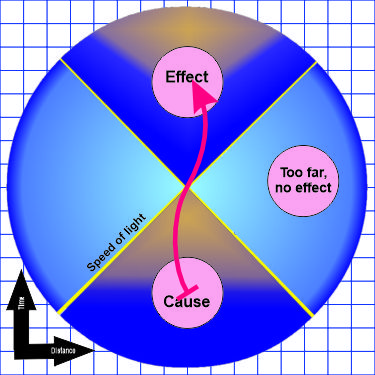
“Now we roll in Einstein’s speed limit. Relativity says that nothing can go faster than light. On a Minkowski diagram like this we draw the lightspeed slope at a 45″ angle. Any physical motion has a slope more vertical than that.”

“Huh?”

“See, Al, you’re going one second per second along time, right? If you’re not making much progress distance‑wise, you don’t do much on Sy’s sideways axis. You move mostly up.”

“Exactly, Vinnie. The bottom and top sections are called ‘timelike‘ because, well, they’re mostly like time.”

“Are the other two sections spacelike?”

“Absolutely. You can’t get from ‘Here & Now‘ to the ‘Too far to see‘ event without going faster than light. Einstein said that’s a no‑no. Suppose that event’s a nova, ‘Now‘ but far away. Astronomers will have to just wait until the nova’s light reaches them at ‘Here‘ but at a later ‘Now.’ Okay, Vinnie, here’s a graphic you haven’t seen yet.”

… and re-interpreted in terms of causality.

“Looks pretty much the same, except for that arrow. What’s cause and effect got to do with time?”

“I don’t want to get into the metaphysical weeds here. There’s a gazillion theories about time — the Universe is expanding and that drives time; entropy always increases and that drives time; time is an emergent property of the underlying structure of the Universe, whatever that means. From an atomic, molecular, mechanical physics point of view, time is the result of causes driving effects. Causes always come first. Your finger bleeds after you cut it, not before. Cause‑effect runs along the time axis. Einstein showed us that cause‑effect can’t travel any faster than lightspeed.”

“That’s a new one. How’d he figure that?”

“Objects move objects to make things happen. They can’t move faster than lightspeed because of the relativity factor.”

“What if the objects are already touching?”

“Your hand and that cup are both made of atoms and it’s really their electric fields that touch. Shifting fields are limited by lightspeed, too.”

“So you’re saying that cause-effect is timelike.”

“Got it in one. Einstein would say causality is not only timelike, but exactly along the time axis. That’s one big reason he was so uncomfortable about action at a distance — a cause ‘Here‘ having an effect ‘There‘ with zero time elapsed would be a horizontal line, pure spacelike, on Minkowski’s graph. Einstein invented the principle of entanglement as a counterexample, thinking it impossible. He’d probably be shocked and distressed to see that today we have experimental proof of entanglement.”

~~ Rich Olcott

In vacuo veritas?

“Let’s see if my notes are complete, Mr Moire. We’re crossed off two possible Universe finales — falling into a Big Crunch or expanding forever while making new matter between the galaxies to keep itself in a steady state. Or the Universe might expand to some critical density and then stay there but we mostly ruled that out because a twitch would push it to either crunching or expanding forever. Einstein’s Cosmological Constant might or might not be dark energy but either way, Friedmann’s equation predicts that the Universe will expand exponentially. Is that all the ways we could end?”

“Of course not, Jeremy. The far distant future’s like anything we humans don’t know much about, we make lots of guesses. Vacuum energy, for instance.”

“Anything to do with getting my roommate off the couch when it’s their turn to do the floors?”

“Very funny, but no. The notion of ‘vacuum‘ has a history. Aristotle said it’s empty space and that’s nothing and you can’t talk about nothing, but of course that’s exactly what he was doing. It wasn’t until Newton’s day that we developed dependable technologies for producing and investigating ‘nothing.’ Turns out that a good vacuum’s hard to find and even outer space is a lot busier than you might think.”

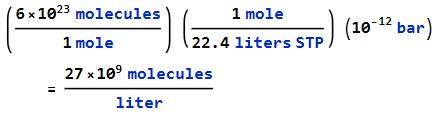
“Yeah, Jim in the Physics lab says he’s working with Ultra‑High Vacuum, a millionth of a millionth of an atmosphere, and the molecules left in the apparatus still cause problems.”

“Wonder how many molecules that is. Time for Old Reliable. <muttering> Avagadro’s Number, 22.4 liters, 10-12 atmospheres … Wow, there’s nearly 30 billion molecules per liter in his rig, a couple hundred times more if he chills it. <scrolling> This Wikipedia article says the solar wind runs only ten thousand protons per liter; interstellar medium’s about a tenth of that. But all those are physical vacuums. Theoretical vacuums are completely empty except they’re sort‑of not.”

“How could they be empty but not? Is that a Schrödinger joke?”

“No, but it does point up how the word has acquired multiple technical meanings. Newton’s concept of a vacuum was basically equivalent to Aristotle’s — simply a space with no matter in it. Two centuries later, Maxwell pointed the way to electric and magnetic fields which meant we needed to define a new vacuum with no such fields. Einstein added his proviso about the speed of light in a vacuum but that was okay. Then along came quantum and strings and several new kinds of vacuum.”

“Why would we need new definitions? Nothing’s nothing, isn’t it?”

“Not necessarily in theory, and that’s the point. For instance, you might use a Maxwell‑inspired theory to think about how a certain charged object behaves in a certain electromagnetic field. You can’t isolate the field’s effects unless you can add it to a theoretical space containing no objects or electromagnetic fields. Make sense?”

“And that’s a Maxwell vacuum? Seems reasonable. Then what?”

“Quantum theories go in the other direction. They start by assuming that Maxwellian vacuums can’t exist, that space itself continually produces virtual particles from their associated fields.”

“Um, conservation of mass?”

“Valid question. This may feel like dodging, but there’s math and experiment to back it up. What’s really conserved, we think, is mass‑energy. Particles, anti‑particles and energy fluctuations averaging to zero over finite time intervals. A dab of energy concentrated to create a particle’s mass? No problem, because that particle will be annihilated and release its energy equivalent almost immediately. To replace the Maxwellian vacuum, quantum theorists co‑opted the word to refer to a system’s lowest possible quantum state or maybe the lowest possible set of states, depending on which kind of calculation is underway. The cosmology people picked up that notion and that’s when the doom‑saying started.”

“Awright, now we’re getting somewhere. What’s their vacuum like?”

“From what I’ve seen, a tall stack of ‘if‘s and hand‑waving. The idea is that our Universe may not be in the lowest possible quantum state and if so, sometime in the next 188 billion years we could suddenly drop from false to true vacuum, in which case everything goes haywire. I’m not convinced that the Universe even has a quantum state. Don’t panic.”

~~ Rich Olcott

Generation(s) of Stars

“How’re we gonna tell, Mr Moire?”

“Tell what, Jeremy?”

“Those two expanding Universe scenarios. How do we find out whether it’s gonna be the Big Rip or the Big Chill?”

“The Solar System will be recycled long before we’d have firm evidence either way. The weak dark energy we have now is most effective at separating things that are already at a distance. In the Big Rip’s script a brawnier dark energy would show itself first by loosening the gravitational bonds at the largest scale. Galaxies would begin scattering into the voids between the multi‑galactic sheets and filaments we’ve been mapping. Only later would the galaxies themselves release their stars to wander off and dissolve when dark energy gets strong enough to overcome electromagnetism.”

“How soon will we see those things happen?”

“If they happen. Plan on 188 billion years or so, depending on how fast dark energy strengthens. The Rip itself would take about 2 billion years, start to finish. Remember, our Sun will go nova in only five billion years so even the Rip scenario is far, far future. I prefer the slower Chill story where the Cosmological Constant stays constant or at least the w parameter stays on the positive side of minus‑one. Weak dark energy doesn’t mess with large gravitationally‑bound structures. It simply pushes them apart. One by one galaxies and galaxy clusters will disappear beyond the Hubble horizon until our galaxy is the only one in sight. I take comfort in the fact that our observations so far put w so close to minus‑one that we can’t tell if it’s above or below.”

“Why’s that?”

“The closer (w+1) approaches zero, the longer the timeline before we’re alone. We’ll have more time for our stars to complete their life cycles and give rise to new generations of stars.”

“New generations of stars? Wow. Oh, that’s what you meant when you said our Solar System would be recycled.”

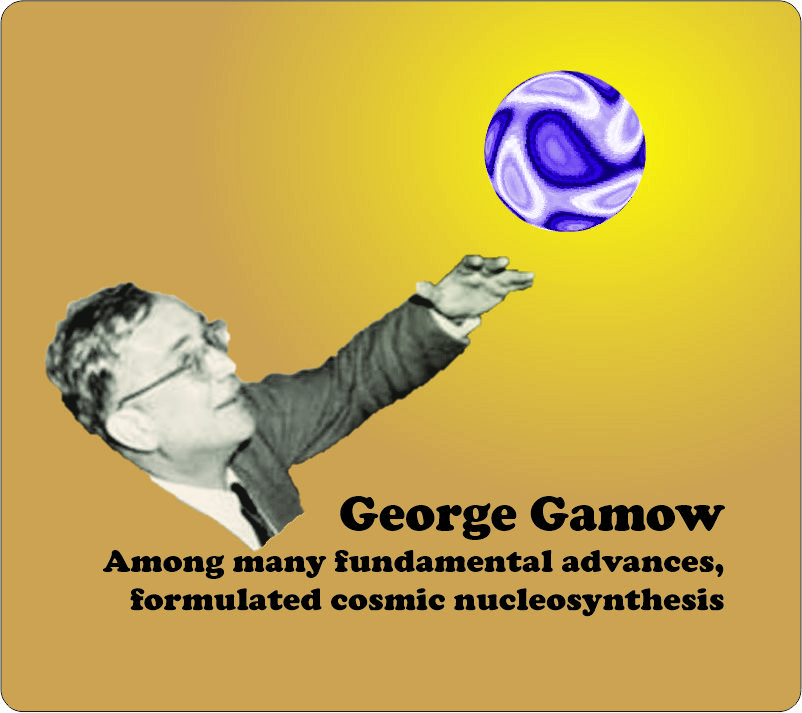
“Mm-hm. Think about it. Back when atoms first coalesced after the Big Bang, they were all either hydrogen or helium with just a smidgeon of lithium for flavor. Where did all the other elements come from? Friedmann’s student George Gamow figured that out, along with lots of other stuff. Fascinating guy, interested in just about everything and good at much of it. Born in Odessa USSR, he and his wife tried twice to defect to the West by kayak. They finally made it in 1933 by leveraging his invitation to Brussels and the Solvay Conference on Physics where Einstein and Bohr had their second big debate. By that time Gamow had produced his ‘liquid drop‘ theory of how heavy atomic nuclei decay by spitting out alpha particles and electrons. He built on that theory to explain how stars serve as breeder reactors.”

“I thought breeder reactors are for turning uranium into plutonium for bombs. Did he have anything to do with that?”

“By the start of the war he was a US citizen as well as a top-flight nuclear theorist but they kept him away from the Manhattan Project. That undoubtedly was because of his Soviet background. During the war years he taught university physics, consulted for the Navy, and thought about how stars work. His atom decay work showed that alpha particles could escape from a nucleus by a process a little like water molecules in a droplet bypassing the droplet’s surface tension. For atoms deep inside the Sun, he suggested that his droplet process could work in reverse. He calculated the temperatures and pressures it would take for gravity to force alpha particles or electrons into different kinds of nuclei. The amazing thing was, his calculations worked.”

“Wait — alpha particles? Where’d they come from if the early stars were just hydrogen and helium?”

“An alpha particle is just a helium atom with the electrons stripped off. Anyway, with Gamow leading the way astrophysicists figured out how much of which elements a given star would create by the time it went nova. Those elements became part of the gas‑dust mix that coalesces to become the next generation of stars. We may have gone through 100 such cycles so far.”

“A hundred generations of stars. Wow.”

~~ Rich Olcott

En Route to Spreading Out

“Gee, Mr Moire, if Einstein and Friedmann are right, some day the Universe will expand exponentially and everything dies. Even Dr Mack says that’s a downer.”

“First, it’s not ‘some day,’ it’s already. We’ve got evidence that exponential expansion became the dominant process five billion years ago. The interesting questions are about what happens during the expansion and what the timeline will be. That’s all controlled by a single weird parameter so naturally the parameter’s conventional symbol is w. Each major component of the Universe has its own value of w and they combine to predict the future course of the Universe.”

“Weird sounds like fun. What is it, another difference like the Cosmological Constant minus that mass‑pressure stuff?”

“Good guess, but it’s not a difference, It’s a ratio, between different flavors of energy.”

“Kinetic and potential, I’ll bet.”

“That split seems to be a common theme in Physics, doesn’t it? In this case, you’re almost right if we stretch things. One of the energy flavors is mass, including both normal and dark matter. If you take the long view, every atom of normal matter will sooner or later break down so you can think of it as a packet of potential energy, pent up and waiting for release. Dark matter, who knows? Anyway, w‘s denominator is mass per unit volume. The numerator’s a little trickier. As you guessed, we need something related to kinetic energy and we slide into that sideways.”

“How so?”

“Well, most of the normal matter is very dilute hydrogen which we can treat like a perfect gas. That’s something we’ve got a good theory for. Per unit volume, gas particle kinetic energy is proportional to pressure and that’s what we use for w‘s numerator. Averaged over the volume of space the pressure‑to‑mass ratio w for matter moving at ordinary speeds is effectively zero.”

“Does dark matter follow the same formula?”

“We pretend it does.”

“How about photons? They don’t have mass so that ratio would be infinity.”

“True, but they do carry momentum and it turns out w is simply ⅓ for photons and neutrinos and anything else traveling at relativistic speeds. Then there’s the Cosmological Constant’s w, which is minus‑one. Since the Big Bang we’ve gone from radiation‑dominated to matter‑dominated to Constant‑dominated; the effective w has shifted from somewhat positive to zero and into negative territory. Thanks to the surviving photons and matter, though, we’re still at least slightly above –1.0.”

“What difference does that make?”

“Minus‑one is the boundary between fates for the Universe. More positive than that, gravity and electromagnetism are guaranteed to be stronger than dark energy. Expansion will move gravity‑bound objects farther away from each other, but the galaxies and each galaxy cluster will stay together. The supply of hydrogen that fuels new stars will peter out. Eventually all the stars will gutter out and disappear into the cold dark as they wait for their constituent atoms to decay. The whole process will take something like 1010¹⁰ years.”

“That’s dark, alright, but at least it’ll take a long time. What happens of w is more negative than minus‑one?”

“The Big Rip. If w is more negative than the threshold, dark energy will grow stronger with time. We don’t know of anything that would limit the growth. First dark energy overpowers gravity and allows the galaxies and stars to disperse. Then it overrides the electromagnetism that holds molecules and rocks together. Eventually even the weak and strong nuclear forces will be defeated — no more atoms. Depending on how extreme w is, figure something like 200 billion years, give or take an eon.”

“Wow. But wait, we’ve covered radiation and mass and the Constant and none of them have a w below the threshold. What can have a more negative w?”

“A hypothesis. If there is anything, pretty much all we have is a name, ‘phantom energy,’ which is even more tentative than ‘dark energy.’ People are working to evaluate w with data. Results so far are so close to –1.0 that we can’t tell if it’s above or below the threshold or just teetering on the brink.”

“Two hundred billion years or way more. No worries, hey?”

~~ Rich Olcott