Hyperbolas But Not Hyperbole

Minus? Where did that come from?”

<Gentle reader — If that question looks unfamiliar, please read the preceding post before this one.>

Jim’s still at the Open Mic. “A clever application of hyperbolic geometry.” Now several of Jeremy’s groupies are looking upset. “OK, I’ll step back a bit. Jeremy, suppose your telescope captures a side view of a 1000‑meter spaceship but it’s moving at 99% of lightspeed relative to you. The Lorentz factor for that velocity is 7.09. What will its length look like to you?”

“Lorentz contracts lengths so the ship’s kilometer appears to be shorter by that 7.09 factor so from here it’d look about … 140 meters long.”

“Nice, How about the clocks on that spaceship?”

“I’d see their seconds appear to lengthen by that same 7.09 factor.”

“So if I multiplied the space contraction by the time dilation to get a spacetime hypervolume—”

“You’d get what you would have gotten with the spaceship standing still. The contraction and dilation factors cancel out.”

“How about if the spaceship went even faster, say 99.999% of lightspeed?”

“The Lorentz factor gets bigger but the arithmetic for contraction and dilation still cancels. The hypervolume you defined is always gonna be just the product of the ship’s rest length and rest clock rate.”

His groupies go “Oooo.”

One of the groupies pipes up. “Wait, the product of x and y is a constant — that’s a hyperbola!”

“Bingo. Do you remember any other equations associated with hyperbolas?”

“Umm… Yes, x2–y2 equals a constant. That’s the same shape as the other one, of course, just rotated down so it cuts the x-axis vertically.”

Jeremy goes “Oooo.”

Jim draws hyperbolas and a circle on the whiteboard. That sets thoughts popping out all through the crowd. Maybe‑an‑Art‑major blurts into the general rumble. “Oh, ‘plus‘ locks x and y inside the constant so you get a circle boundary, but ‘minus‘ lets x get as big as it wants so long as y lags behind!”

Another conversation – “Wait, can xy=constant and x2–y2=constant both be right?”
  ”Sure, they’re different constants. Both equations are true where the red and blue lines cross.”

A physics student gets quizzical. “Jim, was this Minkowski’s idea, or Einstein’s?”

“That’s a darned good question, Paul. Minkowski was sole author of the paper that introduced spacetime and defined the interval, but he published it a year after Einstein’s 1905 Special Relativity paper highlighted the Lorentz transformations. I haven’t researched the history, but my money would be on Einstein intuitively connecting constant hypervolumes to hyperbolic geometry. He’d probably check his ideas with his mentor Minkowski, who was on the same trail but graciously framed his detailed write‑up to be in support of Einstein’s work.”

One of the astronomy students sniffs. “Wait, different observers see the same s2=(ct)2d2 interval between two events? I suppose there’s algebra to prove that.”

“There is.”

“That’s all very nice in a geometric sort of way, but what does s2 mean and why should we care whether or not it’s constant?”

“Fair questions, Vera. Mmm … you probably care that intervals set limits on what astronomers see. Here’s a Minkowski map of the Universe. We’re in the center because naturally. Time runs upwards, space runs outwards and if you can imagine that as a hypersphere, go for it. Light can’t get to us from the gray areas. The red lines, they’re really a hypercone, mark where s2=0.”

From the back of the room — “A zero interval?”

“Sure. A zero interval means that the distance between two events exactly equals lightspeed times light’s travel time between those events. Which means if you’re surfing a lightwave between two events, you’re on an interval with zero measure. Let’s label Vera’s telescope session tonight as event A and her target event is B. If the A–B interval’s ct difference is greater then its d difference then she can see Bif the event is in our past but not beyond the Cosmic Microwave Background. But if a Dominion fleet battle is approaching us through subspace from that black dot, we’ll have no possible warning before they’re on us.”

Everyone goes “Oooo.”

~~ Rich Olcott

Thinking in Spacetime

The Open Mic session in Al’s coffee shop is still going string. The crowd’s still muttering after Jeremy stuck a pin in Big Mike’s “coincidence” balloon when Jim steps up. Jim’s an Astrophysics post‑doc now so we quiet down expectantly. “Nice try, Mike. Here’s another mind expander to play with. <stepping over to the whiteboard> Folks, I give you … a hypotenuse. ‘That’s just a line,’ you say. Ah, yes, but it’s part of some right triangles like … these. Say three different observers are surveying the line from different locations. Alice finds her distance to point A is 300 meters and her distance to point B is 400. Applying Pythagoras’ Theorem, she figures the A–B distance as 500 meters. We good so far?”

A couple of Jeremy’s groupies look doubtful. Maybe‑an‑Art‑Major shyly raises a hand. “The formula they taught us is a2+b2=c2. And aren’t the x and y supposed to go horizontal and vertical?”

“Whoa, nice questions and important points. In a minute I’m going to use c for the speed of light. It’s confusing to use the same letter for two different purposes. Also, we have to pay them extra for double duty. Anyhow, I’m using d for distance here instead of c, OK? To your next point — Alice, Bob and Carl each have their own horizontal and vertical orientations, but the A–B line doesn’t care who’s looking at it. One of our fundamental principles is that the laws of Physics don’t depend on the observer’s frame of reference. In this situation that means that all three observers should measure the same length. The Pythagorean formula works for all of them, so long as we’re working on a flat plane and no-one’s doing relativistic stuff, OK?”

Tentative nods from the audience.

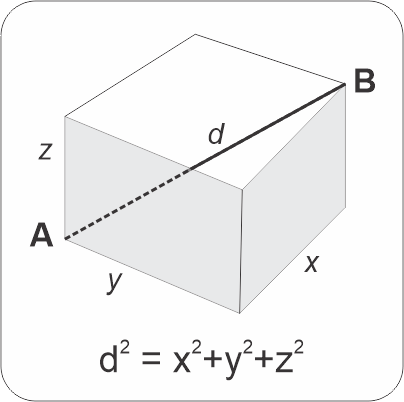
“Right, so much for flat pictures. Let’s up our game by a dimension. Here’s that same A–B line but it’s in a 3D box. <Maybe‑an‑Art‑Major snorts at Jim’s amateur attempt at perspective.> Fortunately, the Pythagoras formula extends quite nicely to three dimensions. It was fun figuring out why.”

Jeremy yells out. “What about time? Time’s a dimension.”

“For sure, but time’s not a length. You can’t add measurements unless they all have the same units.”

“You could fix that by multiplying time by c. Kilometers per second, times seconds, is a length.” His groupies go “Oooo.”

“Thanks for the bridge to spacetime where we have four coordinates — x, y, z and ct. That makes a big difference because now A and B each have both a where and a when — traveling between them is traveling in space and time. Computationally there’s two paths to follow from here. One is to stick with Pythagoras. Think of a 4D hypercube with our A–B line running between opposite vertices. We’re used to calculating area as x×y and volume as x×y×z so no surprise, the hypercube’s hypervolume is x×y×z×(ct). The square of the A–B line’s length would be b2=(ct)2+d2. Pythagoras would be happy with all of that but Einstein wasn’t. That’s where Alice and Bob and Carl come in again.”

“What do they have to do with it?”

“Carl’s sitting steady here on good green Earth, red‑shifted Alice is flying away at high speed and blue‑shifted Bob is flashing toward us. Because of Lorentz contractions and dilations, they all measure different A–B lengths and durations. Each observer would report a different value for b2. That violates the invariance principle. We need a ruggedized metric able to stand up to that sort of punishment. Einstein’s math professor Hermann Minkowski came up with a good one. First, a little nomenclature. Minkowski was OK with using the word ‘point‘ for a location in xyz space but he used ‘event‘ when time was one of the coordinates.”

“Makes sense, I put events on my calendar.”

“Good strategy. Minkowski’s next step quantified the separation between two events by defining a new metric he called the ‘interval.’ Its formula is very similar to Pythagoras’ formula, with one small change: s2=(ct)2–d2. Alice, Bob and Carl see different distances but they all see the same interval.”

Minus? Where did that come from?”

~~ Rich Olcott

The Gelato Model

“Eddie, this ginger gelato’s delicious — not too sweet and just the right amount of ginger bite.”

“Glad you like it, Anne.”

On the way down here, Sy was telling me about how so many things in the Universe run on the same mathematics if you look at them with the right coordinate system. Sy, how do you pick ‘the right coordinate system?”

“The same way you pick the right property to serve as a momentum in Newton’s Equation of Motion — physical intuition. You look for things that fit the system. Sometimes that puts you on the road to understanding, sometimes not. Eddie, you keep track of your gelato sales by flavor. How are they doing?”

“Pistachio’s always a good seller, Sy, but ginger has been coming on strong this year.”

“In motion terns, pistachio’s momentum is constant but ginger is gaining momentum, right?”

“S’what I said.”

“Measured in dollars or trayfuls?”

“In batches. I make it all in-house. I’m proud of that. Dollars, too, of course, but that’s just total for all flavors.”

“Batches all the same size?”

“Some are, some not, depending. If I had a bigger machine I could make more but I do what I can.”

“There you go, Anne, each gelato flavor is like a separate degree of freedom. Eddie’s tracked sales since he started so we can take that date as the origin. Measuring change along any degree in either batches or dollars we have perfectly respectable coordinates although the money view of the system is fuzzier. Velocity is batches per unit time, there’s even a speed limit, and ginger has accelerated. Sound familiar?”

“Sounds like you’re setting up a Physics model.”

“Call it gelato trend physics, but I don’t think I can push the analogy much further. The next step would be to define a useful momentum like Newton did with his Law of Motion.”

F=ma? That’s about acceleration, isn’t it?”

“Probably not in Newton’s mind. Back in his day they were arguing about which was conserved, energy or momentum. It was a sloppy argument because no‑one agreed on crisp definitions. People could use words like ‘quantity of motion‘ to refer to energy or momentum or even something else. Finally Newton defined momentum as ‘mass times velocity‘, but first he had to define ‘mass‘ as ‘quantity of matter‘ to distinguish it from weight which he showed is a force that’s indirectly related to mass.”

“So is it energy or momentum that’s conserved?”

“Both, once you’ve got good definitions of them. But my point is, our car culture has trained us to emphasize acceleration. Newton’s thinking centered on momentum and its changes. In modern terms he defined force as momentum change per unit time. I’m trying to think of a force‑momentum pair for Eddie’s gelato. That’s a problem because I can’t identify an analog for inertia.”

“Inertia? What’s that got to do with my gelato?”

“Not much, and that’s the problem. Inertia is resistance to force. Who can resist gelato? If it weren’t for inertia, the smallest touch would be enough to send an object at high speed off to forever. The Universe would be filled with dust because stars and planets would never get the chance to form. But here we are, which I consider a good thing. Where does inertia come from? Newton changed his mind a couple of times. To this day we only have maybe‑answers to that question.”

“You know we want to know, Sy.”

“Einstein’s favorite guess was Mach’s Principle. There’s about a dozen different versions of the basic idea but they boil down to matter interacting with the combined gravitational and electromagnetic fields generated by the entire rest of the Universe.”

“Wow. Wait, the stars are far away and the galaxies are much, much further away. Their fields would be so faint, how can they have any effect at all?”

“You’re right, Anne, field intensity per star does drop with distance squared. But the number of stars goes up with distance cubed. The two trends multiply together so the force trends grow linearly. It’s a big Universe and size matters.”

“So what about my gelato?”

“We’ll need more research, Eddie. Another scoop of ginger, Anne?”

~~ Rich Olcott

Things That Won’t Work

Vinnie gets a far-away look in his eye. I wait. “Ya know, Sy, there oughtta be a way.”

“A way to what?”

“I ain’t giving up on this faster-than-light communication stuff. I know Einstein said it couldn’t happen because it’d flip cause and effect and he didn’t like that, but that feels too much like philosophy books I’ve read that boil down to, ‘This thing can’t be true because I don’t want it to be.’ Maybe there’s something we ain’t thought of yet.”

“Lots of people have played with that challenge for decades. Do you have any fresh ideas?”

“A couple possibles. Lessee if I’ve got this straight. We’ve got two separate message channels going — one that works instant-like for information between entangled quantum thingies, and one for everything else that’s stuck at lightspeed or less. Suppose I’ve got two entangled pizzas— nah, we’re really talking quantum stuff like electrons and photons so I’ll just say particles. Suppose I’ve got two entangled particles that are some ugly mix of red and green but we know when they’re de-linked they’ll be opposite. I send one to you the regular way but they’re still linked. I look at the one I still got and it’s red, say. The same moment, yours instantly went green but you don’t know that yet until you look or you get status information from me through the not‑instant channel. So the problem is getting information to leak between the two channels, right?”

“That’s about the size of it.”

“OK, try this one. How about I use a magnetic field or something to force mine to red? And maybe a set time later I make it green to confirm I’m in control and it’s a real signal.”

“Sorry, as soon as you manipulate properties in part of an entangled system you break the entanglement and the other part is free to do whatever it wants to. Next?”

“Uhh … time synchronization. How about you and me set a certain time for me to look at mine? You can watch yours and when it flips or not you’ll know.”

“All that does is move the manipulation to the other end of the setup. Me looking at my particle resets yours to whatever color mine isn’t and that breaks the entanglement. Next?”

“Maybe something with a bunch of particles all entangled together? How about—”

“Nup, can’t base a strategy on that. Like everything else quantum, entanglement is statistical. There’s no guarantee that even in our two‑particle system I’ll see green if you see red — the odds are high but not 100%. There’s a proven theorem that says if two particles are ‘maximally entangled,’ adding a third to the system reduces the odds that any two will coordinate their behaviors. A bunch of particles would be even less stable. It’s called the monogamy theorem, care to guess why?”

“Physics fun with metaphors again, cute, but I can see this is a good one. You got anything?”

“Not having to do with entanglement, but I have been playing with a different idea, sort of a blank‑sky approach.”

“You mean blue‑sky.”

“Uh-uh, blank. Think about a sky made of dark matter. Dark matter’s subject to gravity but so far as we know it has absolutely no interaction with electromagnetism of any kind — doesn’t play with electrons, light waves, nothing. Einstein based part of his relativity work on Maxwell’s electromagnetism equations. In fact, that’s where the idea came from that ‘c‘ was the speed limit for the Universe. It was a good idea and there’s a huge amount of evidence that he was right. Everything in our Standard Model except the photon is subject to the Lorentz factor. Both light and gravity acting on normal matter travel at c‑speed. Well, maybe the value of c has something to do with how quarks work. Dark matter doesn’t have quarks. What if dark matter has a different speed limit, maybe a lot higher than c or even no limit at all? Maybe we could exploit that property somehow. How about a dark‑matter telegraph?”

“I’m thinking of my Grampa’s recipe for rabbit stew. ‘First you gotta catch your rabbit,’ he used to say,”

~~ Rich Olcott

The Pizza Connection

“Wait a minute, Sy. If Einstein’s logic proves we can’t have faster‑than‑light communication, what about all the entanglement hype I see in my science magazines?”

“Hype’s the right word, Vinnie. Entanglement’s a real effect, but it doesn’t play well as a communication channel.”

“OK, why not?”

“Let’s set the stage. We’re still in our personal spaceships and we’ve just ordered pizza from Eddie. The entanglement relationship is independent of time and distance so I’m going to skip over how fast we’re going and pretend that Eddie’s using transporter delivery technology, ok?”

“Fine with me,”

“Good. You order your usual double pepperoni with extra cheese, I ask for Italian sausage. Two pizza boxes suddenly appear on our respective mess tables. No reflection on Eddie, but suppose he has a history of getting orders crossed. The quantum formalism says because our orders were filled at the same time and in a single operation, the two boxes are entangled — we don’t know which is which. Before we open the boxes, each of us has a 50:50 shot of getting the right order. It’s like we’ve got a pair of Schrödinger pizzas, half one order and half the other until we look, right?”

“Won’t happen, Eddie’s a pro.”

“True, but stay with me here. I open my box and immediately I know which pizza you received, no matter how far away your ship is from mine. Is that instantaneous communication between us?”

“Of course not, I’m not gonna know which pizza either of us got until I open my own box. Then I’ll know what my meal’s gonna be and I’ll know what you’re having, too. Actually, I’m probably gonna know first because I get hungry sooner than you.”

“Good point. Anyway, entanglement doesn’t transmit human‑scale information. The only communication between us in our spaceships is still limited by Einstein’s rules. But this is a good setup for us to dig a little deeper into the quantum stuff. You rightly rejected the Schrödinger pizza idea because pizza’s human‑scale. One of those boxes definitely holds your pizza or else it definitely holds mine. There’s no in‑between mixtures with human‑scale pizzas. Suppose Eddie sent quantum‑scale nanopizzas, though. Now things get more interesting.”

“Eddie doesn’t mess up orders.”

<sigh> “Even Eddie can’t keep things straight if he sends out a pair of quantum‑scale pizzas. What’s inside a specific entangled box is called a local property. John Stewart Bell proved some statistical criteria for whether a quantum system’s properties are local or are somehow shared among the entangled objects. Scientists have applied his tests to everything from entangled photons up to little squares of diamond. They’ve tracked quantum properties from spin states to vibration modes. A lot of work went into plugging loopholes in Bell’s criteria.”

“What’d they find?”

“The results keep coming up non-local. Our quantum pizzas truly do not have separate characteristics hiding inside their boxes unless Eddie marked a box to destroy the symmetry. All the objects in an entanglement share all the applicable quantum property values until one object gets measured. Instantly, all the entangled objects snap into specific individual property values, like which box holds which pizza. They stop being entangled, too. That happens no matter how far apart they are. Those experimental results absolutely rule out the local‑property idea which was the most appealing version of the ‘underlying reality‘ that Einstein and Bohr argued over.”

“Wait, I can’t tell you anything faster than light, but these quantum thingies automatically do that instant‑like?”

“Annoying, isn’t it? But it’s a sparse form of messaging. My quantum pizza box can tell yours only two things, ‘I’ve been opened‘ and ‘I hold Italian sausage pizza.’ They’re one‑time messages at the quantum level and you as an observer can’t hear either one. Quantum theoreticians call the interaction ‘wave function collapse‘ but Einstein called it ‘spooky action at a distance.’ He hated even that limited amount of instantaneous communication because it goes directly against the first principle of Special Relativity. Relativity has been vigorously tested for over a century. It’s stood up to everything they’ve thrown at it — except for this little mouse nibbling at its base.”

~~ Rich Olcott

Speed Limit

“Wait, Sy, there’s something funny about that Lorentz factor. I’m riding my satellite and you’re in your spaceship to Mars and we compare notes and get different times and lengths and masses and all so we have to use the Lorentz factor to correct numbers between us. Which velocity do we use, yours or mine?”

“Good question, Vinnie. We use the difference between our two frames. We can subtract either velocity from the other one and replace v with that number. Strictly speaking, we’d subtract velocity components perpendicular to the vector between us. If I were to try to land on your satellite I’d have to expend fuel and energy to change my frame’s velocity to yours. When we matched frames the velocity difference would be zero, the Lorentz factor would be 1.0 and I’d see your solar array as a perfect 10×10‑meter square. Our clocks would tick in sync, too.”

“OK, now there’s another thing. That Lorentz formula compares our subtracted speeds to lightspeed c. What do we subtract to get c?”

“Deep question. That’s one of Einstein’s big insights. Suppose from my Mars‑bound spaceship I send out one light pulse toward Mars and another one in the reverse direction, and you’re watching from your satellite. No matter how fast my ship is traveling, Einstein said that you’d see both pulses, forward and backward, traveling at the same speed, c.”

“Wait, shouldn’t that be that your speed gets added to one pulse and subtracted from the other one?”

“Ejected mass works that way, but light has no mass. It measures its speed relative to space itself. What you subtract from c is zero. Everywhere.”

“OK, that’s deep. <pause> But another ‘nother thing—”

“For a guy who doesn’t like equations, you’re really getting into this one.”

“Yeah, as I get up to speed it grows on me. HAW!”

“Nice one, you got me. What’s the ‘nother thing?”

“I remembered how velocity is speed and direction but we’ve been mixing them together. If my satellite’s headed east and your spaceship’s headed west, one of us is minus to the other, right? We’re gonna figure opposite v‑numbers. How’s that work out?”

“You’re right. Makes no difference to the Lorentz factor because the square of a negative difference is the same as the square of its positive twin. You bring up an important point, though — the factor applies to both of us. From my frame, your clock is running slow. From your frame, mine’s the slow one. Einstein’s logic says we’re both right.”

“So we both show the same wrong time, no problem.”

“Nope, you see my clock running slow relative to your clock. I see exactly the reverse. But it gets worse. How about getting your pizza before you order it?”

“Eddie’s good, he ain’t that good. How do you propose to make that happen?”

“Well, I don’t, but follow me here. <working numbers on Old Reliable> Suppose we’re both in spaceships. I’m loafing along at 0.75c relative to Eddie’s pizza place on Earth and your ship is doing 3c. Also, suppose that we can transmit messages and mass much faster than lightspeed.”

“Like those Star Trek transporters and subspace radios.”

“Right. OK, at noon on my personal clock you tell me you’ve ordered pizza so I get one, too. Eddie slaps both our pizzas into his transporter 10 minutes later. The math works out that according to my clock you get your pizza 8.9 minutes before you put in your order. You like that?”

“Gimme a sec … nah, I don’t think so. If I read that formula right with v1 being you and v2 being me, if you run that formula for what I’d see with my velocity on the bottom, that’s a square root of a minus which can’t be right.”

“Yup, the calculation gives an imaginary number, 4.4i minutes, whatever that means. So between us we have two results that are just nonsense — I see effect before cause and you see a ridiculous time. To avoid that sort of thing, Einstein set his speed limit for light, gravity and information.”

“I’m willing to keep under it if you are.”

“Deal.”

~~ Rich Olcott

The Relativity Factor

“Sy, it’s nice that Einstein agreed with Rayleigh’s wave theory stuff but why’d you even drag him in? I thought the faster‑than‑light thing was settled.”

“Vinnie, faster‑than‑light wasn’t even an issue until Einstein came along. Science had known lightspeed was fast but not infinite since Rømer measured it in Newton’s day. ‘Pretty fast,’ they said, but Newtonian mechanics is perfectly happy with any speed you like. Then along came Einstein.”

“Speed cop, was he?”

“Funny, Vinnie. No, Einstein showed that the Universe enforces the lightspeed limit. It’s central to how the Universe works. Come to think of it, the crucial equation had been around for two decades, but it took Einstein to recognize its significance.”

“Ah, geez, equations again.”

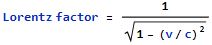
“Just this one and it’s simple. It’s all about comparing v for velocity which is how fast something’s going, to c the speed of light. Nothing mystical about the arithmetic — if you’re going half the speed of light, the factor works out to 1.16. Ninety‑nine percent of c gives you 7.09. Tack on another 9 and you’re up to 22.37 and so on.”

“You got those numbers memorized?”

“Mm-hm, they come in handy sometimes.”

“Handy how? What earthly use is it? Nothing around here goes near that fast.”

“Do you like your GPS? It’d be useless if the Lorentz factor weren’t included in the calculations. The satellites that send us their sync signals have an orbit about 84 000 kilometers wide. They run that circle once a sidereal day, just shy of 86 400 seconds. That works out to 3 kilometers per second and a Lorentz factor of 1.000 005.”

“Yeah, so? That’s pretty close to 1.0.”

“It’s off by 5 parts per million. Five parts per million of Earth’s 25 000-mile circumference is an eighth of a mile. Would you be happy if your GPS directed you to somewhere a block away from your address?”

“Depends on why I’m going there, but I get your point. So where else does this factor come into play?”

“Practically anywhere that involves a precision measurement of length or duration. It’s at the core of Einstein’s Special Relativity work. He thought about observing a distant moving object. It’s carrying a clock and a ruler pointed along the direction of motion. The observer would see ticks of the clock get further apart by the Lorentz factor, that’s time dilation. Meanwhile, they’d see the ruler shrink by the factor’s inverse, that’s space compression.”

“What’s this ‘distant observer‘ business?”

“It’s less to do with distance than with inertial frames. If you’re riding one inertial frame with a GPS satellite, you and your clock stay nicely synchronized with the satellite’s signals. You’d measure its 1×1‑meter solar array as a perfect square. Suppose I’m riding a spaceship that’s coasting to Mars. I measure everything relative to my own inertial frame which is different from yours. With my telescope I’d measure your satellite’s solar array as a rectangle, not a square. The side perpendicular to the satellite’s orbit would register the expected 1 meter high, but the side pointing along the orbit would be shorter, 1 meter divided by the Lorentz factor for our velocity difference. Also, our clocks would drift apart by that Lorentz factor.”

“Wait, Sy, there’s something funny about that equation.”

“Oh? What’s funny?”

“What if somebody’s speed gets to c? That’d make the bottom part zero. They didn’t let us do that in school.”

“And they shouldn’t — the answer is infinity. Einstein spotted the same issue but to him it was a feature, not a bug. Take mass, for instance. When they meet Einstein’s famous E=mc² equation most people think of the nuclear energy coming from a stationary lump of uranium. Newton’s F=ma defined mass in terms of a body’s inertia — the greater the mass, the more force needed to achieve a certain amount of acceleration. Einstein recognized that his equation’s ‘E‘ should include energy of motion, the ½mv² kind. He had to adjust ‘m‘ to keep F=ma working properly. The adjustment was to replace inertial mass with ‘relativistic mass,’ calculated as inertial mass times the Lorentz factor. It’d take infinite force to accelerate any relativistic mass up to c. That’s why lightspeed’s the speed limit.”

~~ Rich Olcott
Three-speed Transmission

“Have I got this straight, Sy? You’re saying that prisms throw rainbows because light goes slower through glass than in air and that bends the beam, but every frequency lightwave bends a different amount. Also you’re saying all the bending happens when speeds switch at the glass face, not inside the glass. Am I right so far?”

“Perfect, Vinnie, but you skipped an important detail.”

“Which one?”

“Snell’s ‘index of refraction‘, the ratio of wave speed in vacuum to wave speed in the medium. The higher the frequency, the higher the speed in the medium so the index decreases towards 1.0. The definition lets us calculate wave speed in the medium from that frequency’s refraction index. For most materials the index is usually greater than 1.0, meaning that the speed inside the material is usually slower than in space.”

“Still using those ‘most‘ and ‘usually‘ weasel‑words.”

“Guilty as charged, because we’ve finally gotten to the ‘multiple speeds of light‘ thing. Which means I need more precise wording. The wave speed we’ve been talking about so far applies to a specific part of the wave, say the peak or trough. Those are wave phases, so I’m going to call that speed the ‘phase speed‘, OK?”

“Fine with me.”

“Good, because the second speed is different. Among his many important contributions, Lord Rayleigh pointed out that you can’t have a pulse that’s one pure frequency. A single‑frequency wave never starts and never ends. Do you remember the time I combined waves to draw a camel?”

“You did, mostly, but there was funny stuff at his nose and butt.”

“Because I only included about a hundred component waves. It’d take many more to kill those boundary zig‑zags. Any finite wave has the same issue. Rayleigh said that an individual wave has a phase speed, but any ‘peculiarity,’ like a pulse rise or fall, could only be created by a group of waves. The peculiarity could travel at a different speed from the component waves, like a pair of scissors where the cutting point moves faster than either blade.”

“Sounds like carrier wave and sidebands on my ham radio. But if different frequencies have different speeds they’d get all out of sync with each other. How does a photon stay in one piece?”

“The vacuum is non-dispersive — the photon’s component waves all travel at the same speed and stay together. If a medium absorbs some frequency, that makes it dispersive and that changes things.”

“Ah, that’s why you hedged about transparency.”

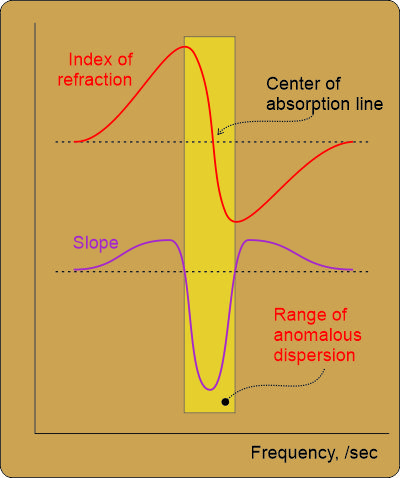
“Exactly. Throw in a few absorbing atoms, like cobalt that absorbs red or gold that absorbs blue, and you get interesting effects from your sideband components interacting. Skipping some math, the bottom line is simple and cute. The group speed’s equation is just like the phase speed’s except there’s a positive or negative correction term in the denominator.”

“Sy, I don’t like equations, remember? I suppose f is frequency in your correction term but what’s slope?”

“That’s a measure of how rapidly the index changes as the frequency changes. For most frequencies and most media, the slope is very slightly negative because the index slowly descends towards 1.0 at high energies. The vg fraction’s denominator stays just less than nf so the group goes slightly faster than the phase. Near an absorption line, though, things get sloppy. Waves that are just a little off the absorber’s favorite frequency can still interact with it. That changes their speed and the ‘corrected’ refraction index.”

“Gimme a sec … guess I’m OK with the positive slopes but there’s that yellow part where the slope is negative. Wouldn’t that make the fraction’s bottom smaller and the group speed higher?”

“Certainly. In fact, under the right conditions the denominator can be less than 1.0. That pushes the group speed above c — faster than light in vacuum, even though the component waves all run slower than vacuum lightspeed. It’s only the between‑component out‑of‑syncness relationship that scissors along beyond c.”

“You said there’s a third speed?”

“Signals. In a dispersive medium those sideband waves get chaotic and can’t carry information. Wave theory and Einstein agree — chaos may be able to travel faster than light, but information can’t.”

~~ Rich Olcott

Through A Prism Brightly

Familiar footsteps outside my office. “C’mon in, Vinnie, the door’s open.”

“Hi, Sy, gotta minute?”

“Sure, Vinnie, business is slow. What’s up?”

“Business is slow for me, too. I was looking over some of your old posts—”

“That slow, eh?”

“You know it. Anyway, I’m hung up on that video where light’s got two different speeds.”

“Three, really.”

“That’s even worse. What’s the story?”

“Well, first thing, it depends on where the light is. If you’re out in the vacuum, far away from atoms, they’re all the same, c. Simple.”

“Matter messes things up, then.”

“Of course. Our familiar kind of matter, anyway, made of charges like quarks and electrons. Light’s whole job is to interact with charges. When it does, things happen.”

“Sure — photon bangs into a rock, it stops.”

“It’s not that simple. Remember the wave-particle craziness? Light’s a particle at either end of its trip but in between it’s a wave. The wave could reflect off the rock or diffract around it. Interstellar infra-red astronomy depends upon IR scooting around dust particles so we can see the stars behind the dust clouds. What gets interesting is when the light encounters a mostly transparent medium.”

“I get suspicious when you emphasize ‘mostly.’ Mostly how?”

“Transparent means no absorption. The only thing that’s completely transparent is empty space. Anything made of normal matter can’t be completely transparent, because every kind of atom absorbs certain frequencies.”

“Glass is transparent.”

“To visible light, but even that depends on the glass. Ever notice how cheap drinking glasses have a greenish tint when you look down at the rim? Some light absorption, just not very much. Even pure silica glass is opaque beyond the near ultraviolet. … Okay, bear with me on this. Why do you suppose Newton made such a fuss about prisms?”

“Because he saw it made a rainbow in sunlight and thought that was pretty?”

“Nothing so mild. We’re talking Newton here. No, it had to do with one of his famous ‘I’m right and everyone else is wrong‘ battles. Aristotle said that sunlight is pure white‑color, and that objects emit various kinds of darkness to overcome the white and produce colors for us. That was academic gospel for 2000 years until Newton decided it was wrong. He went to war with Aristotle using prisms as his primary weapons.”

“So that’s why he invented them?”

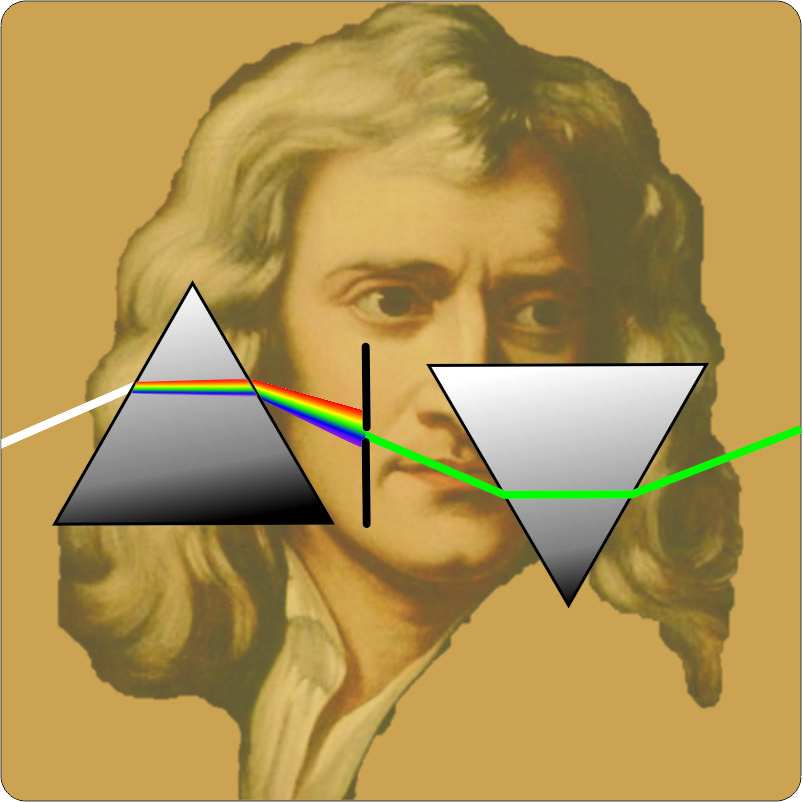
“No, no, they’d been around for millennia, ever since humans discovered that prismatic quartz crystals in a beam of sunlight throw rainbows. Newton’s innovation was to use multiple prisms arrayed with lenses and mirrors. His most direct attack on Aristotle used two prisms. He aimed the beam coming out of the first prism onto a reversed second prism. Except for some red and violet fringes at the edges, the light coming out of the second prism matched the original sunlight beam. That proved colors are in the light, not in Aristotle’s darknesses.”

“Newton won. End of story.”

“Not by a long shot. Aristotle had the strength of tradition behind him. A lot of Continental academics and churchmen had built their careers around his works. Newton’s earlier battles had won him many enemies and some grudging respect but few effective allies. Worse, Newton published his experiments and observations in a treatise which he wrote in English instead of the conventional scholarly Latin. Typical Newtonian belligerence, probably. The French academicians reacted by simply rejecting his claims out of hand. It took a generational turnover before his thinking was widely accepted.”

“Where do speeds come into this?”

“Through another experiment in Newton’s Optics treatise. If he used a card with a hole in it to isolate, say, green light in the space between the two prisms, the light beam coming from the second prism was the matching green. No evidence of any other colors. That was an important observation on its own, but Newton’s real genius move was to measure the diffraction angles. Every color had its own angle. No matter the conditions, any particular light color was always bent by the same number of degrees. Newton had put numbers to colors. That laid the groundwork for all of spectroscopic science.”

“And that ties to speed how?”

~~ Rich Olcott

A Neutral Party

“Hi, folks, sorry I’m late to the party. What are we arguing about and which side am I on?”

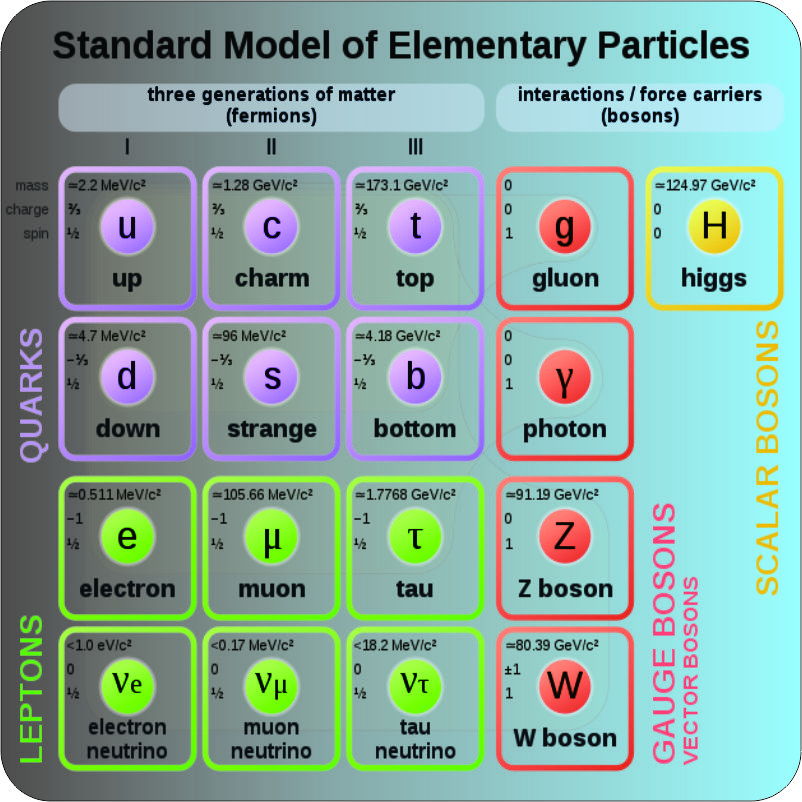
“Hi, Vinnie. We started out talking about neutrality and Jim proved that we’re electrically neutral otherwise we’d spray ourselves apart because of like‑charge repulsons.”

“Yeah, an’ then we got into the Standard Module picture here and how it’s weird that the electron charge exactly cancels out the quark mixture in a proton even though electrons don’t have quarks and quarks don’t have exact charges.”

Jim’s on it. “Almost, Eddie. Quarks have exact charges, but they’re exact fractions. They just add up when you mix three of them to make a particle. Two of them, sometimes. Up‑quark, up‑quark and down‑quark is two‑thirds plus two‑thirds minus one‑third equals one. That’s one proton, exactly opposing one electron’s charge.”

Vinnie’s good at mental math. “What happens when you mix one‑third plus one‑third minus two‑thirds which is zero?”

“Two downs and an up. That’s a neutron.”

“Ups, downs, electrons, protons, neutrons — except for the neutrino the first column’s pretty much atoms, right? What’s with those other boxes?”

“We only see evidence for the other purple‑box quarks in collider records or nuclear reactions. Same for the muon and tau. They’re all way too unstable to contribute much to anything that hangs around. The guys in the red and gold boxes aren’t building blocks, they’re more like glue that holds everything else together. The green‑box neutrinos at the bottom are just weird and we’ll probably be a long time figuring them out.”

“Says here that neutrinos have zero charge, and so do most of the force thingies. Is that really zero or is it just too small to measure?”

“A true Chemistry‑style question, Susan. Charges we can count but you’re right, energy exchanges in a process have to be measured. The zero charges are really zero. For example, Pauli dreamed up the neutrino as an energy‑accounting trick for a nuclear process where all the charges went to known products but there was energy left over. If they existed at all, neutrinos could carry away that energy but they had to have zero charge. A quarter‑century later we detected some and they fit all the requirements.”

Vinnie perks up. “Zero charge so they doesn’t interact with light, teeny mass per each but there’s a hyper‑gazillion of them out there which oughtta add up to a lot of mass. Could neutrinos be what dark matter is?”

“Some researchers thought that for a while but the idea hasn’t held up to inspection. The neutrinos we know about come to about 1% of dark matter’s mass. Some people think there may be a really heavy fourth kind of neutrino that would make up the difference, but it’s a long shot and there’s no firm evidence for it so far. Dark matter doesn’t interact with photons, photons interact with electric charge, quarks have electric charge. If you’ve got quarks you’re not dark matter.”

“How about neutrons floating around?”
 ”Those molecular clouds I’ve read about Aren’t they neutral? Are there neutral stars?”
  ”How about neutron stars and black holes?”
   ”What’s a neutron star?”

“All good questions. Free neutrons are a bad bet, Vinnie — unless they’re bound with protons they usually emit an electron and become a proton within an hour. Susan, electrostatic forces would overwhelm gravity so we believe stars and molecular clouds must be electrically neutral or close to it. Anyway, stars and clouds can’t be dark matter because they’ve got quarks. Eddie, what do you suppose happens when a star uses up the fuel that keeps it big?”

“Since you ask it that way, I suppose it caves in.”

“Got it in one. If the star’s too big to collapse to be a white dwarf but too small to collapse to be a black hole, it collapses to be a neutron star. Really weird objects — a star‑and‑a‑half of of mass packed into a 10‑kilometer sphere, probably spinning super‑fast and possessing a huge magnetic field. From a ‘what is dark matter?‘ perspective, though, collapsed stars of any sort are still made of quarks and can’t qualify.”

“So what is dark matter then?”

“Good question.”

~~ Rich Olcott

  • Thanks to Alex, who asked a question.