Atoms are solar systems? Um, no…

Suddenly there’s a hubbub of girlish voices to one side of the crowd.  “Go on, Jeremy, get up there.”  “Yeah, Jeremy, your theory’s no crazier than theirs.”  “Do it, Jeremy.”

Sure enough, the kid’s here with some of his groupies.  Don’t know how he does it.  He’s a lot younger than the grad students who generally present at these contests, but he’s got guts and he grabs the mic.

“OK, here’s my Crazy Theory.  The Solar System has eight planets going around the Sun, and an oxygen atom has eight electrons going around the nucleus.  Maybe we’re living in an oxygen atom in some humongous Universe, and maybe there are people living on the electrons in our oxygen atoms or whatever.  Maybe the Galaxy is like some huge molecule.  Think about living on an electron in a uranium atom with 91 other planets in the same solar system and what happens when the nucleus fissions.  Would that be like a nova?”

There’s a hush because no-one knows where to start, then Cathleen’s voice comes from the back of the room.  Of course she’s here — some of the Crazy Theory contest ring-leaders are her Astronomy students.  “Congratulations, Jeremy, you’ve joined the Honorable Legion of Planetary Atom Theorists.  Is there anyone in the room who hasn’t played with the idea at some time?”

No-one raises a hand except a couple of Jeremy’s groupies.

“See, Jeremy, you’re in good company.  But there are a few problems with the idea.  I’ll start off with some astronomical issues and then the physicists can throw in some more.  First, stars going nova collapse, they don’t fission.  Second, compared to the outermost planet in the Solar System, how far is it from the Sun to the nearest star?”

A different groupie raises her hand and a calculator.  “Neptune’s about 4 light-hours from the Sun and Alpha Centauri’s a little over 4 light-years, so that would be … the 4’s cancel, 24 hours times 365 … about 8760 times further away than Neptune.”

“Nicely done.  That’s a typical star-to-star distance within the disk and away from the central bulge.  Now, how far apart are the atoms in a molecule?”

“Aren’t they pretty much touching?  That’s a lot closer than 8760 times the distance.”

“Yes, indeed, Jeremy.  Anyone else with an objection?  Ah, Maria.  Go ahead.”

“Yes, ma’am.  All electrons have exactly the same properties, ¿yes? but different planets, they have different properties.  Jupiter is much, much heavier than Earth or Mercury.”

Astrophysicist-in-training Jim speaks up.  “Different force laws.  Solar systems are held together by gravity but at this level atoms are held together by electromagnetic forces.”

“Carry that a step further, Jim.  What does that say about the geometry?”

“Gravity’s always attractive.  The planets are attracted to the Sun but they’re also attracted to each other.  That’ll tend to pull them all into the same plane and you’ll get a flat disk, mostly.  In an atom, though, the electrons or at least the charge centers repel each other — four starting at the corners of a square would push two out of the plane to form a tetrahedron, and so forth.  That’s leaving aside electron spin.  Anyhow, the electronic charge will be three-dimensional around the nucleus, not planar.  Do you want me to go into what a magnetic field would do?”

“No, I think the point’s been made.  Would someone from the Physics side care to chime in?”

“Synchrotron radiation.”

“Good one.  And you are …?”

“Newt Barnes.  I’m one of Dr Hanneken’s students.”

“Care to explain?”

“Sure.  Assume a hydrogen atom is a little solar system with one electron in orbit around the nucleus.  Any time a charge moves it radiates waves into the electromagnetic field.  The waves carry forces that can compel other charged objects to move.  The distance an object moves, times the force exerted, equals the amount of energy expended by the wave.  Therefore the wave must carry energy and that energy must have come from the electron’s motion.  After a while the electron runs out of kinetic energy and falls into the nucleus.  That doesn’t actually happen, so the atom’s not a solar system.”

Jeremy gets general applause when he waves submission, then the crowd’s chant resumes…

.——<“Amanda! Amanda! Amanda!”>Bohr and Bohr atom

~~ Rich Olcott

Heavenly Messengers

A gorgeous Fall day, a little bit cool-ish, perfect for a brisk walk in the park.  I’m striding along the lake-bound path when there’s a breathless shout behind me.  “Hey, Moire, wait up!  I got questions!”

“Hello, Mr Feder.  What’s the topic this time?  And keep up, please, I’ve got geese to watch.”

“I been reading in the business pages <puff, puff> about all the money different countries are putting into ‘multi-messenger astronomy.’  <puff>  What’s that about, anyway?  Who’s sending messages and ain’t the Internet good enough?”

“It’s not who, Mr Feder, it’s what — stars, galaxies, black holes, the Universe.  And the messages are generally either ‘Here I am‘ or ‘Something interesting just happened‘.  The Internet just doesn’t reach that far and besides, no kitten pictures.”

“Pretty simple-sounding messages, so why the big bucks for extra message-catchers?”

“Fair question.  It has to do with what kind of information each messenger carries.  Photons, for instance.”

“Yeah, light-waves, the rainbow.”

“Way more than the rainbow.  Equating light-waves to just the colors we see is like equating sound-waves to just the range from A4 through F4# on a piano.”

“Hey, that’s less than an octave.”

“Yup, and electromagnetism’s scale is hugely broader than that.  Most of the notes, or colors, are way out of our range.  A big tuba makes a deep, low-frequency note but a tiny piccolo makes a high note.  Photon characteristics also scale with the size of where they came from.  Roughly speaking, the shorter the light’s wave-length, the smaller the process it came out of and the smaller its target will be.  Visible light, for instance, is sent and received by loosely-held charge sloshing inside an atom or molecule.  Charge held tight to a nucleus gives rise to higher-energy photons, in the ultra-violet range or beyond.”

“Like how beyond?”

“X-rays can rip electrons right out of a molecule.  Gamma rays are even nastier and involve charge activity inside a nucleus, like during a nuclear reaction.”

“How about in the other direction?  Nothing?”

“Hardly.  Going that way is going to bigger scales.  Infra-red is about parts of molecules vibrating against each other, microwave is about whole molecules rotating.  When your size range gets out to feet-to-miles you’re looking at radio waves that probably originated from free electrons or ions slammed back and forth by electric or magnetic fields.”

“So these light ranges are like messengers that clue us in on what’s going on out there?  Different messengers, different kindsa clues?”

“You got the idea.  Add in that what happens to the light on the way here is also important.  Radio and microwave photons with their long wavelengths swerve around dust particles that block out shorter-wavelength ones.  Light that traversed Einstein-bent space lets us measure the masses of galaxies.  Absorption and polarization at specific wavelengths tell us what species are out there and what they’re doing.  Blue-shifts and red-shifts tell us how fast things are moving towards and away from us.  And of course, atmospheric distortions tell us we’ve got to put satellite observatories above the atmosphere to see better.”

“One messenger, lots of effects.”

“Indeed, but in the past few years we’ve added two more, really important messengers.  Photons are good, but they’re limited to just one of the four fundamental forces.”

“Hey, there’s gotta be more than that.  This is a complicated world.”

“True, but physicists can account for pretty much everything at the physical and chemical level with only four — electromagnetism, gravity, the strong force that holds nuclei together and the weak force that’s active in nuclear transformation processes.  Photons do electromagnetism and that’s all.”

“So you’re saying we’ve got a line on two of the others?”

“Exactly.  IceCube and its kin record the arrival of high-energy neutrinos.  In a sense they are to the weak force what photons are to electromagnetism.  We don’t know whether gravitation works through particles, but LIGO and company are sensitive to changes in the gravitational field that’s always with us.  Each gives us a new perspective on what’s happening out there.”

“So if you get a signal from one of the new messengers at the same time you get a photon signal…”

“Oh, look, the geese are coming in.”

Heavenly messengers

~~ Rich Olcott

Einstein’s Revenge

Vinnie’s always been a sucker for weird-mutant sci-fi films so what Jennie says gets him going.  “So you got these teeny-tiny neutrinos and they mutate?  What do they do, get huge and eat things?”

“Nothing that interesting, Vinnie — or uninteresting, depending on what you’re keen on.  No, what happens is that each flavor neutrino periodically switches to another flavor.”

“Like an electron becomes a muon or whatever?”

“Hardly.  The electron and muon and tau particles themselves don’t swap.  Their properties differ too much —  the muon’s 200 times heaver than the electron and the tau’s sixteen times more massive than that.  It’s their associated neutrinos that mutate, or rather, oscillate.  What’s really weird, though, is how they do that.”

“How’s that?”

“As I said, they cycle through the three flavors.  And they cycle through three different masses.”

“OK, that’s odd but how is it weird?”

“Their flavor doesn’t change at the same time and place as their mass does.”Neutrino braid with sines

“Wait, what?”

“Each kind of neutrino, flavor-wise, is distinct — it reacts with a unique set of particles and yields different reaction products to what the other kinds do.  But experiments show that the mass of each kind of neutrino can vary from moment to moment.  At some point, the mass changes enough that suddenly the neutrino’s flavor oscillates.”

“That makes me think each mass could be a mix of three different flavors, too.”

“Capital, Vinnie!  That’s what the math shows.  It’s two different ways of looking at the same coin.”

“The masses oscillate, too?”

“Oh, indeed.  But no-one knows exactly what the mass values are nor even how the mass variation controls the flavors.  Or the other way to.  We know two of the masses are closer together than to the third but that’s about it.  On the experimental side there’s loads of physicists and research money devoted to different ways of measuring how neutrino oscillation rates depend on neutrino energy content.”

“And on the theory side?”

“Tons of theories, of course.  Whenever we don’t know much about something there’s always room for more theories.  The whole object of experiments like IceCube is to constrain the theories.  I’ve even got one I may present at Al’s Crazy Theory Night some time.”

“Oh, yeah?  Let’s hear it.”

“It’s early days, Al, so no flogging it about, mm?  Do you know about beat frequencies?”

“Yeah, the piano tuner ‘splained it to me.  You got two strings that make almost the same pitch, you get this wah-wah-wah effect called a beat.  You get rid of it when the strings match up exact.”  He grabs a few glasses from the counter and taps them with a spoon until he finds a pair that’s close.  “Like this.”

“Mm-hmm, and when the wah-wahs are close enough together they merge to become a note on their own.  You can just imagine how much more complicated it gets when there are three tones close together.”

I see where she’s going and bring up a display on Old Reliable —an overlay of three sine waves.   “Here you go, Jennie.  The red line is the average of the three regular waves.”Three sines on Old Reliable“Thanks, Sy.  Look, we’ve got three intervals where everything syncs up.  See the new satellite peaks half-way in between?  There’s more hidden pattern where things look chaotic in the rest of the space.”

“Yeah, so?”

“So, Vinnie, my crazy theory is that like a photon’s energy depends on its wave frequency in the electromagnetic field, a neutrino is a combination of three weak-field waves of slightly different frequency, one for each mass.  When they sync up one way you’ve got an electron neutrino, when they sync up a different way you’ve got a muon neutrino, and a third way for a tau neutrino.”

I’ve got to chuckle.  “Nothing against your theory, Jennie, though you’ve got some work ahead of you to flesh it out and test it.  I just can’t help thinking of Einstein and his debates with Bohr.  Bohr maintained that all we can know about the quantum realm are the averages we calculate.  Einstein held that there must be understandable mechanisms underlying the statistics.  Field-based theories like yours are just what Einstein ordered.”

“I could do worse.”Neutrino swirl around Einstein

~~ Rich Olcott

The Neapolitan Particle

“Welcome back, Jennie.  Why would anyone want to steer an ice cube?

“Thanks, Jeremy, it’s nice to be back..  And the subject’s not an ice cube, it’s IceCube, the big neutrino observatory in the Antarctic.”

“Then I’m with Al’s question.  Observatories have this big dome that rotates and inside there’s a lens or mirror or whatever that goes up and down to sight on the night’s target.  OK, the Hubble doesn’t have a dome and it uses gyros but even there you’ve got to point it.  How does IceCube point?”

“It doesn’t.  The targets point themselves.”

“Huh?”

“Ever relayed a Web-page?”

“Sure.”

“Guess what?  You don’t know where the page came from, you don’t know where it’s going to end up.  But it could carry a tracking bug to tell someone at some call-home server when and where the page had been opened.  IceCube works the same way, sort of.  It has a huge 3D array of detectors to record particles coming in from any direction.  A neutrino can come from above, below, any side, no problem — the detectors it touches will signal its path.”

IceCube architecture
Adapted from a work by Francis Halzen, Department of Physics, University of Wisconsin

“How huge?”

“Vastly huge.  The instrument is basically a cubic kilometer of ultra-clear Antarctic ice that’s ages old.  The equivalent of the tracking bugs is 5000 sensors in a honeycomb array more than a kilometer wide.  Every hexagon vertex marks a vertical string of sensors going down 2½ kilometers into the ice.  Each string has a couple of sensors near the surface but the rest of them are deeper than 1½ kilometers.  The sensors are looking for flashes of light.  Keep track of which sensor registered a flash when and you know the path a particle took through the array.”

icecube event 3“Why should there be flashes? I thought neutrinos didn’t interact with matter.”

“Make that, they rarely interact with matter.  Even that depends on what particle the neutrino encounters and what flavor neutrino it happens to be at the moment.”

That gets both Al and me interested.  His “Neutrinos come in flavors?” overlaps my “At the moment?”

“I thought that would get you into this, Sy.  Early experiments detected only 1/3 of the neutrinos we expected to come from the Sun.  Unwinding all that was worth four Nobel prizes and counting.  The upshot’s that there are three different neutrino flavors and they mutate.  The experiments caught only one.”

Vinnie’s standing behind us.  “You’re going to tell us the flavors, right?”

“Hoy, Vinnie, Jeremy’s question was first, and it bears on the others.  Jeremy, you know that blue glow you see around water-cooled nuclear fuel rods?”

“Yeah, looks spooky.  That’s neutrinos?”

“No, that’s mostly electrons, but it could be other charged particles.  It has to do with exceeding the speed of light in the medium.”

“Hey, me and Sy talked about that.  A lightwave makes local electrons wiggle, and how fast the wiggles move forward can be different from how fast the wave group moves.  Einstein’s speed-of-light thing was about the wave group’s speed, right, Sy?”

“That’s right, Vinnie.”

“So anyhow, Jeremy, a moving charged particle affects the local electromagnetic field.  If the particle moves faster than the surrounding atoms can adjust, that generates light, a conical electromagnetic wave with a continuous spectrum.  The light’s called Cherenkov radiation and it’s mostly in the ultra-violet, but enough leaks down to the visible range that we see it as blue.”

“But you said it takes a charged particle.  Neutrinos aren’t charged.  So how do the flashes happen in IceCube?”

“Suppose an incoming high-energy neutrino transfers some of its momentum to a charged particle in the ice — flash!  Even better, the flash pattern provides information for distinguishing between the neutrino flavors.  Muon neutrinos generate a more sharp-edged Cherenkov cone than electron neutrinos do.  Taus are so short-lived that IceCube doesn’t even see them.”Leptons

“I suppose muon and tau are flavors?”

“Indeed, Vinnie.  Any subatomic reaction that releases an electron also emits an electron-flavored neutrino.  If the reaction releases the electron’s heavier cousin, a muon, then you get a muon-flavored neutrino.  Taus are even heavier  and they’ve got their own associated neutrino.”

“And they mutate?”

“In a particularly weird way.”

~~ Rich Olcott

Rhythm Method

A warm Summer day.  I’m under a shady tree by the lake, watching the geese and doing some math on Old Reliable.  Suddenly a text-message window opens up on its screen.  The header bar says 710-555-1701.  Old Reliable has never held a messaging app, that’s not what I use it for.  The whole thing doesn’t add up.  I type in, Hello?

Hello, Mr Moire.  Remember me?

Suddenly I do.  That sultry knowing stare, those pointed ears.  It’s been a yearHello, Ms Baird.  What can I do for you?

Another tip for you, Mr Moire.  One of my favorite star systems — the view as you approach it at near-lightspeed is so ... meaningful.  Your astronomers call it PSR J0337+1715.

So of course I head over to Al’s coffee shop after erasing everything but that astronomical designation.  As I hoped, Cathleen and a few of her astronomy students are on their mid-morning break.  Cathleen winces a little when she sees me coming.  “Now what, Sy?  You’re going to ask about blazars and neutrinos?”

I show her Old Reliable’s screen.  “Afraid not, Cathleen, I’ll have to save that for later.  I just got a message about this star system.  Recognize it?”

“Why, Sy, is that a clue or something?  And why is the lettering in orange?”

“Long story.  But what can you tell me about this star system?”

“Well, it’s probably one of the most compact multi-component systems we’re ever going to run across.  You know what compact objects are?”

“Sure.  When a star the size of our Sun exhausts most of its hydrogen fuel, gravity wins its battle against heat.  The star collapses down to a white dwarf, a Sun-full of mass packed into a planet-size body.  If the star’s a bit bigger it collapses even further, down to a neutron star just a few miles across.  The next step would be a black hole, but that’s not really a star, is it?”

“No, it’s not.  Jim, why not?”

“Because by definition a black hole doesn’t emit light.  A black hole’s accretion disk or polar jets might, but not the object itself.”

“Mm-hm.  Sy, your ‘object’ is actually three compact objects orbiting  around each other.  There’s a neutron star with a white dwarf going around it, and another white dwarf swinging around the pair of them.  Vivian, does that sound familiar?”

“That’s a three-body system, like the Moon going around the Earth and both going around the Sun.  Mmm, except really both white dwarfs would go around the neutron star because it’s heaviest and we can calculate the motion like we do the Solar System.”

“Not quite.  We can treat the Sun as motionless because it has 99% of the mass.  J0337+1715’s neutron star doesn’t dominate its system as much as the Sun does ours.  That outermost dwarf has 20% of its system’s mass.  Phil, what does that suggest to you?”

“It’d be like Pluto and Charon.  Charon’s got 10% of their combined mass and so Pluto and Charon both orbit a point 10% of the way out from Pluto.  From Earth we see Pluto wobbling side to side around that point.  So the neutron star must wobble around the point 20% outward towards the heavy dwarf.  Hey, star-wobble is how we find exoplanets.  Is that what this is about, Mr Moire?  Did someone measure its red-shift behavior?”PSR J0337+1715Cathleen saves me from answering.  “Not quite.  The study Sy’s chasing is actually a cute variation on red-shift measurements.  That ‘PSR‘ designation means the neutron star is a pulsar.  Those things emit electromagnetic radiation pulses with astounding precision, generally regular within a few dozen nanoseconds.  If we receive slowed-down pulses then the object’s going away; sped-up and it’s approaching, just like with red-shifting.  The researchers  derived orbital parameters for all three bodies from the between-pulse durations.  The heavy dwarf is 200 times further out than the light one, for instance.  Not an easy experiment, but it yielded an important result.”
My ears perk up.  “Which was…?”

“The gravitational force between the pulsar and each dwarf was within six parts per million of what Newton’s Laws prescribe.  That observation rules out whole classes of theories that tried to explain galaxies and galaxy clusters without invoking dark matter.”

Cool, huh?

Uh-huh.

~~ Rich Olcott

Symphony for Rubber Ruler

“But Mr Moire, first Vera Rubin shows that galaxies don’t spread out like sand grains on a beach…”

“That’s right, Maria.”

“And then she shows that galaxy streams flow like rivers through the Universe…”

“Yes.”

“And then she finds evidence for dark matter!  She changed how we see the Universe and still they don’t give her the Nobel Prize??!?”

“All true, but there’s a place on Mars that’s named for her and it’ll be famous forever.”

“Really?  I didn’t know about that.  Where is it and why did they give it her name?”

“What do you know about dark matter?”

Rubin inspecting dark matter“Not much.  We can’t see it, and they say there is much more of it than the matter we can see.  If we can’t see it, how did she find it?  That’s a thing I don’t understand, what I came to your office to ask.”

“It all has to do with gravity.  Rubin’s studies of dozens of galaxies showed that they really shouldn’t exist, at least on the basis of the physics we knew about at the time.  She’d scan across a galaxy’s image, measuring how its red-shifted spectrum changed from the coming-toward-us side to the going-away-from-us side.  The red-shift translates to velocity.  The variation she found amazed the people she showed it to.”Pinwheel Galaxy NGC 5457 reduced

“What was amazing about it?”

“It was a flat line.  Look at the galaxy poster on my wall over there.”

“Oh, la galaxia del Molinete.  It’s one of my favorites.”

“We call it the Pinwheel Galaxy.  Where would you expect the stars to be moving fastest?”

“Near the center, of course, and they must move slower in those trailing arms.”

“That’s exactly what Rubin didn’t find.  From a couple of reasonable assumptions you can show that a star’s speed in a rotating galaxy composed only of other stars should be proportional to 1/√R, where R is its distance from the center.  If you pick two stars, one twice as far out as the other, you’d expect the outermost star to be going 1/√2 or only about 70% as fast as the other one.”

“And she found…?”

“Both stars have the same speed.”

“Truly the same?”

“Yes!  It gets better.  Most galaxies are embedded in a ball of neutral hydrogen atoms.  With a different spectroscopic technique Rubin showed that each hydrogen ball around her galaxies rotates at the same speed its galaxy does,  even 50% further out than the outermost stars.  Everything away from the center is traveling faster than it should be if gravity from the stars and gas were the only thing holding the galaxy together.  Her galaxies should have dispersed long ago.”

“Could electrical charge be holding things together?”

“Good idea — electromagnetic forces can be stronger than gravity.  But not here.  Suppose the galaxy has negative charge at its center and the stars are all positive.  That’d draw the stars inward, sure, but star-to-star repulsion would push them apart.  Supposing that neighboring stars have opposite charges doesn’t work, either.  And neutral hydrogen atoms don’t care about charge, anyway.  The only way Rubin and her co-workers could make the galaxy be stable is to assume it’s surrounded by an invisible spherical halo with ten times as much mass as the matter they could account for.”

“Mass that doesn’t shine.  She found ‘dark matter’ with gravity!”

“Exactly.”

“What about planets and dust?  Couldn’t they add up to the missing mass?”

“Nowhere near enough.  In out Solar System, for instance, all the planets add up to only 0.1% of the Sun’s mass.”

“Ah, ‘planets’ reminds me.  Why is Vera Rubin’s name on Mars?”

“Well, it’s not strictly speaking on Mars, yet, but it’s on our maps of Mars.  You know the Curiosity rover we have running around up there?”

“Oh yes, it’s looking for minerals that deposit from water.”

“Mm-hm.  One of those minerals is an iron oxide called hematite.  Sometimes it’s in volcanic lava but most of the time it’s laid down in a watery environment.  And get this — it’s often black or dark gray.  Curiosity found a whole hill of the stuff.”

Vera Rubin Ridge labeled
Adopted from a Curiosity Mastcam image from NASA

“Yes, so…?”

“What else would the researchers name an important geologic feature made of darkish matter?”

~~ Rich Olcott

Quartetto for Rubber Ruler

Suddenly Al’s standing at our table.  “Hey guys, I heard you talking about spectroscopy and stuff and figured you could maybe ‘splain something I read.  Here’s some scones and I brought a fresh pot of coffee..”

“Thanks, Al.  What’s the something?  I’m sure Cathleen can ‘splain.”

“Syyy…”

“It’s this article talking about some scientists going down to Australia to use really old light to look for younger light and it’s got something to do with dark matter and I’m confused.”

“You’re talking about the EDGES project, right?”

“Yeah, I’m pretty sure they said ‘EDGES’ in the article.”

“OK, first we need some background on the background, that really old light you mentioned.  The Cosmic Microwave Background is the oldest light in the Universe, photons struggling out of the white-hot plasma fog that dominated most of the first 377,000 years after the Big Bang.”

“Wait a minute, ‘plasma fog’?”

“Mm-hm.  In those early years the Universe was all free electrons and nuclei colliding with photons and each other.  No photon could travel more than a few centimeters before being blocked by some charged particle.  The Universe had to expand and cool down to 4,000K or so before electrons and nuclei could hold together as atoms and the fog could lift.”

“Cathleen showed me an intensity-frequency plot for those suddenly-free photons.  It was a virtually perfect blackbody curve, identical within a couple parts per million everywhere in the sky.  The thing is, the curve corresponds to a temperature of only 2.73K.  Its peak is in the microwave region, hence the CMB moniker, nestled in between far infrared and HF radio.”

“I thought she said that the fog lifted at 4,000K, Sy.  That’s a lot different from 2-whatever.”

Wavelength-stretching, Vinnie, remember?  Universe expansion stretches the photon waves we measure temperatures with, the further the longer just like Hubble said.  The CMB’s the oldest light in the Universe, coming to us from 13.4 billion lightyears away.  The stretch factor is about 1100.”

“Vinnie, that 2.7K blackbody radiation is the background to the story.  Think of it as a spherical shell around the part of the Universe we can see.  There are younger layers inside that shell and older layers beyond it.”

“What could be outside the Universe, Cathleen?”

“Hey, Al, I carefully said, ‘the part of the Universe we can see.’  I’m quite sure that the Universe extends beyond the spatial volume we have access to, but light from out there hasn’t had a chance to get to us yet.  Going outward from our CMB sphere there’s that 337,000-year-deep shell of electron-nucleus fog.  Beyond that, 47,000 years-worth of quark soup and worse, out to the Big Bang itself.  Coming inward from the CMB we see all the things we know of that have to do with atoms.”

“Like galaxies?”

“Well, not immediately, they took a billion years to build up.  First we had to get through the Dark Ages when there weren’t any photons in the visible light range.  We had huge clouds of hydrogen and helium atoms but virtually all of them were in the ground state.  The CMB photons running around were too low-energy to get any chemistry going, much less nuclear processes.  The Universe was dark and cooling until gravitational attraction made clumps of gas dense enough to light up and become stars.  That’s when things got going.”

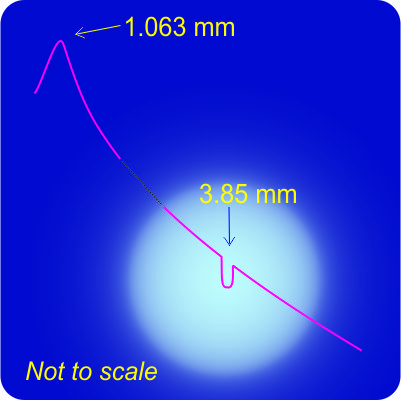
“How’d that make a difference?”Blackbody spectrum with notch

“A ground state hydrogen atom’s lowest available empty energy level is way above what a CMB photon could supply.  Those Dark Age atoms were essentially transparent to the prevailing electromagnetic radiation.  But when starlight came along it excited some atoms so that they could also absorb CMB light.  See the notch on the long-wavelength side of this blackbody curve?  It marks the shadow of starlit hydrogen clouds against the CMB’s glow.  The notch wavelength indicates when the absorption started.  Its position suggests that some stars lit up as early as 180 million years after the Big Bang.”

“Suggests, huh?”

“Mm-hm.  There are other interpretations.  That’s where the fun comes in, both on the theory side and the get-more-data side.  Like looking at different times.”

“Different times?”

“Every wavelength represents a different stretch factor and a different depth into the past.”

~~ Rich Olcott

Terzetto for Rubber Ruler

ruler and sodium lines“So you’re telling me, Cathleen, that you can tell how hot a star is by looking at its color?”

“That’s right, Vinnie.  For most stars their continuous spectrum is pretty close to the blackbody equation tying peak wavelength to temperature.”

“But you can’t do that with far-away stars, right, because the further they are, the more stretched-out their lightwaves get.  Won’t that mess up the peak wavelength?”

“The key is Kirchhoff’s other kinds of spectrum.”

“You’re talking the bright-line and dark-line kinds.”

“Exactly.  Each kind of spectrum comes from a different process — each is affected differently by the object in question and the environment it’s embedded in.  A continuous spectrum is all about charged particles moving randomly in response to the heat energy they’re surrounded by.  It doesn’t matter what kind of particles they are or even whether they’re positive or negative.  Whenever a particle changes direction, it twitches the electromagnetic field and gives off a wave.”

“Right — the higher the temperature the less time between twitches; the wave can’t move as far before things change so the wavelength’s shorter; any speed’s possible so you can turn that dial wherever; I got all that.  So what’s different with the bright-line and dark-line spectrums?”

Cathleen and I both blurt out, “Spectra!” at the same time and give each other a look.  We’re grown-ups now.  We don’t say, “Jinx!” to each other any more.

“Alright, spectra.  But how’re they different?”

I pick up the story.  “Like Cathleen said, continuous spectra from same–temperature stuff look identical no matter what kind of stuff’s involved because heat is motion and each particle moves as a unit  The other kinds of spectrum are about transitions within particles so they’re all about which kind of stuff.  A given kind of atom can only absorb certain wavelengths of light and it can only relax by giving off exactly the same wavelengths.  There’s no in-betweens.”

She cuts in.  “Sodium, for instance.  It has two strong lines in the yellow, at 588.995 and 589.592 nanometers.  Whether in a star or a meteor or fireworks, sodium gives off exactly those colors.  Conversely, in an interstellar cloud or in a star’s outermost layers sodium absorbs exactly those colors from any continuous-spectrum light passing through.”

I’m back in.  “And there’s the key to your unmixing question, Vinnie.  We’ve talked about frames, remember?  Your far-away star’s light-generating layers emit a continuous spectrum that describes its temperature.  If we were right next to it, that’s the spectrum we’d see.  But as you say, we’re a long way away and in our frame the light’s been stretched.  It still looks like the black-body curve but it’s red-shifted because of our relative motion.”

Cathleen’s turn.  “But if there are sodium atoms in the star’s upper layers, their absorptions will cut a pair of notches in that emitted spectrum.  It won’t be a smooth curve, there’ll be two sharp dips in it, close together, with the blue-side one twice as strong as the other one.  Easy to recognize and measure the redshift.  The blackbody peak is redshifted by exactly the same amount so with some arithmetic you’ve got the peak’s original wavelength and the star’s temperature.”

Mine.  “See, because we know what the sodium wavelengths were in the star’s frame, we can divide the dip wavelengths we measure by the rest-frame numbers we know about.  The ratios give us the star’s redshift.”

Spectrum with only blackbody and sodium Cathleen turns to her laptop and starts tapping keys.  “Let’s do an example.  Suppose we’re looking at a star’s broadband spectrogram.  The blackbody curve peaks at 720 picometers.  There’s an absorption doublet with just the right relative intensity profile in the near infra-red at 1,060,190 and 1,061,265 picometers.  They’re 1,075 picometers apart.  In the lab, the sodium doublet’s split by 597 picometers.  If the star’s absorption peaks are indeed the sodium doublet then the spectrum has been stretched by a factor of 1075/597=1.80.  Working backward, in the star’s frame its blackbody peak must be at 720/1.80=400 picometers, which corresponds to a temperature of about 6,500 K.”

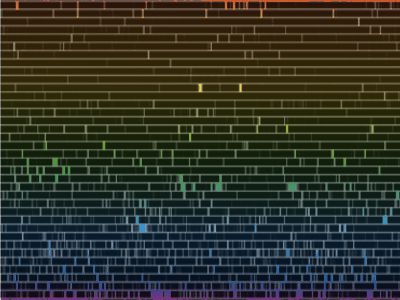
“Old Reliable calculates from that stretch factor and the Hubble Constant the star’s about ten billion lightyears away and fleeing at 240,000 km/s.”

“All that from three peaks.  Spectroscopy’s pretty powerful, huh?”

Cathleen and me: “For sure!    Jinx!”

~~ Rich Olcott

Trio for Rubber Ruler

“It’s all about how lightwaves get generated and then what happens.”

Sy and me talked about that, Cathleen.  Lightwaves come from jiggling electrons, right?”

“Any kind of charged particles, Vinnie, but there’s different ways that can happen.  Each leads to its own kind of spectrum.”

“Different kinds of spectrum?  Do you mean like visible versus infrared and ultraviolet, Cathleen?”

“No, I don’t, Sy.  I’m referring to the thing’s overall appearance in every band.  A hundred and fifty years ago Kirchoff pointed out that light from a source can have lines of color, lines without color, or a smooth display without lines.”

“Like that poster that Al put up between the physicist and astronomer corners?”  (We’re still chatting at a table in Al’s coffee shop.  I’m on my fourth scone.)

Astroruler with solar spectrum
Based on N.A.Sharp, NOAO/NSO/Kitt Peak FTS/AURA/NSF

“Kind of.  That’s based on a famous image created at Kitt Peak Observatory.  In the background there you see a representation of what Kirchoff called a continuous or black-body spectrum, where all the colors fade smoothly into each other in classic rainbow order.  You’re supposed to ignore the horizontal dark lines.”

“And the vertical lines?”

“They form what Kirchoff called an absorption spectrum.  Each dark vertical represents an isolated color that we don’t get from the Sun.”

“You’re saying we get all the other colors but them, right?”

“Exactly, Vinnie.  The Sun’s chromosphere layer filters those specific wavelengths before they get from the deeper photosphere out into space.”

“Complicated filter.”

“Of course.  The Sun contains most of the elements lighter than nickel.  Each kind of atom absorbs its own collection of frequencies.”

“Ah, that’s the quantum thing that Sy and me talked about, right, Sy?”

“Mm-hm.  We only did the hydrogen atom, but the same principles apply.  An electromagnetic wave tickles an atom.  If the wave delivers exactly the right amount of energy, the atom’s chaotic storm of electrons resonates with the energy and goes a different-shaped storm.  But each kind of atom has a limited set of shapes.  If the energy doesn’t match the energy difference between a pair of levels, there’s no absorption and the wave just passes by.”

“But I’ll bet the atom can’t hold that extra energy forever.”

“Good bet, Vinnie.  The flip side of absorption is emission.  I expect that Cathleen has an emission spectrum somewhere on her laptop there.”Emission spectrum“You’re right, Sy.  It’s not a particularly pretty picture, but it shows that nice strong sodium doublet in the yellow and the broad iron and hydrogen lines down in the green and blue.  I’ll admit it, Vinnie, this is a faked image I made to show my students what the solar atmosphere would look like if you could turn off the photosphere’s continuous blast of light.  The point is that the atoms emit exactly the same sets of colors that they absorb.”
“You do what you gotta do, Cathleen.  But tell me, if each kind of atom does only certain colors, where’s that continuous rainbow come from?  Why aren’t we only getting hydrogen colors?”

“Kirchoff didn’t have a clue on that, Vinnie.  It took 50 years and Einstein to solve it.  Not just where the light comes from but also its energy-wavelength profile.”

“So where does the light come from?”

“Pure heat.  You can get a continuous spectrum from a hot wire, molten lava, a hole through the wall of a hot oven, even the primordial chaos of the Big Bang.  It doesn’t matter what kind of matter you’re looking at, the profile just depends on the temperature.  You know that temperature measures the kinetic energy stored in particle random motion, Vinnie?”

“Well, I wouldn’t have put it that way, but yeah.”

“Well, think about the Sun, just a big ball of really hot atoms and electrons and nuclei, all bouncing off each other in frantic motion.  Every time one of those changes direction it affects the electromagnetic field, jiggles it as you say.  The result of all that jiggling is the continuous spectrum.  Absorption and emission lines come from electrons that are confined to an atom, but heat motion is unconfined.”

“How about hot metal?”

“The atoms are locked in their lattice, but heat jiggles the whole lattice.”

~~ Rich Olcott

The Speeds of Light

“I don’t give up easy, Sy.”

“I know that, Vinnie.  Still musing about lightwaves and how they’re all an electron’s fault?”

“Yeah.  Hey, can your OVR app on Old Reliable grab a shot from this movie running on my smartphone?”

“We can try … got it.  Now what?”

“I wanna try mixing that with your magnetic field picture.”

“I’ll bring that up … Here, have at it.”

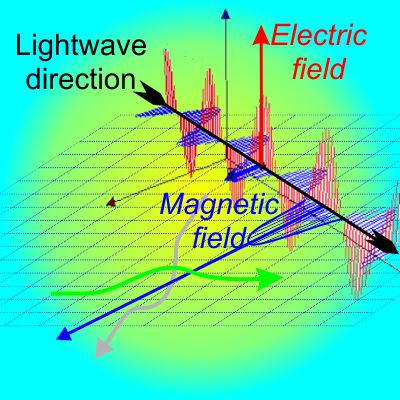
“Umm … Nice app, works very intuitive-like …  OK, see this?”Electrons and lightwave

“Ah.  It’s a bit busy, walk me through what’s in there.”

“OK. First we got the movie’s lightwave.  The ray’s running along that black arrow, see?  Some electron back behind the picture is going up and down to energize the ray and that makes the electric field that’s in red that makes other electrons go up and down, right?”

“That’s the red arrow, hmm?”

“Yeah, that electron got goosed ’cause it was standing in the way.  It follows the electric field’s direction.  Now help me out with the magnetic stuff.”

“Alright.  The blue lines represent the lightwave’s magnetic component.  A lightwave’s magnetic field lines are always perpendicular to its electric field.  Magnetism has no effect on uncharged particles or motionless charged particles.  If you’re a moving charged particle, say an electron, then the field deflects your trajectory.”

“This is what I’m still trying to wrap my head around.  You say that the field’s gonna push the particle perpendicular to the field and to the particle’s own vector.”

“That’s exactly what happens.  The green line, for instance, could represent an electron that crossed the magnetic field.  The field deflected the electron’s path upwards, crossways to the field and the electron’s path.  Then I suppose the electron encountered the reversed field from the lightwave’s following cycle and corrected course again.”

“And the grey line?”

“That’d be an electron crossing more-or-less along the field.  According to the Right Hand Rule it was deflected downward.”

“Wait.  We’ve got two electrons on the same side of the field and they’re deflected in opposite directions then correct back.  Doesn’t that average out to no change?”

“Not quite.  The key word is mostly.  Like gravity fields, electromagnetic fields get weaker with distance.  Each up or down deflection to an electron on an outbound path will be smaller than the previous one so the ‘course corrections’ get less correct.  Inbound electrons get deflected ever more strongly on the way in, of course, but eventually they become outbound electrons and get messed up even more.  All those deflections produce an expanding cone of disturbed electrons along the path of the ray.”

“Hey, but when any electron moves that changes the fields, right?  Wouldn’t there be a cone of disturbed field, too?”

“Absolutely.  The whole process leads to several kinds of dispersion.”

“Like what?”

“The obvious one is simple geometry.  What had been a simple straight-line ray is now an expanding cone of secondary emission.  Suppose you’re an astronomer looking at a planet that’s along that ray, for instance.  Light’s getting to you from throughout the cone, not just from the straight line.  You’re going to get a blurred picture.”

“What’s another kind?”

“Moving those electrons around extracts energy from the wave.  Some fraction of the ray’s original photons get converted to lower-energy ones with lower frequencies.  The net result is that the ray’s spectrum is spread and dispersed towards the red.”

“You said several kinds.”

“The last one’s a doozy — it affects the speeds of light.”

“‘Speeds,’ plural?”ripples in a wave

“There’s the speed of field’s ripples, and there’s the speed of the whole signal, say when a star goes nova.  Here’s a picture I built on Old Reliable.  The gold line is the electric field — see how the ripples make the red electron wobble?  The green dots on the axis give you comparison points that don’t move.  Watch how the ripples move left to right just like the signal does, but at their own speed.”

“Which one’s Einstein’s?”

“The signal.  Its speed is called the group velocity and in space always runs 186,000 mph.  The ripple speed, technically it’s the phase velocity, is slower because of that extracted-and-redistributed-energy process.  Different frequencies get different slowdowns, which gives astronomers clues about the interstellar medium.”

“Clues are good.”

~~ Rich Olcott