Time And The Egg

I unlock my office door and there’s Vinnie in the client chair flipping a coin from hand to hand. If my building ever switches to digital locks he’d take it as a challenge. “Morning, Vinnie.”

“Morning, Sy. Been reading your multiverse series and something you said bothered me.”

“What’s that?”

“Back when you wrote up your anti-Universe idea that some other group had come up with first—”

“Don’t remind me.”

“—you mentioned how time going backwards makes for negative energy, like that’s obvious. It ain’t obvious to me.”

“Okay … Ah. What word keeps coming up in our black hole discussions?”

“Geez, frames again? Universes ain’t black holes.”

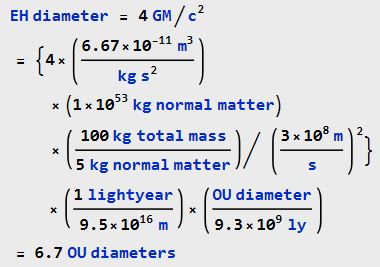
“Don’t be so sure. Suppose there’s a black hole Event Horizon that encloses our entire Observable Universe. An Event Horizon’s diameter depends on how much mass it has inside. Astronomy’s given us an estimate of how much normal matter our Observable Universe contains. I adjusted that number upward to account for the expected quantity of dark matter plus dark energy’s equivalent mass. When I plugged that grand total into Schwarzchild’s formula for the diameter of an Event Horizon, the result was about seven times wider than what we can observe. We could be inside a huge black hole but we’ll never know either way.”

“Whoa! Wouldn’t we notice a drift towards the singularity at its middle?”

“Not if we’re reasonably far out or if the drift rate is tiny compared to the slow chaos of intergalactic space. Mind you, it took us centuries to develop the technology that told us we’re inside the Milky Way and two‑thirds of the way out from the core.”

“We used frames for thinking about going really fast or being outside a black hole. Now we’re inside one or maybe not. How’s frames gonna help us with that?”

“Well, not the inertial frames where we compared relativistic observers, but the idea is similar. A traveler in an intense gravity field experiences slower time in its inertial frame than a distant partner does in theirs. Clocks appear to run weirdly if they’re compared between separate frames whose relative velocities are near lightspeed.”

“Yeah, that’s what we said.”

“Now picture two observational frames, one here in our Universe and one in the anti‑Universe if there is one. Time in the two frames flows in opposite directions away from the Big Bang between them. The two‑frames notion is a convenient way to think about consequences. Negative energy is one.”

“Now we’re getting somewhere. So give.”

“Well, what does energy do?”

“It makes things happen.”

“Negative energy does, too, considered from inside its frame. Looking from our frame, though, negative energy makes things unhappen. This spoon on our table has gravitational potential energy relative to the floor, right?”

“Yeah, you push it over the edge it’ll fall down.”

“But looking from our frame at a similar situation in the anti‑Universe running on anti‑time, an anti‑spoon on its floor has negative gravitational potential energy. We’d see it fall up to its table. Make sense?”

“Gimme a minute.” <pause> “Kinda hard to visualize but I’m starting to get there.” <longer pause> “Alright, you know I hate equations but even I know about Einstein’s E=mc². That is a square so it’s always positive so if E is negative then the mass gotta be negative, too.”

“From our frame all mass in the anti‑Universe looks negative. Negative mass would attract negative mass just like positive mass attracts positive mass here. Gravity in the anti‑Universe would work exactly the same way as our gravity does, so where’s the problem?”

“Gimme another minute.” <more pausing> “Suppose that spoon was an anti‑egg. You’re sayin’ when it goes splat over there, we’re gonna see it unsplat? Unsplatting uses up entropy. How about the ‘Entropy always increases‘ rule?”

“Right on the unsplat, wrong on the other. The full statement of Thermodynamics’ Second Law says that entropy never decreases in an isolated system. You can’t get much more isolated than being a separate Universe — no inputs of energy or matter from our Universe or anywhere else, right? From our frame, it looks like the anti‑Universe flipped the Second Law but that’s only because we’re using the wrong clock.”

~~ Rich Olcott

Noodles or A Sandwich?

“Wait, Sy, your anti-Universe idea says there are exactly two um, sub‑Universes. Even the word ‘multiverse‘ suggests more than that.”

“You’re right, Susan, most of the multiverse proposals go to the other extreme. Maybe the most extreme version grew in reaction to one popular interpretation of quantum theory. Do you know about the ‘Many Worlds‘ notion?”

“Many Worlds? Is that the one about when I decide between noodles for lunch or a sandwich, the Universe splits and there’s one of me enjoying each one?”

“That’s the popular idea. The physics idea is way smaller, far bigger and even harder to swallow. Physicists have been arguing about it for a half‑century.”

“Come again? Smaller AND bigger?”

“Smaller because it’s a quantum‑based idea about microscopic phenomena. Doesn’t say anything about things big enough to touch. Remember how quantum calculations predict statistics, not exact values? They can’t give you anything but averages and spreads. Einstein and Bohr had a couple of marquee debates about that back in the 1930s. Bohr maintained that our only path to understanding observations at the micro‑scale was to accept that events there are random and there’s no point discussing anything deeper than statistics. Einstein’s position was that the very fact that we’re successfully using an average‑based strategy says that there must be finer‑grained phenomena to average over. He called it ‘the underlying reality.’ The string theory folks have chased that possibility all the way down to the Planck‑length scale. They’ve found lots of lovely math but not much else. Hugh Everett had a different concept.”

“With that build‑up, it’d better have something to do with Many Worlds.”

“Oh, it does. Pieces of the idea have been lying around for centuries, but Everett pulled them all together and dressed them up in a quantum suit. Put simply, in his PhD thesis he showed how QM’s statistics can result from averaging over Universes. Well, one Universe per observation, but you experience a sequence of Universes and that’s what you average over.”

“How can you show something like that?”

“By going down the rabbit hole step by step and staying strictly within the formal QM framework. First step was to abstractify the operation of observing. He said it’s a matter of two separate systems, an observer A and a subject B. The A could be a person or electronics or whatever. What’s important is that A has the ability to assess and record B‘s states and how they change. Given all that, the next step is to say that both A and B are quantized, in the sense that each has a quantum state.”

“Wait, EACH has a quantum state? Even if A is a human or a massive NMR machine?”

“That’s one of the hard‑to‑swallows, but formally speaking he’s okay. If a micro‑system can have a quantum state then so can a macro‑system made up of micro‑systems. You just multiply the micro‑states together to get the macro‑state. Which gets us to the next step — when A interrogates B, the two become entangled. We then can only talk about the combined quantum state of the A+B system. Everett referred to an Einstein quote when he wrote that a mouse doesn’t change the Moon by looking at it, but the Moon changes the mouse. The next step’s a doozy so take a deep breath.”

“Ready, I suppose.”

B could have been in any of its quantum states, suppose it’s #10. After the observation, A+B must be an entangled mixture of whatever A was, combined with each of B‘s possible final states. Suppose B might switch to #42. Now we can have A+B(#42), separate from a persisting A+B(#10), plus many other possibles. As time goes by, A+B(#42) moves along its worldline independent of whatever happens to A+B(#10).”

“If they’re independent than each is in its own Universe. That’s the Many Worlds thing.”

“Now consider just how many worlds. We’re talking every potential observing macro‑system of any size, entangled with all possible quantum states of every existing micro‑system anywhere in our Observable Universe. We’re a long way from your noodles or sandwich decision.”

“An infinity of infinities.”

“Each in its own massive world.”

“Hard to swallow.”

~~ Rich Olcott

The Frame Game

A familiar footstep outside my office, “C’mon in, Vinnie, the door’s open.”

“Hi, Sy, how ya doin’?”

“Can’t complain. Yourself?”

“Fine, fine. Hey, I been thinking about something you said while Al and us were talking about rockets and orbits and such. You remember that?”

“We’ve done that in quantity. What statement in particular?”

“It was about when you’re in the ISS, you still see like 88% of Earth’s gravity. But I seen video of those astronauts just floating around in the station. Seems to me those two don’t add up.”

“Hah! We’re talking physics of motion here. What’s the magic word?”

“You’re saying it’s frames? I thought black holes did that.”

“Black holes are an extreme example, but frame‑thinking is an essential tool in analyzing any kind of relative motion. Einstein’s famous ‘happy thought‘ about a man in a free‑falling elevator—”

“Whoa, why is that a happy thought? I been nervous about elevators ever since that time we got stuck in one.”

“At least it wasn’t falling, right? Point is, the elevator and whoever’s in it agree that Newton’s First Law of Motion is valid for everything they see in there.”

“Wait, which Law is that?”

“‘Things either don’t move or else they move at a steady pace along a straight line.’ Suppose you’re that guy—”

“I’d rather not.”

“… and the elevator is in a zero‑gravity field. You take something out of your pocket, put it the air in front of you and it stays there. You give it a tap and it floats away in a straight line. Any different behavior means that your entire frame — you, the elevator and anything else in there — is being accelerated by some force. Let’s take two possibilities. Case one, you and the elevator are resting on terra firma, tightly held by the force of gravity.”

“I like that one.”

“Case two, you and the elevator are way out in space, zero‑gravity again, but you’re in a rocket under 1-g acceleration. Einstein got happy because he realized that you’d feel the same either way. You’d have no mechanical way to distinguish between the two cases.”

“What’s that mean, mechanical?”

“It excludes sneaky ways of outside influence by magnetic fields and such. Anyhow, Einstein’s insight was key to extending Newton’s First Law to figuring acceleration for an entire frame. Like, for instance, an orbiting ISS.”

“Ah, you’re saying that floating astronauts in an 88% Earth-gravity field is fine because the ISS and the guys share the frame feeling that 88% but the guys are floating relative to that frame. But down here if we could look in there we’d see how both kinds of motion literally add up.”

“Exactly. It’s just much easier to think about only one kind at a time.”

“Wait. You said the ISS is being accelerated. I thought it’s going a steady 17500 miles an hour which it’s got to do to stay 250 miles up.”

“Is it going in a straight line?”

“Well, no, it’s going in a circle, mostly, except when it has to dodge some space junk.”

“So the First Law doesn’t apply. Acceleration is change in momentum, and the ISS momentum is constantly changing.”

“But it’s moving steady.”

“But not in a straight line. Momentum is a vector that points in a specific direction. Change the direction, you change the momentum. Newton’s Second Law links momentum change with force and acceleration. Any orbiting object undergoes angular acceleration.”

“Angular acceleration, that’s a new one. It’s degrees per second per second?”

“Yup, or radians. There’s two kinds, though — orbiting and spinning. The ISS doesn’t spin because it has to keep its solar panels facing the Sun.”

“But I’ve seen sci-fi movies set in something that spins to create artificial gravity. Like that 2001 Space Odyssey where the guy does his running exercise inside the ship.”

“Sure, and people have designed space stations that spin for the same reason. You’d have a cascade of frames — the station orbiting some planet, the station spinning, maybe even a ballerina inside doing pirouettes.”

“How do you calculate all that?”

“You don’t. You work with whichever frame is useful for what you’re trying to accomplish.”

“Makes my head spin.”

~~ Rich Olcott

Imagine A Skyrocket Inside A Black Hole

Vinnie’s never been a patient man. “We’re still waiting, Sy. What’s the time-cause-effect thing got to do with black holes and information?”

“You’ve got most of the pieces, Vinnie. Put ’em together yourself.”

“Geez, I gotta think? Lessee, what do I know about black holes? Way down inside there’s a huge mass in a teeny singularity space. Gravity’s so intense that relativity theory and quantum mechanics both give up. That can’t be it. Maybe the disk and jets? No, ’cause some holes don’t have them, I think. Gotta be the Event Horizon which is where stuff can’t get out from. How’m I doing, Sy?”

“You’re on the right track. Keep going.”

“Okay, so we just talked about how mass scrambles spacetime, tilts the time axis down to point towards where mass is so axes stop being perpendicular and if you’re near a mass then time moves you even closer to it unless you push away and that’s how gravity works. That’s part of it, right?”

“As rain. So mass and gravity affect time, then what?”

“Ah, Einstein said that cause‑and‑effect runs parallel with time ’cause you can’t have an effect before what caused it. You’re saying that if gravity tilts time, it’ll tilt cause‑and‑effect?”

“So far as we know.”

“That’s a little weasel-ish.”

“Can’t help it. The time‑directed flow of causality is a basic assumption looking for counter‑examples. No‑one’s come up with a good one, though there’s a huge literature of dubious testimonials. Something called a ‘closed timelike curve‘ shows up in some solutions to Einstein’s equations for extreme conditions like near or inside a black hole. Not a practical concern at our present stage of technology — black holes are out of reach and the solutions depend on weird things like matter with negative mass. So anyhow, what happens to causality where gravity tilts time?”

“I see where you’re going. If time’s tilted toward the singularity inside a black hole, than so is cause‑and‑effect. Nothing in there can cause something to happen outside. Hey, bring up that OVR graphics app on Old Reliable, I’ll draw you a picture.”

“Sure.”

“See, way out in space here this circle’s a frame where time, that’s the red line, is perpendicular to the space dimensions, that’s the black line, but it’s way out in space so there’s no gravity and the black line ain’t pointing anywhere in particular. Red line goes from cause in the middle to effect out beyond somewhere. Then inside the black hole here’s a second frame. Its black line is pointing to where the mass is and time is tilted that way too and nothing’s getting away from there.”

“Great. Now add one more frame right on the border of your black hole. Make the black line still point toward the singularity but make the red line tangent to the circle.”

“Like this?”

“Perfect. Now why’d we put it there?”

“You’re saying that somewhere between cause-effect going wherever and cause-effect only going deeper into the black hole there’s a sweet spot where it doesn’t do either?”

“Exactly, and that somewhere is the Event Horizon. Suppose we’re in a mothership and you’re in our shuttlecraft in normal space. You fire off a skyrocket. Both spacecraft see sparks going in every direction. If you dive below an Event Horizon and fire another skyrocket, in your frame you’d see a normal starburst display. If we could check that from the mothership frame, we’d see all the sparks headed inward but we can’t because they’re all headed inward. All the sparkly effects take place closer in.”

“How about lighting a firework on the Horizon?”

“Good luck with that. Mathematically at least, the boundary is infinitely thin.”

“So bottom line, light’s trapped inside the black hole because time doesn’t let the photons have an effect further outward than they started. Do I have that right?”

“For sure. In fact, you can even think of the hole as an infinite number of concentric shells, each carrying a causality sign reading ‘Abandon hope, all ye who enter here‘. So what’s that say about information?”

“Hah, we’re finally there. Got it. Information can generate effects. If time can trap cause‑effect, then it can trap information, too.”

~~ Rich Olcott

Tilting at Black Holes

“What’s the cause-effect-time thing got to do with black holes and information?”

“We’re getting there, Al. What happens to spacetime near a black hole?”

“Everybody knows that, Sy, spacetime gets stretched and squeezed until there’s infinite time dilation at the Event Horizon.”

“As usual, Vinnie, what everybody knows isn’t quite what is. Yes, Schwarzschild’s famous solution includes that Event Horizon infinity but it’s an artifact of his coordinate system. Al, you know about coordinate systems?”

“I’m a star-watcher, Sy. Sure, I know about latitude and longitude, declination and right ascension, all that stuff no problem.”

“Good. Well, Einstein wrote his General Relativity equations using generalized coordinates, like x,y,z but with no requirement that they be straight lines or at right angles. Schwarzschild solved the equations for a non‑rotating sphere so naturally he used spherical coordinates — radius, latitude and longitude. Since then other people have solved the equations for more complicated cases using more complicated coordinate systems. Their solutions don’t have that infinity.”

“No infinity?”

“Not that one, anyhow. The singularity at the hole’s geometric center is a real thing, not an artifact. So’s a general Event Horizon, but it’s not quite where Schwarzschild said it should be and it doesn’t have quite the properties that everybody thinks they know it has. It’s still weird, though.”

“How so?”

“First thing you have to understand is that when you get close to a black hole, you don’t feel any different. Except for the spaghettification, of course.”

“It’s frames again, ain’t it?”

“With black holes it’s always frames, Vinnie. If you’re living in a distorted space you won’t notice it. Whirl a meter‑long sword around, you’d always see it as a meter long. A distant observer would see you and everything around you as being distorted right along with your space. They’ll see that sword shrink and grow as it passes through different parts of the distortion.”

“Weird.”

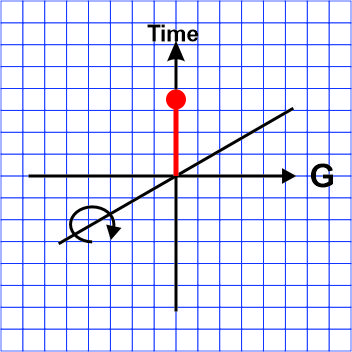
“We’re just getting started, Al. Time’s involved, too. <grabbing a paper napkin and sketching> Here’s three axes, just like x,y,z except one’s time, the G one points along a gravity field, and the third one is perpendicular to the other two. By the way, Al, great idea, getting paper napkins printed like graph paper.”

“My location’s between the Physics and Astronomy buildings, Sy. Gotta consider my clientele. Besides, I got a deal on the shipment. What’s the twirly around that third axis?”

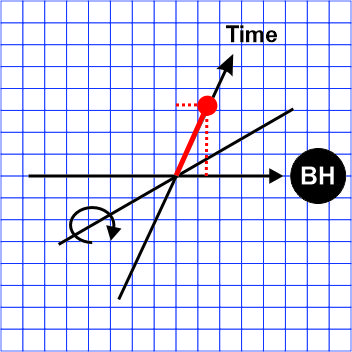
“It’s a reminder that there’s a couple of space dimensions that aren’t in the picture. Now suppose the red ball is a shuttlecraft on an exploration mission. The blue lines are its frame. The thick vertical red line shows it’s not moving because there’s no spatial extent along G. <another paper napkin, more sketching> This second drawing is the mothership’s view from a comfortable distance of the shuttlecraft near a black hole.”

“You’ve got the time axis tilted. What’s that about?”

“Spacetime being distorted by the black hole. You’ve heard Vinnie and me talk about time dilation and space compression like they’re two different phenomena. Thing is, they’re two sides of the same coin. On this graph that shows up as time tilted to mix in with the BH direction.”

“How about those twirly directions?”

“Vinnie, you had to ask. In the simple case where everything’s holding still and you’re not too close to the black hole, those two aren’t much affected. If the big guy’s spinning or if the Event Horizon spans a significant amount of your sky, all four dimensions get stressed. Let’s keep things simple, okay?”

“Fine. So the time axis is tilted, so what?”

“We in the distant mothership see the shuttlecraft moving along pure tilted time. The shuttlecraft doesn’t. The dotted red lines mark its measurements in its blue‑line personal frame. Shuttlecraft clocks run slower than the mothership’s. Worse, it’s falling toward the black hole.”

“Can’t it get away?”

“Al, it’s a shuttlecraft. It can just accelerate to the left.”

“If it’s not too close, Vinnie. The accelerative force it needs is the product of both masses, divided by the distance squared. Sound familiar?”

“That’s Newton’s Law of Gravity. This is how gravity works?”

“General Relativity cut its teeth on describing that tilt.”

~~ Rich Olcott

Holes in A Hole?

Mid-afternoon coffee break time so I head over to Al’s coffee shop. Vinnie’s at his usual table by the door, fiddling with some spilled coffee on the table top. I notice he’s pulled some of it into a ring around a central blob. He looks at it for a moment. His mental gears whirl then he looks up at me. “Hey Sy! Can you have a black hole inside another black hole?”

“That’s an interesting question. Quick answer is, ‘No.’ Longer answer is, ‘Sort of, maybe, but not the way you’re thinking.’ You good with that, Vinnie?”

“You know me better than that, Sy. Pull up a chair and give.”

I wave at Al, who brings me a mug of my usual black mud. “Thanks, Al. You heard Vinnie’s question?”

“Everyone on campus did, Sy. Why the wishy-washy?”

“Depends on your definition of black hole.”

Sky-watcher Al is quick with a response. “It’s a star that collapsed denser than a neutron star.”

Vinne knows me and black holes better than that. “It’s someplace where gravity’s so strong that nothing can get out, not even light.”

“Both right, as far as they go, but neither goes deep enough for Vinnie’s question.”

“You got a better one, I suppose?”

“I do, Vinnie. My definitition is that a black hole is a region of spacetime with such intense gravitation that it wraps an Event Horizon around itself. Al’s collapsed star is one way to create one, but that probably doesn’t account for the Event Horizons around supermassive black holes lurking in galactic cores. Your ‘nothing escapes‘ doesn’t say anything about conditions inside.”

“Thought we couldn’t know what happens inside.”

“Mostly correct, which is why your question is as problematical as you knew it was. Best I can do is lay out possibilities, okay? First possibility is that the outer black hole forms around a pre-existing inner one.”

“Can they do that?”

“In principle. What makes a black hole is having enough mass gathered in close proximity. Suppose you have a black hole floating our there in space, call it Fred, and a neutron star comes sidling by. If the two bodies approach closely enough, the total amount of mass could be large enough to generate a second Event Horizon shell enclosing both of them. How long that’d last is another matter.”

“The outer shell’d go away?”

“No chance of that. Once the shell’s created, the mass is in there and the star is doomed … unless the star’s closest approach matches Fred’s ISCO. That’s Innermost Stable Circular Orbit, about three times Fred’s Event Horizon’s half-diameter if Fred’s not rotating. Then the two bodies might go into orbit around their common center of gravity.”

“How’s rotation come into this?”

“If the mass is spinning, then you’ve got a Kerr black hole, frame-dragging and an ISCO each along and against the spin direction. Oh, wait, I forgot about tidal effects.”

“Like spaghettification, right.”

“Like that but it could be worse. Depending on how tightly neutronium holds itself together, which we don’t know, that close approach might be inside the Roche limit. Fred’s gravity gradient might simply shred the star to grow the black hole’s accretion disk.”

“Grim. You said there’s other possibilities?”

“Sorta like the first one, but suppose the total mass comes from two existing black holes, like the collision that LIGO picked up accidentally back in 2014. Suppose each one is aimed just outside the other’s ISCO. Roche fragmentation wouldn’t happen, I think, because each body’s contents are protected inside its own personal Event Horizon. Uhh … darn, that scheme won’t work and neither will the other one.”

“Why not?”
 ”Why not?”

“Because the diameter of an Event Horizon is proportional to the enclosed mass. The outer horizon’s diameter for the case with two black holes would be exactly the sum of the diameters of the embedded holes. If they’re at ISCO distances apart they’re can’t be close enough to form the outer horizon. For the same reason, I don’t think a neutron star could get close enough, either.”

“No hole in a hole, huh?”

“I’m afraid not.”

~~ Rich Olcott

  • Thanks to Alex and Xander, who asked the question.

Constant’s Companion

“It’s like Mark Twain said, Jeremy — ‘History may not repeat itself, but it rhymes.‘ Newton identified gravity as a force; Einstein proposed the Cosmological Constant. Newton worked the data to develop his Law of Gravity; Friedmann worked Einstein’s theory to devise his model of an exponentially expanding Universe. Newton was uncomfortable with gravity’s ability to act at a distance; Einstein called the Cosmological Constant ‘his greatest blunder.’ The parallels go on.”

“Why didn’t Einstein like the Constant if it explains how the Universe is expanding?”

“It wasn’t supposed to. Expanding Universes weren’t in fashion a century ago when Einstein wrote that paper. At the time everyone including Einstein thought we live in a steady state universe. His first cut at a General Relativity field equation implied a contracting universe so he added a constant term to balance out the contraction even though it made the dynamics look unstable — the Constant had to have just the right value for stability. A decade later Hubble’s data pointed to expansion and Friedman’s equations showed how that can happen.”

“I guess Einstein was embarrassed about that, huh, Mr Moire?”

“Well, he’d thought all along that the Constant was mathematically inelegant. Besides, the Constant isn’t just a number or a term in an equation, it’s supposed to represent a real process in operation. Like Newton’s problem with gravity, Einstein couldn’t identify a mechanism to power the Constant.”

“Power it to do what?”

“Think about universal constants, like the speed of light or the electron charge. Doesn’t matter where you are or how fast you’re traveling in which inertial frame, they’ve got the same values. If the Constant is indeed a constant, it contributes equally to cosmological dynamics from every position in space, whether inside a star or millions of lightyears from any galaxy. Every point must exert the same outward force in every direction or there’d be swirling. And it multiplies — every instant of general expansion makes new points in between the old points and they’ll exert the same force, too.”

“That’s what makes it exponential, right?”

“Good insight. It’s a pretty weak force per unit volume, weaker than gravity. We know that because galaxies and galaxy cluster structures maintain integrity even as they’re drifting apart from each other. Even so, a smidgeon of force from each unit volume in space adds up to a lot of force. Multiply force by distance traveled — that’s a huge amount of energy spent against gravity. The big puzzle is, what’s the energy source? Most of the astrophysics community nominates dark energy to power the Cosmological Constant but that’s not much help.”

“As Dr Prather says in class, Mr Moire, ‘You sound tentative. Please expound.‘ Why wouldn’t dark energy be the power source?”

“In Physics we use the word ‘energy‘ with a very specific meaning. Yes, it gets heavy use with sloppy meanings in everything from show business to crystal therapy, but in hard science nearly every serious research program since the 18th Century has entailed quantitative energy accounting. The First Law of Thermodynamics is conservation of energy. Whenever we see something heating up, a chemical reaction running or a force being applied along a distance, physicists automatically think about the energy being expended and where that energy is coming from. Energy’s got to balance out. But the Constant breaks that rule — we have no idea what process provides that energy. Calling the source ‘dark energy‘ just gives it a name without explaining it.”

“Isn’t the missing energy source evidence against Friedmann’s and Einstein’s equations?”

“That’s a tempting option and initially a lot of researchers took it. Unfortunately, it seems that dark energy is a thing. Or maybe a lot of little things. Several different lines of evidence say that the Constant constitutes twice as much mass‑energy as all normal and dark matter combined. Worse yet, as the Universe expands that share will increase.”

“Wait, will the dark energy invade normal matter and break us up?”

“People argue about that. Normal matter’s held together by electromagnetic forces which are 1038 times stronger than gravity, far stronger yet than dark energy. Dark matter’s gravity helps to hold galaxies together, but who knows what holds dark matter together?”

~~ ROlcott

Time Is Where You Find It

A familiar footstep in the hall outside my office, “C’mon in, Vinnie, the door’s open.”

“Got a few minutes, Sy?”

More than just “a minute.” This sounds serious so I push my keyboard aside. “Sure, what’s up?”

“I’ve been thinking about different things, putting ’em together different ways. I came up with something, sorta, that I wanted to run past you before I brought it to one of Cathleen’s ‘Crazy Theories‘ parties.”

“Why, Vinnie, you’re being downright diffident. Spill it.”

“Well, it’s all fuzzy. First part goes way back to years ago when you wrote that there’s zero time between when a photon gets created and when it gets used up. But that means that create and use-up are simultaneous and that goes against Einstein’s ‘No simultaneity‘ thing which I wonder if you couldn’t get around it using time tick signals to sync up two space clocks.”

“That’s quite a mix and I see why you say it’s fuzzy. Would you be surprised if I used the word ‘frame‘ while clarifying it?”

“I’ve known you long enough it wouldn’t surprise me. Go ahead.”

“Let’s start with the synchronization idea. You’re not the first to come up with that suggestion. It can work, but only if the two clocks are flying in formation, exactly parallel course and speed.”

“Hah, that goes back to our first talk with the frame thing. You’re saying the clocks have to share the same frame like me and that other pilot.”

“Exactly. If the ships are zooming along in different inertial frames, each will measure time dilation in the other. How much depends on their relative velocities.”

“Wait, that was another conversation. We were pretending we’re in two spaceships like we’re talking about here and your clock ran slower than mine and my clock ran slower than yours which is weird. You explained it with equations but I’ve never been good with equations. You got a diagram?”

“Better than that, I’ve got a video. It flips back and forth between inertial frames for Enterprise and Voyager. We’ll pretend that they sync their clocks at the point where their tracks cross. I drew the Enterprise timeline vertical because Enterprise doesn’t move in space relative to Enterprise. The white dots are the pings it sends out every second. Meanwhile, Voyager is on a different course with its own timeline so its inertial frame is rotated relative to Enterprise‘s. The gray dots on Voyager‘s track show when that ship receives the Enterprise pings. On the Voyager timeline the pings arrive farther apart than they are on the Enterprise timeline so Voyager perceives that Enterprise is falling farther and farther behind.”

“Gimme a sec … so Voyager says Enterprise‘s timer is going slow, huh?”

“That’s it exactly. Now look at the rotated frame. The pink dots show when Voyager sends out its pings. The gray dots on Enterprise‘s track show when the pings arrive.”

“And Enterprise thinks that Voyager‘s clock is slow, just backwards of the other crew. OK, I see you can’t use sync pulses to match up clocks, but it’s still weird.”

“Which is where Lorentz and Minkowski and Einstein come into the picture. Their basic position was that physical events are real and there should be a way to measure them that doesn’t depend on an observer’s frame of reference. Minkowski’s ‘interval‘ metric qualifies. After converting time and location measurements to intervals, both crews would measure identical spacetime separations. Unfortunately, that wouldn’t help with clock synchronization because spacetime mixes time with space.”

“How about the photons?”

“Ah, that’s a misquotation. I didn’t say the time is zero, I said ‘proper time‘ and that’s different. An object’s proper time is measured by its clock in its inertial frame while traveling time t and distance d between two events. Anyone could measure t and d in their inertial frame. Minkowski’s interval is defined as s=[(ct)²‑d²]. Proper time is s/c. Intuitively I think of s/c as light’s travel time after it’s done traversing distance d. In space, photons always travel at lightspeed so their interval and proper time are always zero.”

“Photon create and use-up aren’t simultaneous then.”

“Only to photons.”

~~ Rich Olcott

Now And Then And There

Still at our table in Al’s otherwise empty coffee shop. We’re leading up to how Physics scrambled Now when a bell dings behind the counter. Al dashes over there. Meanwhile, Cathleen scribbles on a paper napkin with her colored pencils. She adds two red lines just as Al comes back with a plate of scones. “Here, Sy, if you’re going to talk Minkowski space this might be useful.”

“Hah, you’re right, Cathleen, this is perfect. Thanks, Al, I’ll have a strawberry one. Mmm, I love ’em fresh like this. OK, guys, take a look at Cathleen’s graphy artwork.”

“So? It’s the tile floor here.”

“Not even close, Mr Feder. Check the labels. The up‑and‑down label is ‘Time’ with later as higher. The diagram covers the period we’ve been sitting here. ‘Now‘ moves up, ‘Here’ goes side‑to‑side. ‘Table‘ and ‘Oven‘, different points in space, are two parallel lines. They’re lines because they both exist during this time period. They’re vertical because neither one moves from its relative spatial position. Okay?”

“Go on, Moire.”
  ”Makes sense to me, Sy.”

“Good. ‘Bell‘ marks an event, a specific point in spacetime. In this case it’s the moment when we here at the table heard the bell. I said ‘spacetime‘ because we’re treating space and time as a combined thing. Okay?”

“Go on, Moire.”
  ”Makes sense to me, Sy.”

“So then Al went to the oven and came back to the table. He traveled a distance, took some time to do that. Distance divided by time equals velocity. ‘Table‘ has zero velocity and its line is vertical. Al’s line would tilt down more if he went faster, okay?”

“Mmmm, got it, Sy.”
  ”Cute how you draw the come-back label backwards, lady. Go on, Moire.”

“I do my best, Mr Feder.”

“Fine, you’ve got the basic ideas. Now imagine all around us there’s graph paper like this — except there’s no paper and it’s a 4‑dimensional grid to account for motion in three spatial dimensions while time proceeds. Al left and returned to the same space point so his spacetime interval is just the time difference. If two events differ in time AND place there’s special arithmetic for calculating the interval.”

“So where’s that get us, Moire?”

“It got 18th and 19th Century Physics very far, indeed. Newton and everyone after him made great progress using math based on a nice stable rectangular space grid crossed with an orderly time line. Then Lorentz and Poincaré and Einstein came along.”

“Who’s Poincaré?”

“The foremost mathematician of nineteenth Century France. A mine safety engineer most days and a wide‑ranging thinker the rest of the time — did bleeding‑edge work in many branches of physics and math, even invented a few branches of his own. He put Lorentz’s relativity work on a firm mathematical footing, set the spacetime and gravity stage for Minkowsky and Einstein. All that and a long list of academic and governmental appointments but somehow he found the time to have four kids.”

“A ball of fire, huh? So what’d he do to Newton’s jungle gym?”

“Turned its steel rod framework into jello. Remember how Cathleen’s Minkowski diagram connected slope with velocity? Einstein showed how Lorentz’s relativity factor sets a speed limit for our Universe. On the diagram, that’d be a minimum slope. Going vertical is okay, that’s standing still in space. Going horizontal isn’t, because that’d be instantaneous travel. This animation tells the ‘Now‘ story better than words can.”

“Whah?”
  ”Whah?”

“We’re looking down on three space travelers and three events. Speeds below lightspeed are within the gray hourglass shape. The white line perpendicular to each traveler’s time line is their personal ‘Now‘. The travelers go at different velocities relative to us so their slopes and ‘Now‘ lines are different. From our point of view, time goes straight up. One traveler is sitting still relative to us so its timeline is marked ‘v=0‘ and parallels ours. We and the v=0 traveler see events A, B and C happening simultaneously. The other travelers don’t agree. ‘Simultaneous‘ is an illusion.”

~~ Rich Olcott

E Pluribus

Mr Feder’s a determined fault‑finder. “That gold on James Webb Space Telescope‘s mirror — it’s gonna make all its pictures look funny, yellow‑like instead of whatever the real colors are.”

Cathleen bristles a little. “We astronomers have built our science on recognizing. accounting for and overcoming instrument limitations. Hubble, for instance, went up with a mirror that had been misground so its resolution was a factor of 10 worse than it was supposed to be. It took three years for NASA to install corrective optics. In the meantime we devised a whole catalog of math and computer techniques for pulling usable data out of the mess. Anyway, JWST‘s not designed to make pretty pictures.”

“I thought it was gonna replace Hubble. If it can’t take pictures, what’re we putting it up there for?”

“It’s a successor, not a replacement. JWST is designed to answer a completely different set of questions from the ones that Hubble has been used for. I’m sure we’ll keep using Hubble for as long as it continues to operate. By the way, the Hubble pictures you’ve seen aren’t what Hubble took.”

“Bunk! I’ve seen Hubble shots of the Moon and they look just like what I see through my binocs. Same colors and everything.”

“Not much color in the Moon, Mr Feder. Just different grays except for during a lunar eclipse.”

“That’s true, Al, but the resemblance is no accident. All major telescopes including Hubble, gray‑scale is all they do. Professional and amateur scientists help out by combining and coloring those gray‑scale images.”

“Wait, how do they combine images? Back in the film days I’d forget to wind forward after taking a picture and the double exposures were always a mess.”

“Film and digital are very different technologies, Mr Feder. The sensors in your camera’s film were microscopic silver halide crystals embedded in the coating. Each photon that reached a crystal transformed one silver ion to elemental silver and darkened the image there just a bit. More photons in a particular area, more darkening. There’s no reset, so when you clicked twice on a frame the new darkening supplemented what was already there. Those silver atoms and their location on the film encoded the photos you took.”

<with a sneer> “Wooo — encoded! What’d the processing labs do, count the atoms?”

“In an analog sort of way. Your lab made positive prints by shining light through your negatives onto photosensitive paper that worked the same way as the film. Shadow from the negative’s dark silver atoms prevented silver ion darkening in the corresponding part of the paper. What was bright in the original scene came out bright in the print. And viceversa.”

“But I was taking color photos.”

“Same analog scheme but with fancier chemistry. Your color film had three photosensitive layers. Each layer was designed to record a different set of wavelengths, red, green or blue. Blue photons would darken the bluesensitive layer and so on. From then on the encoding and decoding logic worked the same, color by separate color. Your eyes combine the colors. JWST‘s cameras don’t do any of that.”

“I guess not, it being a million miles away from processing labs.”

“Right, we can only work with numbers that can be transmitted back to Earth. Modern telescopes use digital sensors, dense grids of transistorsize devices that literally count the photons that strike them. Graph how many photons hit each part of the grid during an interval and you’ve got a picture. Better yet, you can do arithmetic on the counts. That opens up a world of analytical and pictorial opportunities that were tedious or impossible with photographic data.” <opens laptop, taps keys> “Here’s a lovely example I recently received from NASA’s Astronomy Picture of the Day service. Gorgeous, hm?”

Symbiotic R Aquarii” — Image Credit: Optical (red, blue): NASA/ESA/STScI;
X-ray (purple): NASA/CXC/SAO/R. Montez et al.;
Processing: Judy Schmidt (CC BY-NC-SA)

“Wow.”
 ”Wow.”
  ”Wow.”

“Image arithmetic in action. That’s two stars in weird orbits around each other. Ms Schmidt combined two Hubble images with one from Chandra, a separate telescope looking at a different part of the spectrum. Old‑style astrophotography couldn’t do that.”

~~ Rich Olcott