
A Virial Homework Problem

“Uh, Mr Moire? Would you mind if we used Old Reliable to do the calculations on this problem about the galaxy cluster’s Virial?”

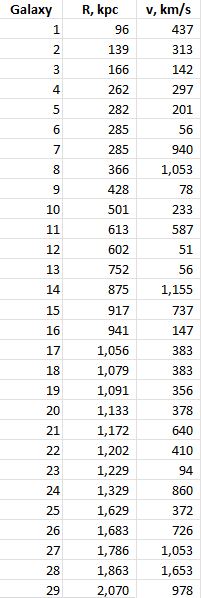
Data extracted and re-scaled from Fig 2 of Smith (1936), The Mass of the Virgo Cluster

“Mm, only if you direct the computation, Jeremy. I want to be able to face Professor Hanneken with a clear conscience if your name ever comes up in the conversation. Where do we start?”

“With the data he printed here on the other side of the problem sheet. Old Reliable can scan it in, right?”

“Certainly. What are the columns?”

“The first one’s clear. The second column is the distance between the galaxy and the center of the cluster. Professor Hanneken said the published data was in degrees but he converted that to kiloparsecs to get past a complication of some sort. The third column is, umm, ‘the relative line‑of‑sight velocity.’ I understand the line‑of‑sight part, but the numbers don’t look relativistic.”

“You’re right, they’re much smaller than lightspeed’s 300,000 km/s. I’m sure the author was referring to each galaxy’s motion relative to the other ones. That’s what the Virial’s about, after all. I’ll bet John also subtracted the cluster’s average velocity from each of the measured values because we don’t care about how the galaxies move relative to us. Okay, we’ve scanned your data. What do we do next?”

“Chart it, please, in a scatter plot. That’s always the first thing I do.”

“Wise choice. Here you go. What do we learn from this?”

“On the whole it looks pretty flat. Both fast and slow speeds are spread across the whole cluster. If the whole cluster’s rotating we’d see faster galaxies near the center but we don’t. They’re all moving randomly so the Virial idea should apply, right?”

“Mm-hm. Does it bother you that we’re only looking at motion towards or away from us?”

“Uhh, I hadn’t thought about that. You’re right, galaxy movements across the sky would be way too slow for us to detect. I guess the slowest ones here could actually be moving as fast as the others but they’re going crosswise. How do we correct for that?”

“Won’t need much adjustment. The measured numbers probably skew low but the average should be correct within a factor of 2. What’s next?”

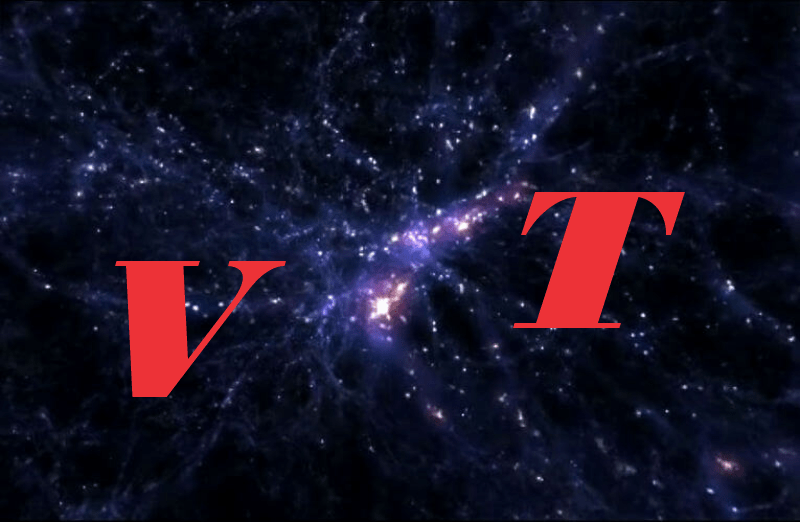
“Let’s do the kinetic energy piece T. That’d be the average of galaxy mass m times v²/2 for each galaxy. But we don’t know the masses. For that matter, the potential energy piece, V=G·M·m/R, also needs galaxy mass.”

“If you divide each piece by m you get specific energy, joules/kilogram of galaxy. That’s the same as (km/s)². Does that help?”

“Cool. So have Old Reliable calculate /2 for each galaxy, then take the average.”

“We get 208,448 J/kg, which is too many significant figures but never mind. Now what?”

“Twice T would be 416,896 which the Virial Theorem says equals the specific potential energy. That’d be Newton’s G times the cluster mass M divided by the average distance R. Wait, we don’t know M but we do know everything else so we can find M. And dividing that by the galaxy count would be average mass per galaxy. So take the average of all the R distances, times the 416,896 number, and divide that by G.”

“What units do you want G in?”

“Mmm… To cancel the units right we need J/kg times parsecs over … can we do solar masses? That’d be easier to think about than kilograms.”

“Old Reliable says G = 4.3×10⁻³ (J/kg)·pc/Mʘ. Also, the average R is … 890,751 parsecs. Calculating M=v²·R/G … says M is about 90 trillion solar masses. With 29 galaxies the average is around 3 trillion solar masses give or take a couple of factors of 2 or so.”

“But that’s a crazy number, Mr Moire. The Milky Way only has 100 billion stars.”

“Sometimes when the numbers are crazy, we’ve done something wrong. Sometimes the numbers tell us something. These numbers mutter ‘dark matter‘ but in the 1930s only Fritz Zwicky was listening.”

~~ Rich Olcott

  • Thanks again to Dr KaChun Yu for pointing out Sinclair Smith’s 1936 paper. Naturally, any errors in this post are my own.

Viral, Virial, What’s The Difference?

A young man’s knock at my office door, eager yet a bit hesitant. “C’mon in, Jeremy, the door’s open.”

“Hi, Mr Moire. Got a minute?”

“It’s slow season, Jeremy. What can I do for you?”

“It’s my physics homework, sir. Professor Hanneken asked a question that I don’t understand.”

“John’s a bit of a joker but asking unsolvable questions isn’t usually one of his things. Well, except for that one about how long it would take to play Mahler’s Piano Quartet if you had only two musicians because of budget restrictions. What’s the question?”

“He wants us to use something called ‘the viral theorem‘ to deduce things about a certain galaxy cluster. I know what viral memes are but I don’t think I’ve ever heard of a theorem that spreads like a virus. I’ve done searches on my class notes and online textbook — nothing. So what is it and how am I supposed to use it?”

“Do you have the question with you?”

“Yessir, it’s #4 on this sheet.”

“Ah, just as I thought. Read it again. The word is ‘virial,’ not ‘viral.’ Big difference.”

“I suppose, but what’s a virial then?”

“We need some context. Imagine a cluster of free‑floating objects bound together by mutual forces of attraction. No central attractor, just lots of pairwise pulling, okay?”

“What kind of forces?”

“That’s the thing, it doesn’t matter. Gravitational, electrostatic, rubber bands even. The only restriction is that the force between each pair of objects follows the same force‑distance rule. For rubber bands it’s mostly just 1/distance until you get near the elastic limit. For gravity and electrostatics the rule is that force runs as 1/distance2. Got that picture?”

<grin> “It’d be tricky rigging up those rubber bands to not get tangled. Anyhow, instead of planets around the Sun you want me to think of stars held in a cluster by each other’s gravity. Do they all have to be the same size or the same distance apart?”

“No, because of what happens next. You’re thinking right — a heavier star pulls harder than a lighter one, and two stars close together feel more mutual force than stars far apart. We account for that variation by taking an average. Multiply force times distance for every possible pairing, then divide the total by the number of objects. The averaged number is the Virial, symbol V.”

“Wait, force times distance. That’s the Physics definition of work, like pulling something up against gravity.”

“Exactly. Work is directed energy. What we’re talking about here is the amount of energy required to pull all those objects away from the center of mass or charge or whatever, out to their current positions. The Virial is the average energy per object. It’s average potential energy because it depends on position, not motion.”

“They’d release all that energy if they just fell together so why don’t … wait, they’re going all different directions so momentum won’t let them, right?”

“You’re on your way. Motion’s involved.”

“Umm … Kepler’s Law — the closer any two of them get, the faster they orbit each other … OH! Kinetic energy! When things fall, potential energy’s converted to kinetic energy. Is there an average kinetic energy that goes up to compensate for the Virial getting smaller?”

“Bingo. When you say ‘average kinetic energy‘ what quantity springs to mind?”

“Temperature. But that’s only for molecules.”

“No reason we can’t define a galactic analog. In fact, Eddington did that back in 1916 when he brought the notion from gas theory over to astrophysics. He even used ‘T‘ for the kinetic average, but remember, this T refers to kinetic energy of stars moving relative to each other, not the temperatures of the stars themselves. Anyhow, the Virial Theorem says that a system of objects is in gravitational or electrostatic equilibrium when the Virial is T/2. Clausius’ ground‑breaking 1870 proof for gases was so general that the theorem’s been used to study everything from sub‑atomic particles to galaxies and dark matter.”

<bigger grin> “With coverage like that, the Virial’s viral after all. Thanks, Mr Moire.”

~~ Rich Olcott

  • Thanks to Dr KaChun Yu for helpful pointers to the literature. Naturally, any errors in this post are my own.

No Symphony on Mars

“Evening, Jeremy, a scoop of your pistachio gelato, please. What’re you reading there?”

“Hi, Mr Moire. It’s A City on Mars by Kelly and Zach Weinersmith. One of my girlfriends read it and passed it along to me. She said it’s been nominated for a Hugo even though it’s non‑fiction and it argues against the kind of go‑to‑Mars‑soon planning that Mr Musk is pushing.”

“Is she right about the argument?”

“Pretty much, so far, but I’m not quite done. You get a clue, though, from the book’s subtitle — ‘Can we settle space, should we settle space, and have we really thought this through?‘ Here’s your gelato.”

“Thanks. Not just Mars, space also?”

“That’s right. It’s about the requirements and implications for people living in space and on the Moon and on Mars. The discussion starts with making and raising babies.”

“That first part sounds like fun.”

“Well, you’d think so, but apparently you need special equipment. Hard to stay in contact if there’s no gravity to key on. But that’s only the start of a problem cascade. Suppose the lady gets pregnant. The good news is in zero gravity it’s easy for her to move around. The bad news is we don’t know whether Earth gravity’s important for making babies develop the way they’re supposed to. Also, delivering a baby isn’t the only medical procedure that’d be a real challenge in zero‑g where you need to keep fluid droplets from bouncing around the cabin and into the air system.”

“Whoa. Hmm, never thought about it in this context before, but babies leak. Diapers can help, but babies burp up stuff along with the air. Yuck! Tears they cry in space would just stay on their eyes instead of rolling down cheeks. So … we’d need OB/GYN clinics and nurseries somewhere down a gravity well.”

“For sure, although no‑one knows whether even the Moon’s 1/6g is strong enough for good development. I know my little cousins burn up a lot of energy just running around. Can’t give a toddler resistance bands or trust it on a treadmill.”

“So we need an all‑ages gym down there, too, with enough room for locals and visiting spacers.”

“You’re coming round to the Weinersmiths’ major recommendation — don’t go until you can go big! Don’t plan on growing from a small colony, plan on starting with a whole city that can support everything you need to be mostly self‑sufficient.”

“So you’re young, Jeremy. Are you looking forward to being a Mars explorer?”

“I’ll admit all that rusty landscape reminds me of Navajoland, but I think I’d rather stay here. On Mars I’d be trapped in tunnels and domes and respirators and protective coveralls. I wouldn’t be able to just go out and run under the sky the way I was brought up to do.”

“Wouldn’t be able to do a lot of things. Concerts would sound weird, according to a paper I just read.”

“Sure, wind instruments wouldn’t work with bubble helmets. We could still have strings, percussion and electronics, though, right?”

“Sure you could have them. But it’s worse than that. Mars atmosphere is very different from Earth’s. Its temperature measured in kelvins is 25% colder. The pressure’s 99% lower. Most important, molecule for molecule Mars’ mostly‑CO2 atmosphere’s is 50% heavier than Earth’s N2‑O2 mixture. Those differences combine to muffle sounds so they don’t carry near as far as they would on Earth. Most sounds travel about 30% more slowly, too, but that’s where a CO2 molecule’s internal operation makes things weird.”

“Internal? I thought molecules in sound waves just bounced off each other like little billiard balls.”

“That’s usually the case unless you’re at such high pressures that molecules can start sticking to each other. CO2 under Mars conditions is different. If there’s enough time between bounces, CO2 can convert some of its forward kinetic energy into random heat. The threshold is about 4 milliseconds. A sound wave frequency longer than that travels noticeably slower.”

“Four milliseconds is 250 Hertz — that’s a middle B.”

“Mm-hm. Hit a cymbal and base drum simultaneously, your audience hears the cymbal first. Terrible acoustics for a band.”

~~ Rich Olcott

Sounds, Harsh And Informative

Vinnie’s frowning. “Wait, Sy. I get how molecules bumping into each other can carry a sound wave across space if the frequency’s low enough and that can maybe account for galaxies having spiral arms. So what’s that got to do with the Sonication Project?”

Now Jeremy’s frowning. “What’s sonication got to do with Astronomy? One of my girl friends uses sonication in Biology lab when she’s studying metabolism in plant cells.”

“Whoa! Sonification, not sonication — they could have called it soundify‑cation but sonification‘s classier. ‘Sonication‘ uses high‑intensity ultrasound to jiggle a sample so roughly that cell walls can’t take the stress. They break open and spill the cell’s internal soup out where your friend’s probes can get to it. Tammy, the chemist down the hall from my lab, uses sonication, too.”

“Whoa, Susan, wouldn’t sonication break up molecules?”

“Depends on the frequency and intensity, Vinnie. Sonication can mess up big floppy proteins and DNA, but chemists who play with little peptides and such don’t care. Tammy does solid‑state chemistry. She’s looking for superconductors and she actually does want to break things. The field’s hot category these days is complex copper oxides doped with other metals. You synthesize those compositions by sintering a mix of oxide powders. To maximize contact for a good reaction you need really fine‑grained powders. Sonication does a great job of shattering brittle oxide grains down to bits just a few‑score atoms wide. But Tammy’s technique is even more elegant than that.”

“Elegant sneezes from the powder?”

Susan wallops my shoulder. “No, Sy, the powders are so small they’d be a lung hazard and some of them are toxic. Everything’s done behind respiratory protection.” <Susan doesn’t joke about lab safety.> “There’s evidence that some of these materials are only superconductive if they have the right kind of layered structure. Turns out that if Tammy has her sonicator setup just right when she preps a sample for sintering, the sound wave peaks and valleys inside the machine make the shattered particles settle out in interesting layers.”

“Like Chladni figures.”

“Oh, you know about them.”

“Yeah, I wrote about them a few years ago. Waves do surprising things.”

Vinnie’s getting impatient. “So what’s sonification then?”

Tinkly music bursts from Cathleen’s tablet. “This one’s listenable, Susan, and it’s a nice demonstration of what sonification’s about and how arbitrary it can be. You start with complicated multi‑dimensional data and use some process to turn it into audible signals. The process algorithm can use any sound characteristics you like — loudness, pitch, timbre, whatever. This example started with the famous Bullet Cluster image that most people accept as the first direct confirmation of dark matter. All the white‑ish thingies are galaxies except for the ones with pointy artifacts — those are stars. The pink haze is X‑ray light from the same region. The blue haze comes from a point‑by‑point assessment of how badly the galaxy images have been distorted by gravitational lensing — that’s an estimate of the dark matter mass between us and that region of sky. Got all that?”

“And that vertical line is like a scan going across the picture?”

“It’s not like a scan, it is a scan. Imagine a collection of tiny multi‑spectral cameras arranged along a carrier bar. As the bar travels across the picture, each camera emits three signals proportional to the amount of white, pink and blue light it sees. If you look close, just to the right of the line, you’ll see moving white, red and blue line‑charts of the respective signals.”

“That’s fine, but what’s with the sound effects?”

“The Project’s sonification processing generated hiss and rumble sounds whose loudness is proportional to the red and blue signals. Each white‑ish peak became a ping whose pitch indicates position along that bar.”

“Why go to all that trouble?”

“The sounds encode the picture for vision‑challenged people. Beyond that, the Project participants hope that with the right algorithms, their music will reveal things the pictures don’t.”

“They should avoid screamy sounds.”

~~ Rich Olcott

Galaxies Sing In A Low Register

Jeremy gets a far‑away look. ”It’s gotta be freakin’ noisy inside the Sun.” just as our resident astronomer steps into Cal’s Coffee.

“Wouldn’t bet that, Jeremy. Depends on where you are in the Sun and on how you define noise.”

Vinnie booms, quietly. ”We just defined it, Cathleen. Atoms or molecules bumping each other in compression waves. Oh, wait, that’s ‘sound,’ you said ‘noise.’ Is that different?”

Susan slurps the last of her chocolate latte. ”Depends on your mood, I guess. All noise is sound, but some sound can be signal. Some people don’t like my slurping so for them it’s noise but Cal hears it as an order for another which makes him happy.”

“Comin’ up, Susan. Hey, Cathleen, maybe you can slap down Sy. He said spiral galaxies have something to do with sound which don’t make sense. Set him straight, okay?”

“Sy, have you all settled that sound isn’t limited to what humans hear?”

“Sure. Everybody’s agreed that infrasound and ultrasound are sound, and that Bishop Berkeley’s fallen tree made a sound even though nobody heard it. That’s probably what got Jeremy thinking about sound inside the Sun.” Jeremy nods.

“Then Vinnie’s definition is too limited and Sy’s statement is correct. Probably.”

That gets a reaction from everyone, though mine is a smile. ”Let ’em have it, Cathleen.”

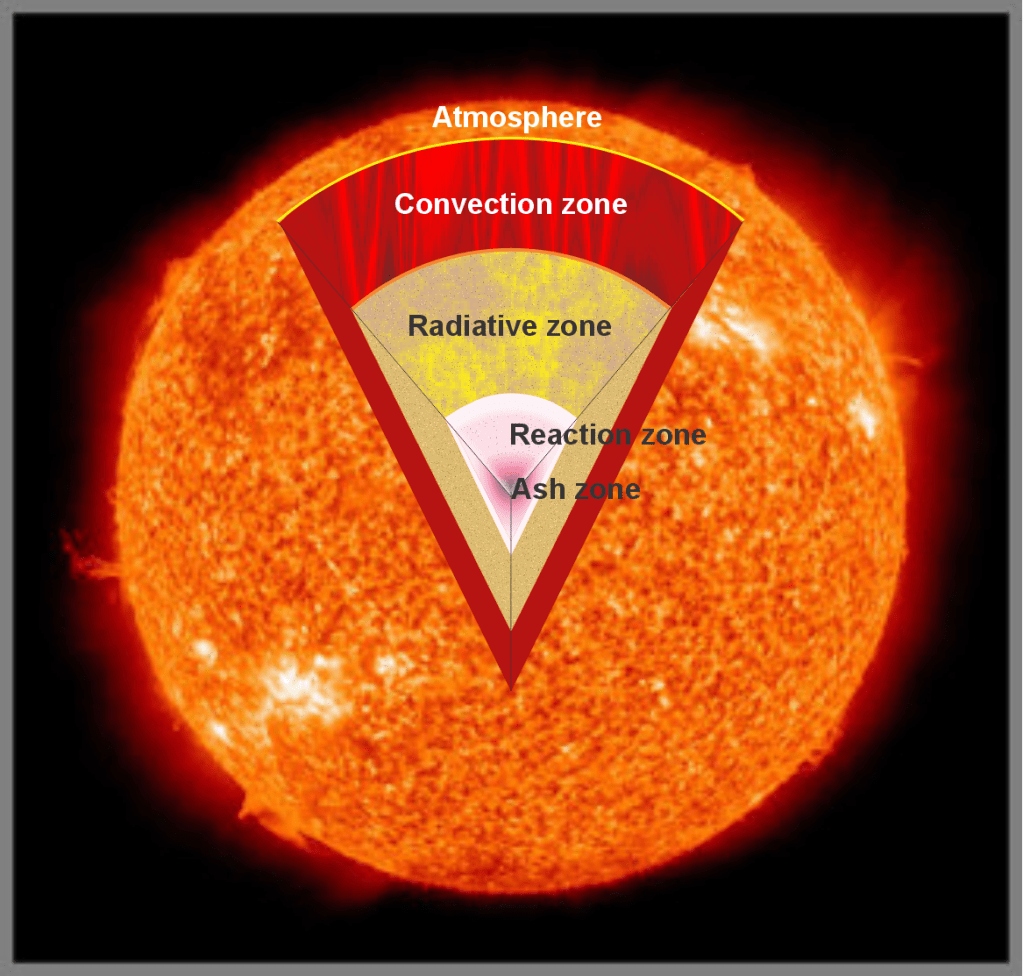
“Okay. Let’s take Jeremy’s idea first and then we’ll get to galaxies.” <fetches her tablet from her purse and a display on her tablet> “Here’s a diagram of the Sun I did for class. If you restrict ‘sound‘ to mean only coherent waves borne by atoms and molecules, there’s no sound in the innermost three zones. The only motion, if Sy grants I can call it that, is photons and subnuclear particles randomly swapping between adjacent nuclei that are basically locked into position by the pressure. Not much actual atomic motion until you’re up in the Convection Zone where rising turbulence is the whole game. Even there most of the particles are ions and electrons rather than neutral atoms. Loud? You might say so but it’d be a continuous random crackle‑buzz, not anything your ears would recognize. Sound waves as such don’t happen until you reach the atmospheric layers. Up there, oh yes, Jeremy, it’s loud.”

Geologist Kareem is a quiet guy, normally just sits and listens to our chatter, but Cathleen’s edging onto his turf. ”How about seismic waves? If there’s a big flare or CME up top, won’t that send vibrations all the way through?”

“Good point, Kareem. Yes, the Sun has p and s waves just like Earth does, but they travel no deeper than the Convection Zone. A different variety we may not have, g waves, would involve the core. Unfortunately, theory says g waves are so weak that the Convection Zone’s chaos swamps them. Anyway, the Sun’s s, p and g waves wouldn’t contribute to what Jeremy would hear because their frequencies are measured in hours or days. Can I get to galaxies now?”

“Please do.”

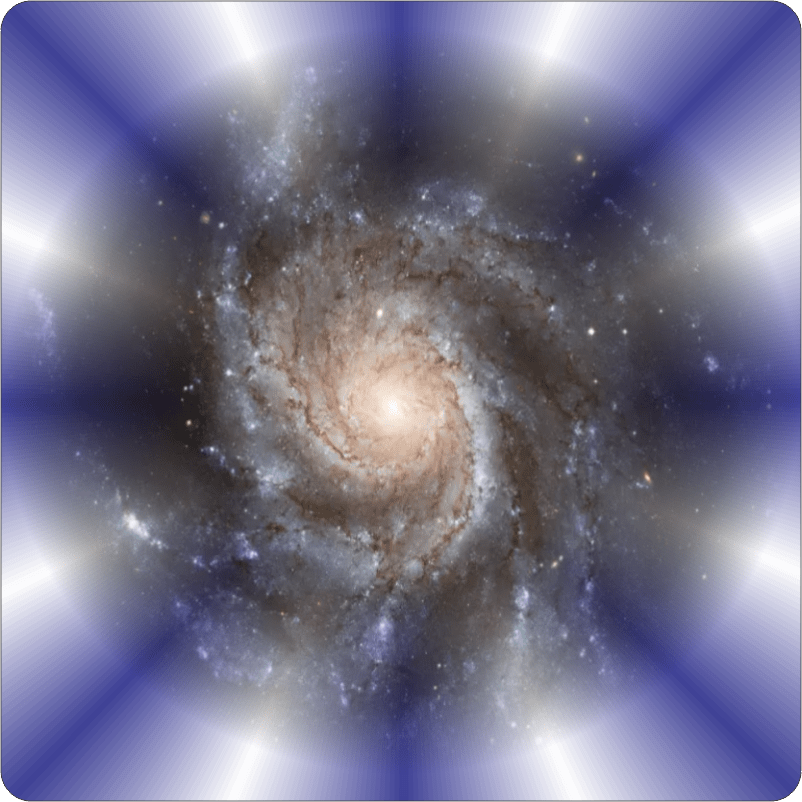
“Thanks.” <another display on her tablet> “Here’s a classic spiral galaxy. Gorgeous, huh? The obvious question is, is it winding in or spraying out? The evidence says ‘No‘ to both. The stars are neither pulled into a whirlpool nor flung out from a central star‑spawner. By and large, the stars or clusters of them are in perfectly good Newtonian orbits around the galactic center of gravity. So why are they collected into those arms? Here’s a clue — most of the blue stars are in the arms.”

“What’s special about blue stars?”

“In general, blue stars are large, hot and young. Our Sun is yellow, about halfway through a 10‑million‑year lifetime. The blue guys burn through their fuel and go nova in a tenth of that time. Blue stars out there tell us that the arms serve as stellar nurseries. It’s not stars gathering into arms, it’s galaxy‑wide rotating waves of gas birthing stars there. There’s argument about whether the wave rotation is intrinsic or whether there’s feedback as each wave is pulled along by star formation at the leading edge and pushed by novae at the trailing edge. Sy’s point, though, is that an arm‑dwelling old red star would experience the spinning gas density pattern as a basso profundo sound wave with a frequency even lower than the million‑year range. Right, Sy?”

“As always, Cathleen.”

~~ Rich Olcott

  • More thanks to Alex.

Screams And Thunders

Coffee time. I step into Cal’s shop and he’s all over me. ”Sy, have you heard about the the NASA sonification project?”

Susan puts down her mocha latte. “I didn’t like some of what they’ve released. Sounds too much like people screaming.”

Jeremy looks up from the textbook he’s reading. ”In space, no-one can hear you scream.”

Vinnie rumbles from his usual table by the door. “Any of these got anything to do with the Cosmic Hum?”

“They have nothing to do with each other, except they do. Spiral galaxies, too.”

“Huh?”
 ”Huh?”
  ”Huh?”
   ”Huh?”

“A mug of my usual, Cal, please, and a strawberry scone.”

“Sure, Sy, here ya go, but you can’t say something like that around here without you tellin’ us how come.”

“Does the name Bishop Berkeley ring a bell with anyone?”

Vinnie’s on it. ”That the ‘If a tree falls in the forest…‘ guy, right? Claimed there’s no sound unless somebody’s there to hear it?”

“And by extension, no sound outside human hearing range.”

“But bats and them use sound we can’t hear.”
 ”So do elephants and whales.”

“Well there you go. So are we agreed that he was wrong?”

“Not quite, Mr Moire. His definition of ‘sound‘ was different from one you’d like. He was a philosopher theorizing about perception, but you’re a physicist. You two don’t even define reality the same way.”

Vinnie’s rumble. ”Good shot, Jeremy. Sound is waves. Sy and me, we talked about them a lot. One molecule bangs into the next one and so on. The molecules don’t move forward, mostly, but the banging does. Sy showed me a video once. So yeah, people listening or not, that tree made a sound. There’s molecules up in space, so there’s sound up there, too, right, Sy?”

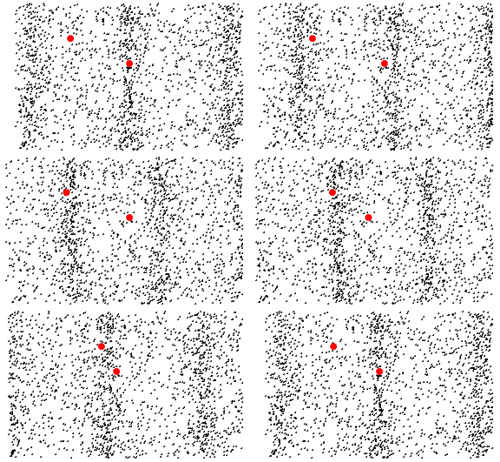
“Mmm, depends on where you are. And what sounds you’re equipped to listen for. The mechanism still works, things advancing a wave by bouncing off each other, but the wave’s length has to be longer than the average distance between the things.” <drawing Old Reliable, pulling up display> “Here’s that video Vinnie saw. I’ve marked two of the particles. You see them moving back and forth over about a wavelength. Suppose a much shorter wave comes along.”

“Umm… Each one would get a forward kick before they got back into position. They wouldn’t oscillate, they’d just keep moving in that direction. No sound wave, just a whoosh.”

“Right, Jeremy. Each out‑of‑sync interaction converts some of the wave’s oscillating energy into one‑way motion. The wave doesn’t get energy back. A dozen wavelengths along, no more wave. So the average distance between particles, we call it the mean free path, sets limits to the length and frequency of a viable wave. Our ears would say it filters out the treble.”

“Space ain’t quite empty so it still has a few atoms to bump together. What kinds of limits do we get out there?”

“Well, there’s degrees of empty. Interplanetary space has more atoms per cubic meter than interstellar which is more crowded than intergalactic. Nebulae and molecular clouds can be even less empty. Huge range, but in general we’re talking wavelengths longer than a million kilometers. Frequencies measured in months or years — low even for your voice, Vinnie.”

Jeremy gets a look on his face. ”One of my girlfriends is a soprano. We tested her in the audio lab and she could hit a note just under two kilohertz, that’s two thousand cycles per second. My top screech was below half that. I could scream in space, but I guess not low enough to be heard.”

“Yeah, keep that spacesuit helmet closed and be sure your radio intercom’s working.”

“Wait, what about screaming over the radio?”

“Radio operates with electromagnetic waves, not bumping atoms. Mean free path limits don’t apply. Radio’s frequency range is around a hundred megahertz, screeching’s no problem. Your broadcast equipment’s response range would set your limits.”

“Sy, those screamy sounds I objected to — you say they can’t have traveled across space as sound waves. Was that a radio transmission?”

“Maybe, Susan. From what I’ve read, we’ve picked up beaucoodles of radio sources, all different types and all over the sky. Each broadcasts a spectrum of different radio frequencies. Some of them are constant radiators, some vary at different rates. You may have heard a recording of a kilohertz variable source.”

<shudder> “All nasty treble, no bass or harmony.”

~~ Rich Olcott

  • Thanks to Alex, who raised several questions.

Map-ematics

Big Vinnie lumbers into my office, a grin on his face and a sheaf of papers in his hand. “Sy, you gotta see these, you’ll love ’em.”

Vinnie and I go way back, so I string him along a little. “New clients, I suppose? Wealthy ones, with interesting problems?”

“Nah, just goofiness. Me and Larry, don’t think you’ve met him yet, were having pizza in Eddie’s place. Larry’d brought his laptop and we got to playing with some map software he just bought. You ever hear of a GIS?”

“Geographic Information Systems? Sure, they go back a century and a half to the guy who mapped cholera cases in London and traced the source back to a contaminated water pump. You use a GIS to produce mapped visualizations of useful geographically‑distributed statistics.”

“Yeah, that, except we weren’t going for anything useful. Here’s the first one we did. We had a list of states alphabetical‑like. There’s whole blocks that start with the same letter, like eight that start with ‘M.’ We told the mapper to put a different color on any three or more that share a letter. Silly, huh?”

“Mm-hm. I don’t see any pattern to it.”

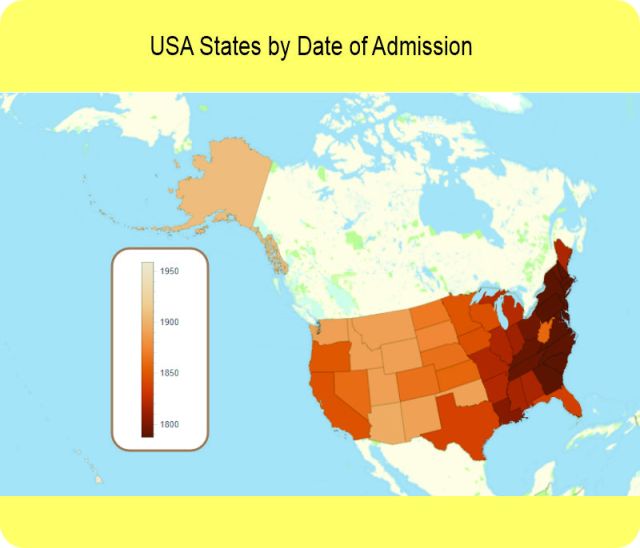
“Right. We didn’t, either, so we went on to build a second map where each state’s colored by the date it entered the Union. We tried a bunch of different color schemes, finally settled on this one.”

“Nice. You can almost see the country growing year‑to‑year. … Ah, Hawai’i’s in there, too, tucked away in the southwest corner. It’s color’s so pale you have to look for it. West Virginia — let me guess, right around 1860 or so, right?”

“1863. Those folks rebelled against the Southern rebellion. Anyway, Jeremy was kinda looking over our shoulder and this map lit a fire for him. You know he’s doing an Indigenous History project with Professor Begaye. He ran off and brought back a list of where each state’s name came from. We coded that up, fed it to the program and this came out.”

“Wow. The Europeans pretty much claimed the coasts but look at all the green. It’s like the states acknowledged they were built on Native land. Indiana comes right out and admits it.”

“Yup. Jeremy said it was pretty poor compensation. I understand how he feels.”

“So, did you map anything more than the USA?”

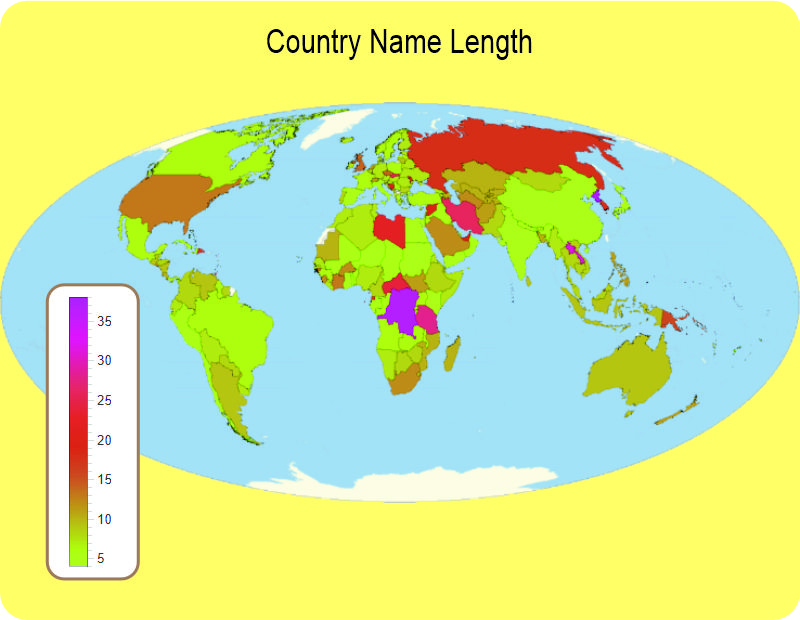
“Of course. Larry wanted more silly so we went with the number of letters in each country’s name.”

“I don’t understand this one. Peru’s green for its short name, naturally, and so are Chad and Cuba, but why are Iran and Iraq different colors? Russia’s name isn’t longer than Saudi Arabia and Madagascar. How can five‑letter Congo be purple for a really long name? Doesn’t make sense.”

“Our name list came from the International Standards Organization. Larry and me, we’re both international charter pilots. We’re often checking ISO files for radio frequencies, airport codes and the like. According to ISO, Iraq is ‘IRAQ‘, but Iran is ‘IRAN (ISLAMIC REPUBLIC OF).’ Russia is ‘RUSSIAN FEDERATION‘ which is longer than the other two. The USA would be redder if it was ‘UNITED STATES OF AMERICA,’ but it’s ‘UNITED STATES‘ and tied with ‘LIECHTENSTEIN‘ and ‘GUINEA‑BISSAU‘ at 13 characters so it’s brown.”

“And Congo?”

“The ISO name is ‘CONGO, THE DEMOCRATIC REPUBLIC OF THE.’ That’s not even the longest. It’s beat by ‘KOREA, DEMOCRATIC PEOPLE’S REPUBLIC OF‘ and ‘MACEDONIA, THE FORMER YUGOSLAV REPUBLIC OF.’ Politics, I suppose, and maybe ego. But I ain’t showed you the coolest map.”

“I’m all eyes.”

“You’ve read Andy Weir’s book, ‘The Martian‘?”

“Of course. Saw the movie, too. It was a nice change watching a drama that didn’t involve people battling each other physically or emotionally.”

“Uh. Yeah. I just saw it as an adventure story. Whatever. You remember Watney’s epic drive across that red desert to recover parts from the Pathfinder lander and then get to the launch vehicle?”

“Mm‑hm, though I don’t remember the geography.”

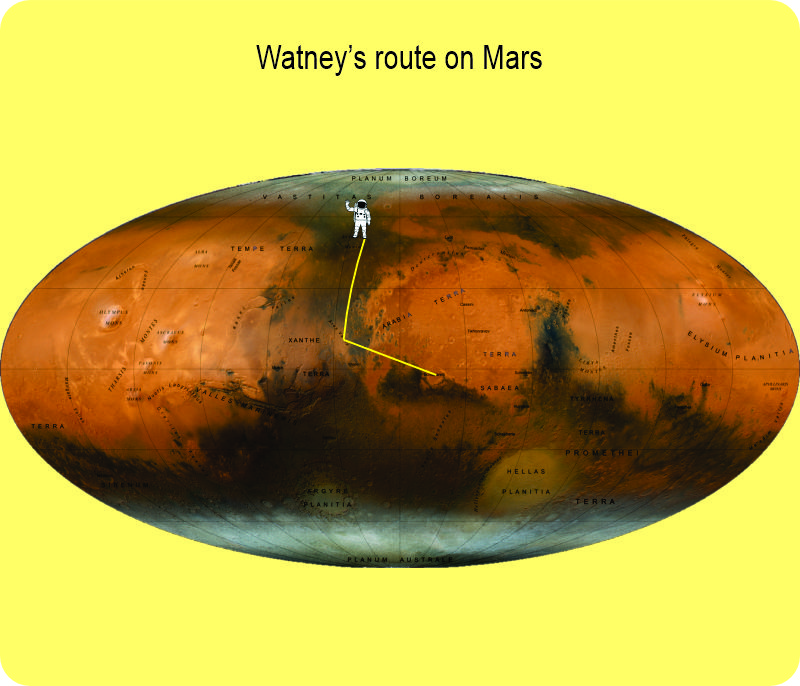
“Well, here’s his road map — Aries Base in Acidalia Planitia to Pathfinder in Chryse Planitia to take‑off from Schiaparelli Crater. Cool, huh?”

“Quite cool.”

Mars image credit: EMM/EXI/Dimitra Atri/NYU Abu Dhabi Center for Space Science

~~ Rich Olcott

Hiding Among The Hill Spheres

Bright Spring sunlight wakes me earlier than I’d like. I get to the office before I need to, but there’s Jeremy waiting at the door. “Morning, Jeremy. What gets you here so soon after dawn?”

“Good morning, Mr Moire. I didn’t sleep well last night, still thinking about that micro black hole. Okay, I know now that terrorists or military or corporate types couldn’t bring it near Earth, but maybe it comes by itself. What if it’s one of those asteroids with a weird orbit that intersects Earth’s orbit? Could we even see it coming? Aren’t we still in danger of all those tides and quakes and maybe it’d hollow out the Earth? How would the planetary defense people handle it?”

“For so early in the day you’re in fine form, Jeremy. Let’s take your barrage one topic at a time, starting with the bad news. We know this particular object would radiate very weakly and in the far infrared, which is already a challenge to detect. It’s only two micrometers wide. If it were to cross the Moon’s orbit, its image then would be about a nanoarcsecond across. Our astrometers are proud to resolve two white‑light images a few milliarcseconds apart using a 30‑meter telescope. Resolution in the far‑IR would be about 200 times worse. So, we couldn’t see it at a useful distance. But the bad news gets worse.”

“How could it get worse?”

“Suppose we could detect the beast. What would we do about it? Planetary defense people have proposed lots of strategies against a marauding asteroid — catch it in a big net, pilot it away with rocket engines mounted on the surface, even blast it with A‑bombs or H‑bombs. Black holes aren’t solid so none of those would work. The DART mission tried using kinetic energy, whacking an asteroid’s moonlet to divert the moonlet‑asteroid system. It worked better than anyone expected it to, but only because the moonlet was a rubble pile that broke up easily. The material it threw away acted as reaction mass for a poorly controlled rubble rocket. Black holes don’t break up.”

“You’re not making getting to sleep any easier for me.”

“Understood. Here’s the good news — the odds of us encountering anything like that are gazillions‑to‑one against. Consider the probabilities. If your beast exists I don’t think it would be an asteroid or even from the Kuiper Belt. Something as exotic as a primordial black hole or a mostly‑evaporated stellar black hole couldn’t have been part of the Solar System’s initial dust cloud, therefore it wouldn’t have been gathered into the Solar System’s ecliptic plane. It could have been part of the Oort cloud debris or maybe even flown in on a hyperbolic orbit from far, far away like ‘Oumuamua did. Its orbit could be along any of an infinite number of orientations away from Earth’s orbit. But it gets better.”

“I’ll take all the improvement you can give me.”

“Its orbital period is probably thousands of years long or never.”

“What difference does that make?”

“You’ve got to be in the right place at the right time to collide. Earth is 4.5 billion years old. Something with a 100‑year orbit would have had millions of chances to pass through a spot we happen to occupy. An outsider like ‘Oumuamua would have only one. We can even figure odds on that. It’s like a horseshoe game where close enough is good enough. The object doesn’t have to hit Earth right off, it only has to pierce our Hill Sphere.”

“Hill Sphere?”

“A Hill Sphere is a mathematical abstract like an Event Horizon. Inside a planet’s Sphere any nearby object feels a greater attraction to the planet than to its star. Velocities permitting, a collision may ensue. The Sphere’s radius depends only on the average planet–star distance and the planet and star masses. Earth’s Hill Sphere radius is 1.5 million kilometers. Visualize Hill Spheres crowded all along Earth’s orbit. If the interloper traverses any Sphere other than the one we’re in, we survive. It has 1 chance out of 471 . Multiply 471 by 100 spheres sunward and an infinity outward. We’ve got a guaranteed win.”

“I’ll sleep better tonight.”

~~ Rich Olcott

A Tug at The Ol’ Gravity Strings

“Why, Jeremy, you’ve got such a stunned look on your face. What happened? Is there anything I can do to help?”

“Sorry, Mr Moire. I guess I’ve been thinking too much about this science fiction story I just read. Which gelato can I scoop for you?”

“Two dips of mint, in a cup. Eddie went heavy with the garlic on my pizza this evening. What got to you in the story?”

“The central plot device. Here’s your gelato. In the story, someone locates a rogue black hole hiding in the asteroid belt. Tiny, maybe a few thousandths of a millimeter across, but awful heavy. A military‑industrial combine uses a space tug to tow it to Earth orbit for some kind of energy source, but their magnetic grapple slips and the thing falls to Earth. Except it doesn’t just fall to Earth, it’s so small it falls into Earth and now it’s orbiting inside, eating away the core until everything crumbles in. I can’t stop thinking about that.”

“Sounds pretty bad, but it might help if we run the numbers.” <drawing Old Reliable from its holster> “First thing — Everything about a black hole depends on its mass, so just how massive is this one?” <tapping on Old Reliable’s screen with gelato spoon> “For round numbers let’s say its diameter is 0.002 millimeter. The Schwartzschild ‘radius’ r is half that. Solve Schwartschild’s r=2GM/c² equation for the mass … plug in that r‑value … mass is 6.7×10²⁰ kilograms. That’s about 1% of the Moon’s mass. Heavy indeed. How did they find this object?”

“The story didn’t say. Probably some asteroid miner stumbled on it.”

“Darn lucky stumble, something only a few microns across. Not likely to transit the Sun or block light from any stars unless you’re right on top of it. Radiation from its accretion disk? Depends on the history — there’s a lot of open space in the asteroid belt but just maybe the beast encountered enough dust to form one. Probably not, though. Wait, how about Hawking radiation?”

“Oh, right, Stephen Hawking’s quantum magic trick that lets a black hole radiate light from just outside its Event Horizon. Does Old Reliable have the formulas for that?”

“Sure. From Hawking’s work we know the object’s temperature and that gives us its blackbody spectrum, then we’ve got the Bekenstein‑Hawking equation for the power it radiates. Mind you, the spectrum will be red‑shifted to some extent because those photons have to crawl out of a gravity well, but this’ll give us a first cut.” <more tapping> “Chilly. 170 kelvins, that’s 100⁰C below room temperature. Most of its sub‑nanowatt emission will be at far infrared wavelengths. A terrible beacon. But suppose someone did find this thing. I wonder what’ll it take to move it here.”

“Can you calculate that?”

“Roughly. Suppose your space tug follows the cheapest possible flight path from somewhere near Ceres. Assuming the tug itself has negligible mass … ” <more tapping> “Whoa! That is literally an astronomical amount of delta-V. Not anything a rocket could do. Never mind. But where were they planning to put the object? What level orbit?”

“Well, it’s intended to beam power down to Earth. Ions in the Van Allen Belts would soak up a lot of the energy unless they station it below the Belts. Say 250 miles up along with the ISS.”

“Hoo boy! A thousand times closer than the Moon. Force is inverse to distance squared, remember. Wait, that’s distance to the center and Earth’s radius is about 4000 miles so the 250 miles is on top of that. 250,000 divided by 4250 … quotient squared … is a distance factor of almost 3500. Put 1% of the Moon that close to the Earth and you’ve got ocean tides 36 times stronger than lunar tides. Land does tides, too, so there’d be earthquakes. Um. The ISS is on a 90‑minute orbit so you’d have those quakes and ocean tides sixteen times a day. I wouldn’t worry about the black hole hollowing out the Earth, the tidal effect alone would do a great job of messing us up.”

“The whole project is such a bad idea that no-one would or could do it. I feel better now.”

~~ Rich Olcott

Visionaries Old And New

Cathleen’s back at the mic. “Let’s have a round of applause for Maria, Jeremy, Madison and C‑J. Thank you all. We have a few minutes left for questions… Paul, you’re first.”

“Thanks, Cathleen. A comment, not a question. As you know, archeoastronomy is my specialty so I applaud Jeremy’s advocacy for the field. I agree with his notion that the Colorado Plateau’s dry, thin air generally lets us see more stars than sea‑level Greeks do. When I go to a good dark sky site, it can be difficult to see the main stars that define a constellation because of all the background dimmer stars. However, I don’t think that additional stars would change the pictures we project into the sky. Most constellations are outlined from only the brightest stars up there. Dimmer stars may confuse the issue, but I very much doubt they would have altered the makeup of the constellations a culture defines. Each culture uses their own myths and history when finding figures among the stars.”

“Thanks for the confirmation from personal experience, Paul. Yes, Sy?”

“Another comment not a question. I’m struck by how Maria’s Doppler technique and Jeremy’s Astrometry complement each other Think of a distant stellar system like a spinning plate balanced on a stick. Doppler can tell you how long the stick is. Astrometry can tell you how wide the plate is. Both can tell you how fast it’s spinning. The strongest Doppler signal comes from systems that are edge‑on to us. The strongest Astrometry signal comes from systems we see face‑on. Those are the extreme cases, of course. Most systems are be at some in‑between angle and give us intermediate signals.”

“That’s a useful classification, Sy. Madison’s and C‑J’s transit technique also fits the edge‑on category. Jim, I can see you’re about to bust. What do you have to tell us about?”

“How about a technique that lets you characterize exoplanets inside a galaxy we see as only a blurry blob? This paper I just read blew me away.”

“Go ahead, you have the floor.”

“Great. Does everyone know about Earendel?” <blank looks from half the audience, mutters about ‘Lord Of The Rings?’ from several> “OK, quick refresher. Earendel is the name astronomers gave to the farthest individual star we’ve ever discovered. It’s either 13 or 28 billion lightyears away, depending on how you define distance. We only spotted it because of an incredible coincidence — the star happens to be passing through an extremely small region of space where light in our general direction is concentrated thousands‑fold into a beam towards us. Earendel may be embedded in a galaxy, but the amplification region is so narrow we can’t see stars that might be right next to it.”

<Feder’s voice> “Ya gonna tell us what makes the region?”

“Only very generally, because it’s complicated. You know what a magnifying lens does in sunlight.”

“Sure. I’ve burnt ants that way.”

“… Right. So what you did was take all the light energy hitting the entire surface of your lens and concentrate it on a miniscule spot. The concentration factor was controlled by the Sun‑to‑lens‑to‑spot distances and the surface area of the lens. Now bring that picture up to cosmological distances. The lens is the combined gravitational field of an entire galaxy cluster, billions of lightyears away from us, focusing light from Earendel’s galaxy billions of lightyears farther away. Really small spots at both ends of the light path and that’s what isolated that star.”

“That’s what got you excited?”

“That’s the start of it. This new paper goes in the other direction. The scientists used brilliant X‑ray light from an extremely distant quasar to probe for exoplanets inside a galaxy’s gravitational lens. Like one of your ants analyzing sunlight’s glare to assess dust flecks on your lens. Or at least their averaged properties. A lens integrates all the light hitting it so your ant can’t see individual grains. What it can do, though, is estimate numbers and size ranges. This paper suggests the lensing galaxy is cluttered with 2000 free‑floating planets per main‑sequence star — stars too far for us to see.”

~~ Rich Olcott

  • Thanks to Dave Martinez and Dr Ka Chun Yu for their informative comments.