The Curve To Be Flattened

<chirp chirp> My phone’s ring-tone for an non-business call. “Moire here.”

“Mr Moire, it’s Jeremy.”

“I hope so, Jeremy, my phone shows your caller-ID. I’m glad you called instead of trying to drop by, the city being under lockdown orders and all. What’s your question?”

“Oh, no question, sir, I just called to chat. It’s lonely over here. If you’ve got the time, anything you’d like to talk about would be fine.”

“Mm… Well, I am working on a project but maybe talking it out will help get my thoughts in order. Have you seen that ‘Flatten the curve‘ chart?”

“Sure, it’s been hard to escape. They use it to tell us why we shouldn’t do group stuff while this virus is going around. Are you writing about where the chart comes from?”

“That’s my project, all right. There’re two ways to get to that chart and I’m trying to decide which will work better. I could start from ecology studies of invading organisms taking over a new territory. At first the organisms multiply rapidly, doubling then doubling again —”

“That’s exponential growth, Mr Moire. We talked about that!”

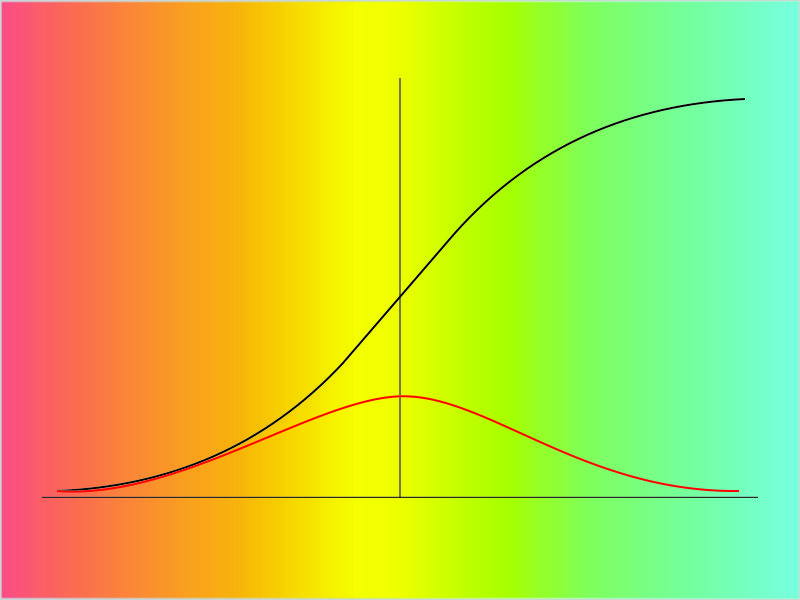
“Just sent you an image. When researchers plot invasions they usually look like the black line, the Logistic Curve. Its height represents the organism’s population as time increases left-to-right. At the beginning there’s that exponential rise. Over on the right the growth rate slows as the plants or animals or bugs use up increasingly scarce resources. The part in the middle’s almost linear. All that’s a familiar story by now, right?”

The Logistic Curve (black) and its slope (red)

“Uh-huh. We talked a lot about ecology back in kid school except we hadn’t learned graphs yet. What’s the red curve?”

“That’s the interesting part I’m trying to write about. One way to look at it is that it’s simply the slope of the Logistic curve. See how where the Logistic is rising, the slope is rising, too? That’s the way exponentials work — ‘the higher the faster‘ as they say. The slope switches direction just where the Logistic switches from growth to slow-down. The Logistic Curve approaches its limit when the organism’s population approaches the carrying capacity of the territory. That’s also where the slope gets shallowest. Very few resources, very little expansion.”

“What’s the other way to look at it?”

“We start with the slope curve itself. It has its own straight-forward interpretation, especially if the organism is a a bacterium or virus that causes disease. Consider the population under attack as the resource. How fast will the disease spread?”

“Uh… what I keep hearing is that if more people get sick, other people will get infected faster.”

“But what happens when nearly everyone’s caught it and they’ve either recovered or left us?”

“Oh, there’ll be fewer people left to catch it so the disease spreads more slowly.”

“Let me put that into algebra. I’ll write N for the total number of people and that’ll be a constant, we hope. At any given time we’ve got S as the current number of people who are susceptible. Then (N‑S) tells us how many people are NOT susceptible. Are you with me?”

“Fine so far.”

“So from what we’ve just said, the rate of infection is low when S is low and also low when (N‑S) is low. One way to make that into an equation is to write the rate as R = K*S*(N‑S). K is just a number we can adjust to account for things like virulence and Social Distance effectiveness. If we plot R against time what shape will it have?”

“Mmm… S is nearly the same as N at the start so (N‑S) is nearly zero then. At the finish, S is nearly zero. Exactly in the middle S equals (N‑S). They each have to be higher than near-zero there. That makes R be low at each end and high in the middle. Ah, that’s sort-of the shape of the slope curve!”

“It’s exactly the shape of the slope curve. So how do we flatten it?”

<click-click, click-click> “Oops, Mr Moire, my phone battery’s about dead. Gotta go get the charger. I’ll be right back.”

“I’ll be here, Jeremy.”

~~ Rich Olcott

Where would you put it all?

Vinnie’s a big guy but he’s good at fading into the background. I hadn’t even noticed him standing in the back corner of Cathleen’s impromptu seminar room until he spoke up. “That’s a great theory, Professor, but I wanna see numbers for it.”

“Which part of it don’t you like, Vinnie?”

“You made it seem so easy for all those little sea thingies to scrub the carbon dioxide out of Earth’s early atmosphere and just leave the nitrogen and oxygen behind. I mean, that’d be a lot of CO2. Where’d they put it all?”

“That’s a reasonable question, Vinnie. Lenore, could you put your Chemistry background to work on it for us?”

“Oh, this’ll be fun, but I don’t want to do it in my head. Mr Moire, could you fire up Old Reliable for the calculations?”

“No problem. OK, what do you want to calculate?”

“Here’s my plan. Rather than work with the number of tons of carbon in the whole atmosphere, I’ll just look at the sky-high column of air sitting on a square meter of Earth’s surface. We’ll figure out how many moles of CO2 would have been in that column back then and then work on how thick a layer of carbon stuff it would make on the surface. Does that sound like a good attack, Professor?”

“Sure, but I see a couple of puzzled looks in the class. You’d better say something about moles first.”

“Hey, I know about moles. Sy and me talked about ’em when he was on that SI kick. They’re like a super dozen, right, Sy?”

“Right, Vinnie. A mole of anything is 6.02×10²³ of that thing. Eggs, atoms, gas molecules, even stars if that’d be useful.”

“Back to my plan. First thing is the CO2 was in that column back when. Maria, your chart showed that Venus’ atmospheric pressure is 100 times ours and Mars’ is 1/100 ours and each of them is nearly pure CO2, right? So I’m going to assume that Earth’s atmosphere was what we have now plus a dose of CO2 that’s the geometric mean of Venus and Mars. OK, Professor?”

“That’d be a good starting point, Lenore.”

“Good. Now we need the mass of that CO2, which we can get from the weight of the column, which we can get from the air pressure, which is what?”

Every car buff in the room, in chorus — “14½ pounds per square inch.”

“I need that in kilograms per square meter.”

“Strictly speaking, pressure’s in newtons per square meter. There’s a difference between weight and force, but for this analysis we can ignore that. Keep going, Lenore.”

“Thanks, Professor. Sy?”

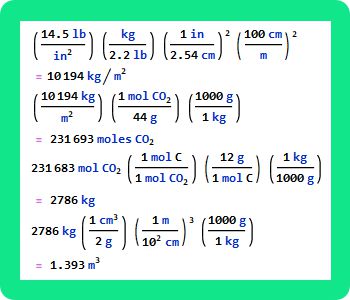
“Old Reliable says 10194 kg/m².”

“So we’ve got like ten-thousand kilograms of CO2 in that really tall meter-square column of ancient air. Now divide that by, um, 44 to get the number of moles of CO2. No, wait, then multiply by 1000 because we’ve got kilograms and it’s 44 grams per mole for CO2.”

“232 thousand moles. Still sounds like a lot.”

“I’m not done. Now we take that carbon and turn it into coal which is solid carbon mostly. One mole of carbon from each mole of CO2. Take the 232 thousand moles, multiply by 12 grams, no make that 0.012 kilogram per mole –“

“2786 kilograms”

“Right. Density of coal is about 2 grams per cc or … 2000 kilograms per cubic meter. So. Divide the kilograms by 2000 to get cubic meters.”

“1.39 meters stacked on that square-meter base.”

“About what I guessed it’d be. Vinnie, if Earth once had a carbon-heavy atmosphere log-halfway between Venus and Mars, and if the sea-plankton reduced all its CO2 down to coal, it’d make a layer all over the planet not quite as tall as I am. If it was chalk it’d be thicker because of the additional calcium and oxygen atoms. A petroleum layer would be thicker, too, with the hydrogens and all, but still.”

Jeremy’s nodding vigorously. “Yeah. We’ve dug up some of the coal and oil and put it back into the atmosphere, but there’s mountains of limestone all over the place.”

Cathleen’s gathering up her papers. “Add in the ocean-bottom carbonate ooze that plate tectonics has conveyor-belted down beneath the continents over the eons. Plenty of room, Vinnie, plenty of room.”

~~ Rich Olcott

The Moon And Chalk

Cathleen’s talking faster near the end of the class. “OK, we’ve seen how Venus, Earth and Mars all formed in the same region of the protosolar disk and have similar overall compositions. We’ve accounted for differences in their trace gasses. So how come Earth’s nitrogen-oxygen atmosphere is so different from the CO2-nitrogen environments on Venus and Mars? Let’s brainstorm — shout out non-atmospheric ways that Earth is unique. I’ll record your list on Al’s whiteboard.”

“Oceans!”

“Plate tectonics!”

“Photosynthesis!”

“Limestone!”

“The Moon!”

“Wombats!” (That suggestion gets a glare from Cathleen. She doesn’t write it down.)

“Goldilocks zone!”

“Magnetic field!”

“People!”

She registers the last one but puts parentheses around it. “This one’s literally a quickie — real-world proof that human activity affects the atmosphere. Since the 1900s gaseous halogen-carbon compounds have seen wide use as refrigerants and solvents. Lab-work shows that these halocarbons catalyze conversion of ozone to molecular oxygen. In the 1970s satellite data showed a steady decrease in the upper-atmosphere ozone that blocks dangerous solar UV light from reaching us on Earth’s surface. A 1987 international pact banned most halocarbon production. Since then we’ve seen upper-level ozone concentrations gradually recovering. That shows that things we do in quantity have an impact.”

“How about carbon dioxide and methane?”

“That’s a whole ‘nother topic we’ll get to some other day. Right now I want to stay on the Mars-Venus-Earth track. Every item on our list has been cited as a possible contributor to Earth’s atmospheric specialness. Which ones link together and how?”

Adopted from image by Immanuel Giel, CC BY-SA 3.0

Astronomer-in-training Jim volunteers. “The Moon has to come first. Moon-rock isotope data strongly implies it condensed from debris thrown out by a huge interplanetary collision that ripped away a lot of what was then Earth’s crust. Among other things that explains why the Moon’s density is in the range for silicates — only 60% of Earth’s density — and maybe even why Earth is more dense than Venus. Such a violent event would have boiled off whatever atmosphere we had at the time, so no surprise the atmosphere we have now doesn’t match our neighbors.”

Astrophysicist-in-training Newt Barnes takes it from there. “That could also account for why only Earth has plate tectonics. I ran the numbers once to see how the Moon’s volume matches up with the 70% of Earth’s surface that’s ocean. Assuming meteor impacts grew the Moon by 10% after it formed, I divided 90% of the Moon’s present volume by 70% of Earth’s surface area and got a depth of 28 miles. That’s nicely within the accepted 20-30 mile range for depth of Earth’s continental crust. It sure looks like our continental plates are what’s left of the Earth’s original crust, floating about on top of the metallic magma that Earth held onto.”

Jeremy gets excited. “And the oceans filled up what the continents couldn’t spread over.”

“That’s the general idea.”

Al’s not letting go. “But why does Earth have so much water and why is it the only one of the three with a substantial magnetic field?”

Cathleen breaks in. “The geologists are still arguing about whether Earth’s surface water was delivered by billions of incoming meteorites or was expelled from deep subterranean sources. Everyone agrees, though, that our water is liquid because we’re in the Goldilocks zone. The water didn’t steam away as it probably did on Venus, or freeze below the surface as it may have on Mars. Why the magnetic field? That’s another ‘we’re still arguing‘ issue, but we do know that magnetic fields protect Earth and only Earth from incoming solar wind.”

“So we’re down to photosynthesis and … limestone?”

“Photosynthesis was critical. Somewhere around two billion years ago, Earth’s sea-borne life-forms developed a metabolic pathway that converted CO2 to oxygen. They’ve been running that engine ever since. If Earth ever did have CO2 like Venus has, green things ate most of it. Some of the oxygen went to oxidizing iron but a lot was left over for animals to breathe.”

“But what happened to the carbon? Wouldn’t life’s molecules just become CO2 again?”

“Life captures carbon and buries it. Chalky limestone, for instance — it’s calcium carbonate formed from plankton shells.”

Jim grins. “We owe it all to the Moon.”

~~ Rich Olcott

Traces of Disparity

Cathleen’s an experienced teacher — she knows when off-topic class discussion is a good thing, and when to get back to the lesson plan. “My challenge question remains — why isn’t Earth’s atmosphere some average of the Mars and Venus ones? Thanks to Jeremy and Newt and Lenore we have reason to expect the planets to resemble each other, but in fact their atmospheres don’t. Maria, tell us what you’ve found about how Earth compares with the others.”

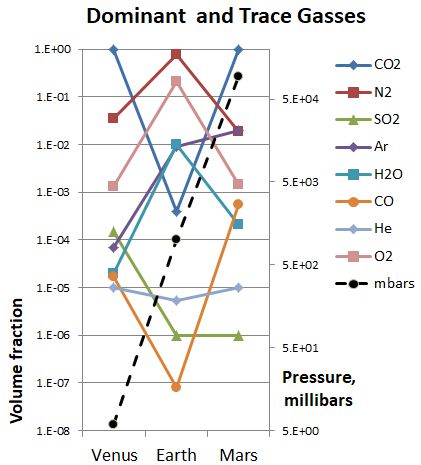
“Yes, Profesora. I found numbers for many of the gasses on each planet and put them into this chart. One thing Earth is right in the middle, most things not.”

“That’s a complicated chart. Read it out to us.”

“Of course. I had to make the vertical scales logarithmic to get the big numbers and small numbers on the same chart. First is the pressure which is the black dotted line. Venus pressure at the surface is nearly 100 times ours but Mars pressure is a bit less than 1/100th of ours. Does that count as Earth being in the middle?”

“That’d be a geometric average. It could be significant, we’ll see. Go on.”

“The gas that is almost the same everywhere is helium, the grey diamonds. That surprised me, because I thought the giant planets got all of that.”

Al’s been listening in. Nothing else going on in his coffee shop, I guess. “I’ll bet most of that helium came from radioactive rocks, not from space. Alpha particles, right, Cathleen?”

Cathleen takes unexpected interruptions in stride. “Bad bet, Al. Uranium and other heavy elements do emit alphas which pick up electrons to become helium atoms. You probably remembered Cleve and Langlet, who first isolated helium from uranium ore. However, the major source of atmospheric alphas is the solar wind. Solar wind interception and atmosphere mass are both proportional to planetary surface area so a constant concentration like this is reasonable. Continue, Maria.”

“The major gasses follow a pattern — about the same fractions on Venus and Mars but much higher or lower than on Earth. Look at carbon dioxide, nitrogen, even oxygen.”

Astronomer-in-training Jim has been doing some mental arithmetic. “Our atmosphere is 100 times denser than on Mars, and Venus is another factor of 100 beyond that. That’s a factor of 104 between them — for every molecule of CO2 on Mars there’s 10,000 on Venus. Oh, but Venus has four times Mars’ surface area so make that 40,000.”

“Good points, both of you. Jim’s approximation leads into something we can learn from Maria’s trace gas numbers. Why do you suppose the concentration of SO2 is about the same for Earth and Mars but 100 times higher on Venus, but the reverse is true for argon? Where do they each come from?”

Jeremy finally has something he can contribute. “Volcanoes! They told us in Geology class that most of our SO2 comes from volcanoes. Before the Industrial Revolution, I mean, when we started burning high-sulfur coal and fuel oils and made things worse. Venus has to be the same. Except for the industry, of course.”

“Probably correct, Jeremy. From radar mapping of Venus we know that it has over 150 large volcanoes. We don’t know how many of them are active, but the Venus Express spacecraft sent back evidence of active vulcanism. In fact, Venus’ SO2 score would probably be even higher if much of its production didn’t oxidize to SO3. That combines with water to form the clouds of sulfuric acid that hide the planet’s surface and reflect sunlight so brightly.”

Maria’s hand is up again. “I don’t understand argon’s purple diamonds, profesora. I know it’s one of the inert gasses so it doesn’t have much chemistry and can’t react into a mineral like CO2 and SO2 can. Shouldn’t argon be about the same on all three planets, like helium?”

“Mm-hm, argon does have a simple chemistry, but its radiochemistry isn’t so simple. Nearly 100% of natural argon is the argon-40 isotope created by radioactive decay of potassium-40. Potassium is tied up in the rocks, so the atmospheric load of argon-40 depends on rocky surface erosion. Not much erosion, not much argon.”

Al’s on tenterhooks. “All this is nice, but you still haven’t said why Earth’s atmosphere is so different.”

~~ Rich Olcott

The Still of The Night

Lenore raises her hand. “Maybe it’s my Chemistry background, but to me that protosolar disk model for the early Solar System looks like a distillation process. You heat up a mixture in the pot and then run the resulting vapors through a multi-stage condenser. Different components of the mixture collect at different points in the condenser depending on the local temperature or maybe something about the condenser’s surface. I got some fun correlations from data I dug up related to that idea.”

“Interesting perspective, Lenore You’re got the floor.”

“Thanks, Professor. Like Newt said, hydrogen and helium atoms are so light that even a low-energy photon or solar wind particle can give them a healthy kick away from the Sun and they wind up orbiting where the gas planets grew up. But there was more sorting than that. Check out this chart.”

“What’re the bubbles?”

“Each bubble represents one planet. I’ve scaled the bubble to show what fraction of the planet is its nickel-iron core. Mercury, for instance, is two-thirds core; the other third is its silicate crust and that’s why its overall density is up there between iron and silicates. Then you go through Venus and Earth, all apparently in the zone where gravity’s inward pull on heavy dust particles is balanced by the solar wind’s intense outward push. From the chart I’d say that outbound metallic and rocky materials are mostly gone by the asteroid belt. Big Jupiter grabs most of the the hydrogen and helium; its little brothers get the leavings. Mars looks like it’s right on the edge of the depletion zone — the numbers suggest that its core, if it has one, is only 12% of its mass.”

Jeremy’s ears prick up. “If it has one?”

“Yeah, the sources I checked couldn’t say for sure whether or not it does. That’s part of why we sent the Insight lander up there. Its seismic data should help decide the matter. With such a small iron content the planet could conceivably have cooled like silicate raisin bread. It might have isolated pockets of iron here and there instead of gathered in at the center.”

“Weird. So the giant planets are all — wait, what’s Saturn doing with a density below water’s?”

“You noticed that. Theoretically, if you could put Saturn on a really big pool of water in a gravity field it’d float.”

Meanwhile, astrophysicist-in-training Newt Barnes has been inspecting the chart. “Uranus and Neptune don’t fit the pattern, Lenore. If it’s just a matter of ‘hydrogen flees farthest,’ then those two ought to be as light as Saturn, maybe lighter.”

“Yeah, that bothered me, too. Uranus and Neptune are giant planets like Jupiter and Saturn, but they’re not ‘gas giants,’ they’re ‘ice giants.’ All four of them seem to have a junky nickel-iron-silicate core, maybe 1-to-10 times Earth’s mass, but aside from that the gas giants are mainly elemental hydrogen and helium whereas Uranus and Neptune are mostly compounds of oxygen, nitrogen and carbon with hydrogen.”

“How’d all those light atoms get so far out beyond the big guys?”

“Not a clue. Can you help, Professor?”

Cathleen draws ellipses on Al’s whiteboard. “Maybe they did, maybe they didn’t — the jury’s still out. We’re used to our nice neat modern Solar System where almost everything follows nearly circular orbits. It took a while to evolve there starting from the chaotic protosolar disk. Many of the early planetesimals probably had narrow elliptical orbits if they had an orbit at all, considering how often they collided with each other. Astromechanics modelers have burned years of computer time trying to account for what we know of the planets, asteroids, comets and the Kuiper and Oort formations we’ve barely begun to learn about. Some popular ‘Jumping Jupiter‘ models show Jupiter and Saturn migrating in towards the Sun and out again, playing hob with Uranus, Neptune and maybe a third ice giant before that one was ejected from the system altogether. It’s entirely possible that the ice giants grew up Sunward of the hydrogen-rich gas giants. We just don’t know.”

“That’s a challenge.”

“Yes, and my challenge question remains — why isn’t Earth’s atmosphere some average of the Mars and Venus ones?”

~~ Rich Olcott

Should These Three Be Alike?

“What’s all the hubbub in the back room, Al? I’m a little early for my afternoon coffee break and your shop’s usually pretty quiet about now.”

“It’s Cathleen’s Astronomy class, Sy. The department double-booked their seminar room so she asked to use my space until it’s straightened out.”

“Think I’ll eavesdrop.” I slide in just as she’s getting started.

“OK, folks, settle. Last class I challenged you with a question. Venus and Mars both have atmospheres that are dominated by carbon dioxide with a little bit of nitrogen. Earth is right in between them. How come its atmosphere is so different? I gave each of you a piece of that to research. Jeremy, you had the null question. Should we expect Earth’s atmosphere to be about the same as the other two?”

Venus coudtops image by Damia Bouic
JAXA / ISAS / DARTS / Damia Bouic

“I think so, ma’am, on the basis of the protosolar nebula hypothesis. The –“

“Wait a minute, Jeremy. Sy, I saw you sneak in. Jeremy, explain that term to him.”

“Yes’m. Uh, a nebula is a cloud of gas and dust out in space. It could be what got shot out of an exploding star or it could be just a twist in a stream of stuff drifting through the Galaxy. If the twist kinks up, gravity pulls the material on either side of the kink towards the middle and you get a rotating disk. Most of what’s in the disk falls towards its center. The accumulated mass at the center lights up to be a star. Meanwhile, what’s left in the disk keeps most of the original angular momentum but it doesn’t whirl smoothly. There’s going to be local vortices and they attract more stuff and grow up to be planets. That’s what we think happens, anyway.”

“Good summary. So what does that mean for Mars, Venus and the Earth?”

“Their orbits are pretty close together, relative to the disk’s radius, so they ought to have encountered about the same mixture of heavy particles and light ones while they were getting up to size. The light ones would be gas atoms, mostly hydrogen and helium. Half the other atoms are oxygen and they’d react to produce oxides — water, carbon monoxide, grains of silica and iron oxide. And oxygen and nitrogen molecules, of course.”

“Of course. Was gravity the only actor in play there?”

“No-o-o, once the star lit up its photons and solar wind would have pushed against gravity.”

“So three actors. Would photons and solar wind have the same effect? Anybody?”

Silence, until astrophysicist-in-training Newt Barnes speaks up. “No, they’d have different effects. The solar wind is heavy artillery — electrons, protons, alpha particles. They’ll transfer momentum to anything they hit, but they’re more likely to hit a large particle like a dust grain than a small one like an atom. On average, the big particles would be pushed away more.”

“And the photons?”

“A photon is selective — it can only transfer momentum to an atom or molecule that can absorb exactly the photon’s energy. But each kind of atom has its own set of emission and absorption energies. Most light emitted by transitions within hydrogen atoms won’t be absorbed by anything but another hydrogen atom. Same thing for helium. The Sun’s virtually all hydrogen and helium. The photons they emit would move just those disk atoms and leave the heavier stuff in place.”

“That’s only part of the photon story.”

“Oh? Oh, yeah. The Sun’s continuous spectrum. The Sun is hot. Heat jiggles whole ions. Those moving charges produce electromagnetic waves just like charge moving within an atom, but heat-generated waves can have any wavelength and interact with anything. They can bake dust particles and decompose compounds that contain volatile atoms. Then those atoms get swept away in the general rush.”

“Which has the greater effect, solar wind or photons?”

“Hard to say without doing the numbers, but I’d bet on the photons. The metal-and-silicate terrestrial planets are close to the Sun, but the mostly-hydrogen giants are further out.”

“All that said, Jeremy, what’s your conclusion?”

“It sure looks like Earth’s atmosphere should be intermediate between Mars and Venus. How come it’s not?”

~~ Rich Olcott

The Big Chill

Jeremy gets as far as my office door, then turns back. “Wait, Mr Moire, that was only half my question. OK, I get that when you squeeze on a gas, the outermost molecules pick up kinetic energy from the wall moving in and that heats up the gas because temperature measures average kinetic energy. But what about expansion cooling? Those mist sprayers they set up at the park, they don’t have a moving outer wall but the air around them sure is nice and cool on a hot day.”

“Another classic Jeremy question, so many things packed together — Gas Law, molecular energetics, phase change. One at a time. Gas Law’s not much help, is it?”

“Mmm, guess not. Temperature measures average kinetic energy and the Gas Law equation P·V = n·R·T gives the total kinetic energy for the n amount of gas. Cooling the gas decreases T which should reduce P·V. You can lower the pressure but if the volume expands to compensate you don’t get anywhere. You’ve got to suck energy out of there somehow.”

Illustrations adapted from drawings by Trianna

“The Laws of Thermodynamics say you can’t ‘suck’ heat energy out of anything unless you’ve got a good place to put the heat. The rule is, heat energy travels voluntarily only from warm to cold.”

“But, but, refrigerators and air conditioners do their job! Are they cheating?”

“No, they’re the products of phase change and ingenuity. We need to get down to the molecular level for that. Think back to our helium-filled Mylar balloon, but this time we lower the outside pressure and the plastic moves outward at speed w. Helium atoms hit the membrane at speed v but they’re traveling at only (v-w) when they bounce back into the bulk gas. Each collision reduces the atom’s kinetic energy from ½m·v² down to ½m·(v-w)². Temperature goes down, right?”

“That’s just the backwards of compression heating. The compression energy came from outside, so I suppose the expansion energy goes to the outside?”

“Well done. So there has to be something outside that can accept that heat energy. By the rules of Thermodynamics, that something has to be colder than the balloon.”

“Seriously? Then how do they get those microdegree above absolute zero temperatures in the labs? Do they already have an absolute-zero thingy they can dump the heat to?”

“Nope, they get tricky. Suppose a gas in a researcher’s container has a certain temperature. You can work that back to average molecular speed. Would you expect all the molecules to travel at exactly that speed?”

“No, some of them will go faster and some will go slower.”

“Sure. Now suppose the researcher uses laser technology to remove all the fast-moving molecules but leave the slower ones behind. What happens to the average?”

“Goes down, of course. Oh, I see what they did there. Instead of the membrane transmitting the heat away, ejected molecules carry it away.”

“Yup, and that’s the key to many cooling techniques. Those cooling sprays, for instance, but a question first — which has more kinetic energy, a water droplet or the droplet’s molecules when they’re floating around separately as water vapor?”

“Lessee… the droplet has more mass, wait, the molecules total up to the same mass so that’s not the difference, so it’s droplet velocity squared versus lots of little velocity-squareds … I’ll bet on the droplet.”

“Sorry, trick question. I left out something important — the heat of vaporization. Water molecules hold pretty tight to each other, more tightly in fact than most other molecular substances. You have to give each molecule a kick to get it away from its buddies. That kick comes from other molecules’ kinetic energy, right? Oh, and one more thing — the smaller the droplet, the easier for a molecule to escape.”

“Ah, I see where this is going. The mist sprayer’s teeny droplets evaporate easy. The droplets are at air temperature, so when a molecule breaks free some neighbor’s kinetic energy becomes what you’d expect from air temperature, minus break-free energy. That lowers the average for the nearby air molecules. They slow their neighbors. Everything cools down. So that’s how sprays and refrigerators and such work?”

“That’s the basic principle.”

“Cool.”

~ Rich Olcott

Thanks to Mitch Slevc for the question that led to this post.

The Hot Squeeze

A young man’s knock, eager yet a bit hesitant.

“C’mon in, Jeremy, the door’s open.”

“Hi, Mr Moire. How’s your Summer so far? I got an ‘A’ on that black hole paper, thanks to your help. Do you have time to answer a question now that Spring term’s over?”

“Hi, Jeremy. Pretty good, congratulations, and a little. What’s your question?”

“I don’t understand about the gas laws. You squeeze a gas, you raise its temperature, but temperature’s the average kinetic energy of the molecules which is mass times velocity squared but mass doesn’t change so how does the velocity know how big the volume is? And if you let a gas expand it cools and how does that happen?”

“A classic Jeremy question. Let’s take it a step at a time, big-picture view first. The Gas Law says pressure times volume is proportional to the amount of gas times the temperature, or P·V = n·R·T where n measures the amount of gas and R takes care of proportionality and unit conversions. Suppose a kid gets on an airplane with a balloon. The plane starts at sea level pressure but at cruising altitude they maintain cabins at 3/4 of that. Everything stays at room temperature, so the balloon expands by a third –“

Kid drawing of an airplane with a red balloon
Adapted from a drawing by Xander

“Wait … oh, pressure down by 3/4, volume up by 4/3 because temperature and n and R don’t change. OK, I’m with you. Now what?”

“Now the plane lands at some warm beach resort. We’re back at sea level but the temp has gone from 68°F back home to a basky 95°F. How big is the balloon? I’ll make it easy for you — 68°F is 20°C is 293K and 95°F is 35°C is 308K.”

“Volume goes up by 308/293. That’s a change of 15 in about 300, 5% bigger than back home.”

“Nice estimating. One more stop on the way to the molecular level. Were you in the crowd at Change-me Charlie’s dark matter debate?”

“Yeah, but I didn’t get close to the table.”

“Always a good tactic. So you heard the part about pressure being a measure of energy per unit of enclosed volume. What does that make each side of the Gas Law equation?”

“Umm, P·V is energy per volume, times volume, so it’s the energy inside the balloon. Oh! That’s equal to n·R·T but R‘s a constant and n measures the number of molecules so T = P·V/n·R makes T proportional to average kinetic energy. But I still don’t see why the molecules speed up when you squeeze on them. That just packs the same molecules into a smaller volume.”

“You’re muddling cause and effect. Let’s try to tease them apart. What forces determine the size of the balloon?”

“I guess the balance between the outside pressure pushing in, versus the inside molecules pushing out by banging against the skin. Increasing their temperature means they have more energy so they must bang harder.”

“And that increases the outward pressure and the balloon expands until things get back into balance. Fine, but think about individual molecules, and let’s pretend that we’ve got a perfect gas and a perfect balloon membrane — no leaks and no sticky collisions. A helium-filled Mylar balloon is pretty close to that. When things are in balance, molecules headed outward approach the membrane with some velocity v and bounce back inward with the same velocity v though in a different direction. Their kinetic energy before hitting the membrane is ½m·v²; after the collision the energy’s also ½m·v² so the temperature is stable.”

“But that’s at equilibrium.”

“Right, so let’s increase the outside pressure to squeeze the balloon. The membrane closes in at some speed w. Out-bound molecules approach the membrane with velocity v just as before but the membrane’s speed boosts the bounce. The ‘before’ kinetic energy is still ½m·v² but the ‘after’ value is bigger: ½m·(v+w)². The total and average kinetic energy go up with each collision. The temperature boost comes from the energy we put into the squeezing.”

“So the heating actually happens out at the edges.”

“Yup, the molecules in the middle don’t know about it until hotter molecules collide with them.”

“The last to learn, eh?.”

“Always the case.”

~~ Rich Olcott

Thanks to Mitch Slevc for the question that led to this post.

Atoms are solar systems? Um, no…

Suddenly there’s a hubbub of girlish voices to one side of the crowd.  “Go on, Jeremy, get up there.”  “Yeah, Jeremy, your theory’s no crazier than theirs.”  “Do it, Jeremy.”

Sure enough, the kid’s here with some of his groupies.  Don’t know how he does it.  He’s a lot younger than the grad students who generally present at these contests, but he’s got guts and he grabs the mic.

“OK, here’s my Crazy Theory.  The Solar System has eight planets going around the Sun, and an oxygen atom has eight electrons going around the nucleus.  Maybe we’re living in an oxygen atom in some humongous Universe, and maybe there are people living on the electrons in our oxygen atoms or whatever.  Maybe the Galaxy is like some huge molecule.  Think about living on an electron in a uranium atom with 91 other planets in the same solar system and what happens when the nucleus fissions.  Would that be like a nova?”

There’s a hush because no-one knows where to start, then Cathleen’s voice comes from the back of the room.  Of course she’s here — some of the Crazy Theory contest ring-leaders are her Astronomy students.  “Congratulations, Jeremy, you’ve joined the Honorable Legion of Planetary Atom Theorists.  Is there anyone in the room who hasn’t played with the idea at some time?”

No-one raises a hand except a couple of Jeremy’s groupies.

“See, Jeremy, you’re in good company.  But there are a few problems with the idea.  I’ll start off with some astronomical issues and then the physicists can throw in some more.  First, stars going nova collapse, they don’t fission.  Second, compared to the outermost planet in the Solar System, how far is it from the Sun to the nearest star?”

A different groupie raises her hand and a calculator.  “Neptune’s about 4 light-hours from the Sun and Alpha Centauri’s a little over 4 light-years, so that would be … the 4’s cancel, 24 hours times 365 … about 8760 times further away than Neptune.”

“Nicely done.  That’s a typical star-to-star distance within the disk and away from the central bulge.  Now, how far apart are the atoms in a molecule?”

“Aren’t they pretty much touching?  That’s a lot closer than 8760 times the distance.”

“Yes, indeed, Jeremy.  Anyone else with an objection?  Ah, Maria.  Go ahead.”

“Yes, ma’am.  All electrons have exactly the same properties, ¿yes? but different planets, they have different properties.  Jupiter is much, much heavier than Earth or Mercury.”

Astrophysicist-in-training Jim speaks up.  “Different force laws.  Solar systems are held together by gravity but at this level atoms are held together by electromagnetic forces.”

“Carry that a step further, Jim.  What does that say about the geometry?”

“Gravity’s always attractive.  The planets are attracted to the Sun but they’re also attracted to each other.  That’ll tend to pull them all into the same plane and you’ll get a flat disk, mostly.  In an atom, though, the electrons or at least the charge centers repel each other — four starting at the corners of a square would push two out of the plane to form a tetrahedron, and so forth.  That’s leaving aside electron spin.  Anyhow, the electronic charge will be three-dimensional around the nucleus, not planar.  Do you want me to go into what a magnetic field would do?”

“No, I think the point’s been made.  Would someone from the Physics side care to chime in?”

“Synchrotron radiation.”

“Good one.  And you are …?”

“Newt Barnes.  I’m one of Dr Hanneken’s students.”

“Care to explain?”

“Sure.  Assume a hydrogen atom is a little solar system with one electron in orbit around the nucleus.  Any time a charge moves it radiates waves into the electromagnetic field.  The waves carry forces that can compel other charged objects to move.  The distance an object moves, times the force exerted, equals the amount of energy expended by the wave.  Therefore the wave must carry energy and that energy must have come from the electron’s motion.  After a while the electron runs out of kinetic energy and falls into the nucleus.  That doesn’t actually happen, so the atom’s not a solar system.”

Jeremy gets general applause when he waves submission, then the crowd’s chant resumes…

.——<“Amanda! Amanda! Amanda!”>Bohr and Bohr atom

~~ Rich Olcott

The Neapolitan Particle

“Welcome back, Jennie.  Why would anyone want to steer an ice cube?

“Thanks, Jeremy, it’s nice to be back..  And the subject’s not an ice cube, it’s IceCube, the big neutrino observatory in the Antarctic.”

“Then I’m with Al’s question.  Observatories have this big dome that rotates and inside there’s a lens or mirror or whatever that goes up and down to sight on the night’s target.  OK, the Hubble doesn’t have a dome and it uses gyros but even there you’ve got to point it.  How does IceCube point?”

“It doesn’t.  The targets point themselves.”

“Huh?”

“Ever relayed a Web-page?”

“Sure.”

“Guess what?  You don’t know where the page came from, you don’t know where it’s going to end up.  But it could carry a tracking bug to tell someone at some call-home server when and where the page had been opened.  IceCube works the same way, sort of.  It has a huge 3D array of detectors to record particles coming in from any direction.  A neutrino can come from above, below, any side, no problem — the detectors it touches will signal its path.”

IceCube architecture
Adapted from a work by Francis Halzen, Department of Physics, University of Wisconsin

“How huge?”

“Vastly huge.  The instrument is basically a cubic kilometer of ultra-clear Antarctic ice that’s ages old.  The equivalent of the tracking bugs is 5000 sensors in a honeycomb array more than a kilometer wide.  Every hexagon vertex marks a vertical string of sensors going down 2½ kilometers into the ice.  Each string has a couple of sensors near the surface but the rest of them are deeper than 1½ kilometers.  The sensors are looking for flashes of light.  Keep track of which sensor registered a flash when and you know the path a particle took through the array.”

icecube event 3“Why should there be flashes? I thought neutrinos didn’t interact with matter.”

“Make that, they rarely interact with matter.  Even that depends on what particle the neutrino encounters and what flavor neutrino it happens to be at the moment.”

That gets both Al and me interested.  His “Neutrinos come in flavors?” overlaps my “At the moment?”

“I thought that would get you into this, Sy.  Early experiments detected only 1/3 of the neutrinos we expected to come from the Sun.  Unwinding all that was worth four Nobel prizes and counting.  The upshot’s that there are three different neutrino flavors and they mutate.  The experiments caught only one.”

Vinnie’s standing behind us.  “You’re going to tell us the flavors, right?”

“Hoy, Vinnie, Jeremy’s question was first, and it bears on the others.  Jeremy, you know that blue glow you see around water-cooled nuclear fuel rods?”

“Yeah, looks spooky.  That’s neutrinos?”

“No, that’s mostly electrons, but it could be other charged particles.  It has to do with exceeding the speed of light in the medium.”

“Hey, me and Sy talked about that.  A lightwave makes local electrons wiggle, and how fast the wiggles move forward can be different from how fast the wave group moves.  Einstein’s speed-of-light thing was about the wave group’s speed, right, Sy?”

“That’s right, Vinnie.”

“So anyhow, Jeremy, a moving charged particle affects the local electromagnetic field.  If the particle moves faster than the surrounding atoms can adjust, that generates light, a conical electromagnetic wave with a continuous spectrum.  The light’s called Cherenkov radiation and it’s mostly in the ultra-violet, but enough leaks down to the visible range that we see it as blue.”

“But you said it takes a charged particle.  Neutrinos aren’t charged.  So how do the flashes happen in IceCube?”

“Suppose an incoming high-energy neutrino transfers some of its momentum to a charged particle in the ice — flash!  Even better, the flash pattern provides information for distinguishing between the neutrino flavors.  Muon neutrinos generate a more sharp-edged Cherenkov cone than electron neutrinos do.  Taus are so short-lived that IceCube doesn’t even see them.”Leptons

“I suppose muon and tau are flavors?”

“Indeed, Vinnie.  Any subatomic reaction that releases an electron also emits an electron-flavored neutrino.  If the reaction releases the electron’s heavier cousin, a muon, then you get a muon-flavored neutrino.  Taus are even heavier  and they’ve got their own associated neutrino.”

“And they mutate?”

“In a particularly weird way.”

~~ Rich Olcott