

Some people are born to scones, some have scones thrust upon them. As I stepped into his coffee shop this morning, Al was loading a fresh batch onto the rack. “Hey, Sy, try one of these.”
“Uhh … not really my taste. You got any cinnamon ones ready?”
“Not much for cheddar-habañero, huh? I’m doing them for the hipster trade,” waving towards all the fedoras on the room. “Here ya go. Oh, Vinnie’s waiting for you.”
I navigated to the table bearing a pile of crumpled yellow paper, pulled up a chair. “Morning, Vinnie, how’s the yellow writing tablet working out for you?”
“Better’n the paper napkins, but it’s nearly used up.”
“What problem are you working on now?”
“OK, I’m still on LIGO and still on that energy question I posed way back — how do I figure the energy of a photon when a gravitational wave hits it in a LIGO? You had me flying that space shuttle to explain frames and such, but kept putting off photons.”
“Can’t argue with that, Vinnie, but there’s a reason. Photons are different from atoms and such because they’ve got zero mass. Not just nearly massless like neutrinos, but exactly zero. So — do you remember Newton’s formula for momentum?”
“Yeah, momentum is mass times the velocity.”
“Right, so what’s the momentum of a photon?”
“Uhh, zero times speed-of-light. But that’s still zero.”
“Yup. But there’s lots of experimental data to show that photons do carry non-zero momentum. Among other things, light shining on an an electrode in a vacuum tube knocks electrons out of it and lets an electric current flow through the tube. Compton got his Nobel prize for that 1923 demonstration of the photoelectric effect, and Einstein got his for explaining it.”
“So then where’s the momentum come from and how do you figure it?”
“Where it comes from is a long heavy-math story, but calculating it is simple. Remember those Greek letters for calculating waves?”
(starts a fresh sheet of note paper) “Uhh… this (writes λ) is lambda is wavelength and this (writes ν) is nu is cycles per second.”
“Vinnie, you never cease to impress. OK, a photon’s momentum is proportional to its frequency. Here’s the formula: p=h·ν/c. If we plug in the E=h·ν equation we played with last week we get another equation for momentum, this one with no Greek in it: p=E/c. Would you suppose that E represents total energy, kinetic energy or potential energy?”
“Momentum’s all about movement, right, so I vote for kinetic energy.”
“Bingo. How about gravity?”
“That’s potential energy ’cause it depends on where you’re comparing it to.”
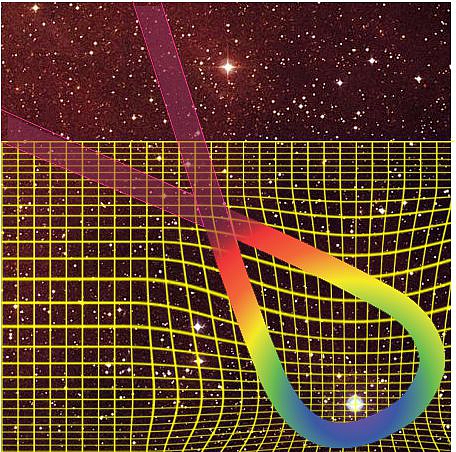
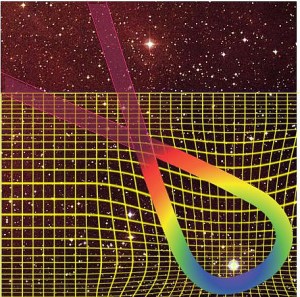 “OK, back when we started this whole conversation you began by telling me how you trade off gravitational potential energy for increased kinetic energy when you dive your airplane. Walk us through how that’d work for a photon, OK? Start with the photon’s inertial frame.”
“That’s easy. The photon’s feeling no forces, not even gravitational, ’cause it’s just following the curves in space, right, so there’s no change in momentum so its kinetic energy is constant. Your equation there says that it won’t see a change in frequency. Wavelength, either, from the λ=c/ν equation ’cause in its frame there’s no space compression so the speed of light’s always the same.”
“Bravo! Now, for our Earth-bound inertial frame…?”
“Lessee… OK, we see the photon dropping into a gravity well so it’s got to be losing gravitational potential energy. That means its kinetic energy has to increase ’cause it’s not giving up energy to anything else. Only way it can do that is to increase its momentum. Your equation there says that means its frequency will increase. Umm, or the local speed of light gets squinched which means the wavelength gets shorter. Or both. Anyway, that means we see the light get bluer?”
“Vinnie, we’ll make a physicist of you yet. You’re absolutely right — looking from the outside at that beam of photons encountering a more intense gravity field we’d see a gravitational blue-shift. When they leave the field, it’s a red-shift.”
“Keeping track of frames does make a difference.”
Al yelled over, “Like using tablet paper instead of paper napkins.”
~~ Rich Olcott


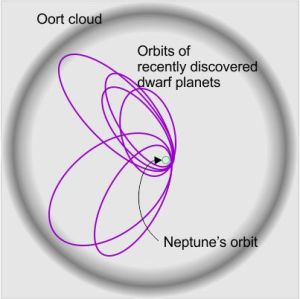


 This video, from an Orbits Table display at the Denver Museum of Nature and Science, shows a different Plutonian weirdness. We’re circling the Solar System at about 50 times Earth’s distance from the Sun (50 AU). Reading inward, the white lines represent the orbits of Neptune, Uranus, Saturn and Jupiter. The Asteroid Belt is the small greenish ring close to the Sun. The four terrestrial planets are even further in. The Kuiper Belt is the greenish ring that encloses the lot.
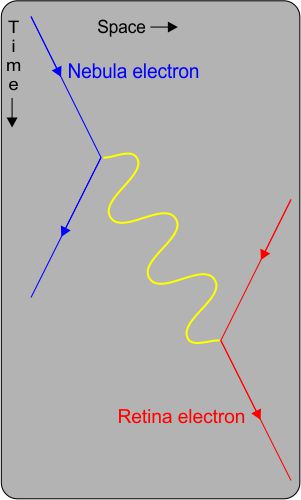 Here we have a Feynman diagram, named for the Nobel-winning (1965) physicist who invented it and much else. The diagram plots out the transaction we just discussed. Not a conventional x-y plot, it shows Space, Time and particles. To the left, that far-away electron emits a photon signified by the yellow wiggly line. The photon has momentum so the electron must recoil away from it.
 It would have been awesome to watch Dragon Princes in battle (from a safe hiding place), but I’d almost rather have witnessed “The Tussles in Brussels,” the two most prominent confrontations between Albert Einstein and Niels Bohr.
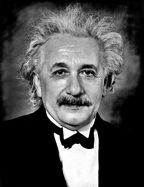 Like Newton, Einstein was a particle guy. He based his famous thought experiments on what his intuition told him about how particles would behave in a given situation. That intuition and that orientation led him to paradoxes such as entanglement, the
  Bohr was six years younger than Einstein. Both Bohr and Einstein had attained Directorship of an Institute at age 35, but Bohr’s has his name on it. He started out as a particle guy — his first splash was a trio of papers that treated the hydrogen atom like a one-planet solar system. But that model ran into serious difficulties for many-electron atoms so Bohr switched his allegiance from particles to Schrödinger’s wave theory. Solve a Schrödinger equation and you can calculate statistics like
  Here’s where Ludwig Wittgenstein may have come into the picture. Wittgenstein is famous for his telegraphically opaque writing style and for the fact that he spent much of his later life disagreeing with his earlier writings. His 1921 book, Tractatus Logico-Philosophicus (in German despite the Latin title) was a primary impetus to the Logical Positivist school of philosophy. I’m stripping out much detail here, but the book’s long-lasting impact on QM may have come from its Proposition 7: “Whereof one cannot speak, thereof one must be silent.“

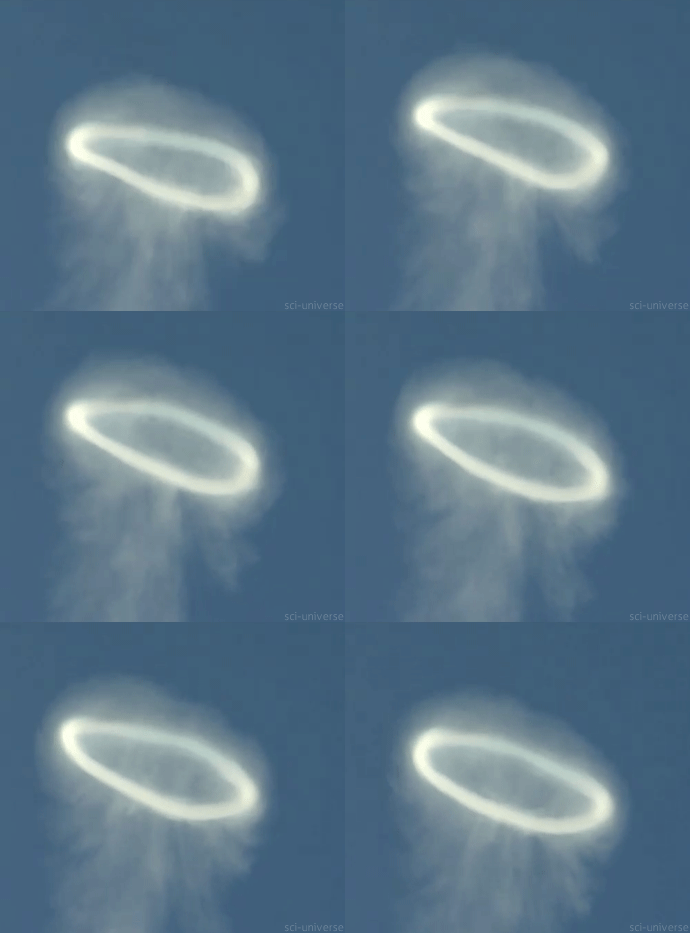
 Grammie always grimaced when Grampie lit up one of his cigars inside the house. We kids grinned though because he’d soon be blowing smoke rings for us. Great fun to try poking a finger into the center, but we quickly learned that the ring itself vanished if we touched it.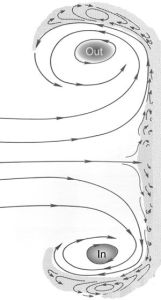

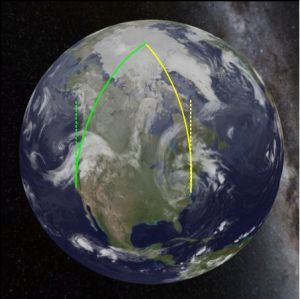 For instance, suppose Fred and Ethel collaborate on a narwhale research project. Fred is based in San Diego CA and Ethel works out of Norfolk VA. They fly to meet their research vessel at the North Pole. Fred’s plane follows the green track, Ethel’s plane follows the yellow one. At the start of the trip, they’re on parallel paths going straight north (the dotted lines). After a few hours, though, Ethel notices the two planes pulling closer together.
 The line rotates as a unit — every skater completes a 360o rotation in the same time. Similarly, everywhere on Earth a day lasts for exactly 24 hours.
 Now suppose our speedy skater hits a slushy patch of ice. Her end of the line is slowed down, so what happens to the rest of the line? It deforms — there’s a new center of rotation that forces the entire line to curl around towards the slow spot. Similarly, that blob near the Equator in the split-Earth diagram curls in the direction of the slower-moving air to its north, which is counter-clockwise.
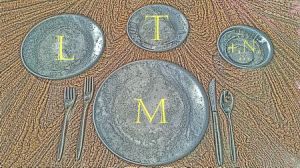 It all started with Newton’s mechanics, his study of how objects affect the motion of other objects. His vocabulary list included words like force, momentum, velocity, acceleration, mass, …, all concepts that seem familiar to us but which Newton either originated or fundamentally re-defined. As time went on, other thinkers added more terms like power, energy and action.
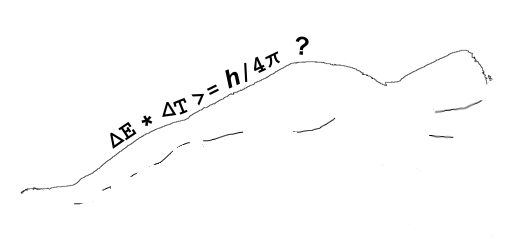 There is another way to get the same dimension expression but things aren’t not as nice there as they look at first glance. Action is given by the amount of energy expended in a given time interval, times the length of that interval. If you take the product of energy and time the dimensions work out as (ML2/T2)*T = ML2/T, just like Heisenberg’s Area.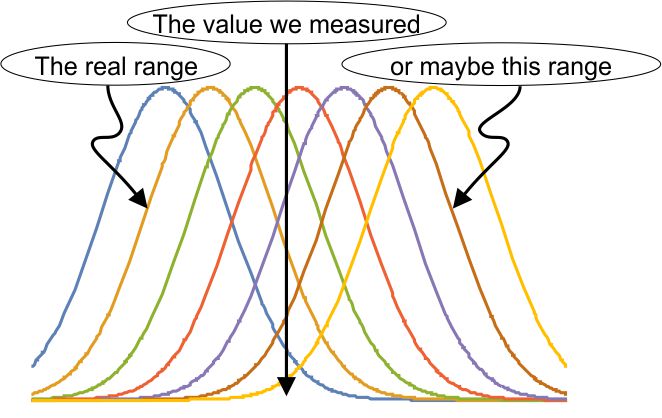
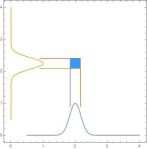 For practice using Heisenberg’s Area, what can we say about the atom? (If you’re checking my math it’ll help to know that the Area, h/4π, can also be expressed as 0.5×10⁻³⁴ kg m2/s; the mass of one hydrogen atom is 1.7×10⁻²⁷ kg; and the speed of light is 3×10⁸ m/s.) On average the atom’s position is at the cube’s center. Its position range is one meter wide. Whatever the atom’s average momentum might be, our measurements would be somewhere within a momentum range of (h/4π kg m2/s) / (1 m) = 0.5×10⁻³⁴ kg m/s. A moving particle’s momentum is its mass times its velocity, so the velocity range is (0.5×10⁻³⁴ kg m/s) / (1.7×10⁻²⁷ kg) = 0.3×10⁻⁷ m/s.
 elaborate mathematical structure. If the measurement is a quantum mechanical result, part of that structure is our familiar bell-shaped curve. It’s an explicit recognition that way down in the world of the very small, we can’t know what’s really going on. Most calculations have to be statistical, predicting an average and an expected range about that average. That prediction may or may not pan out, depending on what the experimentalists find.
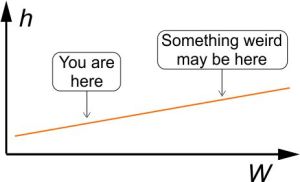 So there could be a collection of bell-curves gathered about the experimental result. Remember those
