Hysteresis Everywhere

“We’ve known each other for a long time, ain’t we, Sy?”

“That we have, Vinnie.”

“So I get suspicious when we’ve specific been talking about a magnetic field making something else magnetic and you keep using general words like ‘driver‘ and ‘deviation‘. You playing games?”

“You caught me. The hysteresis idea spreads a lot farther than magnetism. It addresses an entire dimension Newton was too busy to think about — time.”

“Wait a minute. Newton was all about velocity and acceleration and both of them are something‑per‑time. It’s right there in the units. Twice for acceleration.”

“True, but each is really about brief time intervals. Say you’re riding a roller‑coaster. Your velocity and acceleration change second‑by‑second as forces come at you. Every force changes your net acceleration immediately, not ten minutes from now. Hysteresis is about change that happens because of a cause some time in the past. Newton didn’t tackle time‑offset problems, I suppose mostly because the effects weren’t detectable with the technology of his time.”

“They had magnets.”

“Permanent ones, not electromagnets they could control and measure the effects of. Electromagnetic hysteresis generates effects that Newton couldn’t have known about. Fahrenheit didn’t invent temperature measurement until two years before Newton died, so science hadn’t yet discovered temperature‑dependent hysteresis effects. The microscope had been around for a half‑century or so but in Newton’s day people were still arguing about whether cells were a necessary part of a living organism. Newton’s world didn’t have an inkling of cellular biophysics, much less biophysical hysteresis. At human scale, country‑level economic data if it existed at all was a military secret — not a good environment for studying cases of economic hysteresis.”

“So what you’re saying is that Newton couldn’t have tackled those even if he’d wanted to. Got it. But that’s a pretty broad list of situations. How can you say they’re all hystereseseses, … loopy things?”

“They’ve all got a set of characteristics that you can fit into similar mathematical models. They’re all about some statistical summary of a complex system. The system is under the influence of some outside driver, could be a physical force or something more abstract. The driver can work in either of two opposing directions, and the system can respond to the driver to change in either of two opposing ways. Oh, and a crucial characteristic is that the system has a buffer of some sort that saves a memory of what the driver did and serves it up some time later.”

“Wait, lemme see if I can match those pieces to my magnetic nail. OK, the driver is the outside magnetic field, that’s easy, the system is the magnetic iron atoms, and the summary is the nail’s field. The driver can point north‑to‑south or south‑to‑north and the atoms can, too. Ah, and the memory is the domains ’cause the big ones hold onto the direction the field pointed last. How’d I do?”

“Perfect.”

“Goody for me. So why are those guys on the radio saying the economy is hysterical, ‘scuse, has hysteresis? What’s which part?”

“Economies are complex beasts, with a lot of separate but interacting hysteresis loops. These guys, what were they discussing at the time?”

“Unemployment, if I remember right. They said the job market is sticky, whatever that means.”

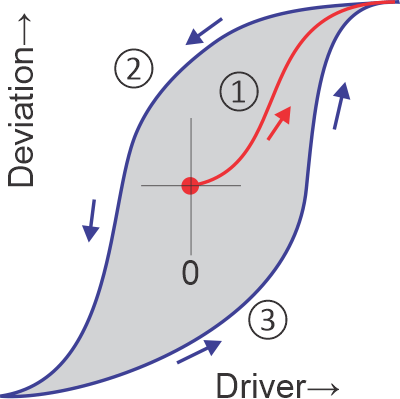
“Good example. Here’s our basic hysteresis loop with some relabeling. Running across we’ve got our driver, the velocity of money, which claims to measure all the buying and selling. Up‑and‑down we’ve got total employment. The red dot is the initial equilibrium, some intermediate level where there’s just enough cash flowing around that some but not all people have jobs. Then a new industry, say cellphones, comes in. Suddenly there’s people making cellphones, selling cellphones, repairing cellphones –“

“I get the idea. More activity, money flows faster, more jobs and people are happy. OK, then the pandemic comes along, money slows down, jobs cut back and around we go. But where’s the stickiness?”

“In people’s heads. If they get into Depression thinking, everyone holds onto cash even if there’s a wonderful new cellphone out there. People have to start thinking that conditions will improve before conditions can improve. That’s the delay factor.”

“Hysterical, all right.”

~~ Rich Olcott

The Hysterical Penguin

“Sy, you said that hysteresis researchers filled in two of Newton’s Physics gaps. OK, I get that he couldn’t do atomic stuff ’cause atoms hadn’t been discovered yet. What’s the other one?”

Proposition XI, Problem VI
from Book I of Newton’s Principia

“Non‑linearity.”

“You’re gonna have to explain that.”

“It’s a math thing. I know you don’t go for equations, so here’s a picture to get you started on how Newton solved problems. Look at all familiar?”

“Whoa, looks like something toward the end of my Geometry class.”

“Exactly. Newton was trained as a geometer and he was good at it. His general strategy was to translate a physical system to a geometrical structure and then work out its properties as a series of geometric proofs. The good news was that he proved a lot of things that started us on the way to quantitative science. The bad news was that his proofs were hard to extend to situations where the geometry wasn’t so easy.”

“That’s easy?”

“For Newton, maybe it was. Who knows? Anyway, the toolkit they gave you in Geometry class was what Newton had to work with — logic, straight lines and some special curves like ellipses and parabolas whose properties had been studied since Euclid, all on a flat plane. Nearly everything depended on finding proportionalities between different distances or areas — this line is twice that one but equal to a third, that sort of thing. Proportionality like that is built into equations like here+(velocity×time)=there. See how distance traveled is proportional to time? The equation plots as a straight line, which is why it’s called a linear equation.”

“So what’s non‑linear look like — all wiggle‑waggle?”

“Not necessarily. Things can vary smoothly along curves that aren’t those classical ones. Newton’s methods are blocked on those but Leibniz’s algebra‑based calculus isn’t. That’s why it won out with people who needed answers. What’s important here is that Newton’s lines can’t describe everything. Mmm… where does a straight line end?”

“Either at a T or never. Same thing for a parabola. Hey, ellipses don’t really end, either.”

“Mm-hm. Newton’s lines either stop abruptly or they continue forever. They don’t grow or peter out exponentially like things in real life do. Suppose something’s velocity changes, for instance.”

“That’s acceleration. I like accelerating.”

“So true, I’ve experienced your driving. But even you don’t accelerate at a constant rate. You go heavy or light or maybe brake, whatever, and our speed goes up or down depending. The only way Newton’s geometry can handle variable acceleration is to break it into mostly‑constant pieces and work one piece at a time. Come to think of it, that may be where he got the idea for his fluxions method for calculus. Fortunately for him, some things like planets and artillery shells move pretty close to what his methods predict. Unfortunately, things like disease epidemics and economies don’t, which is why people are interested in non‑linearity.”

“So what do these hysteresis guys do about it?”

“Mostly algebraic calculus or computer approximations. But there wasn’t just one group of hysteresis guys, there was a bunch of groups, each looking at different phenomena where history makes a difference. Each group had their own method of attack.”

“Like your elephant thing with Anne, lots of notions about entropy.”

Typical hysteresis loop
Red — initial evolution
Blue — subsequent changes

“How’d you find out about that?”

You wrote those posts, Sy, about three years ago.”

“Oh, that’s right. Talk about history. Anyway, it took decades for the ecologists, epidemiologists, civil engineers and several kinds of physicist to realize that they all have systems that behave similarly when driven by a stressor. Starting at some neutral situation, the system evolves in the driver’s direction to some maximum deviation where increased stress has no further effect. When the stress is relieved, the system may stick temporarily at the strained position. When it does evolve away from there, maybe a reverse driver is needed to force a return to the starting situation. In fact, if the forward and reverse drivers are applied repeatedly the system may never get back to the initial unstressed position.”

“Like that iron nail. Not magnetic, then magnetic, then reversed.”

~~ Rich Olcott

Hysteria

<chirp, chirp> “Moire here.”

“Hi, Sy, it’s Vinnie again. Hey, I just heard something on NPR I wanted to check with you on.”

“What’s that?”

“They said that even with the vaccine and all, it’s gonna take years for us to get back to normal ’cause the economy’s hysterical. Does that mean it’s cryin’‑funny or just cryin’? Neither one seems to fit.”

“You’re right about the no‑fit. Hmm… Ah! Could the word have been ‘hysteresis‘?”

“Somethin’ like that. What’s it about?”

“It’s an old Physics word that’s been picked up by other fields. Not misused as badly as ‘quantum,’ thank goodness, but still. The word itself gives you a clue. Do you hear the ‘history‘ in there?”

“Hysteresis, history … cute. So it’s about history?”

“Yup. The classic case is magnetism. Take an iron nail, for instance. The nail might already be magnetized strongly enough to pick up a paper clip. If it can, you can erase the magnetism by heating the nail white‑hot. If the nail’s not magnetic you may be able to magnetize it by giving it a few hammer‑whacks while it’s pointed north‑south, parallel to Earth’s magnetic field. Things get more interesting if we get quantitative. A strong‑enough magnetic field will induce magnetism in that nail no matter what direction it’s pointed. Reverse that field’s direction and the nail stays magnetized, only less so. It takes a stronger reverse field to demagnetize the nail than it took to magnetize it in the first place. See how the history makes a difference?”

“Yeah, for some things.”

“And that’s the point. Some of a system’s properties are as fixed as the nail’s weight or chemical composition. However, it may have other properties we can’t understand without knowing the history. Usually we can’t even predict them without looking at deeper structures. Hysteresis highlights two more gaps in Newton’s Physics. As usual he’s got a good excuse because many history‑dependent phenomena couldn’t even be detected with 17th‑Century technology. We couldn’t produce controllable magnetic fields until the 19th Century, when Oersted and Ampere studied magnetism and electricity. We didn’t understand magnetic hysteresis until the 20th Century.”

“Haw! You’re talking history of history. Anyway, to me it looks like what’s going on is that the strong field gets the magnetic atoms in there to all point the same way and heat undoes that by shaking them up to point random‑like.”

“What about the reversing field?”

“Maybe it points some of the atoms in the other direction and that makes the nail less and less magnetic until the field is strong enough to point everything backwards.”

“Close enough. The real story is that the atoms, iron in this case, are organized in groups called domains. The direction‑switching happens at the domain level — battalions of magnetically aligned atoms — but we had no way to know that until 20th‑Century microscopy came along.”

“So it takes ’em a while to get rearranged, huh?”

“Mmm, that’d be rate-dependent hysteresis, where the difference between forward and backward virtually disappears if you go slow enough. Think about putting your hand slowly into a tub of water versus splashing in there. Slow in, slow out reverses pretty well, but if you splash the water’s in turmoil for quite a long time. Magnetic hysteresis, though, doesn’t care about speed except in the extreme case. It’s purely controlled by the strength of the applied field.”

“I’m thinking about that poor frog.”

‘You would go there, wouldn’t you? Yeah, the legendary frog in slowly heating water would be another history dependency but it’s a different kind. The nail’s magnetism only depends on atoms standing in alignment. A frog is a highly organized system, lots of subsystems that all have to work together. Warming water adds energy that will speed up some subsystems more than others. If Froggy exits the pot before things desynchronize too far then it can recover its original lively state. If it’s trapped in there you’ve got frog soup. By the way, it’s a myth that the frog won’t try to hop out if you warm the water slowly. Frogs move to someplace cool if they get hotter than their personal threshold temperature.”

“Frogs are smarter than legends, huh?”

~~ Rich Olcott

‘Twixt A Rock And A Vortex

A chilly late December walk in the park and there’s Vinnie on a lakeside bench, staring at the geese and looking morose. “Hi, Vinnie, why so down on such a bright day?”

“Hi, Sy. I guess you ain’t heard. Frankie’s got the ‘rona.”

Frankie??!? The guys got the constitution of an ox. I don’t think he’s ever been sick in his life.”

“Probably not. Remember when that bug going around last January had everyone coughing for a week? Passed him right by. This time’s different. Three days after he showed a fever, bang, he’s in the hospital.”

“Wow. How’s Emma?”

“She had it first — a week of headaches and coughing. She’s OK now but worried sick. Hospital won’t let her in to see him, of course, which is a good thing I suppose so she can stay home with the kids and their schoolwork.”

“Bummer. We knew it was coming but…”

“Yeah. Makes a difference when it’s someone you know. Hey, do me a favor — throw some science at me, get my mind off this for a while.”

“That’s a big assignment, considering. Let’s see … patient, pandemic … Ah! E pluribus unum and back again.”

“Come again?”

“One of the gaps that stand between Physics and being an exact science.”

“I thought Physics was exact.”

“Good to fifteen decimal places in a few special experiments, but hardly exact. There’s many a slip ‘twixt theory and practice. One of the slips is the gap between kinematic physics, about how separate objects interact, and continuum physics, where you’re looking at one big thing.”

“This is sounding like that Loschmidt guy again.”

“It’s related but bigger. Newton worked on both sides of this one. On the kinematics side there’s billiard balls and planets and such. Assuming no frictional energy loss, Newton’s Three Laws and his Law of Gravity let us calculate exact predictions for their future trajectories … unless you’ve got more than three objects in play. It’s mathematically impossible to write exact predictions for four or more objects unless they start in one of a few special configurations. Newton didn’t do atoms, no surprise, but his work led to Schrödinger’s equation for an exact description of single electron, single nucleus systems. Anything more complicated, all we can do is approximate.”

“Computers. They do a lot with computers.”

“True, but that’s still approximating. Time‑step by time‑step and you never know what might sneak in or out between steps.”

“What’s ‘continuum‘ about then? Q on Star trek?”

“Hardly, we’re talking predictability here. Q’s thing is unpredictability. A physics continuum is a solid or fluid with no relevant internal structure, just an unbroken mass from one edge to the other. Newton showed how to analyze a continuum’s smooth churning by considering the forces that act on an imaginary isolated packet of stuff at various points in there. He basically invented the idea of viscosity as a way to account for friction between a fluid and the walls of the pipe it’s flowing through.”

“Smooth churning, eh? I see a problem.”

“What’s that?”

“The eddies and whirlpools I see when I row — not smooth.”

“Good point. In fact, that’s the point I was getting to. We can use extensions of Newton’s technique to handle a single well‑behaved whirlpool, but in real life big whirlpools throw off smaller ones and they spawn eddies and mini‑vortices and so on, all the way down to atom level. That turns out to be another intractable calculation, just as impossible as the many‑body particle mechanics problem.”

“Ah‑hah! That’s the gap! Newton just did the simple stuff at both ends, stayed away from the middle where things get complicated.”

“Exactly. To his credit, though, he pointed the way for the rest of us.”

“So how can you handle the middle?”

“The same thing that quantum mechanics does — use statistics. That’s if the math expressions are average‑able which sometimes they’re not, and if statistical numbers are good enough for why you’re doing the calculation. Not good enough for weather prediction, for instance — climate is about averages but weather needs specifics.”

“Yeah, like it’s just started to snow which I wasn’t expecting. I’m heading home. See ya, Sy.”

“See ya, Vinnie. … Frankie. … Geez.

~~ Rich Olcott

A Star’s Tale

It’s getting nippy outside so Al’s moved his out‑front coffee cart into his shop. Jeremy’s manning the curbside take‑out window but I’m walking so I step inside. Limited seating, of course. “Morning, Al. Here’s my hiking mug, fill ‘er up with high‑test and I’ll take a couple of those scones — one orange, one blueberry. Good news that the Governor let you open up.”

“You know it, Sy. Me and my suppliers have been on the phone every day. Good thing we’ve got long‑term relationships and they’ve been willing to carry me but it gets on my conscience ’cause they’re in a crack, too, ya know?”

“Low velocity of money hurts everybody, Al. Those DC doofuses and their political kabuki … but don’t get me started. Hey, you’ve got a new poster over the cash register.”

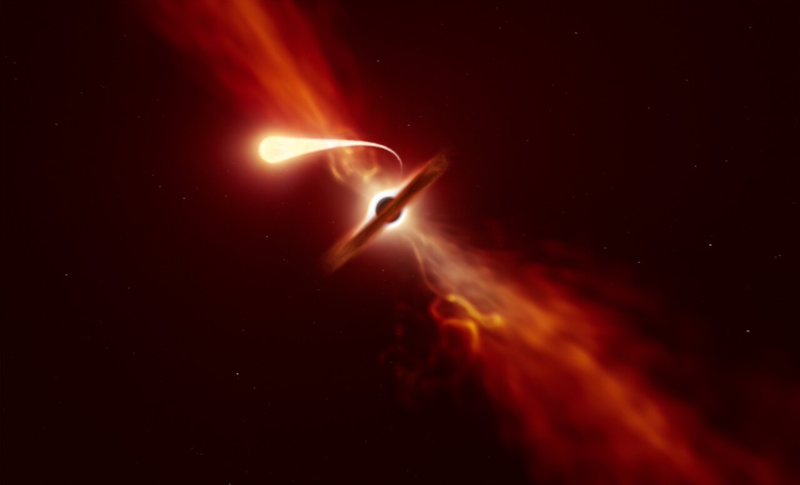
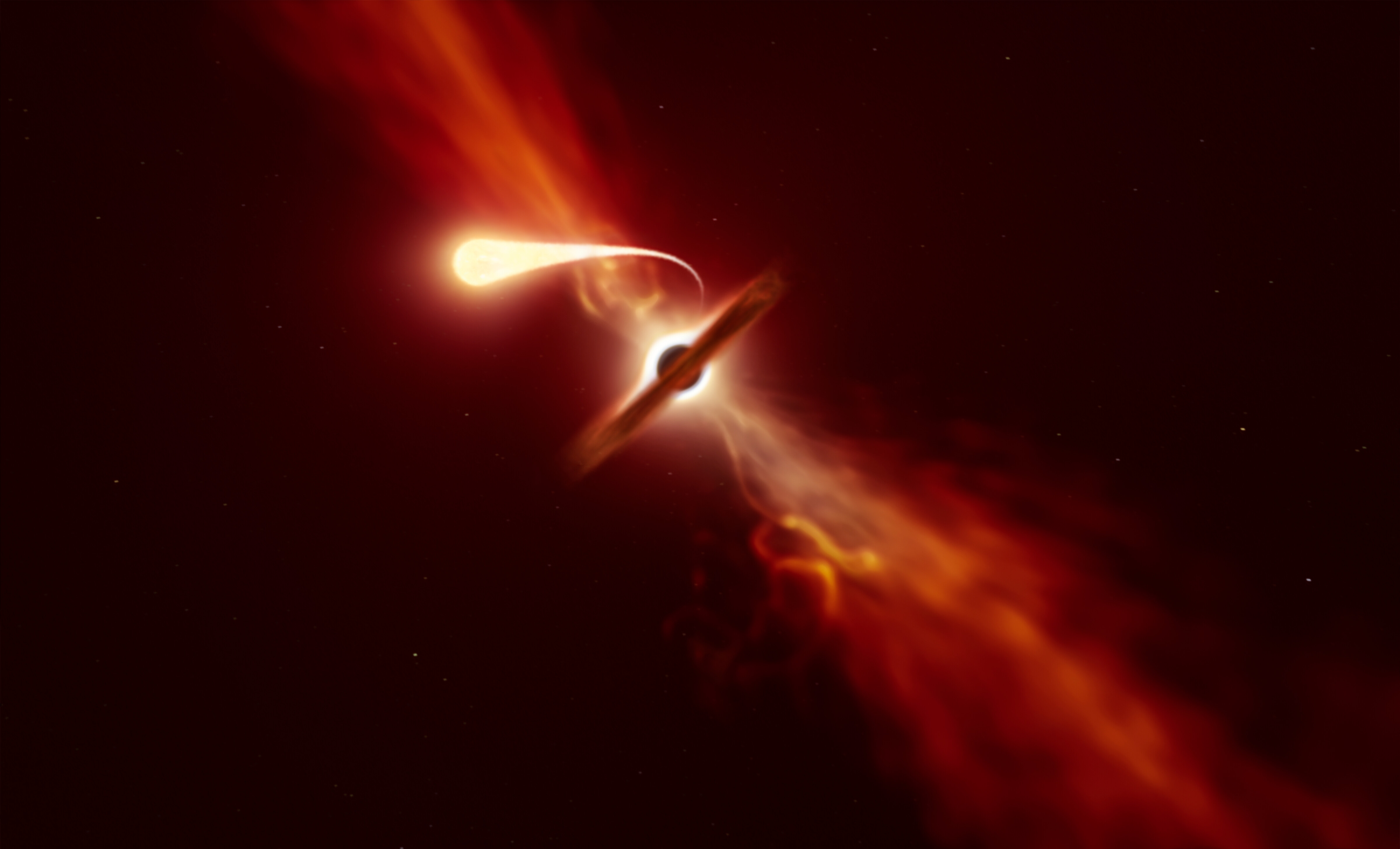
“You noticed. Yeah, it’s a beaut. Some artist’s idea of what it’d look like when a star gets spaghettified and eaten by a black hole. See, it’s got jets and a dust dusk and everything.”

“Very nice, except for a few small problems. That’s not spaghettification, the scale is all wrong and that tail-looking thing … no.”

Artist’s impression of AT2019qiz. Credit: ESO/M. Kornmesser
Under Creative Commons Attribution 4.0 International License

“Not spaghettification? That’s what was in the headline.”

“Sloppy word choice. True spaghettification acts on solid objects. Gravity’s force increases rapidly as you approach the gravitational center. Suppose you’re in a kilometer-long star cruiser that’s pointing toward a black hole from three kilometers away. The cruiser’s tail is four kilometers out. Newton’s Law of Gravity says the black hole pulls almost twice as hard on the nose as on the tail. If the overall field is strong enough it’d stretch the cruiser like taffy. Larry Niven wrote about the effect in his short story, Neutron Star.”

“The black hole’s stretching the star, right?”

“Nup, because a star isn’t solid. It’s fluid, basically a gas held together by its own gravity. You can’t pull on a piece of gas to stretch the whole mass. Your news story should have said ‘tidal disruption event‘ but I guess that wouldn’t have fit the headline space. Anyhow, an atom in the star’s atmosphere is subject to three forces — thermal expansion away from any gravitational center, gravitational attraction toward its home star and gravitational attraction toward the black hole. The star breaks up atom by atom when the two bodies get close enough that the black hole’s attraction matches the star’s surface gravity. That’s where the scale problem comes in.”

Al looks around — no waiting customers so he strings me along. “How?”

“The supermassive black hole in the picture, AT2019qiz, masses about a million Suns‑worth. The Sun‑size star can barely hold onto a gas atom at one star‑radius from the star’s center. The black hole can grab that atom from a thousand star‑radii away, about where Saturn is in our Solar System. The artist apparently imagined himself to be past the star and about where Earth is to the Sun, 100 star‑radii further out. Perspective will make the black hole pretty small.”

“But that’s a HUGE black hole!”

“True, mass‑wise, not so much diameter‑wise. Our Sun’s about 864,000 miles wide. If it were to just collapse to a black hole, which it couldn’t, its Event Horizon would be about 4 miles wide. The Event Horizon of a black hole a million times as massive as the Sun would be less than 5 times as wide as the Sun. Throw in the perspective factor and that black circle should be less than half as wide as the star’s circle.”

“What about the comet‑tail?”

“The picture makes you think of a comet escaping outward but really the star’s material is headed inward and it wouldn’t be that pretty. The disruption process is chaotic and exponential. The star’s gravity weakens as it loses mass but the loss is lop‑sided. Down at the star’s core where the nuclear reactions happen the steady burn becomes an irregular pulse. The tail should flare out near the star. The rest should be jagged and lumpy.”

“And when enough gets ripped away…”

“BLOOEY!”

~~ Rich Olcott

  • Thanks to T K Anderson for suggesting this topic.
  • Link to Technical PS — Where Do Those Numbers Come From?.

A Beetled Brow

Vinnie’s brow was wrinkling so hard I could hear it over the phone. “Boltzmann, Boltzmann, where’d I hear that name before? … Got it! That’s one of those constants, ain’t it, Sy? Molecules or temperature or something?”

“The second one, Vinnie. Avagadro was the molecule counter. Good memory. Come to think of it, both Boltzmann and Avagadro bridged gaps that Loschmidt worked on.”

“Loschmidt’s thing was the paradox, right, between Newton saying events can back up and thermodynamics saying no, they can’t. You said Boltzmann’s Statistical Mechanics solved that, but I’m still not clear how.”

“Let me think of an example. … Ah, you’ve got those rose bushes in front of your place. I’ll bet you’ve also put up a Japanese beetle trap to protect them.”

“Absolutely. Those bugs would demolish my flowers. The trap’s lure draws them away to my back yard. Most of them stay there ’cause they fall into the trap’s bag and can’t get out.”

“Glad it works so well for you. OK, Newton would look at individual beetles. He’d see right off that they fly mostly in straight lines. He’d measure the force of the wind and write down an equation for how the wind affects a beetle’s flight path. If the wind suddenly blew in the opposite direction, that’d be like the clock running backwards. His same equation would predict the beetle’s new flight path under the changed conditions. You with me?”

“Yeah, no problem.”

“Boltzmann would look at the whole swarm. He’d start by evaluating the average point‑to‑point beetle flight, which he’d call ‘mean free path.’ He’d probably focus on the flight speed and in‑the‑air time fraction. With those, if you tell him how many beetles you’ve got he could generate predictions like inter‑beetle separation and how long it’d take an incoming batch of beetles to cross your yard. However, predicting where a specific beetle will land next? Can’t do that.”

“Who cares about one beetle?”

“Well, another beetle might. …
Just thought of a way that Statistical Mechanics could actually be useful in this application. Once Boltzmann has his numbers for an untreated area, you could put in a series of checkpoints with different lures. Then he could develop efficiency parameters just by watching the beetle flying patterns. No need to empty traps. Anyhow, you get the idea.”

Japanese Beetle, photo by David Cappaert, Bugwood.org
under Creative Commons BY 3.0

“Hey, I feel good emptying that trap, I’m like standing up for my roses. Anyway, so how does Avagadro play into this?”

“Indirectly and he was half a century earlier. In 1805 Gay‑Lussac showed that if you keep the pressure and temperature constant, it tales two volumes of hydrogen to react with one volume of oxygen to produce one volume of water vapor. Better, the whole‑number‑ratio rule seemed to hold generally. Avagadro concluded that the only way Gay‑Lussac’s rule could be general is if at any temperature and pressure, equal volumes of every kind of gas held the same number of molecules. He didn’t know what that number was, though.”

“HAW! Avagadro’s number wasn’t a number yet.”

“Yeah, it took a while to figure out. Then in 1865, Loschmidt and a couple of others started asking, “How big is a gas molecule?” Some gases can be compressed to the liquid state. The liquids have a definite volume, so the scientists knew molecules couldn’t be infinitely small. Loschmidt put numbers to it. Visualize a huge box of beetles flying around, bumping into each other. Each beetle, or molecule, ‘occupies’ a cylinder one beetle wide and the length of its mean free path between collisions. So you’ve got three volumes — the beetles, the total of all the cylinders, and the much larger box. Loschmidt used ratios between the volumes, plus density data, to conclude that air molecules are about a nanometer wide. Good within a factor of three. As a side result he calculated the number of gas molecules per unit volume at any temperature and pressure. That’s now called Loschmidt’s Number. If you know the molecular weight of the gas, then arithmetic gives you Avagadro’s number.”

“Thinking about a big box of flying, rose‑eating beetles creeps me out.”

  • Thanks to Oriole Hart for the story‑line suggestion.

~~ Rich Olcott

Bridging A Paradox

<chirp, chirp> “Moire here.”

“Hi, Sy. Vinnie. Hey, I’ve been reading through some of your old stuff—”

“That bored, eh?”

“You know it. Anyhow, something just don’t jibe, ya know?”

“I’m not surprised but I don’t know. Tell me about it.”

“OK, let’s start with your Einstein’s Bubble piece. You got this electron goes up‑and‑down in some other galaxy and sends out a photon and it hits my eye and an atom in there absorbs it and I see the speck of light, right?”

“That’s about the size of it. What’s the problem?”

“I ain’t done yet. OK, the photon can’t give away any energy on the way here ’cause it’s quantum and quantum energy comes in packages. And when it hits my eye I get the whole package, right?”

“Yes, and?”

“And so there’s no energy loss and that means 100% efficient and I thought thermodynamics says you can’t do that.”

“Ah, good point. You’ve just described one version of Loschmidt’s Paradox. A lot of ink has gone into the conflict between quantum mechanics and relativity theory, but Herr Johann Loschmidt found a fundamental conflict between Newtonian mechanics, which is fundamental, and thermodynamics, which is also fundamental. He wasn’t talking photons, of course — it’d be another quarter-century before Planck and Einstein came up with that notion — but his challenge stood on your central issue.”

“Goody for me, so what’s the central issue?”

“Whether or not things can run in reverse. A pendulum that swings from A to B also swings from B to A. Planets go around our Sun counterclockwise, but Newton’s math would be just as accurate if they went clockwise. In all his equations and everything derived from them, you can replace +t with ‑t to make run time backwards and everything looks dandy. That even carries over to quantum mechanics — an excited atom relaxes by emitting a photon that eventually excites another atom, but then the second atom can play the same game by tossing a photon back the other way. That works because photons don’t dissipate their energy.”

“I get your point, Newton-style physics likes things that can back up. So what’s Loschmidt’s beef?”

“Ever see a fire unburn? Down at the microscopic level where atoms and photons live, processes run backwards all the time. Melting and freezing and chemical equilibria depend upon that. Things are different up at the macroscopic level, though — once heat energy gets out or randomness creeps in, processes can’t undo by themselves as Newton would like. That’s why Loschmidt stood the Laws of Thermodynamics up against Newton’s Laws. The paradox isn’t Newton’s fault — the very idea of energy was just being invented in his time and of course atoms and molecules and randomness were still centuries away.”

“Micro, macro, who cares about the difference?”

“The difference is that the micro level is usually a lot simpler than the macro level. We can often use measured or calculated micro‑level properties to predict macro‑level properties. Boltzmann started a whole branch of Physics, Statistical Mechanics, devoted to carrying out that strategy. For instance, if we know enough about what happens when two gas molecules collide we can predict the speed of sound through the gas. Our solid‑state devices depend on macro‑level electric and optical phenomena that depend on micro‑level electron‑atom interactions.”

“Statistical?”

“As in, ‘we don’t know exactly how it’ll go but we can figure the odds…‘ Suppose we’re looking at air molecules and the micro process is a molecule moving. It could go left, right, up, down, towards or away from you like the six sides of a die. Once it’s gone left, what are the odds it’ll reverse course?”

“About 16%, like rolling a die to get a one.”

“You know your odds. Now roll that die again. What’s the odds of snake‑eyes?”

“16% of 16%, that’s like 3 outa 100.”

“There’s a kajillion molecules in the room. Roll the die a kajillion times. What are the odds all the air goes to one wall?”

“So close to zero it ain’t gonna happen.”

“And Boltzmann’s Statistical Mechanics explained why not.”

“Knowing about one molecule predicts a kajillion. Pretty good.”

San Francisco’s Golden Gate Bridge, looking South
Photo by Rich Niewiroski Jr. / CC BY 2.5

~~ Rich Olcott

Question Time

Cathleen unmutes her mic. “Before we wrap up this online Crazy Theories contest with voting for the virtual Ceremonial Broom, I’ve got a few questions here in the chat box. The first question is for Kareem. ‘How about negative evidence for a pre-mammal civilization? Played-out mines, things like that.‘ Kareem, over to you.”

“Thanks. Good question but you’re thinking way too short a time period. Sixty‑six million years is plenty of time to erode the mountain a mine was burrowing into and take the mining apparatus with it.

“Here’s a different kind of negative evidence I did consider. We’re extracting coal now that had been laid down in the Carboniferous Era 300 million years ago. At first, I thought I’d proved no dinosaurs were smart enough to dig up coal because it’s still around where we can mine it. But on second thought I realized that sixty-six million years is enough time for geological upthrust and folding to expose coal seams that would have been too deeply buried for mining dinosaurs to get at. So like the Silurian Hypothesis authors said, no conclusions can be drawn.”

“Nice response, Kareem. Jim, this one’s for you. ‘You said our observable universe is 93 billion lightyears across, but I’ve heard over and over that the Universe is 14 billion years old. Did our observable universe expand faster than the speed of light?‘”

“That’s a deep space question, pun intended. The answer goes to what we mean when we say that the Hubble Flow expands the Universe. Like good Newtonian physicists, we’re used to thinking of space as an enormous sheet of graph paper. We visualize statements like, ‘distant galaxies are fleeing away from us‘ as us sitting at one spot on the graph paper and those other galaxies moving like fireworks across an unchanging grid.

“But that’s not the proper post-Einstein way to look at the situation. What’s going on is that we’re at our spot on the graph paper and each distant galaxy is at its spot, but the Hubble Flow stretches the graph paper. Suppose some star at the edge of our observable universe sent out a photon 13.7 billion years ago. That photon has been headed towards us at a steady 300000 kilometers per second ever since and it finally reached an Earth telescope last night. But in the meantime, the graph paper stretched underneath the photon until space between us and its home galaxy widened by a factor of 3.4.

“By the way, it’s a factor of 3.4 instead of 6.8 because the 93 billion lightyear distance is the diameter of our observable universe sphere, and the photon’s 13.7 billion lightyear trip is that sphere’s radius.

“Mmm, one more point — The Hubble Flow rate depends on distance and it’s really slow on the human‑life timescale. The current value of the Hubble Constant says that a point that’s 3×10¹⁹ kilometers away from us is receding at about 70 kilometers per second. To put that in perspective, Hubble Flow is stretching the Moon away from us by 3000 atom‑widths per year, or about 1/1300 the rate at which the Moon is receding because of tidal friction.”

“Nice calculation, Jim. Our final question is for Amanda. ‘Could I get to one of the other quantum tracks if I dove into a black hole and went through the singularity?‘”

“I wouldn’t want to try that but let’s think about it. Near the structure’s center gravitational intensity compresses mass-energy beyond the point that the words ‘particle’ and ‘quantum’ have meaning. All you’ve got is fields fluctuating wildly in every direction of spacetime. No sign posts, no way to navigate, you wouldn’t be able to choose an exit quantum track. But you wouldn’t be able to exit anyway because in that region the arrow of time points inward. Not a sci‑fi story with a happy ending.”

“<whew> Alright, folks, time to vote. Who presented the craziest theory? All those in favor of Kareem, click on your ‘hand’ icon. … OK. Now those voting for Jim? … OK. Now those voting for Amanda? … How ’bout that, it’s a tie. I guess for each of you there’s a parallel universe where you won the virtual Ceremonial Broom. Congratulations to all and thanks for such an interesting evening. Good night, everyone.”

~~ Rich Olcott

The Sound of Money

<chirp, chirp> “Moire, here, there’ll be a late-night surcharge for this call.”

“Hiya, Sy, it’s me, Vinnie. Got a minute? I wanna run something past you.”

“Sure, if it’s interesting enough to keep me awake.”

“It’s that Physics-money hobby horse you’ve been riding. I think I’ve got another angle on it for you.”

“Really? Shoot.”

“OK, a while ago you and me and Richard Feder talked about waves and how light waves and sound waves are different because light waves make things go up-and-down while the waves go forward but sound waves go back-and-forth.”

“Transverse waves versus compression waves, uh-huh.”

“Yeah and when you look close at a sound wave what you see is individual molecules don’t travel. What happens is like in a pool game where one ball bumps another ball and it stops but the bumped ball moves forward and the first ball maybe even moves back a little.”

“The compression momentum carries forward even though the particles don’t, right.”

“And that means that sound waves only travel as fast as the air molecules can move back and forth which is a lot slower than light waves which move by shaking the electric field. I got that, but why doesn’t sound move a lot faster in something like iron where the atoms don’t have to move?”

“Oh, it does, something like 200 times faster than in air. There’s a couple of factors in play. It all goes back to Newton —”

“Geez, he had a hand in everything Physics, didn’t he?”

“Except for electromagnetism and nuclear stuff. The available technology was just too primitive to let him experiment in those areas. Anyway, Newton discovered a formula connecting the speed of sound in a medium to its density. Like his Law of Gravity, it worked but he didn’t know why it worked. Also like gravity, we’ve got a better idea now.”

“What’s the better idea?”

“The key notions weren’t even invented until decades after Newton’s Principia was published. The magic words are the particulate nature of matter and intermolecular stiffness.”

“Hah?”

“One at a time. Newton was a particle guy to an extent. He believed that light is made of particles, but he didn’t take the next step to thinking of all matter as being made of particles. But it is, and the particles interact with each other. Think of it as stickiness. How effective the stickiness is depends on the temperature and which molecules you’re talking about. Gas molecules have so much kinetic energy relative to their sticky that they mostly just bounce off each other. In liquids and solids the molecules stay close enough together that the stickiness acts like springs. The springs may be more or less stiff depending on which molecules or ions or atoms are involved.”

“I see where you’re going. Stuff with stiffer springs doesn’t move as much as looser stuff at the same temperature; sound goes faster through a solid than through a liquid or gas. That’s what Newton figured out, huh?”

“No, he just measured and said, basically, ‘here’s the formula.‘ Just like with gravity, he didn’t suggest why the numbers were what they were. <yawn> So, you called with an idea about sound and money physics.”

“Right. Got off the track there, but this was helpful. What got me started was some newscaster saying how the Paycheck Protection Program is dumping money into the economy during the pandemic. My first thought was, ‘Haw, that’s gotta be a splash!‘ Then I imagined this pulse of money sloshing back and forth like a wave and that led me to sound waves and then I kept going. No dollar bill moves around that much, but when people spend them that’s like the compression wave moving out.”

“Interesting idea, Vinnie. From a Physics perspective, the question is, ‘How fast does the wave move?’ It’s another temperature‑versus‑stickiness thing.”

“Yeah, I figure money velocity measures the economy like temperature measures molecule motion. Money velocity goes up with inflation. If the velocity’s high people spend their money because why not.”

“Yup. From the government’s perspective the whole purpose of economic stimulation is getting the cash flowing again. Their problem is locating the money velocity kickover point.”

~~ Rich Olcott

Spare Change And Silly Putty

“Ok, Sy, you said Pascal explained the ‘water seeks its level‘ thing before Newton got a chance to. Newton was so smart, though — how’d Pascal beat him to it?”

“Pass me a strawberry scone, Al, and I’ll tell you why.”

“Anything for free food, eh, Sy? Alright, here.”

“Oferpitysake, Al, add it to my tab like always. Too much hassle putting on this face mask just to walk from my car to the scones. Pascal had a 20‑year head start — did his hydrostatics work when Newton wasn’t even in his teens. Unfortunately, Pascal died when Newton was only half-way through college. Whoa, if only Pascal had been alive and productive in France while Newton was in his science years in England and Leibniz was churning at everything in northern Germany. What advances might they have made arguing with each other? Where would our Math and Physics be today?”

“They didn’t like each other?”

“Newton didn’t like anybody. He and Leibniz feuded for decades over who invented calculus. Pascal and Leibniz probably would have gotten along fine — Leibniz could make nice with everyone except Newton. Come to think of it, Newton and Pascal had a lot in common. Newton was a preemie and Pascal was seriously ill for the first year of his life, never got much better. Newton wrote his first formal paper at 22; Pascal publicly proved that vacuums exist by creating some when he was 24. On the flip side, Pascal was 33 when he presented his studies of what we now call the Pascal Triangle but Newton waited until he was 44 to publish his Principia. And each of them spent much of the final quarter of his life on religious, even mystical matters.”

“So did Newton and Pascal both do much about money and water?”

“Not about the combination, though both had a lot to do about each one. Newton was Master of England’s Royal Mint and spent much of his time in office chasing down counterfeiters. Pascal wasn’t a gambler but Fermat was and the two of them teamed up to invent the probability theories that power today’s gaming, finance and insurance industries. So there’s that. Pascal and Newton both pioneered the science of fluids but from different perspectives. Pascal looked at static situations — comparing atmospheric pressure at two different altitudes, that sort of thing. Newton, as usual, studied change — in this case how fluids flow.”

“Pour water into a pipe and it pours out the other end. What’s to study?”

“Measuring how fast it pours and how that’s affected by the pressure and the pipe and what’s being poured. Newton explored the motion of fluids in exhausting detail in Book II of his Principia. As you’d expect, he found that the flow rate of water or any of the other fluids he investigated rises with the pressure and with the cross-sectional area of the pipe. Being Newton, though, he also also considered forces that resist flow. Think about it — the pipe itself doesn’t move and neither does the layer of fluid right next to the pipe’s walls. The flow rate ramps up from zero at the walls to full-on at the center of the pipe. The ramp-up rate depends on the fluid’s viscosity, another concept that Newton discovered or invented depending on how you look at it. Viscosity measures the drag force the slower layers exert on their faster neighbors. Fluids like molasses are viscous because their molecules are really good at grabbing onto molecules in the layers next door.”

“Where’s money fit into this picture?”

“I’m getting to that. Newton thought that each kind of fluid had its own viscosity, always the same. Not quite — temperature makes a difference and there’s non‑Newtonian materials like Silly Putty whose viscosity depends on how fast you yank on them. But the weirdest non‑Newtonian fluid is ultra‑low‑temperature liquid helium. It’s a superfluid and has zero viscosity. The helium atoms experience absolutely no drag from their neighbors and can sneak through the tiniest cracks. Money does the same, right? Each dime and dollar flows with no drag from its cousins.”

“Money’s a superfluid?”

“Yup. Think how it leaks out of your pocket.”

“Uh-huh. … Hey, Sy, about that tab…”

~~ Rich Olcott