One Step After Another

Mid-afternoon, time for a coffee break. As I enter Cal’s shop, I see Cathleen and Kareem chuckling together behind a jumble of Cal’s distinctive graph‑lined paper napkins. “What’s the topic of conversation, guys?”

“Hi, Sy. Kareem and I are comparing ladders.”

I look around, don’t see anything that looks like construction equipment.

“Not that kind, Sy. What’s your definition of a ladder?”

“Getting down to definitions, eh, Kareem? Okay, it’s a framework with steps you can climb up towards something you can’t reach.”

“Well, there you go.”

“Not much help, Cathleen. What are you really bantering about?”

“Each of our fields of study has a framework with steps that let us measure something that’d be way out of reach without it.”

“You’ll appreciate this, Sy — our ladders even use different math. The steps on Cathleen’s ladder are mostly linear, mine are mostly exponential.”

“And they’re both finicky — you have to be really careful when using them.”

“And they’ve both recently had adjustments at the top end.”

“I can see the fun, I think. How about some specifics?”

They exchange a look, Kareem gestures ‘after you‘ and Cathleen opens. “Mine’s in astrometry, Sy, the precise recording of relative positions. Tycho Brahe’s numbers were good to a few dozen arcseconds—”

“Arcsecond?”

1/60 of an arcminute which is 1/60 of a degree which is 1/360 of a full circle around the sky. Good enough in Newton’s day for him to explain planetary orbits, but we’ve come <ahem> a long way since then. The Gaia telescope mission can resolve certain objects down to a few microarcseconds but that’s only half the problem.”

“Let me guess — you have angles but you don’t have distances.”

“Bingo. Distance is astrometry’s biggest challenge.”

“Wait, Newton’s Law of Gravity includes r as the distance between objects. For that matter, Kepler’s Laws use and . Couldn’t you juggle them around to evaluate r?”

“Nope. Kepler did ratios, not absolute values. Newton’s Law has but you can rewrite it as F ² = GMm/r² = G(M/r)(m/r), G times the product of two mass‑to‑distance ratios. Newton’s G is our least‑accurate physical constant and we don’t have good handles on either of those numerators. Before space flight we just had mass ratios like M/m. We only discovered the Moon’s absolute mass when we orbited it with spacecraft of known mass. That’s the lowest rung on our mass ladder. Inside the Solar System we go step by step with orbit ratios. Outside the system everything’s measured relative to Solar mass.”

“I’m getting the ladder idea. So how do you distances?”
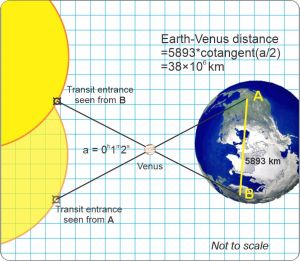
“Lowest rung is parallax, like binocular vision. You look at something from two different points a known distance apart. Measure the angle between the sight‑lines. Figure the triangles to get the something’s distance. The earliest example I know of was in the mid‑1700s when astrometers thousands of miles apart on Earth watched Venus cross the Sun’s disk. Each recorded the precise time they saw Venus touch the Sun’s disk. Given the time shift and the on‑Earth distance, some trigonometry gave them the Earth‑Venus distance. That put a scale to Newtonian orbital diagrams. Parallax across the width of Earth’s orbit yielded stellar distances out to thousands of lightyears with Hubble. We expect ten times better from Gaia.”

“That gets you maybe across the Milky Way. What about farther out?”

“Several ingenious variations on the parallax idea, but mostly standard candles.”
“Candles?”

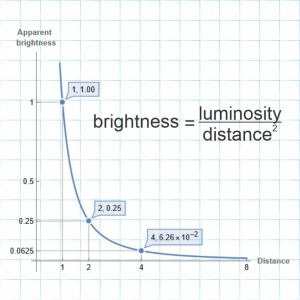
“Suppose you measure the brightness of a candle that’s a known distance away and there’s an equally luminous candle some unknown distance away. Measured brightness falls as the square of the distance, so if the second candle appears half as bright it’s four times the distance and so on. Climbing the cosmic distance ladder is going from one kind of uniformly‑luminous candle to another kind farther away.”

“Such as?”

“We know how brightness relates to bright‑dim‑bright cycle time for several types of variable stars. That gets us out to 30 million lightyears or so. Type I‑a supernovas act as useful candles out to a billion lightyears. Beyond that we can use galaxy surface brightness. That’s where the recent argument started.”

~ Rich Olcott

  • Thanks to Ken Burke for mentioning tellurium‑128’s septillion‑year half‑life.

Why Is Io Hot, Europa Not?

The Acme Pizza and Science Society is back in session at Eddie’s circular table. Al won the last pot so he gets to pick the next topic. “I been reading about Jupiter’s weird moon Io.”

“How’s it any weirder than Ganymede that’s bigger than Mercury?”
  ”Or Europa that’s got geysers and maybe life?”

“Guys, it’s the only yellow moon in the Solar System. You can’t any weirder than that! We got lots of stony moons that are mostly gray, a few water‑ice moons that are white like snow and then there’s Io by itself covered with sulfur.”

“Yellow?”

“Mostly yellow, except where it’s red or dark brown. Or white. They’re all sulfur colors.”

“I’ve seen yellow sulfur, but red?”

“It’s like carbon can be diamond or graphite. Sulfur can be different colors depending on how hot it was when it froze. The article said the white’s probably frozen sulfur dioxide that smells like burning matches.”

“Where’d all that sulfur come from?”

“From inside Io. It’s got like 400 volcanoes that blast out sulfur and stuff. Some of it falls back and that’s why Io is yellow, but a lot gets all the way into space. The article said Io loses a tonne per second. Nothin’ else in the Solar System is that active. Or that dense, probably ’cause it blasted away all its light stuff a long time ago. Anyway, I got a theory.”

“Don’t stop there. What’s the theory?”

“Jupiter’s stripes got all those colors, right, and Sy here wrote astronomers think the brownish bands have sulfur. My theory is that Jupiter got its sulfur from Io. Whaddaya think, Sy?”

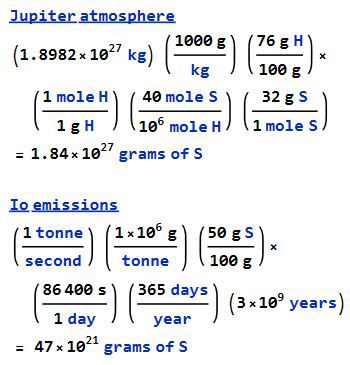
“Interesting idea.” <drawing Old Reliable from its holster> “We need numbers before we can upgrade that to a conjecture.” <screen‑tapping> “So, how much sulfur does Jupiter have, and how much could Io have supplied? … Ah, here’s a chart to get us started. Says for every million hydrogen atoms in Jupiter’s atmosphere there’s 40 sulfurs. This Wikipedia article says that the planet masses 1.898×1027 kilograms. 76% of that is hydrogen which calculates to … 1.8×1027 grams of sulfur.”

“That’s a lot of sulfur.”

“Mm-hm. Now, using your tonne per second loss rate and guessing it’s 50% sulfur and that’s been going on for ¾ of the system’s life so far, I get that Io may have shed about 5×10²² grams of sulfur. That’s short by 4½ powers of 10. Sorry, Al, Io contributed a little to Jupiter’s sulfur stash but not enough to promote your idea to a conjecture.”

Jim tosses some chips into the pot. “It’s worse than that, Sy. Galileo‘s probe fell into a clear hotspot so it sampled Jupiter’s gaseous atmosphere but it totally missed the sulfur tied up in those brown clouds. Jupiter’s got even more sulfur than your calculation shows. But there’s still an open question.”

“What’s open?”

Animation by WolfmanSF, CC0, via Wikimedia Commons

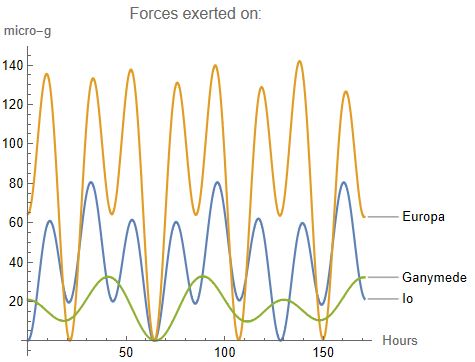
“The inner three Galilean moons are locked into resonant orbits. Laplace explained how their separate gravitational fields continually nudge each other to stay in sync. A 1979 paper supported that explanation but then claimed that the moon‑moon nudges produced enough tidal friction within Io to power volcanoes.”

“What’s wrong with that?”

“It doesn’t tell us why Io’s the only one hot enough to boil off all its water.”

“Io had water?”

“Probably, long ago. All three share the same orbital plane and probably formed from the same disk of gas and dust. Both Europa and Ganymede are water worlds, covered by kilometers of water ice. Io should be wet or the other two would be dry by now. Something’s different with Io and it’s not inter‑moon gravitation.”

“Why not?”

“Numbers. Those moon‑moon interactions are measured in microgravities. Such light impulses can synchronize effectively if repeated often enough, but these just aren’t energetic enough to boil a moon. Besides, Europa stays cool even though it feels a lot more action than Io does.”

“You got a theory?”

“A hypothesis. I’m betting on magnetism. Io’s deep in Jupiter’s lumpy magnetic field which must generate eddy currents in Io’s mostly iron core. I think Io heats up like a pot on an induction stove.”

~~ Rich Olcott

A Diamond in The Sky with Lucy

Mid-afternoon coffee-and-scone time. As I step into his coffee shop Al’s quizzing Cathleen about something in one of his Astronomy magazines. “This Lucy space mission they just sent up, how come it looks like they’re shooting at either side of Jupiter instead of hitting it straight-on? And it’s got this crazy butterfly orbit that crosses the whole Solar System a couple of times. What sense does that make?”

Planned path of Lucy‘s mission to study Trojan asteroids (black dots).
After diagrams by NASA and Southwest Research Institute

“It shoots to either side because there’s interesting stuff out there. We think the Solar System started as a whirling disk of dust that gradually clumped together. The gravity from Jupiter’s clump scarfed up the lion’s share of the leftovers after the Sun coalesced. The good news is, not all of Jupiter’s hoard wound up in the planet. Some pieces made it to Jupiter’s orbit but then collected in the Trojan regions ahead and behind it. Looking at that material may teach us about the early Solar System.”

“Way out there? Why not just fall into Jupiter like everything else did?”

I do Physics, I can’t help but cut in. “It’s the many‑body problem in its simplest case, just the Sun, Jupiter and an asteroid in a three‑body interaction—”

Cathleen gives me a look. “Inappropriate physicsplaining, Sy, we’re talking Astronomy here. Al’s magazine is about locating and identifying objects in space. These asteroids happen to cluster in special locations roughly sixty degrees away from Jupiter.”

“But Al’s question was, ‘Why?‘ You told him why we’re sending Lucy to the Trojans, but Physics is why they exist and why that mission map looks so weird.”

“Good point, go ahead. OK with you, Al?”

“Sure.”

I unholster Old Reliable, my tricked‑out tablet, and start sketching on its screen. “OK, orange dot’s Jupiter, yellow dot’s the Sun. Calculating their motion is a two-body problem. Gravity pulls them together but centrifugal force pulls them apart. The forces balance when the two bodies orbit in ellipses around their common center of gravity. Jupiter’s ellipse is nearly a circle but it wobbles because the Sun orbits their center of gravity. Naturally, once Newton solved that problem people turned to the next harder one.”

“That’s where Lucy comes in?”

“Not yet, Al, we’ve still got those Trojan asteroids to account for. Suppose the Jupiter‑Sun system’s gravity captures an asteroid flying in from somewhere. Where will it settle down? Most places, one body dominates the gravitational field so the asteroid orbits that one. But suppose the asteroid finds a point where the two fields are equal.”

“Oh, like halfway between, right?”

“Between, Al, but not halfway.”

“Right, Cathleen. The Sun/Jupiter mass ratio and Newton’s inverse‑square law put the equal‑pull point a lot closer to Jupiter than to the Sun. If the asteroid found that point it would hang around forever or until it got nudged away. That’s Lagrange’s L1 point. There are two other balance points along the Sun‑Jupiter line. L2 is beyond Jupiter where the Sun’s gravity is even weaker. L3 is way on the other side of the Sun, a bit inside Jupiter’s orbit.”

“Hey, so those 60° points on the orbit, those are two more balances because they’re each the same distance from Jupiter and the Sun, right?”

“There you go, Al. L4 leads Jupiter and L5 runs behind. Lagrange published his 5‑point solution to the three‑body problem in 1762, just 250 years ago. The asteroids found Jupiter’s Trojan regions billions of years earlier.”

“We astronomers call the L4 cluster the Trojan camp and the L5 cluster the Greek camp, but that’s always bothered me. It’d be OK if we called the planet Zeus, but Jupiter’s a Roman god. Roman times were a millennium after classical Greece’s Trojan War so the names are just wrong.”

“I hadn’t thought about that, Cathleen, but you’re right. Anyway, back to Al’s diagram of Lucy’s journey. <activating Old Reliable’s ‘Animate’ function> Sorry, Al, but you’ve been misled. The magazine’s butterfly chart has Jupiter standing still. Here’s a stars-eye view. It’s more like the Trojans will come to Lucy than the reverse.”

~~ Rich Olcott

The Solid Gold Bath Towel

“C’mon, Sy, I heard weaseling there — ‘velocity‑based thinking‘ ain’t the same as velocity numbers.”

“Guilty as charged, Vinnie. The centuries-old ‘velocity of money‘ notion has been superceded for a half-century, but the theory’s still useful in the right circumstances. It’s like Newton’s Law of Gravity that way, except we’ve been drifting away from Newton for a full century.”

“What, gravity doesn’t work any more?”

“Sure it does, and most places the force is exactly what Newton said it should be — proportional to the mass divided by the distance. But it goes wrong when the mass‑to‑distance ratio gets huge, say close to a star or a black hole. That’s when we move up to Einstein’s theory. It includes Newton’s Law as a special case but it covers the high-ratio cases more exactly and accounts for more phenomena.”

“Just for grins, how about when the ratio is tiny?”

“We don’t know. Some cosmologists have suggested that’s what dark energy is about. Maybe when galaxies get really far apart, they’re not attracted to each other quite as much as Newton’s Law says.”

“I suppose the money theories have problems at high and low velocities?”

“That’s one pair of problems. Money velocity is proportional to nominal traffic divided by money supply. Suppose an average currency unit changes hands thousands of times a day. That says people don’t have confidence that money will buy as much tomorrow as it could today. They’ve got hyperinflation.”

“Ah, and at the low end it’d be like me putting Eddie’s autographed $20 in a frame on my wall. No spend, no traffic, zero velocity.”

“Right, but for the economy it’d be everyone putting all their money under their mattresses. Money that’s frozen in place doesn’t do anything except maybe make someone feel good. It’s like water in a stream, it has to be flowing to be useful in generating power.”

“Wait, you used a word back there, ‘nominal.’ What’s that about?”

“Good ears. It points up another important distinction between Physics and Economics. Suppose you’re engineering a mill at that stream and you measure water flow in cubic meters per second. Kinetic energy is mass times velocity squared and power is energy per unit time. If you know water’s density in kilograms per cubic meter you can calculate the stream’s available water power. Density is key to finding mass from volume when volume’s easy to measure, or volume from easily‑measured mass.”

“OK, so what’s that got to do with ‘nominal‘?”

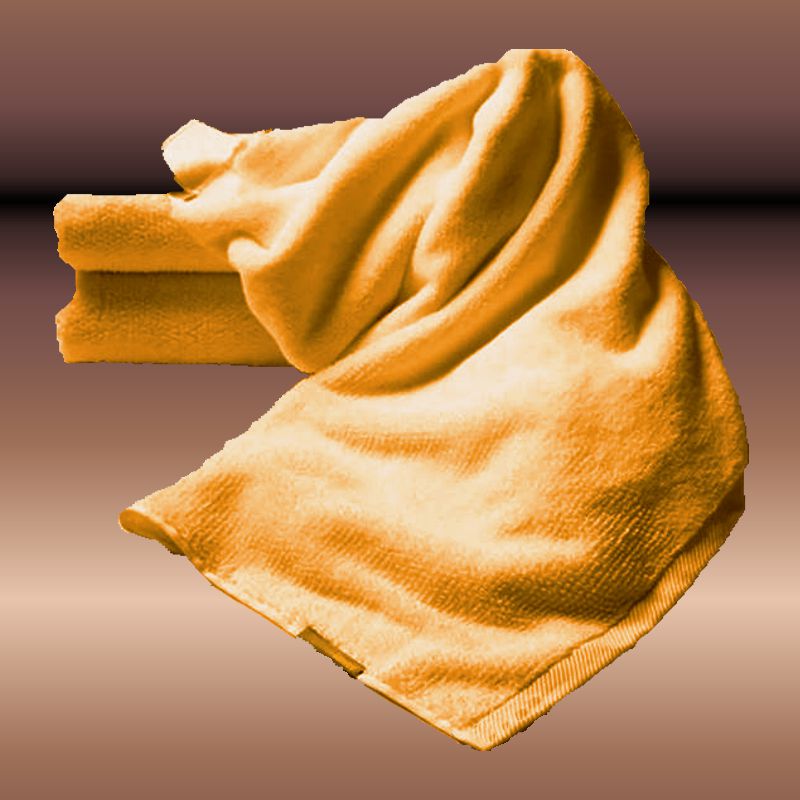
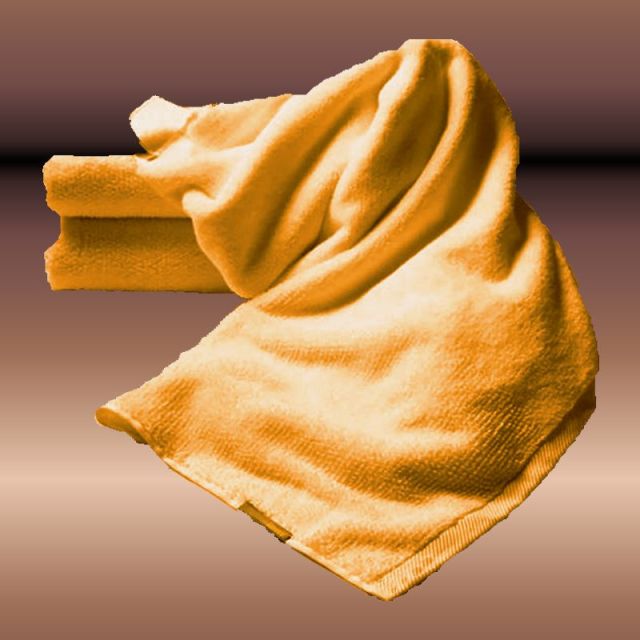
“In economic situations, money is easy to measure — it’s just the price paid — but value is a puzzle. In fact, people say that understanding the linkage between price and value is the central problem of Economics. There’s a huge number of theories out there, with good counter-examples for every one of them. For example, consider the solid gold bath towel.”

“What a stupid idea. Thing like that couldn’t dry you off in the desert.”

“True, but it’s made out of a rare material and some people think rarity makes value. In the right setting it’d be beautiful and there are certainly people who think beauty makes value. A lot of person‑time would be required to create it and some people think labor input is what makes value. The people who think utility makes value would give that towel very low marks. Of course, if you’ve already got plenty of bath towels you’re not about to buy another one so you don’t care.”

“So how do they decide what its price should be?”

“Depends on where you are. Many countries use a supply‑demand auction system that measures value by what people are willing to pay. Planned‑economy countries set prices by government edict. Other countries use a mixed system where the government sets prices for certain commodities like bread and fuel but everything else is subject to haggling. Whatever system’s in use, ‘nominal‘ traffic is the total of all transaction prices and that’s supposed to measure value.”

“Velocity’s supposed to be money supply divided into value flow but we can’t use value so we fake it with money flow?”

“You got it. Then the government tries to manage the money supply so velocity’s in a sweet spot.”

“Sounds rickety.”

“Yup.”

~~ Rich Olcott

On Gravity, Charge And Geese

A beautiful April day, far too nice to be inside working.  I’m on a brisk walk toward the lake when I hear puffing behind me.  “Hey, Moire, I got questions!”

“Of course you do, Mr Feder.  Ask away while we hike over to watch the geese.”

“Sure, but slow down , will ya?  I been reading this guy’s blog and he says some things I wanna check on.”

I know better but I ask anyhow.  “Like what?”

“Like maybe the planets have different electrical charges  so if we sent an astronaut they’d get killed by a ginormous lightning flash.”

“That’s unlikely for so many reasons, Mr Feder.  First, it’d be almost impossible for the Solar System to get built that way.  Next, it couldn’t stay that way if it had been.  Third, we know it’s not that way now.”

“One at a time.”

“OK.  We’re pretty sure that the Solar System started as a kink in a whirling cloud of galactic dust.  Gravity spanning the kink pulled that cloud into a swirling disk, then the swirls condensed to form planets.  Suppose dust particles in one of those swirls, for whatever reason, all had the same unbalanced electrical charge.”

“Right, and they came together because of gravity like you say.”

I pull Old Reliable from its holster.  “Think about just two particles, attracted to each other by gravity but repelled by their static charge.  Let’s see which force would win.  Typical interstellar dust particles run about 100 nanometers across.  We’re thinking planets so our particles are silicate.  Old Reliable says they’d weigh about 2×10¹⁸ kg each, so the force of gravity pulling them together would be …  oh, wait, that’d depend on how far apart they are.  But so would the electrostatic force, so let’s keep going.  How much charge do you want to put on each particle?”

“The minimum, one electron’s worth.”

“Loading the dice for gravity, aren’t you?  Only one extra electron per, umm, 22 million silicon atoms.    OK, one electron it is …  Take a look at Old Reliable’s calculation.gravity vs electrostatic calculation Those two electrons push their dust grains apart almost a quintillion times more strongly than gravity pulls them together.  And the distance makes no difference — close together or far apart, push wins.  You can’t use gravity to build a planet from charged particles.”

“Wait, Moire, couldn’t something else push those guys together — magnetic fields, say, or a shock wave?”

“Sure, which is why I said almost impossible.  Now for the second reason the astronaut won’t get lightning-shocked — the solar wind.  It’s been with us since the Sun lit up and it’s loaded with both positive- and negative-charged particles.  Suppose Venus, for instance, had been dealt more than its share of electrons back in the day.  Its net-negative charge would attract the wind’s protons and alpha particles to neutralize the charge imbalance.  By the same physics, a net-positive planet would attract electrons.  After a billion years of that, no problem.”

“All right, what’s the third reason?”

“Simple.  We’ve already sent out orbiters to all the planets.  Descent vehicles have made physical contact with many of them.  No lightning flashes, no fried electronics.  Blows my mind that our Cassini mission to Saturn did seven years of science there after a six-year flight, and everything worked perfectly with no side-trips to the shop.  Our astronauts can skip worrying about high-voltage landings.”

“Hey, I just noticed something.  Those F formulas look the same.”  He picks up a stick and starts scribbling on the dirt in front of us.  “You could add them up like F=(Gm1m2+k0q1q2)/r2.  See how the two pieces can trade off if you take away some mass but add back some charge?  How do we know we’ve got the mass-mass pull right and not mixed in with some charge-charge push?”

Geese and ducks“Good question.  If protons were more positive than electrons, electrostatic repulsion would always be proportional to mass.  We couldn’t separate that force from gravity.  Physicists have separately measured electron and proton charge.  They’re equal (except for sign) to 10 decimal places.  Unfortunately, we’d need another 25 digits of accuracy before we could test your hypothesis.”

“Aw, look, the geese got babies.”

“The small ones are ducks, Mr Feder.”

~~ Rich Olcott

What’s that funnel about, really?

If you’ve ever watched or read a space opera (oh yes, you have), you know about the gravity well that a spacecraft has to climb out of when leaving a planet.  Every time I see the Museum’s gravity well model (photo below), I’m reminded of all the answers the guy gave to, “Johnny, what can you make of this?

The model’s a great visitor-attracter with those “planets” whizzing around the “Sun,” but this one exhibit really represents several distinct concepts.   For some of them it’s not quite the right shape.DMNS gravity well

The simplest concept is geometrical.  “Down” is the direction you move when gravity’s pulling on you.

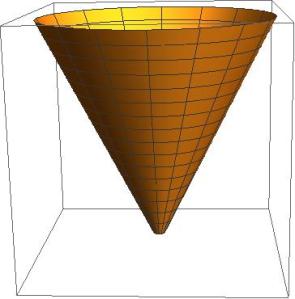
HS cone
Gravitational potential energy change
for small height differences

A gravity well model for that concept would be just a straight line between you and the neighborhood’s most intense gravity source.

You learned the second concept in high school physics class.  Any object has gravitational potential energy that measures the amount of energy it would give up on falling.  Your teacher probably showed you the equation GPE = m·g·h, where m is the mass of the object, h is its height above ground level, and g is a constant you may have determined in a lab experiment.

If the width of the gravity well model at a given height represents GPE at that level, the model is a simple straight-sided cone.

Newton energy cone
Gravitational potential energy change
for large height differences
The h indicates
an approximately linear range
where the HS equation could apply.

But of course it’s not that simple.  Newton’s Law of Gravity says that the potential energy at any height r away from the planet’s center is proportional to 1/r.

Hmm… that looks different from the “proportional to h” equation.  Which is right?

Both equations are valid, but over different distance scales.  The HS teachers didn’t quite lie to you, but they didn’t give you the complete picture either.  Your classroom was about 4000 miles (21,120,000 feet) from Earth’s center, whereas the usual experiments involve height differences of at most a dozen feet.  Even the 20-foot drop from a second-story window is less than a millionth of the way down to Earth’s center.

Check my numbers:

Height h 1/(r+h)
× 108
Difference in 1/(r+h)
× 1014
0 4.734,848,484 0
20 4.734,844,001 4.48
40 4.734,839,517 8.97
60 4.734,835,033 13.45
80 4.734,830,549 17.93
100 4.734,826,066 22.42

rh lineSure enough, that’s a straight line (see the chart).  Reminds me of how Newton’s Law of Gravity is valid except at very short distances.  The HS Law of Gravity works fine for small spans but when the distances get big we have to use Newton’s equation.
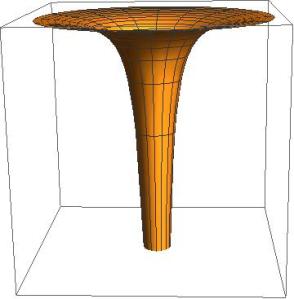
We’re not done yet. That curvy funnel-shaped gravity well model could represent the force of gravity rather than its potential energy.  Newton told us that the force goes as 1/r2 so it decreases much more rapidly than the potential energy does as you get further away.  The gravity force well has a correspondingly sharper curve to it than the gravity energy well.

Newton force cone
The force of gravity
or an embedding diagram

The funnel model could also represent the total energy required to get a real spacecraft off the surface and up into space.  Depending on which sci-fi gimmickry is in play, the energy may come from a chemical or ion rocket, an electromagnetic railgun, or even a tractor beam from some mothership way up there.

No matter the technology, the theoretical energy requirement to get to a given height is the same.  In practice, however, each technology is optimal for some situations but forbiddingly inefficient in others.  Thus, each technology’s funnel  has its own shape and that shape will change depending on the setting.

In modern physics, the funnel model could also represent Einstein’s theory of how a mass “bends” the space around it.  (Take a look at this post, which is about how mass curves space by changing the local distance scale.)  Cosmologists describe the resulting “shapes” with embedding diagrams that are essentially 2D pictures of 3D (or 4D) contour plots.  The contours are closest together where space is most compressed, just as lines showing a steep hillside on a landscape contour map are close together.

The ED around a non-spinning object looks just like the force model picture above.  No surprise — gravitational force is how we we perceive spatial curvature.

~~ Rich Olcott