Clouds From Both Sides Now

I don’t usually see Vinnie in a pensive mood. Moody, occasionally, but there he is at his usual table by the door, staring at the astronomy poster behind Al’s cash register. “Have a scone, Vinnie. What’s on your mind?”

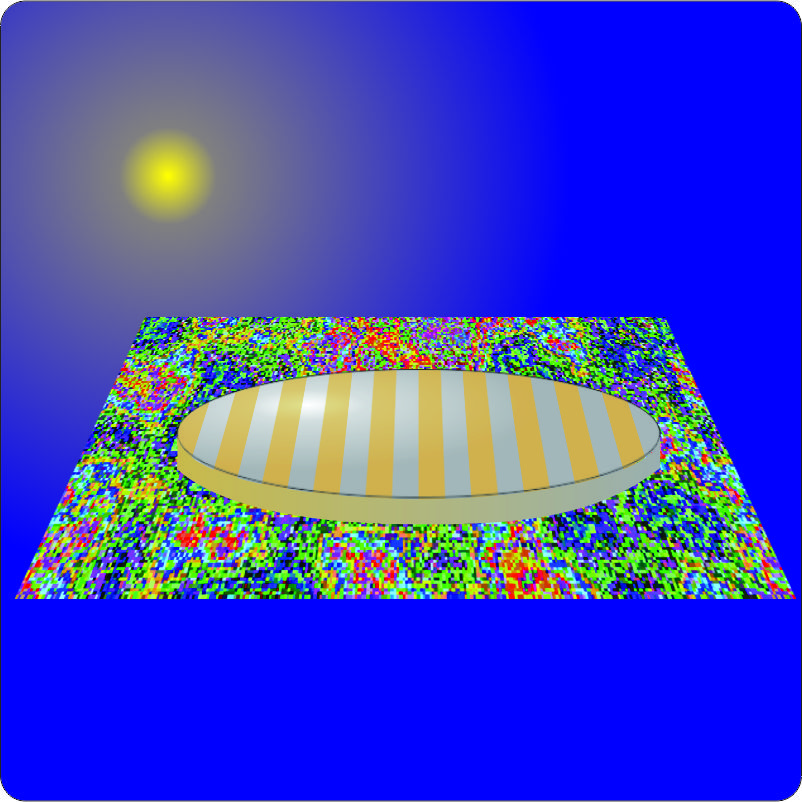
“Thanks, Sy. Welcome back, Cathleen. What’s bugging me is the hard edges on that picture of Jupiter. It looks like those stripes are painted on. Everyone says Jupiter’s not really solid so how come the planet looks so smooth?”

“Cathleen, this is definitely in your astronomer baliwick.”

“I suppose. It’s a matter of scale, Vinnie. The white zones mark updrafts. The whiteness is clouds that rise a couple hundred kilometers above a brownish lower layer. The downdraft belts on either side are transparent enough to let us see the next lower layer. ‘A couple hundred kilometers‘ sounds like a lot, but that’s only a tenth of a percent of Jupiter’s radius. If Jupiter were a foot‑wide ball floating in front of us, the altitude difference would be as thin as a piece of tissue paper. You might be able to feel the ridges and valleys but you’d have a hard time seeing them.”

“But why does the updraft stop so sharp? Is there like a cap on the atmosphere?”

“The clouds stop, but the updrafts don’t. The cloud tops aren’t even close to the top of Jupiter’s atmosphere, any more than Earth clouds reach the top of ours. C’mon, Vinnie, you’re a pilot. Surely you’ve noticed that most thunderheads top out at about the same altitude. Isn’t the sky still blue above them?”

“That’s higher than the planes I fly are cleared for, but I wouldn’t want to get above one anyway. I know a guy who flew over one that was just getting started. He said it’s a bumpy ride but yeah, there’s still kind of a dark blue sky above.”

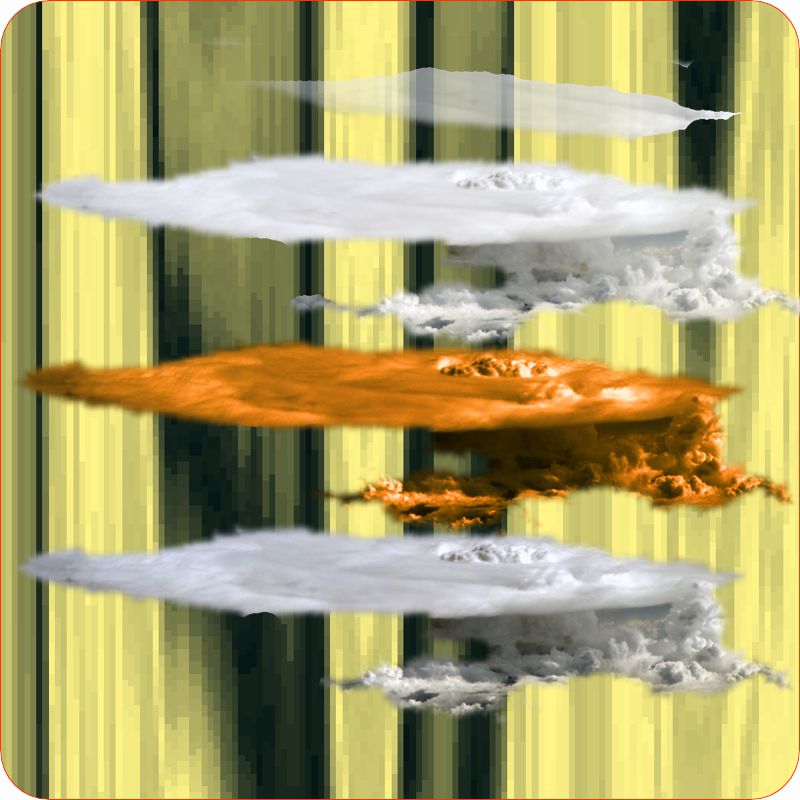
“All of that makes my point — our atmosphere doesn’t stop at the tropospheric boundary where the clouds do. Beyond that you’ve got another 40‑or‑so kilometers of stratosphere. Jupiter’s the same way, clouds go up only partway. For that matter, Jupiter has at least four separate cloud decks.”

“Wait, Cathleen — four? I know how Earth clouds work. Warm humid air rises, expanding and cooling as it goes. When its temperature falls below the dew point or freezing point, its humidity condenses to water droplets or ice crystals and that’s the cloud. I suppose if that same bucketful of air keeps rising far enough the pressure gets so low the water evaporates again and that’s the top of the cloud. How can that happen multiple times?”

“It doesn’t, Sy. In Jupiter’s complicated atmosphere each deck is formed from a different gas. Top layer is a wispy white hydrocarbon fog. The white zone clouds next down are ices of ammonia, which has to get a lot colder than water before it condenses. Water ice probably has a layer much farther down.”

“What’s the brownish layer?”

“There’s one or maybe two of them, each a complex mixture of ammonium ions with various sulfide species. The variety of colors in there make the visible light spectroscopy an opaque muddle.”

“Hey, if the brownish layers block what we can see, how do we even know lower layers are a thing?”

“Good question, Vinnie. Actually, we can do spectroscopy in the middle infrared. That gives us some clues. We’d hoped that the Galileo mission’s deep‑diver probe would sense the lower layers directly but unfortunately it dove into a hot spot where the upwelling heat messes up the layering. Our last resort is modeling. We have an inventory of lab data on thousands of compounds containing the chemical elements we’ve detected on Jupiter. We also have a pretty good temperature‑pressure profile of the atmosphere from the planet’s stratosphere down nearly to the core. Put the two together and we can paint a broad‑brush picture of what compounds should be stable in what physical state at every altitude.”

“Those ‘broad‑brush‘ and ‘should‘ weasel‑words say you’re working with averages like Einstein didn’t like with quantum mechanics. Those vertical winds mix things up pretty good, I’ll bet.”

“Fair objection, Vinnie, but we do what we can.”
~~ Rich Olcott
A Tug at The Ol’ Gravity Strings

“Why, Jeremy, you’ve got such a stunned look on your face. What happened? Is there anything I can do to help?”

“Sorry, Mr Moire. I guess I’ve been thinking too much about this science fiction story I just read. Which gelato can I scoop for you?”

“Two dips of mint, in a cup. Eddie went heavy with the garlic on my pizza this evening. What got to you in the story?”

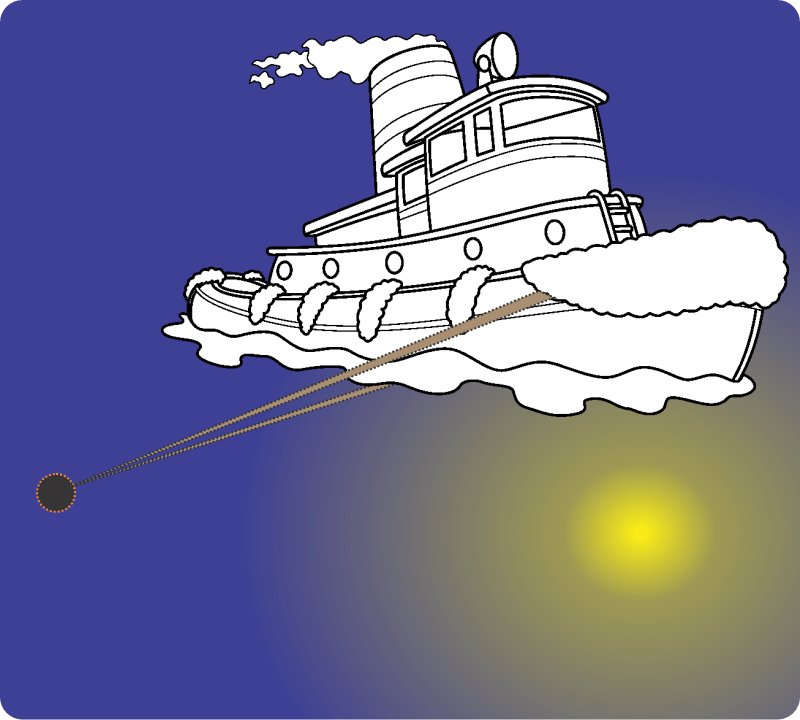
“The central plot device. Here’s your gelato. In the story, someone locates a rogue black hole hiding in the asteroid belt. Tiny, maybe a few thousandths of a millimeter across, but awful heavy. A military‑industrial combine uses a space tug to tow it to Earth orbit for some kind of energy source, but their magnetic grapple slips and the thing falls to Earth. Except it doesn’t just fall to Earth, it’s so small it falls into Earth and now it’s orbiting inside, eating away the core until everything crumbles in. I can’t stop thinking about that.”

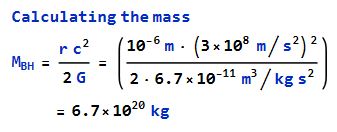
“Sounds pretty bad, but it might help if we run the numbers.” <drawing Old Reliable from its holster> “First thing — Everything about a black hole depends on its mass, so just how massive is this one?” <tapping on Old Reliable’s screen with gelato spoon> “For round numbers let’s say its diameter is 0.002 millimeter. The Schwartzschild ‘radius’ r is half that. Solve Schwartschild’s r=2GM/c² equation for the mass … plug in that r‑value … mass is 6.7×10²⁰ kilograms. That’s about 1% of the Moon’s mass. Heavy indeed. How did they find this object?”

“The story didn’t say. Probably some asteroid miner stumbled on it.”

“Darn lucky stumble, something only a few microns across. Not likely to transit the Sun or block light from any stars unless you’re right on top of it. Radiation from its accretion disk? Depends on the history — there’s a lot of open space in the asteroid belt but just maybe the beast encountered enough dust to form one. Probably not, though. Wait, how about Hawking radiation?”

“Oh, right, Stephen Hawking’s quantum magic trick that lets a black hole radiate light from just outside its Event Horizon. Does Old Reliable have the formulas for that?”

“Sure. From Hawking’s work we know the object’s temperature and that gives us its blackbody spectrum, then we’ve got the Bekenstein‑Hawking equation for the power it radiates. Mind you, the spectrum will be red‑shifted to some extent because those photons have to crawl out of a gravity well, but this’ll give us a first cut.” <more tapping> “Chilly. 170 kelvins, that’s 100⁰C below room temperature. Most of its sub‑nanowatt emission will be at far infrared wavelengths. A terrible beacon. But suppose someone did find this thing. I wonder what’ll it take to move it here.”

“Can you calculate that?”

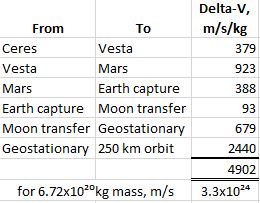
“Roughly. Suppose your space tug follows the cheapest possible flight path from somewhere near Ceres. Assuming the tug itself has negligible mass … ” <more tapping> “Whoa! That is literally an astronomical amount of delta-V. Not anything a rocket could do. Never mind. But where were they planning to put the object? What level orbit?”

“Well, it’s intended to beam power down to Earth. Ions in the Van Allen Belts would soak up a lot of the energy unless they station it below the Belts. Say 250 miles up along with the ISS.”

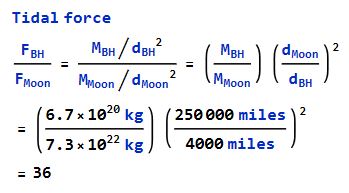
“Hoo boy! A thousand times closer than the Moon. Force is inverse to distance squared, remember. Wait, that’s distance to the center and Earth’s radius is about 4000 miles so the 250 miles is on top of that. 250,000 divided by 4250 … quotient squared … is a distance factor of almost 3500. Put 1% of the Moon that close to the Earth and you’ve got ocean tides 36 times stronger than lunar tides. Land does tides, too, so there’d be earthquakes. Um. The ISS is on a 90‑minute orbit so you’d have those quakes and ocean tides sixteen times a day. I wouldn’t worry about the black hole hollowing out the Earth, the tidal effect alone would do a great job of messing us up.”

“The whole project is such a bad idea that no-one would or could do it. I feel better now.”

~~ Rich Olcott

So Many Lunches

<shudder> “I don’t like Everett’s Many Worlds multiverse, Sy. When I think of all those A‑B entanglements throughout space I just see history as this enormous cable with an exponentially growing number of strands and it keeps getting thicker and more massive. Besides, that’s all about observations at the micro level and I don’t see how it can build up to make two me’s enjoying our different lunches.”

“Most physicists agree with you, Susan, although there have been entire conferences devoted to arguments for, against and about it. His proposal does solve several known problems associated with other interpretations of quantum mechanics but it raises some of its own. To my mind, it just tastes bad. How about another multiverse idea?”

“Is it as cumbersome as that one?”

“Well, it still involves infinity, but probably a smaller one. I think the best way to describe it is to start with black holes. Each one has a region at its geometric center where spacetime is under such stress that we don’t have the physics to understand what’s going on in there. You with me?”

“So far. I’ve read some of your posts about them.”

“Cool. Anyway, one conjecture that’s been floating around is that maybe, especially for the supermassive black holes, the energy stress is so high that Nature relieves it by generating a new blister of spacetime. The blister would be inside the Event Horizon so it’s completely isolated from our Universe. Visualize one of those balloon artists who twists a patch on the surface of a blown-up balloon and suddenly it grows a new bubble there.”

“Like yeast budding new yeastlets?”

“That’s the idea, except these spacetime buds would be rooted inside our Universe like a yeast cell’s internal vesicles rather than budding from the cell’s surface. Because it’s isolated, each bud acts as an independent Universe.”

“But Hubble has shown us a trillion galaxies. If there’s a supermassive black hole at the center of nearly every galaxy…”

“Yup, lots of Universes. But it gets better—”

“I see where you’re going. Each baby Universe can have its own collection of black holes so you can have a cascade of Universes inside Universes like a matryoshka doll. Except the people in each one think theirs is the size of a whole Universe. If there are people there.”

“All of that’s possibly true, assuming there are baby Universes and they have the same physical laws and constants that we do. The speed of light could be different or something. Anyway, I was going to a less exotic scheme. The Observable Universe is the space that contains all the light that’s been directed towards us since the Big Bang 13.7 billion years ago. Thanks to the expansion of the Universe, it’s now a sphere 93 billion lightyears in diameter. Think of it as a big bubble, okay?”

“Mm-hm. You’re thinking about what’s outside that bubble?”

“Mm-hm. Of course light and information from outside haven’t had time to get to us so we have no chance of observing what’s out there and vice‑versa. Do you agree it’s reasonable to assume it’s all just more of the same?”

“Sure.”

“Well then, it must also be reasonable to assume that our observability bubble is surrounded by other observability bubbles and they’re surrounded by more bubbles and so on. The question is, does that go on infinitely far or is there an outermost shell?”

“By definition there’s no way to know for sure.”

“True, but it makes a difference when we’re thinking about the multiverse. If there’s only a finite number of bubbles, even if it’s a big number, then there’s a vanishingly small chance that any of them duplicates ours. No copies of you trying to decide between noodles for lunch or a sandwich. If the number is infinite, though, some cosmologists insist that our bubble in general and you in particular must be duplicated not just once but an infinite number of times. Some of you go for noodles, some for sandwiches, some maybe opt for pizza. All in the same consistent Universe but disconnected from each other by distance and by light’s universal speed limit. Does that count as a multiverse?”

~~ Rich Olcott

Noodles or A Sandwich?

“Wait, Sy, your anti-Universe idea says there are exactly two um, sub‑Universes. Even the word ‘multiverse‘ suggests more than that.”

“You’re right, Susan, most of the multiverse proposals go to the other extreme. Maybe the most extreme version grew in reaction to one popular interpretation of quantum theory. Do you know about the ‘Many Worlds‘ notion?”

“Many Worlds? Is that the one about when I decide between noodles for lunch or a sandwich, the Universe splits and there’s one of me enjoying each one?”

“That’s the popular idea. The physics idea is way smaller, far bigger and even harder to swallow. Physicists have been arguing about it for a half‑century.”

“Come again? Smaller AND bigger?”

“Smaller because it’s a quantum‑based idea about microscopic phenomena. Doesn’t say anything about things big enough to touch. Remember how quantum calculations predict statistics, not exact values? They can’t give you anything but averages and spreads. Einstein and Bohr had a couple of marquee debates about that back in the 1930s. Bohr maintained that our only path to understanding observations at the micro‑scale was to accept that events there are random and there’s no point discussing anything deeper than statistics. Einstein’s position was that the very fact that we’re successfully using an average‑based strategy says that there must be finer‑grained phenomena to average over. He called it ‘the underlying reality.’ The string theory folks have chased that possibility all the way down to the Planck‑length scale. They’ve found lots of lovely math but not much else. Hugh Everett had a different concept.”

“With that build‑up, it’d better have something to do with Many Worlds.”

“Oh, it does. Pieces of the idea have been lying around for centuries, but Everett pulled them all together and dressed them up in a quantum suit. Put simply, in his PhD thesis he showed how QM’s statistics can result from averaging over Universes. Well, one Universe per observation, but you experience a sequence of Universes and that’s what you average over.”

“How can you show something like that?”

“By going down the rabbit hole step by step and staying strictly within the formal QM framework. First step was to abstractify the operation of observing. He said it’s a matter of two separate systems, an observer A and a subject B. The A could be a person or electronics or whatever. What’s important is that A has the ability to assess and record B‘s states and how they change. Given all that, the next step is to say that both A and B are quantized, in the sense that each has a quantum state.”

“Wait, EACH has a quantum state? Even if A is a human or a massive NMR machine?”

“That’s one of the hard‑to‑swallows, but formally speaking he’s okay. If a micro‑system can have a quantum state then so can a macro‑system made up of micro‑systems. You just multiply the micro‑states together to get the macro‑state. Which gets us to the next step — when A interrogates B, the two become entangled. We then can only talk about the combined quantum state of the A+B system. Everett referred to an Einstein quote when he wrote that a mouse doesn’t change the Moon by looking at it, but the Moon changes the mouse. The next step’s a doozy so take a deep breath.”

“Ready, I suppose.”

B could have been in any of its quantum states, suppose it’s . After the observation, A+B must be an entangled mixture of whatever A was, combined with each of B‘s possible final states. Suppose B might switch to . Now we can have A+B(#42), separate from a persisting A+B(#10), plus many other possibles. As time goes by, A+B(#42) moves along its worldline independent of whatever happens to A+B(#10).”

“If they’re independent than each is in its own Universe. That’s the Many Worlds thing.”

“Now consider just how many worlds. We’re talking every potential observing macro‑system of any size, entangled with all possible quantum states of every existing micro‑system anywhere in our Observable Universe. We’re a long way from your noodles or sandwich decision.”

“An infinity of infinities.”

“Each in its own massive world.”

“Hard to swallow.”

~~ Rich Olcott

The Futile Search for Anti-Me

“Nice call, Sy.”

“Beg pardon?”

“Your post a couple weeks ago. You titled it ‘Everything Everywhere All At Once.’ That’s the movie that just won seven Oscars — Best Movie, Best Director, Best Actress and Best Supporting Actress… How’d you predict it?”

“I didn’t, Susan. I wasn’t even trying to. I knew the movie’s plot was based on the multiverse notion. That’s the theme for this post series so it seemed like a natural cultural reference. Besides, that post was about the Big Bang’s growth in a skillionth of a second from a Planck‑length‑size volume out to our ginormous Universe and all its particles. ‘Everything Everywhere All At Once‘ seemed like a nice description of what we think happened. A mug of my usual, Al, and I’m buying Susan’s mocha latte.”

“Sure, Sy. Nice call, by the way. Have a couple of scones, you two, on me.”

“Thanks, Al, and thanks, Sy. You know, I’ve noticed the multiverse idea cropping up a lot lately. They used it in the Spiderman franchise, and the recent Doctor Strange pic, and I just read it’ll be in the next Flash movie.”

“Oh, it’s an old writer’s ploy, Susan. Been around in one form or another since Aristophanes invented Cloudcuckooland for one of his Greek comedies. Small‑screen scifi uses it a lot — Star Trek used it back in the Kirk-Spock shows and DS9 based a whole story arc on the idea. Any time an author wants to move the action to a strange place or bring in some variation on a familiar character, they trot out the multiverse. Completely bogus, of course — they may sound all science‑y but none of them have anything to do with what we physicists have been arguing about.”

“You mean your anti-Universe won’t have an evil version of you in it?”

“I certainly don’t expect it to if it even exists. Suppose an anti‑Universe is out there. Think of all the contingencies that had to go just right during 13½ billion anti‑years of anti‑quark‑soup and anti‑atomic history before there’s an anti‑planet just like Earth in just the right environment around an anti‑star just like ours, all evolved to the level of our anti‑when, not to mention the close shaves our biological and personal histories would have had to scrape through. I’d be amazed if even anti‑humans existed there, let alone individuals anything like you and me. Talk about very low probabilities.”

“You’ve got a point. My folks almost didn’t survive the war back in Korea. A mine went off while they were working in our field — another few feet over and I wouldn’t be here today. But wait, couldn’t everything in the anti‑Universe play out in anti‑time exactly like things have in ours? They both would have started right next to each other with mirror‑image forces at work. It’d be like a pool table show by a really good trick‑shot artist.”

“If everything were that exactly mirror‑imaged, the anti‑me and I would have the same background, attitudes and ethics. The mirror people on those scifi shows generally have motives and moral codes that oppose ours even though the mirror characters physically are dead ringers for their our‑side counterparts. Except the male evil twins generally wear beards and the female ones use darker eye make‑up. No, I don’t think mirror‑imaging can be that exact. The reason is quantum.”

“How did quantum get into this? Quantum’s about little stuff, atoms and molecules, not the Universe.”

“Remember when the Universe was packed into a Planck‑length‑size volume? That’s on the order of 10‑35 meter across, plenty small enough for random quantum effects to make a big difference. What’s important here, though, is everything that happened post‑Bang. The essence of quantum theory is that it’s not clockwork. With a few exceptions, we can only make statistical predictions about how events will go at microscopic scale. Things vary at random. Your chemical reactions are predictable but only because you’re working with huge numbers of molecules.”

“Even then sometimes I get a mess.”

“Well then. If you can’t reliably replicate reactions with gram‑level quantities, how can you expect an entire anti‑Universe to replicate its partner?”

“Then <singing> there can never be another you.”

~~ Rich Olcott

A Nightcap And Secrets

“A coffee nightcap, Sy? It’s decaf so Teena can have some.”

“Sounds good, Sis.”

“Why didn’t Mr Einstein like entanglement, Uncle Sy? Thanks, Mom. A little more cream in it, please.”

“I’ll bet it has to do with the instant-effect aspect, right, Sy?”

“Thanks, Sis, and you’re right as usual. All of Relativity theory rests on the claim that nothing, not light or gravity or causality itself, can travel faster than light in a vacuum. There’s good strong arguments and evidence to support that, but Einstein himself proved that entanglement effects aren’t constrained to lightspeed. Annoyed him no end.”

“Well, your coin story‘s very nice, but it’s just a story. Is there evidence for entanglement?”

“Oh, yes, though it was fifty years after Einstein’s entanglement paper before our technology got good enough to do the experiments. Since then a whole industry of academics and entrepreneurs has grown up to build and apply devices that generate entangled systems.”

“Systems?”

“Mm-hm. Most of the work has been done with pairs of photons, but people have entangled pairs of everything from swarms of ultra‑cold atoms to electrons trapped in small imperfect diamonds. It’s always a matter of linking the pair members through some shared binary property.”

“Binary! I know what that is. Brian has a computer toy he lets me play with. You tell it where to drive this little car and it asks for decisions like left‑right or go‑stop and they’re all yes or no and the screen shows your answer as ‘0’or ‘1’ and that’s binary, right?”

“Absolutely, Teena. The entangled thingies are always created in pairs, remember? Everything about each twin is identical except for that one property, like the two coin metals, so it’s yes, no, or some mixture. Cars can’t do mixtures because they’re too big for quantum.”

“What kinds of properties are we talking about? It’s not really gold and silver, is it?”

“No, you’re right about that, Sis. Transmutation takes way too much power. Entangled quantum states have little or no energy separation which is one reason the experiments are so hard. Photons are the easiest to work with so that’s where most of the entanglement work has been done. Typically the process splits a laser beam into two rays that have contrasting polarizations, say vertical and horizontal. Or the researchers might work with particles like electrons that you can split into right‑ and left‑handed spin. Whatever, call ’em ones and zeroes, you’ve got a bridge between quantum and computing.”

“Brian says binary can do secret codes.”

“He’s right about that. Codes are about hiding information. Entanglement is real good at hiding quantum information behind some strict rules. Rule one is, if you inspect an entangled particle, you break the entanglement.”

“Sounds reasonable. When you measure it you make it part of a big system and it’s not quantum any more.”

“Right, Sis. Rule two, an entanglement only links pairs. No triples or broadcasts. Rule three is for photons — you can have two independent ways to inspect a property, but you need to use the same way for both photons or you’ve got a 50% chance of getting a mismatch.”

“Oho! I see where the hiding comes in. Hmm… From what I’ve read, encryption’s big problem is guarding the key. I think those three rules make a good way to do that. Suppose Rocky and Bullwinkle want to protect their coded messages from Boris Badinoff. They share a series of entangled photon pairs. and they agree to a measurement protocol based on the published daily prices for a series of stocks — for each photon in a series, measure it with Method 1 if the corresponding price is an odd number, Method 2 if it’s even. Rocky measures his photon. If he measures a ‘1’ then Bullwinkle sees a ‘0’ for that photon and he knows Rocky saw a ‘1.’ Rocky encrypts his message using his measured bit string. Bullwinkle flips his bit string and decrypts.”

“Brilliant. Even if Boris knows the proper sequence of measurements, if he peeks at an entangled photon that breaks the entanglement. When Bullwinkle decodes gibberish Rocky has to build another key. Your Mom’s a very smart person, Teena.”

~ Rich Olcott

Tiramisu And Gemstones

“Sis, you say there’s dessert?”

“Of course there is, Sy. Teena, please bring in the tray from the fridge.”

“Tiramisu! You did indeed go above and beyond. Thank you, Teena. Your Mom’s question must be a doozey.”

“I’ll let you enjoy a few spoonfulls before I hit you with it.” <minutes with spoon noises and yumming> “Okay. tell me about entanglement.”

“Whoa! What brought that on?”

“I’ve seen the word bandied about in the popular science press—”

“And pseudoscience—”

“Well, yes. I’m writing something where the notion might come in handy if it makes sense.”

“How can you tell what’s pseudoscience?”

“Good question, Teena. I look for gee-whiz sentences, especially ones that include weasely words like ‘might‘ and ‘could.’ Most important, does the article make or quote big claims that can’t be disproven? I’d want to see pointers to evidence strong enough to match the claims. A respectable piece would include comments from other people working in the same field. Things like that.”

“What your Mom said, and also has the author used a technical term like ‘energy‘ or ‘quantum‘ but stretched it far away from its home base? Usually when they do that and you have even an elementary idea what the term really means, it’s pretty clear that the author doesn’t understand what they’re writing about. That goes double for a lot of what you’ll see on YouTube and social media in general. It’s just so easy to put gibberish up there because there’s no‑one to contradict a claim, or if there is, it’s too late because the junk has already spread. ‘Entanglement‘ is just the latest buzzword to join the junk‑science game.”

“So what can you tell us about entanglement that’s non‑junky?”

“First thing is, it’s strictly a microscopic phenomenon, molecule‑tiny and smaller. Anything you read about people or gemstones being entangled, you can stop reading right there unless it’s for fun.”

“Weren’t Rapunzel and the prince entangled?

“They and all the movie’s other characters were tangled up in the story, yes, but that’s not the kind of entanglement your Mom’s asking about. This kind seems to involve something that Einstein called ‘spooky action at a distance‘. He didn’t like it.”

“‘Seems to‘?”

“Caught me, Sis, but it’s an important point. You make a system do something by acting on it, right? We’re used to actions where force is transmitted by direct contact, like hitting a ball with a bat. We’ve known how direct contact works with solids and fluids since Newton. We’ve extended the theory to indirect contact via electric and other fields thanks to Maxwell and Einstein and a host of other physicists. ‘Action at a distance‘ is about making something happen without either direct or indirect contact and that’s weird.”

“Can you give us an example?”

“How about an entanglement story? Suppose there’s a machine that makes coins, nicely packaged up in gift boxes. They’re for sweethearts so it always makes the coins in pairs, one gold and one silver. These are microscopic coins so quantum rules apply — every coin is half gold and half silver until its box is opened, at which point it becomes all one pure metal.”

“Like Schrödinger’s asleep‑awake kitty‑cat!”

“Exactly, Teena. So Bob buys a pair of boxes, keeps one and gives the other to Alice before he flies off in his rocket to the Moon. Quantum says both coins are both metals. When he lands, he opens his box and finds a silver coin. What kind of coin does Alice have?”

“Gold, of course.”

“For sure. Bob’s coin‑checking instantly affected Alice’s coin a quarter‑million miles away. Spooky, huh?”

“But wait a minute. Alice’s coin doesn’t move. It’s not like Bob pushed on it or anything. The only thing that changed was its composition.”

“Sis, you’ve nailed it. That’s why I said ‘seems to‘. Entanglement’s not really action at a distance. No energy or force is exerted, it’s simply an information thing about quantum properties. Which, come to think of it, is why there’s no entanglement of people or gemstones. Even a bacterium has billions and billions of quantum‑level properties. Entanglement‑tweaking one or two or even a thousand atoms won’t affect the object as a whole.”

~~ Rich Olcott

Dinner Rolls And Star Dust

“MAH-ahm! Uncle Sy’s here! Hi, Uncle Sy, dinner’s almost ready. I’ve saved up some questions for you”

“Hi, Teena, let’s have—”

“Now Teena, we said we’d hold the questions until after the meal. Hi, Sy.”

“Hi, Sis. Smells wonderful. One of Mom’s recipes?”

“Nope, I’m experimenting. Mom’s pasta sauce, though. You toss the salad and we’ll dig in.”

<later> “Wow. Sis, that lasagna was amazing. Five different meats, I think, and four different cheeses? Every mouthful was a new experience. A meal that Mom would’ve been proud of.”

“Six meats, you missed one. Full credit — Teena did the dinner rolls, from scratch, and she composed the salad.”

“Well, young lady, I think your grandma would be proud of you, too. You’ve earned questions. I may stay awake long enough to answer them.”

“Yay.”

“First the dishes, guys, then to the living room.”

“Sure, Sis. And you get a question, too.”

“As a matter of fact…”

<later> “Okay, Teena, question number one.”

“Alright. Umm. Brian tries to annoy me by saying over and over that the Sun’s gonna supernova into a black hole. That’s not true, is it?”

“You can tell Brian that the Sun’s way too small to make either a supernova or a black hole. Yes, the Sun will collapse in something like five billion years, but when that happens it’ll only be a garden‑variety nova. When things calm down there’ll be a white dwarf in the middle of our Solar System, not a black hole. Supernovas come from really big stars and they leave neutron stars behind or sometimes just emptiness. To get a black hole you need a star at least half again bigger than ours. D’ya think that’ll shut Brian down?”

“No-o, because there’s other things he says to annoy me.”

“Like what?”

“That our galaxy’s gonna collide with another one and we’ll all burn up in the explosion.”

“He’s got a thing for disasters, doesn’t he? Well, he’s partially right but mostly wrong. Yes, galaxy Andromeda is on a collision course with the Milky Way. But that collision won’t be anything like what he’s talking about. Remember those bird flocks we talked about?”

“Oh that was so long ago. What was the word? Mur, mur .. something?”

“Murmuration. That was your favorite word back then.”

“Oh, yes. It still is, now that I remember it.” <Sis and I give each other a look.> “What do birds have to do with galaxies?”

“Imagine two flocks colliding. Think there’ll be feathers all over the place?”

“No, the flocks would pass right through each other, except maybe some birds from one flock might fly off with the other one.”

“That’s pretty much what will happen with us and Andromeda. Stars in each galaxy are lightyears apart, hundreds of star‑widths apart, like cars miles apart on a highway. Star‑star collisions during a galaxy collision will be very rare. The galaxy’s own shapes will be distorted and gravity will pull stars from one galaxy to the other, but that’s about the extent of it. Anyway, that’s also about five billion years into the future. So Brian’s off on that prediction, too. Anything else?”

“Actually, yes. He says we’re made of stardust. I thought we’re made of atoms.”

“Indeed we are, but the atoms come from stars. Quick story about how stars work. The oldest and most common kind of atom is hydrogen. Back at the beginning of the Universe that’s all there was. If you shove hydrogen atoms together with enough heat and pressure, like inside stars, they combine to form heavier atoms like carbon and oxygen. You’re made of hydrogen and carbon and oxygen and such, but all your atoms except hydrogen were cooked up inside stars.”

“But how did they get inside me?”

“Remember those novas and supernovas? Doesn’t matter which kind of star collapses, half or more of its atoms spray into the Universe. They become star dust adrift in the winds of space, waiting to become part of another solar system and whatever’s in it. Brian’s right on this one, you are made of star dust.”

“Whooo, that’s awesome!”

“My question’s after dessert, Sy.”

~~ Rich Olcott

  • Thanks to the young Museum visitors who asked these questions.

Wait For It

“So, Jeremy, have I convinced you that there’s poetry in Physics?”

“Not quite, Mr Moire. Symbols can carry implications and equation syntax is like a rhyme scheme, okay, but what about the larger elements we’ve studied like forms and metaphors?”

“Forms? Hoo boy, do we have forms! Books, theses, peer-reviewed papers, conference presentations, poster sessions, seminars, the list goes on and that’s just to show results. Research has forms — theoretical, experimental, and computer simulation which is sort of halfway between. Even within the theory division we have separate forms for solving equations to get mathematically exact solutions, versus perturbation techniques that get there by successive approximations. On the experimental side—”

“I get the picture, Mr Moire. Metaphorically there’s lots of poetry in Physics.”

“Sorry, you’re only partway there. My real point is that Physics is metaphor, a whole cascade of metaphors.”

“Ha, that’s a metaphor!”

“Caught me. But seriously, Science in general and Physics in particular underwent a paradigm shift in Galileo’s era. Before his century, a thousand years of European thought was rooted in Aristotle’s paradigm that centered on analysis and deduction. Thinkers didn’t much care about experiment or observing the physical world. No‑one messed with quantitative observations except for the engineers who had to build things that wouldn’t fall down. Things changed when Tycho Brahe and Galileo launched the use of numbers as metaphors for phenomena.”

“Oh, yeah, Galileo and the Leaning Tower experiment.”

“Which may or may not have happened. Reports differ. Either way, his ‘all things fall at the same speed‘ conclusion was based on many experimental trials where he rolled balls of different material, sizes and weights down a smooth trough and timed each roll.”

“That’d have to be a long trough. I read how he used to count his pulse beats to measure time. One or two seconds would be only one or two beats, not much precision.”

“True, except that he used water as a metaphor for time. His experiments started with a full jug of water piped to flow into an empty basin which he’d weighed beforehand. His laboratory arrangement opened a valve in the water pipe when he released the ball. It shut the valve when the ball crossed a finish line. After calibration, the weight of released water represented the elapsed time, down to a small fraction of a second. Distance divided by time gave him speed and he had his experimental data.”

“Pretty smart.”

“His genius was in devising quantitative challenges to metaphor‑based suppositions. His paradigm of observation, calculation and experimental testing far outlasted the traditionalist factions who tried to suppress his works. Of course that was after a century when Renaissance navigators and cartographers produced maps as metaphors for oceans and continents.”

“Wait, Mr Moire. In English class we learned that a metaphor says something is something else but an analogy is when you treat something like something else. Water standing for time, measurements on a map standing for distances — aren’t those analogies rather than metaphors?”

“Good point. But the distinction gets hazy when things get abstract. Take energy, for example. It’s not an object or even a specific kind of motion like a missile trajectory or an ocean wave. Energy’s a quantity that we measure somewhere somehow and then claim that the same quantity is conserved when it’s converted or transferred somewhere else. That’s not an analogy, it’s a metaphor for a whole parade of ways that energy can be stored or manifested. Thermodynamics and quantum mechanics depend on that metaphor. You can’t do much anywhere in Physics without paying some attention to it. People worry about that, though.”

“Why’s that?”

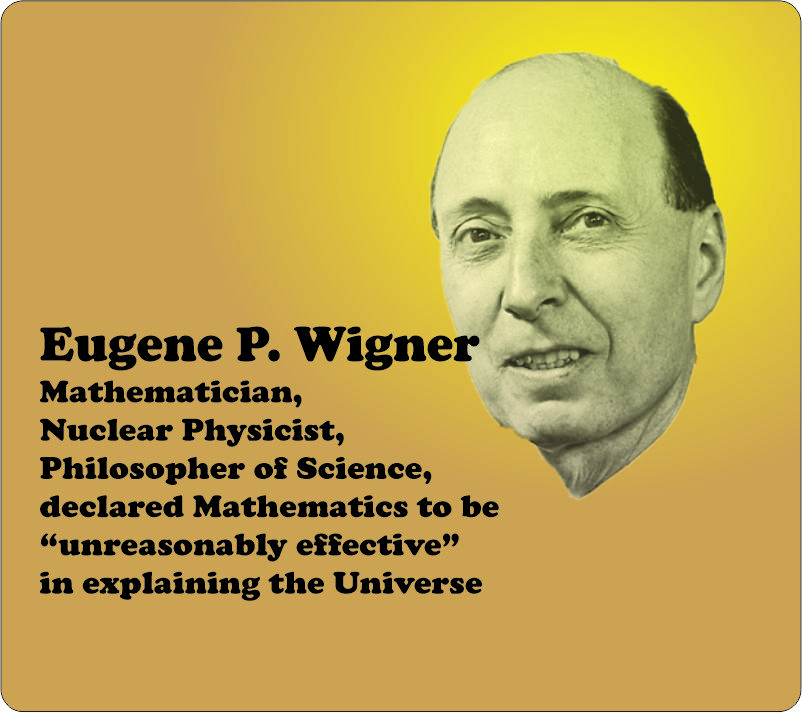
“We don’t really understand why energy and our other fundamental metaphors work as well as they do. No metaphor is perfect, there are always discrepancies, but Physics turns out to be amazingly exact. Chemistry equations balance to within the accuracy of their measuring equipment. Biology’s too complex to mathematize but they’re making progress. Nobel Prize winner Eugene Wigner once wrote a paper entitled, ‘The Unreasonable Effectiveness of Mathematics in The Natural Sciences.’ It’s a concern.”

“Well, after all that, there’s only one thing to say. If you’re in Physics, metaphors be with you.”

~~ Rich Olcott

Making Things Simpler

“How about a pumpkin spice gelato, Mr Moire?”

“I don’t think so, Jeremy. I’m a traditionalist. A double‑dip of pistachio, please.”

“Coming right up, sir. By the way, I’ve been thinking about the Math poetry you find in the circular and hyperbolic functions. How about what you’d call Physics poetry?”

“Sure. Starting small, Physics has symmetries for rhymes. If you can pivot an experiment or system through some angle and get the same result, that’s rotational symmetry. If you can flip it right‑to‑left that’s parity symmetry. I think of a symmetry as like putting the same sound at the end of each line in rhymed verse. Physicists have identified dozens of symmetries, some extremely abstract and some fundamental to how we understand the Universe. Our quantum theory for electrons in atoms is based on the symmetries of a sphere. Without those symmetries we wouldn’t be able to use Schrodinger’s equation to understand how atoms work.”

“Symmetries as rhymes … okaaayy. What else?”

“You mentioned the importance of word choice in poetry. For the Physics equivalent I’d point to notation. You’ve heard about the battle between Newton and Leibniz about who invented calculus. In the long run the algebraic techniques that Leibniz developed prevailed over Newton’s geometric ones because Leibniz’ way of writing math was far simpler to read, write and manipulate — better word choice. Trying to read Newton’s Principia is painful, in large part because Euler hadn’t yet invented the streamlined algebraic syntax we use today. Newton’s work could have gone faster and deeper if he’d been able to communicate with Euler‑style equations instead of full sentences.”

“Oiler‑style?”

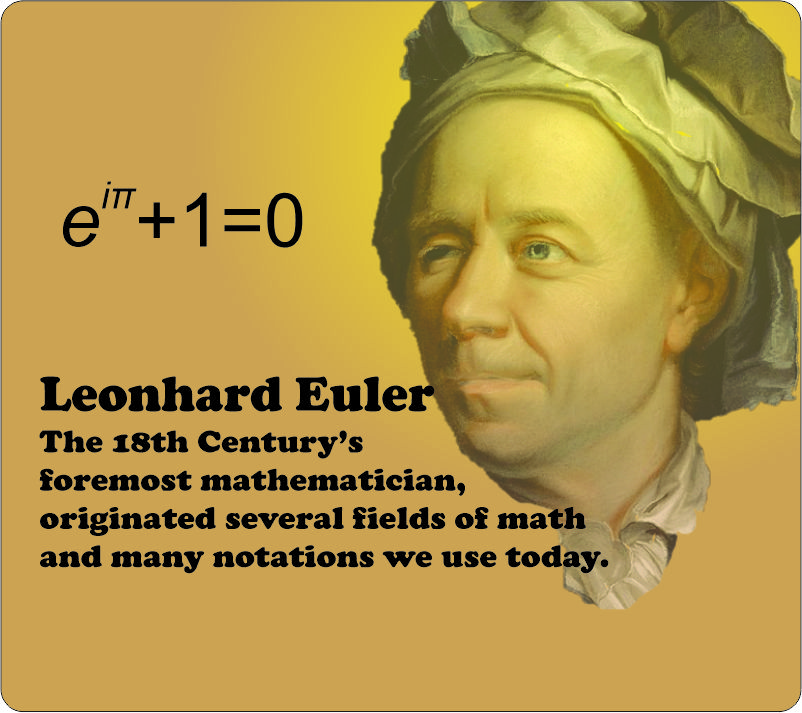
“Leonhard Euler, though it’s pronounced like ‘oiler‘. Europe’s foremost mathematician of the 18th Century. Much better at math than he was at engineering or court politics — both the Russian and Austrian royal courts supported him but they decided the best place for him was the classroom and his study. But while he was in there he worked like a fiend. There was a period when he produced more mathematics literature than all the rest of Europe. Descartes outright rejected numbers involving ‑1, labeled them ‘imaginary.’ Euler considered ‑1 a constant like any other, gave it the letter i and proceeded to build entire branches of math based upon it. Poor guy’s vision started failing in his early 30s — I’ve often wondered whether he developed efficient notational conventions as a defense so he could see more meaning at a glance.”

“He invented all those weird squiggles in Math and Physics books that aren’t even Roman or Greek letters?”

“Nowhere near all of them, but some important ones he did and he pointed the way for other innovators to follow. A good symbol has a well‑defined meaning, but it carries a load of associations just like words do. They lurk in the back of your mind when you see it. π makes you think of circles and repetitive function like sine waves, right? There’s a fancy capital‑R for ‘the set of all real numbers‘ and a fancy capital‑Z for ‘the set of all integers.’ The first set is infinitely larger than the second one. Each symbol carries implications abut what kind of logic is valid nearby and what to be suspicious of. Depends on context, of course. Little‑c could be either speed‑of‑light or a triangle’s hypotenuse so defining and using notation properly is important. Once you know a symbol’s precise meaning, reading an equation is much like reading a poem whose author used exactly the right words.”

“Those implications help squeeze a lot of meaning into not much space. That’s the compactness I like in a good poem.”

“It’s been said that a good notation can drive as much progress in Physics as a good experiment. I’m not sure that’s true but it certainly helps. Much of my Physics thinking is symbol manipulation. Give me precise and powerful symbols and I can reach precise and powerful conclusions. Einstein turned Physics upside down when he wrote the thirteen symbols his General Relativity Field Equation use. In his incredibly compact notation that string of symbols summarizes sixteen interconnected equations relating mass‑energy’s distribution to distorted spacetime and vice‑versa. Beautiful.”

“Beautiful, maybe, but cryptic.”

~~ Rich Olcott