Bigger than you’d think

Al’s coffee shop, the usual mid-afternoon crowd of chatterers and laptop-tappers.  Al’s walking his refill rounds, but I notice he’s carrying a pitcher rather than his usual coffee pot.  “Hey, Al, what’s with the hardware?”

“Got iced coffee here, Sy.  It’s hot out, people want to cool down.  Besides, this is in honor of IceCube.”

“Didn’t realize you’re gangsta fan.”

“Nah, not the rapper, the cool experiment down in the Antarctic.  It was just in the news.”

“Oh?  What did they say about it?”

“It’s the biggest observatory in the world, set up to look for the tiniest particles we know of, and it uses a cubic mile of ice which I can’t think how you’d steer it.”

A new voice, or rather, a familiar one. “One doesn’t, Al.”
Neutrino swirl 1“Hello, Jennie.  Haven’t seen you for a while.”

“I flew home to England to see my folks.  Now I’m back here for the start of the Fall term.  I’ve already picked a research topic — neutrinos.  They’re weird.”

“Hey, Jennie, why are they so tiny?”

“It’s the other way to, Al.  They’re neutrinos because they’re so tiny.  Sy would say that for a long time they were simply an accounting gimmick to preserve the conservation laws.”

“I would?”

“Indeed.  People had noticed that when uranium atoms give off alpha particles to become thorium, the alpha particles always have about the same amount of energy.  The researchers accounted for that by supposing that each kind of nucleus has some certain quantized amount of internal energy.  When one kind downsizes to another, the alpha particle carries off the difference.”

“That worked well, did it?”

“Oh, yes, there are whole tables of nuclear binding energy for alpha radiation.  But when a carbon-14 atom emits a beta particle to become nitrogen-14, the particle can have pretty much any amount of energy up to a maximum.  It’s as though the nuclear quantum levels don’t exist for beta decay.  Physicists called it the continuous beta-spectrum problem and people brought out all sorts of bizarre theories to try to explain it.  Finally Pauli suggested maybe something we can’t see carries off energy and leaves less for the beta.  Something with no charge and undetectable mass and the opposite spin from what the beta has.”

“Yeah, that’d be an accounting gimmick, alright.  The mass disappears into the rounding error.”

“It might have done, but twenty years later they found a real particle.  Oh, I should mention that after Pauli made the suggestion Fermi came up with a serious theory to support it.  Being Italian, he gave the particle its neutrino name because it was neutral and small.”

“But how small?”

“We don’t really know, Al.  We know the neutrino’s mass has to be greater than zero because it doesn’t travel quite as fast as light does.  On the topside, though, it has to be lighter than than a hydrogen atom by at least a factor of a milliard.”

“Milliard?”

“Oh, sorry, I’m stateside, aren’t I?  I should have said a billion.  Ten-to-the-ninth, anyway.”

“That’s small.  I guess that’s why they can sneak past all the matter in Earth like the TV program said and never even notice.”

This gives me an idea.  I unholster Old Reliable and start to work.

“Be right with you… <pause> … Jennie, I noticed that you were being careful to say that neutrinos are light, rather than small.  Good careful, ’cause ‘size’ can get tricky at this scale.  In the early 1920s de Broglie wrote that every particle is associated with a wave whose wavelength depends on the particle’s momentum.  I used his formula, together with Jennie’s upper bound for the neutrino’s mass, to calculate a few wavelength lower bounds.Neutrino wavelength calcMomentum is velocity times mass.  These guys fly so close to lightspeed that for a long time scientists thought that neutrinos are massless like photons.  They’re not, so I used several different v/c ratios to see what the relativistic correction does.  Slow neutrinos are huge, by atom standards.  Even the fastest ones are hundreds of times wider than a nucleus.”

“With its neutrino-ness spread so thin, no wonder it’s so sneaky.”

“That may be part of it, Al.”

“But how do you steer IceCube?”

~~ Rich Olcott

Trio for Rubber Ruler

“It’s all about how lightwaves get generated and then what happens.”

Sy and me talked about that, Cathleen.  Lightwaves come from jiggling electrons, right?”

“Any kind of charged particles, Vinnie, but there’s different ways that can happen.  Each leads to its own kind of spectrum.”

“Different kinds of spectrum?  Do you mean like visible versus infrared and ultraviolet, Cathleen?”

“No, I don’t, Sy.  I’m referring to the thing’s overall appearance in every band.  A hundred and fifty years ago Kirchoff pointed out that light from a source can have lines of color, lines without color, or a smooth display without lines.”

“Like that poster that Al put up between the physicist and astronomer corners?”  (We’re still chatting at a table in Al’s coffee shop.  I’m on my fourth scone.)

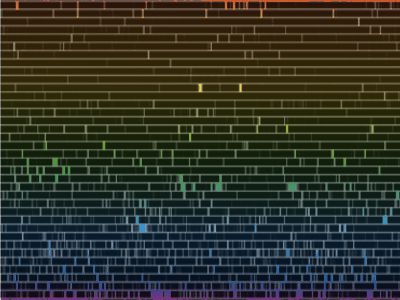
Astroruler with solar spectrum
Based on N.A.Sharp, NOAO/NSO/Kitt Peak FTS/AURA/NSF

“Kind of.  That’s based on a famous image created at Kitt Peak Observatory.  In the background there you see a representation of what Kirchoff called a continuous or black-body spectrum, where all the colors fade smoothly into each other in classic rainbow order.  You’re supposed to ignore the horizontal dark lines.”

“And the vertical lines?”

“They form what Kirchoff called an absorption spectrum.  Each dark vertical represents an isolated color that we don’t get from the Sun.”

“You’re saying we get all the other colors but them, right?”

“Exactly, Vinnie.  The Sun’s chromosphere layer filters those specific wavelengths before they get from the deeper photosphere out into space.”

“Complicated filter.”

“Of course.  The Sun contains most of the elements lighter than nickel.  Each kind of atom absorbs its own collection of frequencies.”

“Ah, that’s the quantum thing that Sy and me talked about, right, Sy?”

“Mm-hm.  We only did the hydrogen atom, but the same principles apply.  An electromagnetic wave tickles an atom.  If the wave delivers exactly the right amount of energy, the atom’s chaotic storm of electrons resonates with the energy and goes a different-shaped storm.  But each kind of atom has a limited set of shapes.  If the energy doesn’t match the energy difference between a pair of levels, there’s no absorption and the wave just passes by.”

“But I’ll bet the atom can’t hold that extra energy forever.”

“Good bet, Vinnie.  The flip side of absorption is emission.  I expect that Cathleen has an emission spectrum somewhere on her laptop there.”Emission spectrum“You’re right, Sy.  It’s not a particularly pretty picture, but it shows that nice strong sodium doublet in the yellow and the broad iron and hydrogen lines down in the green and blue.  I’ll admit it, Vinnie, this is a faked image I made to show my students what the solar atmosphere would look like if you could turn off the photosphere’s continuous blast of light.  The point is that the atoms emit exactly the same sets of colors that they absorb.”

“You do what you gotta do, Cathleen.  But tell me, if each kind of atom does only certain colors, where’s that continuous rainbow come from?  Why aren’t we only getting hydrogen colors?”

“Kirchoff didn’t have a clue on that, Vinnie.  It took 50 years and Einstein to solve it.  Not just where the light comes from but also its energy-wavelength profile.”

“So where does the light come from?”

“Pure heat.  You can get a continuous spectrum from a hot wire, molten lava, a hole through the wall of a hot oven, even the primordial chaos of the Big Bang.  It doesn’t matter what kind of matter you’re looking at, the profile just depends on the temperature.  You know that temperature measures the kinetic energy stored in particle random motion, Vinnie?”

“Well, I wouldn’t have put it that way, but yeah.”

“Well, think about the Sun, just a big ball of really hot atoms and electrons and nuclei, all bouncing off each other in frantic motion.  Every time one of those changes direction it affects the electromagnetic field, jiggles it as you say.  The result of all that jiggling is the continuous spectrum.  Absorption and emission lines come from electrons that are confined to an atom, but heat motion is unconfined.”

“How about hot metal?”

“The atoms are locked in their lattice, but heat jiggles the whole lattice.”

~~ Rich Olcott

They Went That-away. But Why?

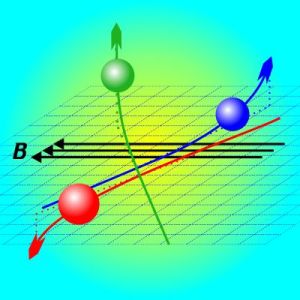
“It’s worse than that, Vinnie.”  I pull out Old Reliable, my math-monster tablet.  “Let me scan in that three-electron drawing of yours.”3 electrons in B-field

“Good enough to keep a record of it?”

“Nope, I want to exercise a new OVR app I just bought.”

“You mean OCR.”

“Uh-uh, this is Original Vector Reconstruction, not Optical Character Recognition.    OCR lets you read a document into a word processor so you can modify it.  OVR does the same thing but with graphics.  Give me a sec … there.  OK, look at this.”3 electrons in B-field revisited

“Cool, you turned my drawing 180°, sort of.  Nice app.  Oh, and you moved the red electron’s path so it’s going opposite to the blue electron instead of parallel to the magnetic field.  Why’d you bother?”

“See the difference between blue and red?”

“Well, yeah, one’s going up, one’s going down.  That’s what I came to you about and you shot down my theory.  Those B-arrows in the magnetic field are going in completely the wrong direction to push things that way.”

“Well, actually, they’re going in exactly the right direction for that, because a magnetic field pushes along perpendiculars.  Ever hear of The Right Hand Rule?”

“You mean like ‘lefty-loosey, righty-tighty’?”

“That works, too, but it’s not the rule I’m talking about.  If you point your thumb in the direction an electron is moving, and your index finger in the direction of the magnetic field, your third finger points in the deflection direction.  Try it.”

“Hurts my wrist when I do it for the blue one, but yeah, the rule works for that.  It’s easier for the red one.  OK, you got this rule, fine, but why does it work?”

“Part of it goes back to the vector math you don’t want me to throw at you.  Let’s just say that there are versions of a Right Hand Rule all over physics.  Many of them are essentially definitions, in the same way that Newton’s Laws of Motion defined force and mass.  Suppose you’re studying the movements directed by some new kind of force.  Typically, you try to define some underlying field in such a way that you can write equations that predict the movement.  You haven’t changed Nature, you’ve just improved our view of how things fit together.”

“So you’re telling me that whoever made that drawing I copied drew the direction those B-arrows pointed just to fit the rule?”

“Almost.  The intensity of the field is whatever it is and the lines minus their pointy parts are wherever they are.  The only thing we can set a rule for is which end of the line gets the arrowhead.  Make sense?”Spiraling electron

“I suppose.  But now I got two questions instead of the one I come in here with.  I can see the deflection twisting that electron’s path into a spiral.  But I don’t see why it spirals upward instead of downward, and I still don’t see how the whole thing works in the first place.”

“I’m afraid you’ve stumbled into a rabbit hole  we don’t generally talk about.  When Newton gave us his Law of Gravity, he didn’t really explain gravity, he just told us how to calculate it.  It took Einstein and General Relativity to get a deeper explanation.  See that really thick book on my shelf over there?  It’s loaded with tables of thermodynamic numbers I can use to calculate chemical reactions, but we didn’t start to understand those numbers until quantum mechanics came along.  Maxwell’s equations let us calculate electricity, magnetism and their interaction — but they don’t tell us why they work.”

“I get the drift.  You’re gonna tell me it goes up because it goes up.”

“That’s pretty much the story.  Electrons are among the simplest particles we know of.  Maxwell and his equations gave us a good handle on how they behave, nothing on why we have a Right Hand Rule instead of a Left Hand Rule.  The parity just falls out of the math.  Left-right asymmetry seems to have something to do with the geometry of the Universe, but we really don’t know.”

“Will string theory help?”

“Physicists have spent 50 years grinding on that without a testable result.  I’m not holding my breath.”

~~ Rich Olcott

RIP, Dr Hawking

Today I depart from my normal schedule and the current story line and science line.  A giant has left us and I want to pay proper tribute.

Dr Stephen Hawking enjoyed telling people of his fortunate birth date, exactly 300 years after Galileo Galilei passed away.  He liked a good joke, and I think he’d be tickled with this additional connection to the man whose work made Hawking’s work possible:
RIP Hawking

The equation in the center of this cut is Hawking’s favorite result, which he wanted to be carved on his gravestone.  It links a black hole’s entropy (S) to its surface area (A).  The other letters denote a collection of constants that have been central to the development of theoretical Physics over the past century and a half:

  • k is Boltzmann’s constant, which links temperature with kinetic energy
  • c is the speed of light, the invariance of which led Einstein to Relativity
  • G is Newton’s universal gravitational constant
  • h is Planck’s constant, the “quantum of action”

Hawking spent much of his career thinking deeply about the implications of Einstein’s concepts.  Newton’s equations support excellent descriptions of everyday physical motions, from the fall of raindrops to the orbits of solar systems.  Einstein’s equations led to insights about conditions at the most extreme — velocities near lightspeed, masses millions of times the Sun’s but packed into a volume only a few dozen miles wide.

But Hawking also pondered extremes of the ultimately large and the ultimately small — the edge of the Universe and distances far smaller than atomic nuclei.  Because his physical condition prohibited speech or quick jottings, he was forced to develop extraordinary powers of concentration and visualization that enabled him to encapsulate in a few phrases insights that would take others books to develop and communicate.

Hawking wrote books, too, of course, of a quality and clarity that turned his name and Science into watchwords for the general public as well as the physics community.  By his life and how he lived it he was an inspiration to many, abled and otherwise.  Science needs its popularizers, though some in the field deprecate them as hangers-on.  Hawking managed to bridge that gap with ease and grace, a giant with standing on either side.

Requiescat in pace, Dr Hawking.  Thank you.

~~ Rich Olcott

The Shape of Water

Amazing what you can do with mozzarella drips and crumbled pizza edges.  Vinnie’s rolling his crumbs into decent-sized marbles.  (Pizza-maker Eddie’s giving him a look.)  He adds a fourth ball to his triangle to make a square.  “So anyway, what you’re telling us is that Bohr’s 8-electron shell isn’t that far off.”

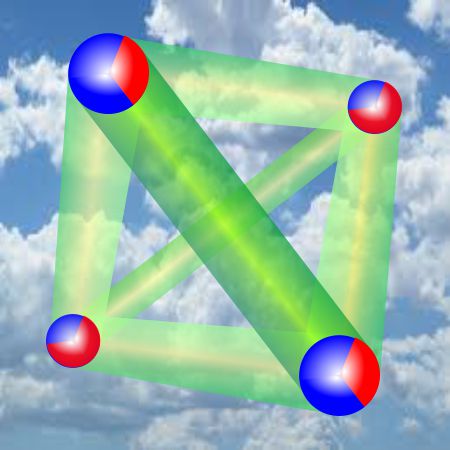
“Oh, it is far off.  Bohr put his electrons in a plane like your square there.  Try putting that fourth ball on top of the others to make a triangular pyramid.  See that?  Counting the bottom it’s a four-sided figure called a tetrahedron.  It’s the fundamental structural building block for most of the Universe’s molecules.”Water molecule“Hey, that’s the alpha-particle shape that the protons and neutrons get themselves into.”

“Good point, Vinnie.  Mind you, though, an alpha particle doesn’t have a central attractor, and it’s a quarter-million times smaller than an atom’s electron cloud.  Got that pyramid shape in mind?”

“Sure.”

“OK, put those balls back in your square. … Put a finger on the north ball and another on the south one.  Now roll them both up into contact on top of the line between the east and west ones.”

“Hey, it’s that tetra-thing again.”

“Right, Eddie.  Any time you have four objects each the same distance from all the others, you’ve got a tetrahedron.  If the ‘objects’ are clouds of electron charge all attracted to the nucleus and all repelled by the other clouds, that’s the shape they’ll take.  It’s no accident that an equal mix of an atom’s spherical and three dumbbell orbitals in a shell makes four equivalent orbitals pointing to the corners of a tetrahedron.”

“Cute, but what’s it get us?”

“It gets us to the chemists’ trick for thinking about molecular structures without doing all the quantum mechanics.  The key is that 8-electron shell.  Forget electrons racing in a ring or electron pairs in a square.  When you see a chemical diagram with four lines coming out of a central atom, think of them in a tetrahedron.  Here’s an example.  Guess what’s the commonest atom in the Universe.”

“Helium.”

“Hydrogen.”

“Eddie’s win with hydrogen — 923,000 atoms out of a million.  Carbon’s the fourth most common, 480 atoms per million.  Think of a carbon atom, floating around in space with four of its six units of electronic charge in its 2-shell.  And it’s surrounded by hydrogen atoms with electrons just begging to pair up with something.  No surprise, there’s suddenly a lot of electron pairing and you’ve got a molecule of methane, CH4.  What’s its shape?  Any hydrogen-hydrogen chains in there?”

“With this build-up, I gotta guess they’re all on the carbon and that they’re splayed out tetrahedron-like, hydrogen centers trying to get away from the other ones and shared charge clouds trying to get away from each other, too.”

“Couldn’t put it better myself, Vinnie.”

“Hey, water’s H2O, right?  You can’t make a tetrahedron from only three atoms.”

“True, Eddie, but an oxygen atom comes with two more electrons than carbon has.  We’ve still got a tetrahedron, but only two of its corners carry a hydrogen.  The other two orbitals stick out their own directions, each loaded with negative charge.  The chemists call that unshared kind of orbital a lone pair.  They often show it as a double-dot on the structure diagram. That’s basically just a bookkeeping device to keep track of electron counts.  All the charge is really spread around throughout all the molecular orbitals just like with atomic orbitals, only it’s not spread evenly.”

“Why do they bother to keep track like that?”

“Lone pairs affect the molecule’s structure.  If it weren’t for them, the water molecule would be a straight line.  In fact, a lone pair orbital crowds the space a bit more than a bonding pair — the H–O–H angle is about 5º smaller than a perfect tetrahedron.”

“Makes sense when you think about it, like you can wave a stick all over the place unless someone grabs the other end.”

“Mm-hm.  The big reason chemists care, though, is that lone pairs can be active centers during a chemical reaction.  All that negative charge just waiting for something positive-ish to come along.”

“Like a really good tip,” grumbles Eddie.

~~ Rich Olcott


Shells A-poppin’

We step into Eddie’s.  Vinnie spots Jeremy behind the gelato stand.  “Hey, kid, you studying something Science-y?”

“Yessir, my geology text.”

“Lemme see it a sec, OK?”

“Sure.  Want a gelato?”

“Yeah, gimme a pistachio, double-dip.  I’ll hold your book while you’re doing that.  Ah-hah, Sy, lookie here, page 37 — new textbook but this atom diagram coulda come right out of that 1912 Bohr paper you don’t like.  See, eight dots in a ring around the nucleus.  Can’t be wrong or it wouldn’t have survived this long, right?”

<sigh>  “What it is isn’t what it was.  Bohr proposed his model as a way to explain atomic spectra.  We’ve got a much better model now — but the two agree on three points.  Atoms organize their electronic charge in concentric shells, innermost shells deepest in the nuclear energy well.  Second, each shell has a limited capacity.  Third, when charge moves from one shell to another, light energy is absorbed or emitted to match the energy difference between shells.  Beyond those, not much.  Here, this diagram hints at the differences.”Better Bohr

“The scrambled-looking half is the new picture?”

“Pure chaos, where the only thing you can be sure of is the averages.  These days the Bohr model survives as just an accounting device to keep track of how much charge is in each shell.  That diagram — what kind of atom is it describing?”

“I dunno, two electrons inside, eight outside, ten total.”

“Could be neon, or a fluoride, oxide, sodium or magnesium ion.  From a quantum perspective they all look the same.”

“Here’s your gelato, sir.”

“Thanks, kid, here’s your book back.  But those are different elements, Sy.”

“The important thing, Vinnie, is they all have an outer shell with eight units of charge.  That’s the most stable configuration.”

“What’s so special about eight, Mr Moire?  If it’s pure chaos shouldn’t any number be OK?”

“Like I said, Jeremy, it’s the averages that count.  Actually, this is one of my favorite examples of what Wigner called ‘The Unreasonable Effectiveness of Mathematics in the Natural Sciences.’  Back in 1782, a century and a quarter before anyone took atoms seriously, Laplace did some interesting math.  Have you ever waited for a pot of water to boil and spent the time tapping the pot to see the ripples?”

“Who hasn’t?  Doesn’t boil any faster, though.”

“True.  Looking at those waves, you saw patterns you don’t see with flat reflectors, right?”

“Oh, yeah — some like dumbbells, a lot of circles.”

“Mm-hm.  In a completely random situation all possible patterns could appear, but the pot’s circular boundary suppresses everything except wave patterns that match its symmetry.  You don’t see hexagons, for instance.”

“That’s right, I didn’t.”

“So there’s Laplace in the 1790s, thinking about Newton’s Law of Gravity, and he realizes that even in the boundaryless Solar System there’s still a boundary condition — any well-behaved standing wave has to have the same value at the central point no matter what direction you come from.  He worked out all the possible stable patterns that could exist in a central field like that.  Some of them look like what you saw in the water.  We now classify them by symmetry and node count.”

“Node?”Disk orbitals

“A region where the pattern hits zero, Vinnie.  Density waves range from zero to some positive value; other kinds range from positive to negative values.  A spherical wave could peak at the center and then go to zero infinitely far away.  One node.  Or it could be zero at the center, peak in a spherical shell some distance out and then fade away.  That’d be two nodes.  Or it could be zero at the center, zero far away, and have two peaks at different distances with a spherical third node in between.  Here’s another two-node pattern — that dumbbell shape with nodes at the center and infinity.  You can add radial nodes partway out.”

“I’m getting the picture.”

“Sure.  You might think Laplace’s patterns are just pretty pictures, but electron charge in atoms and ions just happens to collect in exactly those patterns.  Combine Laplace’s one-node and two-node patterns, you get the two lowest-energy stable shells.  They hold exactly ten charge units.  The energies are right, too.  Effective?”

“Unreasonably.”

~~ Rich Olcott

Water, Water Everywhere — How Come?

Lunch time, so I elbow my way past Feder and head for the elevator.  He keeps peppering me with questions.

“Was Einstein ever wrong?”

“Sure. His equations pointed the way to black holes but he thought the Universe couldn’t pack that much mass into that small a space.  It could.  There are other cases.”

We’re on the elevator and I punch 2.  “Where you going?  I ain’t done yet.”

“Down to Eddie’s Pizza.  You’re buying.”

“Awright, long as I get my answers.  Next one — if the force pulling an electron toward a nucleus goes as 1/r², when it gets to where r=0 won’t it get stuck there by the infinite force?”

“No, because at very short distances you can’t use that simple force law.  The electron’s quantum wave properties dominate and the charge is a spread-out blur.”

The elevator stops at 7.  Cathleen and a couple of her Astronomy students get on, but Feder just peppers on.  “So I read that everywhere we look in the Solar System there’s water.  How come?”

I look over at Cathleen.  “This is Mr Richard Feder of Fort Lee, NJ.  He’s got questions.  Care to take this one?  He’s buying the pizza.”

“Well, in that case.  It all starts with alpha particles, Mr Feder.”

The elevator door opens on 2, we march into Eddie’s, order and find a table.  “What’s an alpha particle and what’s that got to do with water?”

Alpha particle
Two protons and two neutrons, assembled as an alpha particle

“An alpha particle’s a fragment of nuclear material that contains two protons and two neutrons.  99.999% of all helium atoms have an alpha particle for a nucleus, but alphas are so stable relative to other possible combinations that when heavy atoms get indigestion they usually burp alpha particles.”

“And the water part?”

“That goes back to where our atoms come from — all our atoms, but in particular our hydrogen and oxygen.  Hydrogen’s the simplest atom, just a proton in its nucleus.  That was virtually the only kind of nucleus right after the Big Bang, and it’s still the most common kind.  The first generation of stars got their energy by fusing hydrogen nuclei to make helium.  Even now, that’s true for stars about the size of the Sun or smaller.  More massive stars support hotter processes that can make heavier elements.  Umm, Maria, do you have your class notes from last Tuesday?”

“Yes, Professor.”

“Please show Mr Feder that chart of the most abundant elements in the Universe.  Do you see any patterns in the second and fourth columns, Mr Feder?”

Element Atomic number Mass % *103 Atomic weight Atom % *103
Hydrogen 1 73,900 1 92,351
Helium 2 24,000 4 7,500
Oxygen 8 1,040 16 81
Carbon 6 460 12 48
Neon 10 134 20 8
Iron 26 109 56 2
Nitrogen 7 96 14 <1
Silicon 14 65 32 <1

“Hmm…  I’m gonna skip hydrogen, OK?  All the rest except nitrogen have an even atomic number, and all of ’em except nitrogen the atomic weight is a multiple of four.”

“Bravo, Mr Feder.  You’ve distinguished between two of the primary reaction paths that larger stars use to generate energy.  The alpha ladder starts with carbon-12 and adds one alpha particle after another to go from oxygen-16 on up to iron-56.  The CNO cycle starts with carbon-12 and builds alphas from hydrogens but a slow step in the cycle creates nitrogen-14.”

“Where’s the carbon-12 come from?”

“That’s the third process, triple alpha.  If three alphas with enough kinetic energy meet up within a ridiculously short time interval, you get a carbon-12.  That mostly happens only while a star’s going nova, simultaneously collapsing its interior and spraying most of its hydrogen, helium, carbon and whatever out into space where it can be picked up by neighboring stars.”

“Where’s the water?”

“Part of the whatever is oxygen-16 atoms.  What would a lonely oxygen atom do, floating around out there?  Look at Maria’s table.  Odds are the first couple of atoms it runs across will be hydrogens to link up with.  Presto!  H2O, water in astronomical quantities.  The carbon atoms can make methane, CH4; the nitrogens can make ammonia, NH3; and then photons from Momma star or somewhere can help drive chemical reactions  between those molecules.”

“You’re saying that the water astronomers find on the planets and moons and comets comes from alpha particles inside stars?”

“We’re star dust, Mr Feder.”

~~ Rich Olcott

Thoughts of Chair-man Moire

My apples and orange peels question, Sy,  isn’t that the same as Jeremy’s?  What’s the connection between heat capacity and counting?”

“You’re right, Anne.  Hmm.  Say, Al, all your coffee shop tables came with four chairs apiece, right?”

“Yup, four-tops every one, even in the back room.”

“You neaten them all up, four to a table, in the morning?”

“The night before.  There’s never time in the morning, customers demand coffee first thing.”

“But look, we’ve got six people seated at this table.  Where’d the extra chairs come from?”

“Other tables, of course.  Is this going somewhere?”

“Almost there.  So in fact the state of the room at any time will have some random distribution of chairs to tables.  You know on the average there’ll be four at a table, but you don’t know the actual distribution until you look, right?”

“Hey, we’re counting again.  You’re gonna say that’s about entropy ’cause the difference between four at a table and some other number is all random and there’s some formula to calculate entropy from that.”elephants and chairs

“True, Vinnie, but we’re about to take the next step.  How did these chairs wind up around this table?”

“We pulled them over, Mr. Moire.”

“My point is, Jeremy, we spent energy to get them here.  The more chairs that are out of position — ”

“The higher the entropy, but also the more energy went into the chairs.  It’s like that heat capacity thing we started with, the energy that got absorbed rather than driving the steam engine.”

“Awright, Anne!” from Jeremy <Jennie bristles a bit>, “and if all the chairs are in Al’s overnight position it’s like absolute zero.  Hey, temperature is average kinetic energy per particle so can we say that the more often a chair gets moved it’s like hotter?”

Jennie breaks in.  “Not a bit of it, Jeremy!  The whole metaphor’s daft.  We know temperature change times heat capacity equals the energy absorbed, right, and we’ve got a link between energy absorption and entropy, right, but what about if at the end of the day all the chairs accidentally wind up four at a table?  Entropy change is zero, right, but customers expended energy moving chairs about all day and Al’s got naught to set straight.”

“Science in action, I love it!  Anne and Jeremy, you two just bridged a gap it took Science a century to get across.  Carnot started us on entropy’s trail in 1824 but scientists in those days weren’t aware of matter’s atomic structure.  They knew that stuff can absorb heat but they had no inkling what did the absorbing or how that worked.  Thirty years later they understood simple gases better and figured out that average kinetic energy per particle bit.  But not until the 1920s did we have the quantum mechanics to show how parts of vibrating molecules can absorb heat energy stepwise like a table ‘absorbing’ chairs.  Only then could we do Vinnie’s state-counting to calculate entropies.”

“Yeah, more energy, spread across more steps, hiding more details we don’t know behind an average, more entropy.  But what about Jennie’s point?”

“Science is a stack of interconnected metaphors, Vinnie.  Some are better than others.  The trick is attending to the boundaries where they stop being valid.  Jennie’s absolutely correct that my four-chair argument is only a cartoon for illustrating stepwise energy accumulation.  If Al had a billion tables instead of a dozen or so, the odds on getting everything back to the zero state would disappear into rounding error.”

“How does black hole entropy play into this, Sy?”TSE classical vs BH

“Not very well, actually.  Oh, sure, the two systems have similar structures.  They’ve each got three inter-related central quantities constrained by three laws.  Here, I’ve charted them out on Old Reliable.”

“OK, their Second and Third Laws look pretty much the same, but their First Laws don’t match up.”

“Right, Al.  And even Bekenstein pointed out inconsistencies between classic thermodynamic temperature and what’s come to be called Hawking temperature.  Hawking didn’t agree.  The theoreticians are still arguing.  Here’s a funny one — if you dig deep enough, both versions of the First Law are the same, but the Universe doesn’t obey it.”

“That’s it, closing time.  Everybody out.”

~~ Rich Olcott

Taming The Elephant

Suddenly they were all on the attack.  Anne got in the first lick.  “C’mon, Sy, you’re comparing apples and orange peel.  Your hydrogen sphere would be on the inside of the black hole’s event horizon, and Jeremy’s virtual particles are on the outside.”

[If you’ve not read my prior post, do that now and this’ll make more sense.  Go ahead, I’ll wait here.]white satin and 5 elephantsJennie’s turn — “Didn’t the chemists define away a whole lot of entropy when they said that pure elements have zero entropy at absolute zero temperature?”

Then Vinnie took a shot.  “If you’re counting maybe-particles per square whatever for the surface, shouldn’t you oughta count maybe-atoms or something per cubic whatever for the sphere?”

Jeremy posed the deepest questions. “But Mr Moire, aren’t those two different definitions for entropy?  What does heat capacity have to do with counting, anyhow?”

Al brought over mugs of coffee and a plate of scones.  “This I gotta hear.”

“Whew, but this is good ’cause we’re getting down to the nub.  First to Jennie’s point — Under the covers, Hawking’s evaluation is just as arbitrary as the chemists’.  Vinnie’s ‘whatever’ is the Planck length, lP=1.616×10⁻³⁵ meter.  It’s the square root of such a simple combination of fundamental constants that many physicists think that lP2=2.611×10-70 m², is the ‘quantum of area.’  But that’s just a convenient assumption with no supporting evidence behind it.”

“Ah, so Hawking’s ABH=4πrs2 and SBH=ABH/4 formulation with rs measured in Planck-lengths, just counts the number of area-quanta on the event horizon’s surface.”

“Exactly, Jennie.  If there really is a least possible area, which a lot of physicists doubt, and if its size doesn’t happen to equal lP2, then the black hole entropy gets recalculated to match.”

“So what’s wrong with cubic those-things?”

“Nothing, Vinnie, except that volumes measured in lP3 don’t apply to a black hole because the interior’s really four-dimensional with time scrambled into the distance formulas.  Besides, Hawking proved that the entropy varies with half-diameter squared, not half-diameter cubed.”

“But you could still measure your hydrogen sphere with them and that’d get rid of that 1033 discrepancy between the two entropies.”

“Not really, Vinnie.  Old Reliable calculated solid hydrogen’s entropy for a certain mass, not a volume.”

“Hawking can make his arbitrary choice, Sy, he’s Hawking, but that doesn’t let the chemists off the scaffold.  How did they get away with arbitrarily defining a zero for entropy?”

“Because it worked, Jennie.  They were only concerned with changes — the difference between a system’s state at the end of a process, versus its state at the beginning.  It was only the entropy difference that counted, not its absolute value.”

“Hey, like altitude differences in potential energy.”

“Absolutely, Vinnie, and that’ll be important when we get to Jeremy’s question.  So, Jennie, if you’re only interested in chemical reactions and if it’s still in the 19th Century and the world doesn’t know about isotopes yet, is there a problem with defining zero entropy to be at a convenient set of conditions?”

“Well, but Vinnie’s Second Law says you can never get down to absolute zero so that’s not convenient.”

“Good point, but the Ideal Gas Law and other tools let scientists extrapolate experimentally measured properties down to extremely low temperatures.  In fact, the very notion of absolute zero temperature came from experiments where the volume of a  hydrogen or helium gas sample appears to decrease linearly towards zero at that temperature, at least until the sample condenses to a liquid.  With properly calibrated thermometers, physical chemists knocked themselves out measuring heat capacities and entropies at different temperatures for every substance they could lay hands on.”

“What about isotopes, Mr Moire?  Isn’t chlorine’s atomic weight something-and-a-half so there’s gotta be several of kinds of chlorine atoms so any sample you’ve got is a mixture and that’s random and that has to have a non-zero entropy even at absolute zero.”

“It’s 35.4, two stable isotopes, Jeremy, but we know how to account for entropy of mixing and anyway, the isotope mix rarely changes in chemical processes.”

“But my apples and orange peels, Sy — what does the entropy elephant do about them?”

~~ Rich Olcott

Rockfall

<continued>  The coffee shop crowd had gotten rowdy in response to my sloppy physics, but everyone hushed when I reached for my holster and drew out Old Reliable.  All had heard of it, some had seen it in action — a maxed-out tablet with customized math apps on speed-dial.

“Let’s take this nice and slow.  Suppose we’ve got an non-charged, non-spinning solar-mass black hole.  Inside its event horizon the radius gets weird but let’s pretend we can treat the object like a simple sphere.  The horizon’s half-diameter, we’ll call it the radius, is rs=2G·M/c²G is Newton’s gravitational constant, M is the object’s mass and c is the speed of light.  Old Reliable says … about 3 kilometers.  Question is, what happens when we throw a rock in there?  To keep things simple, I’m going to model dropping the rock gentle-like, dead-center and with negligible velocity relative to the hole, OK?”

<crickets>

“Say the rock has the mass of the Earth, almost exactly 3×10⁻⁶ the Sun’s mass.  The gravitational potential energy released when the rock hits the event horizon from far, far away would be E=G·M·m/rs, which works out to be … 2.6874×1041 joules.  What happens to that energy?”falling rock and black hole

rs depends on mass, Mr Moire, so the object will expand.  Won’t that push on what’s around it?”

“You’re thinking it’d act like a spherical piston, Jeremy, pushing out in all directions?”

“Yeah, sorta.”

“After we throw in a rock with mass m, the radius expands from rs to rp=2G·(M+m)/c².  I set m to Earth’s mass and Old Reliable says the new radius is … 3.000009 kilometers.  Granted the event horizon is only an abstract math construct, but suppose it’s a solid membrane like a balloon’s skin.  When it expands by that 9 millimeters, what’s there to push against?  The accretion disk?  Those rings might look solid but they’re probably like Saturn’s rings — a collection of independent chunks of stuff with an occasional gas molecule in-between.  Their chaotic orbits don’t have a hard-edged boundary and wouldn’t notice the 9-millimeter difference.  Inward of the disk you’ve got vacuum.  A piston pushing on vacuum expends zero energy.  With no pressure-volume work getting done that can’t be where the infall energy goes.”

“How about lift-a-weight work against the hole’s own gravity?”

“That’s a possibility, Vinnie.  Some physicists maintain that a black hole’s mass is concentrated in a shell right at the event horizon.  Old Reliable here can figure how much energy it would take to expand the shell that extra 9 millimeters.  Imagine that simple Newtonian physics applies — no relativistic weirdness.  Newton proved that a uniform spherical shell’s gravitational attraction is the same as what you’d get from having the same mass sitting at the shell’s geometric center.  The gravitational pull the shell exerts on itself originally was E=G·M²/rs.  Lifting the new mass from rs to rp will cost ΔE=G·(M+m)²/r– G·M²/rs.  When I plug in the numbers…  That’s interesting.”

Vinnie’s known me long enough to realize “That’s interesting” meant “Whoa, I certainly didn’t expect THAT!

“So what didja expect and whatcha got?”

“What I expected was that lift-it-up work would also be just a small fraction of the infall energy and the rest would go to heat.  What I got for ΔE here was 2.6874×1041 joules, exactly 100% of the input.  I wonder what happens if I use a bigger planet.  Gimme a second … OK, let’s plot a range …  How ’bout that, it’s linear!”ep-es

“Alright, show us!”

All the infall energy goes to move the shell’s combined mass outward to match the expanded size of the event horizon.  I’m amazed that such a simple classical model produces a reasonable result.”

“Like Miss Plenum says, Mr Moire, sometimes the best science comes from surprises.”

“I wouldn’t show it around, Jeremy, except that it’s consistent with Hawking’s quantum-physics result.”

“How’s that?”

“Remember, he showed that a black hole’s temperature varies as 1/M.  We know that temperature is ΔE/ΔS, where the entropy change ΔS varies as .  We’ve just found that ΔE varies as M.  The ΔE/ΔS ratio varies as M/M²=1/M, just like Hawking said.”

Then Jennie got into the conversation.

~~ Rich Olcott