Gettin’ kinky in space

Things were simpler in the pre-Enlightenment days when we only five planets to keep track of.  But Haley realized that comets could have orbits, Herschel discovered Uranus, and Galle (with Le Verrier’s guidance) found Neptune.  Then a host of other astronomers detected Ceres and a host of other asteroids, and Tombaugh observed Pluto in 1930.whirlpool-44x100-reversed

Astronomers relished the proliferation — every new-found object up there was a new test case for challenging one or another competing theory.

Here’s the currently accepted narrative…  Long ago but quite close-by, there was a cloud of dust in the Milky Way galaxy.  Random motion within it produced a swirl that grew into a vortex dozens of lightyears long.

Consider one dust particle (we’ll call it Isaac) afloat in a slice perpendicular to the vortex.  Assume for the moment that the vortex is perfectly straight, the dust is evenly spread across it, and all particles have the same mass.  Isaac is subject to two influences — gravitational and rotational.

making-a-solar-nebula
A kinked galactic cloud vortex,
out of balance and giving rise
to a solar system.

Gravity pulls Isaac towards towards every other particle in the slice.  Except for very near the slice’s center there are generally more particles (and thus more mass) toward and beyond the center than back toward the edge behind him.  Furthermore, there will generally be as many particles to Isaac’s left as to his right.  Gravity’s net effect is to pull Isaac toward the vortex center.

But the vortex spins.  Isaac and his cohorts have angular momentum, which is like straight-line momentum except you’re rotating about a center.  Both of them are conserved quantities — you can only get rid of either kind of momentum by passing it along to something else.  Angular momentum keeps Isaac rotating within the plane of his slice.

An object’s angular momentum is its linear momentum multiplied by its distance from the center.  If Isaac drifts towards the slice’s center (radial distance decreases), either he speeds up to compensate or he transfers angular momentum to other particles by colliding with them.

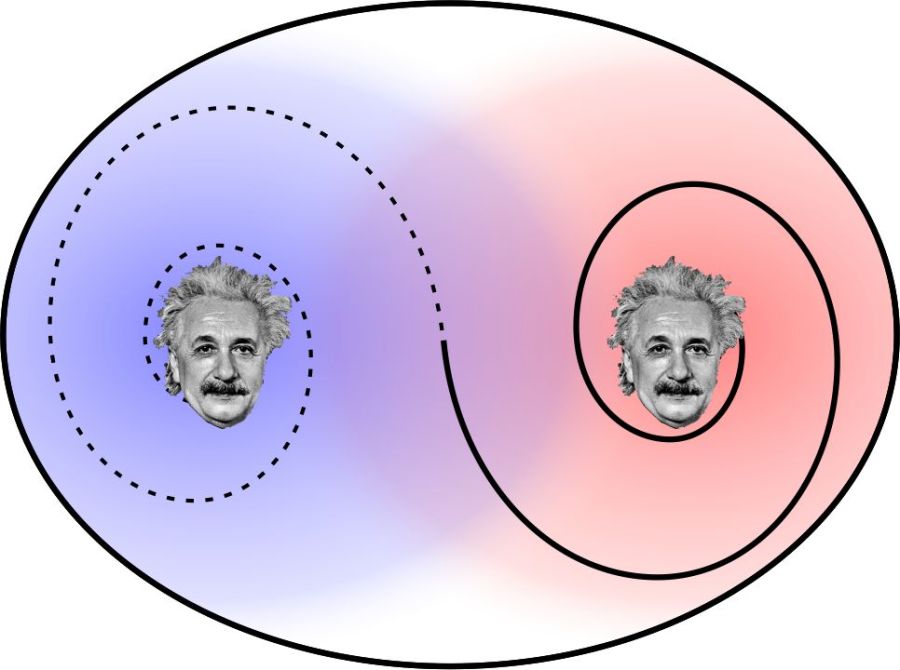
But vortices are rarely perfectly straight.  Moreover, the galactic-cloud kind are generally lumpy and composed of different-sized particles.  Suppose our vortex gets kinked by passing a star or a magnetic field or even another vortex.  Between-slice gravity near the kink shifts mass kinkward and unbalances the slices to form a lump (see the diagram).  The lump’s concentrated mass in turn attracts particles from adjacent slices in a viscous cycle (pun intended).

After a while the lumpward drift depletes the whole neighborhood near the kink.  The vortex becomes host to a solar nebula, a concentrated disk of dust whirling about its center because even when you come in from a different slice, you’ve still got your angular momentum.  When gravity smacks together Isaac and a few billion other particles, the whole ball of whacks inherits the angular momentum that each of its stuck-together components had.  Any particle or planetoid that tries to make a break for it up- or down-vortex gets pulled back into the disk by gravity.

That theory does a pretty good job on the conventional Solar System — four rocky Inner Planets, four gas giant Outer Planets, plus that host of asteroids and such, all tightly held in the Plane of The Ecliptic.

How then to explain out-of-plane objects like Pluto and Eris, not to mention long-period comets with orbits at all angles?outer-orbits-1
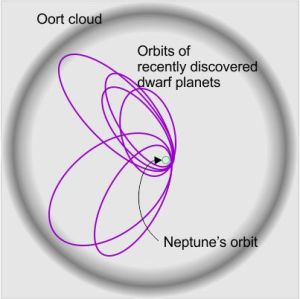
We now know that the Solar System holds more than we used to believe.  Who’s in is still “objects whose motion is dominated by the Sun’s gravitational field,” but the Sun’s net spreads far further than we’d thought.  Astronomers now hypothesize that after its creation in the vortex, the Sun accumulated an Oort cloud — a 100-billion-mile spherical shell containing a trillion objects, pebbles to planet-sized.

At the shell’s average distance from the Sun (see how tiny Neptune’s path is in the diagram) Solar gravity is a millionth of its strength at Earth’s orbit.  The gravity of a passing star or even a conjunction of our own gas giants is enough to start an Oort-cloud object on an inward journey.

These trans-Neptunian objects are small and hard to see, but they’re revolutionizing planetary astronomy.

~~ Rich Olcott

Plutonic Goofyness

goofy-and-dp-pluto
Is Pluto wearing a space helmet?
No, that helmet is Pluto.
(Based on a cartoon by Andy Diehl)

Andy Diehl brings up a question worth considering over a tasty beverage.  How come Pluto’s a dog and Goofy’s a dog but Pluto gets the collar end of the leash?  Hardly seems fair.

Which brings us to that other controversial Pluto, the one that NASA’s New Horizon spacecraft visited last July.  (News flash — on 28 October, NASA announced that they’d received the very last of the data NH accumulated during that 2½-hour visit.)  Official Astronomy has reclassified Pluto from “planet” to “dwarf planet,” but NH honcho Alan Stern and much of the rest of the world say, “No way!”

The traditionalist position is, “But we’ve always called Pluto the ninth planet.”  Well, “always” only goes back to when the preternaturally persistent Clyde Tombaugh discovered the object in 1930.  At the time he found it Pluto was indeed the ninth “planet” out from the Sun.  However, it spends about 10% of each orbit* closer to the Sun than the eighth planet, Neptune.  So should we call it the “seven-and-a-fraction-th” planet?

No, because (1) that contravenes Official Astronomy’s rules, and (2) it’d be silly.

So what are the rules for what’s a planet?

  1. The object must be in orbit around its star.
  2. The object must be massive enough to be rounded by its own gravity.
  3. It must have cleared the neighborhood around its orbit.

“Rounded” is a bit tricky.  It doesn’t mean “spherical” because if you spin a  sphere, centrifugal forces move mass towards its equator.  Earth’s equator is 13.3 miles further away from its center than its poles are.  Miller’s Planet in the Interstellar movie is also a spheroid, even further deformed by elongation towards the black hole it orbits, yet it still rates as “rounded by its gravity” and qualifies as a planet.

Clearing the neighborhood” means “my gravity dominates the motion of everything in my orbit.”  Earth and Jupiter, both acknowledged planets, each have retinues of asteroids in the Trojan positions, at the same distance from the Sun as the host planet but in regions 60º ahead of or behind it.  Even so, both planets often suffer messy encounters (remember Chicxulub and Chelyabinsk?) with asteroids and such that hadn’t gotten the memo.

Neptune meets all three criteria.  Its gravity dominates Pluto’s motion even though Pluto’s in a separate orbit.  For every three of Neptune’s trips around the Sun, Pluto makes exactly two.  The gravitational converse doesn’t hold, though.  Pluto’s mass is 0.1% of Neptune’s so the big guy doesn’t care.

pluto-orbits-1This video, from an Orbits Table display at the Denver Museum of Nature and Science, shows a different Plutonian weirdness.  We’re circling the Solar System at about 50 times Earth’s distance from the Sun (50 AU).  Reading inward, the white lines represent the orbits of Neptune, Uranus, Saturn and Jupiter.  The Asteroid Belt is the small greenish ring close to the Sun.  The four terrestrial planets are even further in.  The Kuiper Belt is the greenish ring that encloses the lot.
The  yellow-orange line is Pluto’s orbit.  Most of the Solar System lies within a thin pancake, the Plane of The Ecliptic. Pluto’s orbit is inclined 17º out of the Plane.  That’s odd.

Theory says that the System evolved from an eddy in a primordial cloud of dust and gas.  Gravity shrank that blob of stuff to form a disk at the eddy’s equator as it drew 99.9% of the system’s mass to form the Sun at the disk’s center.

Newton’s First Law is all about Conservation of Momentum.  When applied to circular motion, it says that if you’re whirling in a certain plane, you’ll continue whirling in that plane unless something knocks you out of that plane.  Hence, the Plane of The Ecliptic.

Pluto’s path is a puzzling challenge to the theory.  It was only a minor puzzle until the 1990’s when astronomers discovered a plethora of Pluto-type objects outside of Neptune’s orbit.  Most run way out of the Plane.  Worst is Eris, at inclination 44º .  Clearly, Pluto’s not special.  It belongs to a large tribe that Astrophysicists must explain if they’re to claim to  understand the Solar System.

~~ Rich Olcott

* – During its current 248-year orbit, Pluto was inside Neptune’s orbit between 1979 and 1999.

Does a photon experience time?

My brother Ken asked me, “Is it true that a photon doesn’t experience time?”  Good question.  As I was thinking about it I wondered if the answer could have implications for Einstein’s bubble.

When Einstein was a grad student in Göttingen, he skipped out on most of the classes given by his math professor Hermann Minkowski.  Then in 1905 Einstein’s Special Relativity paper scooped some work that Minkowski was doing.  In response, Minkowski wrote his own paper that supported and expanded on Einstein’s.  In fact, Minkowski’s contribution changed Einstein’s whole approach to the subject, from algebraic to geometrical.

But not just any geometry, four-dimensional geometry — 3D space AND time.  But not just any space-AND-time geometry — space-MINUS-time geometry.  Wait, what?Pythagoras1

Early geometer Pythagoras showed us how to calculate the hypotenuse of a right triangle from the lengths of the other two sides. His a2+b2 = c2 formula works for the diagonal of the enclosing rectangle, too.

Extending the idea, the body diagonal of an x×y×z cube is √(x2+y2+z2) and the hyperdiagonal  of a an ct×x×y×z tesseract is √(c2t2+x2+y2+z2) where t is time.  Why the “c“?  All terms in a sum have to be in the same units.  x, y, and z are lengths so we need to turn t into a length.  With c as the speed of light, ct is the distance (length) that light travels in time t.

But Minkowski and the other physicists weren’t happy with Pythagorean hyperdiagonals.  Here’s the problem they wanted to solve.  Suppose you’re watching your spacecraft’s first flight.  You built it, you know its tip-to-tail length, but your telescope says it’s shorter than that.  George FitzGerald and Hendrik Lorentz explained that in 1892 with their length contraction analysis.

What if there are two observers, Fred and Ethel, each of whom is also moving?  They’d better be able to come up with the same at-rest (intrinsic) size for the object.

Minkowski’s solution was to treat the ct term differently from the others.  Think of each 4D address (ct,x,y,z) as a distinct event.  Whether or not something happens then/there, this event’s distinct from all other spatial locations at moment t, and all other moments at location (x,y,z).

To simplify things, let’s compare events to the origin (0,0,0,0).  Pythagoras would say that the “distance” between the origin event and an event I’ll call Lucy at (ct,x,y,z) is √(c2t2+x2+y2+z2).

Minkowski proposed a different kind of “distance,” which he called the interval.  It’s the difference between the time term and the space terms: √[c2t2 + (-1)*(x2+y2+z2)].

If Lucy’s time is t=0 [her event address (0,x,y,z)], then the origin-to-Lucy interval is  √[02+(-1)*(x2+y2+z2)]=i(x2+y2+z2).  Except for the i=√(-1) factor, that matches the familiar origin-to-Lucy spatial distance.

Now for the moment let’s convert the sum from lengths to times by dividing by c2.  The expression becomes √[t2-(x/c)2-(y/c)2-(z/c)2].  If Lucy is at (ct,0,0,0) then the origin-to-Lucy interval is simply √(t2)=t, exactly the time difference we’d expect.

Finally, suppose that Lucy departed the origin at time zero and traveled along x at the speed of light.   At any time t, her address is (ct,ct,0,0) and the interval for her trip is √[(ct)2-(ct)2-02-02] = √0 = 0.  Both Fred’s and Ethel’s clocks show time passing as Lucy speeds along, but the interval is always zero no matter where they stand and when they make their measurements.

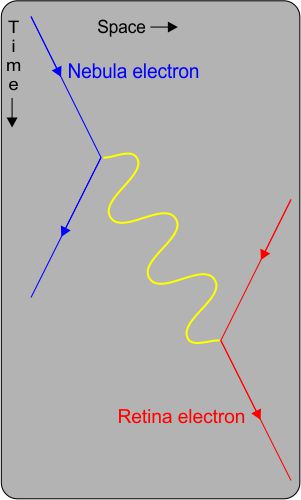
Feynman diagramOne more step and we can answer Ken’s question.  A moving object’s proper time is defined to be the time measured by a clock affixed to that object.  The proper time interval between two events encountered by an object is exactly Minkowski’s spacetime interval.  Lucy’s clock never moves from zero.

So yeah, Ken, a photon moving at the speed of light experiences no change in proper time although externally we see it traveling.

Now on to Einstein’s bubble, a lightwave’s spherical shell that vanishes instantly when its photon is absorbed by an electron somewhere.  We see that the photon experiences zero proper time while traversing the yellow line in this Feynman diagram.  But viewed from any other frame of reference the journey takes longer.  Einstein’s objection to instantaneous wave collapse still stands.

~~ Rich Olcott

Reflections in Einstein’s bubble

There’s something peculiar in this earlier post where I embroidered on Einstein’s gambit in his epic battle with Bohr.  Here, I’ll self-plagiarize it for you…

Consider some nebula a million light-years away.  A million years ago an electron wobbled in the nebular cloud, generating a spherical electromagnetic wave that expanded at light-speed throughout the Universe.

Last night you got a glimpse of the nebula when that lightwave encountered a retinal cell in your eye.  Instantly, all of the wave’s energy, acting as a photon, energized a single electron in your retina.  That particular lightwave ceased to be active elsewhere in your eye or anywhere else on that million-light-year spherical shell.

Suppose that photon was yellow light, smack in the middle of the optical spectrum.  Its wavelength, about 580nm, says that the single far-away electron gave its spherical wave about 2.1eV (3.4×10⁻¹⁹ joules) of energy.  By the time it hit your eye that energy was spread over an area of a trillion square lightyears.  Your retinal cell’s cross-section is about 3 square micrometers so the cell can intercept only a teeny fraction of the wavefront.  Multiplying the wave’s energy by that fraction, I calculated that the cell should be able to collect only 10-75 joules.  You’d get that amount of energy from a 100W yellow light bulb that flashed for 10-73 seconds.  Like you’d notice.

But that microminiscule blink isn’t what you saw.  You saw one full photon-worth of yellow light, all 2.1eV of it, with no dilution by expansion.  Water waves sure don’t work that way, thank Heavens, or we’d be tsunami’d several times a day by earthquakes occurring near some ocean somewhere.

Feynman diagramHere we have a Feynman diagram, named for the Nobel-winning (1965) physicist who invented it and much else.  The diagram plots out the transaction we just discussed.  Not a conventional x-y plot, it shows Space, Time and particles.  To the left, that far-away electron emits a photon signified by the yellow wiggly line.  The photon has momentum so the electron must recoil away from it.

The photon proceeds on its million-lightyear journey across the diagram.  When it encounters that electron in your eye, the photon is immediately and completely converted to electron energy and momentum.

Here’s the thing.  This megayear Feynman diagram and the numbers behind it are identical to what you’d draw for the same kind of yellow-light electron-photon-electron interaction but across just a one-millimeter gap.

It’s an essential part of the quantum formalism — the amount of energy in a given transition is independent of the mechanical details (what the electrons were doing when the photon was emitted/absorbed, the photon’s route and trip time, which other atoms are in either neighborhood, etc.).  All that matters is the system’s starting and ending states.  (In fact, some complicated but legitimate Feynman diagrams let intermediate particles travel faster than lightspeed if they disappear before the process completes.  Hint.)

Because they don’t share a common history our nebular and retinal electrons are not entangled by the usual definition.  Nonetheless, like entanglement this transaction has Action-At-A-Distance stickers all over it.  First, and this was Einstein’s objection, the entire wave function disappears from everywhere in the Universe the instant its energy is delivered to a specific location.  Second, the Feynman calculation describes a time-independent, distance-independent connection between two permanently isolated particles.  Kinda romantic, maybe, but it’d be a boring movie plot.

As Einstein maintained, quantum mechanics is inherently non-local.  In QM change at one location is instantaneously reflected in change elsewhere as if two remote thingies are parts of one thingy whose left hand always knows what its right hand is doing.

Bohr didn’t care but Einstein did because relativity theory is based on geometry which is all about location. In relativity, change here can influence what happens there only by way of light or gravitational waves that travel at lightspeed.

In his book Spooky Action At A Distance, George Musser describes several non-quantum examples of non-locality.  In each case, there’s no signal transmission but somehow there’s a remote status change anyway.  We don’t (yet) know a good mechanism for making that happen.

It all suggests two speed limits, one for light and matter and the other for Einstein’s “deeper reality” beneath quantum mechanics.

~~ Rich Olcott

Is there stuff behind the stats?

dragon plate 3It would have been awesome to watch Dragon Princes in battle (from a safe hiding place), but I’d almost rather have witnessed “The Tussles in Brussels,” the two most prominent confrontations between Albert Einstein and Niels Bohr.
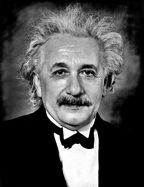
The Tussles would be the Fifth (1927) and Seventh (1933) Solvay Conferences.  Each conference was to center on a particular Quantum Mechanics application (“Electrons and Photons” and “The Atomic Nucleus,” respectively).  However, the Einstein-Bohr discussions went right to the fundamentals — exactly what does a QM calculation tell us?

Einstein’s strength was in his physical intuition.  By all accounts he was a good mathematician but not a great one.  However, he was very good indeed at identifying important problems and guiding excellent mathematicians as he and they attacked those problems together.

Einstein 187Like Newton, Einstein was a particle guy.  He based his famous thought experiments on what his intuition told him about how particles would behave in a given situation.  That intuition and that orientation led him to paradoxes such as entanglement, the EPR Paradox, and the instantaneously collapsing spherical lightwave we discussed earlier.  Einstein was convinced that the particles QM workers think about (photons, electrons, etc.) must in fact be manifestations of some deeper, more fine-grained reality.

bohr 187Bohr was six years younger than Einstein.  Both Bohr and Einstein had attained Directorship of an Institute at age 35, but Bohr’s has his name on it.  He started out as a particle guy — his first splash was a trio of papers that treated the hydrogen atom like a one-planet solar system.  But that model ran into serious difficulties for many-electron atoms so Bohr switched his allegiance from particles to Schrödinger’s wave theory.  Solve a Schrödinger equation and you can calculate statistics like average value and estimated spread around the average for a given property (position, momentum, spin, etc).

wittgenstein 187Here’s where Ludwig Wittgenstein may have come into the picture.  Wittgenstein is famous for his telegraphically opaque writing style and for the fact that he spent much of his later life disagreeing with his earlier writings.  His 1921 book, Tractatus Logico-Philosophicus (in German despite the Latin title) was a primary impetus to the Logical Positivist school of philosophy.  I’m stripping out much detail here, but the book’s long-lasting impact on QM may have come from its Proposition 7: Whereof one cannot speak, thereof one must be silent.

I suspect that Bohr was deeply influenced by the LP movement, which was all the rage in the mid-1920s while he was developing the Copenhagen Interpretation of QM.

An enormous literature, including quite a lot of twaddle, has grown up around the question, “Once you’ve derived the Schrödinger wave function for a given system, how do you interpret what you have?”  Bohr’s Copenhagen Interpretation was that the function can only describe relative probabilities for the results of a measurement.  It might tell you, for instance, that there’s a 50% chance that a particle will show up between here and here but only a 5% chance of finding it beyond there.

Following Logical Positivism all the way to the bank, Bohr denounced as nonsensical or even dangerously misleading any attachment of further meaning to a QM result.  He went so far as to deny the very existence of a particle prior to a measurement that detects it.  That’s serious Proposition 7 there.

I’ve read several accounts of the Solvay Conference debates between Einstein and Bohr.  All of them agree that the conversation was inconclusive but decisive.  Einstein steadfastly maintained that QM could not be a complete description of reality whilst Bohr refused to even consider anything other than inscrutable randomness beneath the statistics.  The audience consensus went to Bohr.

None of the accounts, even the very complete one that I found in George Musser’s book Spooky Action at A Distance, provide a satisfactory explanation for why Bohr’s interpretation dominates today.  Einstein described multiple situations where QM’s logic appeared to contradict itself or firmly established experimental results.  However, at each challenge Bohr deflected the argument from Einstein’s central point to argue a subsidiary issue such as whether Einstein was denying the Heisenberg Uncertainty Principle.

Albert still stood at the end of the bouts, but Niels got the spectators’ decision on points.  Did the ref make the difference?

~~ Rich Olcott

Oh, what an entangled wave we weave

“Here’s the poly bag wiff our meals, Johnny.  ‘S got two boxes innit, but no labels which is which.”
“I ordered the mutton pasty, Jennie, anna fish’n’chips for you.”
“You c’n have this box, Johnny.  I’ll take the other one t’ my place to watch telly.”

<ring>
” ‘Ullo, Jennie?  This is Johnny.  The box over ‘ere ‘as the fish.  You’ve got mine!”


In a sense their supper order arrived in an entangled state.  Our friends knew what was in both boxes together, but they didn’t know what was in either box separately.  Kind of a Schrödinger’s Cat situation — they had to treat each box as 50% baked pasty and 50% fried codfish.

But as soon as Johnny opened one box, he knew what was in the other one even though it was somewhere else.  Jennie could have been in the next room or the next town or the next planet — Johnnie would have known, instantly, which box had his meal no matter how far away that other box was.

By the way, Jennie was free to open her box on the way home but that’d make no difference to Johnnie — the box at his place would have stayed a mystery to him until either he opened it or he talked to her.

Entangled 2Information transfer at infinite speed?  Of course not, because neither hungry person knows what’s in either box until they open one or until they exchange information.  Even Skype operates at light-speed (or slower).

But that’s not quite quantum entanglement, because there’s definite content (meat pie or batter-fried cod) in each box.  In the quantum world, neither box holds something definite until at least one box is opened.  At that point, ambiguity flees from both boxes in an act of global correlation.

There’s strong experimental evidence that entangled particles literally don’t know which way is up until one of them is observed.  The paired particle instantaneously gets that message no matter how far away it is.

Niels Bohr’s Principle of Complementarity is involved here.  He held that because it’s impossible to measure both wave and particle properties at the same time, a quantized entity acts as a wave globally and only becomes local when it stops somewhere.

Here’s how extreme the wave/particle global/local thing can get.  Consider some nebula a million light-years away.  A million years ago an electron wobbled in the nebular cloud, generating a spherical electromagnetic wave that expanded at light-speed throughout the Universe.

cats-eye nebula
The Cat’s Eye Nebula (NGC 6543)
courtesy of NASA’s Hubble Space Telescope

Last night you got a glimpse of the nebula when that lightwave encountered a retinal cell in your eye.  Instantly, all of the wave’s energy, acting as a photon, energized a single electron in your retina.  That particular lightwave ceased to be active elsewhere in your eye or anywhere else on that million-light-year spherical shell.

Surely there was at least one other being, on Earth or somewhere else, that was looking towards the nebula when that wave passed by.  They wouldn’t have seen your photon nor could you have seen any of theirs.  Somehow your wave’s entire spherical shell, all 1012 square lightyears of it, instantaneously “knew” that your eye’s electron had extracted the wave’s energy.

But that directly contradicts a bedrock of Einstein’s Special Theory of Relativity.  His fundamental assumption was that nothing (energy, matter or information) can go faster than the speed of light in vacuum.  STR says it’s impossible for two distant points on that spherical wave to communicate in the way that quantum theory demands they must.

Want some irony?  Back in 1906, Einstein himself “invented” the photon in one of his four “Annus mirabilis” papers.  (The word “photon” didn’t come into use for another decade, but Einstein demonstrated the need for it.)  Building on Planck’s work, Einstein showed that light must be emitted and absorbed as quantized packets of energy.

It must have taken a lot of courage to write that paper, because Maxwell’s wave theory of light had been firmly established for forty years prior and there’s a lot of evidence for it.  Bottom line, though, is that Einstein is responsible for both sides of the wave/particle global/local puzzle that has bedeviled Physics for a century.

~~ Rich Olcott

Perturbed? You’re not the only one

Dolls
Successive approximations
to a real girl, but still not there

It started with the Babylonians.  The Greeks abhorred the notion.  The Egyptians and Romans couldn’t have gotten along without it. Only 1600 years later did Newton gave final polishing to … The Method of Successive Approximations.

Stay with me, we’ll get to The Chicken soon.

Suppose for some weird reason you wanted to know the square root of 2701.  Any Babylonian could see immediately that 2701 is a bit less than 3600 = 602, so as a first approximation they’d guess ½(60 + (2701/60)) = 52.5.  They’d do the multiplication to check: 52.5×52.5 = 2756.25.

Well, 52.5 is closer than 60 but not close enough.  So they’d plug that number into the same formula to get the next successive approximation: ½(52.5 + 2701/52.5) = 51.97.  Check it: 51.97×51.97 = 2700.88.  That was probably good enough for government work in Babylonia, but if the boss wanted an even better estimate they could go around the loop again.

Scientists and engineers tackle a complex problem piecewise.  Start by looking for a simple problem you know how to solve. Adjust that solution little by little to account for the ways in which the real system differs from the simple case.  Successive Approximation is only one of many adjustment strategies invented over the centuries.

The most widely-used technique is called Perturbation Theory (which has nothing to do with the ways kids find to get on their parents’ nerves).  The strategy is to find some single parameter, maybe a ratio of two masses or the relative strength of a particle-particle interaction.  For a realistic solution, it’s important that the parameter’s value be small compared to other quantities in the problem.

Simplify the original problem by keeping that parameter in the equations but assume that it’s zero.  When you’ve found a solution to that problem, you “perturb” the solution — you see what happens to the model when you allow the parameter to be non-zero.

There’s an old story, famous among physicists and engineers, about an association of farmers who wanted to design an optimum chicken-raising operation.  Maybe with an optimal chicken house they could heat the place with the birds’ own body heat, things like that.  They called in an engineering consultant.  He looked around some running farms, took lots of measurements, and went away to compute.  A couple of weeks later he came back, with slides.  (I told you it’s an old story.)  He started to walk the group though his logic, but he lost them when he opened his pitch with, “Assume a spherical chicken…”

Fat chick bank
Henrietta
Fat Chicken Bank by Becky Zee

Now, he may actually have been on the right track.  It’s a known fact that many biological processes (digestion, metabolism, drug dosage, etc.) depend on an organism’s surface area.  A chicken’s surface area could be key to calculating her heat production.  But chickens (for example, our charming Henrietta) have a complicated shape with a poorly-defined surface area.  The engineer’s approximation strategy must have been to estimate each bird as a sphere with a tweakable perturbation parameter reflecting how spherical they aren’t.

Then, of course, he’d have to apply a second adjustment for feathers, but I digress.

Now here’s the thing.  In quantum mechanics there’s only a half-dozen generic systems with exact solutions qualifying them to be “simple” Perturbation Theory starters.  Johnny’s beloved Particle In A Box (coming next week) is one of them.  The others all depend in similar logic — the particle (there’s always only one of them) is confined to a region which contains places where the particle’s not allowed to be. (There’s one exception: the Free Particle has no boundaries and therefore is evenly smeared across the Universe.)

Virtually all other quantum-based results — multi-electron atoms, molecular structures, Feynman diagrams for sub-atomic physics, string theories, whatever — depend on Perturbation Theory.  (The exceptions are topology and group-theory techniques that generally attempt to produce qualitative rather quantitative predictions.)  They need those tweakable parameters.

In quantum-chemical calculations the perturbation parameters are generally reasonably small or at least controllable.  That’s not true for many of the other areas.  This issue is especially problematic for string theory.  In many of its proposed problem solutions no-one knows whether a first-, second- or higher-level approximation even exists, much less whether it would produce reasonable predictions.

I find that perturbing.

~~ Rich Olcott

Another slice of π, wrapped up in a Black Hole crust

Last week a museum visitor wondered, “What’s the volume of a black hole?”  A question easier asked than answered.

Let’s look at black hole (“BH”) anatomy.  If you’ve seen Interstellar, you saw those wonderful images of “Gargantua,” the enormous BH that plays an essential role in the plot.  (If you haven’t seen the movie, do that.  It is so cool.)

A BH isn’t just a blank spot in the Universe, it’s attractively ornamented by the effects of its gravity on the light passing by:

Gargantua 2c
Gargantua,
adapted from Dr Kip Thorne’s book, The Science of “Interstellar”

Working from the outside inward, the first decoration is a background starfield warped as though the stars beyond had moved over so they could see us past Gargantua.  That’s because of gravitational lensing, the phenomenon first observed by Sir Arthur Eddington and the initial confirmation of Einstein’s Theory of General Relativity.

No star moved, of course.  Each warped star’s light comes to us from an altered angle, its lightwaves bent on passing through the spatial compression Gargantua imposes on its neighborhood.  (“Miles are shorter near a BH” — see Gravitational Waves Are Something Else for a diagrammatic explanation.)

Moving inward we come to the Accretion Disc, a ring of doomed particles destined to fall inward forever unless they’re jostled to smithereens or spat out along one of the BH’s two polar jets (not shown).  The Disc is hot, thanks to all the jostling.  Like any hot object it emits light.

Above and below the Disc we see two arcs that are actually images of the Accretion Disc, sent our way by more gravitational lensing.  Very close to a BH there’s a region where passing light beams are bent so much that their photons go into orbit.  The disc’s a bit further out than that so its lightwaves are only bent 90o over (arc A) and under (arc B) before they come to us.

By the way, those arcs don’t only face in our direction.  Fly 360o around Gargantua’s equator and those arcs will follow you all the way.  It’s as though the BH were embedded in a sphere of lensed Disclight.

Which gets us to the next layer of weirdness.  Astrophysicists believe that most BHs rotate, though maybe not as fast as Gargantua’s edge-of-instability rate.  Einstein’s GR equations predict a phenomenon called frame dragging — rapidly spinning massive objects must tug local space along for the ride.  The deformed region is a shell called the Ergosphere.

Frame dragging is why the two arcs are asymmetrical and don’t match up.  We see space as even more compressed on the right-hand side where Gargantua is spinning away from us.  Because the effect is strongest at the equator, the shell should really be called the Ergospheroid, but what can you do?

Inside the Ergosphere we find the defining characteristic of a BH, its Event Horizon, the innermost bright ring around the central blackness in the diagram.  Barely outside the EH there may or may not be a Firewall, a “seething maelstrom of particles” that some physicists suggest must exist to neutralize the BH Information Paradox.  Last I heard, theoreticians are still fighting that battle.

The EH forms a nearly spherical boundary where gravity becomes so intense that the escape velocity exceeds the speed of light.  No light or matter or information can break out.  At the EH, the geometry of spacetime becomes so twisted that the direction of time is In.  Inside the EH and outside of the movies it’s impossible for us to know what goes on.

Finally, the mathematical models say that at the center of the EH there’s a point, the Singularity, where spacetime’s curvature and gravity’s strength must be Infinite.  As we’ve seen elsewhere, Infinity in a calculation is Nature’s was of saying, “You’ve got it wrong, make a better model.”

So we’re finally down to the volume question.  We could simply measure the EH’s external diameter d and plug that into V=(πd3)/6.  Unfortunately, that forthright approach misses all the spatial twisting and compression — it’s a long way in to the Singularity.  Include those effects and you’ve probably got another Infinity.

Gargantua’s surface area is finite, but its volume may not be.

~~ Rich Olcott

The Shape of π and The Universe

pi
This square pi are rounded.

There’s no better way to celebrate 3/14/16 than chatting about how π is a mess but it’s connected to the shape of the Universe, all  while enjoying a nice piece of pie.  I’ll have a slice of that Neil Gaiman Country Apple, please.

The ancient Greeks didn’t quite know what to do about π.  For the Pythagoreans it transgressed a basic tenet of their religious faith — all numbers are supposed to be  integers or at least ratios of integers.  Alas for the faithful, π misbehaves.  The ratio of the circumference of a circle to its diameter just refuses to match the ratio of any pair of integers.

The best Archimedes could do about 250 BCE was determine that π is somewhere between 22/7 (0.04% too high) and 223/71 (0.024% too low).  These days we know of many different ways to calculate π exactly.  It’s just that each of them would take an infinite number of steps to come to a final result.  Nobody’s willing to wait that long, much less ante up the funding for that much computer time.  After all, most engineers are happy with 3.1416.

pi digitsNonetheless, mathematicians and cryptographers have forged ahead, calculating π to more than a trillion digits.  Here for your enjoyment are the 99 digits that come after digit million….

Why cryptographers ?  No-one has yet been able to prove it, but mathematicians are pretty sure that π’s digits are perfectly random.  If you’re given a starting sequence of decimal digits in π, you’ll be completely unable to predict which of the ten possible digits will be the next one.  Cryptographers love random numbers and they’re in π for the picking.


Another π-problem the Greeks gave us was in Euclid’s Geometry.  Euclid did a great job of demonstrating Geometry as an axiomatic system.  He built his system so well that everyone used it for millennia.  The problem was in his Fifth Postulate.  It claimed that parallel lines never meet, or equivalently, that the angles in every triangle add up to 180o.

Neither “fact” is necessarily true and Euclid knew that — he’d even written a treatise (Phaenomena) that used spherical geometry for astronomical calculations.  On our sweetly spherical Earth, a narwhale can swim a mile straight south from the North Pole, turn left and swim straight east for a mile, then turn left again and swim north a mile to get back to the Pole.  That’s a 90o+90o+90o=270o triangle no problem.  Euclid’s 180o rule works only on a flat plane.

cap areaBack to π.  The Greeks knew that the circumference of a circle (c) divided by its diameter (d) is π.  Furthermore they knew that a circle’s area divided by the square of its radius (r) is also π. Euclid was too smart to try calculating the area of the visible sky in his astronomical work.  He had two reasons — he didn’t know the radius of the horizon, and he didn’t know the height of the sky.  Later geometers worked out the area of such a spherical cap.  I was pleased to learn that π is the ratio of the cap’s area to the square of its chord, s2=r2+h2.

The Greeks never had to worry about that formula while figuring our how many tiles to buy for a circular temple floor.  The Earth’s curvature is so small that h is negligible relative to r.  Plain old πr2 works just fine.

CurvaturesAstrophysicists and cosmologists look at much bigger figures, ones so large that curvature has to be figured in.  There are three possibilities
  • Positive curvature, which you get when there’s more growth at the center than at the edges (balloons and waistlines)
  • Zero curvature, flatness, where things expand at the same rate everywhere
  • Negative curvature, which you get when most of the growth is at the edges (curly-leaf lettuce or a pleated skirt)

Near as the astronomers can measure, the overall curvature of the Universe is at most 10-120.  That positive but miniscule value surprised everyone because on theoretical grounds they’d expected a large positive value.  In 1980 Alan Guth explained the flatness by proposing his Inflationary Universe theory.  Dark energy may well  figure into what’s happening, but that’s another story.

Oh, that was tasty pie.

~~ Rich Olcott

The Force(s) of Geometry

There’s a lot more to Geometry than congruent triangles.  Geometry can generate hurricanes and slam you to the floor.

It all starts (of course) with Newton.  His three laws boil down to

Effect is to Cause as Change of Motion is to Force.

They successfully account for the physical movement of pretty much everything bigger than an atom.  But sometimes the forces are a bit weird and it takes Geometry to understand them.

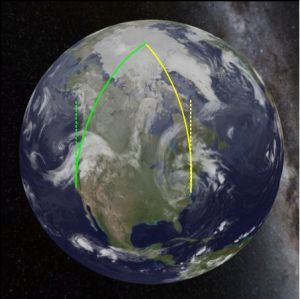
Side forceFor instance, suppose Fred and Ethel collaborate on a narwhale research project.  Fred is based in San Diego CA and Ethel works out of Norfolk VA. They fly to meet their research vessel at the North Pole. Fred’s plane follows the green track, Ethel’s plane follows the yellow one.  At the start of the trip, they’re on parallel paths going straight north (the dotted lines).  After a few hours, though, Ethel notices the two planes pulling closer together.

Ethel calls on her Newton knowledge to explain the phenomenon.  “It can’t be Earth’s gravity moving us together, because that force points down to Earth’s center and this is a sideways motion.  Our planes each weigh about 2000 kilograms and we’re still 2,000 kilometers apart.  By Newton’s F = G m1m2/r2 equation, the gravitational force between us should be (6.7×10⁻¹¹ N m2/kg2) x (2000 kg) x (2000 kg) / (2,000 m)2 = 6.7×10⁻¹¹ newtons, way too small to account for our speed of approach.  Both planes were electrically grounded when we fueled up, so we’re both carrying a neutral electric charge and it can’t be an electrostatic force.  If it were magnetic my compass would be going nuts and it’s not.  Woo-hoo, I’ve discovered a new kind of force!”

See what I did there?  Fred and Ethel would have stayed a constant distance apart if Earth were a cylinder.  Parallel lines running up a cylinder never meet.  But Earth is a sphere, not a cylinder.  Any pair of lines on a sphere must meet, sooner or later.  Ethel’s “sideways force” is a product of Geometry.

Sandy
Images extracted from NOAA’s SOS Explorer app, available from sos.noaa.gov

Hurricanes, too.  This video shows a day in the life of Hurricane Sandy.  Weather geeks will find several interesting details there, but for now just notice the centers of  counter-clockwise rotation (the one off the Florida coast is Sandy).  Storm centers in the Northern Hemisphere virtually always spin counterclockwise.  Funny thing is, in the Southern Hemisphere those centers go clockwise instead.

The difference has to do with angular momentum.  We could get all formal vector math here, but the easy way is to consider how fast the air is moving in different parts of the world.

We’ve all seen at least one ice show act where skaters form a spinning line. The last skater to join up (usually it’s a short girl) has to push like mad to catch the end of that moving line and everyone applauds her success. Meanwhile the tall girl at the center of the line is barely moving except to fend off dizziness.

YellowknifeThe line rotates as a unit — every skater completes a 360o rotation in the same time. Similarly, everywhere on Earth a day lasts for exactly 24 hours.

Skaters at the end of the line must skate faster than those further in because they have to cover a greater distance in the same amount of time.  The same geometry applies to Earth’s atmosphere.  The Earth is 25,000 miles around at the equator but only 12,500 miles around near the latitude of Whitehorse, Canada.  By and large, a blob of air at the equator must move twice as fast as a blob at 60o north.

chain 2Now suppose our speedy skater hits a slushy patch of ice.  Her end of the line is slowed down, so what happens to the rest of the line?  It deforms — there’s a new center of rotation that forces the entire line to curl around towards the slow spot.  Similarly, that blob near the Equator in the split-Earth diagram curls in the direction of the slower-moving air to its north, which is counter-clockwise.

In the Southern hemisphere, “slower” is southward and clockwise.

If not for Geometry (those differing circle sizes), we wouldn’t have hurricanes.  Or gravity — but that’s another story.

~~ Rich Olcott