Marconi Would Be Proud

A warmish Spring day.  I’m under a shady tree by the lake, waiting for the eclipse and doing some math on Old Reliable.  Suddenly there’s a text‑message window on its screen.  The header bar says 710‑555‑1701 . Old Reliable has never held a messaging app, that’s not what I use it for, but the set-up is familiar. I type in, Hello?

Hello, Mr Moire. Remember me?

Of course I do.  That sultry knowing stare, those pointed earsHello, Lieutenant Baird.  It’s been a year.  What can I do for you?

Not Lieutenant any more, I’m back up to Commander, Provisional.

Congratulations. Did you invent something again?

Yes, but I can’t discuss it on this channel. I owe you for the promotion. I got the idea from one of your Crazy Theories posts. You and your friends have no clue but you come up with interesting stuff anyway.

You’re welcome, I suppose. Mind you, your science is four centuries ahead of ours but we do the best we can.

I know that, Mr Moire. Which is why I’m sending you this private chuckle.

Private like with Ralphie’s anti‑gravity gadget? I suggested he add another monitoring device in between two of his components. That changed the configuration you warned me about. He’s still with us, no anti‑gravity, but now he blames me.

Good ploy. Sorry about the blaming. Now it’s your guy Vinnie who’s getting close to something.

Vinnie? He’s not the inventor type, except for those maps he’s done with his buddy Larry. What’s he hit on?

His speculation from your Quantum Field Theory discussion that entanglement is somehow involved with ripples in a QFT field, ripples that are too weak to register as a particle peak. He’s completely backwards on entanglement, but those ripples—

Wait, what’s that about entanglement?

Entanglement is the normal state for quantized particles. Our 24th‑Century science says every real and virtual particle in the Universe is entangled with every other particle that shares the same fields. It’s an all‑embracing quantum state. Forget your reductionist 20th‑Century‑style quantum states, this is something … different. Your Hugh Everett and his mentor John Archibald Wheeler had an inking of that fact a century before your time, though of course they didn’t properly understand the implications and drew a ridiculous conclusion. Anyway, when your experimenting physicists say they’ve created an entangled particle pair, they’ve simply extracted two particles from the common state. When they claim to transmit one of the particles somewhere they’re really damping out the local field peak linked to their particle’s anti‑particle’s anti‑peak at the distant location and that puts an anti‑anti‑particle‑particle peak there. Naturally, that happens nearly instantaneously.

I don’t follow the anti‑particle‑anti‑peak part. Or why it’s naturally instantaneous.

I didn’t expect you to or else I wouldn’t have told you about it. The Prime Directive, you know. Which is why the chuckle has to be private, understand?

I won’t tell. I live in “the city that knows how to keep its secrets,” remember?

Wouldn’t do you any good if you did tell and besides, Vinnie wouldn’t think it’s funny. Here’s the thing. As Vinnie guessed, there are indeed sub‑threshold ripples in all of the fundamental fields that support subatomic particles and the forces that work between them. And no, I won’t tell you how many fields, your Standard Model has quite enough complexity to <heh> perturb your physicists. A couple hundred years in your future, humanity’s going to learn how to manipulate the quarks that inhabit the protons and neutrons that make up a certain kind of atom. You’ll jiggle their fields and that’ll jiggle other fields. Pick the right fields and you get ripples that travel far away in space but very little in time, almost horizontal in Minkowski space. It won’t take long for you to start exploiting some of your purposely jiggled fields for communication purposes. Guess what a lovely anachronism you’ll use to name that capability.

‘Jiggled fields’ sounds like communications tech we use today based on the electromagnetic field — light waves traveling through glass fibers, microwave relays for voice and data—

You’re getting there. Go for the next longer wavelength range.

Radio? You’ll call it radio?

Subspace radio. Isn’t that wonderful?

~~ Rich Olcott
The Situation of The Gravity

<bomPAH-dadadadaDEEdah> It’s been a while since Old Reliable blared that unregistered ringtone. Sure enough, the phone function’s caller‑ID display says 710‑555‑1701.  “Commander Baird, I presume? Long time no hear.”

<downcast tone with a hint of desperation> “It’s Lieutenant now.”

“Sorry to hear that. What happened?”

Project Lonesome was a bust. It took us years to assemble those two planetoids but getting them into the right orbits around the black hole was more of a challenge than we planned for. Planetoid Pine got away from us and fell down through the Event Horizon. One big blast of inforon radiation and no more project. We lost a few robot space tugs but all carbon‑based personnel survived. Medical Bay just now pronounced me healthy — it’s amazing what they can do about pervasive sub‑cellular damage these days. The Board of Inquiry decided no‑one was at fault but they down‑ranked me because I was primary advocate for a jinxed project.”

“Well, those 15-minute orbits were a gamble all along. So why this phone call?”

“You know how it is, sitting in Med Bay with nothing much to do. I was poking around and happened to read a few of the files you’re working on—”

“Which ones?”

“The Projects directory.”

“But those are client files I’ve encrypted with the latest technology.”

“Oh, please, Mr Moire, I am calling from the 24th Century. Upton’s algorithm for zeta‑function decryption is ancient history. Don’t worry, your client’s secrets are safe, although one of your clients may not be.”

“Whoa, say what? Which one? What kind of danger? They all seem healthy, look both ways before crossing the street, that sort of thing.”

“One of those projects is extremely dangerous.”

“Which one? The biometrically‑lockable archery bow shouldn’t cause any problems. The electric yoga outfit? I triple‑checked the wiring and insulation specs, they’re safe and reliable. The robot rabbit? Surely not. Does this involve lethal spy‑craft of some sort? I try to avoid military work.”

“No, it’s the perpetual motion machine.”

“Ralphie’s project? Laws of Thermodynamics and all, I told him that’s just not going to work. He insisted I check his blueprints to make sure nothing’s going to blow up. I gave them a quick glance, didn’t see anything dicey.”

“It wouldn’t be obvious, especially not in view of your primitive science—”

“Hey!”

“No offense intended, Mr Moire, but it is primitive from my perspective. Two hundred years make a difference. Consider the state of Earth’s science in 1723 — Graham was still perfecting the pendulum clock.”

“Point taken, reluctantly. So what should I look for, and why?”

The Prime Directive applies across time periods, too, so I can’t go into detail with you. I’ll just say it’s not any one component, it’s the overall physical arrangement and what will happen when he powers up. Move the boxy bits closer together or further apart by two centimeters and the danger’s gone.”

“But what’s the danger? I can’t just tell him to reconfigure for no reason.”

“Directed gravity, Mr Moire, the sculpting of spacetime. It’s the reason we don’t need safety belts on a starship — we manufacture local gravity that always pulls toward the deck. In fact, directed gravity’s at the heart of warp drive technology. Cochrane stumbled on the effect accidentally but fortunately his lab was in a reinforced hard‑rock tunnel so damage was limited.”

“Anti-gravity? Oh, that’d be so cool. Flying cars at last, and sky‑cycles. Okay, there’d be problems and we’d need an AI-boosted Air Traffic Control agency. The military would be all over the idea. But all that’s way down the road, so to speak. I don’t understand how that puts Ralphie in immediate danger and why would a tunnel help?”

“Not anti-gravity, directed gravity. Gravity’s built into the structure of spacetime. Gravity can’t be blocked, but it can be shifted. The only way to weaken it in one location is to make it stronger somewhere else. Suppose Cochrane had first powered‑up his device on the ground in the open air. Depending on which way it was pointed, either he’d have been crushed between rising magma and down‑falling air, or…”

“I’ll tell Ralphie to re‑configure his gadget. Thanks for the warning.”

~~ Rich Olcott

  • Thanks, Alex, for inspiring this.

Breaking Up? Not So Hard

<transcript of smartphone dictation by Sy Moire, hard‑boiled physicist>
Day 173 of self‑isolation….
Perfect weather for a brisk solitary walk, taking the park route….
There’s the geese. No sign of Mr Feder, just as well….

Still thinking about Ms Baird and her plan for generating electric power from a black hole named Lonesome….
Can just hear Vinnie if I ever told him about this which I can’t….
“Hey, Sy, nothin’ gets out of a black hole except gravity, but she’s using Lonesome‘s magnetic field to generate electricity which is electromagnetic. How’s that happen?”
Good question….

Hhmph, that’s one angry squirrel….
Ah, a couple of crows pecking the ground under its tree. Maybe they’re too close to its acorn stash….

We know a black hole’s only measurable properties are its mass, charge and spin….
And maybe its temperature, thanks to Stephen Hawking….
Its charge is static — hah! cute pun — wouldn’t support continuous electrical generation….
The Event Horizon hides everything inside — we can’t tell if charge moves around in there or even if it’s matter or anti‑matter or something else….
The no‑hair theorem says there’s no landmarks or anything sticking out of the Event Horizon so how do we know the thing’s even spinning?

Ah, we know a black hole’s external structures — the jets, the Ergosphere belt and the accretion disk — rotate because we see red- and blue-shifted radiation from them….
The Ergosphere rotates in lockstep with Lonesome‘s contents because of gravitational frame-dragging….
Probably the disk and the jets do, too, but that’s only a strong maybe….
But why should the Ergosphere’s rotation generate a magnetic field?

How about Newt Barnes’ double‑wheel idea — a belt of charged light‑weight particles inside a belt of opposite‑charged heavy particles all embedded in the Ergosphere and orbiting at the black hole’s spin rate….
Could such a thing exist? Can simple particle collisions really split the charges apart like that?….

OK, fun problem for strolling mental arithmetic. Astronomical “dust” particles are about the size of smoke particles and those are about a micrometer across which is 10‑6 meter so the volume’s about (10‑6)3=10‑18 cubic meter and the density’s sorta close to water at 1 gram per cubic centimeter or a thousand kilograms per cubic meter so the particle mass is about 10‑18×103=10‑15 kilogram. If a that‑size particle collided with something and released just enough kinetic energy to knock off an electron, how fast was it going?

Ionization energy for a hydrogen atom is 13 electronvolts, so let’s go for a collision energy of at least 10 eV. Good old kinetic energy formula is E=½mv² but that’s got to be in joules if we want a speed in meters per second so 10 eV is, lemme think, about 2×10‑18 joules/particle. So is 2×2×10‑18/10‑15 which is 4×10‑3 or 40×10‑4, square root of 40 is about 6, so v is about 6×10‑2 or 0.06 meters per second. How’s that compare with typical speeds near Lonesome?

Ms Baird said that Lonesome‘s mass is 1.5 Solar masses and it’s isolated from external gravity and electromagnetic fields. So anything near it is in orbit and we can use the circular orbit formula v²=GM/r….
Dang, don’t remember values for G or M. Have to cheat and look up the Sun’s GM product on Old Reliable….
Ah-hah, 1.3×10²⁰ meters³/second so Lonesome‘s is also near 1020….
A solar‑mass black hole’s half‑diameter is about 3 kilometers so Lonesome‘s would be about 5×10³ meters. Say we’re orbiting at twice that so r‘s around 104 meters. Put it together we get v2=1020/104=1016 so v=108 meters/sec….
Everything’s going a billion times faster than 10 eV….
So yeah, no problem getting charged dust particles out there next to Lonesome….

Just look at the color in that tree…
Weird when you think about it. The really good color is summertime chlorophyll green when the trees are soaking up sunlight and turning CO2 into oxygen for us but people get excited about dying leaves that are red or yellow…

Well, now. Lonesome‘s Event Horizon is the no-going-back point on the way to its central singularity which we call infinity because its physics are beyond anything we know. I’ve just closed out another decade of my life, another Event Horizon on my own one‑way path to a singularity…

Hey! Mr Feder! Come ask me a question to get me out of this mood.

Author’s note — Yes, ambient radiation in Lonesome‘s immediate vicinity probably would account for far more ionization than physical impact, but this was a nice exercise in estimation and playing with exponents and applied physical principles.

~~ Rich Olcott

Engineering A Black Hole

<bomPAH-dadadadaDEEdah> That weird ringtone on Old Reliable again. Sure enough, the phone function’s caller-ID display says 710‑555‑1701.  “Ms Baird, I presume?”

A computerish voice, aggressive but feminine, with a hint of desperation. “Commander Baird will be with you shortly, Mr Moire. Please hold.”

A moment later, “Hello, Mr Moire.”

“Ms Baird. Congratulations on the promotion.”

“Thank you, Mr Moire. I owe you for that.”

“How so?”

“Your posts about phase-based weaponry got me thinking. I assembled a team, we demonstrated a proof of concept and now Federation ships are being equipped with the Baird‑Prymaat ShieldSaw. Works a treat on Klingon and Romulan shielding. So thank you.”

“My pleasure. Where are you now?”

“I’m on a research ship called the Invigilator. We’re orbiting black hole number 77203 in our catalog. We call it ‘Lonesome‘.”

“Why that name?”

“Because there’s so little other matter in the space nearby. The poor thing barely has an accretion disk.”

“Sounds boring.”

“No, it’s exciting, because it’s so close to a theoretical ideal. It’s like the perfectly flat plane and the frictionless pulley — in real life there are always irregularities that the simple equations can’t account for. For black holes, our only complete solutions assume that the collapsed star is floating in an empty Universe with no impinging gravitational or electromagnetic fields. That doesn’t happen, of course, but Lonesome comes close.”

“But if we understand the theoretical cases and it nearly matches one, why bother with it at all?”

“Engineering reasons.”

“You’re engineering a black hole?”

“In a way, yes. Or at least that’s what we’re working on. We think we have a way to extract power from a black hole. It’ll supply inexhaustible cheap energy for a new Star Fleet anti‑matter factory. “

“I thought the only thing that could escape a black hole’s Event Horizon was Hawking radiation, and it cheats.”

“Gravity escapes honestly. Its intense field generates some unexpected effects. Your physicist Roger Penrose used gravity to explain the polar jets that decorate so many compact objects including black holes. He calculated that if a comet or an atom or something else breakable shatters when it falls into a spinning compact object’s gravitational field, some pieces would be trapped there but under the right conditions other pieces would slingshot outward with more energy than they had going in. In effect, the extra energy would come from the compact object’s angular momentum.”

“And that’s what you’re planning to do? How are you going to trap the expelled pieces?”

“No, that’s not what we’re planning. Too random to be controlled with our current containment field technology. We’re going pure electromagnetic, turning Lonesome into a giant motor‑generator. We know it has a stable magnetic field and it’s spinning rapidly. We’ll start by giving Lonesome some close company. There’s enough junk in its accretion disk for several Neptune‑sized planets. The plan is to use space tugs to haul in the big stuff and Bussard technology for the dust, all to assemble a pair of Ceres-sized planetoids. W’re calling them Pine and Road. We’ll park them in a convenient equatorial orbit in a Lagrange‑stable configuration so Pine, Road and Lonesome stay in a straight line.”

“Someone’s been doing research on old cinema.”

“The Interstellar Movie Database. Anyhow, when the planetoids are out there we string conducting tractor beams between them. If we locate Pine and Road properly, Lonesome’s rotating magnetic field lines will cross the fields at right angles and induce a steady electric current. Power for the anti‑matter synthesizers.”

“Ah, so like Penrose’s process you’re going to drain off some of Lonesome‘s rotational kinetic energy. Won’t it run out?”

Lonesome‘s mass is half again heavier than your Sun’s, Mr Moire. It’ll spin for a long, long time.”

“Umm … that ‘convenient orbit.’ Lonesome‘s diameter is so small that orbits will be pretty speedy. <calculating quickly with Old Reliable> Even 200 million kilometers away you’d circle Lonesome in less than 15 minutes. Will the magnetic field that far out be strong enough for your purposes?”

“Almost certainly so, but the gravimagnetodynamic equations don’t have exact solutions. We’re not going to know until we get there.”

“That’s how research works, all right. Good luck.”

~~ Rich Olcott

Rhythm Method

A warm Summer day.  I’m under a shady tree by the lake, watching the geese and doing some math on Old Reliable.  Suddenly a text-message window opens up on its screen.  The header bar says 710-555-1701.  Old Reliable has never held a messaging app, that’s not what I use it for.  The whole thing doesn’t add up.  I type in, Hello?

Hello, Mr Moire.  Remember me?

Suddenly I do.  That sultry knowing stare, those pointed ears.  It’s been a yearHello, Ms Baird.  What can I do for you?

Another tip for you, Mr Moire.  One of my favorite star systems — the view as you approach it at near-lightspeed is so ... meaningful.  Your astronomers call it PSR J0337+1715.

So of course I head over to Al’s coffee shop after erasing everything but that astronomical designation.  As I hoped, Cathleen and a few of her astronomy students are on their mid-morning break.  Cathleen winces a little when she sees me coming.  “Now what, Sy?  You’re going to ask about blazars and neutrinos?”

I show her Old Reliable’s screen.  “Afraid not, Cathleen, I’ll have to save that for later.  I just got a message about this star system.  Recognize it?”

“Why, Sy, is that a clue or something?  And why is the lettering in orange?”

“Long story.  But what can you tell me about this star system?”

“Well, it’s probably one of the most compact multi-component systems we’re ever going to run across.  You know what compact objects are?”

“Sure.  When a star the size of our Sun exhausts most of its hydrogen fuel, gravity wins its battle against heat.  The star collapses down to a white dwarf, a Sun-full of mass packed into a planet-size body.  If the star’s a bit bigger it collapses even further, down to a neutron star just a few miles across.  The next step would be a black hole, but that’s not really a star, is it?”

“No, it’s not.  Jim, why not?”

“Because by definition a black hole doesn’t emit light.  A black hole’s accretion disk or polar jets might, but not the object itself.”

“Mm-hm.  Sy, your ‘object’ is actually three compact objects orbiting  around each other.  There’s a neutron star with a white dwarf going around it, and another white dwarf swinging around the pair of them.  Vivian, does that sound familiar?”

“That’s a three-body system, like the Moon going around the Earth and both going around the Sun.  Mmm, except really both white dwarfs would go around the neutron star because it’s heaviest and we can calculate the motion like we do the Solar System.”

“Not quite.  We can treat the Sun as motionless because it has 99% of the mass.  J0337+1715’s neutron star doesn’t dominate its system as much as the Sun does ours.  That outermost dwarf has 20% of its system’s mass.  Phil, what does that suggest to you?”

“It’d be like Pluto and Charon.  Charon’s got 10% of their combined mass and so Pluto and Charon both orbit a point 10% of the way out from Pluto.  From Earth we see Pluto wobbling side to side around that point.  So the neutron star must wobble around the point 20% outward towards the heavy dwarf.  Hey, star-wobble is how we find exoplanets.  Is that what this is about, Mr Moire?  Did someone measure its red-shift behavior?”PSR J0337+1715Cathleen saves me from answering.  “Not quite.  The study Sy’s chasing is actually a cute variation on red-shift measurements.  That ‘PSR‘ designation means the neutron star is a pulsar.  Those things emit electromagnetic radiation pulses with astounding precision, generally regular within a few dozen nanoseconds.  If we receive slowed-down pulses then the object’s going away; sped-up and it’s approaching, just like with red-shifting.  The researchers  derived orbital parameters for all three bodies from the between-pulse durations.  The heavy dwarf is 200 times further out than the light one, for instance.  Not an easy experiment, but it yielded an important result.”

My ears perk up.  “Which was…?”

“The gravitational force between the pulsar and each dwarf was within six parts per million of what Newton’s Laws prescribe.  That observation rules out whole classes of theories that tried to explain galaxies and galaxy clusters without invoking dark matter.”

Cool, huh?

Uh-huh.

~~ Rich Olcott

Twinkle, Twinkle, Tabby’s Star

Al was carrying his coffee pot past our table.  “Refills?  Hey, I heard you guys talking about Tabby’s Star.  Have you seen the latest?”

“Ohmigawd, there’s more?”

“Yeah, Cathleen.  They’ve finally found something that’s periodic.”

“Catch us up, Al.  Cathleen said that the dimmings are irregular.”

“They’ve been, Sy.  But remember Cathleen’s chart that showed big dips in 2011 and 2013, about 750 days apart?  Well, guess what?”

“They’ve seen more dips at 750-day intervals, in 2015 and 2017.”

“Well, not quite.  Nobody was looking in 2015.  But Kickstarter funding let the team buy observing time in 2017.  A dip came in right on schedule.  Here’s the picture. [shows smartphone around]”

WTF 2017 peak after day 5
Visible-light photometry of Tabby’s Star
14-28 May 2017
Image from Dr Boyajian’s blog

Cathleen snorted.  “Damn shame we need crowd-funding to support Science these days.”

“True,” I agreed, “but the good news is that the support is there.  Suddenly you’re scribbling on the back of that envelope.  So what does this chart tell us?”

“I’m sure every astronomer out there will tell you, ‘It’s too soon to say anything for sure.‘  This is raw data, which means it’s hasn’t gone through the usual clean-up process to account for instrumental issues, long-term trending, things like that.  The timing is great, though.  The bottom of this dip is at 18May2017.  The first dip bottomed out 2267 days earlier on 4March2011.  Counting the 2015 case that no-one saw, there’d be three intervals from first to most recent.  2267÷3 makes the average 756 days.  Add 756 to the first date and we’re at 28Mar2013, right in the midst of that year’s complex mess.  It does fit together.”

“So whatever’s causing it has a 756-day orbit?”

“Could be.  I know your next question.  If the eclipsing material were in our Solar System, it’d be a bit outside the 687-day orbit of Mars.  But we’ve already ruled out causes near our solar system.  Tabby’s Star is about 1½ times our Sun’s mass.  That 756-day orbit around Tabby, if it is one, is maybe 30% wider than the orbit of Mars.  But.”

[both] “But?”

“But the dip profiles don’t match up from one cycle to the next.  This dip’s only 2% or so, a tenth of the ones in 2011 and 2013.  Of course, the 2013 event spanned multiple dips so Heaven knows which one we should match to.  Even 2011 and 2017 don’t look the same.  The usual quick-and-dirty way to compare dips is to pair up widths at half depth.  That statistic for 2011 is about a day.  This one is twice that or more.  If the absorber is orbiting the star, it’s changing shape and can’t be a planet.”Tabby in orbit
“So what do we got, Sy?”

“Damifino, Al.  Everything Cathleen just told us points to something like an enormous comet loaded with loose rocks that go flying along random paths away from the star.”

“Sorry, Sy, the infrared data rules out the comet dust that would have to be spewed out along with the rocks.  Besides, someone calculated just how much rocky material would be required to reproduce the dimming we’ve seen already.  You’d need a ‘comet’ somewhere between Earth-size and Jupiter-size, and maybe more than one, and with that much mass the rocks wouldn’t fly apart very well.  Oh, and there’s that long-term fading, which the comet idea doesn’t account for.”

“So we’re down to…”

[sigh] “The explanation of last resort, which astronomers are very reluctant to talk about because journalists tend to go overboard.  Maybe, just maybe, we’re witnessing an advanced civilization at work, constructing a Dyson sphere around a star 1500 light years away.  People have talked about such things for decades.  Think about it — the Sun sends out light in all directions.  Earth intercepts only a billionth of that.  If we could completely surround the Sun with solar panels we’d have access to a billion times more energy than if we covered our own planet with panels.  Better yet, it’s all renewable and producing 24 hours a day.  But even with advanced technology, panels around Tabby’s Star would still radiate in the infrared and we don’t see that.”

My smartphone chirped that same odd ringtone and it was that same odd number, 710-555-1701. “Hello, Ms Baird.”

“The Universe is not only stranger than you imagine, Mr Moire, it’s stranger than you can imagine.”

~~ Rich Olcott

The Weirdest, And Naughtiest, Star in The Galaxy

It was an interesting ringtone — aggressive but feminine, with a hint of desperation.  And it was a ringtone I hadn’t programmed into my phone.  The number was intriguing, too — 710-555-1701.  It didn’t add up, so I answered the ring. “Moire here.”

“Hello, Mr Moire, this is Victoria Baird.”

It’s been a long time, Ms Baird.  What can I do for you?”  Her voice and the memory of her pointed ears sent chills down my spine.

“This time it’s what I can do for you, Mr Moire.  Here’s a tip — Tabby’s star.”  I could hear the italics.  I wanted to ask questions but the line went dead.

Considering the context, I called my Astronomy Department source.  “Morning, Cathleen.  It’s break time, can I buy you some of Al’s coffee and a scone?”

“You’re going to ask me questions, aren’t you?  What am I going to have to bone up on?  I know, it’s Tabby’s Star, right?”

“Got it in one, Cathleen.  Meet you at Al’s?”

“Yeah, give me 15 minutes.”Tabbystar 400

A quarter-hour later we had a table, two mugs of coffee and a plate of scones in front of us.  “So how’d you know I’d be asking about Tabby’s star?  And what is it?  And who is Tabby?”

“Tabby is Tabetha (she spells it with an ‘e’) Boyajian, PhD.  She teaches Astronomy at Louisiana State, does research specializing in high-precision star measurement.  In her spare time she manages a citizen-scientist project called Planet Hunters.  The Hunters get their kicks combing through databases from the Kepler satellite telescope.  They get all excited if the records indicate that a star’s been transited.”

“Oh, like that star-dimming that found the TRAPPIST-1 planets?”

“Exactly.  I think they’ve got over a hundred candidate planetary systems and a couple-dozen confirmed ones to their credit by now.  Anyhow, 2012 was a banner year for them, ’cause they raised an alert on what’s now being called the weirdest star in the galaxy.”

“Which would be Tabby’s Star.  Got it.  But what’s weird about it?”

“Poets like to write about ‘the constant stars.’  This star is world-champion not-constant.  You know how stars seem to flicker when you look at them?”

“Yeah, that’s how I tell them apart from planets.”

“Then you know that the flickering comes from starlight getting messed up going through our turbulent atmosphere.  Astronauts don’t see the flickering.  Neither does Kepler up there, so it can reliably detect miniscule variations in a star’s output.  Virtually all of the 150,000 stars it tracked for four years had rock-steady production.  A few of them occasionally dimmed or flared by maybe a percent, but Tabby’s Star (formally known as KIC 8462852) got the Hunters’ attention when it dimmed by 16%.”

“Twenty times a normal dimming!  Did it stay that way or did the light come back up again?”

“Oh, it came back all right, but the curve on the way up didn’t match the curve on the way down.  That was even weirder.  So the team scoured through the star’s 4-year record and found a dozen events on the 0.05-2% scale, plus one at 8% and another at 21%.”

“21%?  That’s a big shadow.”

“Ya think?  Especially since the between-event timing was seriously irregular and some of those events were complex with three or more separate components.  But that’s not all the weirdness. Those dips lasted for hours or even days, longer than most planetary transits.  After Boyajian and her 48 collaborators published their initial report, which has to have one of the naughtiest titles in the astronomical literature, some other —”

“Wait, a naughty title?  C’mon, don’t tease.”

“OK <sigh>.  The technical term for a star’s light output is flux.  That paper was half about the observations and half about what might be causing the variation.  Assuming the star’s real output is constant, the question becomes, ‘What happened to that missing light?‘  Or as the authors put it, ‘Where’s The Flux?‘  Since then both the paper and the star have been informally referred to as WTF.  OK?”

“OK <sigh>.  So you were saying there’s something else.”

“Yeah.  Some other astronomers went digging in the archives.  WTF has been dimming gradually for at least the past 100 years.  Weird, eh?”

“Yeah.  So what’s causing it?”

“We don’t even have good guesses.”

~~ Rich Olcott

A Defective Story

It was an interesting knock at my office door — aggressive but feminine, with a hint of desperation.

“C’mon in, the door’s open.”

She wore a business suit that must have cost a month’s rent.  It fit her like it had been sewn on, and she had all the right sizes.  There was a button missing from the left sleeve.  On the other hand her left lapel bore a Star Trek badge, Security Section.

“What can I do for you, Miss…?”

“My name’s Victoria Baird, Mr Moire.  I’m CEO of ADastra, ‘media relations for the stars.’  I’ve been reading your posts, put two and two together, and thought I’d better drop in.”

“Well, it’s nice to know I’ve got readers.  Which posts caught your attention?”

“Several of them, but mostly this one,” pointing to a Web page on her smartphone.  It was my Breathing Space video.  “You show how gravitational waves fluctuate as they polarize local space.  They induce varying curvatures in different directions.  Curved space is mass, Mr Moire, but this curvature moves at lightspeed.  Hadn’t you noticed that?”

“It crossed my mind, yes, but when I thought about surfing a gravitational wave like ocean surfers do, I realized you’d have to get up to the wave’s speed to ride it.”

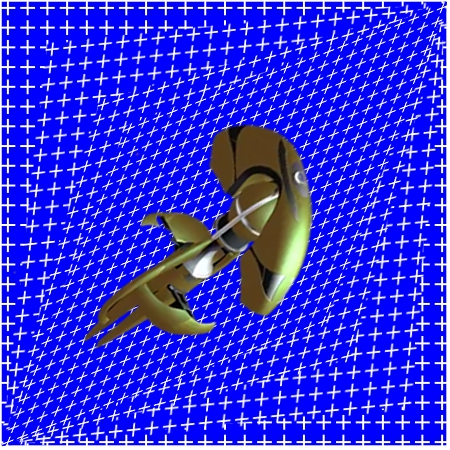
jellyfish-starcraft
Spock’s Jellyfish starcraft,
as seen in the 2009 Star Trek film
(image from the video by Rob Morey)

“There’s more.  Are you familiar with that one-man starcraft that Ambassador Spock used in the 2009 Star Trek film?  The ship with the rotating after-section?”

“I did see ‘Baby Star Trek,’ yes.”

“Did you know that the starcraft’s official design designation is Jellyfish?”

“No, I hadn’t heard that.”

“Well, it is.  And you’ve written about Earth jellyfish, haven’t you, Mr Moire, and how their propulsion system is so efficient?”

I was getting a little tired of her aggressive questions, so I challenged her with one of my own.  “And you see a connection?”

“I do, and that’s why you have to help me, Mr Moire.  Can I trust you?”

“Secrets are my business, Miss Baird.  Uncovering them or covering them up, it’s all the same to me.”

“Maybe I need to let my hair down.”  She removed her cloche cap and her pointed ears sprang free.  “I need you to get me back to my crew.”

“Can’t you just call them on that communicator badge?”

“This is costume jewelry.  The spectrum here on Earth is so crowded that my real badge is useless at long range.  I’ve been looking for subtle signals in the media.  I thought your posts were just such a signal … but I can see you’re a local.”

“Guilty as charged.  I take it the connection you saw resembled the signal you sought?”

“Yes.  You’ve published two of the essential principles of the LaForge Drive.  The first was your displays of spatial curvature in motion.  The second was your description of how jellyfish move by stepping along a ladder of seawater vortices.

jellyfish-2“That’s what the LaForge Drive does, Mr Moire.  The counter-rotating blades are an osmium-hassium alloy, the densest substance known, and under tremendous compression.  Together their mass creates a complex pilot wave in the gravity field.  The spacecraft surfs on that waveform the way a jellyfish surfs on the eddies it creates.

“The wave’s phase velocity exceeds lightspeed by some enormous factor we’ve never been able to measure.  In fact, I’m here on Earth because I was on a research cruise to find if there’s a limit.  We … ran into a problem and I’m part of an away team sent to procure … something we need.”

“That trope’s been done to death, Miss Baird.  And besides, that design wouldn’t be practical.  What’s your real story?”

“What do you mean it’s not practical?”

“You can’t steer.  Pilot waves follow the most intense local spatial curvature, which means the craft will always home like a torpedo on the nearest large mass.”

Suddenly that badge chirped.  “We’ve recovered the detonator, Lieutenant.  Have you kept him from looking out the window?”

“Yes, his eyes have been on me the whole time.  Ready for beam-up.  Goodbye, Mr Moire, that was fun.”

Her form began to shimmer, twinkle … and disappeared.

“Don’t mention it.”

~~ Rich Olcott