Sisyphus on A Sand Dune

I’m walking the park’s paths on a lovely early Spring day when, “There you are, Moire. I got a question!”

“As you always do, Mr Feder. What’s your question this time?”

“OK, this guy’s saying that life is all about fighting entropy but entropy always increases anyway. I seen nothing in the news about us fighting entropy so where’s he get that? Why even bother if we’re gonna lose anyway? Where’s it coming from? Can we plug the holes?”

“That’s 4½ questions with a lot of other stuff hiding behind them. You’re going to owe me pizza at Eddie’s AND a double-dip gelato.”

“You drive a hard bargain, Moire, but you’re on.”

“Deal. Let’s start by clearing away some underbrush. You seem to have the idea that entropy’s a thing, like water, that it flows around and somehow seeps into our Universe. None of that’s true.”

“That makes no sense. How can what we’ve got here increase if it doesn’t come from somewhere?”

“Ah, I see the problem — conservation. Physicists say there are two kinds of quantities in the Universe — conserved and non‑conserved. The number of cards in a deck is is a conserved quantity because it’s always 52, right?”

“Unless you’re in a game with Eddie.”

“You’ve learned that lesson, too, eh? With Eddie the system’s not closed because he occasionally adds or removes a card. Unless we catch him at it and that’s when the shouting starts. So — cards are non-conserved if Eddie’s in the game. Anyway, energy’s a conserved quantity. We can change energy from one form to another but we can’t create or extinguish energy, OK?”

“I heard about that. Sure would be nice if we could, though — electricity outta nothing would save the planet.”

“It would certainly help, and so would making discarded plastic just disappear. Unfortunately, mass is another conserved quantity unless you’re doing subatomic stuff. Physicists have searched for other conserved quantities because they make calculations simpler. Momentum‘s one, if you’re careful how you define it. There’s about a dozen more. The mass of water coming out of a pipe exactly matches the mass that went in.”

“What if the pipe leaks?”

“Doesn’t matter where the water comes out. If you measure the leaked mass and the mass at the pipe’s designed exit point the total outflow equals the inflow. But that gets me to the next bit of underbrush. Energy’s conserved, that’s one of our bedrock rules, but energy always leaks and that’s another bedrock rule. The same rule also says that matter always breaks into smaller pieces if you give it a chance though that’s harder to calculate. We measure both leakages as entropy. Wherever you look, any process that converts energy or matter from one form to another diverts some fraction into bits of matter in random motion and that’s an increase of entropy. One kind of entropy, anyway.”

“Fine, but what’s all this got to do with life?”

“It’s all to get us to where we can talk about entropy in context. You’re alive, right?”

“Last I looked.”

“Ever break a bone?”

<taps his arm> “Sure, hasn’t everybody one time or another?”

“Healed up pretty well, I see. Congratulations. Right after the break that arm could have gone in lots of directions it’s not supposed to — a high entropy situation. So you wore a cast while your bone cells worked hard to knit you together again and lower that entropy. Meanwhile, the rest of your body kept those cells supplied with energy and swept away waste products. You see my point?”

“So what you’re saying is that mending a broken part uses up energy and creates entropy somewhere even though the broken part is less random. I got that.”

“Oh, it goes deeper than that. If you could tag one molecule inside a living cell you’d see it bouncing all over the place until it happens to move where something grabs it to do something useful. Entropy pushes towards chaos, but the cell’s pattern of organized activity keeps chaos in check. Like picnicking on a windy day — only constant vigilance maintains order. That’s the battle.”

“Hey, lookit, Eddie’s ain’t open. I’ll owe you.”

“Pizza AND double-dip gelato.”
~~ Rich Olcott

Presbyopic Astronomy

Her phone call done, Cathleen returns to the Spitzer Memorial Symposium microphone with her face all happiness. “Good news! Jim, the grant came through. Your computer time and telescope access are funded. Woo-hoo!!”

<applause across the audience and Jim grins and blushes>

Cathleen still owns the mic. “So I need to finish up this overview of Spitzer highlights. Where was I?”

Maybe-an-Art-major tries to help. “The middle ground of our Universe.”

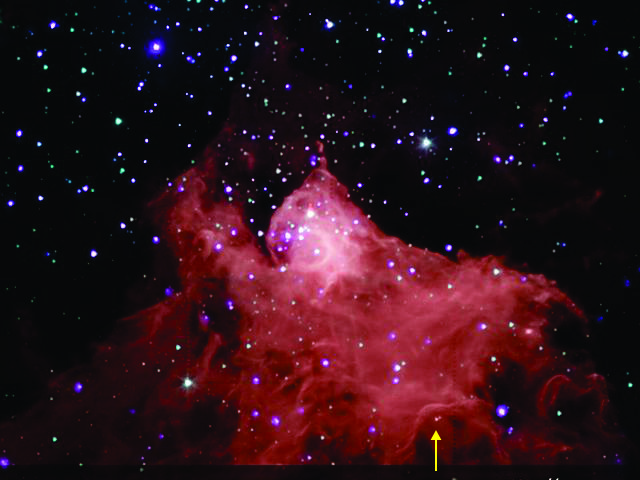
“Ah yes, thanks. So we’ve looked at close-by stars but Spitzer showed us a few more surprises lurking in the Milky Way. This, for instance — most of the image is colorized from the infra‑red, but if you look close you can see Chandra‘s X‑ray view, colorized purple to highlight young stars.”

The Cepheus-B molecular cloud
X-ray: NASA/CXC/PSU/K. Getman et al.; IRL NASA/JPL-Caltech/CfA/J. Wang et al

<hushed general “oooo” from the audience>

“Giant molecular clouds like this are scattered throughout the Milky Way, mostly in the galaxy’s spiral arms. As you see, this cloud’s not uniform, it has clumps and voids. By Earth standards the cloud is still a pretty good vacuum. The clumps are about 10-15 of our atmosphere’s density, but that’s still a million times more dense than our Solar System’s interplanetary space. The clumps appear to be where new stars are born. The photons and other particles from a newly-lit star drive the surrounding dust away. My arrow points to one star with a particularly nice example of that — see the C-shape around the star?”

The maybe-an-Art-major pipes up. “How about that one just a little below center?”

“Uh-huh. There’s so much activity in that dense region that the separate shockwaves collide to create hot spots that’ll generate even more stars in the future. The clouds are mostly held together by their own gravity. They last for tens of millions of years, so we think of them as huge roiling stellar nurseries.”

“Like my kid’s day care center but bigger.”

“Mm-mm, but let’s turn to the Milky Way’s center, home of that famous black hole with the mass of four million Suns and this remarkable structure, a double-helix of warm dust.”

False-color infra-red image of the Double-Helix Nebula
The double helix nebula.
Credit: NASA/JPL-Caltech/M. Morris (UCLA)

Vinnie blurts out, “That’s a jet from a black hole! One of Newt’s babies.”

Newt can’t resist breaking into Cathleen’s pitch. “Maybe it’s a jet, Vinnie. Yes, it’s above the central galactic plane and perpendicular to it, but the helix doesn’t quite point to the central black hole.”

“So take another picture that follows it down.”

“We’d love to, but we can’t. Yet. That image came from a long-wavelength instrument that only operated during Spitzer‘s initial 5-year cold period. Believe me, there are bunches of astronomers who can’t wait for the James Webb Space Telescope‘s far-IR instruments to get into position and start doing science. Meanwhile, we’ve got just the one image and a few earlier ones from an even less-capable spacecraft. This thing may be a lit-up part of a longer structure that twists down to the black hole or at least its accretion disk. We just don’t know.”

Cathleen takes control again. “The next image comes from outside our galaxy — far outside.”

Spitzer visualization of Galaxy MACS 1149-JD1
Credit: NASA/ESA/STScI/W. Zheng (JHU), and the CLASH team

The maybe-an-Art-major snorts, “Pointillism derivative!”

“No, it’s pixels from a starfield image with a very low signal-to-noise ratio. That red blotch in the center is one of the most distant objects ever observed, gracefully named MACS 1149-JD1. It’s a galaxy 13.2 billion lightyears away. That’s so far away that the expansion of the Universe has stretched the galaxy’s emitted photons by a factor of 10.2. Spectrum-wise, 1149-JD1’s ultra-violet light skipped right past the visible range and down into the near infra-red. Intensity-wise, that galaxy’s about 5200 times further away than the Andromeda galaxy. Assuming the two are about the same overall brightness, 1149-JD1 would be about 27 million times fainter than Andromeda.”

“How can we even see anything that dim?”

“We couldn’t, except for a fortunate coincidence. Right in line between us and 1149-JD1 there’s a massive galaxy cluster whose gravity acts like a lens to focus 1149-JD1’s light.”

The seminar’s final words, from maybe-an-Art-major — “A distant light, indeed.”

~~ Rich Olcott

Myopic Astronomy

Cathleen goes into full-on professor mode. “OK folks, settle down for the final portion of “IR, Spitzer and The Universe,” our memorial symposium for the Spitzer Space Telescope which NASA retired on January 30. Jim’s brought us up to speed about what infra-red is and how we work with it. Newt’s given us background on the Spitzer and its fellow Great Observatories. Now it’s my turn to show some of what Astronomy has learned from Spitzer. Thousands of papers have been published from Spitzer data so I’ll just skim a few highlights, from the Solar System, the Milky Way, and the cosmological distance.”

“Ah, Chinese landscape perspective,” murmurs the maybe-an-Art-major.

“Care to expand on that?” Cathleen’s a seasoned teacher, knows how to maintain audience engagement by accepting interruptions and then using them to further her her own presentation.

“You show detail views of the foreground, the middle distance and the far distance, maybe with clouds or something separating them to emphasize the in‑between gaps.”

“Yes, that’s my plan. Astronomically, the foreground would be the asteroids that come closer to the Earth than the Moon does. Typically they reflect about as much light as charcoal so our visible-light telescopes mostly can’t find them. But even though asteroids are as cold as interplanetary space that’s still above absolute zero. The objects glow with infra-red light that Spitzer was designed to see. It found hundreds of Near-Earth Objects as small as 6 meters across. That data helped spark disaster movies and even official conversations about defending us from asteroid collisions.”

<A clique in the back of the room> “Hoo-ahh, Space Force!

Some interruptions she doesn’t accept. “Pipe down back there! Right, so further out in the Solar System, Spitzer‘s ability to detect glowing dust was key to discovering a weird new ring around Saturn. Thanks to centuries of visible‑range telescope work, everyone knows the picture of Saturn and its ring system. The rings together form an annulus, an extremely thin circular disk with a big round hole in the middle. The annulus is bright because it’s mostly made of ice particles. The annulus rotates to match Saturn’s spin. The planet’s rotational axis and the annulus are both tilted by about 27° relative to Saturn’s orbit. None of that applies to what Spitzer found.”

Vinnie’s voice rings out. “It’s made of dust instead of ice, right ?”

Cathleen recognizes that voice. “Good shot, Vinnie, but the differences don’t stop there. The dust ring is less a disk than a doughnut, about 200 thousand times thicker than the icy rings and about 125 times wider than the outermost ice ring. But the weirdest part is that the doughnut rotates opposite to the planet and it’s in Saturn’s orbital plane, not tilted to it. It’s like the formation’s only accidentally related to Saturn. In fact, we believe that the doughnut and its companion moon Phoebe came late to Saturn from somewhere else.”

She takes a moment for a sip of coffee. “Now for the middle distance, which for our purpose is the stars of the Milky Way. Spitzer snared a few headliners out there, like TRAPPIST-1, that star with seven planets going around it. Visible-range brightness monitoring suggested there was a solar system there but Spitzer actually detected light from individual planets. Then there’s Tabby’s Star with its weird dimming patterns. Spitzer tracked the star’s infra‑red radiance while NASA’s Swift Observatory tracked the star’s emissions in the ultra‑violet range. The dimming percentages didn’t match, which ruled out darkening due to something opaque like an alien construction project. Thanks to Spitzer we’re pretty sure the variation’s just patchy dust clouds.”

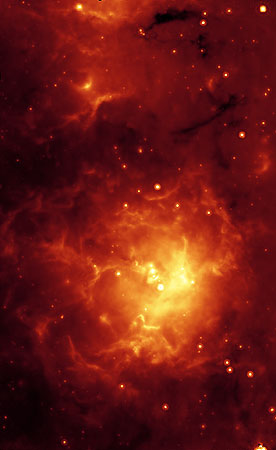
Spitzer view of the Trifid Nebula
Credit: NASA/JPL-Caltech/J. Rho (SSC/Caltech)

<from the crowd in general> “Awww.”

“I know, right? Anyway, Spitzer‘s real specialty is inspecting warm dust, so no surprise, it found lots of baby stars embedded in their dusty matrix. Here’s an example. This image contains 30 massive stars and about 120 smaller ones. Each one has grown by eating the dust in its immediate vicinity and having lit up it’s now blowing a bubble in the adjacent dust.” <suddenly her cellphone rings> “Oh, sorry, this is a call I’ve got to take. Talk among yourselves, I’ll be right back.”

~~ Rich Olcott

The Fourth Brother’s Quest

Newt Barnes is an informed and enthusiastic speaker in Cathleen’s “IR, Spitzer and the Universe” memorial symposium. Unfortunately Al interrupts him by bustling in to refresh the coffee urn.

After the noise subsides, Newt picks up his story. “As I was saying, it’s time for the Spitzer‘s inspirational life story. Mind you, Spitzer was designed to inspect very faint infra-red sources, which means that it looks at heat, which means that its telescope and all of its instruments have to be kept cold. Very cold. At lift-off time, Spitzer was loaded with 360 liters of liquid helium coolant, enough to keep it below five Kelvins for 2½ years.”

“Kelvins?”

“Absolute temperature. That’d be -268°C or -450°F. Very cold. The good news was that clever NASA engineers managed to stretch that coolant supply an extra 2½ years so Spitzer gave us more than five years of full-spectrum IR data.”

<mild applause>

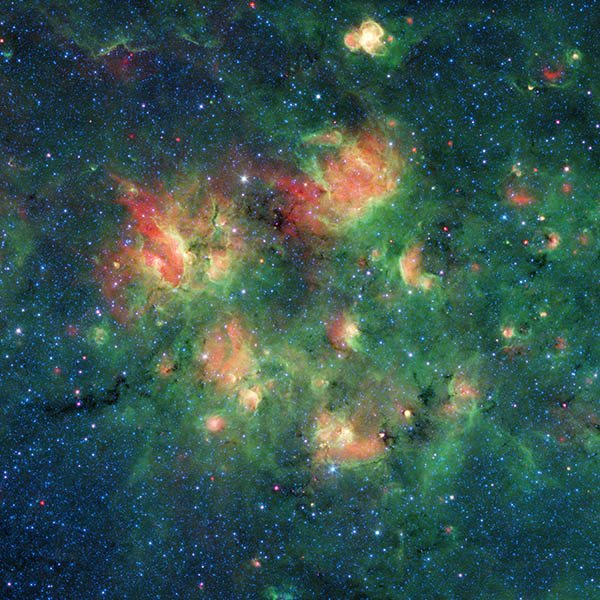
“Running out of coolant would have been the end for Spitzer, except it really marked a mid-life transition. Even without the liquid helium, Spitzer is far enough from Earth’s heat that the engineers could use the craft’s solar arrays as a built-in sunshield. That kept everything down to about 30 Kelvins. Too warm for Spitzer‘s long-wavelength instruments but not too warm for its two cameras that handle near infra-red. They chugged along just fine for another eleven years and a fraction. During its 17-year life Spitzer produced pictures like this shot of a star-forming region in the constellation Aquila…”

NASA/JPL-Caltech/Milky Way Project.

The maybe-an-Art-major goes nuts, you can’t even make out the words, but Newt barrels on. “Here’s where I let you in on a secret. The image covers an area about twice as wide as the Moon so you shouldn’t need a telescope to spot it in our Summertime sky. However, even on a good night you won’t see anything like this and there are several reasons why. First, the light’s very faint. Each of those color-dense regions represents a collection of hundreds or thousands of young stars. They give off tons of visible light but nearly all of that is blocked by their dusty environment. Our nervous system’s timescale just isn’t designed for capturing really faint images. Your eye acts on photons it collects during the past tenth of a second or so. An astronomical sensor can focus on a target for minutes or hours while it accumulates enough photons for an image of this quality.”

“But you told us that Spitzer can see through dust.”

“That it can, but not in visible colors. Spitzer‘s cameras ignored the visible range. Instead, they gathered the incoming infrared light and separated it into three wavelength bands. Let’s call them long, medium and short. In effect, Spitzer gave us three separate black-and-white photos, one for each band. Back here on Earth, the post-processing team colorcoded each of those photos — red for long, green for medium and blue for short. Then they laid the three on top of each other to produce the final image. It’s what’s called ‘a falsecolor image’ and it can be very informative if you know what to look for. Most published astronomical images are in fact enhanced or colorcoded like this in some way to highlight structure or indicate chemical composition or temperature.”

“What happened after the extra extra years?”

“Problems had just built up. Spitzer doesn’t orbit the Earth, it orbits the Sun a little bit slower than Earth does. It gets further away from us every minute. It used to be able to send us its data almost real-time, but now it’s so far away a 2hour squirt-cast drains its batteries. Recharging the batteries using Spitzer‘s solar arrays tilts the craft’s antenna away from Earth — not good. Spitzer‘s about 120° behind Earth now and there’ll come a time when it’ll be behind the Sun from us, completely out of communication. Meanwhile back on Earth, the people and resources devoted to Spitzer will be needed to run the James Webb Space Telescope. NASA decided that January 30 was time to pull the plug.”

Cathleen takes the mic. “Euge, serve bone et fidélis. Well done, thou good and faithful servant.”

~~ Rich Olcott

A Tale of Four Brothers

Jim hands the mic to Cathleen, who announces, “Bio-break time. Please be back here in 15 minutes for the next speaker. Al will have fresh coffee and scones for us.” <a quarter-hour later> “Welcome back, everyone, to the next session of our ‘IR, Spitzer and the Universe‘ memorial symposium. Our next speaker will turn our focus to the Spitzer Space Telescope itself. Newt?”

“Thanks, Cathleen. Let’s start with a portrait of Spitzer. I’m putting this up because Spitzer‘s general configuration would fit all four of NASA’s Great Observatories…

A NASA artist’s impression of Spitzer against an IR view of the Milky Way’s dust

“Each of them was designed to be carried into space by one of NASA’s space shuttles so they had to fit into a shuttle’s cargo bay — a cylinder sixty feet long and fifteen feet in diameter. Knock off a foot or so each way to allow for packing materials and loading leeway.”

<voice from the crowd> “How come they had to be in space? It’d be a lot cheaper on the ground.”

“If you’re cynical you might say that NASA had built these shuttles and they needed to have some work for them to do. But the real reasons go back to Lyman Spitzer (name sound familiar?). Right after World War II he wrote a paper listing the benefits of doing Astronomy outside of our atmosphere. We think Earth’s atmosphere is transparent, but that’s only mostly true and only at certain wavelengths. Water vapor and other gases block out great swathes of the infrared range. Hydrogen and other atoms absorb in the ultraviolet and beyond. Even in the visible range we’ve got dust and clouds. And of course there’s atmospheric turbulence that makes stars twinkle and astronomers curse.”

“So he wanted to put telescopes above all that.”

“Absolutely. He leveraged his multiple high-visibility posts at Princeton, constantly promoting government support of high-altitude Astronomy. He was one of the Big Names behind getting NASA approved in the first place. He lived to see the Hubble Space Telescope go into service, but unfortunately he died just a couple of years before its IR companion was put into orbit.”

“So they named it after him?”

“They did, indeed. The Spitzer was the fourth and final product of NASA’s ‘Great Observatories’ program designed to investigate the Universe from beyond Earth’s atmosphere. The Hubble Space Telescope was first. It was built to observe visible light but it also gave NASA experience doing unexpected inflight satellite repairs. <scattered chuckles in the audience. The maybe-an-Art-major nudges a neighbor for a whispered explanation.> The Atlantis shuttle put Hubble into orbit in 1990. Thirty years later it’s still producing great science for us.”

<The maybe-an-Art-major yells out> “And beautiful pictures!”

“Yes, indeed. OK, a year later Atlantis put Compton Gamma Ray Observatory into orbit. Its sensors covered a huge range of the spectrum, about twenty octaves as Jim would put it, from hard X-rays on upward. In its nine years of life it found nearly 300 sources for those high-energy photons that we still don’t understand. It also detected some 2700 gamma ray bursts and that’s something else we don’t understand other than that they’re way outside our intergalactic neighborhood.”

“Only nine years?”

“Sad, right? Yeah, one of its gyroscopes gave out and NASA had to bring it down. Some people fussed, ‘It’ll come down on our heads and we’re all gonna die!‘ but the descent stayed under control. Most of the satellite burned up on re-entry and the rest splashed harmlessly into the Indian Ocean.”

<quiet snuffle>

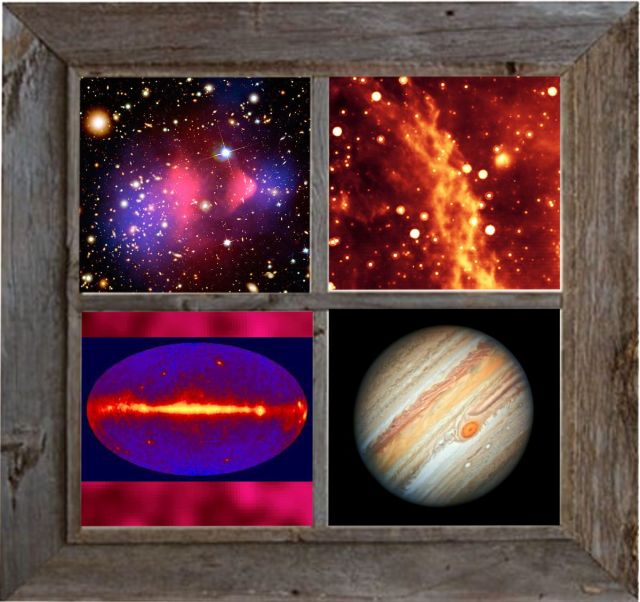
“Cheer up, it gets better. A month and a half after Compton‘s end, the Columbia shuttle put Chandra X-Ray Observatory into orbit. Like Hubble, Chandra‘s still going strong and uncovering secrets for us. Chandra was first to record X-rays coming from the huge black hole at the Milky Way’s core. Chandra data from the Bullet Cluster helped confirm the existence of dark matter. Thanks to Chandra we understand Jupiter’s X-ray emissions well enough to steer the Juno spacecraft away from them. The good stuff just keeps coming.”

“Thanks, that helps me feel better.”

“Good, because it’s time for the Spitzer‘s inspirational life story.”

~~ Rich Olcott