A Beetled Brow

Vinnie’s brow was wrinkling so hard I could hear it over the phone. “Boltzmann, Boltzmann, where’d I hear that name before? … Got it! That’s one of those constants, ain’t it, Sy? Molecules or temperature or something?”

“The second one, Vinnie. Avagadro was the molecule counter. Good memory. Come to think of it, both Boltzmann and Avagadro bridged gaps that Loschmidt worked on.”

“Loschmidt’s thing was the paradox, right, between Newton saying events can back up and thermodynamics saying no, they can’t. You said Boltzmann’s Statistical Mechanics solved that, but I’m still not clear how.”

“Let me think of an example. … Ah, you’ve got those rose bushes in front of your place. I’ll bet you’ve also put up a Japanese beetle trap to protect them.”

“Absolutely. Those bugs would demolish my flowers. The trap’s lure draws them away to my back yard. Most of them stay there ’cause they fall into the trap’s bag and can’t get out.”

“Glad it works so well for you. OK, Newton would look at individual beetles. He’d see right off that they fly mostly in straight lines. He’d measure the force of the wind and write down an equation for how the wind affects a beetle’s flight path. If the wind suddenly blew in the opposite direction, that’d be like the clock running backwards. His same equation would predict the beetle’s new flight path under the changed conditions. You with me?”

“Yeah, no problem.”

“Boltzmann would look at the whole swarm. He’d start by evaluating the average point‑to‑point beetle flight, which he’d call ‘mean free path.’ He’d probably focus on the flight speed and in‑the‑air time fraction. With those, if you tell him how many beetles you’ve got he could generate predictions like inter‑beetle separation and how long it’d take an incoming batch of beetles to cross your yard. However, predicting where a specific beetle will land next? Can’t do that.”

“Who cares about one beetle?”

“Well, another beetle might. …
Just thought of a way that Statistical Mechanics could actually be useful in this application. Once Boltzmann has his numbers for an untreated area, you could put in a series of checkpoints with different lures. Then he could develop efficiency parameters just by watching the beetle flying patterns. No need to empty traps. Anyhow, you get the idea.”

Japanese Beetle, photo by David Cappaert, Bugwood.org
under Creative Commons BY 3.0

“Hey, I feel good emptying that trap, I’m like standing up for my roses. Anyway, so how does Avagadro play into this?”

“Indirectly and he was half a century earlier. In 1805 Gay‑Lussac showed that if you keep the pressure and temperature constant, it tales two volumes of hydrogen to react with one volume of oxygen to produce one volume of water vapor. Better, the whole‑number‑ratio rule seemed to hold generally. Avagadro concluded that the only way Gay‑Lussac’s rule could be general is if at any temperature and pressure, equal volumes of every kind of gas held the same number of molecules. He didn’t know what that number was, though.”

“HAW! Avagadro’s number wasn’t a number yet.”

“Yeah, it took a while to figure out. Then in 1865, Loschmidt and a couple of others started asking, “How big is a gas molecule?” Some gases can be compressed to the liquid state. The liquids have a definite volume, so the scientists knew molecules couldn’t be infinitely small. Loschmidt put numbers to it. Visualize a huge box of beetles flying around, bumping into each other. Each beetle, or molecule, ‘occupies’ a cylinder one beetle wide and the length of its mean free path between collisions. So you’ve got three volumes — the beetles, the total of all the cylinders, and the much larger box. Loschmidt used ratios between the volumes, plus density data, to conclude that air molecules are about a nanometer wide. Good within a factor of three. As a side result he calculated the number of gas molecules per unit volume at any temperature and pressure. That’s now called Loschmidt’s Number. If you know the molecular weight of the gas, then arithmetic gives you Avagadro’s number.”

“Thinking about a big box of flying, rose‑eating beetles creeps me out.”

  • Thanks to Oriole Hart for the story‑line suggestion.

~~ Rich Olcott

Bridging A Paradox

<chirp, chirp> “Moire here.”

“Hi, Sy. Vinnie. Hey, I’ve been reading through some of your old stuff—”

“That bored, eh?”

“You know it. Anyhow, something just don’t jibe, ya know?”

“I’m not surprised but I don’t know. Tell me about it.”

“OK, let’s start with your Einstein’s Bubble piece. You got this electron goes up‑and‑down in some other galaxy and sends out a photon and it hits my eye and an atom in there absorbs it and I see the speck of light, right?”

“That’s about the size of it. What’s the problem?”

“I ain’t done yet. OK, the photon can’t give away any energy on the way here ’cause it’s quantum and quantum energy comes in packages. And when it hits my eye I get the whole package, right?”

“Yes, and?”

“And so there’s no energy loss and that means 100% efficient and I thought thermodynamics says you can’t do that.”

“Ah, good point. You’ve just described one version of Loschmidt’s Paradox. A lot of ink has gone into the conflict between quantum mechanics and relativity theory, but Herr Johann Loschmidt found a fundamental conflict between Newtonian mechanics, which is fundamental, and thermodynamics, which is also fundamental. He wasn’t talking photons, of course — it’d be another quarter-century before Planck and Einstein came up with that notion — but his challenge stood on your central issue.”

“Goody for me, so what’s the central issue?”

“Whether or not things can run in reverse. A pendulum that swings from A to B also swings from B to A. Planets go around our Sun counterclockwise, but Newton’s math would be just as accurate if they went clockwise. In all his equations and everything derived from them, you can replace +t with ‑t to make run time backwards and everything looks dandy. That even carries over to quantum mechanics — an excited atom relaxes by emitting a photon that eventually excites another atom, but then the second atom can play the same game by tossing a photon back the other way. That works because photons don’t dissipate their energy.”

“I get your point, Newton-style physics likes things that can back up. So what’s Loschmidt’s beef?”

“Ever see a fire unburn? Down at the microscopic level where atoms and photons live, processes run backwards all the time. Melting and freezing and chemical equilibria depend upon that. Things are different up at the macroscopic level, though — once heat energy gets out or randomness creeps in, processes can’t undo by themselves as Newton would like. That’s why Loschmidt stood the Laws of Thermodynamics up against Newton’s Laws. The paradox isn’t Newton’s fault — the very idea of energy was just being invented in his time and of course atoms and molecules and randomness were still centuries away.”

“Micro, macro, who cares about the difference?”

“The difference is that the micro level is usually a lot simpler than the macro level. We can often use measured or calculated micro‑level properties to predict macro‑level properties. Boltzmann started a whole branch of Physics, Statistical Mechanics, devoted to carrying out that strategy. For instance, if we know enough about what happens when two gas molecules collide we can predict the speed of sound through the gas. Our solid‑state devices depend on macro‑level electric and optical phenomena that depend on micro‑level electron‑atom interactions.”

“Statistical?”

“As in, ‘we don’t know exactly how it’ll go but we can figure the odds…‘ Suppose we’re looking at air molecules and the micro process is a molecule moving. It could go left, right, up, down, towards or away from you like the six sides of a die. Once it’s gone left, what are the odds it’ll reverse course?”

“About 16%, like rolling a die to get a one.”

“You know your odds. Now roll that die again. What’s the odds of snake‑eyes?”

“16% of 16%, that’s like 3 outa 100.”

“There’s a kajillion molecules in the room. Roll the die a kajillion times. What are the odds all the air goes to one wall?”

“So close to zero it ain’t gonna happen.”

“And Boltzmann’s Statistical Mechanics explained why not.”

“Knowing about one molecule predicts a kajillion. Pretty good.”

San Francisco’s Golden Gate Bridge, looking South
Photo by Rich Niewiroski Jr. / CC BY 2.5

~~ Rich Olcott

Breaking Up? Not So Hard

<transcript of smartphone dictation by Sy Moire, hard‑boiled physicist>
Day 173 of self‑isolation….
Perfect weather for a brisk solitary walk, taking the park route….
There’s the geese. No sign of Mr Feder, just as well….

Still thinking about Ms Baird and her plan for generating electric power from a black hole named Lonesome….
Can just hear Vinnie if I ever told him about this which I can’t….
“Hey, Sy, nothin’ gets out of a black hole except gravity, but she’s using Lonesome‘s magnetic field to generate electricity which is electromagnetic. How’s that happen?”
Good question….

Hhmph, that’s one angry squirrel….
Ah, a couple of crows pecking the ground under its tree. Maybe they’re too close to its acorn stash….

We know a black hole’s only measurable properties are its mass, charge and spin….
And maybe its temperature, thanks to Stephen Hawking….
Its charge is static — hah! cute pun — wouldn’t support continuous electrical generation….
The Event Horizon hides everything inside — we can’t tell if charge moves around in there or even if it’s matter or anti‑matter or something else….
The no‑hair theorem says there’s no landmarks or anything sticking out of the Event Horizon so how do we know the thing’s even spinning?

Ah, we know a black hole’s external structures — the jets, the Ergosphere belt and the accretion disk — rotate because we see red- and blue-shifted radiation from them….
The Ergosphere rotates in lockstep with Lonesome‘s contents because of gravitational frame-dragging….
Probably the disk and the jets do, too, but that’s only a strong maybe….
But why should the Ergosphere’s rotation generate a magnetic field?

How about Newt Barnes’ double‑wheel idea — a belt of charged light‑weight particles inside a belt of opposite‑charged heavy particles all embedded in the Ergosphere and orbiting at the black hole’s spin rate….
Could such a thing exist? Can simple particle collisions really split the charges apart like that?….

OK, fun problem for strolling mental arithmetic. Astronomical “dust” particles are about the size of smoke particles and those are about a micrometer across which is 10‑6 meter so the volume’s about (10‑6)3=10‑18 cubic meter and the density’s sorta close to water at 1 gram per cubic centimeter or a thousand kilograms per cubic meter so the particle mass is about 10‑18×103=10‑15 kilogram. If a that‑size particle collided with something and released just enough kinetic energy to knock off an electron, how fast was it going?

Ionization energy for a hydrogen atom is 13 electronvolts, so let’s go for a collision energy of at least 10 eV. Good old kinetic energy formula is E=½mv² but that’s got to be in joules if we want a speed in meters per second so 10 eV is, lemme think, about 2×10‑18 joules/particle. So is 2×2×10‑18/10‑15 which is 4×10‑3 or 40×10‑4, square root of 40 is about 6, so v is about 6×10‑2 or 0.06 meters per second. How’s that compare with typical speeds near Lonesome?

Ms Baird said that Lonesome‘s mass is 1.5 Solar masses and it’s isolated from external gravity and electromagnetic fields. So anything near it is in orbit and we can use the circular orbit formula v²=GM/r….
Dang, don’t remember values for G or M. Have to cheat and look up the Sun’s GM product on Old Reliable….
Ah-hah, 1.3×10²⁰ meters³/second so Lonesome‘s is also near 1020….
A solar‑mass black hole’s half‑diameter is about 3 kilometers so Lonesome‘s would be about 5×10³ meters. Say we’re orbiting at twice that so r‘s around 104 meters. Put it together we get v2=1020/104=1016 so v=108 meters/sec….
Everything’s going a billion times faster than 10 eV….
So yeah, no problem getting charged dust particles out there next to Lonesome….

Just look at the color in that tree…
Weird when you think about it. The really good color is summertime chlorophyll green when the trees are soaking up sunlight and turning CO2 into oxygen for us but people get excited about dying leaves that are red or yellow…

Well, now. Lonesome‘s Event Horizon is the no-going-back point on the way to its central singularity which we call infinity because its physics are beyond anything we know. I’ve just closed out another decade of my life, another Event Horizon on my own one‑way path to a singularity…

Hey! Mr Feder! Come ask me a question to get me out of this mood.

Author’s note — Yes, ambient radiation in Lonesome‘s immediate vicinity probably would account for far more ionization than physical impact, but this was a nice exercise in estimation and playing with exponents and applied physical principles.

~~ Rich Olcott

Big Bang│Gnab Gib?

Anne’s an experienced adventurer, but almost exploding the Earth when she tried transporting herself into an anti‑Universe was a jolt. It takes her a while to calm down. Fortunately, I’m there to help. <long soothing pause> “Sy, I promise that’s one direction I’ll never ‘push’ to go again.”

“No reason to go there and big reasons not to. <long friendly pause> Hmm. You’ve told me that when you use your superpower to go somewhere, you can feel whether there’d be a wall or something in the way. That’s how you know to get to a safer location before you ‘push.’ Didn’t you get that feeling before you went to meet anti‑Anne?”

“No, it felt just like just any other ‘push.’ Why?”

“I’m curious. Could you feel for just a second in the direction opposite to anti‑Anne? For Heaven sake don’t go there! Just look, OK?”

“All right … <shiver> Now, that’s weird. There’s nothing there, except there’s not even a there there, if you know what I mean.”

“I think I do, and you’ve just given us one more clue to where you almost went. Whoa, no more shivering, you’re back here safe where there’s normal matter and real locations, OK? <another soothing pause> That’s better. So, I was assuming a binary situation, an anti‑Universe obeying a Charge‑Parity‑Time symmetry that’s exactly the reverse of ours. The math allows only the two possibilities. You observed ‘no there there’ when you tried for a third option. That’s support for the assumption.”

“How could we have even two Universes?”

“It goes back to the high‑energy turmoil at the Big Bang’s singularity. Symmetry says the chaos in the singularity should have generated as many anti‑atoms, umm, as many positrons and anti‑protons, as their normal equivalents.”

“Positrons?”

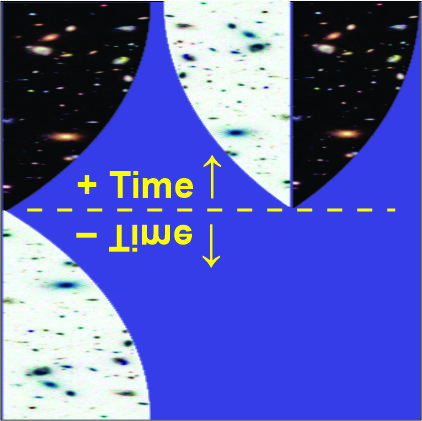
“Anti‑electrons. Long story. The big puzzle is, where did those anti‑guys go? One proposal that’s been floating around is that while normal matter and our normal CPT symmetry expanded from the singularity to make our Universe, the anti‑matter and reversed symmetry expanded in some kind of opposite direction to make the anti‑Universe. You may have found that direction. Here, I’ll do a quick sketch on Old Reliable.”

“Looks like some of the banged‑up painted‑up battle shields I saw a thousand years ago.”

“It does, a little. Over on the top left is our normal‑matter Universe with galaxies and all, expanding out of the singularity at time zero. Time runs vertically upward from that point. I can’t draw three spatial dimensions so just one expanding sideways will have to do, OK?”

“No problem, I do x‑y‑z‑t thinking all the time when I use my superpower.”

“Of course you do. Well, coming down out of the singularity into minus‑time we’ve got the anti‑Universe. I’ve reversed the color scheme because why not, although I expect their colors would look exactly like ours because we know that photons are their own anti‑particles and should behave the same in both Universes.”

“They do. Anti‑Anne looked just like me, white satin and all.”

“Excellent, another clue. Anyway, see how minus‑time increases in the negative direction as the anti‑Universe expands just like plus‑time increases positively for us?”

“Mmm, yeah, but we only call them minus and plus because we’re standing outside of both of them. Looking from the inside, I’d say time in each increases towards expansion.”

“Good insight, you’re way ahead of me. That’s what I’ve drawn on the right side of the sketch. The two are perfectly equivalent except for CPT and anti‑CPT. Time direction, x‑y‑z space directions, even spin orientation, can all be made parallel between the two. However, the charges are reversed. Anti‑Anne’s atoms have positrons where we have electrons, negative anti‑protons where we have positive protons. When anti‑matter meets matter, there’s massive energy release from equivalent charged particles neutralizing each other.”

“Wait. Gravity. Wouldn’t anti‑matter particles repel each other? Your picture has galaxies and they couldn’t grow up with everything backwards.”

“Nope, you’re carrying this model too far. The only thing that’s reversed is charge. Masses work the same in each symmetry. Gravity pays attention to mass, not charge, and it’s always a force of attraction.”

“Anyway, not going back there.”

“Good.”

~~ Rich Olcott