
Abstract cosmic composition with colorful swirling ribbons, organic forms, and stars

A Cosmic Trattoria

Walt is not amused. ” ‘Not likely but probably’ — what kind of answer is that, Moire? You going for Pratchett’s ‘million-to-one chances crop up nine times out of ten’?”

“You asked me two questions, I gave you two answers. I won’t even bill you for one of them.”

“You know my opinion about lagniappes. We’ll pay for both, but only if we get value.”

“Your first question was, could a nova have flung a chunk of neutronium that’ll hit our Solar System?” <starts tapping on Old Reliable’s screen> “I assume your people are worried about protecting Earth.”

“I neither confirm nor deny that assumption.”
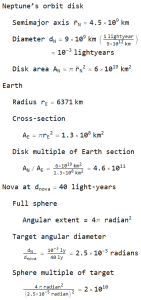
“Either way, by geometry alone the likelihood’s negligible. All our System’s planets and most of the satellites and asteroids and comets are within a few degrees of the Plane of the Ecliptic. Think of everything from Neptune’s orbit inward as a thin flat disk. From above, Earth’s cross‑section area is almost a trillionth of the disk’s area. Suppose your nova is 10 times as far away as our nearest star. Worst case is the nova hanging directly above the Ecliptic. Our disk would be a circular patch in the nova’s sky. If the nova throws a neutronium chunk, it can choose randomly from 20 billion patches the same size as ours; Earth is only a trillionth of one of them. Best case is the nova’s located edge-on to our disk; the odds of a hit would be far smaller. A neutronium chunk striking Earth is a framazillion times less likely than a hit from one of our own near‑Earth asteroids.”

“‘Framazillion.’ I’m going to quote you on that.”

“No extra charge. Now for your second question, whether we could detect a neutronium interloper. Yes, if we’re looking in the right direction with the right detectors.”

“Needs a full-sky survey, obviously, because we have no clue where it’s coming from. What kind of detectors? It’s got to be warmer than empty space. Infrared?”

“Mm-hm. The chunk’s free electrons would shine with black‑body radiation.at all wavelengths but IR’s your best choice.”

“Free electrons? I thought the thing was made of neutrons.”

“Sorry, that’s pop‑sci simplification. The neutrons in a neutronium object are stabilized by gravitational compression, but the gravity field tapers off near the surface. Deep inside you’ve got neutron soup, possibly superfluid, but the particles further up aren’t crowded quite as tightly and have ways of freezing up. There’s a slushy lower crust of nuclear pasta, then an atomic upper crust of iron and its transition‑metal relatives plus some hydrogen and helium. Finally there’s a free‑electron ‘atmosphere’.”

“Wait — nuclear pasta?”

“Technical term, believe it or not. Liquid water and ice make a slush, right, one ingredient occurring in two phases. Water has about 20 different phases—”

“Ice-nine, in Vonnegut’s book.”

“That’s a plot device, I’m talking real ice here. You get different ices at different temperatures and pressures because the microscopic‑level components re‑arrange. We think neutronium does the same. Near the top of a neutron star’s lower crust, the pressure’s low enough that neutrons and protons can clump together as monster nuclei with a high neutron/proton ratio. Theorists depict them as ‘gnocci‘ (or ‘meatballs’) floating in the uncrystallized neutron phase. Down below where the pressure’s higher, the gnocci phase breaks up to form long thin strands of ‘spaghetti.’ Even further down you get sheets of ‘lasagna’ and so on. Physicists can have fun, too. Anyway, IR detectors would be best because the star’s gravity field redshifts UV and visible black‑body emissions to longer wavelengths. But your problem is, that’s not neutronium‑specific.”

“Right, any warm rock would emit IR. Is there something else?”

“Yes, there is, and we already have the right observatories in place and operating.”

“What do they detect?”

“Neutrinos, the lightest particles we know of, about a millionth the mass of an electron. Every time a proton absorbs an electron and converts to a neutron, neutrinos are emitted. That happens a lot in neutronium; a chunk of it ought to be a bright neutrino source. We’ve got a dozen neutrino telescopes in operation all over the world. If they spot something, you’ll hear about it.”

“Bye.”

“Don’t mention it.”

~ Rich Olcott
Rugged asteroid surrounded by glowing debris in a colorful nebula

Neutral Under Pressure

The Acme Building’s elevator takes me to the 12th floor with no hiccups, for a change. I unlock my office door and there’s “Walt,” standing in the middle of the room brandishing his cane with what looks like a fat cell phone plugged into it somehow. “The place is clean, Mr Moire. No listeners in the elevator shaft, corridor or office space, and I put temporary foam over your windows to block laser‑bounce sound pickup.”

“That’s good to know, Walt. Should I give you credit for fixing the elevator?”

“Not publicly. Found a dark web relay routine freeloading elevator’s controller computer. Disabled it so the machine can do its real job.”

“Nice work. But why so surreptitious? You know I don’t do military consults. And why come up to my office instead of meeting at Eddie‘s or the park as usual?”

“Tradecraft, Mr Moire — never use the same location too often. Espionage is a thing, military or not, and it doesn’t recognize national boundaries. My people have their secrets, too.”

“Naturally. What are your people curious about this time?”

“Neutronium.”

“Neutronium?”

“Yes, what can you tell me about it?”

“It’s really dense. You’ve heard the line that atoms are mostly empty space. An atomic nucleus is maybe a few femtometers across, but it floats in a ball of space that’s a thousand to ten thousand times wider. The space isn’t empty, of course — it’s occupied by spread‑out electronic charge. Neutronium doesn’t have that not‑quite‑empty space. A neutronium ball with the Sun’s mass would be a dozen kilometers across.”

“Mashed‑together charge like a metal. Would neutronium be shiny?”

“Possibly. I’ve never seen any.”

“Are there neutronium ores you could mine for?”

“Not on Earth, guaranteed. Except for the noble metals like gold, ore atoms are isolated from each other, dispersed in minerals like oxides or sulfides. Neutronium by its nature would have to be in a massive isolated deposit.”

“By its nature?”

“An isolated neutron lives about 15 minutes before it spits out an electron and becomes a proton. A neutron near enough to another nuclear particle is stabilized by the weak nuclear force, but that’s ineffective beyond a few femtometers. Either a neutron’s in an atomic nucleus or it’s mashed up against other neutrons in neutronium or it’s dead.”

“How about a chunk of neutronium buried in one of these ultra‑dense asteroids I’ve read about, like 33 Polyhymnia, or 16 Psyche that we’ve sent a space mission to look at?”

“You have read up, haven’t you? Not even those two asteroids are dense enough to host more than a speck of neutronium. Asteroid mass and volume are separate measurements; you need both to figure mass‑per‑volume density. Each component is a challenging exercise in accurate observation. The first guesstimate for Polyhymnia was that it was more than 10 times denser than iron. That’s why you’ve heard of it. With better data now we think both Polyhymnia and Psyche are at about the density of iron. Higher than most but too low for neutronium by a factor of quintillions.”

“Where else could we go for neutronium?”

“This’ll take some background. The more massive the star, the bigger its diameter and the longer it lives, right?”

Walt gives me a suspicious eye. “You’re fudging, Mr Moire.”

“Nothing gets past you, Walt. More massive stars burn hotter. The heat bulges them out, as you’d expect. The fudge is they exhaust their fuel faster so they die sooner. When the fuel gives out and they go nova, big guys collapse harder than smaller ones can. Their collapse squeezes their residual core tighter. Collapsing a really big star crams its remains into a volume smaller than its Schwartzschild radius. That makes a black hole. Smaller stars can’t go that far. The crush might stop when the residue’s electrons are squeezed into its atomic nuclei. Protons there could capture them and become neutrons. If so, you’ve got neutronium and a neutron star.”

“A nova’s pretty violent, shoots material out randomly?”

“One of the sloppiest, most violent events in the Universe.”

“Could a nova have flung a neutronium fragment through our Solar System like something flung ‘Oumuamua? Could we detect that?”

“Not likely but probably.”

~ Rich Olcott

Nervous dog hiding in alley with police car sirens, fireworks, and crowd unrest

How Loud Can It Get?

Mr Richard Feder stumbles into Cal’s Coffee Shop with his hands over his ears. “Holy Pete, those fireworks were loud! They pulled out all the stops with that finale. BAM! BaBANG! BAMBAMBAM!! I’m still jazzed, see, I’m shaking. My dog back home’s hiding under the bed.”

Cal shoves a mug at him. “Try some of this.”

“Smells like a bakery. What is it?”

“It’s called chai. Just some spices and decaf tea. Supposed to be calming.”

<sips> “Hmm. … Yeah, seems to be working. Still can’t get over the impossible noise level, though. Had to be hundreds of decibels.”

I’m over here nursing my usual cup of mud. “Several hundred decibels can’t happen on Earth.”

“Hey, I was right there, I heard it, I felt it!”

“What you felt wasn’t sound, and it’s not measured in decibels.”

“Sounded like sound.”

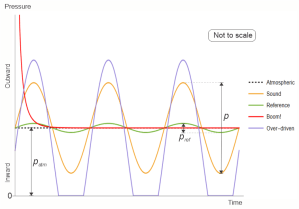
<sketching on Old Reliable> “Sound is a continuous wave of out‑and‑in pressure changes, like the orange line here. The variation is what matters — push and pull, the waves average out to atmospheric pressure. What you felt was a shock front, a quick pulse of high pressure, all outward like the red line. OK, you felt a bunch of shock fronts, but not the regular waves that decibels care about.”

“What’s the green line about? It’s regular.”

“That stands as a baseline for comparisons. I’ve marked its high‑low range as pref. Most people doing sound measurements set pref to the smallest pressure swing that most people can hear, about 2×10⁻¹⁰ atmospheres—”

“That’s pretty small.”

“Indeed, but you’ve got to start somewhere. If you whisper to a partner at exactly that sound wave level, p=pref, the p/pref ratio is 1.0. That’s zero on the bel scale. Sounds from rustling leaves have a p/pref ratio about ten times larger. We give that a two‑bel rating. Every factor of ten above that rates an additional two bels. A busy nightclub could easily have a p/pref ratio near 105, ten bels, a hundred thousand times more pressure swing than your quiet whisper.”

“What’s that got to do with decibels?”

“They’re for rating sound waves that are between ten‑factors. ‘Deci-‘ means one‑tenth so there’s ten decibels per bel. The noise police would assess that ten‑bel nightclub at 100 decibels. If you sit right next to the loudspeakers where the sound pressure is 120 decibels, the extra 20 decibels pummel your eardrums with an extra ten times the pressure swing. Which is why people suffer short-term hearing loss at that intensity.”

“Uhhh… so 300 decibels from those fireworks would be a 1015 ratio which is a lot but why do you say it’s impossible?”

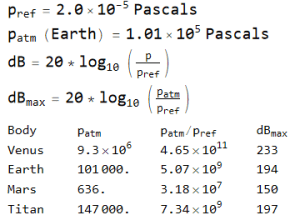
“That’s what the blue ‘Over‑driven’ line is about. Suppose you give an alarm siren a continuously growing power feed. As the siren’s power increases, it emits pressure peaks that push out more strongly and valleys that pull in more strongly. When the valley’s part of p eventually grows to atmospheric pressure patm, the sound’s pressure valleys try to drop below zero, which they can’t because zero is is a vacuum. Further output power beyond that level only goes to the outward pressure phase. The siren isn’t making a sound any more, it’s making push pulses. Maximum loudness happens when the p/pref ratio nears patm/pref. On Earth, patm/pref is 5×10⁹. If you do the math, that’s 194 decibels. You just can’t make a sound any louder than that, no matter how you modify the siren.”

“You said ‘on Earth’ twice, like the limit’s different on other planets?”

“Sure. The same formula applies to any body with a solid surface and an atmosphere. The Solar System has only three planets and one moon that qualify. Here, I’ll tell Old Reliable to run the numbers for those. … How about that? Earth’s ‘loudest possible sound’ almost exactly matches the one for Saturn’s moon Titan. Mars is 40 decibels quieter than we are, but Venus is 40 decibels louder.”

“Dogs got sensitive ears. I bet they’d like it on Mars. They’d probably invent a different bel scale, though.”

Nervous dog hiding in alley with police car sirens, fireworks, and crowd unrest

~ Rich Olcott

Airborne Amazons

Vinnie blows into Cal’s place dripping wet. “Man, it’s coming down out there! This monsoon’s trying to drown us.”

“No monsoon, Vinnie, this rain’s from an atmospheric river.”

“Monsoon, river, what’s the difference, I’m soaked, Cathleen!”

“Cal, Vinnie needs a warm‑up mug, quick!”

“Comin’ right up. Here you go, Vinnie. Cathleen, I’ve always used ‘monsoon’ for rain like this. What’s wrong with that?”

“Because a proper monsoon is seasonal; the year’s too early for monsoon season around here.”

“Didn’t realize we had a monsoon season. I just figure if it’s not snowing and it’s not steaming we got rain.”

“Not funny, Vinnie. Our local weather deserves better from you. We have lots of sunny days even during our July‑September monsoon season.”

“Why pick on those particular months?”

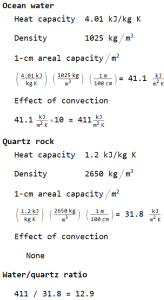
“Temperature and wind patterns. Sy would push the ‘because’ all the way down to heat capacity difference. Per unit area, a one‑centimeter layer of rock has about ¾ the heat capacity of the same thickness of still water. Convective water circulation magnifies the difference by ten.”

“So?”

“So a given amount of energy will raise the temperature of a rock expanse almost 13 times as many degrees as it would the same ocean area. On the other hand, night‑time energy radiation cools rock by almost 13 degrees where the ocean would cool by one. Compared to the ocean, land surface gets hotter in the daytime, cools off more at night.”

“So?”

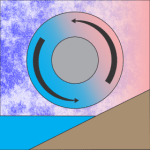
“So Summer sunlight heats land area more than its neighboring ocean. Air over warm land expands and rises, making room for water‑laden air from the relatively cool ocean cover. That air warms and rises, too, but as it rises it cools again. The water vapor condenses and rain falls. Come Autumn, land temperature drops more than ocean surface temperature does. That reverses the air’s general circulation and shuts off the rain. End of monsoon season.”

“It works that way all over the world?”

“Most everywhere except Antarctica. Apparently it stays so cold there all year around that the back‑and‑forth rocking never gets a chance to develop.”

“Doesn’t seem to have anything to do with the Coriolis Effect.”

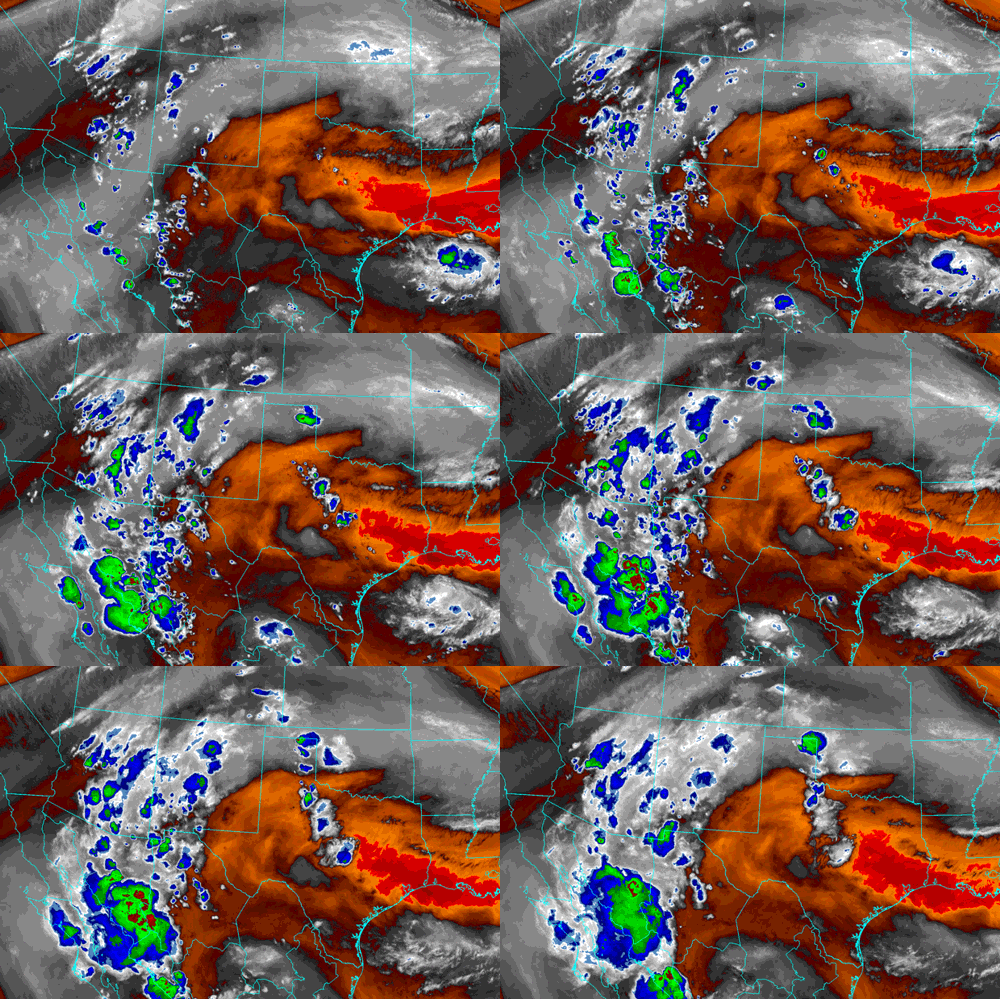
“Most of the movement is roughly perpendicular to the local coastlines, but Coriolis gets into play farther away from the coast. The North American monsoon, for instance, comes up from the Gulf of California and trends northeast across the mountain states into Kansas and Oklahoma.”

Water vapor, afternoon of August 22, 2018. Dry air is orange.
Image from Albuquerque, NM National Weather Service

“That strong west‑to‑east trend looks like some weather maps I’ve used flown by. Is that an atmospheric river?”

“Similar, Vinnie, but no. Atmospheric rivers are a completely separate phenomenon from monsoons — different physical settings, different behavior. They’re both fueled by warm oceanic water vapor but that’s about it. Monsoons are seasonal, last for months, and hover over particular regions; atmospheric rivers are perennial, generally live for only a few days, and wander around. We’ve known about monsoons for millennia, but it wasn’t until 1992 that scientists had satellite data to support the rivers notion.”

“How can they be perennial and only last for days?”

“I meant that individual rivers come and go but the northern and southern hemispheres generally have about four each throughout the year. Rivers thousands of kilometers long, hundreds of kilometers wide, carrying as much water as the Amazon. Together they’re responsible for transporting 80‑90% of the tropical moisture that crosses the mid‑latitudes each year.”

“That’s a lot of water hanging over our heads. How could people have just missed them all those years?”

Vinnie has a calculating look. “A million square kilometers. How tall are these things?”

“Can’t give you a firm answer. Probably a kilometer or two but that’s a guess. The satellite sensors register total water mass from orbit down to ground. The numbers peak around 60 millimeters of H₂O per square centimeter. Spread along a one‑kilometer height that’s 60 g/m³ maximum; figure a 30‑gram average.”

“It’s just moist air, then, not liquid water. Cal, your breath’s more humid than that. A million cubic kilometers of 30‑gram 1‑meter cubes packs a lot of grams. I’m sure I’ve flown right through those things without noticing them.”

~ Rich Olcott

The Coriolis Mandala

“Cathleen, this Coriolis Effect‘s rule is so easy. The force always twists you to the right no matter which way you travel. Going north, you swerve eastward; going south you swerve westward, always to the right. But what about the in‑betweens? What if I’m going east or west? Does the force just go away?”

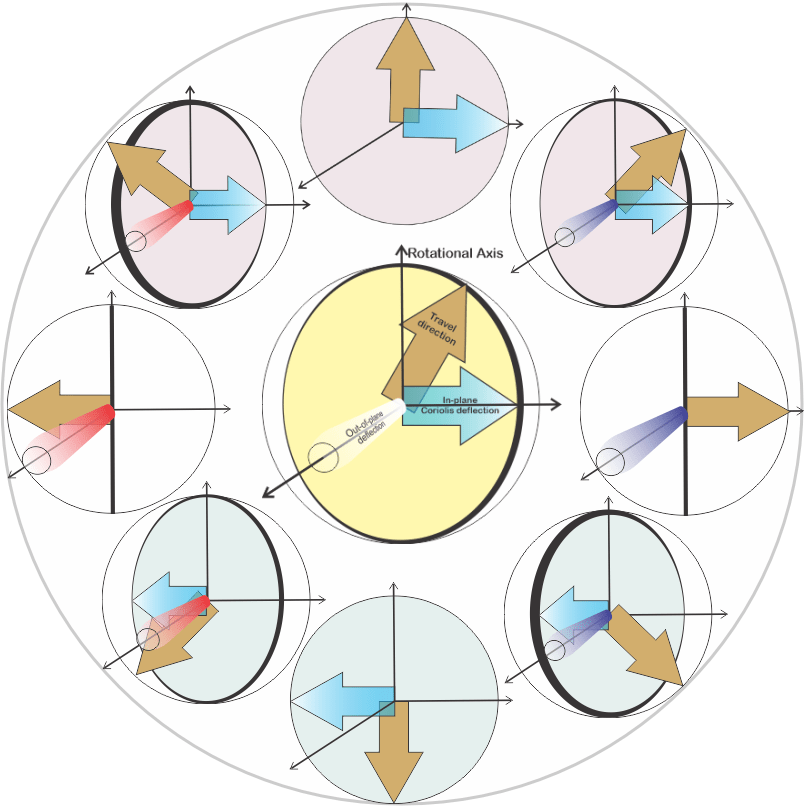
“Of course not, Cal, but it mutates. Mind you, the rules you quoted only apply in Earth’s northern hemisphere. If you’re south of the Equator they go the other direction. Anyway, the northbound and southbound cases everybody writes about are the simplest to describe. You might be surprised how it varies across all the compass points separating them.” <pulling another image up on her tablet> “Here’s a chart I did for my class.”

“Whoa, that’s complicated.”

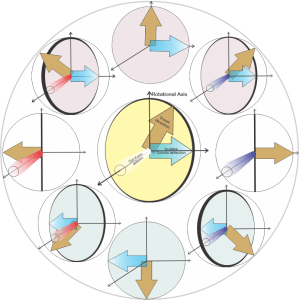
“Let me break it down for you. The circles around the outside represent different travel orientations — north’s at the top, then northeast to its left, directly east at the three-o’clock position, and so on. The brown arrows point to the corresponding direction. They’re all the same length to imply equal travel speed because why not.”

“Southbound’s at the bottom, just like on a map, right?”

“Right. Now, the blue arrow in a circle shows the relative Coriolis force experienced by an object traveling in that circle’s direction. See how the leftward force falls off from full‑strength if you’re northbound, to 70% if you’re going northeast, so zero for eastbound motion.”

“I’ll take your word for the 70%, but yeah, that’s what the picture shows. Wait, right after you turn the corner from east to south that blue arrow flips like the rule says.”

“It’s not like there’s a big toggle switch somewhere. If you’re going a little bit north of due east, there’s just a little bit of east‑pushing Coriolis; drive just a little bit south of due east there’s just a little bit of west‑pushing Coriolis. Build a Coriolis swerve‑meter. Swivel it all around the compass. It’ll show peak force when pointed north or south. The force smoothly fades away through zero, grows to a peak in the other direction, fades away, then re‑grows as you come back full circle.”

“So that’s what the pink and green disks are about, huh? Strong to fade‑away east both sides in the top half, strong to fade‑away west in the south?”

“You’ve got it.”

“What’s the red and blue stuff about then?”

“Re‑think the picture to 3‑D. Visualize each of those circles as a sphere. The thin black arrows are x‑y‑z pointers coming out from the sphere’s center. Can you see that?”

“The arrows coming out an angle, that’s like coming out of the screen?”

“Mm‑hm. Suppose you’re driving straight east in a vehicle that doesn’t care about gravity. What would happen?”

“Heh‑heh‑heh, lift‑off!”

“Exactly. It’s not centrifugal force, technically, but the Coriolis Effect’s equation establishes a trade‑off between Coriolis acting horizontally and a centrifuge‑like sibling acting vertically. Both sibs act to increase or decrease an object’s effective inertia depending on the object’s direction of motion relative to Earth’s rotation. The vertical component strengthens as the horizontal component weakens and vice‑versa.”

“The vertical one is the tubes coming out?”

“Yes, that’s what those are about. Long tubes in the diagram indicate high relative strength, short tubes signify weaker intensity, which is why the northbound and southbound spheres don’t have any tubes at all.” <grins> “Sy would appreciate my color choices.”

“I don’t get the joke.”

“Over there on the left side, the vertical component is upward, towards us. If a star’s coming towards its spectrum is shifted to shorter wavelengths, bluer than it it were standing still. No surprise, we call that a blue shift. Being an astronomer, I made those tubes blue‑ish.”

“I suppose the right side has red tubes because the vertical component pushes down when you’re westbound?”

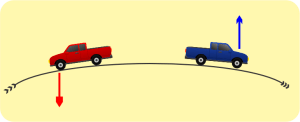
“You broke the code, Cal. Red‑shifted stars are flying away from us. I’m being careful here — the red tubes don’t represent a true centripetal force. There’s no pushing and the effect doesn’t depend on distance from the rotation axis. But it makes a westbound truck act a bit like the road’s coming up to meet it.”

~ Rich Olcott
The Winds of Change

“You said that so careful, Cathleen.”

“What that was that, Cal?”

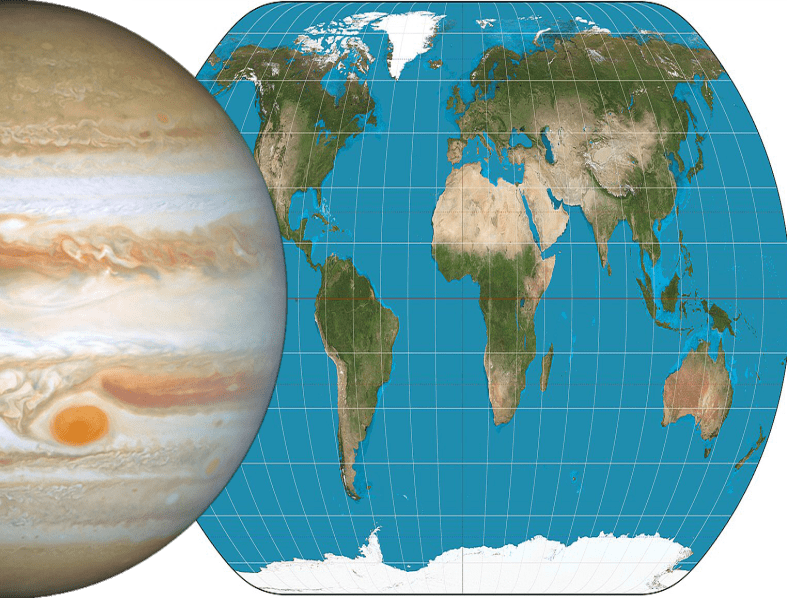
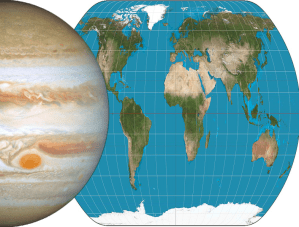
“When you said those blue donuts in your diagram could be Earth’s equivalent to Jupiter’s brown bands. Why not the white zones, too?”

“Because Earth has a much better analog for the white zones. Juno‘s observations showed us Jupiter’s white zones floating a hundred or more kilometers above the brown stuff.”

“We don’t have that much room, do we?”

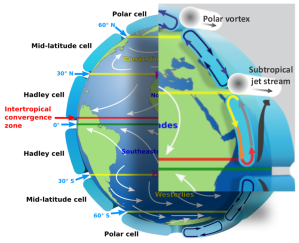
“Nowhere near. Our clouds and weather stay inside the troposphere, mostly less than a dozen kilometers up. Inside that shell, though, similar dynamics may apply.” <scribbling on her tablet> “Here’s a grossly oversimplified sketch.”

“White frosting on the donuts?”

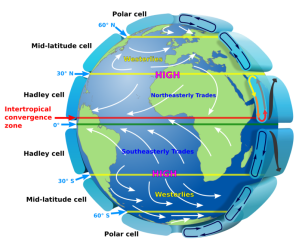
“Winds, Cal, not frosting, though they are cold. Think of each blue donut as a conveyor belt transporting air between warm and cold regions. The arrows reflect separate lower‑level and upper‑level wind regimes. What happens up at 60°N?”

“That’s actually a ring, right, goes all around the planet up there? I see two lower‑level conveyor belt donuts dumping at the same meridian — stuff’s gonna pile up over the ring unless the upper‑level parts move it out fast enough.”

“They do, mostly, during each hemisphere’s Summer. Winter’s another matter. The lower‑level conveyors are more sensitive to surface conditions than their upper‑level partners; seasonal surface condition changes affect the dump/clear balance. Wind speed’s driven by density difference; cold winter air is denser than summer air, even in the Arctic. Typical wintertime lower‑level polar cell transport dumps more air into that convergence than the upper‑level mechanism can sweep away.”

“So it piles up, like I said. Just sits there, I bet.”

“It might if the Earth weren’t rotating. That dense air acts to lift lighter air coming in from the South—”

“I know! Coriolis in action! The lighter southern air gets into the upper level first and it’s already turning to the east so it kicks that white cylinder into going east, too. Except it’s a ring.”

“It’s a continuous process so getting there first doesn’t count. But yes, eastward momentum from lighter southern air is the dominant influence that speeds the polar jet stream’s winds on their way, 200 kilometers/hour or more.”

“Whoa, that ‘polar jet stream’ phrase just sunk in. I keep hearing the weather guy talking about how the polar jet stream brings down the cold.”

“That’s like saying robins bring the springtime. The warm/cold front’s established by the balance between cold’s centrifugal force, heat’s poleward momentum and Coriolis twisting everything to the right. The jet stream just rides the back of the front. To my mind, it’s more accurate to say that the cold brings down the polar jet.”

“Cart before the horse.”

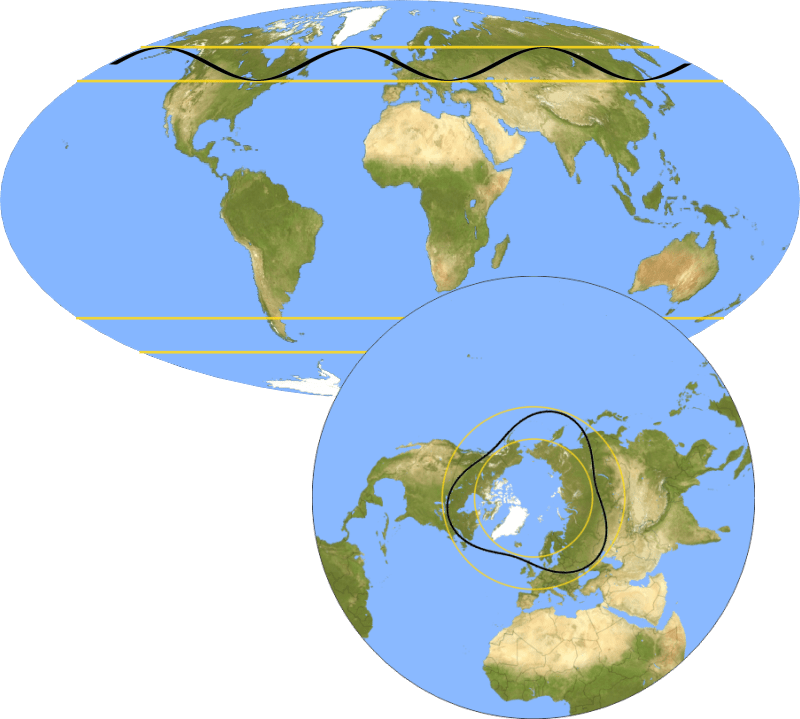
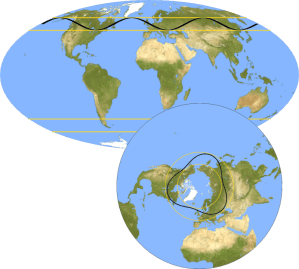
“Mm-hm. Remember I said that diagram is a gross simplification. One of the simplifications was to localize the stream at 60°N. Here’s a slightly less gross simplification. That ‘ring’ isn’t circular, it ranges more-or-less regularly between 60° and 45° in a nice pattern.”

“The crinkly circle looks like a coffee grinder part. So the cold just slides down that jet from Greenland to Europe.”

“Um, no. Weather doesn’t travel along the streams and the waves aren’t locked in place. The whole structure rotates eastward. Carl‑Gustaf Rossby discovered that, which is why it’s called a Rossby wave. Rossby was an early pioneer in atmospheric physics; his group’s weather predictions help decide World War II. Anyway, even Rossby waves are simplifications.”

“How much more unsimple can it be?”

“Much more. This idealized sketch shows how things might settle down under stable conditions. Conditions are rarely stable, especially now that global warming is upsetting the apple cart. The polar land areas are warming up the most, which means the polar cell’s outbound air currents are weaker and patchier than they used to be.”

“So the warm air masses can punch up closer to the poles like Summertime. Big deal.”

“Very big. Amplify the Rossby wave beyond a certain point, distortions create vortex cascades inside the peaks — the structure goes chaotic. Cold air leaks out past the warm air, like for this horrible early May snowstorm we’re getting.”

“Global warming causes cold air leaks. How about that?”

~ Rich Olcott

Belts And Zones

“This cold-brew latte concoction — good choice, Cal. Thanks.”

“You’re welcome, Cathleen. Sounded like it’d fit your mood. Hey, Sy’s latitude racetracks got me wondering. Do Jupiter’s stripes follow the same pattern?”

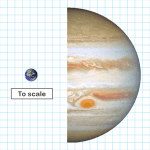
“The ‘racetracks’ exist, sort of, but they’re a very small part of a very complicated picture. Jupiter’s belts and zones are each wider than Earth. Maybe half an Earth‑width deep, too. That’s just a small fraction of Jupiter’s fluid interior. A grand arena for a host of dueling pseudo‑forces.”

“Lotsa ways for winds to work, then.”

“Indeed. Ferocious drafts everywhere, up, down and sideways. Water in all its forms is a major weather driver here on Earth. Jupiter has water, too, in multiple forms acting at multiple atmospheric levels. It also has ammonia, sulfides, phosphines, tholins, hydrocarbons, a potpourri of chemicals flavoring its hydrogen and helium. Ammonia has gas/liquid and liquid/solid transitions like water does but they happen at their own temperatures and pressures. Jupiter’s white zones are mostly ammonia ice floating a couple hundred kilometers above its brown belts of ammonium sulfides and tholins. We’re still learning about how the planet’s complicated ammonia‑sulfides system works. Compared to Jupiter, Earth’s atmosphere is a kid’s toy.”

“Earth’s a lot smaller, for sure. Do we have belts and zones?”

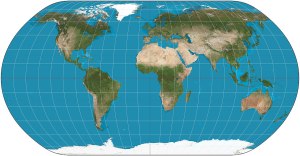
“Oh, yes. You’ve seen evidence for them on a world map, but maybe you haven’t noticed it.” <pulls up an image on her tablet> “All those deserts stretching across low latitudes north and south of the forested Equator and below the boreal forests. Pretty distinctive pattern, right?”

“How about that? My astronomy magazines carry photos from Chile’s waterless Atacama observatories all the time. I’ve never connected those with the Australian outback or Namibia’s desert. All at the same level, aren’t they? And the Sahara’s tan blotch goes all the way east to the Gobi and matches northern Mexico and USA’s high plains on the other side. The green areas must get all the water that the deserts don’t. How does that square with your vapor‑ice water pump theory?”

“Sideways, actually. I don’t claim that molecules evaporating near the Equator make it all the way to an ice sheet in a single pass. The heat energy does, eventually, but the molecules get waylaid by the Coriolis force. That’s where the racetracks come in. I can’t do better than this graphic. Each of those flattened blue ovals is a slice through an air‑mass donut that dominates its latitude range.”

“That third‑down donut pretty much covers the Sahara. Is that why it’s dry?”

“It’s a big part of the reason, but you’re way ahead of me. Look at the colored arrows inside that donut’s slice on the right. Why do they point where they do?”

“Well, we’re hottest at the Equator. Hot air rises which is why the red arrow goes up. We said rising air over the ocean carries evaporated water with it, right, which the grey arrow will drop close by as the Earth spins eastward. That’s why the Equator’s got the forest. How’m I doin’?”

“Just fine. How about the yellow and orange arrows?”

“Um, the yellow’s colliding with the next donut north so it’s gotta go down?”

“There’s more to it than that. The air up high gets chilled which makes it more dense. That’s the major reason it descends. When it gets down to ground level, though, how much water does it hold?”

“Not much, ’cause it rained out over the Equator’s forests. The orange arrow’s gonna be thirsty so it’ll pick up more water sweeping over the ocean.”

“But what if it sweeps over land?”

“Ah‑hah. It’ll suck the land dry and THAT’s why the Sahara is where it is.”

“Right. Now, those black arrows over the same cell…?”

“Northbound twisting to the right — that’s Coriolis in action. The gray arrow up top must skew eastward. By the rules, the southbound orange arrow at sea level skews west. Hey, that’s those white‑arrow trade winds. Cool.”

“Those blue donuts could be Earth’s version of Jupiter’s brown belts.”

~ Rich Olcott
Tropical beach with palm trees next to icy polar region with glaciers.

The Big Water Pump

“Springtime! Could you make me a lilac latte, Cal?”

“Maybe if I left out the coffee, Cathleen. Lilac’s too delicate to stand up to coffee’s punch. How about a cold brew of light roast? I just made a batch. Plenty of caffeine in there, not too much intensity and you can imagine the flowery part.”

“I’ll have that, and a lemon scone, please.”

“Here you go, fresh from the filter. Hey, you sure lit a fire under Sy. He’s done a whole string of posts about Coriolois Effects.”

“Tsk, Cal, the scientist’s name was Coriolis. I’m not surprised there’s been multiple posts — the same pseudo‑force shows up in many ways.”

“Pseudo‑force?”

<looks around> “Good, Sy’s not here. He’d talk our ears off about inertial frames. My quick answer from a planet scientist perspective is that real forces are the ones that make things happen in systems where everything’s moving in straight lines at a steady pace.”

“Like on a pool table?”

“Mm-hm. You can generally make good predictions on systems like that, which is how pool sharks make their money. But if part of the system is accelerating in some way, maybe it’s rotating, you’ve got two choices for predicting how the system will behave. The hard way is to calculate each individual component’s motion in a single coordinate system using just the real forces. The easier way is to group components that have a common acceleration. Pick a convenient group to serve as your base subsystem. Define another subsystem for the components that all have the same acceleration relative to the first subsystem and so on. Then you pretend a pseudo‑force drives the interactions between your subsystems.”

“Like Earth and our Moon make a subsystem ’cause they orbit the Sun together and you said rotation’s a kind of acceleration. The pseudo‑force is centrifugal, fighting against the Sun’s gravity to keep Earth’s subsystem in orbit!”

“I love it when that kind of connection‑making happens in my classroom. Thank you, Cal.”

“You’re welcome. So your subsystems are what Sy calls frames?”

“Pretty much. Skipping some technical caveats, that’s the idea. When I think about atmosphere dynamics, I could try to calculate the planet’s whole atmosphere as an incredibly messy collection of atoms. I prefer to think of the Earth as a subsystem hosting some number of air mass subsystems, all embedded in the Universe system. The Universe enforces straight‑line inertia and the Earth adds rotational acceleration but the air masses are constrained to the planet’s spherical geometry. The Coriolis pseudo‑force summarizes all three effects. The calculation’s still messy, but it’s a lot more manageable. And then there’s water.”

“Water?”

“The piston that drives the climate. Water molecules are small so they move easily through the atmosphere. The important thing is, they’re good at transporting heat energy.”

“How’s that? They’d be the same temperature as everything else.”

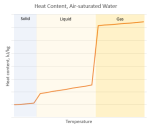
“Temperature doesn’t always measure energy. Water molecules like to hold onto other water molecules. It takes energy to get them apart. When they get back together, the energy’s released so it’s like the freed‑up molecules store heat energy. In solid water, every molecule is locked into position. Melting a given mass of water amounts to breaking those locks. The liquid mass at freezing temperature contains more energy than the ice did. When liquid water evaporates, the gas contains even more energy, because the molecules can roam even more freely. Visualize a bucket of water someplace warm.”

“A Hawai’ian beach.”

“That bucketful absorbs heat energy as it evaporates, cooling the Pacific Ocean. Winds sweep up the gas and carry it north to the Arctic where it freezes. In the process it warms the ice cap by giving up its liquid‑to‑gas heat and also its solid‑to‑liquid heat. Water’s two active phase transitions make it a far more efficient heat transporter than dry air alone.”

“One bucket’s teeny in the ocean, though.”

“Multiply that by gazillions. We have gigatons of surface water. The evaporate/freeze/melt process cycles as the icecaps degrade, continuously acting to moderate Earth’s temperature differences. If Earth were dry, the gradient would be far steeper. Thermal gradients drive air movement. A dry Earth’s extreme temperature discrepancies would generate permanent gale‑force winds towards the poles.”

~ Rich Olcott
Atmospheric Jiu-jitsu

A gorgeous early Spring day for a walk by the lake — blue sky, air just the right side of crisp, trees showing their young green leaves, geese goosily paddling around. As I pass the park bench I hear a familiar voice. “Hello, Mr Moire.”

“Morning, Walt. It’s been a while. What do your people want to know about now?”

“We’ve been reading your series of posts about the Coriolis Effect. You have masses of air pushing each other around, you have pendulums twisting about, and you have objects flying weird orbits around latitudes instead of the planet’s center. Which is the real Effect?”

“All three.”

“They’re so different. How can all three be right?”

“Knowing something of your interests, I can think of another Coriolis application will help clarify the connection. How do you steer an old‑fashioned artillery shell?”

“You don’t, you aim it.” <His eyes are looking inward.> “Those old howitzers, you traverse to the target’s coordinates, set the elevation for the distance and your munitions and whatever your barrel’s still good for, load ‘er up, let ‘er rip and wait for the forward observer to tell you how to adjust.”

“No correction for the Earth turning west‑to‑east beneath the shell’s trajectory?”

“No need. Inside a max 10‑mile range, the artillery, target and shell all share the same initial eastward vector. Windage and temperature inversions are more of a problem than Coriolis forces. That’s where judgement, feedback and reload speed come in.”

“Now stand that up against a cruise missile.”

“Very different situation. With cannons, all the propulsion happens at the start. That’s why they call it ballistic. Cruise missiles have an extended boost phase, maybe more than one, so they can do in‑flight steering. On the other hand, range is hundreds of miles or more so you do need to figure in relative easting.”

“And the easting correction takes power, right?”

“Of course.”

“From the missile’s point of view, that power goes to counteract the Coriolis force pushing it off‑course. You don’t see it from the ground but the missile does. Clearer now?”

“Give me a minute.” <sketches on his notepad> “Okay, counteracting attempt to deflect course — got it. Hmm, a pendulum’s even simpler, because it’s not trying to keep in sync with the Earth’s rotation. No forces in play crosswise to the swing plane so it can maintain orientation relative to the Universe. To museum visitors it looks like something’s twisting, but it’s us doing the moving. The air masses, though … forces are in play with that one.”

“It’s always important to keep track of who’s doing what to whom. That system has four distinct frames of reference: the Earth, a moving air mass, the air mass it collides with, and the Universe.”

“The Universe?”

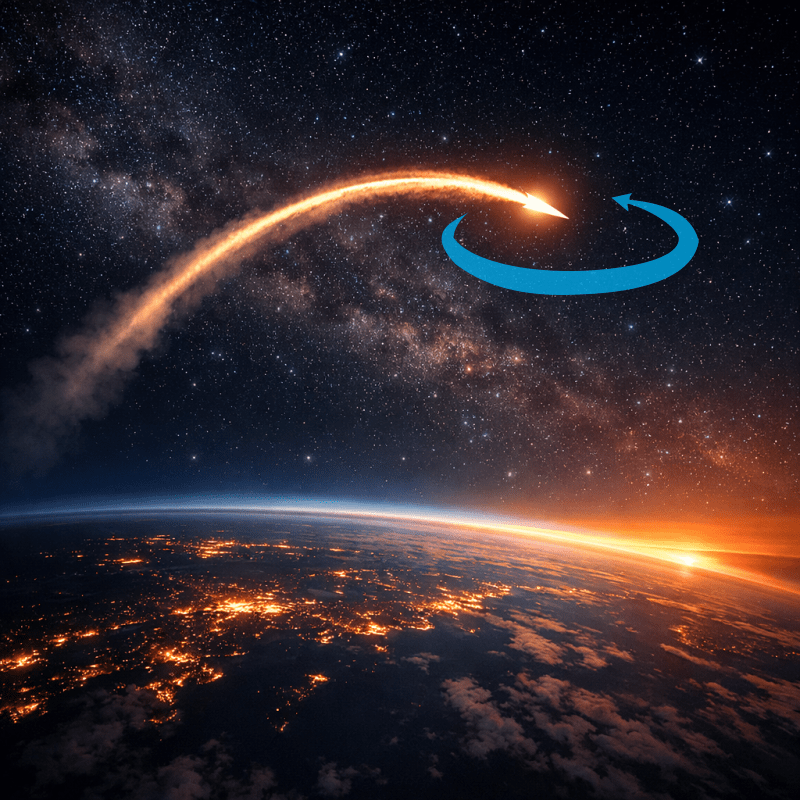
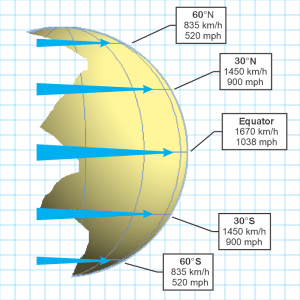
“Sets the stage for Newton’s First Law, about conservation of linear momentum. Say there’s an air mass hovering over Dallas, latitude 30° north. Relative to the Earth it’s stationary, but relative to the Sun and the rest of the Universe it has an eastward vector clocking 1450 km/hour. Now suppose that mass moves north relative to the Earth.”

“But there’s already an airmass taking up space there, say in Manitoba. There’ll be a collision, northbound momentum against Manitoban inertia.”

“Here’s where Coriolis gets into the game. Manitoba may have zero motion relative to Earth, but Manitoba and its air mass are also moving eastward relative to the Universe. Manitoba’s speed is slower than Dallas’ but it’s not zero. Manitoba’s momentum deflects the Dallas mass into an even more easterly vector.”

“You’re saying that Coriolis plays jiu‑jitsu with the atmosphere.”

“I wouldn’t have come up with that interpretation, but it’s reasonable.”

“What about the weird orbits?”

“Not really orbits, more like equilibrium bands. The concept comes from the theoretical notion that every latitude along a meridian has a natural equilibrium speed where air pressure balances other forces. The bands would be parallel circles around the globe except for geography and transient disturbances. Dallas’ 1450‑km/h number was an example. If you exceed your local natural speed, centrifugal force moves you towards the Equator; if you’re a slowpoke, you’re shoved towards the nearest pole. Real weather’s more complicated.”

“Everything’s always more complicated.”

~ Rich Olcott
The Polar Expression

“Good afternoon, Mr … Moire, yes?”

“The same. Can I help you?”

“Yes. I am Tomas Frashko. I am new to this University. I could not help overhearing—”

“The whole neighborhood couldn’t help overhearing.”

“Mmm, yes. My sympathy. But I have some questions, if you have a moment.”

“My coffee mug’s not empty yet. Please sit down. I’ll help if I can.”

“Thank you. I have often seen the Coriolis Effect explained as an atmospheric effect — northbound air with high‑speed low‑latitude momentum deflected eastward by slower‑moving air already at higher latitudes. The last part of your recent post goes to some trouble to avoid that explanation. Why is that?”

“Because the Effect doesn’t only play with the atmosphere. It drives gyre currents in the oceans and probably the magma flows deep inside Earth’s mantle.”

“So fluids, not just air. But it is still a matter of fluid with a velocity in one direction being diverted by fluid with a different velocity. Also, these cases are planet‑scale effects operating over large distances. Surely systems at small scale do not experience a measurable amount of Coriolis force.”

“But they do. Museum Foucault pendulums swing on a scale measured in meters. There’s dozens of them on display all over the world, they act just as Coriolis’ ideas predicted, and the host institutions go to a great deal of trouble to ensure the steady swinging isn’t disturbed by rushing air.”

“Ah, yes. I have seen the pendulum exhibit in our museum in the city where I grew up. A hypnotic thing, swinging back and forth on its wire, each swing a little closer to knocking down a pin … finally! Then slowly turning direction to knock down another one. The museum docent said the plane of the pendulum’s swing pivots to demonstrate Earth’s rotation, but then she mentioned that the full circle takes more than a day to complete. She couldn’t explain why.”

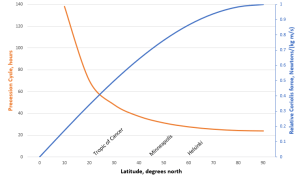
“If it were swinging from a point above the North or South Pole it would be a one-day completion, 15 arcseconds per second.. Scientists tried mounting one at the South Pole and that’s exactly what they determined. The poles are the only points on Earth’s surface where the the pendulum’s inertial frame matches Earth’s so it looks like the Earth is simply turning beneath the pendulum. On the other hand, along the Equator the Coriolis force doesn’t affect a pendulum’s motion at all.”

“Not at all?”

“Nope. Centrifugal force, a little bit, but not Coriolis force.”

“Does the one become the other?”

“Oh no, they’re quite different. Centrifugal force represents competition between dissimilarly rotating frames; Coriolis force represents their coupling. If you’re riding on a merry‑go‑round—”

“A what?”

“Mm, you’d probably call it a carousel.”

“Ah. Yes, go on.”

“If you’re riding on a carousel, your straight‑line inertia in the fairgrounds frame tries to drive you forward. To stay in position on the rotating carousel, you fight that outward inertial impetus by holding onto something. In the ride’s rotating frame, that looks like you’re exerting centripetal force to counterbalance a centrifugal force that the fairgrounds frame doesn’t see.”

“Yes, yes, but how does that differ from Coriolis force?”

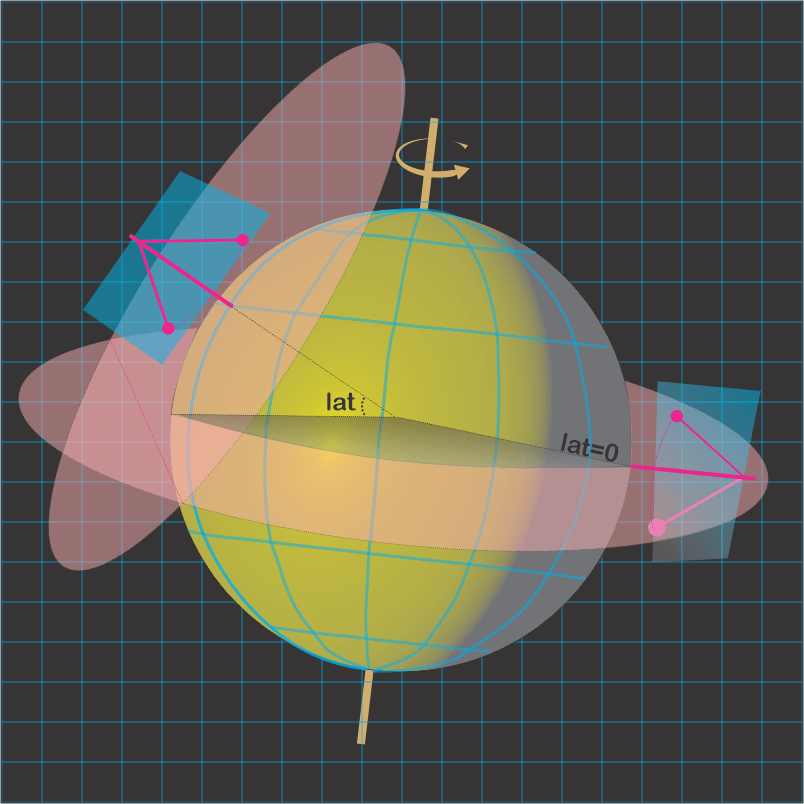
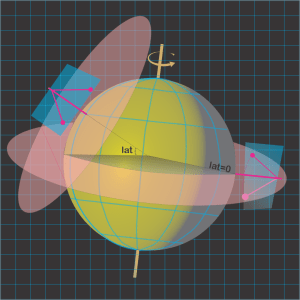
“Centrifugal force depends on an object’s distance from the center of rotation. Coriolis force doesn’t care about that. It rises with the sine of the angle between the object’s vector and the axis of rotation. On a sphere the relevant angle is the latitude. A northbound object, could be a pendulum bob, arrives at the North Pole traveling perpendicular to the Earth’s axis. Perpendicular angles have the maximum sine, 1.0. The Coriolis coupling is strongest there and that’s why a pendulum’s reference frame is locked to the Earth’s 24‑hour period. At the equator a northbound object moves parallel to the polar axis. Parallel lines have zero angle with zero sine so the Coriolis coupling’s zero. A pendulum’s plane of motion at the equator stays where it started, infinite precession completion time.”

“And in‑between?”

“In between. A pendulum’s cycle would run 27.7 hours in Helsinki, more than 60 hours at the Tropic of Cancer.”

“Small coupling, not much swerving.”

~ Rich Olcott
  • Thanks to Ric Werme for his thoughtful comments and suggestions.