
It was an interesting knock at my office door — aggressive but feminine, with a hint of desperation.
“C’mon in, the door’s open.”
She wore a business suit that must have cost a month’s rent. It fit her like it had been sewn on, and she had all the right sizes. There was a button missing from the left sleeve. On the other hand her left lapel bore a Star Trek badge, Security Section.
“What can I do for you, Miss…?”
“My name’s Victoria Baird, Mr Moire. I’m CEO of ADastra, ‘media relations for the stars.’ I’ve been reading your posts, put two and two together, and thought I’d better drop in.”
“Well, it’s nice to know I’ve got readers. Which posts caught your attention?”
“Several of them, but mostly this one,” pointing to a Web page on her smartphone. It was my Breathing Space video. “You show how gravitational waves fluctuate as they polarize local space. They induce varying curvatures in different directions. Curved space is mass, Mr Moire, but this curvature moves at lightspeed. Hadn’t you noticed that?”
“It crossed my mind, yes, but when I thought about surfing a gravitational wave like ocean surfers do, I realized you’d have to get up to the wave’s speed to ride it.”

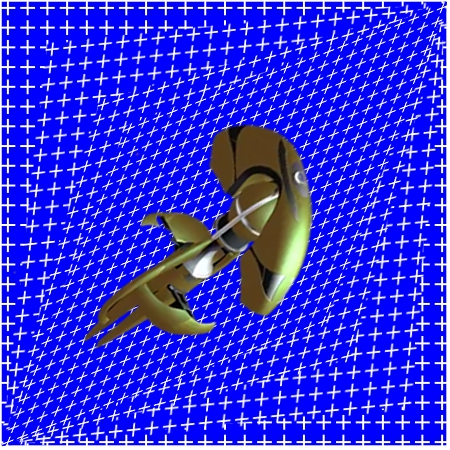
as seen in the 2009 Star Trek film
(image from the video by Rob Morey)
“There’s more. Are you familiar with that one-man starcraft that Ambassador Spock used in the 2009 Star Trek film? The ship with the rotating after-section?”
“I did see ‘Baby Star Trek,’ yes.”
“Did you know that the starcraft’s official design designation is Jellyfish?”
“No, I hadn’t heard that.”
“Well, it is. And you’ve written about Earth jellyfish, haven’t you, Mr Moire, and how their propulsion system is so efficient?”
I was getting a little tired of her aggressive questions, so I challenged her with one of my own. “And you see a connection?”
“I do, and that’s why you have to help me, Mr Moire. Can I trust you?”
“Secrets are my business, Miss Baird. Uncovering them or covering them up, it’s all the same to me.”
“Maybe I need to let my hair down.” She removed her cloche cap and her pointed ears sprang free. “I need you to get me back to my crew.”
“Can’t you just call them on that communicator badge?”
“This is costume jewelry. The spectrum here on Earth is so crowded that my real badge is useless at long range. I’ve been looking for subtle signals in the media. I thought your posts were just such a signal … but I can see you’re a local.”
“Guilty as charged. I take it the connection you saw resembled the signal you sought?”
“Yes. You’ve published two of the essential principles of the LaForge Drive. The first was your displays of spatial curvature in motion. The second was your description of how jellyfish move by stepping along a ladder of seawater vortices.
 “That’s what the LaForge Drive does, Mr Moire. The counter-rotating blades are an osmium-hassium alloy, the densest substance known, and under tremendous compression. Together their mass creates a complex pilot wave in the gravity field. The spacecraft surfs on that waveform the way a jellyfish surfs on the eddies it creates.
“The wave’s phase velocity exceeds lightspeed by some enormous factor we’ve never been able to measure. In fact, I’m here on Earth because I was on a research cruise to find if there’s a limit. We … ran into a problem and I’m part of an away team sent to procure … something we need.”
“That trope’s been done to death, Miss Baird. And besides, that design wouldn’t be practical. What’s your real story?”
“What do you mean it’s not practical?”
“You can’t steer. Pilot waves follow the most intense local spatial curvature, which means the craft will always home like a torpedo on the nearest large mass.”
Suddenly that badge chirped. “We’ve recovered the detonator, Lieutenant. Have you kept him from looking out the window?”
“Yes, his eyes have been on me the whole time. Ready for beam-up. Goodbye, Mr Moire, that was fun.”
Her form began to shimmer, twinkle … and disappeared.
“Don’t mention it.”
~~ Rich Olcott

 “Squeeze in two sides, pop out the other two, eh?”


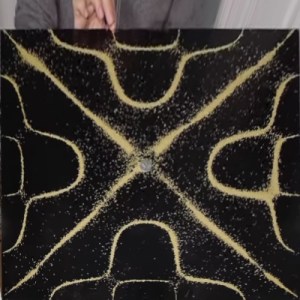
 The underlying physics is straightforward. The string produces a stable tone only if its motion has nodes at both ends, which means the vibration has to have a whole number of nodes, which means you have to pluck halfway between two of the nodes you want. If you pluck it someplace like 39¼:264.77 then you excite a whole lot of frequencies that fight each other and die out quickly.
 Add a few more planets in a random configuration and stability goes out the window — but then something interesting happens. It’s
 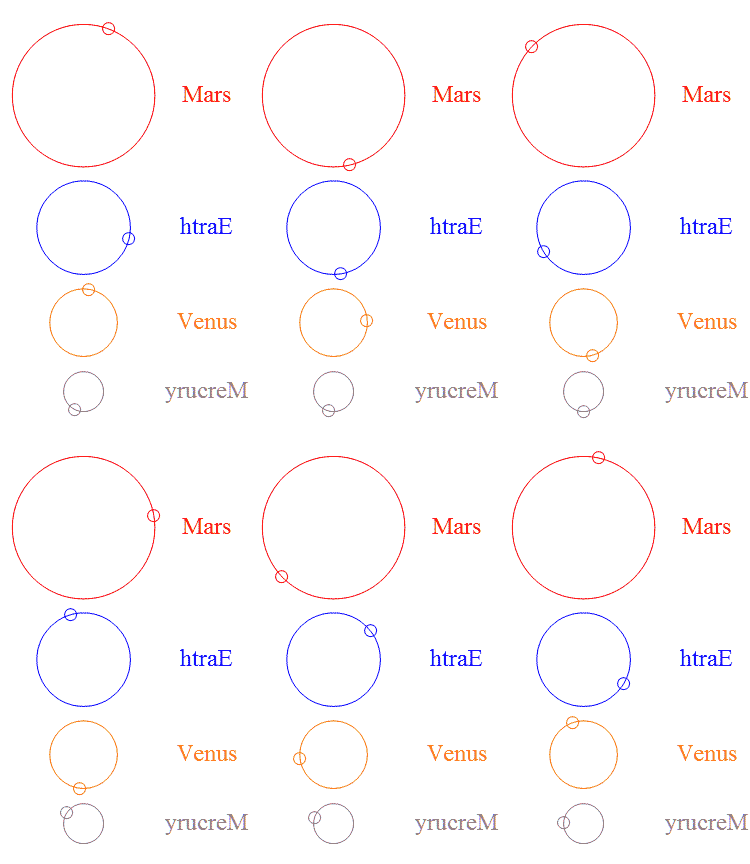 The usual rings-around-the-Sun diagram doesn’t show the specialness of the orbits we’ve got. This chart shows the four innermost planets in their “ideal” orbits, properly scaled and with approximately the right phases. I used artistic license to emphasize the gear-like action by reversing Earth’s and Mercury’s direction. Earth and Mars are never near each other, nor are Earth and Venus.



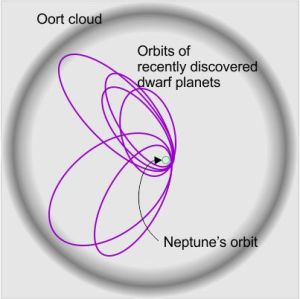


 This video, from an Orbits Table display at the Denver Museum of Nature and Science, shows a different Plutonian weirdness. We’re circling the Solar System at about 50 times Earth’s distance from the Sun (50 AU). Reading inward, the white lines represent the orbits of Neptune, Uranus, Saturn and Jupiter. The Asteroid Belt is the small greenish ring close to the Sun. The four terrestrial planets are even further in. The Kuiper Belt is the greenish ring that encloses the lot.
 Before you get any further in this post, follow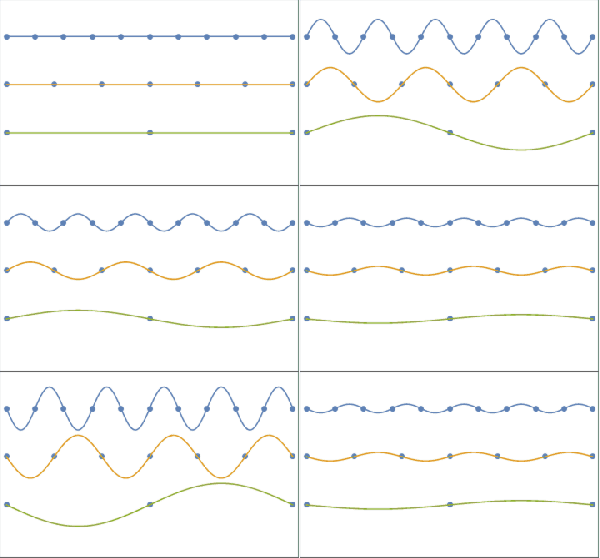
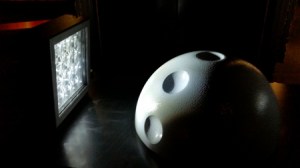 This photo, part of the LAMP exhibit at the Denver Museum of Nature and Science, shows why. It’s a model of a cratered Moon lit by sunlight.


 Hard Science Ain't Hard

