
Some people are born to scones, some have scones thrust upon them. As I stepped into his coffee shop this morning, Al was loading a fresh batch onto the rack. “Hey, Sy, try one of these.”
“Uhh … not really my taste. You got any cinnamon ones ready?”
“Not much for cheddar-habañero, huh? I’m doing them for the hipster trade,” waving towards all the fedoras on the room. “Here ya go. Oh, Vinnie’s waiting for you.”
I navigated to the table bearing a pile of crumpled yellow paper, pulled up a chair. “Morning, Vinnie, how’s the yellow writing tablet working out for you?”
“Better’n the paper napkins, but it’s nearly used up.”
“What problem are you working on now?”
“OK, I’m still on LIGO and still on that energy question I posed way back — how do I figure the energy of a photon when a gravitational wave hits it in a LIGO? You had me flying that space shuttle to explain frames and such, but kept putting off photons.”
“Can’t argue with that, Vinnie, but there’s a reason. Photons are different from atoms and such because they’ve got zero mass. Not just nearly massless like neutrinos, but exactly zero. So — do you remember Newton’s formula for momentum?”
“Yeah, momentum is mass times the velocity.”
“Right, so what’s the momentum of a photon?”
“Uhh, zero times speed-of-light. But that’s still zero.”
“Yup. But there’s lots of experimental data to show that photons do carry non-zero momentum. Among other things, light shining on an an electrode in a vacuum tube knocks electrons out of it and lets an electric current flow through the tube. Compton got his Nobel prize for that 1923 demonstration of the photoelectric effect, and Einstein got his for explaining it.”
“So then where’s the momentum come from and how do you figure it?”
“Where it comes from is a long heavy-math story, but calculating it is simple. Remember those Greek letters for calculating waves?”
(starts a fresh sheet of note paper) “Uhh… this (writes λ) is lambda is wavelength and this (writes ν) is nu is cycles per second.”
“Vinnie, you never cease to impress. OK, a photon’s momentum is proportional to its frequency. Here’s the formula: p=h·ν/c. If we plug in the E=h·ν equation we played with last week we get another equation for momentum, this one with no Greek in it: p=E/c. Would you suppose that E represents total energy, kinetic energy or potential energy?”
“Momentum’s all about movement, right, so I vote for kinetic energy.”
“Bingo. How about gravity?”
“That’s potential energy ’cause it depends on where you’re comparing it to.”
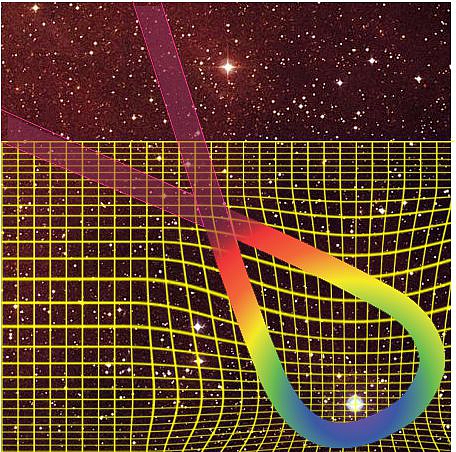
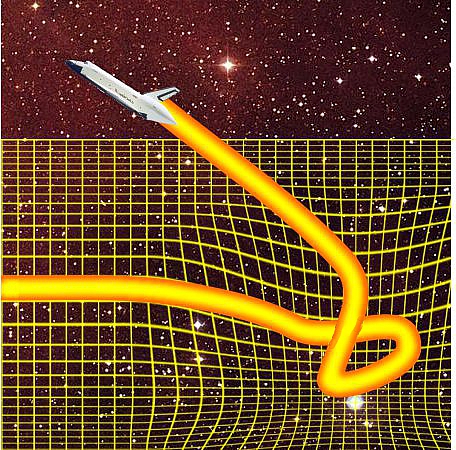
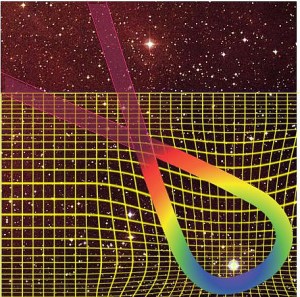 “OK, back when we started this whole conversation you began by telling me how you trade off gravitational potential energy for increased kinetic energy when you dive your airplane. Walk us through how that’d work for a photon, OK? Start with the photon’s inertial frame.”
“That’s easy. The photon’s feeling no forces, not even gravitational, ’cause it’s just following the curves in space, right, so there’s no change in momentum so its kinetic energy is constant. Your equation there says that it won’t see a change in frequency. Wavelength, either, from the λ=c/ν equation ’cause in its frame there’s no space compression so the speed of light’s always the same.”
“Bravo! Now, for our Earth-bound inertial frame…?”
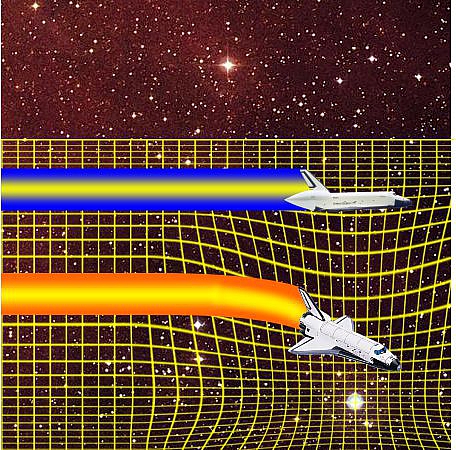
“Lessee… OK, we see the photon dropping into a gravity well so it’s got to be losing gravitational potential energy. That means its kinetic energy has to increase ’cause it’s not giving up energy to anything else. Only way it can do that is to increase its momentum. Your equation there says that means its frequency will increase. Umm, or the local speed of light gets squinched which means the wavelength gets shorter. Or both. Anyway, that means we see the light get bluer?”
“Vinnie, we’ll make a physicist of you yet. You’re absolutely right — looking from the outside at that beam of photons encountering a more intense gravity field we’d see a gravitational blue-shift. When they leave the field, it’s a red-shift.”
“Keeping track of frames does make a difference.”
Al yelled over, “Like using tablet paper instead of paper napkins.”
~~ Rich Olcott
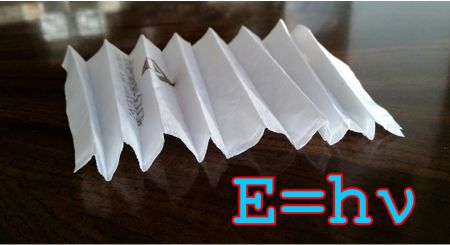
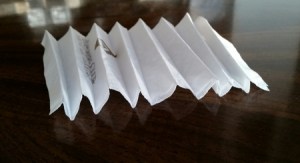 I smoothed out one of Vinnie’s crumpled napkins. As I folded it into pleats and scooted it along the table I said, “Doesn’t mess up the wave so much as change the way we think about it. We’re used to graphing out a spatial wave as an up-and-down pattern like this that moves through time, right?”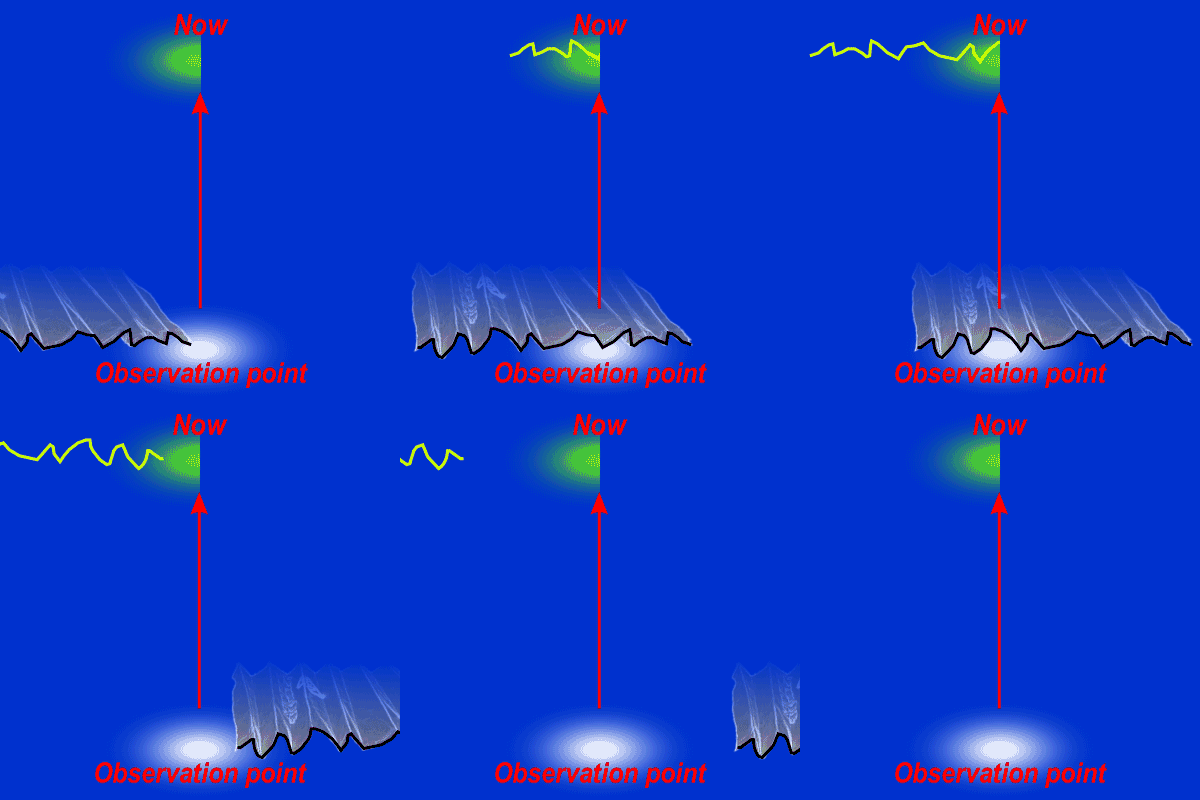

 All this before Mr Sonny Perdue III is confirmed as the new Secretary of Agriculture. That name rings a bell, right? Yeah, Perdue Farms, the country’s #3 poultry farmer. It’s hard not to connect dots to the Department suddenly wanting to hide farm inspection records.





 “Does the Moon go around the Earth or does the Earth go around the Moon?”

 “That’s what the LaForge Drive does, Mr Moire. The counter-rotating blades are an osmium-

 “Squeeze in two sides, pop out the other two, eh?”

