Abstract Horses

It was a young man’s knock, eager and a bit less hesitant than his first visit.

“C’mon in, Jeremy, the door’s open.”

“Hi, Mr Moire, it’s me, Jerem…  How did ..?  Never mind.  Ready for my black hole questions?”

“I’ll do what I can, Jeremy, but mind you, even the cosmologists are still having a hard time understanding them.  What’s your first question?”

“I read where nothing can escape a black hole, not even light, but Hawking radiation does come out because of virtual particles and what’s that about?”

“That’s a very lumpy question.  Let’s unwrap it one layer at a time.  What’s a particle?”

“A little teeny bit of something that floats in the air and you don’t want to breathe it because it can give you cancer or something.”

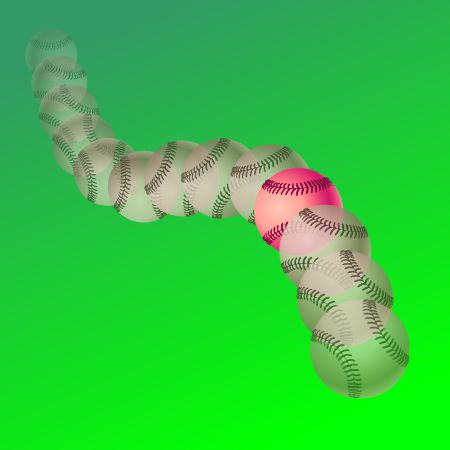
“That, too, but we’re talking physics here.  The physics notion of a particle came from Newton.  He invented it on the way to his Law of Gravity and calculating the Moon’s orbit around the Earth.  He realized that he didn’t need to know what the Moon is made of or what color it is.  Same thing for the Earth — he didn’t need to account for the Earth’s temperature or the length of its day.  He didn’t even need to worry about whether either body was spherical.  His results showed he could make valid predictions by pretending that the Earth and the Moon were simply massive points floating in space.”

Accio abstractify!  So that’s what a physics particle is?”

“Yup, just something that has mass and location and maybe a velocity.  That’s all you need to know to do motion calculations, unless the distance between the objects is comparable to their sizes, or they’ve got an electrical charge, or they move near lightspeed, or they’re so small that quantum effects come into play.  All other properties are irrelevant.”

“So that’s why he said that the Moon was attracted to Earth like the apple that fell on his head was — in his mind they were both just particles.”

“You got it, except that apple probably didn’t exist.”

“Whatever.  But what about virtual particles?  Do they have anything to do with VR goggles and like that?”

“Very little.  The Laws of Physics are optional inside a computer-controlled ‘reality.’  Virtual people can fly, flow of virtual time is arbitrary, virtual electrical forces can be made weaker or stronger than virtual gravity, whatever the programmers decide will further the narrative.  But virtual particles are much stranger than that.”

“Aw, they can’t be stranger than Minecraft.  Have you seen those zombie and skeleton horses?”Horses

“Yeah, actually, I have.  My niece plays Minecraft.  But at least those horses hang around.  Virtual particles are now you might see them, now you probably don’t.  They’re part of why quantum mechanics gave Einstein the willies.”

“Quantum mechanics comes into it?  Cool!  But what was Einstein’s problem?  Didn’t he invent quantum theory in the first place?”

“Oh, he was definitely one of the early leaders, along with Bohr, Heisenberg, Schrödinger and that lot.  But he was uncomfortable with how the community interpreted Schrödinger’s wave equation.  His row with Bohr was particularly intense, and there’s reason to believe that Bohr never properly understood the point that Einstein was trying to make.”

“Sounds like me and my Dad.  So what was Einstein’s point?”

“Basically, it’s that the quantum equations are about particles in Newton’s sense.  They lead to extremely accurate predictions of experimental results, but there’s a lot of abstraction on the way to those concrete results.  In the same way that Newton reduced Earth and Moon to mathematical objects, physicists reduced electrons and atomic nuclei to mathematical objects.”

“So they leave out stuff like what the Earth and Moon are made of.  Kinda.”

“Exactly.  Bohr’s interpretation was that quantum equations are statistical, that they give averages and relative probabilities –”

“– Like Schrödinger’s cat being alive AND dead –”

“– right, and Einstein’s question was, ‘Averages of what?‘  He felt that quantum theory’s statistical waves summarize underlying goings-on like ocean waves summarize what water molecules do.  Maybe quantum theory’s underlying layer is more particles.”

“Are those the virtual particles?”

“We’re almost there, but I’ve got an appointment.  Bye.”

“Sure.  Uhh… bye.”

~~ Rich Olcott

Wikipedia Skillz

A young man’s knock, eager yet a bit hesitant.

“C’mon in, the door’s open.”

Tall kid, glasses, hoodie thrown back.

“Hi, Mr Moire, can I ask you some questions?  I’m doing a term paper on black holes and I’ve read up on in Wikipedia but there’s things I don’t understand and besides Ms Plenum said not to trust Wikipedia.”

“Hold on, son, let’s get acquainted first.  You are…?”

“My name’s Jeremy Yazzie, sir, and I’m like Richard Feynman’s archetypical intelligent high school student he wanted to explain things to except he gave up on particle spin.”

“Well, you have done your homework, though you’ve muddled a couple of his quotes.  But about Wikipedia — Ms Plenum’s mostly right but in my experience the technical articles are pretty dependable.  Those writers are usually more interested in explaining than convincing.  Have you checked Wikipedia’s Talk pages?”

“There’s, like, comments?”

“Sort of, except Talk pages lie behind articles and target what’s right or wrong and what should be changed to make the article better.  I often learn as much from the technical discussion as I do from the article itself.”

wikieyes
A riff on Wikipedia’s logo, original in Wikimedia Commons

“I’ve never seen those pages.  How do I get to them?”

“You need a desktop view.  That’s the standard view when you use a desktop or laptop computer, but you can only maybe get to it on a handheld device.  Depends on the device, the browser, and even their maintenance levels.  Do you have a handheld in that backpack?”

“Yeah, an iPad.”

“Safari, Firefox and Chrome can all show that other view.”

“I’ve got all three.”

“Great, pull up Chrome, get to Wikipedia and look up ‘Black hole.'”

… “Got it.  Uhh… don’t see anything about a Talk page.”

“You’re looking at ‘mobile mode.’  See that three-dots icon at the top right?  Tap on it and check the pop-up menu.”

“Hah, here’s one that says, Request Desktop Site.  I’ll tap on that.  Hey, now I’ve got tabs above the text, one says Article and another that says Talk.  Whoa, here’s one that says View Source.  Whups, now there’s a box that says I can start editing.  Better not, huh?  How do I get out of that?”

“Tap your browser’s backup button.  By the way, even though in principle anyone can edit any article, the Wikipedia moderators have locked down some of the most popular or controversial just to prevent update wars.  This article’s one of those.”

“Yeah, I just backed up then tried View Source again and it says I’m not an established registered user.  No duh, right?  OK, lessee what’s in the Talk page.  Umm, how-to stuff and then organization stuff and then, huh! ‘this article has been rated GA-class on the quality scale.’ People come around and, like, check your work?”

“Absolutely, which is why I think Ms Plenum’s advice is a little too pessimistic.  Trust but verify — if you see something you’d like to quote but you don’t want to look foolish, double-check with another source.  But on the whole I’ve found the science, math and other technical articles to be trustworthy.”

“Aha, the first set of comments is about my questions, Hawking radiation and how black holes evaporate and what are virtual particles and like that.”

“So many questions, so little time.  Let’s finish off with the browser issue before we dive into physics.  Bring up your Firefox browser on that iPad.”

“All right.  Mmm, I’m going to Wikipedia, and I’m searching for ‘Black hole’ … got it, but the display doesn’t have tabs or a three-dot icon.”

“Firefox has two ways to get to desktop mode.  One way is to tap the three-bar icon at the top right…”

“YESS! the pop-up menu has half-a-dozen options and there’s Request Desktop Site.  Hey, it toggles, I can flip modes back and forth.  Sweet!  What’s the other way?”

“Press-and-hold the reload circle-arrow in the address bar.”

“A-hah, that opens a Request Desktop Site button right under the arrow.  Cool, that’s a toggle, too.  How does Safari handle this stuff?”

“They use the reload circle-arrow ploy, same as Firefox, dunno who did it first.”

“Oops, late for class.  Seeya.”

“Don’t mention it.”

~~ Rich Olcott

Questions, Meta-questions and Answers

<We rejoin Sy and Vinnie in the library stacks…> “Are you boys discussing me?”

<unison> “Oh, hi, Ramona.”

“Actually no, Ramona, we were discussing relativistic time dilation.”

“I know that, Sy, I’ve been reading your posts. Now I’ve got a question.”

“But how…?  Never mind.  Guess I’d better watch my writing.  What can I do for you?”

“You and Vinnie have been going on about kinetic time dilation and gravitational time dilation like they’re two separate things, right?”

“That’s how we’ve treated them, right, but the textbooks do the same.  The velocity-dependent time-stretch equation, tslow/tfast = √[1-(v²/c²)], comes out of Einstein’s Special Theory of Relativity. The gravity-dependent equation, tslow/tfast = √[1-(2G·M/r·c²)], came from his General Theory of Relativity.”

“But there’s no rule that says an object can’t be moving rapidly while it’s in a gravitational field, is there?  That Endurance spacecraft orbiting the black hole in the Interstellar movie certainly seemed to be in that situation.”

“No question, Ramona.  General Relativity’s just more, er, general.”

“Fine, but shouldn’t they work together?”

That got Vinnie started.  “Yeah, Sy, I started this with LIGO and gravity but you and those space shuttles got me into this speed thing.  How do you bridge ’em?”

“Not easily.  Einstein set the rules of the game when he wrote down his fundamental equations.  Physicists and mathematicians have been trying to solve them ever since.  Schwarzchild found the first solution within a year after the equations hit the streets, but he did the simplest possible system — a non-rotating spherical object with no electrical charge and alone in the Universe.  It took another half-century before Kerr and friends figured out how to handle rotating spheres with an electric charge, but even those objects are assumed to be isolated from all other masses.  Mm … how do you figure velocity, Vinnie?”

“Distance divided by time, easy.”

“Not quite that easy.  The equations say that if you’re close to a massive object, space gets compressed, time gets stretched, and the time and space dimensions get scrambled.  Literally.  Time near a Schwarzchild object points inward as you approach the sphere’s center, and don’t ask me how to visualize that.  A Kerr object has a belt around its equator where time runs backwards.  Craziness.”

“Well, how about if I’m not that close?”

“That’s easier to answer, Ramona.  Suppose the three of us are each flying at safe distances from some heavy object with mass M.  I’m farthest away so I’m holding the fastest clock.  We’ll compare Vinnie’s and your clocks to mine.  OK?”3-clocks

“Sure, why not?”

“Fine.  Now, Vinnie, you’re closer in, resting on the direct line between me and the object.  You’re at distance r from it.  How fast does your clock run?”

“Uhhh…  We’re both on that same radial line so we’re in the same inertial frame, no kinetic effect.  I suppose you see it ticking slower because of the gravitational effect.”

“M-hm, and my clock ticks how often between ticks of yours?”

“You want the equation, huh?  All right, it’s tvinnie/tsy = √[1-(2G·M/r·c²)].”

“You’re reading my mind with those subscripts.  Now, Ramona, you’re at that same distance from the object but you’re in orbit around it.  Measured against Vinnie’s position you’ve got velocity v.  How fast is his clock ticking compared to yours?”

“Mmm…  We’re at the same level in the gravity field, so the gravitational thing makes no difference.  So … tramona/tvinnie = √[1-(v²/c²)].  Aaand, he’d see my clock running slow by the same amount. That’s weird.”

“Weird but true.  Last step — Ramona, you’re deeper in the gravitational field and you’re speeding away from me, so tramona/tsy=(tramona/tvinnie)*(tvinnie/tsy)=√[1-(2G·M/r·c²)]*√[1-(v²/c²)] covers both.”

“OK, that’s settled.  Back to Vinnie’s original question.  LIGOs are set in concrete, their velocities are zero so LIGO signals are all about gravity, right?”

“Right.”

Ramona links arms with him.  “Let’s go dancing.”  Then she gives me the eye.  “Sugarlumps, Sy?  Really?”

On the 12th floor of the Acme Building, high above the city, one man still tries to answer the Universe’s persistent questions — Sy Moire, Physics Eye.

~~ Rich Olcott

Weight And Wait, Two Aspects of Time

I was deep in the library stacks, hunting down a journal article so old it hadn’t been digitized yet.  As I rounded the corner of Aisle 5 Section 2, there he was, leaning against a post and holding a clipboard.

“Vinnie?  What are you doing here?”

“Waiting for you.  You weren’t in your office.”

“But how…?  Never mind.  What can I do for you?”

“It’s the time-dilation thing.  You said that there’s two kinds, a potential energy kind and a kinetic energy kind, but you only told me about the first one.”

“Hey, Ramona broke up that conversation, don’t blame me.  You got blank paper on that clipboard?”

“Sure.  Here.”

“Quick review — we said that potential energy only depends on where you are.  Suppose you and a clock are at some distance r away from a massive object like that Gargantua black hole, and my clock is way far away.  I see your clock ticking slower than mine.  The ratio of their ticking rates, tslow/tfast = √[1-(2G·M/r·c²)], only depends on the slow clock’s position.  Suppose you move even closer to the massive object.  That r-value gets smaller, the fraction inside the parentheses gets closer to 1, the square root gets smaller and I see your clock slow down even more.  Sound familiar?”

“Yeah, but what about the kinetic thing?”time-and-the-rovers

“I’m getting there.  You know Einstein’s famous EEinstein=m·c² equation.  See?  The formula contains neither a velocity nor a position.  That means EEinstein is the energy content of a particle that’s not moving and not under the influence of any gravitational or other force fields.  Under those conditions the object is isolated from the Universe and we call m its rest mass.  We good?”

“Yeah, yeah.”

“OK, remember the equation for gravitational potential energy?”

E=G·M·m/r.

“Let’s call that Egravity.  Now what’s the ratio between gravitational potential energy and the rest-mass energy?”

“Uh … Egravity/EEinstein = G·M·m/r·m·c² = G·M/r·c². Hey, that’s exactly half the fraction inside the square root up there. tslow/tfast = √[1-(2 Egravity/EEinstein)].  Cool.”

“Glad you like it.  Now, with that under our belts we’re ready for the kinetic thing.  What’s Newton’s equation for the kinetic energy of an object that has velocity v?”

E=½·m·v².

“I thought you’d know that.  Let’s call it Ekinetic.  Care to take a stab at the equation for kinetic time dilation?”

“As a guess, tslow/tfast = √[1-(2 Ekinetic/EEinstein)]. Hey, if I plug in the formulas for each of the energies, the halves and the mass cancel out and I get tslow/tfast = √[1-2(½m·v²/m·c²)] = √[1-(v²/c²)].  Is that it?”

“Close.  In Einstein’s math the kinetic energy expression is more complicated, but it leads to the same formula as yours.  If the velocity’s zero, the square root is 1.0 and there’s no time-slowing.  If the object’s moving at light-speed (v=c), the square root is zero and the slow clock is infinitely slow.  What’s interesting is that an object’s rest energy acts like a universal energy yardstick — both flavors of time-slowing are governed by how the current energy quantity compares to EEinstein.”

“Wait — kinetic energy depends on velocity, right, which means that it’ll look different from different inertial frames.  Does that mean that the kinetic time-slowing depends on the frames, too?”

“Sure it does.  Best case is if we’re both in the same frame, which means I see you in straight-line motion.  Each of us would get the same number if we measure the other’s velocity.  Plug that into the equation and each of us would see the same tslow for the other’s clock.  If we’re not doing uniform straight lines then we’re in different frames and our two dilation measurements won’t agree.”

“… Ramona doesn’t dance in straight lines, does she, Sy?”

“That reminds me of Einstein’s quote — ‘Put your hand on a hot stove for a minute, and it seems like an hour. Sit with a pretty girl for an hour, and it seems like a minute. That’s relativity.‘  You’re thinking curves now, eh?”

“Are you boys discussing me?”

<unison> “Oh, hi, Ramona.”

~~ Rich Olcott

Goldilocks Zone and The Three Gazillion Bears

“Tell me a bedtime story, Uncle Sy.”

“OK, Teena, what kind of story?”

“One with bears in it.  Nice bears.”

“Hmm…  How about ‘Goldilocks Zone and The Three Gazillion Bears’?”

“Gazillion?  Is that what kind of a bear they are?”

“No, that’s a number word.  It means ‘more than you could ever hope to count.’  Like a million but way way more.”

“But if you can’t count them, how do you know there are three times that many?”

“You’ll see, have patience.”

“Little girls don’t have patience, Uncle Sy, I wanna hear the story.  Wait, water bears?”

“Mm-hm, they’re a different kind of bear.”

“What’s different about them, and what do they do with water?  I bet they swim.”

“Why yes, they do.  In fact, they spend most of their time in water or at least being wet.  Another thing that’s special about them is that they’re tiny, about the size of the smallest dot you can see on your Mommy’s computer screen here.”
waterbear 1“If they’re so small, why are they called bears?”

“Take a look.  Doesn’t she look kind of like a nice bear?”

“She’s got too many legs.”

“She’s got just the right number for water bears.”

“And she’s green.”

“Well, yes, but the picture’s kind of pretend and doesn’t show proper colors.  She’s so small she’s almost transparent.  She eats particles of algae and such, so maybe in real life she might be sort of green.”

“I like the way she’s smiling.  She reminds me of …  the fat man in the Laurel-n-Hardy movie you showed me last Saturday.”

“Oliver Hardy?  Yeah, I can see that.  Except the smiley bit is actually a wrinkle.  Her mouth is the round thing that looks like a nose.”

“That’s silly.  If her nose is her mouth how can she breathe?”

“Through her skin.  Animals can do that if they’re very small.”

“How else is she different?”

“Well, her kind’s one of Earth’s oldest animals.  Scientists have found water bear fossils over 500 million years old, twice as old as the oldest dinosaur.”

“Older than dinosaurs!”

“But the big thing and the big puzzle is, they’re amazingly rugged little beasties.  They live all over the world — high on mountaintops, at the bottom of the sea, next to ice at the South Pole and next to boiling hot springs.  In experiments, water bears have survived doses of chemicals and radiation that would kill most other creatures.  Astronauts on the ISS even exposed dried-out water bears to the vacuum of space.  The little guys just got happy-active again when they were brought back inside and dunked in some water.”

“What’s the puzzle?”

“Why are they so tough?  They make special molecules that protect them against dehydration and radiation and toxins even though they live in wet environments that don’t get irradiated and rarely get poisoned.  Fish and insects that evolved in lightless caves stopped using energy to make eyes they don’t need.  Why or even how have water bears held onto all that specialized protective DNA for hundreds of millions of years?”

“Does anybody know the answer?”

“Nope.  Some people have guessed that because water bears can survive exposure to space, maybe they came to Earth from another planet somewhere.  Maybe some advanced civilization sprayed water bears out into the Universe to spread life around.  Doesn’t that sound spooky?”

“Ooohh, yeah.  I like that.  Water bears from space!”

“But it gets better.  Maybe there’s different kinds of water bears for different kinds of planets.  That’s where Goldilocks Zones come in.  What did Goldilocks say about the porridge?”

“This bowl’s too hot and this bowl’s too cold, but this bowl is j-u-s-t right!”Water bears and planet“Yup, and that’s one way astronomers can classify planets.  Earth’s in the Goldilocks Zone for liquid water, essential for life as we know it.  Saturn’s moon Titan might support some other kind of life in its cold hydrocarbon seas.  If that’s the case, there’d be a much colder Goldilocks Zone for that kind of life.  Maybe there’s another, hotter Goldilocks Zone for life that’s happy in molten silica.  And maybe there’s water bears designed for each kind of Goldilocks Zone.”

“Mommy, Uncle Sy’s being silly again.”

“Nighty-night, Teena-girl.  Sweet dreams.”

“Nighty-night.”

~~ Rich Olcott

How Many Ways Can You Look at The Sky?

Cathleen and I were discussing her TRAPPIST-1 seminar in Al’s coffee shop when a familiar voice boomed over the room’s chatter.

“Hey, Cathleen, I got questions.”

“Vinnie?”

“Yeah, Sy, he hangs out with the Astronomy crew sometimes.  You know him, too, huh?”

“From way back.  Long story.”

“What’re your questions, Vinnie?”

“I missed the start of your talk, Cathleen, but why so much hype about this TRAPPIST-1 system?  We’ve already found 3,500 stars with planets, right, and some of them have several.  What’s so special here?”

“You’re right, Vinnie, Kepler-90 has seven planets, just like TRAPPIST-1. (brandishes a paper napkin)  But that star’s more than 60 times further from us than TRAPPIST-1 is.  It’s just too far away for us to be able to learn much more about the planets than their masses and orbital characteristics.  This new system’s only 40 lightyears away, close enough that we’ve got a hope of seeing what’s in the planetary atmospheres.”

(another paper napkin)  “That ties in with the second thing that’s special.  The star’s surface temperature, 2550ºK, is so low that even though its planets orbit very close in, three of them are probably in the Goldilocks Zone.  They’re not too hot and not too cold for liquid water to exist on their surface.  IF there’s liquid water on one of them and IF there’s something living there, we should be able to detect traces of that biochemistry in the planet’s atmosphere.”

Star demographics
Observational data (dots) and four different models
of star count (vertical axis) versus temperature.
Hotter stars are to the left.

(napkin #3)  “The third special thing is that TRAPPIST-1 is the first-known planet-hosting star in its category — ultra-cool dwarf stars burning below 2700°K.  Finding those stars is hard — they’re small and dim.  No-one really knows how many there are compared to the other categories.  Some models say they should be rare, other models suggest they could be as common as G-type stars like our Sun.  IF there’s lots of ultra-cool dwarfs and IF they generally have planets like G-type stars do, then the category’s a new prime target for exoplanet hunters seeking life-signs.”

“Why’s that?”

“Because it’s easier to spot a small planet around a small star than around a big one.  Transits across TRAPPIST-1 dim its light by 1% or so.  A TRAPPIST-1 planet transiting our Sun would dim it by 1/100th of that.  The same problem hinders planet-finding methods fishing for stars that wobble because a planet’s orbiting around it.”

“Alright, I get that TRAPPIST-1 is special.  My other question is, I heard the part of your talk where you figured the odds on seeing its transits, but you lost me with the word steradian.  My dictionary says that’s an area on a sphere divided by the square of the sphere’s radius. What would that get me?  Where’d your numbers come from?”

“You need one additional piece of information.  If you take any sphere’s total surface area and divide that by r², you’ll always get 4π steradians.  You can use that to convert between absolute surface area and fraction of the sphere.  Mmm…  Sy, you own some land outside of town, yes?”

“A little.”

“And you have mineral rights?”

“Oh, yeah, that’s why I bought it.”

“And they go how far down?”

“All the way to the center of the Earth.”

“So your claim’s actually a pyramid 6370 kilometers deep.  When I moved here I learned it’s impolite to ask how much land someone has.  For round numbers I’ll assume 40 acres, which is about 1,000 square meters.  (tapping keys on her smartphone)  The Earth’s radius is 6.37×10⁶ meters, so Sy’s claim is 1,000/(6.37×106)2 = 2.47×10⁻¹¹ steradians.  Divide 4π by that and you get … 5.08×10¹¹.  So Earth’s entire surface has room for 5.08×10¹¹ patches matching Sy’s.  Visualize 5.08×10¹¹ pyramids pointing in every direction from Earth’s center.  Now extend each pyramid outward to define a separate patch of sky.  Got that picture, Vinnie?”viewing cones

“Sort of.”

“TRAPPIST-1 is 3.74×10¹⁷ meters away.  TRAPPIST-1h’s orbit is a near-circle whose radius is 9.45×10⁹ meters.  It covers π(9.45×10⁹)2/(3.74×1017)2 = 2.00×10⁻¹⁵ steradians on a sphere centered on us. Divide 4π by 2.00×10-15 …  6.27×10¹⁵ sky-patches the size of TRAPPIST-1h’s orbit.  They had to pick the right patch to find TRAPPIST-1.”

“Long odds.”

“Yep.”

~~ Rich Olcott

The Luck o’ The (insert nationality here)

“Afternoon, Al.  What’s the ruckus in the back room?”

“Afternoon, Sy.  That’s the Astronomy crew and their weekly post-seminar coffee-and-critique session.  This time, though, they brought their own beer.  You know I don’t have a beer license, just coffee, right?  Could you go over there and tell ’em to keep it covered so I don’t get busted?”

“Sure, Al.  … Afternoon, folks.  What’s all the happy?”

“Hey, Sy, welcome to the party.  Trappist beer, straight from Belgium!”

“Don’t mind if I do, Cathleen, but Al sure would like for you to put that carton under the table.  Makes him nervous.”

“Sure, no problem.”

“Thanks.  I gather your seminar was about the new seven-planet system.  How in the world do the Trappists connect to that story?”

“Patriotism.  The find was announced by a team from Belgium’s University of Liege.  They’ve built a pair of robotic telescopes tailored for seeking out rocks and comets local to our Solar System.  Exoplanets, too.  Astronomers love tying catchy acronyms to their projects.  This group’s proudly Belgian so they called their robots TRAnsiting Planets and Planetesimals Small Telescopes, ergo TRAPPIST, to honor the country’s 14 monasteries.  And their beer.  Mainly the beer, I’ll bet.”

“So the planets are a Belgian discovery?”

“Well, the lead investigator, Michaël Gillon, is at Liege, and so are half-a-dozen of his collaborators.  Their initial funding came from the Belgian government.  But by the time the second paper came out, the one that claimed a full seven planets spanning a new flavor of Goldilocks Zone, they’d pulled in support and telescope time from over a dozen other countries — USA, India, UK, France, Morocco, Saudi Arabia… the list goes on.  So it’s Belgian mostly but not only.”

“I love international science.  Next question — I see the planets are listed as TRAPPIST-1b, TRAPPIST-1c, and so on up to TRAPPIST-1h.  What happened to TRAPPIST-1a?”

“Rules of nomenclature, Sy.  TRAPPIST-1a is the star itself.  Actually, the star already had a formal name, which I just happen to have written down in my seminar notes somewhere … here it is, 2MASS J23062928 – 0502285.  You can see why TRAPPIST-1 is more popular.”

“I’m not even going to ask how that other name unwinds.  So what was the seminar topic this week?”

7 planets
TRAPPIST-1’s planets,
drawn to scale against their star. The
green ones are in the Goldilocks Zone.

“The low probability for us ever noticing those planets blocking the star’s light.”

“I’d think seeing a star winking on and off like it’s sending Morse code would attract attention.”

“That’s not close to what it was doing.  It’s all about the scale.  You know those cartoons that show planets together with their host sun?”

(showing her my smartphone) “Like this one?”

“Yeah.  It’s a lie.”

“How is it lying?”

“It pretends they’re all right next to the star.   7 planets perspectiveThis image is a little better.”  (showing me her phone)  “This artist at least tried to build in some perspective.  Even in this tiny solar system, about 1/500 the radius of ours, the star’s distance to each planet is hundreds to a thousand times the size of the planet.  You just can’t show planets AND their orbits together in a linear diagram.  Now, think about how small these planets are compared to their sun.”

“Aaaa-hah!   When there’s an eclipse, only a small fraction of the light is blocked.”

“That’s part of it.  Each eclipse (we call them transits) dims the measured brightness by only a percent or so.  But it’s worse than that.”

eclipses“How so?”

“All those orbits lie in a single plane.  We can’t see the transits unless our position lines up with that plane.  If we’re as little as 1½° out of the plane, we miss them.  But it’s worse than that.”

“How so?”

“During a transit, each planet casts a conical shadow that defines a patch in TRAPPIST-1’s sky.  You can tile TRAPPIST-1’s sky with about 150,000  patches that size.  There’s one chance in 150,000 of being in the right patch to see that 1% dimming.  In our sky there are over 6×10¹⁵ patches the size of TRAPPIST-1h’s orbit.  The team had to inspect the just right patch to find it.”

“With odds like that, no wonder TRAPPIST uses robots.”

“Yep.”

~~ Rich Olcott

The New System’s in Tune

<We interrupt our running story line to bring you this important development…>

“Morning, Sy.  What can I get you?”

“My usual mugfull of black, Al.  What’s the Scone-of-The-Day?”

“I’m calling this The Trappist.  It’s got raspberry jam!”

“Why that name?”

“In honor of TRAPPIST-1, you know, that star they just found a bunch of planets around.”

“Your coffee shop being right next to the Astronomy building, I guess you’ve heard a lot about it.”

“Sy, you couldn’t believe.  The planetologists are going nuts of course, even though no-one’s actually seen the planets, and the astrometrics folks are lining up for telescope time ’cause they’ve got a whole new class of stars to monitor and of course the astrophysicists get to figure out how the system even works.”

“Astrometrics folks?  New class of stars?”

“Yeah, the high-precision star-measurers.  They didn’t used to pay attention to the small, dim stars because why bother.  But now … woo-hoo, whole new ballgame.”

“Nobody’s seen those planets?  How do they know they’re there?”

“Process of elimination, Sy.  The TRAPPIST telescopes picked up repetitive dark blips in the light coming from that star.  It’s a close, fast-moving star so there’s no sense supposing it’s like going behind or in front of a regular array of rocks or stars or something.  It’s not wobbling side-to-side like it would if it was a binary so it’s not traveling along with another star.  If the blips were sunspots going around as the star rotates there’d be only one rhythm, but these blips come in too complicated for that.  Besides, the star’s low-activity, too cool for lotsa sunspots.  Gotta be planets eclipsing it.”

trappist-1-system-450
NASA’s artistic (and cute) rendition
of the TRAPPIST-1 system
Note the close-in steam and the frost further out

“Sounds pretty good, but…”

“Hey Sy, there was something else, maybe you could explain it.  One astrophysics guy was real impressed that the planets had residences.  I didn’t understand that.”

“Residences?  That’s a new one on me.”

“Had something to do with the blip periods.  Yeah, here’s the paper napkin he wrote ’em all down on.”

Object
TRAPPIST-1x
Period, days
Resonance
Actual /
Expected
b
1.51
c
2.42
5c:8b
1.002
d
4.05
3d:5c
1.004
e
6.10
2e:3d
1.004
f
9.20
2f:3e
1.006
g
12.35
3g:4f
1.007
h
20?
5h:8g
1.012?

“Oh, resonances! That I recognize, and yeah, those numbers are much more convincing.  Remember my post about gear logic?”

“Sorry, Sy, that must’ve been a long time ago and who has time to read?”

“I understand.  OK, that post explained how planets that survive the early chaos of a forming solar system tend to wind up in orbits whose relative year-lengths form ratios of small whole numbers.  In our system, for instance, the length of Pluto’s year is exactly 3/2 of Neptune’s, Neptune’s year is twice that of Uranus, and so on.  If a planet doesn’t synch up with its neighbors, it’ll collide with someone or be flung out of the system.  Put another way, a system’s not stable if its planetary orbit periods are just any old numbers.  Make sense?”

“I suppose, so…?”

“So look at this guy’s table.  The periods of each pair of adjacent objects follow that rule almost exactly.  Five times c‘s period is less than 0.25% away from eight times b‘s, and so on all the way out to h, which I take it has an uncertain period because the guy put in that question mark.  In fact, I think this system follows the rule more tightly than our Solar System does.  As far as I’m concerned that regularity in the periods makes the case for TRAPPIST-1 having planets.  You hear anything else?”

“Yeah, there was a lot of excitement about the middle three planets being in some kind of Goldilocks zone.  What’s that about?”

“Hah, I’d be excited, too.  If a planet’s too close to the star, like Mercury is to ours, it’ll be too hot for liquid water.  If the planet’s too far, any water it has would be frozen stiff.  Either way, not good for life to grow there.  In the Goldilocks zone, it’s…”

“Just right, huh, Sy?”

“On the nose, Al.  I’m going to have to read up on TRAPPIST-1.”

~~ Rich Olcott

Three Body Problems

The local science museum had a showing of the Christopher Nolan film Interstellar so of course I went to see it again.  Awesome visuals and (mostly) good science because Nolan had tapped the expertise of Dr Kip Thorne, one of the primary creators of LIGO.  On the way out, Vinnie collared me.

“Hey, Sy, ‘splain something to me.”

“I can try, but first let’s get out of the weather.  Al’s coffee OK with you?”

“Yeah, sure, if his scones are fresh-baked.”

Al saw me walking in.  “Hey, Sy, you’re in luck, I just pulled a tray of cinnamon scones out of the oven.”  Then he saw Vinnie.  “Aw, geez, there go my paper napkins again.”

Vinnie was ready.  “Nah, we’ll use the backs of some ad flyers I grabbed at the museum.  And gimme, uh, two of the cinnamons and a large coffee, black.”

“Here you go.”

At our table I said, “So what’s the problem with the movie?”

“Nobody shrank.  All this time we been talking about how things get smaller in a strong gravity field.  That black hole, Gargantua, was huge.  The museum lecture guy said it was like 100 million times as heavy as the Sun.  When the people landed on its planet they should have been teeny but everything was just regular-size.  And what’s up with that ‘one hour on the planet is seven years back home’ stuff?”

“OK, one thing at a time.  When the people were on the planet, where was the movie camera?”

“On the planet, I suppose.”

“Was the camera influenced by the same gravitational effects that the people were?”

“Ah, it’s the frames thing again, ain’t it?  I guess in the on-planet inertial frame everything stays the relative size they’re used to, even though when we look at the planet from our far-away frame we see things squeezed together.”

(I’ve told you that Vinnie’s smart.)  “You got it.  OK, now for the time thing.  By the way, it’s formally known as ‘time dilation.’  Remember the potential energy/kinetic energy distinction?”

“Yeah.  Potential energy depends on where you are, kinetic energy depends on how you’re moving.”

“Got it in one.  It turns out that energy and time are deeply intertwined all through physics.  Would you be surprised if I told you that there are two kinds of time dilation, one related to gravitational potential and the other to velocity?”

“Nothing would surprise me these days.  Go on.”

“The gravity one dropped out of Einstein’s Theory of Special Relativity.  The velocity one arose from his General Relativity work.”  I grabbed one of those flyers.  “Ready for a little algebra?”

“Geez.  OK, I asked for it.”gargantua-3
“You certainly did.  I’ll just give you the results, and mind you these apply only near a non-rotating sphere with no electric charge.  Things get complicated otherwise.  Suppose the sphere has mass M and you’re circling around it at a distance r from its geometric center.  You’ve got a metronome ticking away at n beats per your second and you’re perfectly happy with that.  We good?”

“So far.”

“I’m watching you from way far away.  I see your metronome running slow, at only n√[1-(2 G·M/r·c²)] beats per my second.  G is Newton’s gravity constant, c is the speed of light.  See how the square root has to be less than 1?”

“Your speed of light or my speed of light?”

“Good question, considering we’re talking about time and space getting all contorted, but Einstein guarantees that both of us measure exactly the same speed.  So anyway, in the movie both the Miller’s Planet landing team and that poor guy left on good ship  Endurance are circling Gargantua.  Earth observers would see both their clocks running slow.  But Endurance is much further out (larger r, smaller fraction) from Gargantua than Miller’s Planet is.  Endurance’s distance gave its clock more beats per Earth second than the planet gets, which is why the poor guy aged so much waiting for the team to return.”

“I wondered about that.”

Then we heard Ramona’s husky contralto.  “Hi, guys.  Al said you were back here talking physics.  Who wants to take me dancing?”

We both stood up, quickly.

“Whee, this’ll be fun.”

~~ Rich Olcott

Gravity’s Real Rainbow

Some people are born to scones, some have scones thrust upon them.  As I stepped into his coffee shop this morning, Al was loading a fresh batch onto the rack.  “Hey, Sy, try one of these.”

“Uhh … not really my taste.  You got any cinnamon ones ready?”

“Not much for cheddar-habañero, huh?  I’m doing them for the hipster trade,” waving towards all the fedoras on the room.  “Here ya go.  Oh, Vinnie’s waiting for you.”

I navigated to the table bearing a pile of crumpled yellow paper, pulled up a chair.  “Morning, Vinnie, how’s the yellow writing tablet working out for you?”

“Better’n the paper napkins, but it’s nearly used up.”

“What problem are you working on now?”

“OK, I’m still on LIGO and still on that energy question I posed way back — how do I figure the energy of a photon when a gravitational wave hits it in a LIGO?  You had me flying that space shuttle to explain frames and such, but kept putting off photons.”

“Can’t argue with that, Vinnie, but there’s a reason.  Photons are different from atoms and such because they’ve got zero mass.  Not just nearly massless like neutrinos, but exactly zero.  So — do you remember Newton’s formula for momentum?”

“Yeah, momentum is mass times the velocity.”

“Right, so what’s the momentum of a photon?”

“Uhh, zero times speed-of-light.  But that’s still zero.”

“Yup.  But there’s lots of experimental data to show that photons do carry non-zero momentum.  Among other things, light shining on an an electrode in a vacuum tube knocks electrons out of it and lets an electric current flow through the tube.  Compton got his Nobel prize for that 1923 demonstration of the photoelectric effect, and Einstein got his for explaining it.”

“So then where’s the momentum come from and how do you figure it?”

“Where it comes from is a long heavy-math story, but calculating it is simple.  Remember those Greek letters for calculating waves?”

(starts a fresh sheet of note paper) “Uhh… this (writes λ) is lambda is wavelength and this (writes ν) is nu is cycles per second.”

“Vinnie, you never cease to impress.  OK, a photon’s momentum is proportional to its frequency.  Here’s the formula: p=h·ν/c.  If we plug in the E=h·ν equation we played with last week we get another equation for momentum, this one with no Greek in it:  p=E/c.  Would you suppose that E represents total energy, kinetic energy or potential energy?”

“Momentum’s all about movement, right, so I vote for kinetic energy.”

“Bingo.  How about gravity?”

“That’s potential energy ’cause it depends on where you’re comparing it to.”

light-in-a-gravity-well“OK, back when we started this whole conversation you began by telling me how you trade off gravitational potential energy for increased kinetic energy when you dive your airplane.  Walk us through how that’d work for a photon, OK?  Start with the photon’s inertial frame.”

“That’s easy.  The photon’s feeling no forces, not even gravitational, ’cause it’s just following the curves in space, right, so there’s no change in momentum so its kinetic energy is constant.  Your equation there says that it won’t see a change in frequency.  Wavelength, either, from the λ=c/ν equation ’cause in its frame there’s no space compression so the speed of light’s always the same.”

“Bravo!  Now, for our Earth-bound inertial frame…?”

“Lessee… OK, we see the photon dropping into a gravity well so it’s got to be losing gravitational potential energy.  That means its kinetic energy has to increase ’cause it’s not giving up energy to anything else.  Only way it can do that is to increase its momentum.  Your equation there says that means its frequency will increase.  Umm, or the local speed of light gets squinched which means the wavelength gets shorter.  Or both.  Anyway, that means we see the light get bluer?”

“Vinnie, we’ll make a physicist of you yet.  You’re absolutely right — looking from the outside at that beam of photons encountering a more intense gravity field we’d see a gravitational blue-shift.  When they leave the field, it’s a red-shift.”

“Keeping track of frames does make a difference.”

Al yelled over, “Like using tablet paper instead of paper napkins.”

~~ Rich Olcott