

“C’mon in, the door’s open.”
Vinnie clomps in and he opens the conversation with, “I don’t believe that stuff you wrote about LIGO. It can’t possibly work the way they say.”
“Well, sir, would you mind telling me why you have a problem with those posts?” I’m being real polite, because Vinnie’s a smart guy and reads books. Besides, he’s Vinnie.
“I’m good with your story about how Michelson’s interferometer worked and why there’s no æther. Makes sense, how the waves mess up when they’re outta step. Like my platoon had to walk funny when we crossed a bridge. But the gravity wave thing makes no sense. When a wave goes by maybe it fiddles space but it can’t change where the LIGO mirrors are.”
“Gravitational wave,” I murmur, but speak up with, “What makes you think that space can move but not the mirrors?”
“I seen how dark energy spreads galaxies apart but they don’t get any bigger. Same thing must happen in the LIGO machine.”
“Not the same, Vinnie. I’ll show you the numbers.”
“Ah, geez, don’t do calculus at me.”
“No, just arithmetic we can do on a spreadsheet.” I fire up the laptop and start poking in astronomical (both senses) numbers. “Suppose we compare what happens when two galaxies face each other in intergalactic space, with what happens when two stars face each other inside a galaxy. The Milky Way’s my favorite galaxy and the Sun’s my favorite star. Can we work with those?”
“Yeah, why not?”
“OK, we’ll need a couple of mass numbers. The Sun’s mass is… (sound of keys clicking as I query Wikipedia) … 2×1030 kilograms, and the Milky Way has (more key clicks) about 1012 stars. Let’s pretend they’re all the Sun’s size so the galaxy’s mass is (2×1030)×1012 = 2×1042 kg. Cute how that works, multiplying numbers by adding exponents, eh?”
“Cute, yeah, cute.” He’s getting a little impatient.
“Next step is the sizes. The Milky Way’s radius is 10×104 lightyears, give or take.. At 1016 meters per lightyear, we can say it’s got a radius of 5×10²⁰ meters. You remember the formula for the area of a circle?”
“Sure, it’s πr2.” I told you Vinnie’s smart.
“Right, so the Milky Way’s area is 25π×1040 m2. Meanwhile, the Sun’s radius is 1.4×10⁹ m and its cross-sectional area must be 2π×1018 m2. Are you with me?”
“Yeah, but what’re we doing playing with areas? Newton’s gravity equations just talk about distances between centers.” I told you Vinnie’s smart.
“OK, we’ll do gravity first. Suppose we’ve got our Milky Way facing another Milky Way an average inter-galactic distance away. That’s about 60 galaxy radii, about 300×1020 meters. The average distance between stars in the Milky Way is about 4 lightyears or 4×10¹⁶ meters. (I can see he’s hooked so I take a risk) You’re so smart, what’s that Newton equation?”
“Force or potential energy?”
“Alright, I’m impressed. Let’s go for force.”
“Force equals Newton’s G times the product of the masses divided by the square of the distance.”
“Full credit, Vinnie. G is about 7×10-11 newton-meter²/kilogram², so we’ve got a gravity force of (typing rapidly) (7×10-11)×(2×1042)×(2×1042)/(300×1020)² = 3.1×1029 N for the galaxies, and (7×10-11)×(2×1030)×(2×1030)/(4×1016)² = 1.75×10¹⁷ N for the stars. Capeesh?”
“Yeah, yeah. Get on with it.”
“Now for dark energy. We don’t know what it is, but theory says it somehow exerts a steady pressure that pushes everything away from everything. That outward pressure’s exerted here in the office, out in space, everywhere. Pressure is force per unit area, which is why we calculated areas.
“But the pressure’s really, really weak. Last I saw, the estimate’s on the order of 10-9 N/m². So our Milky Way is pushed away from that other one by a force of (10-9)×(25π×1040) ≈ 1031 N, and our Sun is pushed away from that other star by a force of (10-9)×(2π×1018) ≈ 1010 N with rounding. Here, look at the spreadsheet summary…”
| Force, newtons | Between Galaxies | Between stars |
|---|---|---|
| Gravity | 3.1×1029 | 1.75×10¹⁷ |
| Dark energy | 1031 | 1010 |
| Ratio | 3.1×10⁻² | 17.5×10⁶ |
“So gravity’s force pulling stars together is 18 million times stronger than dark energy’s pressure pushing them apart. That’s why the galaxies aren’t expanding.”
“Gotta go.”
(sound of door-slam )
“Don’t mention it.”
~~ Rich Olcott


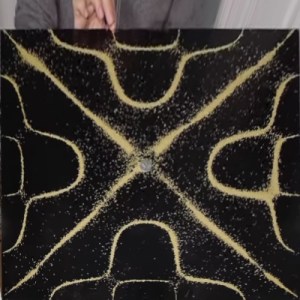
 The underlying physics is straightforward. The string produces a stable tone only if its motion has nodes at both ends, which means the vibration has to have a whole number of nodes, which means you have to pluck halfway between two of the nodes you want. If you pluck it someplace like 39¼:264.77 then you excite a whole lot of frequencies that fight each other and die out quickly.
 Add a few more planets in a random configuration and stability goes out the window — but then something interesting happens. It’s
 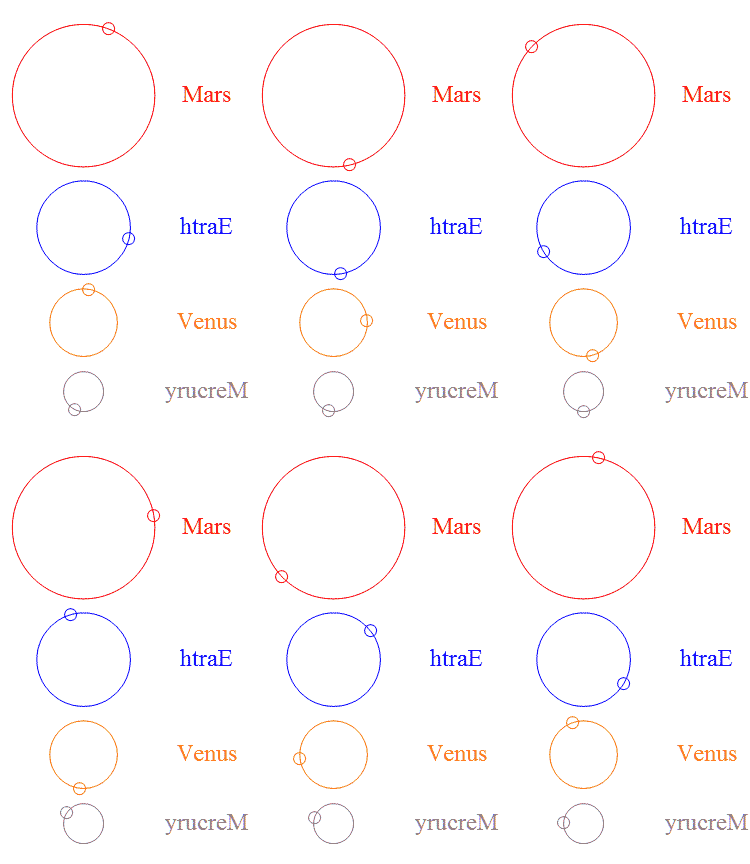 The usual rings-around-the-Sun diagram doesn’t show the specialness of the orbits we’ve got. This chart shows the four innermost planets in their “ideal” orbits, properly scaled and with approximately the right phases. I used artistic license to emphasize the gear-like action by reversing Earth’s and Mercury’s direction. Earth and Mars are never near each other, nor are Earth and Venus.
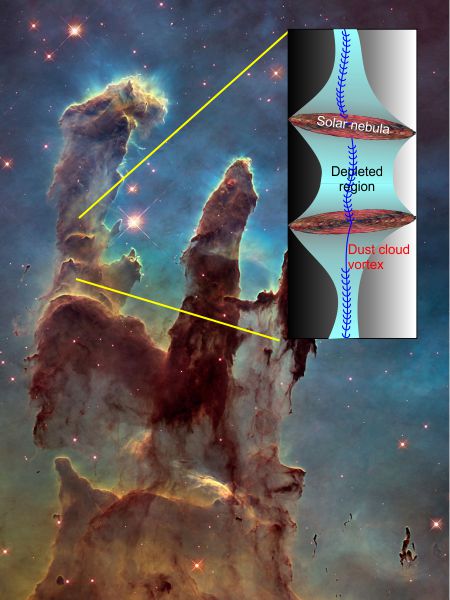





 This video, from an Orbits Table display at the Denver Museum of Nature and Science, shows a different Plutonian weirdness. We’re circling the Solar System at about 50 times Earth’s distance from the Sun (50 AU). Reading inward, the white lines represent the orbits of Neptune, Uranus, Saturn and Jupiter. The Asteroid Belt is the small greenish ring close to the Sun. The four terrestrial planets are even further in. The Kuiper Belt is the greenish ring that encloses the lot.
 Before you get any further in this post, follow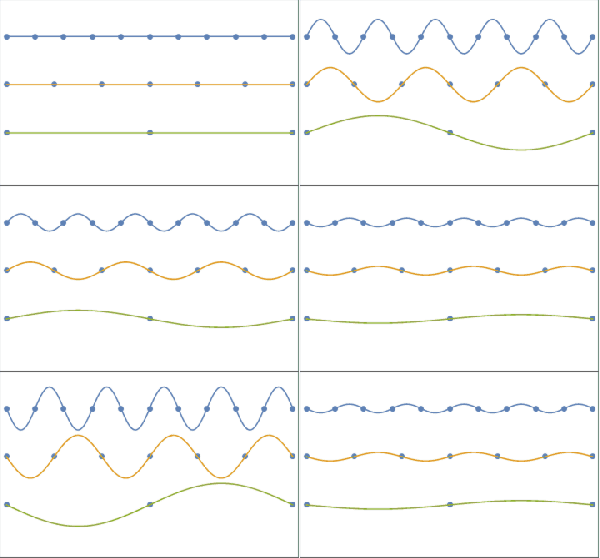
 This photo, part of the LAMP exhibit at the Denver Museum of Nature and Science, shows why. It’s a model of a cratered Moon lit by sunlight.







 Long ago in a far-away career, I taught a short-course about then-current theories on the origin of life. The lab portion of the course centered on the 1952


