“Hot Jets, Captain Neutrino!”

“Hey, Cathleen, while we’re talking IceCube, could you ‘splain one other thing from that TV program?”

“Depends on the program, Al.”

“Oh, yeah, you weren’t here when we started on this.  So I was watching this program and they were talking about neutrinos and how there’s trillions of them going through like my thumbnail every second and then IceCube saw this one neutrino that they’re real excited about so what I’m wondering is, what’s so special about just that neutrino? How do they even tell it apart from all the others?”

“How about the direction it came from, Cathleen?  We get lotsa neutrinos from the Sun and this one shot in from somewhere else?”

SMBH jet and IceCube
Images from NASA and JPL-Caltech

“An interesting question, Vinnie.  The publicity did concern its direction, but the neutrino was already special.  It registered 290 tera-electron-volts.”

“Ter-what?”

“Sorry, scientific shorthand — tera is ten-to-the-twelfth.  A million electrons poised on a million-volt gap would constitute a Tera-eV of potential energy.  Our Big Guy had 290 times that much kinetic energy all by himself.”

“How’s that stack up against other neutrinos?”

“Depends on where they came from.  Neutrinos from a nuclear reactor’s uranium or plutonium fission carry only about 10 Mega-eV, wimpier by a factor of 30 million.  The Sun’s primary fusion process generates neutrinos peaking out at 0.4 MeV, 25 times weaker still.”

“How about from super-accelerators like the LHC?”

“Mmm, the LHC makes TeV-range protons but it’s not designed for neutrino production.  We’ve got others that have been pressed into service as neutrino-beamers. It’s a complicated process — you send protons crashing into a target.  It spews a splatter of pions and K-ons.  Those guys decay to produce neutrinos that mostly go in the direction you want.  You lose a lot of energy.  Last I looked the zippiest neutrinos we’ve gotten from accelerators are still a thousand times weaker than the Big Guy.”

I can see the question in Vinnie’s eyes so I fire up Old Reliable again.  Here it comes… “What’s the most eV’s it can possibly be?”  Good ol’ Vinnie, always goes for the extremes.

“You remember the equation for kinetic energy?”

“Sure, it’s E=½ m·v², learned that in high school.”

“And it stayed with you.  OK, and what’s the highest possible speed?”

“Speed o’ light, 186,000 miles per second.”

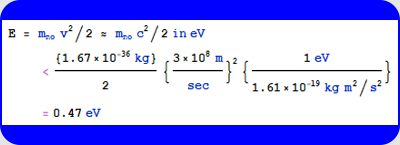
“Or 300 million meters per second, ’cause that’s Old Reliable’s default setting.  Suppose we’ve got a neutrino that’s going a gnat’s whisker slower than light.  Let’s apply that formula to the neutrino’s rest mass which is something less than 1.67×10-36 kilograms…”Speedy neutrino simple calculation“Half an eV?  That’s all?  So how come the Big Guy’s got gazillions of eV’s?”
“But the Big Guy’s not resting.  It’s going near lightspeed so we need to apply that relativistic correction to its mass…Speedy neutrino relativistic calculation“That infinity sign at the bottom means ‘as big as you want.’  So to answer your first question, there isn’t a maximum neutrino energy.  To make a more energetic neutrino, just goose it to go even closer to the speed of light.”

“Musta been one huge accelerator that spewed the Big Guy.”

“One of the biggest, Al.”  Cathleen again.  “That’s the exciting thing about what direction the particle came from.”

“Like the North Pole or something?”

“Much further away, much bigger and way more interesting.  As soon as IceCube caught that neutrino signal, it automatically sent out a “Look in THIS direction!” alert to conventional observatories all over the world.  And there it was — a blazar, 5.7 billion lightyears away!”

“Wait, Cathleen, what’s a blazar?”

“An incredibly brilliant but highly variable photon source, from radio frequencies all the way up to gamma rays and maybe cosmic rays.  We think the thousands we’ve catalogued are just a fraction of the ones within range.  We’re pretty sure that each of them depends on a super-massive black hole in the center of a galaxy.  The current theory is that those photons come from an astronomy-sized accelerator, a massive swirling jet that shoots out from the central source.  When the jet happens to point straight at us, flash-o!”

Duck!

“I wouldn’t worry about a neutrino flood.  The good news is IceCube’s signal alerted astronomers to check TXS 0506+056, a known blazar, early in a new flare cycle.”

“An astrophysical fire alarm!”

~~ Rich Olcott

Cube Roots

Cathleen steps into at Al’s for her morning coffee-and-scone.  “Heard you guys talking neutrinos so I’ll bet Al got you started with something about IceCube.  Isn’t it an awesome project?  Imagine instrumenting a cubic kilometer of ice, and at the South Pole!”

“Ya got me, Cathleen.  It knocked me out that anyone would even think of building it.  Where did the idea come from, anyhow?”

“I don’t know specifically, but it’s got a lot of ancestors, going back to the Wilson Cloud Chamber in the 1920s.”

“Oh, the cloud chamber!  Me and my brother did one for the Science Fair — used dry ice and some kind of alcohol in a plastic-covered lab dish if I remember right, and we set it next to one of my Mom’s orange dinner plates.  Spooky little ghost trails all over the place.”

“That’s basically what the first ones were.  An incoming particle knocks electrons out of vapor molecules all along its path.  The path is visible because the whole thing is so cold that other vapor molecules condense to form micro-droplets around the ions.  Anderson’s cloud chambers were good enough to get him a Nobel Prize for discovering the positron and muon.  But table-top devices only let you study low-energy particles — high-energy ones just shoot through the chamber and exit before they do anything interesting.”

“So the experimenters went big?”

“Indeed, Sy, massive new technologies, like bubble chambers holding thousands of gallons of liquid hydrogen or something else that reacts with neutrinos.  But even those experiments had a problem.”

“And that was…?”

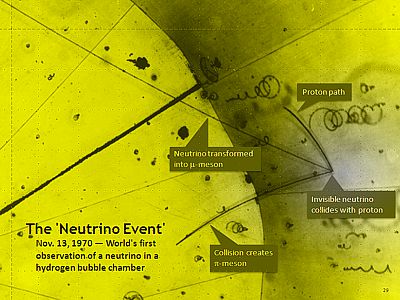
FirstNeutrinoEventAnnotated 2
Adapted from public domain image
courtesy of Argonne National Laboratory

“They all depended on photography to record the traces.  Neutrino-hunting grad students had to measure everything in the photos, because neutrinos don’t make traces — you only find them by finding bigger particles that were disturbed just so.  The work got really intense when the astrophysicists got into the act, trying to understand why the Sun seemed to be giving off only a third of the neutrinos it’s supposed to.  Was the Sun going out?”

“Wait, Cathleen, how’d they know how many neutrinos it’s supposed to make?”

“Wow, Vinnie, you sure know how to break up a narrative, but it’s a fair question.  OK, quick answer.  We know the Sun’s mostly made of hydrogen and we know how much energy it gives off per second.  We’ve figured out the nuclear reactions it must be using to generate that energy.  The primary process combines four hydrogen nuclei  to make a helium nucleus.  Each time that happens you get a certain amount of energy, which we know, plus two neutrinos.  Do the energy arithmetic, multiply the number of heliums per second by two and you’ve got the expected neutrino output.”

“So is the Sun going out?”

“As usual, Al cuts to the chase.  No, Al, it’s still got 5 billion years of middle age ahead of it.  The flaw in the argument was that we assumed that our detectors were picking up all the neutrinos.”

“My mutations!”

“Yes, Vinnie.  Our detector technology at the time only saw electron neutrinos.  The Sun’s reactions emit electron neutrinos.  But the 93-million mile trip to Earth gave those guys plenty of time to oscillate through muon neutrino to tau neutrino and back again.  All we picked up were the ones that had gone through an integer number of cycles.”

“We changed technology, I take it?”

“Right again, Sy.  Instead of relying on nuclear reactions initiated by electron neutrinos, we went so spark chambers — crossed grids of very fine electrified wire in a box of argon gas.  Wherever a passing neutrino initiated an ionization, zap! between the two wires closest to that point.  Researchers could computerize the data reduction.  Turns out that all three neutrino flavors are pretty good at causing ionizations so the new tech cleared up the Solar Paradox, but only after we solved a different problem — the new data was point-by-point.  Working back from those points to the traces took some clever computer programming.”

“Ah, I see the connection with IceCube.  It doesn’t register traces, either, just the points where those sensors see the Cherenkov flashes.  It’s like a spark chamber grown big.”

“Cubic-kilometer big.”

~~ Rich Olcott

Einstein’s Revenge

Vinnie’s always been a sucker for weird-mutant sci-fi films so what Jennie says gets him going.  “So you got these teeny-tiny neutrinos and they mutate?  What do they do, get huge and eat things?”

“Nothing that interesting, Vinnie — or uninteresting, depending on what you’re keen on.  No, what happens is that each flavor neutrino periodically switches to another flavor.”

“Like an electron becomes a muon or whatever?”

“Hardly.  The electron and muon and tau particles themselves don’t swap.  Their properties differ too much —  the muon’s 200 times heaver than the electron and the tau’s sixteen times more massive than that.  It’s their associated neutrinos that mutate, or rather, oscillate.  What’s really weird, though, is how they do that.”

“How’s that?”

“As I said, they cycle through the three flavors.  And they cycle through three different masses.”

“OK, that’s odd but how is it weird?”

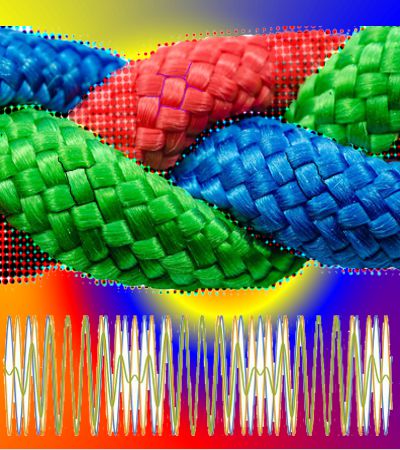
“Their flavor doesn’t change at the same time and place as their mass does.”Neutrino braid with sines

“Wait, what?”

“Each kind of neutrino, flavor-wise, is distinct — it reacts with a unique set of particles and yields different reaction products to what the other kinds do.  But experiments show that the mass of each kind of neutrino can vary from moment to moment.  At some point, the mass changes enough that suddenly the neutrino’s flavor oscillates.”

“That makes me think each mass could be a mix of three different flavors, too.”

“Capital, Vinnie!  That’s what the math shows.  It’s two different ways of looking at the same coin.”

“The masses oscillate, too?”

“Oh, indeed.  But no-one knows exactly what the mass values are nor even how the mass variation controls the flavors.  Or the other way to.  We know two of the masses are closer together than to the third but that’s about it.  On the experimental side there’s loads of physicists and research money devoted to different ways of measuring how neutrino oscillation rates depend on neutrino energy content.”

“And on the theory side?”

“Tons of theories, of course.  Whenever we don’t know much about something there’s always room for more theories.  The whole object of experiments like IceCube is to constrain the theories.  I’ve even got one I may present at Al’s Crazy Theory Night some time.”

“Oh, yeah?  Let’s hear it.”

“It’s early days, Al, so no flogging it about, mm?  Do you know about beat frequencies?”

“Yeah, the piano tuner ‘splained it to me.  You got two strings that make almost the same pitch, you get this wah-wah-wah effect called a beat.  You get rid of it when the strings match up exact.”  He grabs a few glasses from the counter and taps them with a spoon until he finds a pair that’s close.  “Like this.”

“Mm-hmm, and when the wah-wahs are close enough together they merge to become a note on their own.  You can just imagine how much more complicated it gets when there are three tones close together.”

I see where she’s going and bring up a display on Old Reliable —an overlay of three sine waves.   “Here you go, Jennie.  The red line is the average of the three regular waves.”Three sines on Old Reliable“Thanks, Sy.  Look, we’ve got three intervals where everything syncs up.  See the new satellite peaks half-way in between?  There’s more hidden pattern where things look chaotic in the rest of the space.”

“Yeah, so?”

“So, Vinnie, my crazy theory is that like a photon’s energy depends on its wave frequency in the electromagnetic field, a neutrino is a combination of three weak-field waves of slightly different frequency, one for each mass.  When they sync up one way you’ve got an electron neutrino, when they sync up a different way you’ve got a muon neutrino, and a third way for a tau neutrino.”

I’ve got to chuckle.  “Nothing against your theory, Jennie, though you’ve got some work ahead of you to flesh it out and test it.  I just can’t help thinking of Einstein and his debates with Bohr.  Bohr maintained that all we can know about the quantum realm are the averages we calculate.  Einstein held that there must be understandable mechanisms underlying the statistics.  Field-based theories like yours are just what Einstein ordered.”

“I could do worse.”Neutrino swirl around Einstein

~~ Rich Olcott

Bigger than you’d think

Al’s coffee shop, the usual mid-afternoon crowd of chatterers and laptop-tappers.  Al’s walking his refill rounds, but I notice he’s carrying a pitcher rather than his usual coffee pot.  “Hey, Al, what’s with the hardware?”

“Got iced coffee here, Sy.  It’s hot out, people want to cool down.  Besides, this is in honor of IceCube.”

“Didn’t realize you’re gangsta fan.”

“Nah, not the rapper, the cool experiment down in the Antarctic.  It was just in the news.”

“Oh?  What did they say about it?”

“It’s the biggest observatory in the world, set up to look for the tiniest particles we know of, and it uses a cubic mile of ice which I can’t think how you’d steer it.”

A new voice, or rather, a familiar one. “One doesn’t, Al.”
Neutrino swirl 1“Hello, Jennie.  Haven’t seen you for a while.”

“I flew home to England to see my folks.  Now I’m back here for the start of the Fall term.  I’ve already picked a research topic — neutrinos.  They’re weird.”

“Hey, Jennie, why are they so tiny?”

“It’s the other way to, Al.  They’re neutrinos because they’re so tiny.  Sy would say that for a long time they were simply an accounting gimmick to preserve the conservation laws.”

“I would?”

“Indeed.  People had noticed that when uranium atoms give off alpha particles to become thorium, the alpha particles always have about the same amount of energy.  The researchers accounted for that by supposing that each kind of nucleus has some certain quantized amount of internal energy.  When one kind downsizes to another, the alpha particle carries off the difference.”

“That worked well, did it?”

“Oh, yes, there are whole tables of nuclear binding energy for alpha radiation.  But when a carbon-14 atom emits a beta particle to become nitrogen-14, the particle can have pretty much any amount of energy up to a maximum.  It’s as though the nuclear quantum levels don’t exist for beta decay.  Physicists called it the continuous beta-spectrum problem and people brought out all sorts of bizarre theories to try to explain it.  Finally Pauli suggested maybe something we can’t see carries off energy and leaves less for the beta.  Something with no charge and undetectable mass and the opposite spin from what the beta has.”

“Yeah, that’d be an accounting gimmick, alright.  The mass disappears into the rounding error.”

“It might have done, but twenty years later they found a real particle.  Oh, I should mention that after Pauli made the suggestion Fermi came up with a serious theory to support it.  Being Italian, he gave the particle its neutrino name because it was neutral and small.”

“But how small?”

“We don’t really know, Al.  We know the neutrino’s mass has to be greater than zero because it doesn’t travel quite as fast as light does.  On the topside, though, it has to be lighter than than a hydrogen atom by at least a factor of a milliard.”

“Milliard?”

“Oh, sorry, I’m stateside, aren’t I?  I should have said a billion.  Ten-to-the-ninth, anyway.”

“That’s small.  I guess that’s why they can sneak past all the matter in Earth like the TV program said and never even notice.”

This gives me an idea.  I unholster Old Reliable and start to work.

“Be right with you… <pause> … Jennie, I noticed that you were being careful to say that neutrinos are light, rather than small.  Good careful, ’cause ‘size’ can get tricky at this scale.  In the early 1920s de Broglie wrote that every particle is associated with a wave whose wavelength depends on the particle’s momentum.  I used his formula, together with Jennie’s upper bound for the neutrino’s mass, to calculate a few wavelength lower bounds.Neutrino wavelength calcMomentum is velocity times mass.  These guys fly so close to lightspeed that for a long time scientists thought that neutrinos are massless like photons.  They’re not, so I used several different v/c ratios to see what the relativistic correction does.  Slow neutrinos are huge, by atom standards.  Even the fastest ones are hundreds of times wider than a nucleus.”

“With its neutrino-ness spread so thin, no wonder it’s so sneaky.”

“That may be part of it, Al.”

“But how do you steer IceCube?”

~~ Rich Olcott

Naming the place and placing the name

“By the way, Cathleen, is there any rhyme or reason to that three-object object‘s funky name?  I’ve still got it on Old Reliable here.”

PSR J0337+1715

“It’s nothing like funky, Sy, it’s perfectly reasonable and in fact it’s far more informative than a name like ‘Barnard’s Star.’  The ‘PSR‘ part says that the active object, the reason anyone even looked in that system’s direction, is a pulsar.”

“And the numbers?”

“Its location in two parts.  Imagine a 24-hour clockface in the Solar Plane.  The zero hour points to where the Sun is at the Spring equinox.  One o’clock is fifteen degrees east of that, two o’clock is another fifteen degrees eastward and so on until 24 o’clock is back pointing at the Springtime Sun.  Got that?”

“Mm, … yeah.  It’d be like longitudes around the Earth, except the Earth goes around in a day and this clock looks like it measures a year.”

“Careful there, it has nothing to do with time.  It’s just a measure of angle around the celestial equator.  It’s called right ascension.

“How about intermediate angles, like between two and three o’clock?”

“Sixty arc-minutes between hours, sixty arc-seconds between arc-minutes, just like with time.  If you need to you can even go to tenths or hundredths of an arc-second, which divide the circle into … 8,640,000 segments.”

“OK, so if that’s like longitudes, I suppose there’s something like latitudes to go with it?”

“Mm-hm, it’s called declination.  It runs perpendicular to ascension, from plus-90° up top down to 0° at the clockface to minus-90° at the bottom.  Vivian, show Sy Figure 3 from your paper.”Right ascension and declination“Wait, right ascension in hours-minute-seconds but declination in degrees?”

“Mm-hm.  Blame history.  People have been studying the stars and writing down their locations for a long time.  Some conventions were convenient back in the day and we’re not going to give them up.  So anyway, an object’s J designation with 4-digit numbers tells you which of 13 million directions to look to find it.  Roughly.”

“Roughly?”

“That’s what the ‘J‘ is about.  If the Earth’s rotation were absolutely steady and if the Sun weren’t careening about a moving galaxy, future astronomers could just look at an object’s angular designation and know exactly where to look to find it again.  But it’s not and it does and they won’t.  The Earth’s axis of rotation wobbles in at least three different ways, the Sun’s orbit around the galaxy is anything but regular and so on.  Specialists in astrometry, who measure things to fractions of an arc-second, keep track of time in more ways than you can imagine so we can calculate future positions.  The J-names at least refer back to a specific point in time.  Mostly.  You want your mind bent, look up epoch some day.”

“Plane and ship navigators care, too, right?”

“Not so much.  Earth’s major wobble, for instance, shifts our polar positions only about 40 parts per million per year.  A course you plotted last week from here to Easter Island will get you there next month no problem.”

Old Reliable judders in my hand.  Old Reliable isn’t supposed to have a vibration function, either.  Ask her about interstellar navigation.  “Um, how about interstellar navigation?”Skewed Big Dipper

“Oh, that’d be a challenge.  Once you get away from the Solar System you can’t use the Big Dipper to find the North Star, any of that stuff, because the constellations look different from a different angle.  Get a couple dozen lightyears out, you’ve got a whole different sky.”

“So what do you use instead?”

“I suppose you could use pulsars.  Each one pings at a unique repetition interval and duty cycle so you could recognize it from any angle.  The set of known pulsars would be like landmarks in the galaxy.  If you sent out survey ships, like the old-time navigators who mapped the New World, they could add new pulsars to the database.  When you go someplace, you just triangulate against the pulsars you see and you know where you are.”

If they happen to point towards you! You only ever see 20% of them.  Starquakes and glitches and relativistic distortions mess up the timings.  Poor Xian-sheng goes nuts each time we drop out of warp.

~~ Rich Olcott

A Recourse to Pastry

There’s something wrong about the displays laid out on Al’s pastry counter — no symmetry.  One covered platter holds eight pinwheels in a ring about a central one, but the other platter’s central pinwheel has only a five-pinwheel ring around it.  I yell over to him.  “What’s with the pastries, Al?  You usually balance things up.”

“Ya noticed, hey, Sy?  It’s a tribute to the Juno spacecraft.  She went into orbit around Jupiter on the 5th of July 2016 so I’m celebrating her anniversary.”

“Well, that’s nice, but what do pinwheels have to do with the spacecraft?”

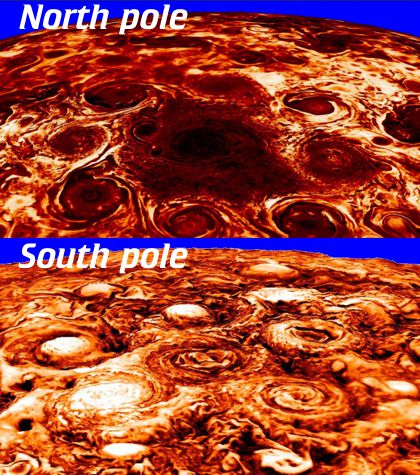
“Haven’t you seen the polar pictures she sent back?  Got a new poster behind the cash register.  Ain’t they gorgeous?”Jupiter both poles“They’re certainly eye-catching, but I thought Jupiter’s all baby-blue and salmon-colored.”

Astronomer Cathleen’s behind me in line.  “It is, Sy, but only in photographs using visible sunlight.  These are infrared images, right, Al?”

“Yeah, from … lemme look at the caption … Juno‘s JIRAM instrument.”

“Right, the infrared mapper.  It sees heat-generated light that comes from inside Jupiter.  It’s the same principle as using blackbody radiation to take a star’s temperature, but here we’re looking at a planet.  Jupiter’s way colder than a star so the wavelengths are longer, but on the other hand it’s close-up so we don’t have to reckon with relativistic wavelength stretching.  At any rate, infrared wavelengths are too long for our eyes to see but they penetrate clouds of particulate matter like interstellar dust or the frigid clouds of Jupiter.”

Jupiter south pole 1
NASA mosaic view of Jupiter’s south pole by visible light

“So this red hell isn’t what the poles actually look like?”

“No, Al,  the visible light colors are in the tops of clouds and they’re all blues and white.  These infrared images show us temperature variation within the clouds.  Come to think of it, that Hell’s frozen over — if I recall correctly, the temperature range in those clouds runs from about –10°C to –80°C.  In Fahrenheit that’d be from near zero to crazy cold.”

“Those aren’t just photographs in Al’s poster?”

“Oh, no, Sy, there’s a lot of computer processing in between Juno‘s wavelength numbers and what the public sees.  The first step is to recode all the infrared wavelengths to visible colors.  In that north pole image I’d say that they coded red-to-black as warm down to white as cool.  The south pole image looks like warmest is yellow-to-white, coolest is red.”

“How’d you figure that?”

“The programs fake the apparent heights.  The warmest areas are where we can see most deeply into the atmosphere, which would be at the center or edge of a vortex.  The cooler areas would be upper-level material.  The techs use that logic to generate the perspective projection that we interpret as a 3-D view.”

Vinnie’s behind us in line and getting impatient.  “I suppose there’s Science in those pretty pictures?”

“Tons of it, and a few mysteries.  JIRAM by itself is telling the researchers a lot about where and how much water and other small molecules reside in Jupiter’s atmosphere.  But Juno has eight other sensors.  Scientists expect to harvest important information from each of them.  Correlations between the data streams will give us exponentially more.”

He’s still antsy.  “Such as?”

“Like how Jupiter’s off-axis magnetic field is related to its lumpy gravitational field.  When we figure that out we’ll know a lot more about how Jupiter works, and that’ll help us understand Saturn and gas-giant exoplanets.”GRS core

Al breaks in.  “What about the mysteries, Cathleen?”

“Those storms, for instance.  They look like Earth-style hurricanes, driven by upwelling warm air.  They even go in the right direction.  But why are they crammed together so and how can they stay stable like that?  Adjacent gears have to rotate in opposite directions, but these guys all go in the same direction.  I can’t imagine what the winds between them must be like.”

“And how come there’s eight in the north pole ring but only five at the other pole?”

“Who knows, Vinnie?  The only guess I have is that Jupiter’s so big that one end doesn’t know what the other end’s doing.”

“Someone’s gonna have to do better than that.”

“Give ’em time.”

~~ Rich Olcott

Zwicky Too Soon

Big Vinnie barrels into the office, again. “Hey, Sy, word is you been short-changing Fritz Zwicky. What’s the story?”

“Hey, I never even met the guy.  He died in 1974.  How could I do him a bad deal?”

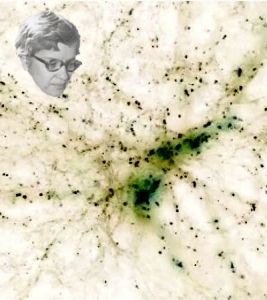
“Not giving him full credit.  I read an article about him.  He talked about ‘dark matter’ almost fifty years before Vera Rubin.”

“You’ve got a point there.  Like Vera Rubin he had a political problem, but his was quite different than hers.”

“Political?  I thought all you had to do was be right.”

“No, you have to be right and you have to have people willing to spend time validating or refuting your claims.  Rubin wasn’t a self-advertiser, so it took a while for people to realize why her results were important.  They did look at them, though, and they did give her credit.  Zwicky’s was a different story.”

“Wasn’t he right?”

“Sometimes right, often wrong.  Thing was, he generated too many ideas for people to cope with.  Worse, he was one of those wide-ranging intellects who adds one plus one to make two.  Trouble was, Zwicky got his ones from different specialties that don’t normally interact.  When people didn’t immediately run with one of his claims he took it personally and lashed out, publicly called ’em fools or worse.  Never a good tactic.”

“Gimme a f’rinstance.”

“OK.  Early 1930’s, Zwicky’s out in the still-raw wilds of California, practically nothing out there but movie studios and oil wells, using a manual blink-comparator like the one Clyde Tombaugh used about the same time to find Pluto.  He’s scanning images taken with Palomar’s new wide-angle telescope to search out novae, stars that suddenly get brighter.  He’s finding dozens of them but a few somehow get orders of magnitude brighter than the rest.  He and his buddy Walter Baade call the special ones ‘supernovae.'”

“Ain’t that novas?”

“Novae — we’re being proper astronomers here and it’s a Latin word.  Anyway, Zwiky’s trying to figure out where a supernova’s enormous luminosity comes from.  He got his start in solid-state physics and he still keeps up on both Physics and Astronomy.  Just a year earlier, James Cavendish over in atomic physics had announced the discovery of the neutron.  Zwicky sees that neutrons are the solution to his problem — gravity can pack together no-charge neutrons to a much higher density than it can pack positive-charge protons.  He proposes that a supernova happens when a big-enough star uses up its fuel and collapses to the smallest possible object, a neutron star.  Furthermore, he says that the collapse releases so much gravitational energy that supernovae give off cosmic rays, the super-high-energy photons that were one of the Big Questions of the day.”

“Sounds reasonable, I suppose.”

“Well, yeah, now.  But back then most astronomers had never heard of neutrons.  To solve at a stroke both cosmic rays and supernovae, using this weird new thing called a neutron, and with the proposal coming from somewhere other than Europe or Ivy League academia — well, it was all too outlandish to take seriously.  No-one did, for decades.”

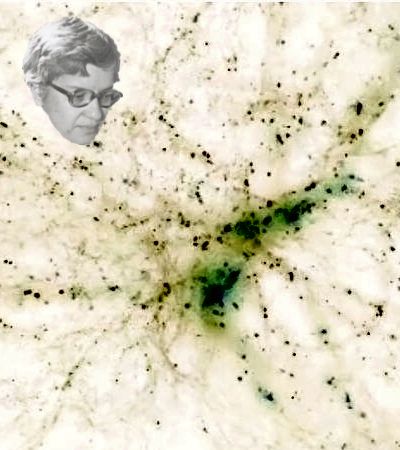
“He didn’t like that, huh?”Zwicky inspecting dark matter

“No, he did not.  And he railed about it, not only in private conversations but in papers and in the preface to one of the two galaxy catalogs he published.  Same thing with galaxy clusters.”

“Wait, you wrote that Rubin found clusters.”

“I did and she did.  Actually, I wrote that she confirmed clustering.  We knew for 150 years that galaxies bunch together in our 2-D sky, but it took Zwicky’s measurements to group the Coma Cluster galaxies in 3-D.  Problem was, they were moving too fast.  If star gravity were the only thing holding them together they should have scattered ages ago.”

“Dark matter, huh?”

“Yup, Zwicky claimed invisible extra mass bound the cluster together.  More Zwicky outlandishness and once again his work was ignored for years.”

“Even though he was right.”

“Mm-hm.  But he could be wrong, too.  He didn’t like Hubble’s expanding Universe idea so he came up with a ‘tired light’ theory to explain the red-shifts.  He touted that idea heavily but there was too much evidence against it.”

“One of those angry ‘lone wolf’ scientists.”

“And bitter.”

~~ Rich Olcott

Symphony for Rubber Ruler

“But Mr Moire, first Vera Rubin shows that galaxies don’t spread out like sand grains on a beach…”

“That’s right, Maria.”

“And then she shows that galaxy streams flow like rivers through the Universe…”

“Yes.”

“And then she finds evidence for dark matter!  She changed how we see the Universe and still they don’t give her the Nobel Prize??!?”

“All true, but there’s a place on Mars that’s named for her and it’ll be famous forever.”

“Really?  I didn’t know about that.  Where is it and why did they give it her name?”

“What do you know about dark matter?”

Rubin inspecting dark matter“Not much.  We can’t see it, and they say there is much more of it than the matter we can see.  If we can’t see it, how did she find it?  That’s a thing I don’t understand, what I came to your office to ask.”

“It all has to do with gravity.  Rubin’s studies of dozens of galaxies showed that they really shouldn’t exist, at least on the basis of the physics we knew about at the time.  She’d scan across a galaxy’s image, measuring how its red-shifted spectrum changed from the coming-toward-us side to the going-away-from-us side.  The red-shift translates to velocity.  The variation she found amazed the people she showed it to.”Pinwheel Galaxy NGC 5457 reduced

“What was amazing about it?”

“It was a flat line.  Look at the galaxy poster on my wall over there.”

“Oh, la galaxia del Molinete.  It’s one of my favorites.”

“We call it the Pinwheel Galaxy.  Where would you expect the stars to be moving fastest?”

“Near the center, of course, and they must move slower in those trailing arms.”

“That’s exactly what Rubin didn’t find.  From a couple of reasonable assumptions you can show that a star’s speed in a rotating galaxy composed only of other stars should be proportional to 1/√R, where R is its distance from the center.  If you pick two stars, one twice as far out as the other, you’d expect the outermost star to be going 1/√2 or only about 70% as fast as the other one.”

“And she found…?”

“Both stars have the same speed.”

“Truly the same?”

“Yes!  It gets better.  Most galaxies are embedded in a ball of neutral hydrogen atoms.  With a different spectroscopic technique Rubin showed that each hydrogen ball around her galaxies rotates at the same speed its galaxy does,  even 50% further out than the outermost stars.  Everything away from the center is traveling faster than it should be if gravity from the stars and gas were the only thing holding the galaxy together.  Her galaxies should have dispersed long ago.”

“Could electrical charge be holding things together?”

“Good idea — electromagnetic forces can be stronger than gravity.  But not here.  Suppose the galaxy has negative charge at its center and the stars are all positive.  That’d draw the stars inward, sure, but star-to-star repulsion would push them apart.  Supposing that neighboring stars have opposite charges doesn’t work, either.  And neutral hydrogen atoms don’t care about charge, anyway.  The only way Rubin and her co-workers could make the galaxy be stable is to assume it’s surrounded by an invisible spherical halo with ten times as much mass as the matter they could account for.”

“Mass that doesn’t shine.  She found ‘dark matter’ with gravity!”

“Exactly.”

“What about planets and dust?  Couldn’t they add up to the missing mass?”

“Nowhere near enough.  In out Solar System, for instance, all the planets add up to only 0.1% of the Sun’s mass.”

“Ah, ‘planets’ reminds me.  Why is Vera Rubin’s name on Mars?”

“Well, it’s not strictly speaking on Mars, yet, but it’s on our maps of Mars.  You know the Curiosity rover we have running around up there?”

“Oh yes, it’s looking for minerals that deposit from water.”

“Mm-hm.  One of those minerals is an iron oxide called hematite.  Sometimes it’s in volcanic lava but most of the time it’s laid down in a watery environment.  And get this — it’s often black or dark gray.  Curiosity found a whole hill of the stuff.”

Vera Rubin Ridge labeled
Adopted from a Curiosity Mastcam image from NASA

“Yes, so…?”

“What else would the researchers name an important geologic feature made of darkish matter?”

~~ Rich Olcott

Concerto for Rubber Ruler

An unfamiliar knock at my office door — more of a tap than a knock. “C’mon in, the door’s open.”

¿Está ocupado?

“Hi, Maria. No, I’m not busy, just taking care of odds and ends. What can I do for you?”

“I’m doing a paper on Vera Rubin for la profesora. I have the biographical things, like she was usually the only woman in her Astronomy classes and she had to make her own baño at Palomar Observatory because they didn’t have one for señoras, and she never got the Nobel Prize she deserved for discovering dark matter.

“Wait, you have all negatives there.  Her life had positives, too.  What about her many scientific breakthroughs?”

“That’s why I’m here, for the science parts I don’t understand.”

“I’ll do what I can. What’s the first one?”

“In her thesis she showed that galaxies are ‘clumped.’  What is that?”

“It means that the galaxies aren’t spread out evenly.  Astronomers at the time believed, I guess on the basis of Occam’s Razor, that galaxies were all the same distance from their neighbors.”

“Occam’s Razor?  Ah, la navaja de Okcam.  Yes, we study that in school — do not assume more than you have to.  But why would evenly be a better assumption than clumpy?”

“At the time she wrote her thesis the dominant idea was that the Big Bang’s initial push would be ‘random’ — every spot in the Universe would have an equal chance of hosting a galaxy.  But she found clusters and voids.  That made astronomers uncomfortable because they couldn’t come up with a mechanism that would make things look that way.  It took twenty years before her observations were accepted.  I’ve long thought part of her problem was that her thesis advisor was George Gamow.  He was a high-powered physicist but not an observational astronomer.  For some people that was sufficient excuse to ignore Rubin’s work.”

“Another excuse.”

“Yes, that, too.”

“But why did she have to discover the clumpy?  You can just look up in the sky and see things that are close to each other.”

“Things that appear to be close together in the sky aren’t necessarily close together in the Universe.  Look out my window.  See the goose flying there?”

“Mmm…  Yes!  I see it.”

“There’s an airplane coming towards it, looks about the same size.  Think they’ll collide?”

“Of course no.  The airplane looks small because it’s far away.”

“But when their paths cross, we see them at the same point in our sky, right?”

“The same height up, yes, and the same compass direction, but they have different distances from us.”

“Mm-hm.  Geometry is why it’s hard to tell whether or not galaxies are clustered.  Two galaxy images might be separated by arc-seconds or less.  The objects themselves could be nearest neighbors or separated by half-a-billion lightyears.  Determining distance is one of the toughest problems in observational astronomy.”

“That’s what Vera Rubin did?  How?”

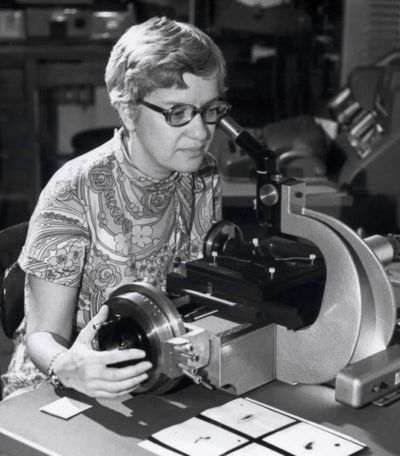
“In theory, the same way we do today.  In practice, by a lot of painstaking manual work.  She did her work back in the early 1950s, when ‘computer’ was a job title, not a device.  No automation — electronic data recording was a leading-edge research topic.  She had to work with images of spectra spread out on glass plates, several for each galaxy she studied.  Her primary tool, at least in the early days, was a glorified microscope called a measuring engine.  Here’s a picture of her using one.” Vera Rubin

“She looks through the eyepiece and then what?”

“She rotates those vernier wheels to move each glass-plate feature on the microscope stage to the eyepiece’s crosshairs.  The verniers give the feature’s x– and y-coordinates to a fraction of a millimeter.  She uses a gear-driven calculating machine to turn galaxy coordinates into sky angles and spectrum coordinates into wavelengths.  The wavelengths, Hubble’s law and more arithmetic give her the galaxy’s distance from us.  More calculations convert her angle-angle-distance coordinates to galactic xy-z-coordinates.  Finally she calculates distances between that galaxy and all the others she’s already done.  After processing a few hundred galaxies, she sees groups of short-distance galaxies in reportable clusters.”

“Wouldn’t a 3-D graphic show them?”

“Not for another 50 years.”

~~ Rich Olcott

Quartetto for Rubber Ruler

Suddenly Al’s standing at our table.  “Hey guys, I heard you talking about spectroscopy and stuff and figured you could maybe ‘splain something I read.  Here’s some scones and I brought a fresh pot of coffee..”

“Thanks, Al.  What’s the something?  I’m sure Cathleen can ‘splain.”

“Syyy…”

“It’s this article talking about some scientists going down to Australia to use really old light to look for younger light and it’s got something to do with dark matter and I’m confused.”

“You’re talking about the EDGES project, right?”

“Yeah, I’m pretty sure they said ‘EDGES’ in the article.”

“OK, first we need some background on the background, that really old light you mentioned.  The Cosmic Microwave Background is the oldest light in the Universe, photons struggling out of the white-hot plasma fog that dominated most of the first 377,000 years after the Big Bang.”

“Wait a minute, ‘plasma fog’?”

“Mm-hm.  In those early years the Universe was all free electrons and nuclei colliding with photons and each other.  No photon could travel more than a few centimeters before being blocked by some charged particle.  The Universe had to expand and cool down to 4,000K or so before electrons and nuclei could hold together as atoms and the fog could lift.”

“Cathleen showed me an intensity-frequency plot for those suddenly-free photons.  It was a virtually perfect blackbody curve, identical within a couple parts per million everywhere in the sky.  The thing is, the curve corresponds to a temperature of only 2.73K.  Its peak is in the microwave region, hence the CMB moniker, nestled in between far infrared and HF radio.”

“I thought she said that the fog lifted at 4,000K, Sy.  That’s a lot different from 2-whatever.”

Wavelength-stretching, Vinnie, remember?  Universe expansion stretches the photon waves we measure temperatures with, the further the longer just like Hubble said.  The CMB’s the oldest light in the Universe, coming to us from 13.4 billion lightyears away.  The stretch factor is about 1100.”

“Vinnie, that 2.7K blackbody radiation is the background to the story.  Think of it as a spherical shell around the part of the Universe we can see.  There are younger layers inside that shell and older layers beyond it.”

“What could be outside the Universe, Cathleen?”

“Hey, Al, I carefully said, ‘the part of the Universe we can see.’  I’m quite sure that the Universe extends beyond the spatial volume we have access to, but light from out there hasn’t had a chance to get to us yet.  Going outward from our CMB sphere there’s that 337,000-year-deep shell of electron-nucleus fog.  Beyond that, 47,000 years-worth of quark soup and worse, out to the Big Bang itself.  Coming inward from the CMB we see all the things we know of that have to do with atoms.”

“Like galaxies?”

“Well, not immediately, they took a billion years to build up.  First we had to get through the Dark Ages when there weren’t any photons in the visible light range.  We had huge clouds of hydrogen and helium atoms but virtually all of them were in the ground state.  The CMB photons running around were too low-energy to get any chemistry going, much less nuclear processes.  The Universe was dark and cooling until gravitational attraction made clumps of gas dense enough to light up and become stars.  That’s when things got going.”

“How’d that make a difference?”Blackbody spectrum with notch

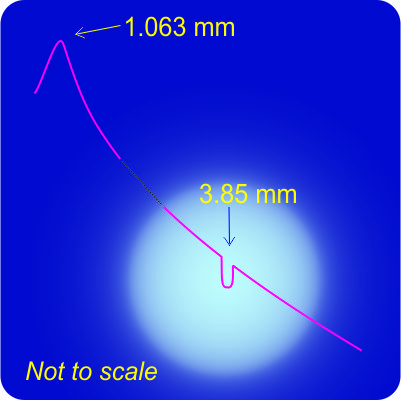
“A ground state hydrogen atom’s lowest available empty energy level is way above what a CMB photon could supply.  Those Dark Age atoms were essentially transparent to the prevailing electromagnetic radiation.  But when starlight came along it excited some atoms so that they could also absorb CMB light.  See the notch on the long-wavelength side of this blackbody curve?  It marks the shadow of starlit hydrogen clouds against the CMB’s glow.  The notch wavelength indicates when the absorption started.  Its position suggests that some stars lit up as early as 180 million years after the Big Bang.”

“Suggests, huh?”

“Mm-hm.  There are other interpretations.  That’s where the fun comes in, both on the theory side and the get-more-data side.  Like looking at different times.”

“Different times?”

“Every wavelength represents a different stretch factor and a different depth into the past.”

~~ Rich Olcott