

 Long ago in a far-away career, I taught a short-course about then-current theories on the origin of life. The lab portion of the course centered on the 1952 Miller-Urey experiment the first demonstration that amino acids could be produced abiotically.
Imagine my surprise when I learned that Miller’s original lab apparatus is on exhibit at the Denver Museum of Nature and Science, where I volunteer now.
The diagram’s notes describe the basic experiment. Load up the system with whatever gases you think might have been in the primeval atmosphere. Start cooling water running through the condenser (double-wall tubing below the upper sphere) and gently heat the water sample you’ve put in the bottom sphere. Vapors travel up the tube into the top sphere where there’s a spark arcing between two electrodes (the black lines at 45º). Water vapor passing by sweeps any gas-spark reaction products back down to the bottom sphere.
Let the whole thing stew for a while (Miller ran his for a week, we let ours go for two), then draw off and analyze a sample of the solution in the bottom sphere. In Stanley’s day his analytical techniques found 5 amino acids. In 1971 (I think) we found (I think) 8 or 9. More recent work-ups of Miller’s sealed original samples found 25, including all 20 considered essential to life. So yeah, if you supply enough energy to a methane-ammonia-water system (Miller added hydrogen to that; we didn’t, for safety reasons) you can make the building blocks for proteins.
The experiment has been repeated probably thousands of times by different researchers in the last half-century. Some replications were duplicates of Miller’s, some started with recipes derived from other theories about what Earth’s early atmosphere looked like.
And there’s the problem. In Miller’s day we thought that Earth’s atmosphere was basically comet-tail concentrate. That’d be mostly water vapor along with a couple of volatiles like methane and ammonia. Later on we realized that much of our atmosphere is volcano belch — a hodgepodge of carbon dioxide, carbon monoxide, methane, hydrogen, sulfur gases, nitrogen, argon, helium, various acids, multiple kinds of rock dust…. Some of that is left-overs from Earth’s initial stages; some has been generated by subsequent geological processes like serpentinization, which can generate both methane and hydrogen.
If you’re running a Miller experiment you’re free to load the apparatus with whatever mixture you think other scientists might think is reasonable for an Earth on the verge of Biology. No oxygen, though — the chemistry of ancient rocks rules out significant atmospheric O2 before about 3½ billion years ago.
Now the researchers are playing variations on the theme, asking whether conditions on (or within) Titan could also generate complex compounds that given a billion years could self-organize into anything we’d recognize as life. So what did Titan’s atmosphere look like a few billion years ago?
That’s a toughie, because we don’t have on-the-ground (or out-of-the-ground) data like we have for Earth. We’ll have to make do with theory, which starts with this chart.

At any given temperature you can calculate the average energy per gas molecule (any kind of gas). Combine that with the known mass of a specific kind of molecule and you can compute its speed.
On any given world you can calculate the minimum speed (the escape velocity) that an object (rocket, rock or gas molecule) needs to have in order to overcome the world’s gravitational pull.
The chart combines both calculations for some important molecules for worlds in the Solar System that have atmospheres. For instance, Earth’s average temperature (give or take a few dozen degrees) is 300ºK=27ºC≈80ºF. From the chart, hydrogen and helium should be able to (and do) leave our atmosphere quickly. However, Earth’s gravity is sufficient to hold onto its original dowry of the heavier species. By contrast, the four massive planets would have to warm up by hundreds of degrees before they lose even the light gases.
Sure enough, Titan’s atmosphere is mostly nitrogen. The astronomers measure its methane and hydrogen content in parts per thousand but those concentrations aren’t the same going from top to bottom of Titan’s atmosphere. Therein lies an intriguing tale, but it’ll have to wait for the next post.
~~ Rich Olcott

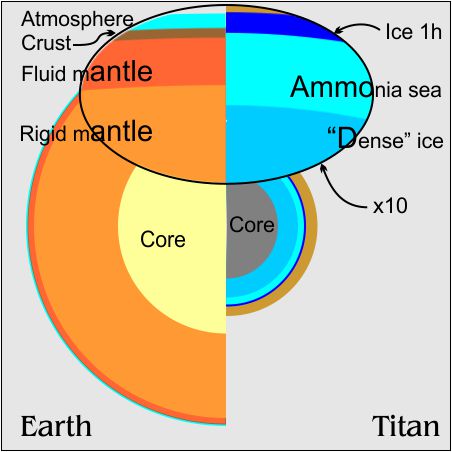
 The primary reason we think Titan is so wet is that Titan’s density is about halfway between rock and water. We know there are other light molecules on Titan — ammonia, methane, etc. We don’t know how much of each. Those compounds don’t have water’s complex phase behavior but many can dissolve in it. That’s why that hypothetical “Ammonia sea” is in the top diagram.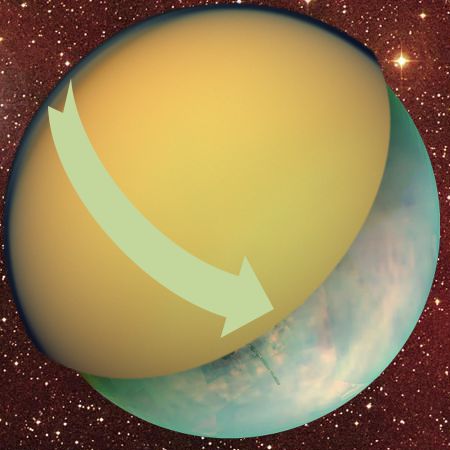

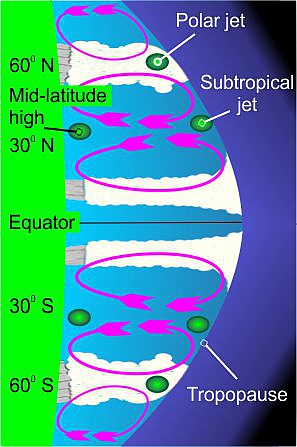 Air warmed by the equatorial Sun rises, only to sink as it heads poleward. Our packet loops between the Equator and about 30ºN (see the diagram).
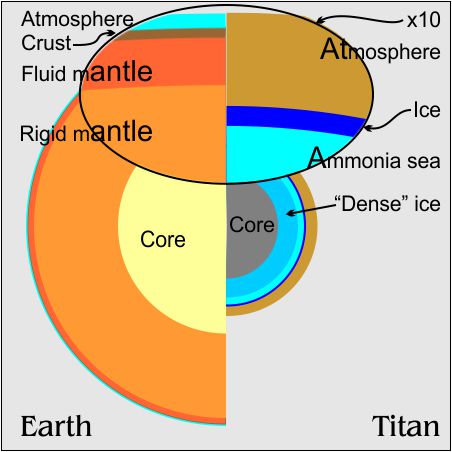 Titan’s atmosphere is heavy-duty compared with Earth’s — 6 times deeper and about 1½ times the surface pressure. When I read those numbers I thought, “Huh? But Titan’s diameter is only 40% as big as Earth’s and its surface gravity is only 10% of ours. How come it’s got such a heavy atmosphere?”
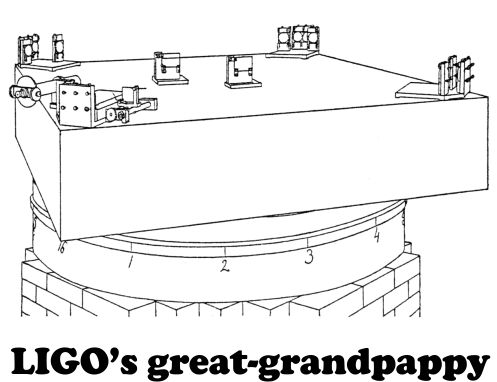
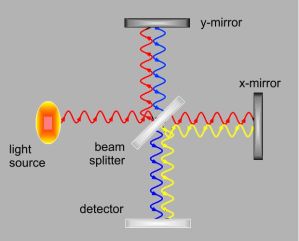 Their common experimental strategy sounds simple enough — compare two beams of light that had traveled along different paths


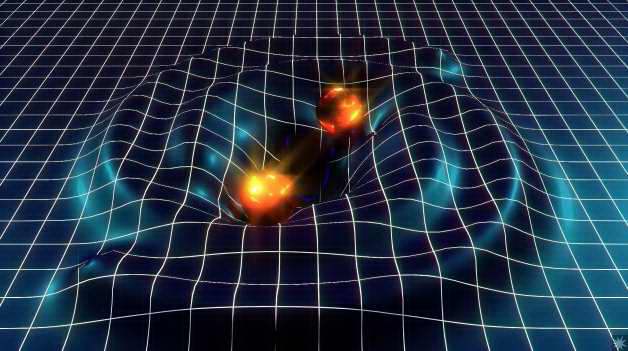
 Of all the wave varieties we’re familiar with, gravitational waves are most similar to (NOT identical with!!) sound waves. A sound wave consists of cycles of compression and expansion like you see in this graphic. Those dots could be particles in a gas (classic “sound waves”) or in a liquid (sonar) or neighboring atoms in a solid (a xylophone or marimba).
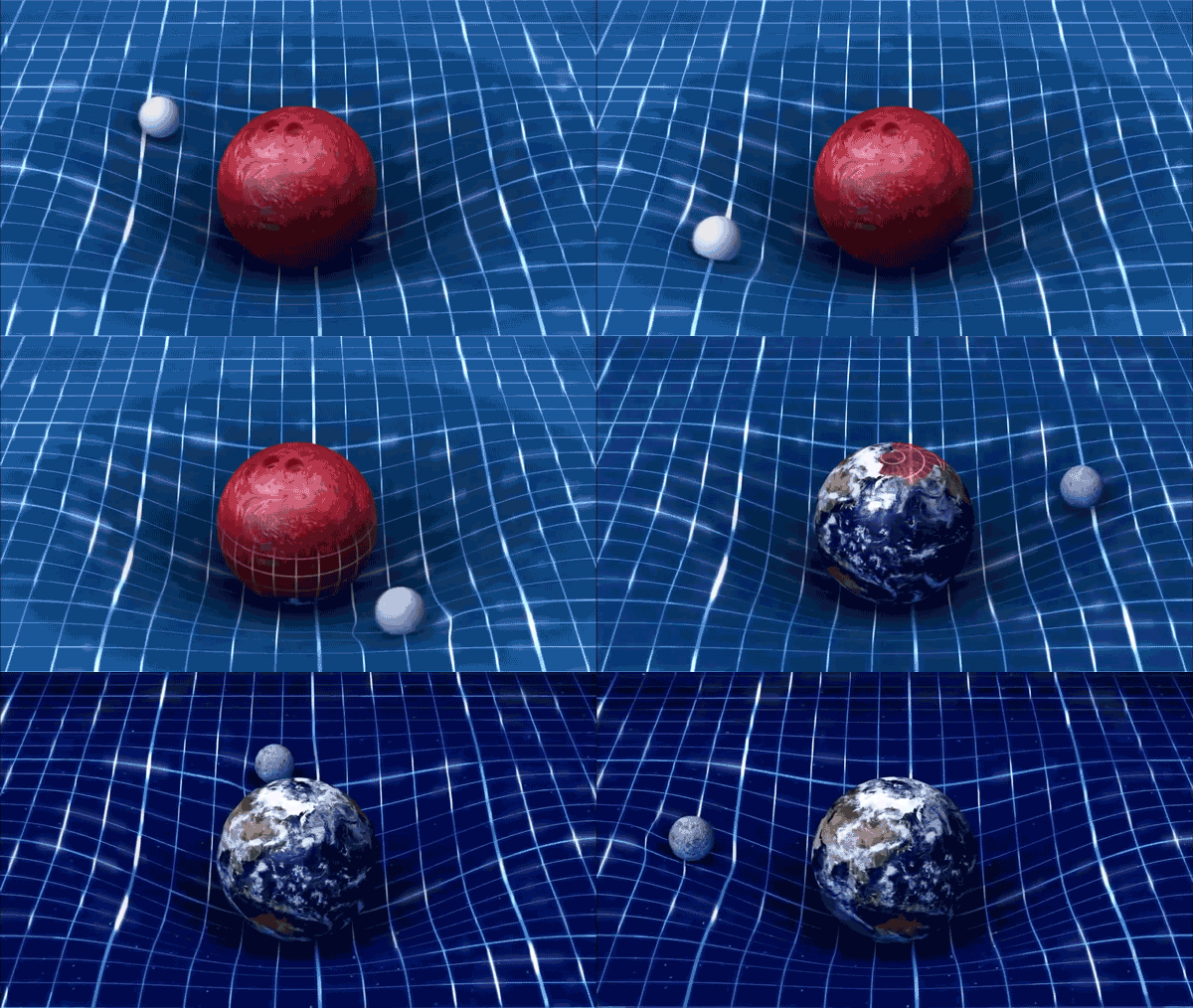
 Einstein noticed that implication of his Theory of General Relativity and in 1916 predicted that the path of starlight would be bent when it passed close to a heavy object like the Sun. The graphic shows a wave front passing through a static gravitational structure. Two points on the front each progress at one graph-paper increment per step. But the increments don’t match so the front as a whole changes direction. Sure enough, three years after Einstein’s prediction, Eddington observed just that effect while watching a total solar eclipse in the South Atlantic.
 We’re being dynamic here, so the simulation has to include the fact that changes in the mass configuration aren’t felt everywhere instantaneously. Einstein showed that space transmits gravitational waves at the speed of light, so I used a scaled “speed of light” in the calculation. You can see how each of the new features expands outward at a steady rate.
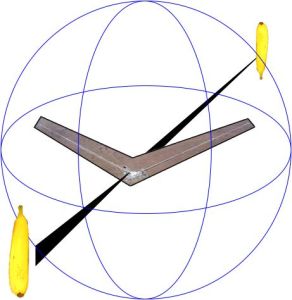 The second question is harder. The best the aLIGO team could do was point to a “banana-shaped region” (their words, not mine) that covers about 1% of the sky. The team marshaled a world-wide collaboration of observatories to scan that area (a huge search field by astronomical standards), looking for electromagnetic activities concurrent with the event they’d seen. Nobody saw any. That was part of the evidence that this collision involved two black holes. (If one or both of the objects had been something other than a black hole, the collision would have given off all kinds of photons.)
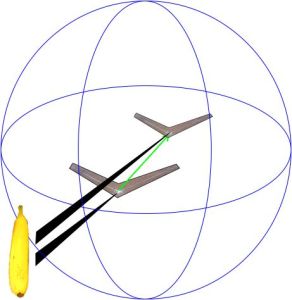 In contrast, a LIGO facility is (roughly speaking) omni-directional. When a LIGO installation senses a gravitational pulse, it could be coming down from the visible sky or up through the Earth from the other hemisphere — one signal doesn’t carry the “which way?” information. The diagram above shows that situation. (The “chevron” is an image of the LIGO in Hanford WA.) Models based on the signal from that pair of 4-km arms can narrow the source field to a “banana-shaped region,” but there’s still that 180o ambiguity.
 The great “if only” is that the VIRGO installation in Italy was not recording data when the Hanford WA and Livingston LA saw that September signal. With three recordings to reconcile, the aLIGO+VIRGO combination would have had enough information to slice that banana and localize the event precisely.

 We can investigate things that take longer than an instrument’s characteristic time by making repeated measurements, but we can’t use the instrument to resolve successive events that happen more quickly than that. We also can’t resolve events that take place much closer together than the instrument’s characteristic length.
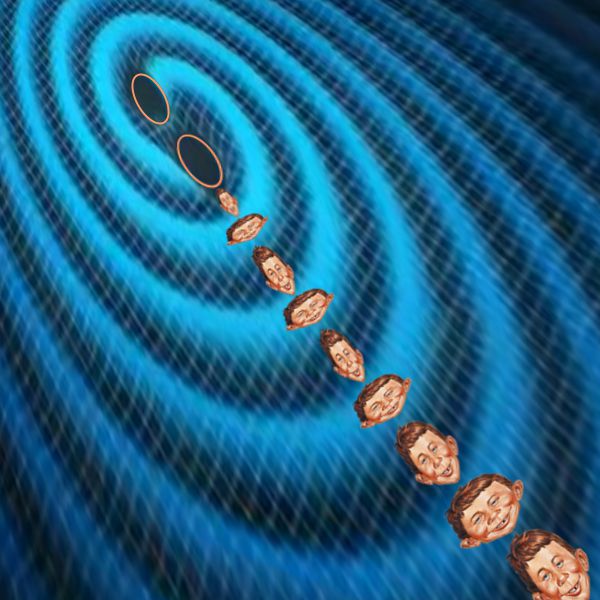
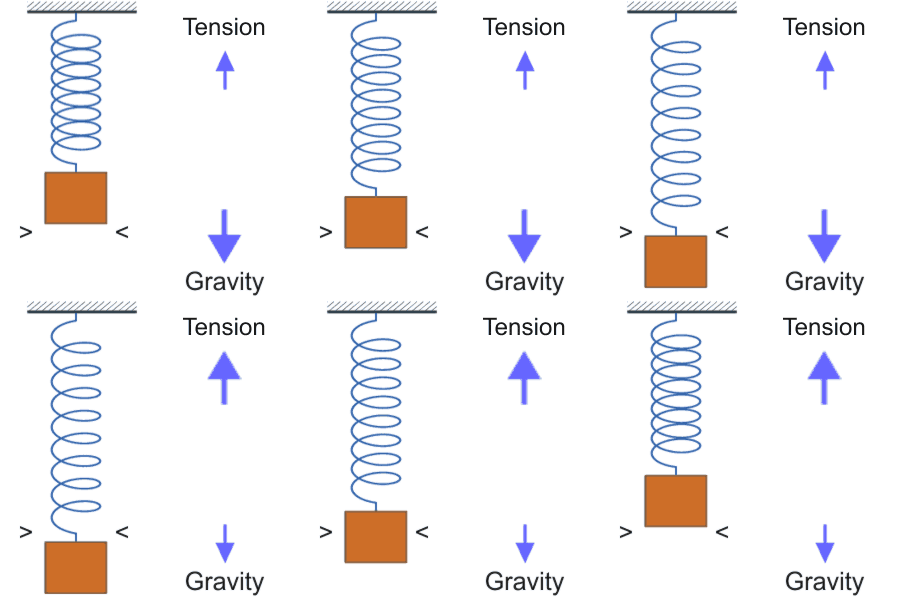 A wave happens in a system when a driving force and a restoring force take turns overshooting an equilibrium point AND the away-from-equilibrium-ness gets communicated around the system. The system could be a bunch of springs tied together in a squeaky old bedframe, or labor and capital in an economic system, or the network of water molecules forming the ocean surface, or the fibers in the fabric of space (whatever those turn out to be).
 An isolated black hole is surrounded by an intense gravitational field and a corresponding compression of spacetime. A pair of black holes orbiting each other sends out an alternating series of tensions, first high, then extremely high, then high…
 Almost a century later, James Clerk Maxwell (the bearded fellow at left) wrote down his electromagnetism equations that explain how light works. Half a century later, Einstein did the same for gravity.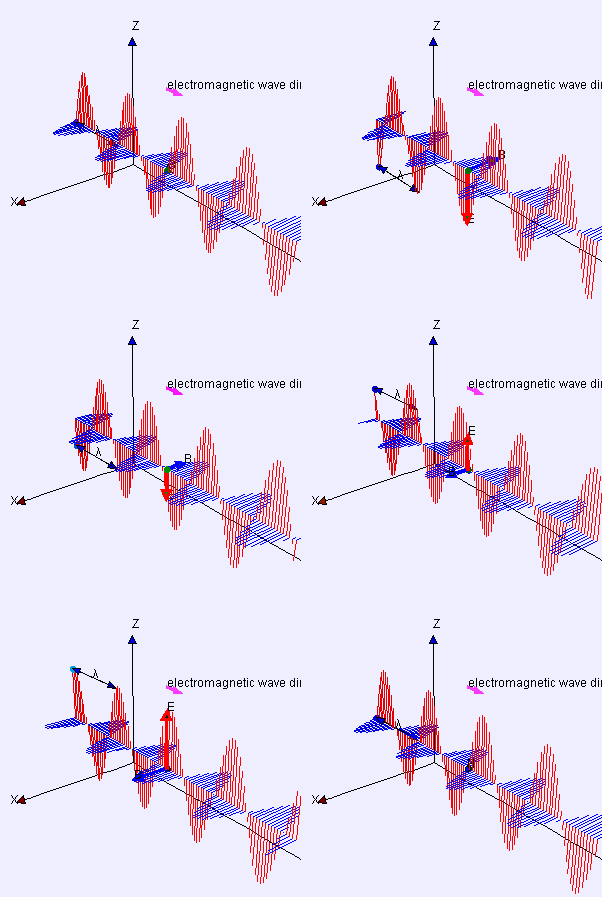
 Gravitodynamics is completely unlike electrodynamics. Gravity’s transverse “force” doesn’t act to move a whole mass up and down like Maxwell’s picture at left. Instead, as shown by Einstein’s picture, gravitational waves stretch and compress while leaving the center of mass in place. I put “force” in quotes because what’s being stretched and compressed is space itself. See
  Hard Science Ain't Hard


