White Noise And Red

“That point’s kinda weak, Sy. The NANOGrav team says 15 years of pulsar timing data let them hear the Universe humming. What’s the difference if they call it a hum or a rumble or a warble?”

“Not much, Vinnie. Matter of taste and scale, I guess. As a human I think of a ‘hum‘ as something in the auditory range, roughly 60‑120 cycles per second. Whatever these folks have found, it rumbles in years per cycle. Scaled to the Sun’s ten‑billion‑year lifetime I suppose that’d be a supersonic screech.”

“Whatever they’ve found? We don’t know?”

“Not yet, Al. The team likes one hypothesis but it’ll take years to collect enough data for firm support or refutation.”

“In addition to the 15 years‑worth they’ve got already? Why not just add more antennas?”

“What they’re following changes so slowly they need a long baseline to have confidence that jiggles they see are real. Part of this paper is about conclusions the team reached after they stuck a few extra years of old data onto the front of their time series.”

“You can do that?”

“Sure. The series is just a big database, like a spreadsheet with a page for each pulsar and a row on that page for each blink. The row captures the recorded time for the blink’s peak, but also a bunch of other data like measures related to pulse width and asymmetry, the corrected peak time, identifiers for the reporting observatory and reference time standard—”

Corrected time? Looks suspicious. What did they correct for?”

“Of course you’re suspicious, Vinnie, but so are they and so are other astronomers. You don’t want to make a big announcement like this unless you’ve checked everything for error sources. For instance, Earth moving around the Sun means we’re a little closer to a particular pulsar at one time of year, further away six months later.”

“So you correct the timings to what they’d be at the Sun’s center, right?”

“That’s just for starters. Jupiter and the Sun orbit around their common center of gravity on an 11.8‑year cycle. The researchers had to pull data from the Juno mission to correct for the Sun’s personal waltz. Of course the Solar System is moving relative to the stellar background, another correction. Then maybe the pulsar itself is part of a binary, happens a lot, and it’s probably moving through the sky, too — lots of careful corrections. That’s step one.”

“Then what?”

“Use each pulsar’s corrected timings to build a mathematical model of its idealized behavior. Once you know what’s ‘normal‘, you can start talking about jiggles that deviate from normal.”

“Reminds me of the ephemeris trick — sort of build an artificial pulsar to compare against.”

“Exactly the same idea, Vinnie, and by the way, ephemerides are still used but not to define the length of a second. Step three is statistical analysis: compare all possible deviation histories, every pulsar against every other pulsar.”

“Sounds like a lot of work, even for a computer. So what did they find?”

“Well, what they observed was that the pulsar timings we received weren’t as absolutely regular as they would have been with a static gravitational field. The overall picture resembled fog in a noisy room, waves of every size skittering in every direction and messing up reception. When the researchers broke that picture down by frequency, the waves shorter than 21 months or so added up to just white noise, complete randomness.”

“A hiss, not a hum. What about the longer waves?”
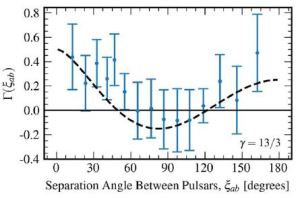
Fig 1(c) from Agazie, el al (2023).

“Red noise — jiggles heavy‑loaded on longer wavelengths out to the 16‑year maximum their data’s good for so far. But that’s not all. When they plotted jiggle correlation between pulsars separated at different angles across the sky, the curve mostly matched a prediction for the gravitational wave pattern that would be generated by a large number of randomly distributed independent sources.”

“Lots of sources, which would be…?”

“We don’t know. One hypothesis is that they’re pairs of supermassive black holes orbiting each other at the centers of merged galaxies. But I’ve read another paper giving a dozen other explanations. Everyone’s waiting for more data.”
~~ Rich Olcott
Not A Hum, A Rumble

Vinnie taps on the magazine. “Sy, you’ve done it again. We ask you one question, you spend a lot of time talking about something else entire. They got this article here” <tap> “says the NANOGrav team captured the hum of the Universe. Al and me, we ask you about that and you get us discussing pulsars. Seems to me,” <tap tap> “that if you got a pulsar and the pulses got only a 3% duty cycle they’d sound more like clicks and,” <taptaptaptap> “if it’s a 10 millisecond pulsar that’s a hundred per second and they’d be more like a low‑pitched buzz, nothing like a hum.”

“One more short detour, Vinnie, sorry. Remember when we discussed the VLA, the Very Large Array of radio telescopes in northern New Mexico?”

“Sorta. I do remember visiting the place, out in the desert miles away from anywhere. They’ve got a couple dozen dish antennas each as wide as a four‑lane road, all spread out along railroad tracks. Big dishes for catching weak signals I understand, but I forget why there’s lots of dishes instead of one huge one or how that even works.”

“One reason is simple mechanics. A huge dish would try to sail away in the desert wind. VLA admins even have to safe‑mount those 25‑meter ones when things get gusty. But the real reason goes to how the array works as one big instrument. Here’s a hint — the dishes can be miles apart and lightspeed isn’t infinite.”

“Ah, that joggled my memory. It’s about when a signal comes in from some nova or something, each dish registers it with a slightly different arrival time and then the computers play match‑up games with all the time differences to figure exactly what angle the signal came from, right?”

“Roughly. The VLA’s multi‑dish design is about being able to resolve signal sources that are close together in the sky so yeah, slightly different angles. The Event Horizon Telescope team used the same strategy and a collection of radio dishes all over the world to produce those orange‑ring images of supermassive black holes. NANOGrav and the other Pulsar Timing Arrays sort of the flip the strategy.”

“At last we get to NANOGrav. Wait, they use lots of antennas to send signals to a star?”

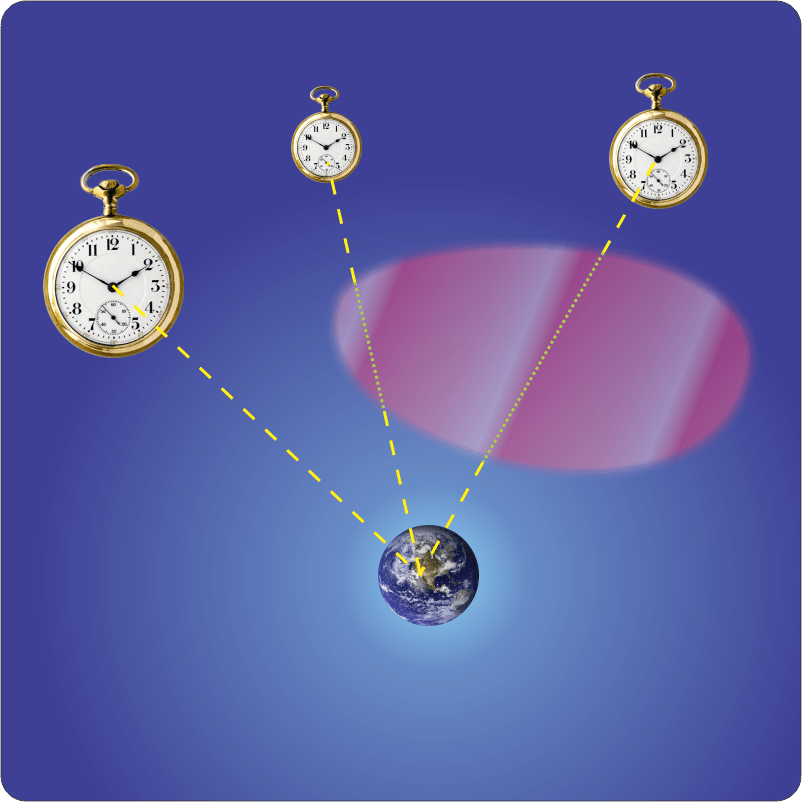
“Nothing like that, Al. No, they use just a few antennas but they track the timing of many pulsars. About 70 at last count.”

“But we know what the timing is, to nanoseconds you said.”

“One word, Vinnie. ‘Frames‘.”

“Aw geez, Sy. Again?”

“Mm-hm. In the pulsar’s frame, it’s majestically rotating at a steady pace, tens or hundreds of times per second relative to its neighbors. Its beam proudly announces its presence on an absolutely regular schedule save for a small but steady slow‑down. In our frame, though, things can happen to a pulse as it heads our way.”

“Like what?”

“It might pass through a molecular cloud. We know those exist. Photons in the right wavelength ranges could interact with cloud components. That’d delay them, stretch the pulse, might even create interference between successive pulses. On the theory side, some cosmologists think the Universe may hold objects like cosmic strings or curvature‑induced domain walls that could delay, deflect or otherwise mess up a pulse. The best possibility, though, is that a gravitational wave could cross the path of a pulse en route to us.”

“Why is that a good thing?”

“Because they’d interact to alter that pulse’s timing. Gravitational waves stretch and squeeze time as they squeeze and stretch space. If a wave crosses a traveling pulse, the pulse will get here either early or late depending. Better yet, if we track enough pulsars scattered across the sky we might even see a parade of offset timings as the wave encounters different pulse beams. Hasn’t happened yet, though. The NANOGrav reports so far are about the background variation as waves from everywhere traverse the paths we’re watching.”

“The article says a hum.”

“Hum sounds come in waves per second. The gravitational background happens in waves per decade, such a low frequency even elephants couldn’t hear it.”

“OK, it’s rumble, not a hum. But why either one?”

~~ Rich Olcott

LIGO And NANOGrav

Afternoon coffee time, but Al’s place is a little noisier than usual. “Hey, Sy, come here and settle this.”

“Settle what, Al? Hi, Vinnie.”

<waves magazine> “This NANOGrav thing, they claim it’s a brand‑new kind of gravity wave. What’s that about?”

“Does it really say, ‘gravity wave‘? Let me see that. … <sigh> Press release journalism at its finest. ‘Gravity waves’ and ‘gravitational waves’ are two entirely different things.”

“I kinda remember you wrote about that, but it was so long ago I forget how they’re different.”

“Gravity waves happen in a fluid, like air or the ocean. Some disturbance, like a heat spike or an underwater landslide, pushes part of the fluid upward relative to a center of gravity. Gravity acts to pull that part down again but in the meantime the fluid’s own internal forces spread the initial up‑shift outwards. Adjacent fluid segments pull each other up and down and that’s a gravity wave. The whole process keeps going until friction dissipates the energy.”

“Gravitational waves don’t do that?”

“No, because gravitational waves temporarily modify the shape of space itself. The center doesn’t go up and down, it…” <showing a file on Old Reliable> “Here, see for yourself what happens. It’s called quadrupolar distortion. Mind you, the effects are tiny percentagewise which is why the LIGO apparatus had to be built kilometer‑scale in order to measure sub‑femtometer variations. The LIGO engineers took serious precautions to prevent gravity waves from masquerading as gravitational waves.”

“Alright, so now we’ve almost got used to LIGO machines catching these waves from colliding black holes and such. How are NANOGrav waves different?”

“Is infrared light different from visible light?”

“The Hubble sees visible but the Webb sees infrared.”

“Figures you’d have that cold, Al. What I think Sy’s getting at is they’re both electromagnetic even though we only see one of them. You’re gonna say the same for these new gravitational waves, right, Sy?”

“Got it in one, Vinnie. There’s only one electromagnetic field in the Universe but lots of waves running through it. Visible light is about moving charge between energy levels in atoms or molecules which is how the visual proteins in our eyes pick it up. Infrared can’t excite electrons. It can only waggle molecule parts which is why we feel it as heat. Same way, there’s only one gravitational field but lots of waves running through it. The LIGO devices are tuned to pick up drastic changes like the <ahem> massive energy release from a black hole collision.”

“You said ‘tuned‘. Gravitational waves got frequencies?”

“Sure. And just like light, high frequencies reflect high‑energy processes. LIGO detects waves in the kilohertz range, thousands of peaks per second. NANOGrav’s detection range is sub‑nanohertz, where one cycle can take years to complete. Amazingly low energy.”

“How can they detect anything that slow?”

“With really good clocks and a great deal of patience. The new reports are based on fifteen years of data, half a billion seconds counted out in nanoseconds.”

“Hey, wait a minute. LIGO’s only half‑a‑dozen years old. Where’d they get the extra data from, the future?”

“Of course not. Do you remember us working out how LIGO works? The center sends out a laser pulse along two perpendicular arms, then compares the two travel times when the pulse is reflected back. Light’s distance‑per‑time is constant, right? When a passing gravitational wave squeezes space along one arm, the pulse in that arm completes its round trip faster. The two times don’t match any more and everyone gets excited.”

“Sounds familiar.”

“Good. NANOGrav also uses a timing‑based strategy, but it depends on pulsars instead of lasers. Before you ask, a pulsar is a rotating neutron star that blasts a beam of electromagnetic radiation. What makes it a pulsar is that the beam points away from the rotation axis. We only catch a pulse when the beam points straight at us like a lighthouse or airport beacon. Radio and X‑ray observatories have been watching these beasts for half a century but it’s only in the past 15 years that our clocks have gotten good enough to register timing hiccups when a gravitational wave passes between us and a pulsar.”

~ Rich Olcott

The Big Skip?

Suddenly Vinnie gets a grin all over his face. “Tell me something, Cathleen. Suppose I’m a pilot in a shuttle craft like in Star Trek. Tell me how conditions change as I dive down into Jupiter.”

“Hmm .. okay. Mind you, it’ll be a dangerous flight. You’ll fly through an atmosphere that’s mostly molecular hydrogen which is notorious for sneaking into metallic materials and weakening them. I recommend investing in a Starfleet‑grade force shield to keep the atmosphere completely away from your hull. While you’re in the stratosphere high above the cloud decks you’ll see a deep blue sky pretty much the same as Earth’s stratosphere. Try to avoid the thin gray clouds in the upper troposphere — their greasy hydrocarbons will fog your windshield. You want to stick to clear air as much as possible so dodge around the white ammonia‑ice zones. You can drop a couple hundred kilometers more before you hit the top of a brownish ammonium sulfides band.”

“Once I’m that deep there’s clear air underneath the white deck, right?”

“We just don’t know. Unlikely, but if you do want to fly beneath a zone you’ll have to traverse the jetstream separating it from your band. Pick the pole‑ward zone — jetstreams on that side seem to host fewer thunderstorms. Strap in for the jump, because the jetstreams sustain windspeeds 2‑3 times what we get in a Category 5 hurricane. Things’ll get muddier when you drop beneath the brown clouds.”

“Brown as mud, uh-huh.”

“No, I mean literal mud, maybe. First there’s a water‑ice layer and below that there may be a layer of clay‑ish or silicate droplets which may include water of crystallization. I like to visualize clouds of opal, but of course there’d be no sunlight to see them by. A bit lower and you’ll fly through helium rain. Get past all that and you’re about 20% of the way down, about two Earth diameters.”

“That’s where I bump into something?”

“No, that’s the transition zone where heat and pressure convert molecular H₂ into a metallic fluid of protons embedded in a conducting ocean of electrons. Sy, how do you suppose that would affect Vinnie’s aerodynamics?”

“Destructively. If his shuttle’s skin doesn’t rupture he’d be floating rather than sinking. Net density of an intact hull and everything inside would be less than the prevailing density outside where protons are crammed together. Even powered descent would be tough.”

“Sy, that’s exactly what my crazy idea needs! Cathleen, when’s your next Crazy Theory seminar?”

“Not until next term, some time in the Fall. C’mon, Vinnie, out with it!”

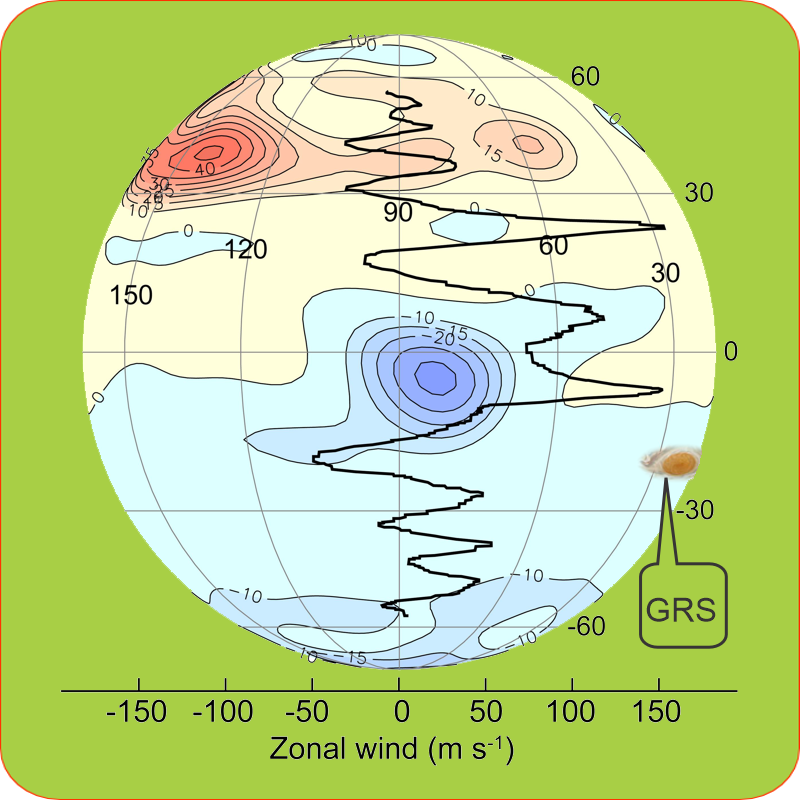
Magnetism and wind map by NASA/JPL-Caltech/SwRI/John E. Connerney. Great Red Spot image added by the author.

“All right. That diagram you showed us with the red and blue spots in Jupiter’s off‑center magnetic field? It got me thinking. You get magnetism from moving charge, right, and they say Earth’s field comes from swirls in the molten iron deep underneath our crust. Jupiter doesn’t have iron so much, but you say it’s got electrons in liquid metallic hydrogen and that oughta be able to swirl, too. Maybe Jupiter has a shallow major swirl on that one side.”

“And just what do you suggest would cause a swirl like that?”

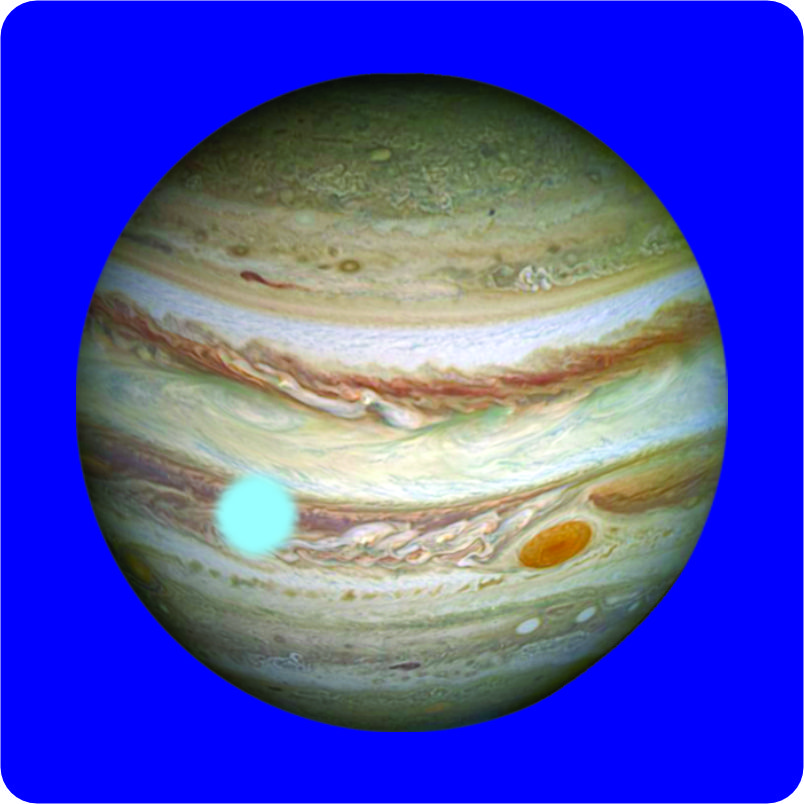
“Al was talking the other day about ‘the grand tack hypothesis‘ where Jupiter waltzed in across the inner Solar System before it waltzed back out and settled down where it’s at. Suppose while it was waltzing it hit a planetoid, maybe the size of Io. The little guy couldn’t sink and wouldn’t stick because metallic hydrogen’s liquid so it’d skip across the surface and shoot away and maybe became a moon. That’d raise a swirl like I’m talking about. See, on the map a line crossing the line between the magnetic red and blue spots could be the skip path.”

<silence>

“Hey, and the Great Red Spot, see how it’s like opposite to where I guess the hit was, that’d be like a through-planet resonance like on Mars where that Hellas meteor strike is opposite the Tharsis Bulge.”

<long pause>

“I dunno, Cathleen, Io’s so weird, do you suppose…”

“I dunno, Sy. Io has that magnetic bridge to Jupiter…”

~ Rich Olcott

Stripes And Solids

“Any other broad-brush Jupiter averages, Cathleen?”

“How about chemistry, Vinnie? Big picture, 84% of Jupiter’s atoms are hydrogen, 16% are helium.”

“Doesn’t leave much room for asteroids and such that fall in.”

“Less than a percent for all other elements. Helium doesn’t do chemistry, so from a distant chemist’s perspective Jupiter and Saturn both look like a dilute hydrogen‑helium solution of every other element. But the solvent’s not a typical laboratory liquid.”

“Hard to think of a gas as a solvent.”

“True, Sy, but chemistry gets strange under high temperatures and pressures.”

“Hey, I always figured Jupiter to be cold ’cause it’s farther from the Sun than us.”

“Good logic, Vinnie, but Jupiter generates its own heat. That’s one reason its weather is different from ours. Earth gets more than 99% of its energy budget from sunlight, especially in the infrared. There’s year‑long solar heating at low latitudes but only half‑years of that near the Poles. The imbalance is behind the temperature disparities that drive our prevailing weather patterns.”

“Jupiter’s not like that?”

“Nope. It gets 30 times less energy from the Sun than Earth does and actually gives off more heat than it receives. Its poles and equator are at virtually the same chilly temperature. There’s a small amount of heat flow from equator to poles, but most of Jupiter’s heat migrates spherically from a 24,000 K fever near its core to its outer layers.”

“What could generate all that heat?”

“Probably several contributors. The dominant one is gravitational potential energy from everything falling inward and banging into everything else. Random rock or atom collisions generate heat. Entropy rules.”

“Sounds reasonable. What’s another?”

“Radioactives. Half of Earth’s internal heating comes from gravity, same mechanism as Jupiter though on a smaller scale. The rest comes from unstable isotopes like uranium, thorium and potassium‑40. Also aluminum‑26, back in the early years, but that’s all gone now. Jupiter undoubtedly ate from the same dinner table. Those fissionable atoms split and release heat whenever they feel like it whether or not they’re collected in one place like in a reactor or bomb. Whatever the origin, Jupiter ferries that heat to the surface and dumps it as infrared radiation.”

“Yeah or else it’d explode or something.”

“Mm-hm. The question is, what are the heat‑carrying channels? They must thread their way through the planet’s structure.”

“It’s just a big ball of gas, how can it have structure?”

“I can help with that, Vinnie. Remember a few years back I wrote about high‑pressure chemistry? Hydrogen gets weird at a million bars‑‑‑”

“Anyone’d get weird after that many bars, Sy.” <heh, heh>

“Ha ha, Vinnie. A bar is pressure equal to one Earth atmosphere. Pressures deep inside Jupiter get into hundreds of megabars. Hydrogen molecules down there are crammed so close together that their electron clouds merge and you have a collection of protons floating in a sea of electron charge. They call it metallic hydrogen, but it’s fluid like mercury, not crystalline. Cathleen, when you refer to Jupiter’s structure you’re thinking layers?”

“That’s right, Sy, but the layers may or may not be arranged like Earth’s crust, mantle, core scheme. A lot of the Juno data is consistent with that — a shell of the atmosphere we see, surrounding a thick layer of increasingly compressed hydrogen‑helium over a core of heavy stuff suspended in metallic hydrogen. About 20% down we think the helium is squeezed out and falls like rain, only to evaporate again at a lower level. The core’s metallic hydrogen may even be solid despite thousand‑degree temperatures — we just don’t know how hydrogen behaves in that regime.”

“What other kind of layering can there be?”

“Experiments have demonstrated that under the right conditions a rapidly spinning fluid can self-organize into a series of concentric rotating cylinders. Maybe Jupiter and the other gas planets follow that model and the stripes show where the cylinders intersect with gravity’s spherical imperative. Coaxial cylinders would account for the equator and poles rotating at different rates. Juno data indicates that Jupiter’s equatorial zone has more ammonia than the rest of its atmosphere. Maybe between‑cylinder winds trap the ammonia and prevent it from mixing with the next deeper cylinder.”

~ Rich Olcott

Red And Blue Enigmas

“All that cloud stuff goes on in Jupiter’s tissue-paper outer layer. What’s the rest of the planet doing, Cathleen?”

“You’re not going to like this, Vinnie, but all we’ve got so far is broad‑brush averages. The Galileo atmosphere probe penetrated less than 0.2% of the way to the center. The good news is that the Juno probe has been sending us oodles of data about Jupiter’s gravity and magnetic fields. That’s great for planet‑wide theorizing, not quite as useful for weather prediction.”

“Can the data explain the Great Red Spot?”

“Well, it ruled out some ideas. Back in the day we thought the Spot was a deep whirlpool opening a view into the interior. Nope. Juno‘s measurements revealed that the Spot is actually a dome rising hundreds of kilometers above the white cloud‑tops. When one window closes, another one opens, I suppose. The fact that the Spot’s a dome says down below there’s an immense energy source lifting the gases above it. We don’t know what it is or why it’s there or how for two centuries it’s mostly held position in a completely fluid environment.”

“Weird. You’d expect something like that at a special location, like at one of the poles, but the Spot isn’t even on the planet’s equator.”

“Right, Sy. Its latitude is 22° south.”

“Hey, that’s the Tropic of Capricorn.”

“Almost, Vinnie, but not relevant. Earth’s two Tropics are at 23½° north and south. If the Earth’s rotational axis were perpendicular to its solar orbit, the Sun’s highest position would always be directly over the Equator. But Earth’s axis is tilted at 23½° to our orbital plane. To see the noon Sun at the zenith you’d have to be 23½° north of the Equator in June, 23½° south of the Equator in December. Jupiter’s rotational axis is tilted, too, but by only 3°. That rules out significant seasonality on Jupiter, but it also says that on Jupiter there’s nothing special about 22° except that it’s where the Spot hangs out.”

“How about longitude?”

“Longitude on Jupiter is an embarrassing topic. Zero longitude on Earth, our Prime Meridian, runs through Greenwich Observatory in London, right? I don’t want to get into the history behind that. On a completely gaseous planet like Jupiter, there’s no stable physical object to tag with a zero. Jupiter’s cloud‑tops rotate faster near its equator than at its poles. Neither rotation syncs with Jupiter’s magnetic field which is like Earth’s except it’s much more intense and it points in the opposite direction. Oh, and it’s offset from the center of the planet and it’s lumpy. For lack of a better alternative, astronomers arbitrarily thumbtacked Jupiter’s Prime Meridian to its magnetic field. They selected the magnetic longitudinal line that pointed directly towards Earth at a particular moment in 1965. Given a good clock and the field’s rate of rotation you can calculate where that line will be at any other time.”

“Sounds like that ephemeris strategy Sy told me about in our elevator adventure. Why’s that embarrassing?”

“Well, back in 1965 the tool of choice for studying Jupiter’s rotating magnetic field was radio spectroscopy. Technology wasn’t as good as we have now and they … didn’t get a completely accurate rate of rotation. We’re stuck with a standard coordinate system where the Prime Meridian slips about 3° every year relative to the magnetic field. Even the Great Red Spot slips a little.”

“Cathleen, I’ve read that Juno uncovered a region of particularly intense magnetic activity they’re calling Jupiter’s Great Blue Spot. Does it have any connection to the Red Spot?”

Magnetism and wind map by NASA/JPL-Caltech/SwRI/John E. Connerney. Great Red Spot image added by the author.

“Probably not, Sy, the Red Spot’s 15° south and 60° east of the Blue. But with Jupiter who knows?”

“Got any other interesting averages?”

“Extreme wind speeds. There’s a jet stream between each pair of Jupiter’s stripes, eastbound on the poleward side of a white zone, westbound in the other side. Look at the zig‑zag graph on this chart. 75 meters/second is 167 miles per hour is a Category 5 hurricane here on Earth. At latitudes near Jupiter’s equator average winds are double that.”

~~ Rich Olcott
Clouds From Both Sides Now

I don’t usually see Vinnie in a pensive mood. Moody, occasionally, but there he is at his usual table by the door, staring at the astronomy poster behind Al’s cash register. “Have a scone, Vinnie. What’s on your mind?”

“Thanks, Sy. Welcome back, Cathleen. What’s bugging me is the hard edges on that picture of Jupiter. It looks like those stripes are painted on. Everyone says Jupiter’s not really solid so how come the planet looks so smooth?”

“Cathleen, this is definitely in your astronomer baliwick.”

“I suppose. It’s a matter of scale, Vinnie. The white zones mark updrafts. The whiteness is clouds that rise a couple hundred kilometers above a brownish lower layer. The downdraft belts on either side are transparent enough to let us see the next lower layer. ‘A couple hundred kilometers‘ sounds like a lot, but that’s only a tenth of a percent of Jupiter’s radius. If Jupiter were a foot‑wide ball floating in front of us, the altitude difference would be as thin as a piece of tissue paper. You might be able to feel the ridges and valleys but you’d have a hard time seeing them.”

“But why does the updraft stop so sharp? Is there like a cap on the atmosphere?”

“The clouds stop, but the updrafts don’t. The cloud tops aren’t even close to the top of Jupiter’s atmosphere, any more than Earth clouds reach the top of ours. C’mon, Vinnie, you’re a pilot. Surely you’ve noticed that most thunderheads top out at about the same altitude. Isn’t the sky still blue above them?”

“That’s higher than the planes I fly are cleared for, but I wouldn’t want to get above one anyway. I know a guy who flew over one that was just getting started. He said it’s a bumpy ride but yeah, there’s still kind of a dark blue sky above.”

“All of that makes my point — our atmosphere doesn’t stop at the tropospheric boundary where the clouds do. Beyond that you’ve got another 40‑or‑so kilometers of stratosphere. Jupiter’s the same way, clouds go up only partway. For that matter, Jupiter has at least four separate cloud decks.”

“Wait, Cathleen — four? I know how Earth clouds work. Warm humid air rises, expanding and cooling as it goes. When its temperature falls below the dew point or freezing point, its humidity condenses to water droplets or ice crystals and that’s the cloud. I suppose if that same bucketful of air keeps rising far enough the pressure gets so low the water evaporates again and that’s the top of the cloud. How can that happen multiple times?”

“It doesn’t, Sy. In Jupiter’s complicated atmosphere each deck is formed from a different gas. Top layer is a wispy white hydrocarbon fog. The white zone clouds next down are ices of ammonia, which has to get a lot colder than water before it condenses. Water ice probably has a layer much farther down.”

“What’s the brownish layer?”

“There’s one or maybe two of them, each a complex mixture of ammonium ions with various sulfide species. The variety of colors in there make the visible light spectroscopy an opaque muddle.”

“Hey, if the brownish layers block what we can see, how do we even know lower layers are a thing?”

“Good question, Vinnie. Actually, we can do spectroscopy in the middle infrared. That gives us some clues. We’d hoped that the Galileo mission’s deep‑diver probe would sense the lower layers directly but unfortunately it dove into a hot spot where the upwelling heat messes up the layering. Our last resort is modeling. We have an inventory of lab data on thousands of compounds containing the chemical elements we’ve detected on Jupiter. We also have a pretty good temperature‑pressure profile of the atmosphere from the planet’s stratosphere down nearly to the core. Put the two together and we can paint a broad‑brush picture of what compounds should be stable in what physical state at every altitude.”

“Those ‘broad‑brush‘ and ‘should‘ weasel‑words say you’re working with averages like Einstein didn’t like with quantum mechanics. Those vertical winds mix things up pretty good, I’ll bet.”

“Fair objection, Vinnie, but we do what we can.”

~~ Rich Olcott
Why Is Io Hot, Europa Not?

The Acme Pizza and Science Society is back in session at Eddie’s circular table. Al won the last pot so he gets to pick the next topic. “I been reading about Jupiter’s weird moon Io.”

“How’s it any weirder than Ganymede that’s bigger than Mercury?”
  ”Or Europa that’s got geysers and maybe life?”

“Guys, it’s the only yellow moon in the Solar System. You can’t any weirder than that! We got lots of stony moons that are mostly gray, a few water‑ice moons that are white like snow and then there’s Io by itself covered with sulfur.”

“Yellow?”

“Mostly yellow, except where it’s red or dark brown. Or white. They’re all sulfur colors.”

“I’ve seen yellow sulfur, but red?”

“It’s like carbon can be diamond or graphite. Sulfur can be different colors depending on how hot it was when it froze. The article said the white’s probably frozen sulfur dioxide that smells like burning matches.”

“Where’d all that sulfur come from?”

“From inside Io. It’s got like 400 volcanoes that blast out sulfur and stuff. Some of it falls back and that’s why Io is yellow, but a lot gets all the way into space. The article said Io loses a tonne per second. Nothin’ else in the Solar System is that active. Or that dense, probably ’cause it blasted away all its light stuff a long time ago. Anyway, I got a theory.”

“Don’t stop there. What’s the theory?”

“Jupiter’s stripes got all those colors, right, and Sy here wrote astronomers think the brownish bands have sulfur. My theory is that Jupiter got its sulfur from Io. Whaddaya think, Sy?”

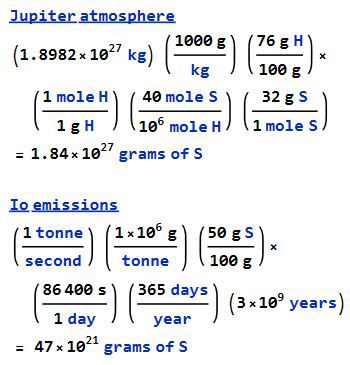
“Interesting idea.” <drawing Old Reliable from its holster> “We need numbers before we can upgrade that to a conjecture.” <screen‑tapping> “So, how much sulfur does Jupiter have, and how much could Io have supplied? … Ah, here’s a chart to get us started. Says for every million hydrogen atoms in Jupiter’s atmosphere there’s 40 sulfurs. This Wikipedia article says that the planet masses 1.898×1027 kilograms. 76% of that is hydrogen which calculates to … 1.8×1027 grams of sulfur.”

“That’s a lot of sulfur.”

“Mm-hm. Now, using your tonne per second loss rate and guessing it’s 50% sulfur and that’s been going on for ¾ of the system’s life so far, I get that Io may have shed about 5×10²² grams of sulfur. That’s short by 4½ powers of 10. Sorry, Al, Io contributed a little to Jupiter’s sulfur stash but not enough to promote your idea to a conjecture.”

Jim tosses some chips into the pot. “It’s worse than that, Sy. Galileo‘s probe fell into a clear hotspot so it sampled Jupiter’s gaseous atmosphere but it totally missed the sulfur tied up in those brown clouds. Jupiter’s got even more sulfur than your calculation shows. But there’s still an open question.”

“What’s open?”

Animation by WolfmanSF, CC0, via Wikimedia Commons

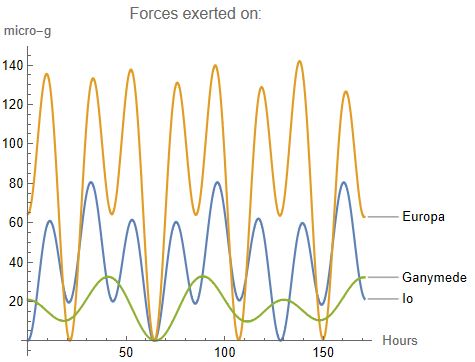
“The inner three Galilean moons are locked into resonant orbits. Laplace explained how their separate gravitational fields continually nudge each other to stay in sync. A 1979 paper supported that explanation but then claimed that the moon‑moon nudges produced enough tidal friction within Io to power volcanoes.”

“What’s wrong with that?”

“It doesn’t tell us why Io’s the only one hot enough to boil off all its water.”

“Io had water?”

“Probably, long ago. All three share the same orbital plane and probably formed from the same disk of gas and dust. Both Europa and Ganymede are water worlds, covered by kilometers of water ice. Io should be wet or the other two would be dry by now. Something’s different with Io and it’s not inter‑moon gravitation.”

“Why not?”

“Numbers. Those moon‑moon interactions are measured in microgravities. Such light impulses can synchronize effectively if repeated often enough, but these just aren’t energetic enough to boil a moon. Besides, Europa stays cool even though it feels a lot more action than Io does.”

“You got a theory?”

“A hypothesis. I’m betting on magnetism. Io’s deep in Jupiter’s lumpy magnetic field which must generate eddy currents in Io’s mostly iron core. I think Io heats up like a pot on an induction stove.”

~~ Rich Olcott

SPLASH Splish plink

<chirp, chirp, chirp, chirp> “Moire here. This’d better be good.”

“Hello, Mr Moire. I’m one of your readers.”

“Do you have any idea what time it is?”

“Afraid not, I don’t know what time zone you’re in.”

“It’s three o’clock in the morning! Why are you calling me at this hour?”

“Oh, sorry, it’s mid-afternoon here. Modern communications tech is such a marvel. No matter, you’re awake so here’s my question. I’ve been pondering that micro black hole you’ve featured in the last couple of posts. You convinced me it would have a hard time hitting Earth but then I started thinking about it hitting the Sun. The Sun’s diameter is 100 times Earth’s so it presents 10,000 times more target area, yes? Further, the Sun’s 300,000 times more massive than Earth so it has that much more gravity. Surely the Sun is a more effective black hole attractor than Earth is.”

“That’s a statement, not a question. Worse yet, you’re comparing negligible to extremely negligible and neither one is worth losing sleep over which is what I’m doing now.”

“Wait on, I’ve not gotten to my question yet which is, suppose a black hole did happen to collide with the Sun. What would happen then?”

<yawn> “Depends on the size of the black hole. If it’s supermassive, up in the billion‑sun range, it wouldn’t hit the Sun. Instead, the Sun would hit the black hole but there’d be no collision. The Sun would just sink quietly through the Event Horizon.”

“Wouldn’t it rip apart?”

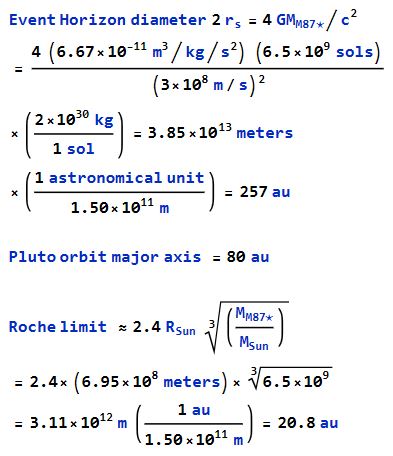
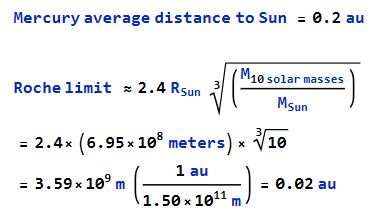
“You’re thinking of those artistic paintings showing great blobs of material being torn away by a black hole’s gravity. Doesn’t work that way, at least not at this size range.” <grabbing Old Reliable from my nightstand and key‑tapping> “Gravitational forces are distance‑dependent. Supermassives are large even by astronomical standards. The M87* black hole, the first one ESA got an image of, has the mass of 6 billion Suns and an Event Horizon three times wider than Pluto’s orbit. The tidal ripping‑apart you’re looking for only happens when the mass centers of two objects approach within Roche’s limit. Suppose a Sun‑sized star flew into M87*’s Event Horizon. Their Roche limit would be 100 astronomical units inside the Event Horizon. If any ripping happened, no evidence could escape to us.”

“Another illusion punctured.”

“Don’t give up hope. The next‑smaller size category have masses near our Sun’s. The Event Horizon of a 10‑solar‑mass black hole would be only about 60 kilometers wide. The Roche Zone for an approaching Sun is a million times wider. There’s plenty of opportunity for ferocious ripping on the way in.”

“Somehow that’s a comfort, but my question was about even smaller black holes — micro‑size flyspecks such as you wrote about. What effect would one have on the Sun?”

“You’d think it’d be a simple matter of the micro‑hole, let’s call it Mikey, diving straight to the Sun’s center while gobbling Sun‑stuff in a gluttonous frenzy, getting exponentially bigger and more voracious every second until the Sun implodes. Almost none of that would happen. The Sun’s an incredibly violent place. On initial approach Mikey’d be met with powerful, rapidly moving magnetic fields. If he’s carrying any charge at all they’d give him whip‑crack rides all around the Sun’s mostly‑vacuum outer layers. He might not ever escape down to the Convection Zone.”

“He’d dive if he escaped there or he’s electrically neutral.”

“Mostly not. The Convection Zone’s 200,000-kilometer depth takes up two‑thirds of the Sun’s volume and features hyper‑hurricane winds roaring upward, downward and occasionally sideward. Mikey would be a very small boat in a very big forever storm.”

“But surely Mikey’s density would carry him through to the core.”

“Nope, the deeper you go, the smaller the influence of gravity. Newton proved that inside a massive spherical shell, the net gravitational pull on any small object is zero. At the Sun’s core it’s all pressure, no gravity.”

“Then the pressure will force‑feed mass into Mikey.”

“Not so much. Mikey has jets and and an accretion disk. Their outward radiation pressure sets an upper limit on Mikey’s gobbling speed. The Sun will nova naturally before Mikey has any effect.”

“No worries then.”

~~ Rich Olcott

Hiding Among The Hill Spheres

Bright Spring sunlight wakes me earlier than I’d like. I get to the office before I need to, but there’s Jeremy waiting at the door. “Morning, Jeremy. What gets you here so soon after dawn?”

“Good morning, Mr Moire. I didn’t sleep well last night, still thinking about that micro black hole. Okay, I know now that terrorists or military or corporate types couldn’t bring it near Earth, but maybe it comes by itself. What if it’s one of those asteroids with a weird orbit that intersects Earth’s orbit? Could we even see it coming? Aren’t we still in danger of all those tides and quakes and maybe it’d hollow out the Earth? How would the planetary defense people handle it?”

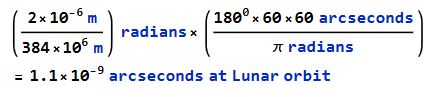
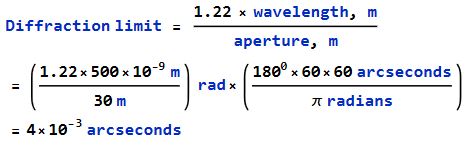
“For so early in the day you’re in fine form, Jeremy. Let’s take your barrage one topic at a time, starting with the bad news. We know this particular object would radiate very weakly and in the far infrared, which is already a challenge to detect. It’s only two micrometers wide. If it were to cross the Moon’s orbit, its image then would be about a nanoarcsecond across. Our astrometers are proud to resolve two white‑light images a few milliarcseconds apart using a 30‑meter telescope. Resolution in the far‑IR would be about 200 times worse. So, we couldn’t see it at a useful distance. But the bad news gets worse.”

“How could it get worse?”

“Suppose we could detect the beast. What would we do about it? Planetary defense people have proposed lots of strategies against a marauding asteroid — catch it in a big net, pilot it away with rocket engines mounted on the surface, even blast it with A‑bombs or H‑bombs. Black holes aren’t solid so none of those would work. The DART mission tried using kinetic energy, whacking an asteroid’s moonlet to divert the moonlet‑asteroid system. It worked better than anyone expected it to, but only because the moonlet was a rubble pile that broke up easily. The material it threw away acted as reaction mass for a poorly controlled rubble rocket. Black holes don’t break up.”

“You’re not making getting to sleep any easier for me.”

“Understood. Here’s the good news — the odds of us encountering anything like that are gazillions‑to‑one against. Consider the probabilities. If your beast exists I don’t think it would be an asteroid or even from the Kuiper Belt. Something as exotic as a primordial black hole or a mostly‑evaporated stellar black hole couldn’t have been part of the Solar System’s initial dust cloud, therefore it wouldn’t have been gathered into the Solar System’s ecliptic plane. It could have been part of the Oort cloud debris or maybe even flown in on a hyperbolic orbit from far, far away like ‘Oumuamua did. Its orbit could be along any of an infinite number of orientations away from Earth’s orbit. But it gets better.”

“I’ll take all the improvement you can give me.”

“Its orbital period is probably thousands of years long or never.”

“What difference does that make?”

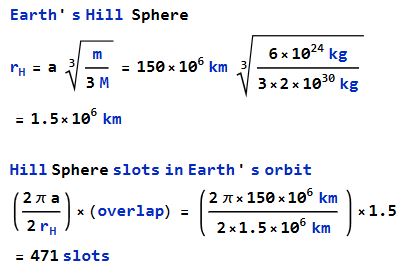
“You’ve got to be in the right place at the right time to collide. Earth is 4.5 billion years old. Something with a 100‑year orbit would have had millions of chances to pass through a spot we happen to occupy. An outsider like ‘Oumuamua would have only one. We can even figure odds on that. It’s like a horseshoe game where close enough is good enough. The object doesn’t have to hit Earth right off, it only has to pierce our Hill Sphere.”

“Hill Sphere?”

“A Hill Sphere is a mathematical abstract like an Event Horizon. Inside a planet’s Sphere any nearby object feels a greater attraction to the planet than to its star. Velocities permitting, a collision may ensue. The Sphere’s radius depends only on the average planet–star distance and the planet and star masses. Earth’s Hill Sphere radius is 1.5 million kilometers. Visualize Hill Spheres crowded all along Earth’s orbit. If the interloper traverses any Sphere other than the one we’re in, we survive. It has 1 chance out of 471 . Multiply 471 by 100 spheres sunward and an infinity outward. We’ve got a guaranteed win.”

“I’ll sleep better tonight.”

~~ Rich Olcott