Planetary Chemistry

The deal’s gone round to Susan. “Another thing, Kareem — your assumption ignores Chemistry.”

“Didn’t Cathleen take care of that with her nuclear reactions in the star’s core?”

“Not even close. Nuclear reactions in general are literally a million or more times more energetic than chemical ones. Your classic AA alkaline battery is 1½ volts, right, but the initial step in Cathleen’s proton‑to‑helium process would net 1½ megavolts if we could set it up in a battery. Regular chemistry just re‑arranges atoms, doesn’t have a chance when nuclear’s going on.”

“Like trying to carve a cameo with dynamite, huh?”

“Not quite. If nuclear is dynamite, then bench chemistry is a bandsaw. I’d say the analog for carving a cameo would be cell biology. That operates at the millivolt level.”

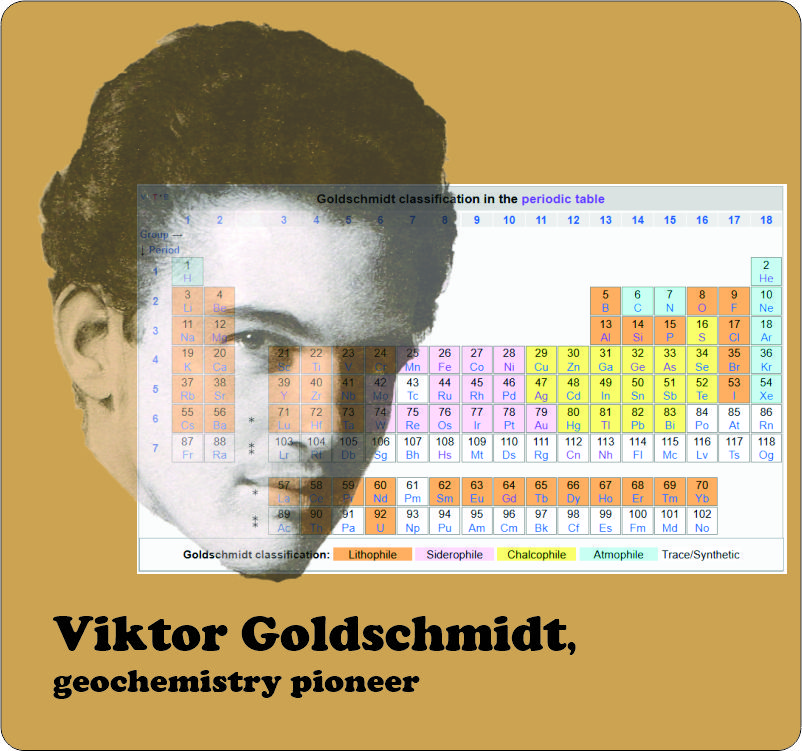
Cathleen holds up her tablet again. “Speaking of abundance graphs, here’s another one I built for my Astronomy class. I divided each element’s atom count in Earth’s crust by its atom count in the Universe. I color-coded the points according to Goldschmidt’s classification scheme. The lines mark the average ratio for each class. Compared to the Universe, oxide‑formers are ten times more concentrated in the crust than sulfide‑formers are, 150 times more concentrated than iron‑mixers, 900 times more than gases. I see the numbers but I don’t feel comfortable with them. Kareem, what do I tell my students?”

“Happy to explain the what, but Susan will have to explain the why. Goldschmidt started as a mineralogist, invented Geochemistry while bouncing around between Sweden, Norway and Germany until he barely escaped from the Nazis and was smuggled into England. He pioneered using crystallographic and thermodynamic analysis in geology. His scheme slotted each chemical element into one of those five classes. For example, he lumped the five lightest inert gases together with hydrogen, nitrogen and carbon into what he called the Atmophile class because they mostly stay in the atmosphere.”

“Carbon?”

“Yeah, that one’s iffy because coal and limestone. His reasoning involved carbon monoxide, carbon dioxide and methane which don’t show up in rocks. There are other edge cases, like radon which ought to count as a gas but shows up in rocks and basements because it’s locked where it was generated as part of uranium’s decay sequence. We mostly find uranium in oxide minerals so Goldschmidt put it and radon into his Lithophile class of metals that occur in oxides. That’s opposed to mercury, silver and a dozen or so other elements that generally show up in sulfide minerals — that’s his Chalcophile class. There’s another dozen or so that dissolve into molten iron so they’re Siderophiles. We don’t see much of those in Earth’s crust because they were swept down to the core as the molten planet differentiated. Finally, there’s a whole batch of radioactives that huddle together as Other. But why those elements do those things, I dunno. Susan, your turn.”

“It’s a lovely application of Pearson’s Hard‑Soft Acid‑Base theory. Hard chemical thingies have a high charge‑to‑volume ratio. Also, their charge is tightly bound so it doesn’t polarize. Oxide, carbonate and fluoride ions are Hard, and so are alkali and alkali metal ions like sodium and calcium. Uranium’s Hard when it’s at high oxidation state like in a uranyl ion UO22+. (Eddie, stop snickering, that’s its proper name.) Soft thingies are just the reverse — big thingies with mushy electron clouds. Iodide is Soft and so are mercury, silver and gold ions. Bulk metals are extremely Soft, chemically speaking, because their electron clouds are so diffuse. The point is, Hard thingies combine best with Hard thingies, Soft thingies with Soft.”

“So the Lithophiles are Hard metals that make Hard‑Hard stony oxides. I suppose that extends to fluorides and carbonates?”

“Sure.”

“Then the sulfide ores, Goldschmidt’s Chalcogens, are Soft‑Soft compounds. The Siderophile metals combine with each other better than anyone else, and the Atmophiles don’t combine with anything. Cool.”

“Ah‑HAH! Then on my graph the Hard oxides are most common in the crust because they’re light and so float above the heavier Soft sulfides and the ultra‑Soft metals that sink to the core. Our planet is layered by Hardness.”

“Does the same logic apply to asteroids?”

“Sort of.”

~~ Rich Olcott

GOLD! GOLD! GOLD! Not.

“Ya think there’s water on the Psyche asteroid, Kareem?”

“No more than a smidgeon, Cal.”

“Why so little? They’ve found hundreds of tons of it on the Moon.”

“Wait, water found on the moon? I’d heard about the Chinese rover finding sulfur but I didn’t think anybody’s gotten into a shadowy area that may be icy because sunlight never heats it.”

“Catch up, Eddie. We’ve known about hydrogen on the Moon since the Lunar Reconnaissance Orbiter almost 15 years ago. We just weren’t sure any of it was water‑ice. Could be hydroxyls coating the outside of oxide and silicate moon rocks, or water of crystallization locked into mineral structures.”

“That’s the kind of caveat I’d expect from a chemist, Susan, throwing chemical complexity into the mess.”

“Well, sure, Sy. Silicate chemistry is a mess. Nature rarely gives us neat lab‑purified materials. The silicon‑oxygen lattice in a silicate can host almost any combination of interstitial metal ions. On top of that, the solar wind showers the Moon with atomic and ionic hydrogens eager to bond with surface oxygens and maybe even migrate further into the bulk. The Apollo astronauts found plagioclase rocks, right? That name covers a whole range of aluminum‑silicate compositions from calcium‑rich like we find in meteorites to sodium‑rich that are common in Earth rocks. The astronauts’ rocks were dry, dry, dry, but that collecting was done where the missions landed, near the Moon’s equator. What’s got the geologists all excited is satellite data from around the Moon’s south pole. The spectra suggest actual water molecules at or just below the surface there. Lots of water.”

“Mm-hm, me and a lot of other Earth‑historians would love to compare that water’s isotopic break‑out against Earth and the asteroids and comets.”

“Understood, Kareem. but why so down on Psyche having water?”

“Two arguments. Attenuation, for one. Psyche is 2½ times farther from the Sun than the Earth‑Moon system. Per unit area at the target, stuff coming out of the Sun thins out as the square of the distance. The solar wind near Psyche is at least 85% weaker than what the Moon gets. If Psyche’s built up any watery skin it’s much thinner than the Moon’s. And that’s assuming that they’re both covered with the same kind of rocks.”

“The other argument?”

“Depends on Psyche’s density which we’re still zeroing in on.”

“This magazine article says it’s denser than iron. That’s why they’re shouting ‘GOLD! GOLD! GOLD!‘ like Discworld Dwarfs, ’cause gold is heavier than iron.”

“Shouldn’t that be ‘dwarves‘?”

“Not according to Terry Pratchett. He ought to know ’cause he wrote the books about them.”

“True. So’s saying gold and a lot of the other precious metals are much denser than iron. Unfortunately, it now looks like Psyche isn’t. An object’s density is its mass divided by its volume. You measure an asteroid’s mass by how it affects the orbits of nearby asteroids. That’s hard to do when asteroids average as far apart as the Moon and the Earth. Early mass estimates were as much as three times too big. Also, Psyche’s potato‑shaped. Early size studies just happened to have worked from images taken when the asteroid was end‑on to us. Those estimates had the volume too small. Divide too‑big by too‑small you get too‑big squared.”

“So we still don’t know the density.”

“As I said, we’re zeroing in. Overall Psyche seems to be a bit denser than your average stony meteorite but nowhere near as dense as iron, let alone gold or platinum. We’re only going to get a good density value when our spacecraft of known mass orbits Psyche at close range.”

“No gold?”

“I wouldn’t say none. Probably about the same gold/iron ratio that we have here on Earth where you have to process tonnes of ore to recover grams of gold. Your best hope as an astro‑prospector is that Psyche’s made of solid metal, but in the form of a rubble‑pile like we found Ryugu and Bennu to be. That would bring the average density down to the observed range. It’d also let you mine the asteroid chunk‑wise. Oh, one other problem…”

“What’s that?”

“Transportation costs.”

Adapted from a NASA illustration
Credit: NASA/JPL-Caltech/ASU

~~ Rich Olcott

Not Silly-Season Stuff, Maybe

“Keep up the pace, Mr Feder, air conditioning is just up ahead.”

“Gotta stop to breathe, Moire, but I got just one more question.”

“A brief pause, then. What’s your question?”

“What’s all this about LK99 being a superconductor? Except it ain’t? Except maybe it is? What is LK99, anyway, and how do superconductors work? <puffing>”

“So many question marks for just one question. Are you done?”

“And why do news editors care?”

“There’s lots of ways we’d put superconductivity to work if it didn’t need liquid‑helium temperatures. Efficient electric power transmission, portable MRI machines, maglev trains, all kinds of advances, maybe even Star Trek tricorders.”

“Okay, I get how zero‑resistance superconductive wires would be great for power transmission, but how do all those other things have anything to do with it?”

“They depend on superconductivity’s conjoined twin, diamagnetism.”

Dia—?”

“Means ‘against.’ It’s sort of an application of Newton’s Third Law.”

“That’s the one says, ‘If you push on the Universe it pushes back,’ right?”

“Very good, Mr Feder. In electromagnetism that’s called Lenz’ Law. Suppose you bring a magnet towards some active conductor, say a moving sheet of copper. Or maybe it’s already carrying an electric current. Either way, the magnet’s field makes charge carriers in the sheet move perpendicular to the field and to the prevailing motion. That’s an eddy current.”

“How come?”

“Because quantum and I’m not about to get into that in this heat. Emil Lenz didn’t propose a mechanism when he discovered his Law in 1834 but it works. What’s interesting is what happens next. The eddy current generates its own magnetic field that opposes your magnet’s field. There’s your push‑back and it’s called diamagnetism.”

“I see where you’re going, Moire. With a superconductor there’s zero resistance and those eddy currents get big, right?”

“In theory they could be infinite. In practice they’re exactly strong enough to cancel out any external magnetic field, up to a limit that depends on the material. A maglev train’s superconducting pads would float above its superconducting track until someone loads it too heavily.”

“What about portable MRI you said? It’s not like someone’s gonna stand on one.”

“A portable MRI would require a really strong magnet that doesn’t need plugging in. Take that superconducting sheet and bend it into a doughnut. Run your magnet through the hole a few times to start a current. That current will run forever and so will the magnetic field it generates, no additional power required. You can make the field as strong as you like, again within a limit that depends on the material.”

“Speaking of materials, what’s the limit for that LK99 stuff?”

“Ah, just in time! Ahoy, Susan! Out for a walk yourself, I see. We’re on our way to Al’s for coffee and air conditioning. Mr Feder’s got a question that’s more up your Chemistry alley than my Physics.”

“LK99, right? It’s so newsy.”

“Yeah. What is it? Does it superconduct or not?”

“Those answers have been changing by the week. Chemically, it’s basically lead phosphate but with copper ions replacing some of the lead ions.”

“They can do that?”

“Oh yes, but not as neatly as we’d like. Structurally, LK99’s an oxide framework in the apatite class — a lattice of oxygens with phosphorus ions sitting in most of the holes in the lattice, lead ions in some of the others. Natural apatite minerals also have a sprinkling of hydroxides, fluorides or chlorides, but the reported synthesis doesn’t include a source for any of those.”

“Synthesis — so the stuff is hand‑made?”

“Mm‑hm, from a series of sold‑state reactions. Those can be tricky — you grind each of your reactants to a fine powder, mix the powders, seal them in a tube and bake at high temperature for hours. The heat scrambles the lattices. The atoms can settle wherever they want, mostly. I think that’s part of the problem.”

“Like maybe they don’t?”

“Maybe. There are uncontrollable variables — grinding precision, grain size distribution, mixing details, reaction tube material, undetected but critical impurities — so many. That’s probably why other labs haven’t been able to duplicate the results. Superconductivity might be so structure‑sensitive that you have to prepare your sample j‑u‑s‑t right.”

~~ Rich Olcott

Well, well, well

<chirp, chirp> “Moire here.”

“Hi, Sy, it’s Susan Kim. I’m at a break point while this experiment runs. Do you want to check the scones at Al’s?”

“I’ve got a bad case of February, feel like just hibernating somewhere. Can’t get started on anything so I might as well head over there.”

“You need Al’s patented Morning Dynamite brew. See you in a couple of minutes.”


“Hi, Al. My usual mocha latte, please, and your special wake-up potion for Sy. He’s got the Februaries.”

“Here you go, Susan. Bottom of the pot coming at ya, Sy. It’ll get ya lively, for sure.”

<We grab a table.> “So, Susan, what’s this experiment that you can just let alone for a while?”

“One of your blog posts inspired it. Do you remember the one about warm water freezing faster than cold?”

“Sometimes it does that, but the point of the post was how it’s only randomly sometimes in some experiments and not at all in others. Are you experimenting with water freezing?”

“No, but I’m working on a related problem. I can’t say much about it other than that there’s an industrial process that depends on recovering a crystalline product from a hot, concentrated solution. The problem is that if the solution is too weak nothing crystallizes when it cools but if it’s too concentrated the whole batch solidifies in one big mass. The industry wants to find the right conditions for making lots of small crystals. I’ve got a grant to research ways to do that.”

“That does sound a little like water freezing. How did my blog post help?”

“I was thinking about how crystals form. We know a lot about how ions or molecules come in from solution to attach to the surface of a growing crystal. Either they’re electrostatically pulled to just the right spot or they bounce on and off the surface until they find a place they fit into. But how does that surface get started in the first place?”

“Well, I imagine it happens when two molecules love each other very mu— OW!”

“Sy Moire, get your mind back on Science! … Sorry, did it really hurt that much?”

“It wouldn’t have but that’s the same spot on the same shoulder that Cathleen got me on.”

“Actually, your flip remark isn’t that far from what we think happens except the correct verb is ‘attract,’ not ‘love.‘ Some researchers even call the initial speck ‘the embryo‘ but most of us say ‘nucleus.’ Nucleation might start with only a few molecules clicking into the right configuration, or it might require a cluster of hundreds being mostly right. The process might even require help from short‑lived solvent structures. So many variables. Nobody has a good predictive theory or even broadly useful models. It’s all by art and rule of thumb.”

“Sounds like a challenge.”

“Oh, it is. Here’s the tip I took from your blog post. You mentioned that some of the freezing studies used hundreds of trials and reported what percent of them froze. Most of the industrial crystallization studies work at pilot plant scale, with liters or gallons of solution going into each trial. I decided to go small instead. Lab supply companies sell culture plates for biological work. Typically they’re polystyrene trays holding up to a hundred one‑milliliter wells. I bought a bunch of those, and I also bought a machine that can automatically load the wells with whatever solutions I like. I’ve positioned it next to a temperature‑controlled cabinet with a camera to photograph a batch of trays at regular intervals.”

“Nice, so you can set up many duplicates at each chemical concentration and keep statistics on how many form crystals at each temperature.”

“At high concentrations I expect all the wells to show crystals. The obvious measurement will be crystal size range at each temperature. But with no change in apparatus I can go to lower and lower concentrations to where crystallization itself is random like the freezing experiments. Some wells will crystallize, some won’t. Statistics on those trays may tell us things about nucleation. It’s gonna be fun.”

“D’ya suppose the planets are culture plate wells for creation’s life experiments?”

~~ Rich Olcott

A Match Game

<chirp chirp> “Lab C-324, Susan Kim speaking.”

<hoarsely> “Hi Susan, it’s Sy. Fair warning. The at‑home test I just ran says I’ve got Covid. I’ve had all four shots but it looks like some new variant dodged in anyway. We had coffee together at Al’s yesterday so I wanted to warn you. Better stock up on cough medicine and such.”

“Ooh. Thanks, Sy, sorry to hear that. If it’s any consolation, you’re not alone. About half the lab’s empty today because of Covid. I’m just waiting for this last extraction to complete and then I’m outta here myself. There’s chicken soup going in the slow‑cooker at home.”

“Ah, yes, a Jewish mother’s universal remedy.”

“Korean mothers, too, Sy, except we use more garlic. Chicken soup’s a standard all over the world — soothing, easy on the stomach and loaded with protein.”

“While you’re in wait mode, maybe you could explain something to me.”

“I can try. What is it?”

“How do these tests work? I swabbed my nose, swirled the yuck with the liquid in the little vial and put three drops into the ‘sample port‘ window. In the next few minutes fluid crept across the display window next to the port and I saw dark bars at the T and C markers. What’s that all about?”

“Miracles of modern immunochemistry, Sy, stuff we wouldn’t have been able to execute fifty years ago. What do you know about antibodies?”

“Not much. I’ve read a little about immunology but I always get the antibodies confused with the antigens and then my understanding goes south.”

“Ignore the ‘anti‘ parts — an antigen is usually a part of something from outside that generates an immune response. As part of the response, cells in your body build antibodies, targeted proteins that stick to specific antigens. Each unique antibody is produced by just a few of your cells. When you’re under a disease attack, your antibodies that match the attacker’s antigens lock onto the attacker to signal your defender cells what needs chewing up. About half‑a‑dozen Nobel Prizes went to researchers who figured out how to get a lab‑grown cell to react to a given antigen and then how to clone enough copies of that cell to make industrial quantities of the corresponding antibody. You follow?”

“So far, so good.”

“One more layer of detail. All antibodies are medium-sized proteins with the same structure like a letter Y. There’s a unique targeting bit at the end of each upper arm. An antigen can be anything — a fragment of protein or carbohydrate, a fatty acid, even some minerals.”

“Wait. If a protein can be an antigen, does that mean that an antibody can be an antigen, too?”

“Indeed, that’s the key for your test kit’s operation. The case holds a strip of porous plastic like filter paper that’s been treated with two narrow colorless stripes and a dot. The T stripe contains immobilized antibody for some fragment of the virus. The C stripe contains immobilized antibody antibody.”

“Hold on — an antibody that targets another antibody like maybe the bottom of the Y?”

“Exactly. That’s the control indicator. The dot holds virus antibodies that can move and they’re linked to tiny particles of gold. Each gold particle is way too small to see, but a bunch of them gathered together looks red‑brown. Okay, you put a few drops of yuckified liquid on top of the dot and the mixture migrates along the porous material. You tell me what happens.”

“Wait, what’s in that liquid?”

“It’s standard pH-buffered saline, keeps the proteins healthy.”

“Hmm. Alright, the dot’s gold‑labeled virus antibody grabs virus in my yuck and swims downstream. The T stripe’s virus antibody snags the virus‑antigen combination particles and I see red‑brown there. Or not, if there’s no virus. Meanwhile, the creeping liquid sweeps other gold‑labeled antibodies, virus‑bound or not, until they hit the C stripe and turn it red‑brown if things are working right. Uhhh, how much gold are we talking about?”

“Colloidal gold particles are typically balls maybe 50 nanometers across. Stripe area’s about 1 mm2, times 50 nanometers, density 19.32 kg/m3, gold’s $55 per gram today … about 5 microcents worth.”

~~ Rich Olcott

The Threshold of Stuffiness

<chirp chirp> “Moire here.”

“Hi, Sy, it’s Susan Kim. I read your humidifier piece and I’ve got your answer for you.”

“Answer? I didn’t know I’d asked a question.”

“Sure you did. You worked out that your humidifier mostly keeps your office at 45% relative humidity by moisturizing incoming air that’s a lot drier than that. As a chemist I like how you brought in moles to check your numbers. Anyway, you wondered how to figure the incoming airflow. I’ve got your answer. It’s a scaling problem.”

“Mineral scaling? No, I don’t think so. The unit’s mostly white plastic so I wouldn’t see any scaling, but it seems to be working fine. I’ve been using de-ionized water and following the instructions to rinse the tank with vinegar every week or so.”

“Nope, not that kind of scale, Sy. You’ve got a good estimate from a small sample and you wondered how to scale it up, is all.”

“Sample? How’d I take a sample?”

“You gave us the numbers. Your office is 1200 cubic feet, right, and it took 88 milliliters of water to raise the relative humidity to where you wanted it, right, and the humidifier used a 1000 milliliters of water to keep it there for a day, right? Well, then. If one roomful of air requires 88 milliliters, then a thousand milliliters would humidify (1000/88)=11.4 room changes per day.”

“Is that a good number?”

“I knew you’d ask. According to the ventilation guidelines I looked up, ‘Buildings occupied by people typically need between 5 and 10 cubic feet per minute per person of fresh air ventilation.‘ You’re getting 11.4 roomfuls per day, times your office volume of 1200 cubic feet, divided by 1440 minutes per day. That comes to 9.5 cubic feet per minute. On the button if you’re alone, a little bit shy if you’ve got a client or somebody in there. I’d say your building’s architect did a pretty good job.”

“I like the place, except for when the elevators act up. All that figuring must have you thirsty. Meet me at Al’s and I’ll buy you a mocha latte.”

“Sounds like a plan.”


“Hi, folks. Saw you coming so I drew your usuals, mocha latte for Susan, black mud for Sy. Did I guess right?”

“Al, you make mocha lattes better than anybody.”

“Thanks, Susan, I do my best. Go on, take a table.”

“Susan, I was thinking while I walked over here. My cousin Crystal doesn’t like to wear those N95 virus masks because she says they make her short of breath. Her theory is that they trap her exhaled CO2 and those molecules get in the way of the O2 molecules she wants to breathe in. What does chemistry say to that theory?”

“Hmm. Well, we can make some estimates. N95 filtration is designed to block 95% of all particles larger than 300 nanometers. A couple thousand CO2 molecules could march abreast through a mesh opening that size no problem. An O2 molecule is about the same size. Both kinds are so small they never contact the mesh material so there’s essentially zero likelihood of differential effect.”

“So exhaled CO2 isn’t preferentially concentrated. Good. How about the crowd‑out idea?”

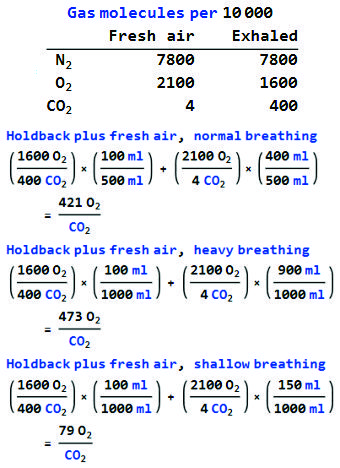
“Give me a second. <tapping on phone> Not supported by the numbers, Sy. There’s one CO2 for every 525 O2‘s in fresh air. Exhaled air is poorer in O2, richer in CO2, but even there oxygen has a 4‑to‑1 dominance.”

“But if the mask traps exhaled air…”

“Right. The key number is the retention ratio, what fraction of an exhaled breath the mask holds back. A typical exhale runs about 500 milliliters, could be half that if you’ve got lung trouble, twice or more if you’re working hard. This mask looks about 300 milliliters just sitting on the table, but there’s probably only 100 milliliters of space when I’m wearing it. It’s just arithmetic to get the O2/CO2 ratio for each breathing mode, see?”

“Looks good.”

“Even a shallow breather still gets 79 times more O2 than CO2. Blocking just doesn’t happen.”

“I’ll tell Crys.”

~ Rich Olcott

It’s The Heat AND The Humidity

<from the casebook of Sy Moire, Consulting Physicist> Monday. Weather sunny, warm for this time of year. Dry, bad effects on nose and throat at wake‑up time. Bought a room humidifier Friday at Big Box — up‑scale, 4‑liter reservoir, ultrasonic but silent, WiFi‑enabled etc. Long way from the jug with boiler tube my folks used to use. WiFi’s a sneaky way to avoid building a remote control — just use the customer’s smart phone. Guess that keeps the price down.

Good news is, phone app does graphs of relative humidity against time. Had it in measure-only mode in office Monday night, baseline wobbled in the 32-36% range. Bad news is, when the device is running on Automatic it works toward a 45% target but had trouble getting near that high on its maiden effort on Saturday. Wondered, how much water would it have to send into the room to hit the target?

Start with the numbers. “45%” is forty‑five percent of what? Surely not some arbitrary maximum. Weather guy talks about relative humidity so, relative to what? Searched a little in the internet. All the sources say RH is a ratio of ratios, something over maximum something. “Something” is water vapor mass per unit volume or else water vapor mass per total gas mass in the same volume. Clouds, fog, raindrops and snowflakes don’t count. Then things get fuzzy. Some sources say the maximum is “saturation” which is just a tautology. The most precise definition says “the partial pressure of water in air over a large flat surface of pure water under laboratory conditions” <shudder>.

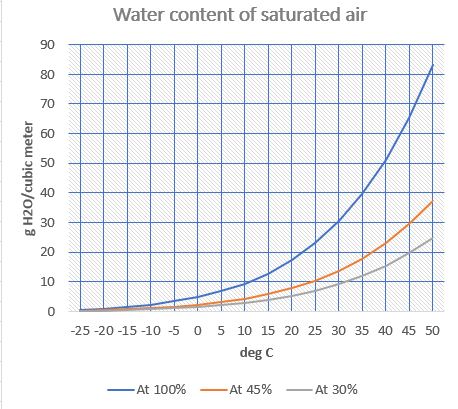
Doing engineer stuff here so keep it simple. Found a chart of water vapor content at 100% humidity at different temperatures. Will go with that. No surprise, the warmer the air, the more water mass it can hold before fogging up. I’m comfortable around 68°F which is 20°C. The chart says 100% saturated 20°C air holds 17.3 grams of water per cubic meter. 45% of that is 7.8 and 30% is 5.3. Need to know how many cubic meters in the office.

OK, measured the room as 10’×15′ with an 8′ ceiling. Ignore the space the furniture takes up. Total volume is 1200 cubic feet. Old Reliable says that’s 34 cubic meters. If the room’s at 100% humidity its air holds
  (34 m3)×(17.3 g/m3)
   = 588 grams of water.
At 1000 grams per liter that’s 0.588 liter or about a pint. Suppose humidifier starts when the room’s at 30% humidity. For a 15% bump to 45% the gadget has to vaporize
  (34 m3)×(17.3 g/m3)×(0.45-0.30)
   = 88 g = 88 milliliters.

Wow, that’s only about 6 tablespoons. Does that number even make sense? OK, air is about 80% N2, molecular weight 28. The other 20% is mostly O2, molecular weight 32. The average is near 29. Basic chem class stuff — at Earth‑typical room temp and pressure, a 22.4‑liter chunk of air has a mass near 29 grams, so office’s roomful of air would mass
  (29g/mole)×(1 mole/22.4 liters)
   ×(1000 liters/m3)×(34 m3/room)
    = 44 kilograms
The 588-gram number says that it’d get foggy in here if the moisture content ever got much above (588 g)/(44000 g) = 1.3% by mass, which sounds reasonable.

88 milliliters ain’t much, so how come the unit used up a liter of water in just one day?

Ah-hah. Air’s not sitting still. Ventilation system continually brings in low‑humidity outside air. Plus, clients complain in the wintertime about cold drafts leaking in around the door, transom and windows. If it weren’t for air shuttling in and out, we’d use up all the oxygen in here — that isn’t happening. Wonder how to calculate that flow. Bottom line is, humidifier doesn’t moisten what’s in the room so much as it loads up what comes in dry.

Problem — evaporating water cools air, Old Reliable says 2256 kilojoules per kilogram. 88 grams won’t have much effect, but a liter/day is a kilogram/day. An hour is 1/24 of a day. 1/24 liter means 94 kilojoules per hour of cooling. Air heat capacity is 1 kilojoule/(kilogram oC). (94 kJ/44 kg air)=2.1 degrees per hour. Suddenly I feel chilly.

~~ Rich Olcott

Candle, Candle, Burning Bright

<chirp, chirp> “Moire here.”

“Hi, Sy, it’s Susan Kim. I did a little research after our chat. The whale oil story isn’t quite what we’re told.”

“Funny, I’ve been reading up on whales, too. So what’s your chemical discovery?”

“What do we get from a fire, Sy?”

“Light, heat and leftovers.”

“Mm-hm, and back in 18th Century America, there was plenty of wood and coal for heat. Light was the problem. I can’t imagine young Abe Lincoln reading by the flickering light of his fireplace — he must have had excellent eyesight. If you wanted a mostly steady light you burned some kind of fat, either wax candles or oil lamps.”

“Wait, aren’t fat and wax and oil three different things?”

“Not to a chemist. Fat’s the broadest category, covers molecules and mixtures with chains of ‑CH2‑ groups that don’t dissolve in water. Maybe the chains include a few oxygen atoms but the molecules are basically hydrocarbons. Way before we knew about molecules, though, we started classifying fats by whether or not the material is solid at room temperature. Waxes are solid, oils are liquid. You’re thinking about waxy‑looking coconut oil, aren’t you?”

“Well….”

“Coconuts grow where rooms are warm so we call it an oil, OK? I think it’s fun that you can look at a molecular structure and kind of predict whether the stuff will be waxy or oily.”

“How do you do that?”

“Mmm… It helps to know that a long chain of ‑CH2‑ groups tends to be straight‑ish but if there’s an ‑O‑ link in the chain the molecule can bend and even rotate there. Also, you get a kink in the chain wherever there’s a –CH=CH– double bond. We call that a point of unsaturation.”

“Ah, there’s a word I recognize, from foodie conversations. Saturated, unsaturated, polyunsaturated — that’s about double bonds?”

“Yup. So what does your physicist intuition make of all that?”

“I’d say the linear saturated molecules ought to pack together better than the bendy unsaturated ones. Better packing means lower entropy, probably one of those solid waxes. The more unsaturation or more ‑O‑ links, the more likely something’s an oil. How’d I do?”

“Spot on, Sy. Now carry it a step further. Think of a –CH2– chain as a long methane. How do suppose the waxes and oils compare for burning?”

“Ooo, now that’s interesting. O2 has much better access to fuel molecules if they’re in the gas phase so a good burn would be a two‑step process — first vaporization and then oxidation. Oils are already liquid so they’d go gaseous more readily than an orderly solid wax of the same molecular weight. Unless there’s something about the –O– links that ties molecules together…”

“Some kinds have hydrogen-bond bridging but most of them don’t.”

“OK. Then hmm… Are the double-bond kinks more vulnerable to oxygen attack?”

“They are, indeed, which is why going rancid is a major issue with the polyunsaturated kinds.”

“Oxidized hydrocarbon fragments can be stinky, huh? Then I’d guess that oil flames tend to be smellier than wax flames. And molecules we smell aren’t getting completely oxidized so the flame would probably be smokier, too. And sootier. Under the same conditions, of course.”

“Uh-huh. Would you be surprised if I told you that flames from waxes tend to be hotter than the ones from oils?”

“From my experience, not surprised. Beeswax candlelight is brighter and whiter than the yellow‑orange light I saw when the frying oil caught fire. Heat glow changes red to orange to yellow to white as the source gets hotter. Why would the waxes burn hotter?”

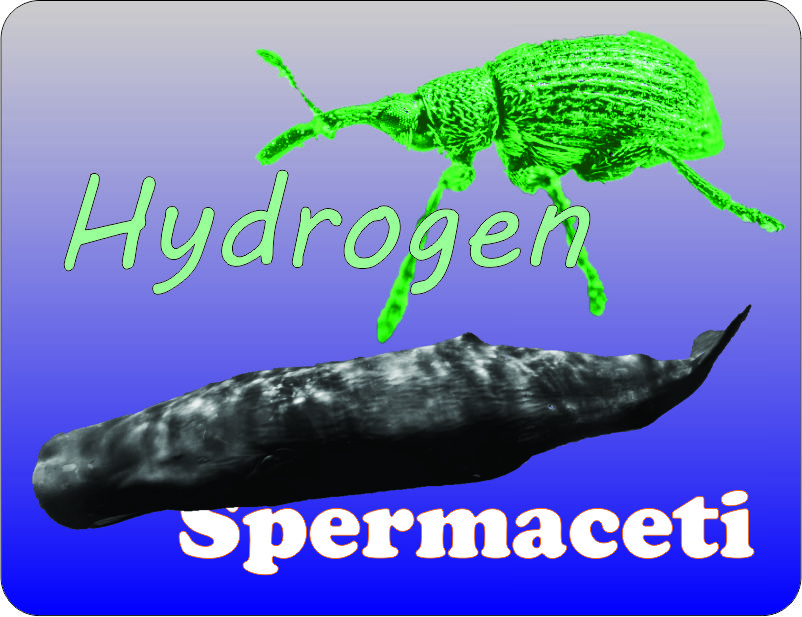
“I haven’t seen any studies on it. I like to visualize those straight chains as candles burning from the ends and staying alight longer than short oil fragments can, but that’s a guess. Ironic that a hydrogen flame is just a faint blue, even though it’s a lot hotter than any hydrocarbon flame. Carbon’s the key to flamelight. Anyway, the slaughter started when we learned a mature sperm whale’s head holds 500 gallons of waxy spermaceti that burns even brighter than beeswax.”

~~ Rich Olcott

  • Whale image adapted from a photo by Gabriel Barathieu CC BY SA 2.0

The Venetian Blind Problem

Susan Kim gives me the side‑eye. “Sy, I get real suspicious when someone shows me a graph with no axis markings. I’ve seen that ploy used too often by people pushing a bias — you don’t know what happens offstage either side and you don’t know whether an effect was large or small. Your animated chart was very impressive, how that big methane infrared absorption peak just happens to fill in the space between CO2 and H2O peaks. But how wide is the chart compared to the whole spectrum? Did you cherry‑pick a region that just happens to make your point?”

“Susan, how could you accuse me of such underhanded tactics? But I confess — you’re right, sort of. <more tapping on Old Reliable’s keyboard> The animation only covered the near‑IR wavelengths from 1.0 to 5.0 micrometers. Here’s the whole strip from 0.2 micrometers in the near UV, out to 70 micrometers in the far IR. Among other things, it explains the James Webb Space Telescope, right, Al?”

Spectrum of Earth’s atmosphere. Adapted
under the Creative Commons 3.0 license
from Robert Wohde’s work
with the HITRAN2004 spectroscopic database,

“I know the Webb’s set up for IR astronomy from space, Sy. Wait, does this graph say there’s too much water vapor blocking the galaxy’s IR and that’s why they’re putting the scope like millions of miles away out there?”

“Not quite. The mission designers’ problem was the Sun’s heat, not Earth’s water vapor. The solution was to use Earth itself to shield the device from the Sun’s IR emissions. The plan is to orbit the Webb around the Earth‑Sun L2 point, about a million miles further out along the Sun‑Earth line. Earth’s atmosphere being only 60 miles thick, most of it, the Webb will be quite safe from our water molecules. No, our steamy atmosphere’s only a problem for Earth‑based observatories that have to peer through a Venetian blind with a few missing slats at very specific wavelengths.”

“Don’t forget, guys, the water spectrum is a barrier in both directions. Wavelengths the astronomers want to look at can’t get in, but also Earth’s heat radiation at those wavelengths can’t get out. Our heat balance depends on the right amount of IR energy making it out through where those missing slats are. That’s where Sy’s chart comes in — it identifies the wavelengths under threat by trace gases that aren’t so trace any more.”

“And we’re back to your point, Susan. We have to look at the whole spectrum. I heard one pitch by a fossil fuel defender who based his whole argument on the 2.8‑micrometer CO2 peak. ‘It’s totally buried by water’s absorption,‘ he claimed. ‘Can’t possibly do us any further damage.’ True, so far as it goes, but he carefully ignored CO2‘s other absorption wavelengths. Pseudoscience charlatan, ought to be ashamed of himself. Methane’s not as strong an absorber as CO2, but its peaks are mostly in the right places to do us wrong. Worse, both gas concentrations are going up — CO2 is 1½ times what it was in Newton’s day, and methane is 2½ times higher.”

“Funny how they both go up together. I thought the CO2 thing was about humanity burning fossil fuels but you said methane operations came late to that game.”

“Right on both counts, Al. Researchers are still debating why methane’s risen so bad but I think they’re zeroing in on cow gas — belches and farts. By and large, industry has made the world’s population richer over the past two centuries. People who used to subsist on a grain diet can now afford to buy meat so we’ve expanded our herds. Better off is good, but there’s an environmental cost.”

Al gets a far-away look. “Both those gases have carbon in them, right? How about we burn methane without the carbon in, just straight hydrogen?”

Susan gets excited. “Several groups in our lab are working on exactly that possibility, Al. The 2H2+O2→2H2O reaction yields 30% more energy per oxygen atom than burning methane. We just need to figure out how to use hydrogen economically.”

~~ Rich Olcott

Going from Worse to Bad

Al delivers coffees to our table, then pauses. “Why methane?”

Susan Kim looks up from her mocha latte. “Sorry?”

“Why all the fuss about methane all of a sudden? I thought carbon dioxide was the baddie. Everybody’s switching from coal to natural gas which they say is just methane and now that’s a bad thing, too. I’m confused. You’re a chemist, unconfuse me.”

“You’re right, there’s mixed message out there. Here’s the bottom line. Methane’s bad, but coal’s a worse bad.”

“OK, but why?”

“Pass me a paper napkin so I can write down the chemical reactions. When we look at them in detail there’s all kinds of complicated reaction paths, but the overall processes are pretty simple. The burnable part of coal is carbon. In an efficient coal‑fired process what happens is
  C + O2 → CO2 + energy.
The C is carbon, of course and O2 is an oxygen molecule, two atoms linked together. Carbon atoms weigh 12 and each oxygen atoms weighs 16, so 12 grams of carbon produces 12+(2×16)=44 grams of CO2. Scaling up, 12 tons of carbon produces 44 tons of CO2 and so on. The energy scales up, too. and that’s what heats the boilers that make the steam that spins the turbines that make electricity.”

“I heard a couple of weasel words but go on to methane.”

“You caught them, eh? They’re important weasels and we’ll get to them. OK, methane is CH4 and its overall burn equation is
  CH4 + 2O2 → CO2 + 2H2O + energy.
Oxidizing those hydrogens releases about twice as much energy per carbon as the coal reaction does.”

“Already I see one big advantage for methane — more bang per CO2. So about those weasels…”

“Right. Well, coal isn’t just pure burnable carbon. It’s 350‑million‑year‑old trees and ferns and animal carcasses and swamp muck and mineral sediments, all pressure‑baked together. There’s sulfur and nitrogen in there, mixed in with nasty elements like mercury and arsenic.”

“The extras go up the smokestack along with the CO2, huh? Bad, for sure.”

“The good news is that coal-burning power plants are under the gun to clean up those emissions. The bad news is that effective mitigation technologies themselves cost energy. That lowers the net yield. But the inefficiency gets worse. Think coal trains.”

“Yeah, half the time I get held up on the way home by one of those hundred‑car strings, either full-up heading to the power plant or empties going back for another load.”

“Mm-hm. Transporting coal takes energy, and so does mining it and crushing it and pre‑treating to get rid of dirt and then taking care of the ashes. Even less net energy output per ton of smokestack CO2, even worse inefficiency. See why coal’s on its way out?”

“I guess all that didn’t matter when it was cheap to dig up and there wasn’t much competition.”

“You put your finger on it, Al. Coal got its foot in the door with steam engines 300 years ago when about the only other things you could burn were wood and whale oil. Crude oil got big in the mid‑1800s but it had to be refined and that made it expensive. Cheap natural gas wasn’t really a thing until fracking came along 50 years ago, but that brought a different set of issues.”

“Yeah, I’ve seen videos of people lighting their kitchen sink water on fire. And wasn’t there an earthquake thing in Oklahoma?”

“That was an interesting situation. Oklahoma’s in the middle of the continent, not a place you’d expect earthquakes, but they began experiencing flurries of shallow ones in 2011. The fracking process starts with water pumped at high pressure into gas-bearing strata to loosen things up. People suspected fracking was connected to the earthquakes. It was, but only indirectly. When fracked gas comes out of a well, water does, too. The rig operators pump that expelled water down old oil wells. Among other things, the state’s Corporation Commission is in charge of their hydrocarbon production. When the Commission ordered a 60% cut in the waste‑water down‑pumping, the earthquake rate dropped by 90%. Sometimes regulations are good things, huh?”

~~ Rich Olcott