Naming the place and placing the name

“By the way, Cathleen, is there any rhyme or reason to that three-object object‘s funky name?  I’ve still got it on Old Reliable here.”

PSR J0337+1715

“It’s nothing like funky, Sy, it’s perfectly reasonable and in fact it’s far more informative than a name like ‘Barnard’s Star.’  The ‘PSR‘ part says that the active object, the reason anyone even looked in that system’s direction, is a pulsar.”

“And the numbers?”

“Its location in two parts.  Imagine a 24-hour clockface in the Solar Plane.  The zero hour points to where the Sun is at the Spring equinox.  One o’clock is fifteen degrees east of that, two o’clock is another fifteen degrees eastward and so on until 24 o’clock is back pointing at the Springtime Sun.  Got that?”

“Mm, … yeah.  It’d be like longitudes around the Earth, except the Earth goes around in a day and this clock looks like it measures a year.”

“Careful there, it has nothing to do with time.  It’s just a measure of angle around the celestial equator.  It’s called right ascension.

“How about intermediate angles, like between two and three o’clock?”

“Sixty arc-minutes between hours, sixty arc-seconds between arc-minutes, just like with time.  If you need to you can even go to tenths or hundredths of an arc-second, which divide the circle into … 8,640,000 segments.”

“OK, so if that’s like longitudes, I suppose there’s something like latitudes to go with it?”

“Mm-hm, it’s called declination.  It runs perpendicular to ascension, from plus-90° up top down to 0° at the clockface to minus-90° at the bottom.  Vivian, show Sy Figure 3 from your paper.”Right ascension and declination“Wait, right ascension in hours-minute-seconds but declination in degrees?”

“Mm-hm.  Blame history.  People have been studying the stars and writing down their locations for a long time.  Some conventions were convenient back in the day and we’re not going to give them up.  So anyway, an object’s J designation with 4-digit numbers tells you which of 13 million directions to look to find it.  Roughly.”

“Roughly?”

“That’s what the ‘J‘ is about.  If the Earth’s rotation were absolutely steady and if the Sun weren’t careening about a moving galaxy, future astronomers could just look at an object’s angular designation and know exactly where to look to find it again.  But it’s not and it does and they won’t.  The Earth’s axis of rotation wobbles in at least three different ways, the Sun’s orbit around the galaxy is anything but regular and so on.  Specialists in astrometry, who measure things to fractions of an arc-second, keep track of time in more ways than you can imagine so we can calculate future positions.  The J-names at least refer back to a specific point in time.  Mostly.  You want your mind bent, look up epoch some day.”

“Plane and ship navigators care, too, right?”

“Not so much.  Earth’s major wobble, for instance, shifts our polar positions only about 40 parts per million per year.  A course you plotted last week from here to Easter Island will get you there next month no problem.”

Old Reliable judders in my hand.  Old Reliable isn’t supposed to have a vibration function, either.  Ask her about interstellar navigation.  “Um, how about interstellar navigation?”Skewed Big Dipper

“Oh, that’d be a challenge.  Once you get away from the Solar System you can’t use the Big Dipper to find the North Star, any of that stuff, because the constellations look different from a different angle.  Get a couple dozen lightyears out, you’ve got a whole different sky.”

“So what do you use instead?”

“I suppose you could use pulsars.  Each one pings at a unique repetition interval and duty cycle so you could recognize it from any angle.  The set of known pulsars would be like landmarks in the galaxy.  If you sent out survey ships, like the old-time navigators who mapped the New World, they could add new pulsars to the database.  When you go someplace, you just triangulate against the pulsars you see and you know where you are.”

If they happen to point towards you! You only ever see 20% of them.  Starquakes and glitches and relativistic distortions mess up the timings.  Poor Xian-sheng goes nuts each time we drop out of warp.

~~ Rich Olcott

Rhythm Method

A warm Summer day.  I’m under a shady tree by the lake, watching the geese and doing some math on Old Reliable.  Suddenly a text-message window opens up on its screen.  The header bar says 710-555-1701.  Old Reliable has never held a messaging app, that’s not what I use it for.  The whole thing doesn’t add up.  I type in, Hello?

Hello, Mr Moire.  Remember me?

Suddenly I do.  That sultry knowing stare, those pointed ears.  It’s been a yearHello, Ms Baird.  What can I do for you?

Another tip for you, Mr Moire.  One of my favorite star systems — the view as you approach it at near-lightspeed is so ... meaningful.  Your astronomers call it PSR J0337+1715.

So of course I head over to Al’s coffee shop after erasing everything but that astronomical designation.  As I hoped, Cathleen and a few of her astronomy students are on their mid-morning break.  Cathleen winces a little when she sees me coming.  “Now what, Sy?  You’re going to ask about blazars and neutrinos?”

I show her Old Reliable’s screen.  “Afraid not, Cathleen, I’ll have to save that for later.  I just got a message about this star system.  Recognize it?”

“Why, Sy, is that a clue or something?  And why is the lettering in orange?”

“Long story.  But what can you tell me about this star system?”

“Well, it’s probably one of the most compact multi-component systems we’re ever going to run across.  You know what compact objects are?”

“Sure.  When a star the size of our Sun exhausts most of its hydrogen fuel, gravity wins its battle against heat.  The star collapses down to a white dwarf, a Sun-full of mass packed into a planet-size body.  If the star’s a bit bigger it collapses even further, down to a neutron star just a few miles across.  The next step would be a black hole, but that’s not really a star, is it?”

“No, it’s not.  Jim, why not?”

“Because by definition a black hole doesn’t emit light.  A black hole’s accretion disk or polar jets might, but not the object itself.”

“Mm-hm.  Sy, your ‘object’ is actually three compact objects orbiting  around each other.  There’s a neutron star with a white dwarf going around it, and another white dwarf swinging around the pair of them.  Vivian, does that sound familiar?”

“That’s a three-body system, like the Moon going around the Earth and both going around the Sun.  Mmm, except really both white dwarfs would go around the neutron star because it’s heaviest and we can calculate the motion like we do the Solar System.”

“Not quite.  We can treat the Sun as motionless because it has 99% of the mass.  J0337+1715’s neutron star doesn’t dominate its system as much as the Sun does ours.  That outermost dwarf has 20% of its system’s mass.  Phil, what does that suggest to you?”

“It’d be like Pluto and Charon.  Charon’s got 10% of their combined mass and so Pluto and Charon both orbit a point 10% of the way out from Pluto.  From Earth we see Pluto wobbling side to side around that point.  So the neutron star must wobble around the point 20% outward towards the heavy dwarf.  Hey, star-wobble is how we find exoplanets.  Is that what this is about, Mr Moire?  Did someone measure its red-shift behavior?”PSR J0337+1715Cathleen saves me from answering.  “Not quite.  The study Sy’s chasing is actually a cute variation on red-shift measurements.  That ‘PSR‘ designation means the neutron star is a pulsar.  Those things emit electromagnetic radiation pulses with astounding precision, generally regular within a few dozen nanoseconds.  If we receive slowed-down pulses then the object’s going away; sped-up and it’s approaching, just like with red-shifting.  The researchers  derived orbital parameters for all three bodies from the between-pulse durations.  The heavy dwarf is 200 times further out than the light one, for instance.  Not an easy experiment, but it yielded an important result.”

My ears perk up.  “Which was…?”

“The gravitational force between the pulsar and each dwarf was within six parts per million of what Newton’s Laws prescribe.  That observation rules out whole classes of theories that tried to explain galaxies and galaxy clusters without invoking dark matter.”

Cool, huh?

Uh-huh.

~~ Rich Olcott

Zwicky Too Soon

Big Vinnie barrels into the office, again. “Hey, Sy, word is you been short-changing Fritz Zwicky. What’s the story?”

“Hey, I never even met the guy.  He died in 1974.  How could I do him a bad deal?”

“Not giving him full credit.  I read an article about him.  He talked about ‘dark matter’ almost fifty years before Vera Rubin.”

“You’ve got a point there.  Like Vera Rubin he had a political problem, but his was quite different than hers.”

“Political?  I thought all you had to do was be right.”

“No, you have to be right and you have to have people willing to spend time validating or refuting your claims.  Rubin wasn’t a self-advertiser, so it took a while for people to realize why her results were important.  They did look at them, though, and they did give her credit.  Zwicky’s was a different story.”

“Wasn’t he right?”

“Sometimes right, often wrong.  Thing was, he generated too many ideas for people to cope with.  Worse, he was one of those wide-ranging intellects who adds one plus one to make two.  Trouble was, Zwicky got his ones from different specialties that don’t normally interact.  When people didn’t immediately run with one of his claims he took it personally and lashed out, publicly called ’em fools or worse.  Never a good tactic.”

“Gimme a f’rinstance.”

“OK.  Early 1930’s, Zwicky’s out in the still-raw wilds of California, practically nothing out there but movie studios and oil wells, using a manual blink-comparator like the one Clyde Tombaugh used about the same time to find Pluto.  He’s scanning images taken with Palomar’s new wide-angle telescope to search out novae, stars that suddenly get brighter.  He’s finding dozens of them but a few somehow get orders of magnitude brighter than the rest.  He and his buddy Walter Baade call the special ones ‘supernovae.'”

“Ain’t that novas?”

“Novae — we’re being proper astronomers here and it’s a Latin word.  Anyway, Zwiky’s trying to figure out where a supernova’s enormous luminosity comes from.  He got his start in solid-state physics and he still keeps up on both Physics and Astronomy.  Just a year earlier, James Cavendish over in atomic physics had announced the discovery of the neutron.  Zwicky sees that neutrons are the solution to his problem — gravity can pack together no-charge neutrons to a much higher density than it can pack positive-charge protons.  He proposes that a supernova happens when a big-enough star uses up its fuel and collapses to the smallest possible object, a neutron star.  Furthermore, he says that the collapse releases so much gravitational energy that supernovae give off cosmic rays, the super-high-energy photons that were one of the Big Questions of the day.”

“Sounds reasonable, I suppose.”

“Well, yeah, now.  But back then most astronomers had never heard of neutrons.  To solve at a stroke both cosmic rays and supernovae, using this weird new thing called a neutron, and with the proposal coming from somewhere other than Europe or Ivy League academia — well, it was all too outlandish to take seriously.  No-one did, for decades.”

“He didn’t like that, huh?”Zwicky inspecting dark matter

“No, he did not.  And he railed about it, not only in private conversations but in papers and in the preface to one of the two galaxy catalogs he published.  Same thing with galaxy clusters.”

“Wait, you wrote that Rubin found clusters.”

“I did and she did.  Actually, I wrote that she confirmed clustering.  We knew for 150 years that galaxies bunch together in our 2-D sky, but it took Zwicky’s measurements to group the Coma Cluster galaxies in 3-D.  Problem was, they were moving too fast.  If star gravity were the only thing holding them together they should have scattered ages ago.”

“Dark matter, huh?”

“Yup, Zwicky claimed invisible extra mass bound the cluster together.  More Zwicky outlandishness and once again his work was ignored for years.”

“Even though he was right.”

“Mm-hm.  But he could be wrong, too.  He didn’t like Hubble’s expanding Universe idea so he came up with a ‘tired light’ theory to explain the red-shifts.  He touted that idea heavily but there was too much evidence against it.”

“One of those angry ‘lone wolf’ scientists.”

“And bitter.”

~~ Rich Olcott

Symphony for Rubber Ruler

“But Mr Moire, first Vera Rubin shows that galaxies don’t spread out like sand grains on a beach…”

“That’s right, Maria.”

“And then she shows that galaxy streams flow like rivers through the Universe…”

“Yes.”

“And then she finds evidence for dark matter!  She changed how we see the Universe and still they don’t give her the Nobel Prize??!?”

“All true, but there’s a place on Mars that’s named for her and it’ll be famous forever.”

“Really?  I didn’t know about that.  Where is it and why did they give it her name?”

“What do you know about dark matter?”

Rubin inspecting dark matter“Not much.  We can’t see it, and they say there is much more of it than the matter we can see.  If we can’t see it, how did she find it?  That’s a thing I don’t understand, what I came to your office to ask.”

“It all has to do with gravity.  Rubin’s studies of dozens of galaxies showed that they really shouldn’t exist, at least on the basis of the physics we knew about at the time.  She’d scan across a galaxy’s image, measuring how its red-shifted spectrum changed from the coming-toward-us side to the going-away-from-us side.  The red-shift translates to velocity.  The variation she found amazed the people she showed it to.”Pinwheel Galaxy NGC 5457 reduced

“What was amazing about it?”

“It was a flat line.  Look at the galaxy poster on my wall over there.”

“Oh, la galaxia del Molinete.  It’s one of my favorites.”

“We call it the Pinwheel Galaxy.  Where would you expect the stars to be moving fastest?”

“Near the center, of course, and they must move slower in those trailing arms.”

“That’s exactly what Rubin didn’t find.  From a couple of reasonable assumptions you can show that a star’s speed in a rotating galaxy composed only of other stars should be proportional to 1/√R, where R is its distance from the center.  If you pick two stars, one twice as far out as the other, you’d expect the outermost star to be going 1/√2 or only about 70% as fast as the other one.”

“And she found…?”

“Both stars have the same speed.”

“Truly the same?”

“Yes!  It gets better.  Most galaxies are embedded in a ball of neutral hydrogen atoms.  With a different spectroscopic technique Rubin showed that each hydrogen ball around her galaxies rotates at the same speed its galaxy does,  even 50% further out than the outermost stars.  Everything away from the center is traveling faster than it should be if gravity from the stars and gas were the only thing holding the galaxy together.  Her galaxies should have dispersed long ago.”

“Could electrical charge be holding things together?”

“Good idea — electromagnetic forces can be stronger than gravity.  But not here.  Suppose the galaxy has negative charge at its center and the stars are all positive.  That’d draw the stars inward, sure, but star-to-star repulsion would push them apart.  Supposing that neighboring stars have opposite charges doesn’t work, either.  And neutral hydrogen atoms don’t care about charge, anyway.  The only way Rubin and her co-workers could make the galaxy be stable is to assume it’s surrounded by an invisible spherical halo with ten times as much mass as the matter they could account for.”

“Mass that doesn’t shine.  She found ‘dark matter’ with gravity!”

“Exactly.”

“What about planets and dust?  Couldn’t they add up to the missing mass?”

“Nowhere near enough.  In out Solar System, for instance, all the planets add up to only 0.1% of the Sun’s mass.”

“Ah, ‘planets’ reminds me.  Why is Vera Rubin’s name on Mars?”

“Well, it’s not strictly speaking on Mars, yet, but it’s on our maps of Mars.  You know the Curiosity rover we have running around up there?”

“Oh yes, it’s looking for minerals that deposit from water.”

“Mm-hm.  One of those minerals is an iron oxide called hematite.  Sometimes it’s in volcanic lava but most of the time it’s laid down in a watery environment.  And get this — it’s often black or dark gray.  Curiosity found a whole hill of the stuff.”

Vera Rubin Ridge labeled
Adopted from a Curiosity Mastcam image from NASA

“Yes, so…?”

“What else would the researchers name an important geologic feature made of darkish matter?”

~~ Rich Olcott

Intermezzo for Rubber Ruler

¡Dios mio!  Vera Rubin confirms that galaxies cluster and no-one thinks that’s important?”

“That was in the 1950s, Maria.  Her report was just a degree thesis and a minor paper.  Her advisor, who should have pushed her case but didn’t, was a cosmologist instead of an observational astronomer.  At the time, many considered cosmology to be just barely not metaphysics.  What she reported didn’t bear on what the astronomers of the day considered the Big Questions, like how do stars work and is the expansion of the Universe accelerating.”

“That’s political, ¿no?

“That’s part of how science works — if observations  look important, other people work to invalidate them.  If results look important, other people work to rebut them.  The claims that are validated and can’t be rebutted survive.  But the verifiers and rebutters only work on what their colleagues consider to be important.  Deciding what’s important is a political process.  The history of science is littered with claims that everyone dismissed as unimportant until decades later when they suddenly gained the spotlight.  Galaxy clustering is one of those cases.  All things considered, I think clustering’s initial obscurity had more to do with the current state of the science than with her being a woman.”

“So how did Vera Rubin react to the nada?”

“She went back to her observing, which is what she was happiest doing anyway.  Especially when computers came along and her long-time colleague Kent Ford built a spiffy electronic spectrograph.  No more gear-calculating all day for a single number, no more peering down that measuring engine microscope tube.  Results came more quickly and she could look at larger assemblies out there in the Universe.  Which led to her next breakthrough.”

Rubin inspecting metagalaxy
“Dark matter, yes?”

“No, that came later.  This one was about streams.”

“Of water?”

“Of galaxies.  At the time, most astronomers thought that galaxy motion was a solved problem.  You know about Hubble Flow?”

“No.  Is that the streaming?”

“It’s the background for streaming.  Hubble Flow is the overall expansion of the Universe, all the galaxies moving away from each other.  But it’s not uniform motion.  We know, for instance, that the Andromeda and Milky Way galaxies are going to collide in about five billion years.  Think of galaxies like gas molecules in an expanding balloon.  On the average every molecule gets further away from its neighbors, but if you watched an individual molecule you’d see it bouncing back and forth.  Astronomers call that extra movement ‘peculiar motion.'”

“‘Peculiar’ like ‘odd?'”

“It’s an old-fashioned use of the word — ‘peculiar’ like ‘distinctive’ or ‘unique.’  Anyway, the community’s general notion was you could account for galaxy movement as a simple random motion laid on top of the Hubble Flow.”

“Again Occam’s Razor cuts too close?”

“For sure.  Rubin and Ford looked at data for almost a hundred distant galaxies all over the sky.  Not just any galaxies.  They carefully picked a set of one kind of galaxy, known in the trade as ScI, all of which have about the same ratio of absolute brightness to diameter.  Measure the diameter, you get the absolute brightness.  A distant light appears dimmer as the square of its distance.  Measure the brightness we see on Earth, make a few corrections, and the inverse square law lets you calculate how far the galaxy is from here.  Then Hubble’s distance-speed law tells you how fast you expect the galaxy to be receding.  That’s half of it.”

“OK…?”

“The other half is how fast the galaxies are really moving.  For that Rubin and Ford turned to spectroscopy.  From the red/blue-shift of each galaxy they had an independent measure of its speed relative to us.  Guess what?  They didn’t match the Hubble Flow speeds.”

Galactic velocity anisotropy
Adapted from
Astronomical Journal 81, 719-37 (1976).

“Faster or slower?”

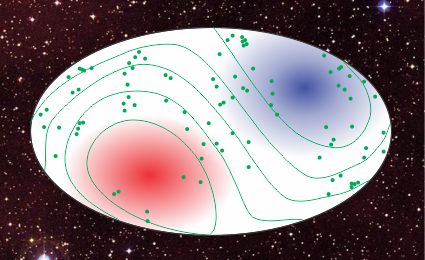
“Both!  In one half the sky these distant galaxies appear to be fleeing faster than the Hubble Flow, and in the other half they’re going slower.  The simplest explanation is that our entire Local Group is streaming towards the ‘slowest’ part of the sky.  Rubin and company had discovered a large-scale, third kind of galactic motion — rivers of galaxies streaming through the Universe.”

“Did the people get excited?”

“Not for a while, of course.”

~~ Rich Olcott

Concerto for Rubber Ruler

An unfamiliar knock at my office door — more of a tap than a knock. “C’mon in, the door’s open.”

¿Está ocupado?

“Hi, Maria. No, I’m not busy, just taking care of odds and ends. What can I do for you?”

“I’m doing a paper on Vera Rubin for la profesora. I have the biographical things, like she was usually the only woman in her Astronomy classes and she had to make her own baño at Palomar Observatory because they didn’t have one for señoras, and she never got the Nobel Prize she deserved for discovering dark matter.

“Wait, you have all negatives there.  Her life had positives, too.  What about her many scientific breakthroughs?”

“That’s why I’m here, for the science parts I don’t understand.”

“I’ll do what I can. What’s the first one?”

“In her thesis she showed that galaxies are ‘clumped.’  What is that?”

“It means that the galaxies aren’t spread out evenly.  Astronomers at the time believed, I guess on the basis of Occam’s Razor, that galaxies were all the same distance from their neighbors.”

“Occam’s Razor?  Ah, la navaja de Okcam.  Yes, we study that in school — do not assume more than you have to.  But why would evenly be a better assumption than clumpy?”

“At the time she wrote her thesis the dominant idea was that the Big Bang’s initial push would be ‘random’ — every spot in the Universe would have an equal chance of hosting a galaxy.  But she found clusters and voids.  That made astronomers uncomfortable because they couldn’t come up with a mechanism that would make things look that way.  It took twenty years before her observations were accepted.  I’ve long thought part of her problem was that her thesis advisor was George Gamow.  He was a high-powered physicist but not an observational astronomer.  For some people that was sufficient excuse to ignore Rubin’s work.”

“Another excuse.”

“Yes, that, too.”

“But why did she have to discover the clumpy?  You can just look up in the sky and see things that are close to each other.”

“Things that appear to be close together in the sky aren’t necessarily close together in the Universe.  Look out my window.  See the goose flying there?”

“Mmm…  Yes!  I see it.”

“There’s an airplane coming towards it, looks about the same size.  Think they’ll collide?”

“Of course no.  The airplane looks small because it’s far away.”

“But when their paths cross, we see them at the same point in our sky, right?”

“The same height up, yes, and the same compass direction, but they have different distances from us.”

“Mm-hm.  Geometry is why it’s hard to tell whether or not galaxies are clustered.  Two galaxy images might be separated by arc-seconds or less.  The objects themselves could be nearest neighbors or separated by half-a-billion lightyears.  Determining distance is one of the toughest problems in observational astronomy.”

“That’s what Vera Rubin did?  How?”

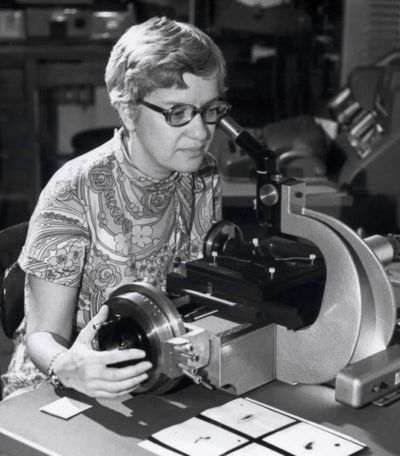
“In theory, the same way we do today.  In practice, by a lot of painstaking manual work.  She did her work back in the early 1950s, when ‘computer’ was a job title, not a device.  No automation — electronic data recording was a leading-edge research topic.  She had to work with images of spectra spread out on glass plates, several for each galaxy she studied.  Her primary tool, at least in the early days, was a glorified microscope called a measuring engine.  Here’s a picture of her using one.” Vera Rubin

“She looks through the eyepiece and then what?”

“She rotates those vernier wheels to move each glass-plate feature on the microscope stage to the eyepiece’s crosshairs.  The verniers give the feature’s x– and y-coordinates to a fraction of a millimeter.  She uses a gear-driven calculating machine to turn galaxy coordinates into sky angles and spectrum coordinates into wavelengths.  The wavelengths, Hubble’s law and more arithmetic give her the galaxy’s distance from us.  More calculations convert her angle-angle-distance coordinates to galactic xy-z-coordinates.  Finally she calculates distances between that galaxy and all the others she’s already done.  After processing a few hundred galaxies, she sees groups of short-distance galaxies in reportable clusters.”

“Wouldn’t a 3-D graphic show them?”

“Not for another 50 years.”

~~ Rich Olcott

Quartetto for Rubber Ruler

Suddenly Al’s standing at our table.  “Hey guys, I heard you talking about spectroscopy and stuff and figured you could maybe ‘splain something I read.  Here’s some scones and I brought a fresh pot of coffee..”

“Thanks, Al.  What’s the something?  I’m sure Cathleen can ‘splain.”

“Syyy…”

“It’s this article talking about some scientists going down to Australia to use really old light to look for younger light and it’s got something to do with dark matter and I’m confused.”

“You’re talking about the EDGES project, right?”

“Yeah, I’m pretty sure they said ‘EDGES’ in the article.”

“OK, first we need some background on the background, that really old light you mentioned.  The Cosmic Microwave Background is the oldest light in the Universe, photons struggling out of the white-hot plasma fog that dominated most of the first 377,000 years after the Big Bang.”

“Wait a minute, ‘plasma fog’?”

“Mm-hm.  In those early years the Universe was all free electrons and nuclei colliding with photons and each other.  No photon could travel more than a few centimeters before being blocked by some charged particle.  The Universe had to expand and cool down to 4,000K or so before electrons and nuclei could hold together as atoms and the fog could lift.”

“Cathleen showed me an intensity-frequency plot for those suddenly-free photons.  It was a virtually perfect blackbody curve, identical within a couple parts per million everywhere in the sky.  The thing is, the curve corresponds to a temperature of only 2.73K.  Its peak is in the microwave region, hence the CMB moniker, nestled in between far infrared and HF radio.”

“I thought she said that the fog lifted at 4,000K, Sy.  That’s a lot different from 2-whatever.”

Wavelength-stretching, Vinnie, remember?  Universe expansion stretches the photon waves we measure temperatures with, the further the longer just like Hubble said.  The CMB’s the oldest light in the Universe, coming to us from 13.4 billion lightyears away.  The stretch factor is about 1100.”

“Vinnie, that 2.7K blackbody radiation is the background to the story.  Think of it as a spherical shell around the part of the Universe we can see.  There are younger layers inside that shell and older layers beyond it.”

“What could be outside the Universe, Cathleen?”

“Hey, Al, I carefully said, ‘the part of the Universe we can see.’  I’m quite sure that the Universe extends beyond the spatial volume we have access to, but light from out there hasn’t had a chance to get to us yet.  Going outward from our CMB sphere there’s that 337,000-year-deep shell of electron-nucleus fog.  Beyond that, 47,000 years-worth of quark soup and worse, out to the Big Bang itself.  Coming inward from the CMB we see all the things we know of that have to do with atoms.”

“Like galaxies?”

“Well, not immediately, they took a billion years to build up.  First we had to get through the Dark Ages when there weren’t any photons in the visible light range.  We had huge clouds of hydrogen and helium atoms but virtually all of them were in the ground state.  The CMB photons running around were too low-energy to get any chemistry going, much less nuclear processes.  The Universe was dark and cooling until gravitational attraction made clumps of gas dense enough to light up and become stars.  That’s when things got going.”

“How’d that make a difference?”Blackbody spectrum with notch

“A ground state hydrogen atom’s lowest available empty energy level is way above what a CMB photon could supply.  Those Dark Age atoms were essentially transparent to the prevailing electromagnetic radiation.  But when starlight came along it excited some atoms so that they could also absorb CMB light.  See the notch on the long-wavelength side of this blackbody curve?  It marks the shadow of starlit hydrogen clouds against the CMB’s glow.  The notch wavelength indicates when the absorption started.  Its position suggests that some stars lit up as early as 180 million years after the Big Bang.”

“Suggests, huh?”

“Mm-hm.  There are other interpretations.  That’s where the fun comes in, both on the theory side and the get-more-data side.  Like looking at different times.”

“Different times?”

“Every wavelength represents a different stretch factor and a different depth into the past.”

~~ Rich Olcott

Terzetto for Rubber Ruler

ruler and sodium lines“So you’re telling me, Cathleen, that you can tell how hot a star is by looking at its color?”

“That’s right, Vinnie.  For most stars their continuous spectrum is pretty close to the blackbody equation tying peak wavelength to temperature.”

“But you can’t do that with far-away stars, right, because the further they are, the more stretched-out their lightwaves get.  Won’t that mess up the peak wavelength?”

“The key is Kirchhoff’s other kinds of spectrum.”

“You’re talking the bright-line and dark-line kinds.”

“Exactly.  Each kind of spectrum comes from a different process — each is affected differently by the object in question and the environment it’s embedded in.  A continuous spectrum is all about charged particles moving randomly in response to the heat energy they’re surrounded by.  It doesn’t matter what kind of particles they are or even whether they’re positive or negative.  Whenever a particle changes direction, it twitches the electromagnetic field and gives off a wave.”

“Right — the higher the temperature the less time between twitches; the wave can’t move as far before things change so the wavelength’s shorter; any speed’s possible so you can turn that dial wherever; I got all that.  So what’s different with the bright-line and dark-line spectrums?”

Cathleen and I both blurt out, “Spectra!” at the same time and give each other a look.  We’re grown-ups now.  We don’t say, “Jinx!” to each other any more.

“Alright, spectra.  But how’re they different?”

I pick up the story.  “Like Cathleen said, continuous spectra from same–temperature stuff look identical no matter what kind of stuff’s involved because heat is motion and each particle moves as a unit  The other kinds of spectrum are about transitions within particles so they’re all about which kind of stuff.  A given kind of atom can only absorb certain wavelengths of light and it can only relax by giving off exactly the same wavelengths.  There’s no in-betweens.”

She cuts in.  “Sodium, for instance.  It has two strong lines in the yellow, at 588.995 and 589.592 nanometers.  Whether in a star or a meteor or fireworks, sodium gives off exactly those colors.  Conversely, in an interstellar cloud or in a star’s outermost layers sodium absorbs exactly those colors from any continuous-spectrum light passing through.”

I’m back in.  “And there’s the key to your unmixing question, Vinnie.  We’ve talked about frames, remember?  Your far-away star’s light-generating layers emit a continuous spectrum that describes its temperature.  If we were right next to it, that’s the spectrum we’d see.  But as you say, we’re a long way away and in our frame the light’s been stretched.  It still looks like the black-body curve but it’s red-shifted because of our relative motion.”

Cathleen’s turn.  “But if there are sodium atoms in the star’s upper layers, their absorptions will cut a pair of notches in that emitted spectrum.  It won’t be a smooth curve, there’ll be two sharp dips in it, close together, with the blue-side one twice as strong as the other one.  Easy to recognize and measure the redshift.  The blackbody peak is redshifted by exactly the same amount so with some arithmetic you’ve got the peak’s original wavelength and the star’s temperature.”

Mine.  “See, because we know what the sodium wavelengths were in the star’s frame, we can divide the dip wavelengths we measure by the rest-frame numbers we know about.  The ratios give us the star’s redshift.”

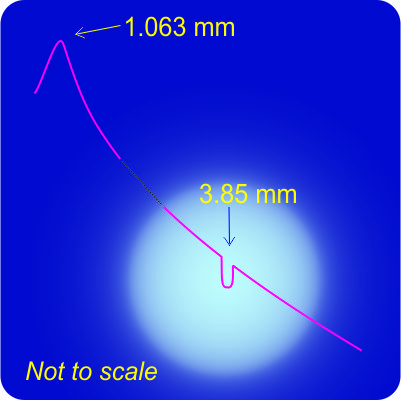
Spectrum with only blackbody and sodium Cathleen turns to her laptop and starts tapping keys.  “Let’s do an example.  Suppose we’re looking at a star’s broadband spectrogram.  The blackbody curve peaks at 720 picometers.  There’s an absorption doublet with just the right relative intensity profile in the near infra-red at 1,060,190 and 1,061,265 picometers.  They’re 1,075 picometers apart.  In the lab, the sodium doublet’s split by 597 picometers.  If the star’s absorption peaks are indeed the sodium doublet then the spectrum has been stretched by a factor of 1075/597=1.80.  Working backward, in the star’s frame its blackbody peak must be at 720/1.80=400 picometers, which corresponds to a temperature of about 6,500 K.”

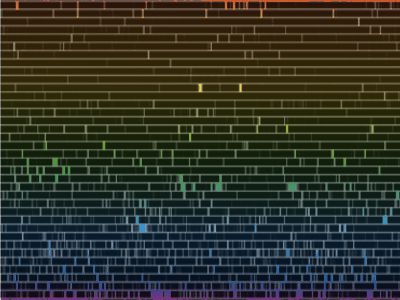
“Old Reliable calculates from that stretch factor and the Hubble Constant the star’s about ten billion lightyears away and fleeing at 240,000 km/s.”

“All that from three peaks.  Spectroscopy’s pretty powerful, huh?”

Cathleen and me: “For sure!    Jinx!”

~~ Rich Olcott

Trio for Rubber Ruler

“It’s all about how lightwaves get generated and then what happens.”

Sy and me talked about that, Cathleen.  Lightwaves come from jiggling electrons, right?”

“Any kind of charged particles, Vinnie, but there’s different ways that can happen.  Each leads to its own kind of spectrum.”

“Different kinds of spectrum?  Do you mean like visible versus infrared and ultraviolet, Cathleen?”

“No, I don’t, Sy.  I’m referring to the thing’s overall appearance in every band.  A hundred and fifty years ago Kirchoff pointed out that light from a source can have lines of color, lines without color, or a smooth display without lines.”

“Like that poster that Al put up between the physicist and astronomer corners?”  (We’re still chatting at a table in Al’s coffee shop.  I’m on my fourth scone.)

Astroruler with solar spectrum
Based on N.A.Sharp, NOAO/NSO/Kitt Peak FTS/AURA/NSF

“Kind of.  That’s based on a famous image created at Kitt Peak Observatory.  In the background there you see a representation of what Kirchoff called a continuous or black-body spectrum, where all the colors fade smoothly into each other in classic rainbow order.  You’re supposed to ignore the horizontal dark lines.”

“And the vertical lines?”

“They form what Kirchoff called an absorption spectrum.  Each dark vertical represents an isolated color that we don’t get from the Sun.”

“You’re saying we get all the other colors but them, right?”

“Exactly, Vinnie.  The Sun’s chromosphere layer filters those specific wavelengths before they get from the deeper photosphere out into space.”

“Complicated filter.”

“Of course.  The Sun contains most of the elements lighter than nickel.  Each kind of atom absorbs its own collection of frequencies.”

“Ah, that’s the quantum thing that Sy and me talked about, right, Sy?”

“Mm-hm.  We only did the hydrogen atom, but the same principles apply.  An electromagnetic wave tickles an atom.  If the wave delivers exactly the right amount of energy, the atom’s chaotic storm of electrons resonates with the energy and goes a different-shaped storm.  But each kind of atom has a limited set of shapes.  If the energy doesn’t match the energy difference between a pair of levels, there’s no absorption and the wave just passes by.”

“But I’ll bet the atom can’t hold that extra energy forever.”

“Good bet, Vinnie.  The flip side of absorption is emission.  I expect that Cathleen has an emission spectrum somewhere on her laptop there.”Emission spectrum“You’re right, Sy.  It’s not a particularly pretty picture, but it shows that nice strong sodium doublet in the yellow and the broad iron and hydrogen lines down in the green and blue.  I’ll admit it, Vinnie, this is a faked image I made to show my students what the solar atmosphere would look like if you could turn off the photosphere’s continuous blast of light.  The point is that the atoms emit exactly the same sets of colors that they absorb.”

“You do what you gotta do, Cathleen.  But tell me, if each kind of atom does only certain colors, where’s that continuous rainbow come from?  Why aren’t we only getting hydrogen colors?”

“Kirchoff didn’t have a clue on that, Vinnie.  It took 50 years and Einstein to solve it.  Not just where the light comes from but also its energy-wavelength profile.”

“So where does the light come from?”

“Pure heat.  You can get a continuous spectrum from a hot wire, molten lava, a hole through the wall of a hot oven, even the primordial chaos of the Big Bang.  It doesn’t matter what kind of matter you’re looking at, the profile just depends on the temperature.  You know that temperature measures the kinetic energy stored in particle random motion, Vinnie?”

“Well, I wouldn’t have put it that way, but yeah.”

“Well, think about the Sun, just a big ball of really hot atoms and electrons and nuclei, all bouncing off each other in frantic motion.  Every time one of those changes direction it affects the electromagnetic field, jiggles it as you say.  The result of all that jiggling is the continuous spectrum.  Absorption and emission lines come from electrons that are confined to an atom, but heat motion is unconfined.”

“How about hot metal?”

“The atoms are locked in their lattice, but heat jiggles the whole lattice.”

~~ Rich Olcott

Étude for A Rubber Ruler

93% redder?  How do you figure that, Sy, and what’s it even mean?”

“Simple arithmetic, Vinnie.  Cathleen said that most-distant galaxy is 13 billion lightyears away.  I primed Old Reliable with Hubble’s Constant to turn that distance into expansion velocity and compare it with lightspeed.  Here’s what came up on its screen.”Old Reliable z calculation“Whoa, Sy.  Do you read the final chapter of a mystery story before you begin the book?”

“Of course not, Cathleen.  That way you don’t know the players and you miss what the clues mean.”

“Which is the second of Vinnie’s questions.  Let’s take it a step at a time.  I’m sure that’ll make Vinnie happier.”

“It sure will.  First step — what’s a parsec?”

“Just another distance unit, like a mile or kilometer but much bigger.  You know that a lightyear is the distance light travels in an Earth year, right?”

“Right, it’s some huge number of miles.”

“About six trillion miles, 9½ trillion kilometers.  Multiply the kilometers by 3.26 to get parsecs.  And no, I’m not going to explain the term, you can look it up.  Astronomers like the unit, other people put it in the historical-interest category with roods and firkins.”

“Is that weird ‘km/sec/Mparsec’ mix another historical thing?”

“Uh-huh.  That’s the way Hubble wrote it in 1929.  It makes more sense if you look at it piecewise.  It says for every million parsecs away from us, the outward speed of things in general increases by 70 kilometers per second.”

“That helps, but it mixes old and new units like saying miles per hour per kilometer.  Ugly.  It’d be prettier if you kept all one system, like (pokes at smartphone screen) … about 2.27 km/sec per 1018 kilometers or … about 8 miles an hour per quadrillion miles.  Which ain’t much now that I look at it.”

“Not much, except it adds up over astronomical distances.  The Andromeda galaxy, for instance, is 15×1018 miles away from us, so by your numbers it’d be moving away from us at 120,000 miles per hour.”

“Wait, Cathleen, I thought Andromeda is going to collide with the Milky Way four billion years from now.”

Opposing motion in a starfield“It is, Sy, and that’s one of the reasons why Hubble’s original number was so far off.  He only looked at about 50 close-by galaxies, some of which are moving toward us and some away.  You only get a view of the general movement when you look at large numbers of galaxies at long distances.  It’s like looking through a window at a snowfall.  If you concentrate on individual flakes you often see one flying upward, even though the fall as a whole is downward.  Andromeda’s 250,000 mph march towards us is against the general expansion.”

“Like if I’m flying a plane and the airspeed indicator says I’m doing 200 but my ground-speed is about 140 then I must be fighting a 60-knot headwind.”

“Exactly, Vinnie.  For Andromeda the ‘headwind’ is the Hubble Flow, that general outward trend.  If Sy’s calculation were valid, which it’s not, then that galaxy 13 billion lightyears from here would indeed be moving further away at  93% of lightspeed.  Someone living in that galaxy could shine a 520-nanometer green laser at us.  At this end we see the beam stretched by 193% to 1000nm.  That’s outside the visible range, well into the near-infrared.  All four visible lines in the hydrogen spectrum would be out there, too.”

“So that’s why ‘old hydrogens’ look different — if they’re far enough away in the Hubble Flow they’re flying away from us so fast all their colors get stretched by the red-shift.”

“Right, Vinnie.”

“Wait, Cathleen, what’s wrong with my calculation?”

“Two things, Sy.  Because the velocities are close to lightspeed, you need to apply a relativistic correction factor.  That velocity ratio Old Reliable reported — call it b.  The proper stretch factor is z=√ [(1+b)/(1–b)].  Relativity takes your 93% stretch down to (taps on laptop keyboard) … about 86%.  The bluest wavelength on hydrogen’s second-down series would be just barely visible in the red at 680nm.”

“What’s the other thing?”Ruler in perspective

“The Hubble Constant can’t be constant.  Suppose you run the movie backwards.  The Universe shrinks steadily at 70 km/sec/Mparsec.  You hit zero hundreds of millions of years before the Big Bang.”

“The expansion must have started slow and then accelerated.”

“Vaster and faster, eh?”

“Funny, Sy.”

~~ Rich Olcott