Terzetto for Rubber Ruler

ruler and sodium lines“So you’re telling me, Cathleen, that you can tell how hot a star is by looking at its color?”

“That’s right, Vinnie.  For most stars their continuous spectrum is pretty close to the blackbody equation tying peak wavelength to temperature.”

“But you can’t do that with far-away stars, right, because the further they are, the more stretched-out their lightwaves get.  Won’t that mess up the peak wavelength?”

“The key is Kirchhoff’s other kinds of spectrum.”

“You’re talking the bright-line and dark-line kinds.”

“Exactly.  Each kind of spectrum comes from a different process — each is affected differently by the object in question and the environment it’s embedded in.  A continuous spectrum is all about charged particles moving randomly in response to the heat energy they’re surrounded by.  It doesn’t matter what kind of particles they are or even whether they’re positive or negative.  Whenever a particle changes direction, it twitches the electromagnetic field and gives off a wave.”

“Right — the higher the temperature the less time between twitches; the wave can’t move as far before things change so the wavelength’s shorter; any speed’s possible so you can turn that dial wherever; I got all that.  So what’s different with the bright-line and dark-line spectrums?”

Cathleen and I both blurt out, “Spectra!” at the same time and give each other a look.  We’re grown-ups now.  We don’t say, “Jinx!” to each other any more.

“Alright, spectra.  But how’re they different?”

I pick up the story.  “Like Cathleen said, continuous spectra from same–temperature stuff look identical no matter what kind of stuff’s involved because heat is motion and each particle moves as a unit  The other kinds of spectrum are about transitions within particles so they’re all about which kind of stuff.  A given kind of atom can only absorb certain wavelengths of light and it can only relax by giving off exactly the same wavelengths.  There’s no in-betweens.”

She cuts in.  “Sodium, for instance.  It has two strong lines in the yellow, at 588.995 and 589.592 nanometers.  Whether in a star or a meteor or fireworks, sodium gives off exactly those colors.  Conversely, in an interstellar cloud or in a star’s outermost layers sodium absorbs exactly those colors from any continuous-spectrum light passing through.”

I’m back in.  “And there’s the key to your unmixing question, Vinnie.  We’ve talked about frames, remember?  Your far-away star’s light-generating layers emit a continuous spectrum that describes its temperature.  If we were right next to it, that’s the spectrum we’d see.  But as you say, we’re a long way away and in our frame the light’s been stretched.  It still looks like the black-body curve but it’s red-shifted because of our relative motion.”

Cathleen’s turn.  “But if there are sodium atoms in the star’s upper layers, their absorptions will cut a pair of notches in that emitted spectrum.  It won’t be a smooth curve, there’ll be two sharp dips in it, close together, with the blue-side one twice as strong as the other one.  Easy to recognize and measure the redshift.  The blackbody peak is redshifted by exactly the same amount so with some arithmetic you’ve got the peak’s original wavelength and the star’s temperature.”

Mine.  “See, because we know what the sodium wavelengths were in the star’s frame, we can divide the dip wavelengths we measure by the rest-frame numbers we know about.  The ratios give us the star’s redshift.”

Spectrum with only blackbody and sodium Cathleen turns to her laptop and starts tapping keys.  “Let’s do an example.  Suppose we’re looking at a star’s broadband spectrogram.  The blackbody curve peaks at 720 picometers.  There’s an absorption doublet with just the right relative intensity profile in the near infra-red at 1,060,190 and 1,061,265 picometers.  They’re 1,075 picometers apart.  In the lab, the sodium doublet’s split by 597 picometers.  If the star’s absorption peaks are indeed the sodium doublet then the spectrum has been stretched by a factor of 1075/597=1.80.  Working backward, in the star’s frame its blackbody peak must be at 720/1.80=400 picometers, which corresponds to a temperature of about 6,500 K.”

“Old Reliable calculates from that stretch factor and the Hubble Constant the star’s about ten billion lightyears away and fleeing at 240,000 km/s.”

“All that from three peaks.  Spectroscopy’s pretty powerful, huh?”

Cathleen and me: “For sure!    Jinx!”

~~ Rich Olcott

Trio for Rubber Ruler

“It’s all about how lightwaves get generated and then what happens.”

Sy and me talked about that, Cathleen.  Lightwaves come from jiggling electrons, right?”

“Any kind of charged particles, Vinnie, but there’s different ways that can happen.  Each leads to its own kind of spectrum.”

“Different kinds of spectrum?  Do you mean like visible versus infrared and ultraviolet, Cathleen?”

“No, I don’t, Sy.  I’m referring to the thing’s overall appearance in every band.  A hundred and fifty years ago Kirchoff pointed out that light from a source can have lines of color, lines without color, or a smooth display without lines.”

“Like that poster that Al put up between the physicist and astronomer corners?”  (We’re still chatting at a table in Al’s coffee shop.  I’m on my fourth scone.)

Astroruler with solar spectrum
Based on N.A.Sharp, NOAO/NSO/Kitt Peak FTS/AURA/NSF

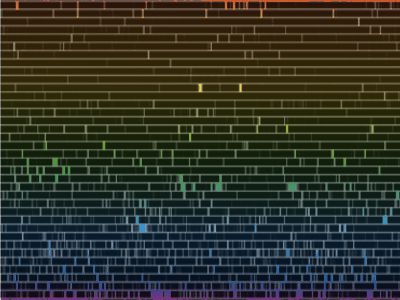
“Kind of.  That’s based on a famous image created at Kitt Peak Observatory.  In the background there you see a representation of what Kirchoff called a continuous or black-body spectrum, where all the colors fade smoothly into each other in classic rainbow order.  You’re supposed to ignore the horizontal dark lines.”

“And the vertical lines?”

“They form what Kirchoff called an absorption spectrum.  Each dark vertical represents an isolated color that we don’t get from the Sun.”

“You’re saying we get all the other colors but them, right?”

“Exactly, Vinnie.  The Sun’s chromosphere layer filters those specific wavelengths before they get from the deeper photosphere out into space.”

“Complicated filter.”

“Of course.  The Sun contains most of the elements lighter than nickel.  Each kind of atom absorbs its own collection of frequencies.”

“Ah, that’s the quantum thing that Sy and me talked about, right, Sy?”

“Mm-hm.  We only did the hydrogen atom, but the same principles apply.  An electromagnetic wave tickles an atom.  If the wave delivers exactly the right amount of energy, the atom’s chaotic storm of electrons resonates with the energy and goes a different-shaped storm.  But each kind of atom has a limited set of shapes.  If the energy doesn’t match the energy difference between a pair of levels, there’s no absorption and the wave just passes by.”

“But I’ll bet the atom can’t hold that extra energy forever.”

“Good bet, Vinnie.  The flip side of absorption is emission.  I expect that Cathleen has an emission spectrum somewhere on her laptop there.”Emission spectrum“You’re right, Sy.  It’s not a particularly pretty picture, but it shows that nice strong sodium doublet in the yellow and the broad iron and hydrogen lines down in the green and blue.  I’ll admit it, Vinnie, this is a faked image I made to show my students what the solar atmosphere would look like if you could turn off the photosphere’s continuous blast of light.  The point is that the atoms emit exactly the same sets of colors that they absorb.”
“You do what you gotta do, Cathleen.  But tell me, if each kind of atom does only certain colors, where’s that continuous rainbow come from?  Why aren’t we only getting hydrogen colors?”

“Kirchoff didn’t have a clue on that, Vinnie.  It took 50 years and Einstein to solve it.  Not just where the light comes from but also its energy-wavelength profile.”

“So where does the light come from?”

“Pure heat.  You can get a continuous spectrum from a hot wire, molten lava, a hole through the wall of a hot oven, even the primordial chaos of the Big Bang.  It doesn’t matter what kind of matter you’re looking at, the profile just depends on the temperature.  You know that temperature measures the kinetic energy stored in particle random motion, Vinnie?”

“Well, I wouldn’t have put it that way, but yeah.”

“Well, think about the Sun, just a big ball of really hot atoms and electrons and nuclei, all bouncing off each other in frantic motion.  Every time one of those changes direction it affects the electromagnetic field, jiggles it as you say.  The result of all that jiggling is the continuous spectrum.  Absorption and emission lines come from electrons that are confined to an atom, but heat motion is unconfined.”

“How about hot metal?”

“The atoms are locked in their lattice, but heat jiggles the whole lattice.”

~~ Rich Olcott

Étude for A Rubber Ruler

93% redder?  How do you figure that, Sy, and what’s it even mean?”

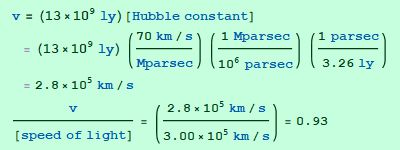
“Simple arithmetic, Vinnie.  Cathleen said that most-distant galaxy is 13 billion lightyears away.  I primed Old Reliable with Hubble’s Constant to turn that distance into expansion velocity and compare it with lightspeed.  Here’s what came up on its screen.”Old Reliable z calculation“Whoa, Sy.  Do you read the final chapter of a mystery story before you begin the book?”
“Of course not, Cathleen.  That way you don’t know the players and you miss what the clues mean.”

“Which is the second of Vinnie’s questions.  Let’s take it a step at a time.  I’m sure that’ll make Vinnie happier.”

“It sure will.  First step — what’s a parsec?”

“Just another distance unit, like a mile or kilometer but much bigger.  You know that a lightyear is the distance light travels in an Earth year, right?”

“Right, it’s some huge number of miles.”

“About six trillion miles, 9½ trillion kilometers.  Multiply the kilometers by 3.26 to get parsecs.  And no, I’m not going to explain the term, you can look it up.  Astronomers like the unit, other people put it in the historical-interest category with roods and firkins.”

“Is that weird ‘km/sec/Mparsec’ mix another historical thing?”

“Uh-huh.  That’s the way Hubble wrote it in 1929.  It makes more sense if you look at it piecewise.  It says for every million parsecs away from us, the outward speed of things in general increases by 70 kilometers per second.”

“That helps, but it mixes old and new units like saying miles per hour per kilometer.  Ugly.  It’d be prettier if you kept all one system, like (pokes at smartphone screen) … about 2.27 km/sec per 1018 kilometers or … about 8 miles an hour per quadrillion miles.  Which ain’t much now that I look at it.”

“Not much, except it adds up over astronomical distances.  The Andromeda galaxy, for instance, is 15×1018 miles away from us, so by your numbers it’d be moving away from us at 120,000 miles per hour.”

“Wait, Cathleen, I thought Andromeda is going to collide with the Milky Way four billion years from now.”

Opposing motion in a starfield“It is, Sy, and that’s one of the reasons why Hubble’s original number was so far off.  He only looked at about 50 close-by galaxies, some of which are moving toward us and some away.  You only get a view of the general movement when you look at large numbers of galaxies at long distances.  It’s like looking through a window at a snowfall.  If you concentrate on individual flakes you often see one flying upward, even though the fall as a whole is downward.  Andromeda’s 250,000 mph march towards us is against the general expansion.”
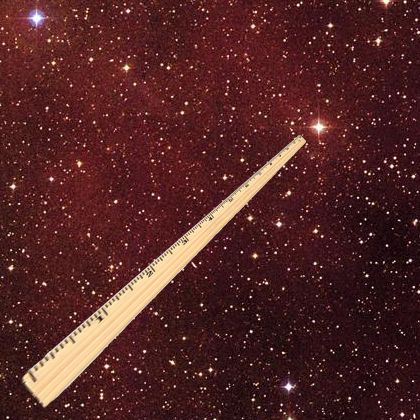
“Like if I’m flying a plane and the airspeed indicator says I’m doing 200 but my ground-speed is about 140 then I must be fighting a 60-knot headwind.”

“Exactly, Vinnie.  For Andromeda the ‘headwind’ is the Hubble Flow, that general outward trend.  If Sy’s calculation were valid, which it’s not, then that galaxy 13 billion lightyears from here would indeed be moving further away at  93% of lightspeed.  Someone living in that galaxy could shine a 520-nanometer green laser at us.  At this end we see the beam stretched by 193% to 1000nm.  That’s outside the visible range, well into the near-infrared.  All four visible lines in the hydrogen spectrum would be out there, too.”

“So that’s why ‘old hydrogens’ look different — if they’re far enough away in the Hubble Flow they’re flying away from us so fast all their colors get stretched by the red-shift.”

“Right, Vinnie.”

“Wait, Cathleen, what’s wrong with my calculation?”

“Two things, Sy.  Because the velocities are close to lightspeed, you need to apply a relativistic correction factor.  That velocity ratio Old Reliable reported — call it b.  The proper stretch factor is z=√ [(1+b)/(1–b)].  Relativity takes your 93% stretch down to (taps on laptop keyboard) … about 86%.  The bluest wavelength on hydrogen’s second-down series would be just barely visible in the red at 680nm.”

“What’s the other thing?”Ruler in perspective

“The Hubble Constant can’t be constant.  Suppose you run the movie backwards.  The Universe shrinks steadily at 70 km/sec/Mparsec.  You hit zero hundreds of millions of years before the Big Bang.”

“The expansion must have started slow and then accelerated.”

“Vaster and faster, eh?”

“Funny, Sy.”

~~ Rich Olcott

Toccata for A Rubber Ruler

“How the heck do they know that?”

“Know what, Vinnie?”

“That the galaxy they saw with that gravitational lens is 13 billion years old?  I mean, does it come with a birth certificate, Cathleen?”

“Mm, it does, sort of — hydrogen atoms.  Really old hydrogen atoms.”

“Waitaminit.  Hydrogen’s hydrogen — one proton, one electron per atom.  They’re all the same, right?  How do you know one’s older than another one?”

“Because they look different.”

“How could they look different when they’re all the same?”

“Let me guess, Cathleen.  These old hydrogens, are they far far away?”

“On the button, Sy.”

“What where they’re at got to do with it?”

“It’s all about spectroscopy and the Hubble constant, Vinnie.  What do you know about Edwin Hubble?”

“Like in Hubble Space Telescope?  Not much.”

“Those old atoms were Hubble’s second big discovery.”

“Your gonna start with the other one, right?”

“Sorry, classroom habit.  His first big discovery was that there’s more to the Universe than just the Milky Way Galaxy.  That directly contradicted Astronomy’s Big Names.  They all believed that the cloudy bits they saw in the sky were nebulae within our galaxy.  Hubble’s edge was that he had access to Wilson Observatory’s 100-inch telescope that dwarfed the smaller instruments that everyone else was using.  Bigger scope, more light-gathering power, better resolution.”

“Hubble won.”

“Yeah, but how he won was the key to his other big discovery.  The crucial question was, how far away are those ‘nebulae’?  He needed a link between distance and something he could measure directly.  Stellar brightness was the obvious choice.  Not the brightness we see on Earth but the brightness we’d see if we were some standard distance away from it.  Fortunately, a dozen years earlier Henrietta Swan Leavitt found that link.  Some stars periodically swing bright, then dim, then bright again.  She showed that for one subgroup of those stars, there’s a simple relationship between the star’s intrinsic brightness and its peak-to-peak time.”Astroruler

“So Hubble found stars like that in those nebulas or galaxies or whatever?”

“Exactly.  With his best-of-breed telescope he could pick out individual variable stars in close-by galaxies.  Their fluctuation gave him intrinsic brightness.  The brightness he measured from Earth was a lot less.  The brightness ratios gave him distances.  They were a lot bigger than everyone thought.”

“Ah, so now he’s got a handle on distance.  Scientists love to plot everything against everything, just to see, so I’ll bet he plotted something against distance and hit jackpot.”

“Well, he was a bit less random than that, Sy.  There were some theoretical reasons to think that the Universe might be expanding.  The question was, how fast?  For that he tapped another astronomer’s results.  Vesto Slipher at Lowell Observatory was looking at the colors of light emitted by different galaxies.  None had light exactly like our Milky Way’s.  A few were a bit bluer, but most were distinctly red-shifted.”

“Like the Doppler effect in radar?  Things coming toward you blue-shift the radar beam, things going away red-shift it?”

“Similar to that, Vinnie, but it’s emitted light, not a reflected beam. To a good approximation, though, you can say that the red shift is proportional to the emitting object’s speed towards or away from us.  Hubble plotted his distance number for each galaxy he’d worked on, against Slipher’s red-shift speed number for the same galaxy.  It wasn’t the prettiest graph you’ve ever seen, but there was a pretty good correlation.  Hubble drew the best straight line he could through the points.  What’s important is that the line sloped upward.”

“Lemme think … If everything just sits there, there’d be no red-shift and no graph, right?  If everything is moving away from us at a steady speed, then the line would be flat — zero slope.  But he saw an upward slope, so the farther something is the faster it’s going further from us?”

“Bravo, Vinnie.  That’s the expansion of the Universe you’ve heard about.  Locally there are a few things coming toward us — that’s those blue-shifted galaxies, for instance — but the general trend is away.”

“So that’s why you say those far-away hydrogens look different.  By the time we see their light it’s been red-shifted.”

“93% redder.”

~~ Rich Olcott

Gentle pressure in the dark

“C’mon in, the door’s open.”

Vinnie clomps in and he opens the conversation with, “I don’t believe that stuff you wrote about LIGO.  It can’t possibly work the way they say.”

“Well, sir, would you mind telling me why you have a problem with those posts?”  I’m being real polite, because Vinnie’s a smart guy and reads books.  Besides, he’s Vinnie.

“I’m good with your story about how Michelson’s interferometer worked and why there’s no æther.  Makes sense, how the waves mess up when they’re outta step.  Like my platoon had to walk funny when we crossed a bridge.  But the gravity wave thing makes no sense.  When a wave goes by maybe it fiddles space but it can’t change where the LIGO mirrors are.”

“Gravitational wave,” I murmur, but speak up with, “What makes you think that space can move but not the mirrors?”

“I seen how dark energy spreads galaxies apart but they don’t get any bigger.  Same thing must happen in the LIGO machine.”

“Not the same, Vinnie.  I’ll show you the numbers.”

“Ah, geez, don’t do calculus at me.”de-vs-gravity

“No, just arithmetic we can do on a spreadsheet.” I fire up the laptop and start poking in  astronomical (both senses) numbers.  “Suppose we compare what happens when two galaxies face each other in intergalactic space, with what happens when two stars face each other inside a galaxy.  The Milky Way’s my favorite galaxy and the Sun’s my favorite star.  Can we work with those?”

“Yeah, why not?”

“OK, we’ll need a couple of mass numbers.  The Sun’s mass is… (sound of keys clicking as I query Wikipedia) … 2×1030 kilograms, and the Milky Way has (more key clicks) about 1012 stars.  Let’s pretend they’re all the Sun’s size so the galaxy’s mass is (2×1030)×1012 = 2×1042 kg. Cute how that works, multiplying numbers by adding exponents, eh?”

“Cute, yeah, cute.”  He’s getting a little impatient.

“Next step is the sizes.  The Milky Way’s radius is 10×104 lightyears, give or take..  At 1016 meters per lightyear, we can say it’s got a radius of 5×10²⁰ meters.  You remember the formula for the area of a circle?”

“Sure, it’s πr2.” I told you Vinnie’s smart.

“Right, so the Milky Way’s area is 25π×1040 m2.  Meanwhile, the Sun’s radius is 1.4×10⁹ m and its cross-sectional area must be 2π×1018 m2.  Are you with me?”

“Yeah, but what’re we doing playing with areas?  Newton’s gravity equations just talk about distances between centers.”  I told you Vinnie’s smart.

“OK, we’ll do gravity first.  Suppose we’ve got our Milky Way facing another Milky Way an average inter-galactic distance away.  That’s about 60 galaxy radii,  about 300×1020 meters.  The average distance between stars in the Milky Way is about 4 lightyears or 4×10¹⁶ meters.  (I can see he’s hooked so I take a risk)  You’re so smart, what’s that Newton equation?”

Force or potential energy?”

“Alright, I’m impressed.  Let’s go for force.”

“Force equals Newton’s G times the product of the masses divided by the square of the distance.”

“Full credit, Vinnie.  G is about 7×10-11 newton-meter²/kilogram², so we’ve got a gravity force of (typing rapidly) (7×10-11)×(2×1042)×(2×1042)/(300×1020)² = 3.1×1029 N for the galaxies, and (7×10-11)×(2×1030)×(2×1030)/(4×1016)² = 1.75×10¹⁷ N for the stars.  Capeesh?”

“Yeah, yeah.  Get on with it.”

“Now for dark energy.  We don’t know what it is, but theory says it somehow exerts a steady pressure that pushes everything away from everything.  That outward pressure’s exerted here in the office, out in space, everywhere.  Pressure is force per unit area, which is why we calculated areas.

“But the pressure’s really, really weak.  Last I saw, the estimate’s on the order of 10-9 N/m².  So our Milky Way is pushed away from that other one by a force of (10-9)×(25π×1040) ≈ 1031 N, and our Sun is pushed away from that other star by a force of (10-9)×(2π×1018) ≈ 1010 N with rounding.  Here, look at the spreadsheet summary…”

 Force, newtons Between Galaxies Between stars
Gravity 3.1×1029 1.75×10¹⁷
Dark energy 1031 1010
Ratio 3.1×10⁻² 17.5×10⁶

“So gravity’s force pulling stars together is 18 million times stronger than dark energy’s pressure pushing them apart.  That’s why the galaxies aren’t expanding.”

“Gotta go.”

(sound of door-slam )

“Don’t mention it.”

~~ Rich Olcott

Light’s hourglass

Terry Pratchett’s anthropomorphic character Death (who always speaks in UPPER CASE with a voice that sounds like tombstones falling) has a thing about hourglasses.  So do physicists, but theirs don’t have sand in them.  And they don’t so much represent Eternity as describe it.  Maybe.

The prior post was all about spacetime events (an event is the combination of a specific (x,y,z) spatial location with a specific time t) and how the Minkowski diagram divides the Universe into mutually exclusive pieces:

  • “look but don’t touch” — the past, all the spacetime events which could have caused something to happen where/when we are
  • “touch but don’t look” — the future, the events where/when we can cause something to happen
  • “no look, no touch” — the spacelike part that’s so far away that light can’t reach us and we can’t reach it without breaching Einstein’s speed-of-light constraint
  • “here and now” — the tiny point in spacetime with address (ct,x,y,z)=(0,0,0,0)

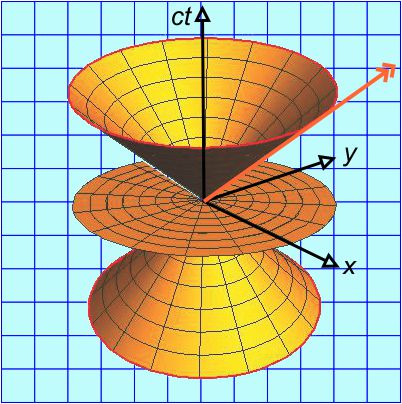
Light_s hourglassLast week’s Minkowski diagram was two-dimensional.  It showed time running along the vertical axis and Pythagorean distance d=√(x²+y²+z²) along the horizontal one.  That was OK in the days before computer graphics, but it  loaded many different events onto the same point on the chart.  For instance, (0,1,0,0), (0,-1,0,0), (0,0,1,0) and (0,0,0,1) (and more) are all at d=1.
This chart is one dimension closer to what the physicists really think about.  Here we have x and y along distinct axes.  The z axis is perpendicular to all three, and if you can visualize that you’re better at it than I am.  The xy plane (and the xyz cube if you’re good at it) is perpendicular to t.

That orange line was in last week’s diagram and it means the same thing in this one.  It contains events that can use light-speed somehow to communicate with the here-and-now event.  But now we see that the line into the future is just part of a cone (or a hypercone if you’re good at it).

If we ignite a flash of light at time t=0, at any positive time t that lightwave will have expanded to a circle (or bubble) with radius d=c·t. The circles form the “future” cone.

Another cone extends into the past.  It’s made up of all the events from which a flash of light at time at some negative t would reach the here-and-now event.

The diagram raises four hotly debated questions:

  • Is the pastward cone actually pear-shaped?  It’s supposed to go back to The Very Beginning.  That’s The Big Bang when the Universe was infinitesimally small.  Back then d for even the furthest event from (ct,0,0,0) should have been much smaller than the nanometers-to-lightyears range of sizes we’re familiar with today.  But spacetime was smaller, too, so maybe everything just expanded in sync once we got past Cosmic Inflation.  We may never know the answer.
  • What’s outside the cones?  You think what you see around you is right now?  Sorry.  If the screen you’re reading this on is a typical 30 inches or so distant, the light you’re seeing left the screen 2½ nanoseconds ago.  Things might have changed since then.  We can see no further into the Universe than 14 billion lightyears, and even that only tells us what happened 14 billion years ago.  Are there even now other Earth-ish civilizations just 15 billion lightyears away from us?  We may never know the answer.
  • How big is “here-and-now”?  We think of it as a size=zero mathematical point, but there are technical grounds to think that the smallest possible distance is the Planck length, 1.62×10⁻³⁵ meters.  Do incidents that might affect us occur at a smaller scale than that?  Is time quantized?  We may never know the answers.
  • Do the contents of the futureward cone “already” exist in some sense, or do we truly have free will?  Einstein thought we live in a block universe, with events in future time as fixed as those in past time.  Other thinkers hold that neither past not future are real.  I like the growing block alternative, in which the past is real and fixed but the future exists as maybes.  We may never know the answer.

~~ Rich Olcott

Does a photon experience time?

My brother Ken asked me, “Is it true that a photon doesn’t experience time?”  Good question.  As I was thinking about it I wondered if the answer could have implications for Einstein’s bubble.

When Einstein was a grad student in Göttingen, he skipped out on most of the classes given by his math professor Hermann Minkowski.  Then in 1905 Einstein’s Special Relativity paper scooped some work that Minkowski was doing.  In response, Minkowski wrote his own paper that supported and expanded on Einstein’s.  In fact, Minkowski’s contribution changed Einstein’s whole approach to the subject, from algebraic to geometrical.

But not just any geometry, four-dimensional geometry — 3D space AND time.  But not just any space-AND-time geometry — space-MINUS-time geometry.  Wait, what?Pythagoras1

Early geometer Pythagoras showed us how to calculate the hypotenuse of a right triangle from the lengths of the other two sides. His a2+b2 = c2 formula works for the diagonal of the enclosing rectangle, too.

Extending the idea, the body diagonal of an x×y×z cube is √(x2+y2+z2) and the hyperdiagonal  of a an ct×x×y×z tesseract is √(c2t2+x2+y2+z2) where t is time.  Why the “c“?  All terms in a sum have to be in the same units.  x, y, and z are lengths so we need to turn t into a length.  With c as the speed of light, ct is the distance (length) that light travels in time t.

But Minkowski and the other physicists weren’t happy with Pythagorean hyperdiagonals.  Here’s the problem they wanted to solve.  Suppose you’re watching your spacecraft’s first flight.  You built it, you know its tip-to-tail length, but your telescope says it’s shorter than that.  George FitzGerald and Hendrik Lorentz explained that in 1892 with their length contraction analysis.

What if there are two observers, Fred and Ethel, each of whom is also moving?  They’d better be able to come up with the same at-rest (intrinsic) size for the object.

Minkowski’s solution was to treat the ct term differently from the others.  Think of each 4D address (ct,x,y,z) as a distinct event.  Whether or not something happens then/there, this event’s distinct from all other spatial locations at moment t, and all other moments at location (x,y,z).

To simplify things, let’s compare events to the origin (0,0,0,0).  Pythagoras would say that the “distance” between the origin event and an event I’ll call Lucy at (ct,x,y,z) is √(c2t2+x2+y2+z2).

Minkowski proposed a different kind of “distance,” which he called the interval.  It’s the difference between the time term and the space terms: √[c2t2 + (-1)*(x2+y2+z2)].

If Lucy’s time is t=0 [her event address (0,x,y,z)], then the origin-to-Lucy interval is  √[02+(-1)*(x2+y2+z2)]=i(x2+y2+z2).  Except for the i=√(-1) factor, that matches the familiar origin-to-Lucy spatial distance.

Now for the moment let’s convert the sum from lengths to times by dividing by c2.  The expression becomes √[t2-(x/c)2-(y/c)2-(z/c)2].  If Lucy is at (ct,0,0,0) then the origin-to-Lucy interval is simply √(t2)=t, exactly the time difference we’d expect.

Finally, suppose that Lucy departed the origin at time zero and traveled along x at the speed of light.   At any time t, her address is (ct,ct,0,0) and the interval for her trip is √[(ct)2-(ct)2-02-02] = √0 = 0.  Both Fred’s and Ethel’s clocks show time passing as Lucy speeds along, but the interval is always zero no matter where they stand and when they make their measurements.

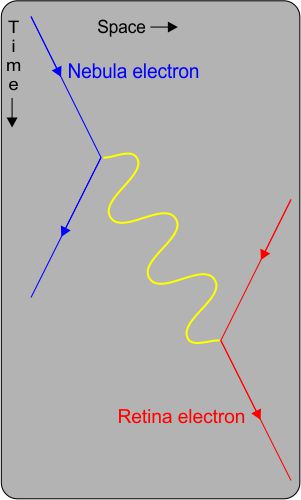
Feynman diagramOne more step and we can answer Ken’s question.  A moving object’s proper time is defined to be the time measured by a clock affixed to that object.  The proper time interval between two events encountered by an object is exactly Minkowski’s spacetime interval.  Lucy’s clock never moves from zero.

So yeah, Ken, a photon moving at the speed of light experiences no change in proper time although externally we see it traveling.

Now on to Einstein’s bubble, a lightwave’s spherical shell that vanishes instantly when its photon is absorbed by an electron somewhere.  We see that the photon experiences zero proper time while traversing the yellow line in this Feynman diagram.  But viewed from any other frame of reference the journey takes longer.  Einstein’s objection to instantaneous wave collapse still stands.

~~ Rich Olcott

A Summertime Slice of π

So you think you’re standing still?  Let’s run some circles, all variations on the theme of 2πR…

Circles in circles
The Earth rotates on its axis,
as it and the moon revolve around their barycenter,
as the barycenter revolves around the Sun.
Not to scale, of course.

The Earth’s radius is 4,000 miles and it completes one rotation every 24 hours.  Its circumference at the Equator (2πR) is 25,000 miles, so if you’re reading this in Ecuador you’re doing 25000/24 = 1041 miles per hour.

I’m writing this in Denver, at 39.75oN, where the circumference perpendicular to the axis of rotation is only 19,200 miles.  Sitting here I’m circling the Earth at 800 miles per hour.  But that’s not all.

The Earth and the Moon both revolve around their common center of gravity (their barycenter).  The barycenter is inside the Earth, offset from its center by 2881 miles.  The center of the Earth runs a circle around the barycenter once every month (27.3 days), at a relatively piddly 27.6 miles per hour.  But that’s not all.

Circles in circles
One year of Denver’s distance from Sag A*,
the black hole at the center of the Milky Way.
The green curve is our orbit around the Sun.
The blue curve adds in the monthly wobble
as we revolve around the barycenter.
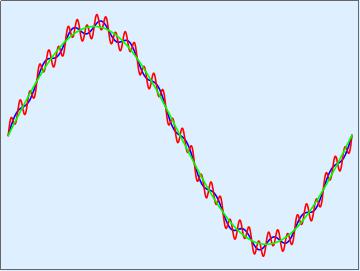
The red curve includes our daily rotation. (Should be 365 cycles but I used artistic license to cut that down to 36. Besides, the vertical scale’s all wrong. Sue me.)

Earth’s orbit is (nearly) a circle.  The orbit’s radius is 93 million miles so its circumference is 584 million miles.  If you ran that many miles in a year you’d have to hit a pace of 66,600 miles per hour (no rest stops).  But that’s not all.

The Sun’s not just standing still all alone in space.  It’s part of the Milky Way Galaxy, which rotates once per 230 million years.  The Sun is about 26,000 light-years (152.8 quadrillion miles) from the center of the galaxy, so in one cycle it travels some 960 quadrillion miles.  That’s a rate of 476,000 miles per hour.  But that’s not all.

The Milky Way is one of about 50 galaxies in the Local Group.  The galaxies move with respect to each other and the whole assembly undoubtedly rotates.  Unfortunately, the astronomers are just now devising technology that can measure all that motion.  Expect large numbers for the net speeds when they figure them out.  But that’s not all.

The entire Local Group is flying towards a point in the constellation Centaurus.  Our flight speed has been measured at about 1,430,000 miles per hour.  The astronomers think the flight is linear, but on a larger scale it may be part of yet another rotation.

Feeling a bit dizzy?  Have a frosty glass of iced tea with your delicious π and just let the Earth spin along.

~~ Rich Olcott

Throwing a Summertime curve

All cats are gray in the dark, and all lines are straight in one-dimensional space.  Sure, you can look at a garden hose and see curves (and kinks, dammit), but a short-sighted snail crawling along on it knows only forward and backward.  Without some 2D notion of sideways, the poor thing has no way to sense or cope with curvature.

Up here in 3D-land we can readily see the hose’s curved path through all three dimensions.  We can also see that the snail’s shell has two distinct curvatures in 3D-space — the tube has an oval cross-section and also spirals perpendicular to that.

But Einstein said that our 3D-space itself can have curvature.  Does mass somehow bend space through some extra dimension?  Can a gravity well be a funnel to … somewhere else?

No and no.  Mathematicians have come up with a dozen technically different kinds of curvature to fit different situations.  Most have to do with extrinsic non-straightness, apparent only from a higher dimension.  That’s us looking at the hose in 3D.

Einstein’s work centered on intrinsic curvature, dependent only upon properties that can be measured within an object’s “natural” set of dimensions.Torus curvature

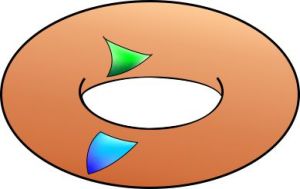
On a surface, for instance, you could draw a triangle using three straight lines.  If the figure’s interior angles sum up to exactly 180°, you’ve got a flat plane, zero intrinsic curvature.  On a sphere (“straight line” = “arc from a great circle”) or the outside rim of a doughnut, the sum is greater than 180° and the curvature is positive.
Circle curvatures
If there’s zero curvature and positive curvature, there’s gotta be negative curvature, right?  Right — you’ll get less-than-180° triangles on a Pringles chip or on the inside rim of a doughnut.

Some surfaces don’t have intersecting straight lines, but you can still classify their curvature by using a different criterion.  Visualize our snail gliding along the biggest “circle” he/she/it (with snails it’s complicated) can get to while tethered by a thread pinned to a point on the surface. Divide the circle’s circumference by the length of the thread.  If the ratio’s equal to 2π then the snail’s on flat ground.  If the ratio is bigger than ,  the critter’s on a saddle surface (negative curvature). If it’s smaller, then he/she/it has found positive curvature.

In a sense, we’re comparing the length of a periphery and a measure of what’s inside it.  That’s the sense in which Einsteinian space is curved — there are regions in which the area inside a circle (or the volume inside a sphere) is greater than or less than what would be expected from the size of its boundary.

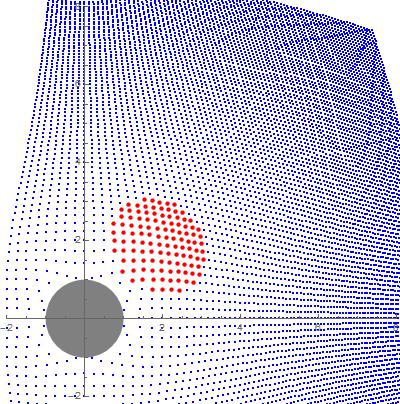
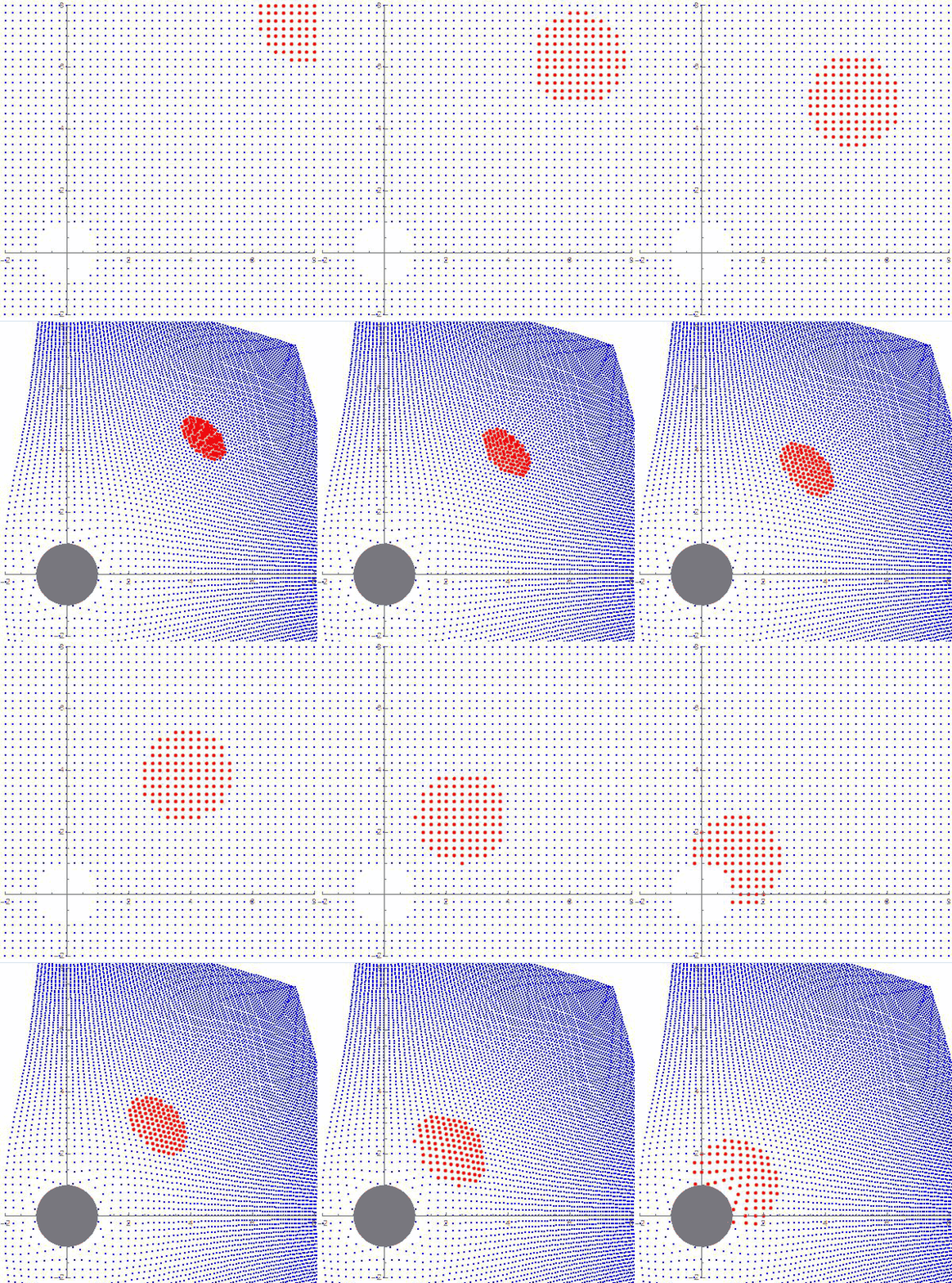
Here’s an example.  The upper panel’s dotted grid represents a simple flat space being traversed by a “disk.”  See how the disk’s location has no effect on its size or shape.  As a result, dividing its circumference by its radius always gives you 2π.Curvature 3

In the bottom panel I’ve transformed* the picture to represent space in the neighborhood of a black hole (the gray circle is its Event Horizon) as seen from a distance.  Close-up, every row of dots would appear straight.  However, from afar the disk’s apparent size and shape depend on where it is relative to the BH.

By the way, the disk is NOT “falling” into the BH.  This is about the shape of space itself — there’s no gravitational attraction or distortion by tidal spaghettification.

Visually, the disk appears to ooze down one of those famous 3D parabolic funnels.  But it doesn’t — all of this activity takes place within the BH’s equatorial plane, a completely 2D place.  The equations generate that visual effect by distorting space and changing the local distance scale near our massive object.  This particular distortion generates positive curvature — at 90% through the video, the disk’s C/r ratio is about 2% less than 2π.

As I tell Museum visitors, “miles are shorter near a black hole.”

~~ Rich Olcott

* – If you’re interested, here are the technical details.  A Schwarzchild BH, distances as multiples of the EH radius.  The disk (diameter 2.0) is depicted at successive time-free points in the BH equatorial plane.  The calculation uses Flamm’s paraboloid to convert each grid point’s local (r,φ) coordinates to (w,φ) to represent the spatial configuration as seen from r>>w.

The Shape of π and The Universe

pi
This square pi are rounded.

There’s no better way to celebrate 3/14/16 than chatting about how π is a mess but it’s connected to the shape of the Universe, all  while enjoying a nice piece of pie.  I’ll have a slice of that Neil Gaiman Country Apple, please.

The ancient Greeks didn’t quite know what to do about π.  For the Pythagoreans it transgressed a basic tenet of their religious faith — all numbers are supposed to be  integers or at least ratios of integers.  Alas for the faithful, π misbehaves.  The ratio of the circumference of a circle to its diameter just refuses to match the ratio of any pair of integers.

The best Archimedes could do about 250 BCE was determine that π is somewhere between 22/7 (0.04% too high) and 223/71 (0.024% too low).  These days we know of many different ways to calculate π exactly.  It’s just that each of them would take an infinite number of steps to come to a final result.  Nobody’s willing to wait that long, much less ante up the funding for that much computer time.  After all, most engineers are happy with 3.1416.

pi digitsNonetheless, mathematicians and cryptographers have forged ahead, calculating π to more than a trillion digits.  Here for your enjoyment are the 99 digits that come after digit million….

Why cryptographers ?  No-one has yet been able to prove it, but mathematicians are pretty sure that π’s digits are perfectly random.  If you’re given a starting sequence of decimal digits in π, you’ll be completely unable to predict which of the ten possible digits will be the next one.  Cryptographers love random numbers and they’re in π for the picking.


Another π-problem the Greeks gave us was in Euclid’s Geometry.  Euclid did a great job of demonstrating Geometry as an axiomatic system.  He built his system so well that everyone used it for millennia.  The problem was in his Fifth Postulate.  It claimed that parallel lines never meet, or equivalently, that the angles in every triangle add up to 180o.

Neither “fact” is necessarily true and Euclid knew that — he’d even written a treatise (Phaenomena) that used spherical geometry for astronomical calculations.  On our sweetly spherical Earth, a narwhale can swim a mile straight south from the North Pole, turn left and swim straight east for a mile, then turn left again and swim north a mile to get back to the Pole.  That’s a 90o+90o+90o=270o triangle no problem.  Euclid’s 180o rule works only on a flat plane.

cap areaBack to π.  The Greeks knew that the circumference of a circle (c) divided by its diameter (d) is π.  Furthermore they knew that a circle’s area divided by the square of its radius (r) is also π. Euclid was too smart to try calculating the area of the visible sky in his astronomical work.  He had two reasons — he didn’t know the radius of the horizon, and he didn’t know the height of the sky.  Later geometers worked out the area of such a spherical cap.  I was pleased to learn that π is the ratio of the cap’s area to the square of its chord, s2=r2+h2.

The Greeks never had to worry about that formula while figuring our how many tiles to buy for a circular temple floor.  The Earth’s curvature is so small that h is negligible relative to r.  Plain old πr2 works just fine.

CurvaturesAstrophysicists and cosmologists look at much bigger figures, ones so large that curvature has to be figured in.  There are three possibilities

  • Positive curvature, which you get when there’s more growth at the center than at the edges (balloons and waistlines)
  • Zero curvature, flatness, where things expand at the same rate everywhere
  • Negative curvature, which you get when most of the growth is at the edges (curly-leaf lettuce or a pleated skirt)

Near as the astronomers can measure, the overall curvature of the Universe is at most 10-120.  That positive but miniscule value surprised everyone because on theoretical grounds they’d expected a large positive value.  In 1980 Alan Guth explained the flatness by proposing his Inflationary Universe theory.  Dark energy may well  figure into what’s happening, but that’s another story.

Oh, that was tasty pie.

~~ Rich Olcott