Five More Alternate Universes?

I unlock my office door and there’s Vinnie inside, looking out the window. “Your 12th‑floor view’s pretty nice, Sy. From above the tree tops you can see leaf buds just starting to show their early green colors.”

“What are you doing here, Vinnie? I thought you were charter‑flying to Vancouver.”

“The guy canceled. Said with all the on‑again, off‑again tariffs there’s no sense traveling to make a deal when he doesn’t know what he’s dealing with. So I got some time to think.”

“And you came here so it’s something physics‑technical.”

“Yeah, some. I notice colors a lot when I’m flying. Some of those trees down there this time of year are exactly the same bright yellow‑green as some of the rice paddies I’ve flown over. But all the trees get the same hard dark green by August before they go every different color when the chlorophyll fades away.”

I’ve noticed that. So you came here to talk about spectra?”

“Some other time. This time I want to talk about dark matter.”

“But we call it dark matter precisely because it doesn’t do light. All our normal matter is made of atoms and the atoms are made of electrons and nuclei and each nucleus is made of protons and neutrons and protons and neutrons are made of quarks. Electrons and quarks carry electrical charge. Anything with electrical charge is subject to electromagnetism, one way or another. Dark matter doesn’t notice electromagnetism. If dark matter had even the slightest interaction with light’s electromagnetic field, we wouldn’t be able to see galaxies billions of lightyears away.”

“Calm down, Sy, breath a couple times. Stay with me here. From your stuff and what else I’ve read, all we know about dark matter is a lot of things it isn’t or doesn’t do. The only force we know it respects is gravity so it attracts itself and also normal matter and they all clump up to make galaxies and such, right?”

<a bit reluctantly and on a rising note> “Mm‑hnn…?”

“I read your three‑part series about the Bullet Cluster, where we think two galaxy clusters went though each other and their gas clouds gave off a lot of X‑rays that didn’t match where the stars were or where the gravity was so the astronomers blame dark matter for the gravity, right?”

“That’s pretty much it. So?”

“So the other thing I got from that series was maybe there’s friction between dark matter and other dark matter, like it doesn’t just slide past itself. If dark matter is particles, maybe they’re sorta sticky and don’t bounce off each other like billiard balls. That doesn’t make sense if all they do is gravity.”

“I see where you’re going. You’re thinking that maybe dark matter feels some kind of force that’s not gravity or electromagnetism.”

“That’s it! We’ve got light photons carrying electromagnetic forces to hold our molecules and rocks together. Could there be dark photons carrying some dark‑sticky force to connect up dark molecules and dark rocks and stuff?”

“That’s an interesting—”

“I ain’t done yet, Sy. It gets better. I’ve read a bunch of articles saying there’s about five times as much dark matter in the Universe as normal matter. You physicists love symmetry, suppose it’s exactly five times as much. There’d be six kinds of force, one called electromagnetism and a different snooty force each for five kinds of dark matter and that’ll add up to the 25% we can’t see. Like, a purple dark force for purple dark rocks, naturally they’re not really purple, and a yellow dark force and so on.”

“You’re proposing that each kind of dark matter responds only to its own special force, so no cross‑communication?”

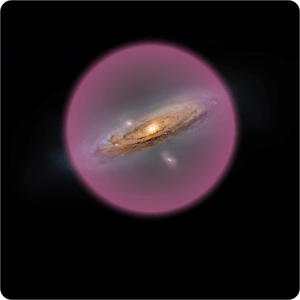
“Yup, gravity’s the only thing they’d all agree on. That bein’ the case, the galaxies would hold six times as many stars as we think, except 5/6 of them are invisible to our 1/6. Five alternate universes sharing space with ours. Cozy, huh?”

“Clever, Vinnie, except for the evidence that most galaxies are embedded in huge nearly‑spherical halos of dark matter. The halos would have collapsed long ago if only gravity and stickiness were in play.”

“Dang.”

~ Rich Olcott
The Hacker’s Rap

  • And now for something completely different…

 <click>  <click>  <click>  <click>
So your Mac’s gone splat?
 Well how ’bout that?
Now baby, don’t you panic.
By the light of my screen
You’ll be in a different scene
When I’ve made ME your data mechanic.

 <click>

You think you got secrets?
 You ain’t met me yet.
I’m on a roll,
 you’ve lost control
An’ there ain’t no RESET.
Ethics ain’t my style.
Nasty makes me smile:
You’re in a jam
 ’cause I’ve got a plan
For your personal keyset.
Might as well resign, dear,
Your system’s mine, that’s clear,
Yeah, my attack
 does not hold back
  It’ll feel like a cardiac
    hack,
      Jack,
‘Cause I’m a HACKER!
Ain’t no mush-head slacker.
I can mess your metal mind an’ that’s a fact, son!
Check this action:
If I feel a dejection
  Because of a rejection,
 I can make a selection
 From my collection,
 Set up a connection
 And you’ll get a digital infection
  That defies detection
  Or correction.
 Virus inspection
  Ain’t no protection
 And your objection
 Confirms my direction
 And amplifies my —

        satisfection.

‘Cause I’m a HACKER!
I got tons of tricks in my pack here.
Ain’t no food in the freezer?
No problem, man – I can download pizza.
 Can’t touch this, eithah
  cause it’s a virtual pizza!

You run Windows?
 You’ll hear the wind blow.
You run iOS?
 Say “Bye-bye,” oh yes.
You run Chrome?
 Won’t be no-one home.
You run Android?
 I’ll hit you like an asteroid.
You run Linux?
 You’ll feel the force of my
   mimic gimmicks.
Go on, run to a mainframe —
 You’ll still be in my pain game.
You feel safe in the cloud somewhere?
 You’re right in front of my easy chair.

‘Cause I’m a HACKER!
I POP <click> I FIZZ
 when I find what ROOT’s password is.
I SMILE <click> I GRIN <click>
 I sack the system that lets me in.
Things SPIN <click> Things SPARK <click>
 And suddenly your screen goes dark —
A sadder but wiser LAN you’ll be
‘Cause I am
 TROUBLE
 with a capital T
 and that rhymes with C
 and that stands for
  <click>  <click>  <click>  <click>
   CLICK

~ Rich Olcott


12345 and 8 and 2025

Okay, I’ve got this thing about prime numbers. Some people get all woozy for holiday music as December marches along, but the turning of the year puts me into numeric mode. I’ve done year‑end posts about the special properties of the integer 2016 and integers made up of 3s and 7s. (Sheldon Cooper’s favorite, 73, is just part of an interesting crowd.)

I looked up “2025” in the On-line Encyclopedia of Integer Sequences (the OED of numbers). That number is involved in 1028 different series or families. Sequence A016754, the Central Octagonal Numbers, has some fun visuals. Draw a dot. Then draw eight dots symmetrically around it. You have nine dots. Nine is O2, the second Central Octagonal Number (an octagon enclosing a center, such a surprise). It’s ‘second‘ after O1=1, for that first dot. Now draw another octagon of dots around the core you started, but with two dots on each side. Those 16 dots plus the 9 inside make 25, so O3=25. An octagon with three dots on each side has 24 dots so O4 is 1+8+16+24=49 (see the figure). And so on. If you do the arithmetic, you’ll find that O22, the 22nd Central Octagonal Number, is 2025. Its visual has 22 rings (including the central dot), 168 dots in its outermost ring, for 2025 dots in all.

In case you’re wondering, there is a non-centered series of octagonal numbers that grow out of a dot placed at a vertex of a starter octagon. 2025 isn’t in that series. See the hexagon equivalent in my 2015 post.

Sadly, 2025 isn’t a prime year. Prime‑number years, 2003 and 2011 for example, can be evenly divided by no integer other themselves (and one, of course). 2017 was a prime year, but we won’t see another until 2027. Leap year numbers are divisible by 4 so they can’t ever be prime. That property disqualified 2020 and 2024. It’ll do the same for 2028 and 2032.

Two primes that are as close together as possible, separated only by a single (necessarily even) number, are called twins. There were no twin‑prime years in the 700s, the 900s or the 1500s. The thirteen prime years in the twenty‑first century include three sets of twins, 2027‑2029, 2081‑2083 and 2087‑2089.

If a number’s not prime, then it must be divisible by at least two factors other than itself and one. 2018 and 2019, for example, each have just two factors (2×1009 and 3×673, respectively). Numbers could have more factors, naturally — 2010 is 2×3×5×67 and 2030 is 2×5×7×29, four factors each.

A single factor could be used multiple times — 2024 is 2×2×2×11×23, also written as 23×11×23, for a total of 5 factors. We’re just entering a 6‑factor year (see below) but a formidable factor‑champion is on the horizon. Computer geeks may be particularly fond of the year 2048, known in the trade as 2k (not to be confused with Y2K). The number 2048 has eleven factors, more than any year number of last or this millennium. 2048 is 211, the result of eleven 2s multiplied together. Change just one of those 2s to a 3 and you have 3072 which is a long time from now.

So anyhow, I was poking at 2025, just seeing what was in there. The 5 at the tail‑end is a dead give‑away non‑prime‑wise because the only prime that ends in a 5 is … 5. Another useful trick – add up the digits. If the sum is divisible by 3, so is the number. If the sum is divisible by 9 so is the number. Easy to figure 2+0+2+5=9, so two easy ways to know that 2025‘s not prime.

By the time I got done breaking the number down into all six of its factors, look what a pretty pattern appeared:

Finally, 2025 appears 8 times in this post’s text. Happy New Year.

~~ Rich Olcott

Behold, a square?

It’s been a while since I heard that footstep in the hall outside my office. “Door’s open, Vinnie, c’mon in.”

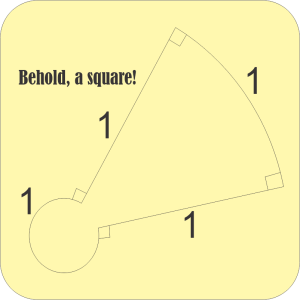
“Hi, Sy. Brought you a thing.” <lays a card on my desk> “So the question is, how is this a square?”

“Is this another puzzle you got from Larry?”

“Yeah. He said you could ‘splain it.”

“Well, the idea’s clear — four right angles, four equal sides, sounds square-ish to me.”

“Yeah, but is the picture lying to us the way that other one did?”

“Fair question. Let’s see whether we can construct it with some real numbers. Both of those arcs seem to be parts of concentric circles so I’ll assume that.” <drawing on card> “The one that’s most of a circle has a radius I’ll call r.”

“You’re gonna do equations, ain’t you? You know I hate equations.”

“You asked the question. Bear with me, this won’t take long. Those two straight lines seem to run radially out from the almost‑circle’s center. I’ll call the angle between them a. By the way, if the lines are indeed radial then we’re guaranteed that all four of those ‘right angle’ markers are truthful. Any radius meets its circumference in a right angle, right?”

“Learned that in Geometry class.”

“I certainly hope so. Okay, the radius of the outer arc is 1 plus the radius of the inner arc so the length of the outer arc is the angle times that or a(1+r) —”

“Wait, where did that come from? You can’t just multiply the angle and radius together like that.”

“Sure you can. What’s the formula for a circle’s circumference?”

2πr.”

“Which is an angle, , times the radius.”

“How is an angle? Should be 360°.”

“It’s like feet and meters ‑ same value, different units. Physicists like radians. 180° is π radians and the length of a semicircle is πr. Other arcs work the same way. It’s perfectly legal to multiply angle and radius if you express the angle in radians. So that outer arc length is a(1+r) and that’s 1 according to the diagram. Are you with me?”

“I suppose.”

“Now for the almost‑circle. Its angle is minus that bit that got stretched out. Are we agreed that the arc length is (2π-a)r?”

“And that’s also 1.”

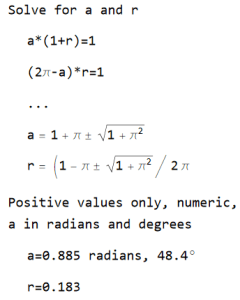
“Right. So we have two unknowns a and r, and two equations to settle them with: a(1+r)=1 and (2π-a)r=1. Simple high school algebra but I’ll spare you the pain and just ask Old Reliable for the result.”

“Thank you.”

“So there’s your answer. Yes, the keyhole figure can be truthful if the angle is 48.4° and the sticky‑out part is about 5½ times longer than the almost‑circle’s radius. Any other angle or radius and the diagram’s wrong. Happy?”

“Yeah.” <quiet moment> “Hey, I just figured out a different way. The latitude lines and longitude lines always cross at right angles, right?”

“Right.”

“So you could do a keyhole ‘square’ on the Earth, right? Circle the North Pole at some latitude, except take a detour straight south, then straight west for a while, then straight back north just in time to meet your part‑circle’s starting point. I’ve flown crazy routes a little like that but that’s always been point‑to‑point. How do you from‑scratch figure something like that so that all the sides are the same length?”

“Whoa, that’s a much harder problem. You’re flying over Earth’s surface so r is constant but now you’ve got two angular variables, latitude and longitude. The north‑south tracks are pretty straight‑forward — you’re good if one starts at the same latitude the other stops at. The tough part is how to split the 360° of longitude between the two east‑west tracks so that the southern arc is the same length as the northern one and they both match the north‑south distance which depends on the start‑stop latitudes. That’s not quadratic equations any more, we’re looking at transcendental equations involving trig functions. There may not be a closed‑form solution. To get those angles we’d need a load of computer time doing successive approximations toward a numerical solution. Surely keyhole‑square routes exist but they’re well‑hidden.”

“Regular squares’re much easier. Colorado or Wyoming’d be no problem.”

~~ Rich Olcott

Not Enough Monkeys

“Morning, Sy. You see the news about the Infinite Monkey thing?”

“No, Cal, with everything else going on I seem to have missed that.”

“Understandable. I only heard about it from a ‘lighter side of the news’ piece on the radio. Something about disproving what everybody used to believe. You wrote about it a while ago, didn’t you?”

“Mm-hm. Did a lot of arithmetic for that one. The idea is that if you somehow managed to get an infinite number of monkeys banging away on typewriters, sooner or later one of them would produce the complete works of Shakespeare. The piece I did, gee, years ago, used Terry Pratchett’s idea of a library that contains all the books that have been written, all those that will be written, and all those that would have been written but the author thought better of it. I asked, how big is that library?”

“That’s gotta be a lot of books. Here’s your coffee.”

“Thanks. I guessed maybe a billion, maximum. The Library of Congress has only 30‑some million, last I looked, and that’s real books. Anyhow, I decided to compare that to the number of possible books, printed up using some configuration of 500 characters.”

“500? What else besides ‘a, b, c‘?”

“Upper case, lower case, blanks, punctuation, math symbols, alphabets from other languages, whatever. No pictographic systems like Japanese kanji and Chinese but you can’t have everything. I defined ‘possible book’ as 500 pages, 4000 characters per page so two million per book.”

“All my books are shorter than that and they don’t scramble alphabets from different languages.”

“Short books you could pad to 500 characters with blanks at the end. Some of the experimental fanfic I’ve seen is pretty creative. At any rate, I calculated 5002,000,000 = 105,397,940 different possible books. Limit the library to 250 pages and 100 characters in, say, Spanish with no math that’d be 1001,000,000 = 102,000,000 different possible books, which is still huge, right?”

“My calculator doesn’t do numbers up in the air like that. I’ll believe you, it’s a big number. So where are you going with this?”

“So even a billion‑book library would be swamped by the other 105,397,931 books in an all‑possible‑books library. My point in that old post was that the monkeys could indeed type up Shakespeare but you wouldn’t be able to find it in the welter of absolute nonsense books.”

“Looks good to me, so what’d these guys prove?”

“Dunno, haven’t seen their paper yet. Give me a minute with Old Reliable … Ah, here it is, ‘A numerical evaluation of the Finite Monkeys Theorem by Woodcock and Falletta. Aand it’s not paywalled!” <reading> “Wait, finite — that’s different.”

“How’s it different? Arithmetic’s arithmetic, right?”

“Until you get into infinities. True infinity operates differently than ‘large beyond anything we can measure’. I highlighted the difference in a tech note I wrote a few years ago. How would you bet if someone suggested there’s an exact duplicate Earth existing somewhere else in the Universe?”

“That’s what that goofy ‘Everything Everywhere’ movie was all about, right? Multiverses?”

“Mmm, no, the bet’s about only in our Universe.”

“Knowing you, I’d stay out of the betting.”

“Wise choice. The right answer is ‘It depends’. I calculated that there could be 1.54×10154 possible Earths with exactly the same atom count that we have, just arranged differently, maybe swap one nickel atom with one iron atom inside a hematite rock. So 1.54×10154 chances for an identical copy of you. If the Universe is infinite, then you’re guaranteed to have not just one, but an infinite number of identical copies, each of whom thinks they’re the only you.”

“That’s comforting, somehow.”

“On the other hand, if the Universe is finite, then the planet creation process would have to run through something like 10150 creations before it had a good shot at re‑making you. Vanishingly small odds.”

“So what’s this got to do with finite monkeys?”

“Woodcock and Falletta maintain that there’s only a limited number of monkeys and they’re time‑constrained. Under those conditions, there’s vanishingly small odds for Shakespeare or even the word ‘bananas’.”

~ Rich Olcott

The Importance of Saving Data

  • A repost from 8 years ago, but it’s become timely again. Eight years ago my concern was data related to Public Health and animal welfare. Subsequent event proved that concern was well‑founded. This time around the climate and Public Health issues are still with us but the likelihood of ideological meddling spreads much more broadly, to research related to psychoactives, guns, citizenship status and more. Forewarned is forearmed.

Sorry, but I’ve got to break into my normal Monday-morning stream to spread this around.  It’s a ProPublica document (click on the link to pull down a copy) detailing safe ways to leak information.

When I first heard about the data-stashing “parties” I thought it was something of an over-reaction.  Climate scientists and students organizing a massive effort to copy important data out of government files in case the new Administration decided to cover it all up somehow.

I’ve changed my mind.

What changed it was USDA’s suddenly blocking access to their animal welfare database, the one that keeps inspection records on research labs, companies, zoos, circuses, and animal transporters and how well they adhere to the Animal Welfare Act.

The agency said in a statement that it revoked public access to the reports “based on our commitment to being transparent …”  Being transparent by blocking information — there’s a certain Orwellian flavor to that, but it gets better.

I followed this article‘s link to see the original statement.  Well, I tried to follow it.  FireFox flat-out refused to show me the page because “Your connection is not secure. The owner of acis.aphis.educ.usda.gov has configured their website improperly.”  The error code was “SEC_ERROR_UNKNOWN_ISSUER.” Funny that an official .gov site mucked up its security certificate.

Then I tried Microsoft’s  edge browser, which has less alert security than my beefed-up FireFox.  edge showed me an imposing and somewhat threatening USDA e-Login page including the statements that “Unauthorized or improper use of this system may result in disciplinary action, as well as civil and criminal penalties…. You have no reasonable expectation of privacy regarding any communications or data transiting or stored on this information system…. Your consent is final and irrevocable…

disappearing-lorem-ipsum

All this before Mr Sonny Perdue III is confirmed as the new Secretary of Agriculture. That name rings a bell, right?  Yeah, Perdue Farms, the country’s #3 poultry farmer. It’s hard not to connect dots to the Department suddenly wanting to hide farm inspection records.

So, it’s now pretty clear that we can expect other government-funded databases to disappear without warning, especially databases even remotely related to climate change, drug safety, water supply degradation, … you know, the things that there are regulations about that get in the way when your object is to maximize profits.

So — if you’re in science and you have possession of or access to data (databases, files, whatever) that might be in jeopardy

  1. Get it to an offsite and secure backup ASAP
  2. When/if it becomes clear that your or the public’s access to that data is about to be restricted, take one or more of the actions laid out in the ProPublica document.

Sometimes it’s rational to be paranoid.

~~ Rich Olcott

Mushy stuff

“Amanda! Amanda! Amanda!”

“All right, everyone, settle down for our final Crazy Theorist. Jim, you’re up.”

“Thanks, Cathleen. To be honest I’m a little uncomfortable because what I’ve prepared looks like a follow-on to Newt’s idea but we didn’t plan it that way. This is about something I’ve been puzzling over. Like Newt said, black holes have mass, which is what everyone pays attention to, and charge, which is mostly unimportant, and spin. Spin’s what I’ve been pondering. We’ve all got this picture of a perfect black sphere, so how do we know it’s spinning?”

Voice from the back of the room — “Maybe it’s got lumps or something on it.”

“Nope. The No-hair Theorem says the event horizon is mathematically smooth, no distinguishing marks or tattoos. Question, Jeremy?”

“Yessir. Suppose an asteroid or something falls in. Time dilation makes it look like it’s going slower and slower as it gets close to the event horizon, right? Wouldn’t the stuck asteroid be a marker to track the black hole’s rotation?”

“Excellent question.” <Several of Jeremy’s groupies go, “Oooh.”> “Two things to pay attention to here. First, if we can see the asteroid, it’s not yet inside the horizon so it wouldn’t be a direct marker. Beyond that, the hole’s rotation drags nearby spacetime around with it in the ergosphere, that pumpkin‑shaped region surrounding the event horizon except at the rotational poles. As soon as the asteroid penetrates the ergosphere it gets dragged along. From our perspective the asteroid spirals in instead of dropping straight. What with time dilation, if the hole’s spinning fast enough we could even see multiple images of the same asteroid at different levels approaching the horizon.”

Jeremy and all his groupies go, “Oooh.”

“Anyhow, astronomical observation has given us lots of evidence that black holes do spin. I’ve been pondering what’s spinning in there. Most people seem to think that once an object crosses the event horizon it becomes quantum mush. There’d be this great mass of mush spinning like a ball. In fact, that was Schwarzchild’s model for his non-rotating black hole — a simple sphere of incompressible fluid that has the same density throughout, even at the central singularity.”

VBOR — “Boring!”

“Well yeah, but it might be correct, especially if spaghettification and the Firewall act to grind everything down to subatomic particles on the way in. But I got a different idea when I started thinking about what happened to those two black holes that LIGO heard collide in 2015. It just didn’t seem reasonable that both of those objects, each dozens of solar masses in size, would get mushed in the few seconds it took to collide. Question, Vinnie?”

“Yeah, nice talk so far. Hey, Sy and me, we talked a while ago about you can’t have a black hole inside another black hole, right, Sy?”

“That’s not quite what I said, Vinnie. What I proved was that after two black holes collide they can’t both still be black holes inside the big one. That’s different and I don’t think that’s where Jim’s going with this.”

“Right, Mr Moire. I’m not claiming that our two colliders retain their black hole identities. My crazy theory is that each one persists as a high‑density nubbin in an ocean of mush and the nubbins continue to orbit in there as gravity propels them towards the singularity.”

VBOR —”Orbit? Like they just keep that dance going after the collision?”

“Sure. What we can see of their collision is an interaction between the two event horizons and all the external structures. From the outside, we’d see a large part of each object’s mass eternally inbound, locked into the time dilation just above the joined horizon. From the infalling mass perspective, though, the nubbins are still far apart. They collide farther in and farther into the future. The event horizon collision is in their past, and each nubbin still has a lot of angular momentum to stir into the mush. Spin is stirred-up mush.”

Cathleen’s back at the mic. “Well, there you have it. Amanda’s male-pattern baldness theory, Newt’s hyper‑planetary gear, Kareem’s purple snowball or Jim’s mush. Who wins the Ceremonial Broom?”

The claque responds — “Amanda! Amanda! Amanda!”

~ Rich Olcott

A Big Purple Snowball

Cathleen’s back at the mic. “Okay, folks, now for the third speaker in tonight’s Crazy Theory seminar. Kareem, you have the floor.”

“Thanks, Cathleen. Some of you already know I do old‑rock geology. If a rock has a bone in it, I’m not interested. Paleontology to me is like reading this morning’s newspaper. So let me take you back to Precambrian times when Earth may have been purple.”

Kareem’s a quiet guy but he’s got the story‑teller’s gift, probably honed it at field expedition campfires, so we all settle back to listen.

“Four and a half billion years ago, Earth was bright orange. That’s not the color it reflected, that’s the color it glowed. You’ve all seen glass‑blowers at work, how the material gives off a bright orange light coming out of the flame or furnace, soft and ready to be formed. That’s what the planet’s surface was like after its Moon‑birthing collision with Theia. Collisions like that release so much heat that there’s no rocks, just layers of smooth molten glassy slag floating on fluid silicates and nickel‑iron like in a blast furnace. No atmosphere, all the volatiles have been boiled off into space. Got the picture?”

General nodding, especially from maybe‑an‑Art‑major who’s good at pictures.

“Time passes. Heat radiating away cools the world from the outside inward. Now the surface is a thin glassy cap, black like obsidian and basalt, mostly smooth. The cooling contracting cap fractures from the tension while the shrinking interior pulls inward, slow but not gentle. The black glassy surface becomes low craggy mountains and razor‑rubble, sharp enough to slice hiking boots to ribbons. There’s no erosive wind or water yet to round things off. Everything stays sharp‑edged.”

Voice from the back of the room — “Where’s our water from then?”

“Good question. Could be buried water that never got the chance to escape past the cap, could be water ferried in on icy comets or worldlets. People argue about it and I’m not taking sides. The planet gets a new color after it cools enough to hold onto water molecules however they got there — but that water doesn’t stay on the surface. Raindrops hitting still‑hot rock hiss back into steamy clouds. If you were on the moon at the time you’d see a white‑and‑grey Earth like Jupiter’s curdled cloud-tops. Visualize a series of million‑year Hurricane Debbies, all over the world.”

He pauses to let that sink in.

“When things finally cool down enough to allow surface water there’s oceans, but they’re not blue. Millions of years of wind and water erosion have ground the sharp rubble to spiky dust. Most of the thrust‑raised mountains, too. Much of the dust is suspended or dissolved in the ocean turning it black. For a while. The dust is loaded with minerals, especially sulfides, very nutritious for a group of not‑quite bacteria called Archaea that eat sulfides using a molecule that’s powered by green light but reflects red and blue. When the Archaea take over, the oceans look magenta from the reflected red and blue.”

Maybe‑an‑Art‑major giggles.

“Next major event, we think, was the Huronian Glaciation, when most or all of the Earth was a solid white because it was covered with ice. Killed off most or the Archaea. When that melted, different parts of the ocean turned black from floating dead Archaea and and then milky turquoise from sulfur particles. Next stage was purple, from a different group of sulfur‑eating purple almost‑bacteria. Then we had snowball whiteness again, which gave green‑reflecting chlorophyll‑users a chance to take over, clear our the sulfur and leave the oceans blue.”

VBOR — “That’s your Crazy Theory?”

“No, that’s mostly mainstream. Question is, what terminated the deepfreezes? Lots of ideas out there — solar dimming and brightening, different combinations of CO2 and methane from volcanoes or bacteria, even meteorites. Anyone remember Ian Malcom’s repeated line in the Jurassic Park movies?”

Everyone — “Life will find a way!”

“Right on. My crazy’s about the two almost‑bacteria. Suppose each kind managed to infiltrate their day’s Great Extinction glaciers. Suppose planet‑wide bacterial purple pigments absorbed sunlight’s energy, melting the ice. Karma, yes?”

~ Rich Olcott

A Great Big Mesh

Cal has my coffee mug filled as soon as I step into his shop. “Get to the back room quick, Sy. Cathleen’s got another Crazy Theories seminar going back there.”

So I do. First thing I hear is Amanda finishing her turn at the mic. “And that’s why humans evolved male pattern baldness.”

A furor of “Amanda! Amanda! Amanda!” then Cathleen regains control. “Thank you, Amanda. Next up — Newt Barnes. What’s your Crazy Theory, Newt?”

“Crazy idea, not a theory, but I like it. Everybody’s heard of black holes, right?”

<general nodding>

“And we’ve all heard that nothing can leave a black hole, not even light.”

<more nodding>

“Well in fact that’s mostly not true. There’s so much confusion about black holes. We’ve known about a black hole’s event horizon and its internal mass since the 1920s. It took years for us to realize that the central mass could wrap a shiny accretion disk around itself, and an ergosphere, and maybe spit out jets. So, close outside the Event Horizon there’s a lot of light‑emitting structure, right?”

<A bit less nodding, but still.>

“Right. So I’ll skip in past a few controversial layers and get down to the famously black event horizon. Why’s it black?”

Voice from the back of the room — “Because photons can’t get out because escape velocity’s faster than lightspeed.”

“That’s the answer I expected, but it’s also one of the confusing parts. You’re right, the horizon marks the level where outward‑bound massy particles can’t escape. The escape velocity equation depends on trading off kinetic and gravitational potential energy. Any particle with mass would have to convert an impossible amount of kinetic energy into gravitational potential energy to get through the barrier. But zero‑mass particles, photons and such, are pure kinetic energy. They aren’t bound by a gravitational potential so escape velocity trade‑offs simply don’t apply. There’s a deeper reason photons also can’t get out.”

VBOR — “So what’s trapping them?”

“Time. It traps photons and any kind of information. The other thing about the Event Horizon is, it’s the level where spacetime is so bent around that the time‑coordinate is just on the verge of pointing inward. Once you’re inside that boundary the cause‑and‑effect arrow of time is against you. Whatever direction you point your flashlight, its beam will emerge in your future and that’s away from the horizon. Trying to send a signal outside would be like sending it into your past, which you can’t do. Nothing gets away from a black hole except…”

“Except?”

“Roger Penrose found a loophole and I may have found another one. There’s something that Wheeler called the No-Hair Theorem. It says that the Event Horizon hides everything inside it except for its mass, electric charge and angular momentum.”

“How do those get out?”

“They don’t get out so much as serve as backdrop for all the drama in the rest of the structure. If you know the mass, for instance, you can calculate its temperature and the Horizon’s diameter and a collection of other properties.”

Cathleen senses a teachable moment and breaks in. “Talk about charge and spin, Newt.”

“I was going there, Cathleen. Kerr and company’s equations take account of both of those. Turns out the attractive forces between opposite charges are so much stronger than gravity that it’s hard for an object in space to build up a significant amount of either kind of charge without getting neutralized almost immediately. Kind of ironic that the Coulomb force, far stronger than gravity, generates net energy contributions that are much smaller than the gravity‑based ones. Spin, though, that’s where the loopholes are. Penrose figured out how particles from the accretion disk could dip into the black hole’s spinning ergosphere, steal some of its energy, and stream up to power the jets.”

VBOR — “What’s your loophole then?”

“Speed contrast between layers. The black hole mass is spinning at a great rate, dragging nearby spacetime and the ergosphere and the accretion disk around with it. But the layers go slower as you move outward. Station a turbine generator like an idler gear between any two layers and you’re pulling power from the black hole’s spin.”

Silence … then, “Amanda! Amanda! Amanda!”

~ Rich Olcott

A.I. and The Ouroboros Effect

The Acme Building Science and Pizza Society is meeting again around the big table near the kitchen in Eddie’s Pizza Place. It’s my deal so I set the next topic. “Artificial Intelligence.” There’s some muttering but play starts.

Cal has first honors. “Not my favorite thing. I hadda change my name ’cause of A.I., f’crying out loud.”

Eddie antes up a chip. “But Cal, your astronomy magazines are loaded with new discoveries that some A.I. made rummaging through godzillabytes of big telescope data. Train an A.I. on a few thousand normal galaxies and then let it chase through the godzillabytes. It says ‘Here’s a weird one‘ and the human team gets to publish papers about a square galaxy or something.”

Susan chips in. “What about all the people who’ve been saved from cancer because an A.I. found bad cells while screening histology images?”

Kareem folds. “Not much A.I. in Geology yet. Our biggest Big Data project these days is whole‑Earth tomography. That uses pretty much all the computer time we can get funds for. A.I.’s Large Language Models soak up all the research money.”

Vinnie raises by a chip. “I use autopilot a lot when I’m flying, but that’s up in the air, Great Circle point‑to‑point and no worries about pedestrian traffic. Autopilot in a car? Not for me, thanks — too many variables and I’ve seen too many crazy situations you couldn’t predict. Black ice in the winter, roadwork and bicyclists the rest of the year — I want to be able to steer and brake when I need to.”

Susan grins. “Are you a stick‑shift purist, Vinnie?”

“Naw, automatic transmissions are okay these days and besides my car uses electric motors and doesn’t even have a transmission. Lots of torque at low revs and that’s the way I like it. What about you, Cathleen? Got any A.I. war stories?”

Cathleen calls Vinnie’s raise. “A few. One thing I’ve learned — chatbots have a limited working memory. I once asked a bot to list Jupiter’s 35 biggest moons in decreasing order of size. It got the first 24 in the right order, then some more moons out of order and two of them were moons of Saturn. So ‘trust but verify‘ like the man said. Sy, you do a lot of writing. What’s your experience?”

I call Cathleen’s raise. “Mixed. I’m a generalist so I have to read a lot of papers or at least be aware of them. Summarizer bots do a decent job on some reports but miss badly when it comes to tying together material that’s not already well organized. Probably comes from that working memory limitation you noticed, Cathleen. The other problem I’ve seen doesn’t apply so much to technical work but it’s a killer for essays and fiction that have anything to do with interactions between people.”

“I’ve seen that, too. No soul.”

“Soul’s the word I’ve been looking for, Kareem. The bots are good at picking up styles and ‘who said what‘ surface material, but they fail completely at emotional subtext, the ‘why‘ that’s the actual thread of a conversation. Subtext is why we read good novels. From what I’ve been seeing recently, it’s not going to get any better.”

“Nothing does, I’m starting to think.”

“C’mon, Cal, your coffee’s improved since the city put in better water pipes. On the other hand, you owe the pot a bet.”

“Sorry. I’m still in, okay?” <sound of chips clinking> “So why’s A.I. not gonna get better? I keep reading how different ones passed tougher tests.”

“Well, that’s the thing. If you’re reading about it online, the bots are, too. What they read goes into their training database. Those impressive test scores may just be the result of inadvertent cheating — but the software’s so opaque that its developers simply don’t know whether or not that’s true. Just another case of the Ouroboros Effect.”

Eddie and Susan meet Cal’s bet, then Vinnie goes all‑in and shows his three queens. “Ouroboros, Sy?”

“The Norse World Snake that eats its tail. Bogus A.I.‑generated output used as A.I. input yields worse output. That’s a loss, not a gain. Unlike here where my four kings take the pot.”

“Geez, Sy, again?”

~~ Rich Olcott