Three Feet High And Rising

“Bless you, Al, for your air conditioning and your iced coffee.”

“Hiya, Susan. Yeah, you guys do look a little warm. What’ll you have, Sy and Mr Feder?”

“Just my usual mug of mud, Al, and a strawberry scone. Put Susan’s and my orders on Mr Feder’s tab, he’s been asking us questions.”

“Oh? Well, I suppose, but in that case I get another question. Cold brew for me, Al, with ice and put a shot of vanilla in there.”

“So what’s your question?”

“Is sea level rising or not? I got this cousin he keeps sending me proofs it ain’t but I’m reading how NYC’s talking big bucks to build sea walls around Manhattan and everything. Sounds like a big boondoggle.” <pulling a crumpled piece of paper from his pocket and smoothing it out a little> “Here’s something he’s sent me a couple times.”

“That’s bogus, Mr Feder. They don’t tell us moon phase or time of day for either photo. We can’t evaluate the claim without that information. The 28‑day lunar tidal cycle and the 24‑hour solar cycle can reinforce or cancel each other. Either picture could be a spring tide or a neap tide or anything in‑between. That’s a difference of two meters or more.”

“Sy. the meme’s own pictures belie its claim. Look close at the base of the tower. The water in the new picture covers that sloping part of the base that was completely above the surface in the old photo. A zero centimeter rise, my left foot.”

“Good point, Susan. Mind if I join the conversation from a geologist’s perspective? And yes, we have lots of independent data sources that show sea levels are rising in general.”

“Dive right in, Kareem, but I thought you were an old‑rocks guy.”

“I am, but I study old rocks to learn about the rise and fall of land masses. Sea level variation is an important part of that story. It’s way more complicated than what that photo pretends to deny.”

“Okay, I get that tides go up and down so you average ’em out over a day, right? What’s so hard?”

“Your average will be invalid two weeks later, Mr Feder, like Sy said. To suppress the the Sun’s and Moon’s cyclic variations you’d have to take data for a full year, at least, although a decade would be better.”

“I thought they went like clockwork.”

“They do, mostly, but the Earth doesn’t. There’s several kinds of wobbles, a few of which may recently have changed because Eurasia weighs less.”

“Huh?”
 ”Huh?”
  ”Huh?”

“Mm-hm, its continental interior is drying out, water fleeing the soil and going everywhere else. That’s 10% of the planet’s surface area, all in the Northern hemisphere. Redistributing so much water to the Southern hemisphere’s oceans changes the balance. The world will spin different. Besides, the sea’s not all that level.”

“Sea level’s not level?”

“Nope. Surely you’ve sloshed water in a sink or bathtub. The sea sloshes, too, counterclockwise. Galileo thought sloshing completely accounted for tides, but that was before Newton showed that the Moon’s gravity drives them. NASA used satellite data to build a fascinating video of sea height all over the world. The sea on one side of New Zealand is always about 2 meters higher than on the opposite side but the peak tide rotates. Then there’s storm surges, tsunamis, seiche resonances from coastal and seafloor terrain, gravitational irregularities, lots of local effects.”
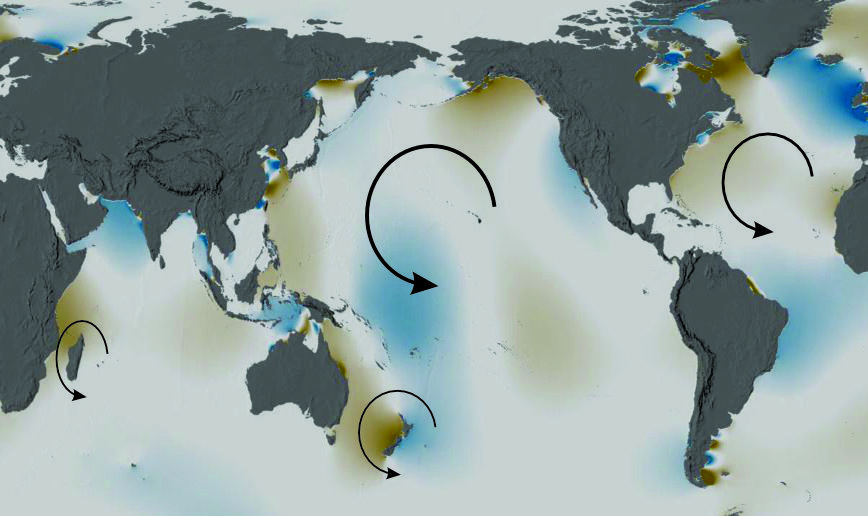
Adapted from a video by NASA’s Scientific Visualization Studio

Susan, a chemist trained to consider conservation of mass, perks up. “Wait. Greenland and Antarctica are both melting, too. That water plus Eurasia’s has to raise sea level.”

“Not so much. Yes, the melting frees up water mass that had been locked up as land-bound ice. But on the other hand, it also counteracts sea rise’s major driver.”

“Which is?”

“Expansion of hot water. I did a quick calculation. The Mediterranean Sea averages 1500 meters deep and about 15°C in the wintertime. Suppose it all warms up to 35°C. Its sea level would rise by about 3.3 meters, that’s 10 feet! Unfortunately, not much of Greenland’s chilly outflow will get past the Straits of Gibraltar.”

~~ Rich Olcott
Y2K plus 25 plus 2½

Mike reminded me of the task we took on mid‑year in 1997, 27½ years ago. If I recall correctly, that’s when the IT department we worked for got serious about New Year’s Day 2000.

This was an outgrowth of our disaster preparedness project. Some context: large corporation, HQ and most of the manufacturing in New Jersey, the rest in Memphis. The good news: the IT center was in Memphis where I lived. The bad news: Memphis is on the eastern edge of Tornado Alley’s range from Oklahoma across central Arkansas. Most of the twisters seem to dodge north or south around the city, but you never know.

True story — The Memphis plant had an Uninterruptible Power Supply (UPS) facility housed in a separate structure behind the computer room. The UPS held a ton of lead‑acid batteries and power conditioning equipment, plus an automated diesel generator outside. One thunderstormy afternoon a lightning bolt took out the power line to the building. Everything went dark. The UPS kicked in within milliseconds and our IT equipment kept running just fine — until a second lightning bolt took out the generator. The utility’s linemen, bless ’em, had us powered back up a few hours later and just minutes before Management’s deadline for declaring a disaster.

“Declare a disaster” means you kick over to your spare copy “in The Cloud,” right? Not in those days. The Cloud (which really is market‑ese for “somebody else’s computer”) isn’t a viable operation without telecomm speeds a hundred times faster than the comm lines we had in the 1990s. Back then Disaster Recovery (DR) was a multi-step process:

  • Backup your essential programs and data onto tape
  • Truck the tapes to a secure distant storage vault
  • When/if a disaster is declared, move operations to an offsite DR center that offers comparable IT facilities (computers, data storage, network connections, etc.)
    • Truck the tapes to the DR center. People, too, if necessary.
    • Read the tapes onto DR center storage.
    • Pray that your backups in fact had all the stuff you need and that the data’s sufficiently up‑to‑date for business requirements.

Clunky, huh? But the process gave us practice in cloning our systems and thinking about risks. That’s where our Y2K prep started.

The real “Y2K problem” wasn’t the 2‑digit‑year design flaw, it was the impossibility of doing reliable date logic or calculations when the dates in question might be in either century. Did “X” happen before or after a deadline? No way to know when “12” is all you’ve got to work with. Fixing the problem was a multi‑prong challenge:

  • Revise the data structure to hold a four‑digit year.
  • Revise the stored data with the right four‑digit year numbers.
  • Revise the programs that handle the data but…
  • Don’t break the programs that you revise.

Most of the program updates weren’t particularly challenging, it’s just that there were so many of them. Some enterprises knew their own software well enough that they did that work in‑house. Others shipped the work overseas, a tremendous boon to India’s fledgling software industry. Still others said, “Our competitive advantage is our product line and marketing team, not our home‑grown programs. We’ll convert to an industry‑standard replacement even though we’ll have to change how we’ve been doing business.”

Whichever strategy was chosen, the devil was in the testing. No way could new code or data structures be checked out with live data on our production system.

We needed a testbed, a sandbox, “System 2K,” whatever you want to call it, that was isolated from the live systems we made our money from. It had to have no‑leaks portals for programmer access, code revisions and artificial test‑case data. Most importantly, its system clock had to be adjustable to any future date.

That’s where my team came in. Using what we’d learned from our DR practice runs, we cloned our running system and bolted on some tricksy infrastructure. Don’t ask about technical details, that’s a quarter‑century ago and I don’t remember them.

But I’m proud to say that New Year’s Day 2000 was boring.

~ Rich Olcott

  • Thanks to Mike Newsom, whose comment inspired this post, and to Bob, Susie, Ralph, Tom, Doug, Mick, Don, Roy and the rest of the project team.

The Situation of The Gravity

<bomPAH-dadadadaDEEdah> It’s been a while since Old Reliable blared that unregistered ringtone. Sure enough, the phone function’s caller‑ID display says 710‑555‑1701.  “Commander Baird, I presume? Long time no hear.”

<downcast tone with a hint of desperation> “It’s Lieutenant now.”

“Sorry to hear that. What happened?”

Project Lonesome was a bust. It took us years to assemble those two planetoids but getting them into the right orbits around the black hole was more of a challenge than we planned for. Planetoid Pine got away from us and fell down through the Event Horizon. One big blast of inforon radiation and no more project. We lost a few robot space tugs but all carbon‑based personnel survived. Medical Bay just now pronounced me healthy — it’s amazing what they can do about pervasive sub‑cellular damage these days. The Board of Inquiry decided no‑one was at fault but they down‑ranked me because I was primary advocate for a jinxed project.”

“Well, those 15-minute orbits were a gamble all along. So why this phone call?”

“You know how it is, sitting in Med Bay with nothing much to do. I was poking around and happened to read a few of the files you’re working on—”

“Which ones?”

“The Projects directory.”

“But those are client files I’ve encrypted with the latest technology.”

“Oh, please, Mr Moire, I am calling from the 24th Century. Upton’s algorithm for zeta‑function decryption is ancient history. Don’t worry, your client’s secrets are safe, although one of your clients may not be.”

“Whoa, say what? Which one? What kind of danger? They all seem healthy, look both ways before crossing the street, that sort of thing.”

“One of those projects is extremely dangerous.”

“Which one? The biometrically‑lockable archery bow shouldn’t cause any problems. The electric yoga outfit? I triple‑checked the wiring and insulation specs, they’re safe and reliable. The robot rabbit? Surely not. Does this involve lethal spy‑craft of some sort? I try to avoid military work.”

“No, it’s the perpetual motion machine.”

“Ralphie’s project? Laws of Thermodynamics and all, I told him that’s just not going to work. He insisted I check his blueprints to make sure nothing’s going to blow up. I gave them a quick glance, didn’t see anything dicey.”

“It wouldn’t be obvious, especially not in view of your primitive science—”

“Hey!”

“No offense intended, Mr Moire, but it is primitive from my perspective. Two hundred years make a difference. Consider the state of Earth’s science in 1723 — Graham was still perfecting the pendulum clock.”

“Point taken, reluctantly. So what should I look for, and why?”

The Prime Directive applies across time periods, too, so I can’t go into detail with you. I’ll just say it’s not any one component, it’s the overall physical arrangement and what will happen when he powers up. Move the boxy bits closer together or further apart by two centimeters and the danger’s gone.”

“But what’s the danger? I can’t just tell him to reconfigure for no reason.”

“Directed gravity, Mr Moire, the sculpting of spacetime. It’s the reason we don’t need safety belts on a starship — we manufacture local gravity that always pulls toward the deck. In fact, directed gravity’s at the heart of warp drive technology. Cochrane stumbled on the effect accidentally but fortunately his lab was in a reinforced hard‑rock tunnel so damage was limited.”

“Anti-gravity? Oh, that’d be so cool. Flying cars at last, and sky‑cycles. Okay, there’d be problems and we’d need an AI-boosted Air Traffic Control agency. The military would be all over the idea. But all that’s way down the road, so to speak. I don’t understand how that puts Ralphie in immediate danger and why would a tunnel help?”

“Not anti-gravity, directed gravity. Gravity’s built into the structure of spacetime. Gravity can’t be blocked, but it can be shifted. The only way to weaken it in one location is to make it stronger somewhere else. Suppose Cochrane had first powered‑up his device on the ground in the open air. Depending on which way it was pointed, either he’d have been crushed between rising magma and down‑falling air, or…”

“I’ll tell Ralphie to re‑configure his gadget. Thanks for the warning.”

~~ Rich Olcott

  • Thanks, Alex, for inspiring this.

Science or Not-science?

Vinnie trundles up to Jeremy’s gelato stand. “I’ll take a Neapolitan, one each chocolate, vanilla and strawberry.”

“Umm… Eddie forgot to order more three-dip cones and I’m all out. I can give you three separate cones or a dish.”

“The dish’ll be fine, way less messy. Hey, Sy, I got a new theory.”

“Mm… Unless you’ve got a lot of firm evidence it can’t be a theory. Could be a conjecture or if it’s really good maybe a hypothesis. What’s your idea?”

“Thing is, Sy, there can’t be any evidence. Ever. That’s the fun of it.”

“Conjecture, then. C’mon, out with it.”

“Well, you remember all that stuff about how time bends toward a black hole’s mass and that’s how gravity works?”

“Sure, except it’s not just black holes. Time bends the same way toward every mass, it’s just more intense with black holes.”

“Understood. Anyway, we talked once about how stars collapse to form black holes but that’s only up to a certain size, I forget what—”

“Ten to fifteen solar masses. Beyond that the collapse goes supernova and doesn’t leave much behind but dust.”

“Right. So you said we don’t know how to make size‑30 black holes like the first pair that LIGO found.”

“We’ve got a slew of hypotheses but the jury’s still out.”

“That’s what I hear. Well, if we don’t even know that much then we for‑sure don’t know how to make the supermassive black hole the science magazines say we’ve got in the middle of the Milky Way.”

“We’ve found that nearly every galaxy has one, some a lot bigger than ours. Why that’s true is one of the biggest mysteries in astrophysics.”

“And I know the answer! What if those supermassive guys started out as just big lumps of dark matter and then they wrapped themselves in more dark matter and everything else?”

“Cute idea, but the astronomy data says we can account for galaxy shapes and behavior if they’re embedded at the center of a spherical halo of dark matter.”

“Not a problem, Sy. Look at the numbers. Our superguy is a size‑4‑million, right? The whole Milky Way’s a billion times heavier than that. Tuck an extra billionth into the middle of the swirl and the stars wouldn’t see the difference.”

“Okay, but there’s more data that says dark matter spreads itself pretty evenly, doesn’t seem to clump up like you need it to.”

“Yeah, but maybe there’s two kinds, one kind clumpy and the other kind not. Only way to find out is to look inside a superguy but time blocks information flow out of there. So no‑one can say I’m wrong!”

“But sir, that’s not science!”

“Why not, kid?”

“The unit my philosophy class did on Popper.”

“The stuff you sniff or the penguins guy?”

“Neither, Karl Popper the philosopher. Dr Crom really likes Popper’s work so we spent a lot of time reading him. Popper was one of the Austrian intellectuals the Nazis chased out when they took power in the 1930s. Popper traveled around, wound up in New Zealand where he wrote his Open Society book that shredded Hegel and Marx. Those sections were fun reading even if they were wordy. Anyway, one of Popper’s big things was the demarcation problem, how to tell the difference between what’s a scientific assertion and what’s not. He decided the best criterion was if there’s a way to prove the assertion false. Not whether it was false but whether it could at least be tested. I was surprised by how many goofy things the Greeks said that would qualify as Popper‑scientific even though they were just made up and have been proven wrong.”

“Well there you go, Vinnie. Physics and the Universe don’t let us see into a supermassive black hole, therefore your idea isn’t testable even in principle. Jeremy’s right, it’s not scientific even though it’s all dressed up in a Science suit.”

“I can still call it a conjecture, though, right, Sy?”

“Conjecture it is. Might even be true, but we’ll never know unless we somehow find out something about dark matter that surprises us. We’ve been surprised a lot, though, so don’t give up hope.”

~~ Rich Olcott

Wait For It

“So, Jeremy, have I convinced you that there’s poetry in Physics?”

“Not quite, Mr Moire. Symbols can carry implications and equation syntax is like a rhyme scheme, okay, but what about the larger elements we’ve studied like forms and metaphors?”

“Forms? Hoo boy, do we have forms! Books, theses, peer-reviewed papers, conference presentations, poster sessions, seminars, the list goes on and that’s just to show results. Research has forms — theoretical, experimental, and computer simulation which is sort of halfway between. Even within the theory division we have separate forms for solving equations to get mathematically exact solutions, versus perturbation techniques that get there by successive approximations. On the experimental side—”

“I get the picture, Mr Moire. Metaphorically there’s lots of poetry in Physics.”

“Sorry, you’re only partway there. My real point is that Physics is metaphor, a whole cascade of metaphors.”

“Ha, that’s a metaphor!”

“Caught me. But seriously, Science in general and Physics in particular underwent a paradigm shift in Galileo’s era. Before his century, a thousand years of European thought was rooted in Aristotle’s paradigm that centered on analysis and deduction. Thinkers didn’t much care about experiment or observing the physical world. No‑one messed with quantitative observations except for the engineers who had to build things that wouldn’t fall down. Things changed when Tycho Brahe and Galileo launched the use of numbers as metaphors for phenomena.”

“Oh, yeah, Galileo and the Leaning Tower experiment.”

“Which may or may not have happened. Reports differ. Either way, his ‘all things fall at the same speed‘ conclusion was based on many experimental trials where he rolled balls of different material, sizes and weights down a smooth trough and timed each roll.”

“That’d have to be a long trough. I read how he used to count his pulse beats to measure time. One or two seconds would be only one or two beats, not much precision.”

“True, except that he used water as a metaphor for time. His experiments started with a full jug of water piped to flow into an empty basin which he’d weighed beforehand. His laboratory arrangement opened a valve in the water pipe when he released the ball. It shut the valve when the ball crossed a finish line. After calibration, the weight of released water represented the elapsed time, down to a small fraction of a second. Distance divided by time gave him speed and he had his experimental data.”

“Pretty smart.”

“His genius was in devising quantitative challenges to metaphor‑based suppositions. His paradigm of observation, calculation and experimental testing far outlasted the traditionalist factions who tried to suppress his works. Of course that was after a century when Renaissance navigators and cartographers produced maps as metaphors for oceans and continents.”

“Wait, Mr Moire. In English class we learned that a metaphor says something is something else but an analogy is when you treat something like something else. Water standing for time, measurements on a map standing for distances — aren’t those analogies rather than metaphors?”

“Good point. But the distinction gets hazy when things get abstract. Take energy, for example. It’s not an object or even a specific kind of motion like a missile trajectory or an ocean wave. Energy’s a quantity that we measure somewhere somehow and then claim that the same quantity is conserved when it’s converted or transferred somewhere else. That’s not an analogy, it’s a metaphor for a whole parade of ways that energy can be stored or manifested. Thermodynamics and quantum mechanics depend on that metaphor. You can’t do much anywhere in Physics without paying some attention to it. People worry about that, though.”

“Why’s that?”

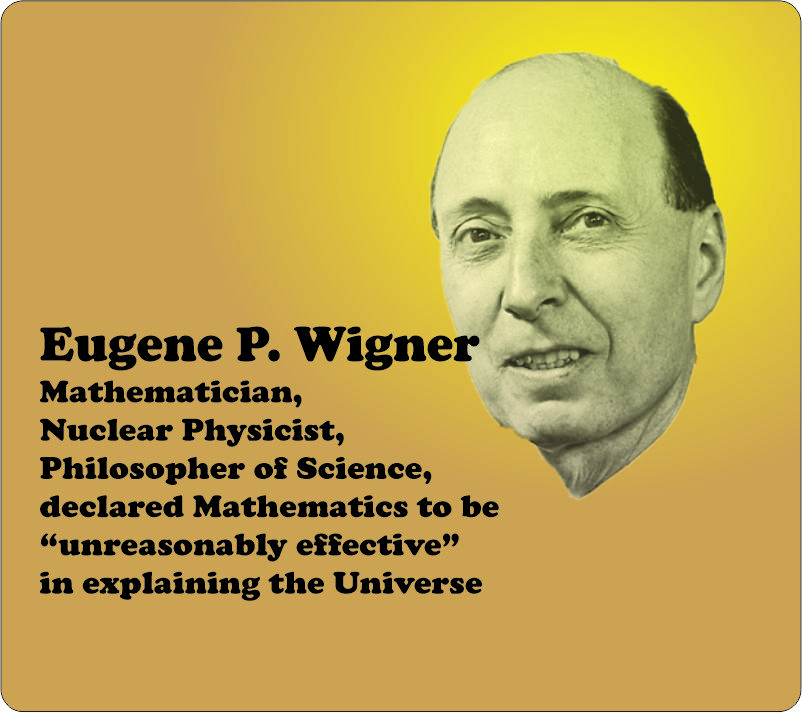
“We don’t really understand why energy and our other fundamental metaphors work as well as they do. No metaphor is perfect, there are always discrepancies, but Physics turns out to be amazingly exact. Chemistry equations balance to within the accuracy of their measuring equipment. Biology’s too complex to mathematize but they’re making progress. Nobel Prize winner Eugene Wigner once wrote a paper entitled, ‘The Unreasonable Effectiveness of Mathematics in The Natural Sciences.’ It’s a concern.”

“Well, after all that, there’s only one thing to say. If you’re in Physics, metaphors be with you.”

~~ Rich Olcott

Prime Contenders

Between COVID and the post‑holiday wind‑down, things are slow. Vinnie and I are playing cards on my office side table, except my only deck is missing the heart face cards (long story) so we’re just trying to edge‑stack them. It’s not going well. “Geez, Sy, these towers collapse so quick, it’s boring. What else you got around here?”

“Well, before you arrived I was chasing prime numbers on Old Reliable for a New Year piece. Did you know, for instance, there we’re smack in the middle of a decade-long prime year dearth?”

“Prime year dearth?”

Prime as in not divisible by any number other than itself and one, dearth as in no year’s name being a prime number since 2017 and the next one isn’t until 2027. In the forty‑four years leading up to 2017 we averaged one prime per 5½ years. On the other hand, after 2029 (also a prime year, by the way) there’s fifty‑two years with only five primes.””

“Is there some rule for how many to expect?”

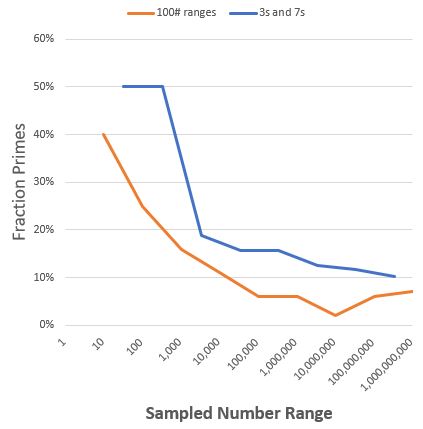
“Sort of. I sampled a series of hundred‑number ranges on up to a billion. The percentage of primes fell off as the numbers got larger, settled in at about 6%.”

“Makes sense — you got a bigger number, you got more little numbers that might divide into it.”

“Mm-hm. Something weird happens around ten million, though. The percentage drops down to only 2% but then it goes right back up to around 6% and stays there. I tried different scan resolutions but couldn’t locate any single especially long non‑prime string. The mathematicians have carried the research a lot further than my little experiment. The Prime Number Theorem gives a general curve that’s good ‘for sufficiently large numbers,’ but a million is a small number on their scale. As a physicist I’m a bit frustrated because the Theorem says, ‘This is the way it is‘ but it doesn’t give a reason. Although there probably isn’t a reason, any more than there’s a reason for 2017 being a prime to begin with.”

“I know what you mean. My car’s Owner Manual is the same way. Uhh… as I recall, you had a post a while ago about primes and 3’s and 7’s.”

“That was for New Year 2016, to be exact. Yeah, I found a collection of primes like 3337 and 733333 that have a string of 3’s or 7’s fronted and trailed by 3’s or 7’s. It wasn’t a bad bet. No primes (except 2 and 5) can have 0, 2, 4, 5, 6 or 8 as a trailing digit, right?”

“Lemme think for a minute. … Right.”

“That list didn’t include scrambled combinations like 37737, so what I did this year was to use Old Reliable to construct a big list of all possible 3’s‑and‑7’s numbers between 3 and a billion.”

“That’s a lot of numbers.”

“Not so many, actually, only about 1000. I told Old Reliable not to sample numbers that have any non‑3‑or‑7 digit buried in them somewhere. That’s a lot of pass‑overs.”

“That’s a lot of checking and skipping.”

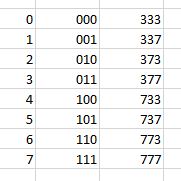
“I used a short cut. It’s easy to build a list of all possible numbers with a certain number of binary digits — just count in binary. The three‑digit binary numbers, for instance, give you every zero‑one combination between 000 is zero and 111 is seven. Then I converted all the zeroes to 3’s and all the ones to 7’s and got every 3’s‑and‑7’s number between a hundred and a thousand with no interlopers. As a bonus that method organizes the overall list by powers of ten, like 333 to 777 in a sublist, 3333 to 7777 in another and so on. I counted the primes in each sublist and charted all the sublist percentages in the same graph as the hundred‑number sampling. Pretty much the same curve, but no dip near 10 million. For the heck of it I played the same game with 1’s and 9’s. Same behavior. Oh well.”

“So that’s how you keep yourself occupied on a slow day, huh? I got a New Year prediction for you.”

“What’s that?”

“I’m gonna bring you a couple fresh decks of playing cards.”

~~ Rich Olcott

Maybe It’s Just A Coincidence

Raucous laughter from the back room at Al’s coffee shop, which, remember, is situated on campus between the Physics and Astronomy buildings. It’s Open Mic night and the usual crowd is there. I take a vacant chair which just happens to be next to the one Susan Kim is in. “Oh, hi, Sy. You just missed a good pitch. Amanda told a long, hilarious story about— Oh, here comes Cap’n Mike.”

Mike’s always good for an offbeat theory. “Hey, folks, I got a zinger for you. It’s the weirdest coincidence in Physics. Are you ready?” <cheers from the physicists in the crowd> “Suppose all alone in the Universe there’s a rock and a planet and the rock is falling straight in towards the planet.” <turns to Al’s conveniently‑placed whiteboard> “We got two kinds of energy, right?”

Potential Energy    Kinetic Energy

Nods across the room except for Maybe-an-Art-major and a couple of Jeremy’s groupies. “Right. Potential energy is what you get from just being where you are with things pulling on you like the planet’s gravity pulls on the rock. Kinetic energy is what potential turns into when the pulls start you moving. For you Physics smarties, I’m gonna ignore temperature and magnetism and maybe the rock’s radioactive and like that, awright? So anyway, we know how to calculate each one of these here.”

PE = GMm/R    KE = ½mv²

“Big‑G is Newton’s gravitational constant, big‑M is the planet’s mass, little‑m is the rock’s mass, big‑R is how far apart the things are, and little‑v is how fast the rock’s going. They’re all just numbers and we’re not doing any complicated calculus or relativity stuff, OK? OK, to start with the rock is way far away so big‑R is huge. Big number on the bottom makes PE’s fraction tiny and we can call it zero. At the same time, the rock’s barely moving so little‑v and KE are both zero, close enough. Everybody with me?”

More nods, though a few of the physics students are looking impatient.

“Right, so time passes and the rock dives faster toward the planet Little‑v and kinetic energy get bigger. Where’s the energy coming from? Gotta be potential energy. But big‑R on the bottom gets smaller so the potential energy number gets, wait, bigger. That’s OK because that’s how much potential energy has been converted. What I’m gonna do is write the conversion as an equation.

GMm/R=½mv²

“So if I tell you how far the rock is from the planet, you can work the equation to tell me how fast it’s going and vice-versa. Lemme show those straight out…”

v=(2GM/R)    R=2GM/v²

Some physicist hollers out. “The first one’s escape velocity.”

“Good eye. The energetics are the same going up or coming down, just in the opposite direction. One thing, there’s no little‑m in there, right? The rock could be Jupiter or a photon, same equations apply. Suppose you’re standing on the planet and fire the rock upward. If you give it enough little‑v speed energy to get past potential energy equals zero, then the rock escapes the planet and big‑R can be whatever it feels like. Big‑R and little‑v trade off. Is there a limit?”

A couple of physicists and an astronomy student see where this is going and start to grin.

“Newton physics doesn’t have a speed limit, right? They knew about the speed of light back then but it was just a number, you could go as fast as you wanted to. How about we ask how far the rock is from the planet when it’s going at the speed of light?”

R=2GM/

Suddenly Jeremy pipes up. “Hey that’s the Event Horizon radius. I had that in my black hole term paper.” His groupies go “Oooo.”

“There you go, Jeremy. The same equation for two different objects, from two different theories of gravity, by two different derivations.”

“But it’s not valid for lightspeed.”

“How so?”

“You divided both sides of your conversion equation by little‑m. Photons have zero mass. You can’t divide by zero.”

Everyone in the room goes “Oooo.”

~~ Rich Olcott

Engineering A Black Hole

<bomPAH-dadadadaDEEdah> That weird ringtone on Old Reliable again. Sure enough, the phone function’s caller-ID display says 710‑555‑1701.  “Ms Baird, I presume?”

A computerish voice, aggressive but feminine, with a hint of desperation. “Commander Baird will be with you shortly, Mr Moire. Please hold.”

A moment later, “Hello, Mr Moire.”

“Ms Baird. Congratulations on the promotion.”

“Thank you, Mr Moire. I owe you for that.”

“How so?”

“Your posts about phase-based weaponry got me thinking. I assembled a team, we demonstrated a proof of concept and now Federation ships are being equipped with the Baird‑Prymaat ShieldSaw. Works a treat on Klingon and Romulan shielding. So thank you.”

“My pleasure. Where are you now?”

“I’m on a research ship called the Invigilator. We’re orbiting black hole number 77203 in our catalog. We call it ‘Lonesome‘.”

“Why that name?”

“Because there’s so little other matter in the space nearby. The poor thing barely has an accretion disk.”

“Sounds boring.”

“No, it’s exciting, because it’s so close to a theoretical ideal. It’s like the perfectly flat plane and the frictionless pulley — in real life there are always irregularities that the simple equations can’t account for. For black holes, our only complete solutions assume that the collapsed star is floating in an empty Universe with no impinging gravitational or electromagnetic fields. That doesn’t happen, of course, but Lonesome comes close.”

“But if we understand the theoretical cases and it nearly matches one, why bother with it at all?”

“Engineering reasons.”

“You’re engineering a black hole?”

“In a way, yes. Or at least that’s what we’re working on. We think we have a way to extract power from a black hole. It’ll supply inexhaustible cheap energy for a new Star Fleet anti‑matter factory. “

“I thought the only thing that could escape a black hole’s Event Horizon was Hawking radiation, and it cheats.”

“Gravity escapes honestly. Its intense field generates some unexpected effects. Your physicist Roger Penrose used gravity to explain the polar jets that decorate so many compact objects including black holes. He calculated that if a comet or an atom or something else breakable shatters when it falls into a spinning compact object’s gravitational field, some pieces would be trapped there but under the right conditions other pieces would slingshot outward with more energy than they had going in. In effect, the extra energy would come from the compact object’s angular momentum.”

“And that’s what you’re planning to do? How are you going to trap the expelled pieces?”

“No, that’s not what we’re planning. Too random to be controlled with our current containment field technology. We’re going pure electromagnetic, turning Lonesome into a giant motor‑generator. We know it has a stable magnetic field and it’s spinning rapidly. We’ll start by giving Lonesome some close company. There’s enough junk in its accretion disk for several Neptune‑sized planets. The plan is to use space tugs to haul in the big stuff and Bussard technology for the dust, all to assemble a pair of Ceres-sized planetoids. W’re calling them Pine and Road. We’ll park them in a convenient equatorial orbit in a Lagrange‑stable configuration so Pine, Road and Lonesome stay in a straight line.”

“Someone’s been doing research on old cinema.”

“The Interstellar Movie Database. Anyhow, when the planetoids are out there we string conducting tractor beams between them. If we locate Pine and Road properly, Lonesome’s rotating magnetic field lines will cross the fields at right angles and induce a steady electric current. Power for the anti‑matter synthesizers.”

“Ah, so like Penrose’s process you’re going to drain off some of Lonesome‘s rotational kinetic energy. Won’t it run out?”

Lonesome‘s mass is half again heavier than your Sun’s, Mr Moire. It’ll spin for a long, long time.”

“Umm … that ‘convenient orbit.’ Lonesome‘s diameter is so small that orbits will be pretty speedy. <calculating quickly with Old Reliable> Even 200 million kilometers away you’d circle Lonesome in less than 15 minutes. Will the magnetic field that far out be strong enough for your purposes?”

“Almost certainly so, but the gravimagnetodynamic equations don’t have exact solutions. We’re not going to know until we get there.”

“That’s how research works, all right. Good luck.”

~~ Rich Olcott

4 Tips 4 A Young Scientist

From: Robin Feder <rjfeder@fortleenj.com>
To: Sy Moire <sy@moirestudies.com>
Subj: Questions

Dear Mr. Moire, I am a High School student who has a crazy theory about dark matter. I get bored often and do not learn as much as I think most believe I should in science class. I was thinking about dark matter and how it reacts oppositely of how we expect it to. We expect it to probably not follow “normal” physics. This got me thinking about other impossible things the human mind has thought of. One of them caught my mind–absolute zero. The logic connected itself in my mind and later that day I typed up a doc just to keep my ideas. I played with it and the more I thought about it the evidence started to overlap. I have finally found an end to the theory. I am now ready to send this theory with some scientists who actually have the expertise to critique me. Please give me your thoughts as I of course am not fully confident in it. I have a lot of information that I can’t fit in one email so this is all for now. Hope to improve it. Sincerely, Robin Feder


From: Sy Moire <sy@moirestudies.com>
To: Robin Feder <rjfeder@fortleenj.com>

Subj: Re: Questions

My best to your Dad, Robin, you take after him and I’m glad you’re thinking about science. I hear you about the boring classes often feel that way if the other kids don’t pick things up as quickly as you do. Maybe your teachers can point you to supplementary materials that’ll perk up your interest.

Before we get into your topics I’ll give you some tips that may help your future. The first is, keep an idea notebook. It could be a physical book you keep in your pocket or it could be a directory of files on your phone or computer, doesn’t matter. What does matter is that you record all your ideas as they occur to you so you don’t forget one that might become important later on. In science and other fields, ideas are your stock in trade so you want to preserve your inventory. That absolute‑zero doc is a good start.

Second tip is, after you’ve written down an idea, take a long look at it and ask yourself, “How could I disprove this?” and write that down, too. The essence of science is that it relies more on disproving things than proving them. Get into the habit of thinking about disproof — it’s a powerful way of filtering out incorrect thinking. Works better in some areas than others but in general there’s forward progress.

The reason I highlighted “after” up there is that the first thought, even if it’s wrong, often leads to second and third thoughts that are better. If you discard ideas too quickly you limit yourself. Think of it as an ongoing one‑person brainstorming session. So write first, maybe cross off later, OK?

Third tip is, read up on what your idea is about. A lot. Every field of study has its own “language,” a set of words and concepts that people in the field generally understand. You need to have some command of those if you’re going to ask them clear questions about your idea.

That’s for two reasons. The most important is that using the correct terminology speeds up communication — neither you nor they will have to stop and explain a term or concept. But in addition, if you use the words and concepts properly that tells your conversation partner that you respect their time enough to have done your initial reading.

Fourth tip is where to look for that initial reading. Most textbooks, even shiny freshly-printed ones, are decades behind the current research frontiers. You need to go deeper. You’ll Google your topic, of course, to find popular science articles. Here’s another path to more recent work. Start at a good Wikipedia article. Follow the links to its key recent footnotes and Google the names of the paper’s authors. Many of them will have blogs that they write for a student audience. Follow those blogs.

Looking forward to reading those two files.

Regards,
Sy Moire.

~~ Rich Olcott

Question Time

Cathleen unmutes her mic. “Before we wrap up this online Crazy Theories contest with voting for the virtual Ceremonial Broom, I’ve got a few questions here in the chat box. The first question is for Kareem. ‘How about negative evidence for a pre-mammal civilization? Played-out mines, things like that.‘ Kareem, over to you.”

“Thanks. Good question but you’re thinking way too short a time period. Sixty‑six million years is plenty of time to erode the mountain a mine was burrowing into and take the mining apparatus with it.

“Here’s a different kind of negative evidence I did consider. We’re extracting coal now that had been laid down in the Carboniferous Era 300 million years ago. At first, I thought I’d proved no dinosaurs were smart enough to dig up coal because it’s still around where we can mine it. But on second thought I realized that sixty-six million years is enough time for geological upthrust and folding to expose coal seams that would have been too deeply buried for mining dinosaurs to get at. So like the Silurian Hypothesis authors said, no conclusions can be drawn.”

“Nice response, Kareem. Jim, this one’s for you. ‘You said our observable universe is 93 billion lightyears across, but I’ve heard over and over that the Universe is 14 billion years old. Did our observable universe expand faster than the speed of light?‘”

“That’s a deep space question, pun intended. The answer goes to what we mean when we say that the Hubble Flow expands the Universe. Like good Newtonian physicists, we’re used to thinking of space as an enormous sheet of graph paper. We visualize statements like, ‘distant galaxies are fleeing away from us‘ as us sitting at one spot on the graph paper and those other galaxies moving like fireworks across an unchanging grid.

“But that’s not the proper post-Einstein way to look at the situation. What’s going on is that we’re at our spot on the graph paper and each distant galaxy is at its spot, but the Hubble Flow stretches the graph paper. Suppose some star at the edge of our observable universe sent out a photon 13.7 billion years ago. That photon has been headed towards us at a steady 300000 kilometers per second ever since and it finally reached an Earth telescope last night. But in the meantime, the graph paper stretched underneath the photon until space between us and its home galaxy widened by a factor of 3.4.

“By the way, it’s a factor of 3.4 instead of 6.8 because the 93 billion lightyear distance is the diameter of our observable universe sphere, and the photon’s 13.7 billion lightyear trip is that sphere’s radius.

“Mmm, one more point — The Hubble Flow rate depends on distance and it’s really slow on the human‑life timescale. The current value of the Hubble Constant says that a point that’s 3×10¹⁹ kilometers away from us is receding at about 70 kilometers per second. To put that in perspective, Hubble Flow is stretching the Moon away from us by 3000 atom‑widths per year, or about 1/1300 the rate at which the Moon is receding because of tidal friction.”

“Nice calculation, Jim. Our final question is for Amanda. ‘Could I get to one of the other quantum tracks if I dove into a black hole and went through the singularity?‘”

“I wouldn’t want to try that but let’s think about it. Near the structure’s center gravitational intensity compresses mass-energy beyond the point that the words ‘particle’ and ‘quantum’ have meaning. All you’ve got is fields fluctuating wildly in every direction of spacetime. No sign posts, no way to navigate, you wouldn’t be able to choose an exit quantum track. But you wouldn’t be able to exit anyway because in that region the arrow of time points inward. Not a sci‑fi story with a happy ending.”

“<whew> Alright, folks, time to vote. Who presented the craziest theory? All those in favor of Kareem, click on your ‘hand’ icon. … OK. Now those voting for Jim? … OK. Now those voting for Amanda? … How ’bout that, it’s a tie. I guess for each of you there’s a parallel universe where you won the virtual Ceremonial Broom. Congratulations to all and thanks for such an interesting evening. Good night, everyone.”

~~ Rich Olcott