


Again with the fizzing sound. Her white satin still looked good. A little travel-worn, but on her that looked even better. Her voice still sounded like molten silver — “Hello.”
“Hello, Anne. Where you been?”
“You wouldn’t believe. I don’t believe. I’ve got to get some control over this.”
“What’s the problem?”
“I never know where I’ll be next. Or when. Or even how it’ll look when I get there. We’ve met before, haven’t we?”
“Yes, we have, and you told me your memory works in circles. We figured out that when you ‘push,’ you relocate to a reality with a different probability.”
“But it could also be a different time. Future, past, it’s so confusing. Sometimes I meet myself and I don’t know whether I’m coming or going. We never know what to say to each other. It’s horrible way to be.”
“It sounds awful. Here, have a tissue. So, how can I help you?”
“You do theory stuff. Can you physics a way to let me steer through all this?”
<fizzing sound> Another Anne appeared, next to my file cabinet on the far side of the office. “Don’t mind me, just passing through.” <more fizzing> She flickered away. My ears itched a little.
“See? And she always knows more than I do, except when I know more than she does.”
“I’m beginning to get the picture. Mind if I ask you a few questions?”
“Anything, if it’ll help solve this.”
“When you time-hop, do you use the same kind of ‘push’ feeling that sends you to different probabilities?”
“No-o, it’s a little different, but not much.”
“We found that you have to ‘push’ harder to get to a less-probable reality. Is there the same kind of difference between past and future hopping?”
“Now you mention it, yes! It’s always easier to jump to the future. I have to struggle sometimes when I get too far ahead of myself.”
“Can you do time and probability together?”
“Hard to say. When I hop I mostly just try to work out when I am, much less whether things are odd.”
“Give it a shot. Try a couple of ‘nearby places’ and come back here/now. Just use tiny ‘pushes.’ I don’t want you to get lost again.”
“Me neither. OK, here I go.” <prolonged flickering and fizzing> “Is this the right place? I tried a couple of hops here in your office, and <charming blush> stole some of your papers. Here.”
“Perfect, Anne, objective evidence is always best. Let’s see… Yep, this report is one I finished a week ago, looks OK, and this one … I recognize the name of a client I’ve not yet hooked, but the spelling! The letter ‘c’ isn’t there at all — ‘rekognize,’ ‘sirkle,’ ‘siense’ — that’s low probability for sure.”
“Actually, it felt like higher probability.”
“Whatever. One more question. I gather that most of your hops are more-or-less good ones but every once in a while you drop into a complete surprise, something you’re totally not used to.”
“Uh-huh.”
“I’ll bet the surprises happen when you’re in a jam and do a get me out of here jump.”
“Huh! I’d not made that connection, but you’re right.”
“I think I’ve got the picture. When you ‘push,’ you somehow displace yourself on a surface that has two dimensions — time and probability. You move around in those two dimensions independently from how you move in 3-D space. I take it you’re comfortable dong that but you want more control over it, right?”
“Mmm, yeah. It’s kind of my special superpower, you know? I don’t want to give it up entirely.”
“Good, because I wouldn’t know how to make that happen for you. Best I can do is give you some strategy coaching, OK?”
“That’d be a big help.”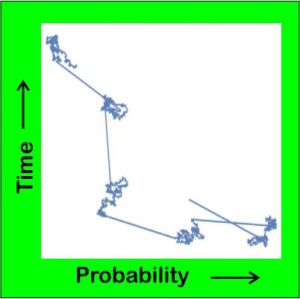
“Stay calm.”
“That’s it? Where’s the physics in that?”
“Ever hear of the Drunkard’s Walk?”
“I’ve seen a few.”
“Well, you’re doing one.”
“Beg pardon?”
“It’s math talk for a stepwise process where every step goes in a random direction. Your problem is that some of the steps are way too big. Keep the steps small and you’ll stay in familiar territory.”
<molten silver, coming closer> “Like … here?”
“Stay calm.”
~~ Rich Olcott



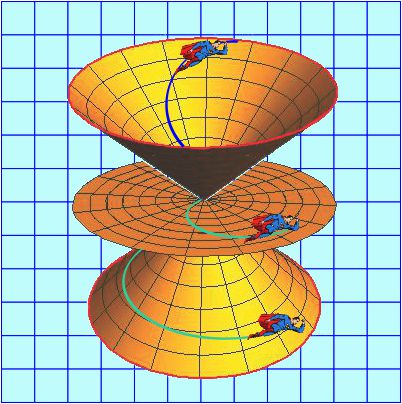


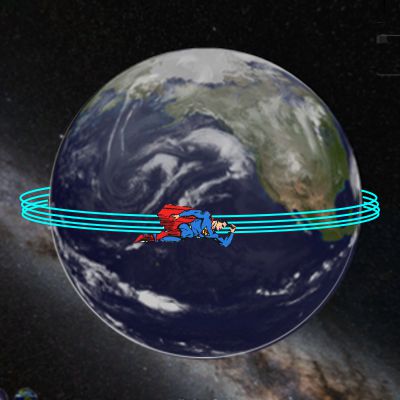 But for this post let’s consider a trope that’s been taken off the shelf again and again since those days, even in the movies. This rendition should get the idea across — Our Hero, in a desperate effort to fix a narrative hole the writers had dug themselves into, is forced to fly around the Earth at faster-than-light speeds, thereby reversing time so he can patch things up.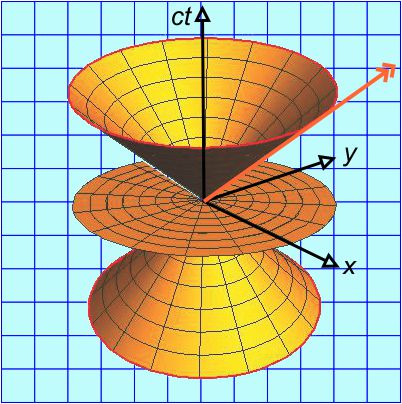
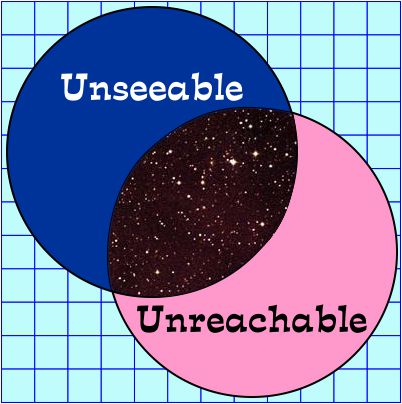
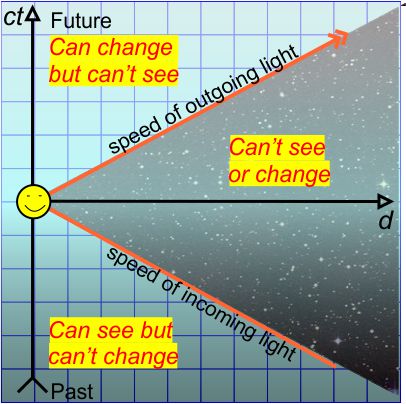
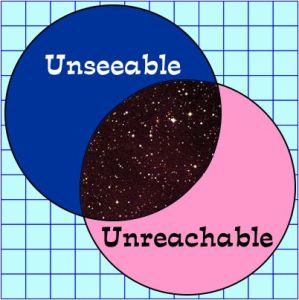 The rest of the Minkowski diagram could do for a Venn diagram. We at (0,0,0,0) can do something that will cause something to happen at (ct,x,y,z) to the left of the top orange line. However, we won’t be able to see that effect until we time-travel forward to its t. That region is “reachable but not seeable.”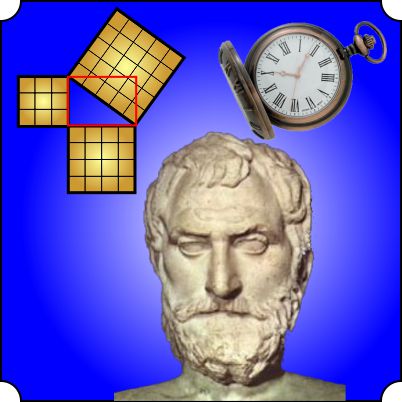
 One more step and we can answer Ken’s question. A moving object’s proper time is defined to be the time measured by a clock affixed to that object. The proper time interval between two events encountered by an object is exactly Minkowski’s spacetime interval. Lucy’s clock never moves from zero.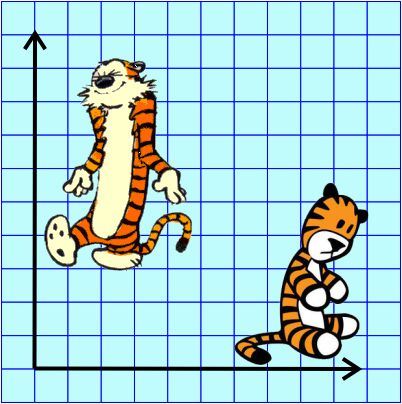
 I so miss Calvin and Hobbes, the wondrous, joyful comic strip that cartoonist Bill Watterson gave us between 1985 and 1995. Hobbes was a stuffed toy tiger — except that 6-year-old Calvin saw him as a walking, talking man-sized tiger with a sarcastic sense of humor.
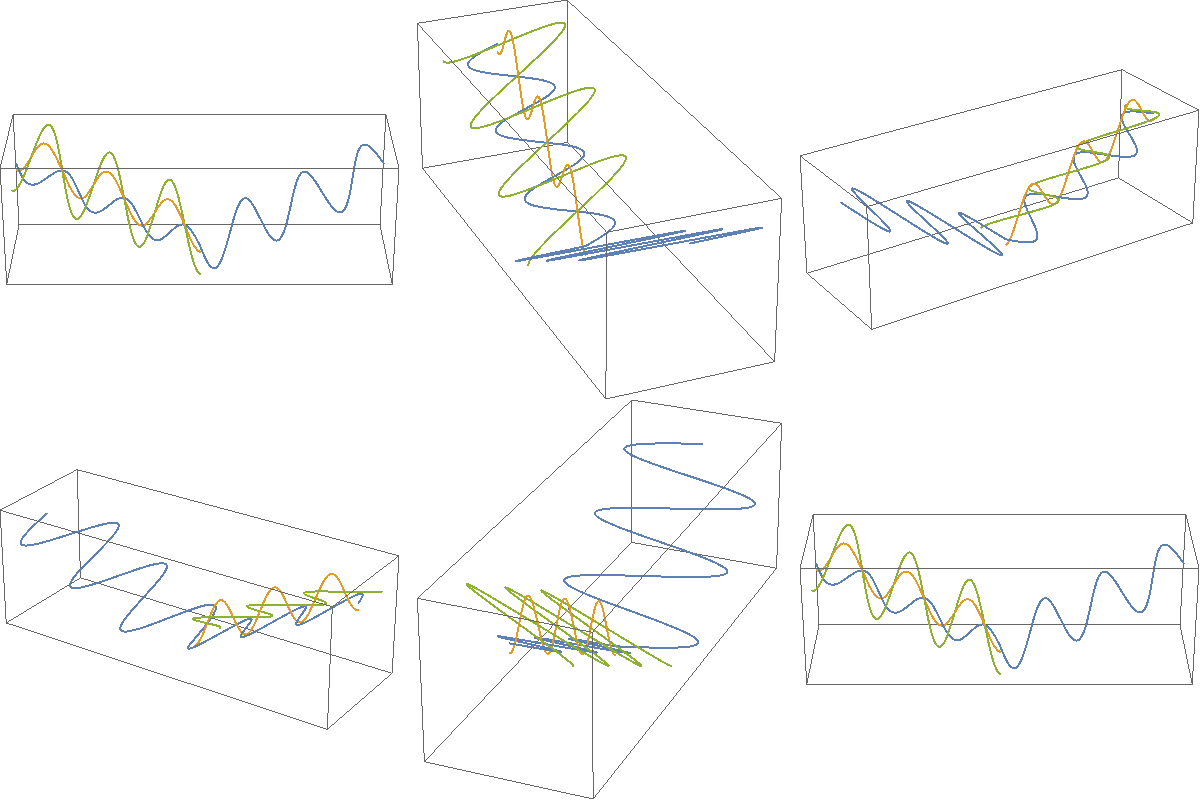 In this video, orange, green and blue electromagnetic fields shine in from one side of the box onto its floor. Each color’s field is polar because it “lives” in only one plane. However, the beam as a whole is unpolarized because different components of the total field direct recipient electrons into different planes giving zero net polarization. The Sun and most other familiar light sources emit unpolarized light.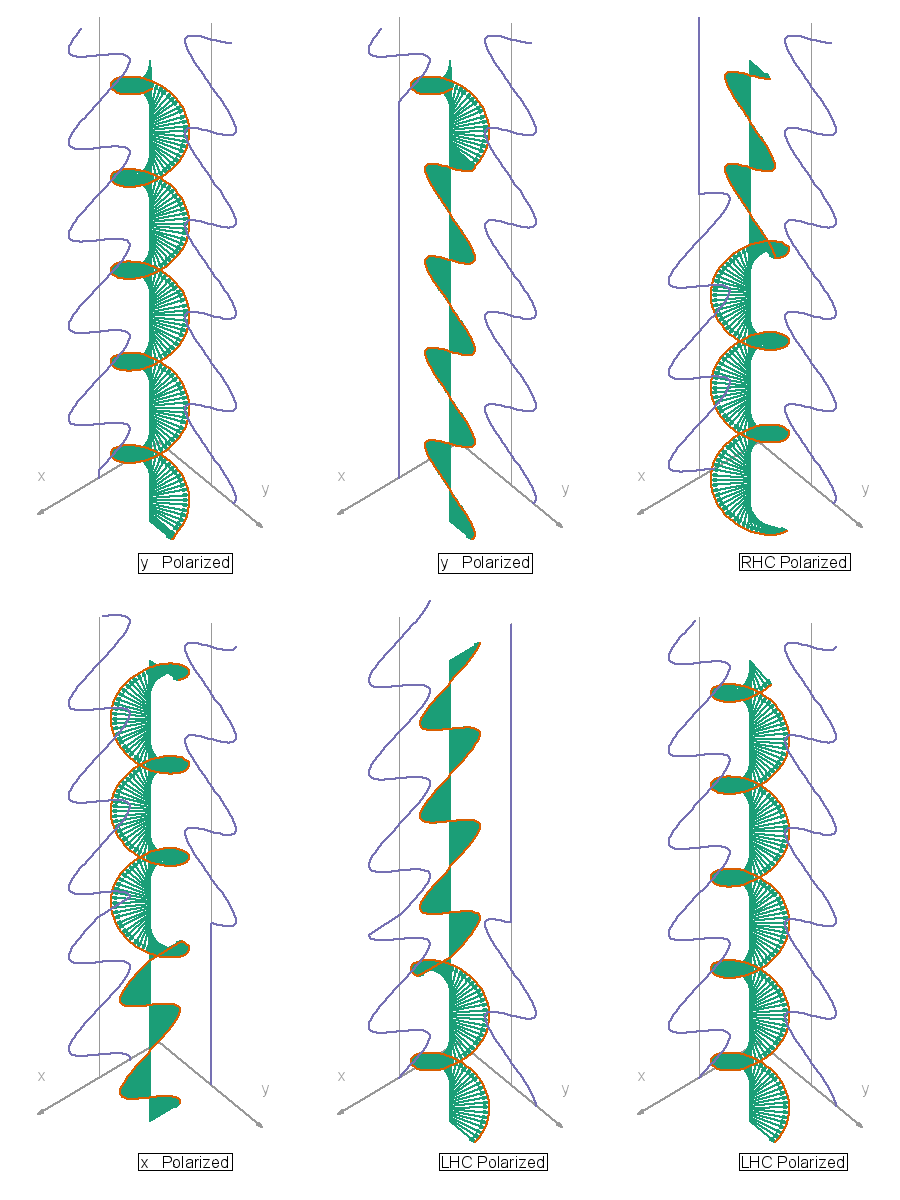
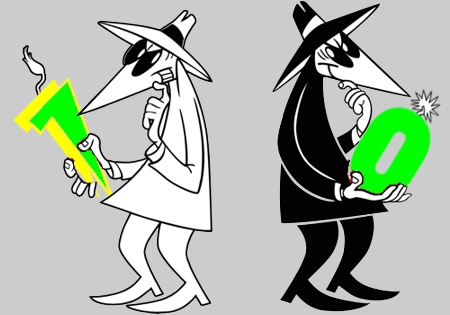
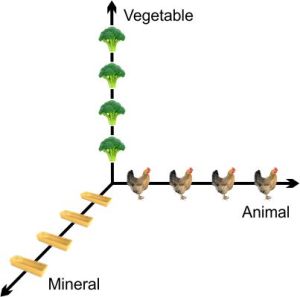 Suppose you had a graph with one axis for counting animal things and another for counting vegetable things. Animals added to animals makes more animals; vegetables added to vegetables makes more vegetables. If you’ve got a chicken, two potatoes and an onion, and you share with your buddy who has a couple of carrots, some green beans and another onion, you’re on your way to a nice chicken stew.
 Hard Science Ain't Hard
