Quarkery

Susan, aghast. “But I thought the Standard Model was supposed to be the Theory of Everything.”

Jim, abashed. “A lot of us wish that phrase had never been invented. Against the mass of the Universe it’s barely the theory of anything.”

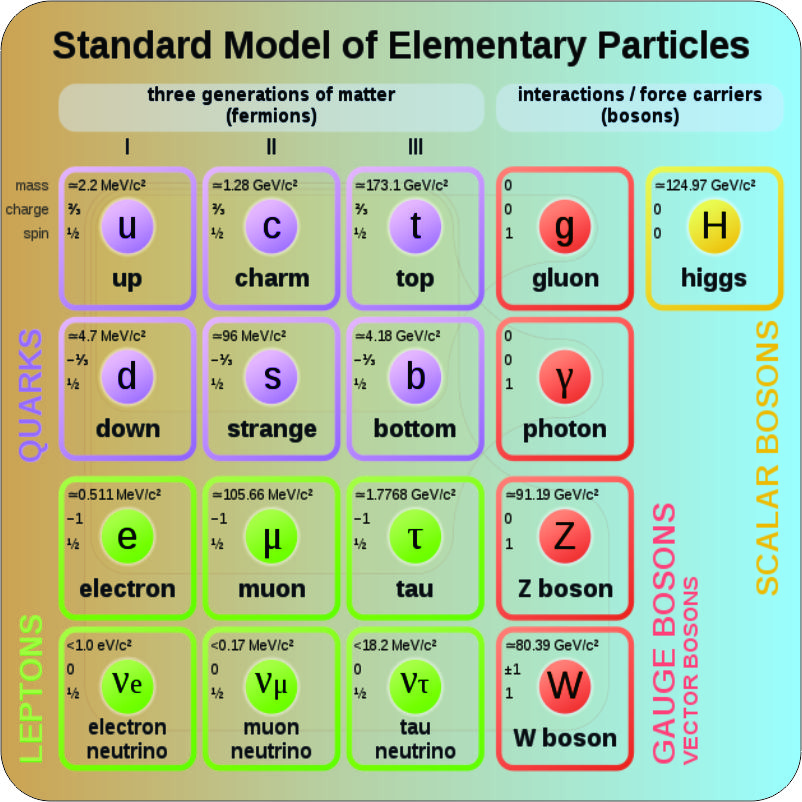
Me, typecast. “That’s a heavy claim, Jim. Big Physics has put many dollars and fifty years of head time into filling out that elegant table of elementary particles. I remember the celebration when the LHC finally found the Higgs boson in 2012. I’ve read that the Higgs field is responsible for the mass of the Universe.”

“A little bit true, Sy, sort of. We think it’s responsible for about 1% of the mass of all the matter we understand. There’s another mechanism that accounts for the other 99%.”

Eddie, downcast. “I’m lost, guys. What Standard Module are you talking about?”

“Do you remember the Periodic Table of the chemical elements?”

“A little. Science class had big poster up on the wall. Had all kinds of atoms in it, right?”

“Yup. Scientists spent centuries breaking down minerals and compounds to find substances that chemical methods couldn’t break down any further. Those were the chemical elements, things like iron and carbon and oxygen. The Periodic Table arranges elements so as to highlight similarities in how they’ll interact. The Standard Model carries that idea down to the sub‑subatomic level.”

“Wait, sub‑subatomic level?”

“Mm-hm. Chemists would say that ‘subatomic‘ is about electrons, protons and neutrons. Count an atom’s electrons. That and some fairly simple rules can tell you what structure types it prefers to participate in and what it reacts with. Count the protons and neutrons in its nucleus. That gives you its atomic weight and starts you on the road to figuring reaction quantities. That’s all that the chemists need to know about atoms. All due respect, Susan, but physicists want to dig deeper. That’s what the Standard Model is all about.”

“So you’re saying that the protons and neutrons are made of these … quarks and things? Is that what comes out of those collider experiments?”

“No on both, Eddie. You ever whack a light pole with a baseball bat?”

“Sure, who hasn’t?”

“The sounds that came out, do you think the pole was made of them?”

“Course not, and I never bought the Brooklyn Bridge, neither.”

“Calm down, Eddie, just making a point. Suppose before you whacked that pole you’d attached a whole string of sensitive microphones all up and down it, and then when you whacked it you recorded all the vibrations your whack set off. Do you think with the recorded frequencies and a lot of math a good audio engineer could tell you what the pole is made of and how thick the casing is?”

“Maybe.”

“That’s what’s going on with the colliders. They whack particles with other particles, record everything that comes out and use math to work out what must have happened to make that event happen. Theory together with data from a huge number of whacks let people like Heisenberg, Gell‑Mann, Ne’eman and Nishijima to the seventeen boxes in that table.”

“‘Splain those particles to me.”

“Don’t think particles, think collections of properties. The Periodic Table’s ‘iron‘ box is about having 26 electrons and combining with 24 grams of oxygen to form 80 grams of Fe2O3. In the Standard Model table, the boxes are about energy, charge, lifetime, some technical properties, and rules for which can interact with what. We’ve never seen a free‑standing quark particle and there’s good reason to think we never will. We mostly see only two‑ or three‑quark mixtures. Some of the properties, like charge, simply add together. It takes a mixture to make a particle.”

“Then how did they figure what goes into a box?”

“Theoreticians worked to find the minimum set of independent properties that could still describe observations. Different mixtures of up and down quarks, for instance, account for protons, neutrons and many mesons.”

Vinnie, at last. “Hi, folks, sorry I’m late to the party. What are we arguing about and which side am I on?”

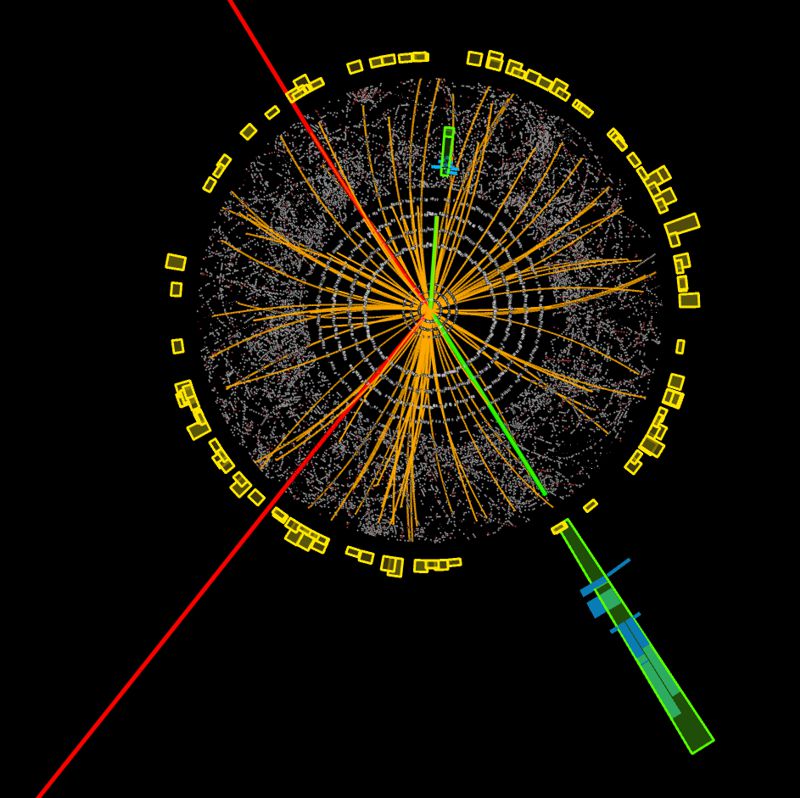
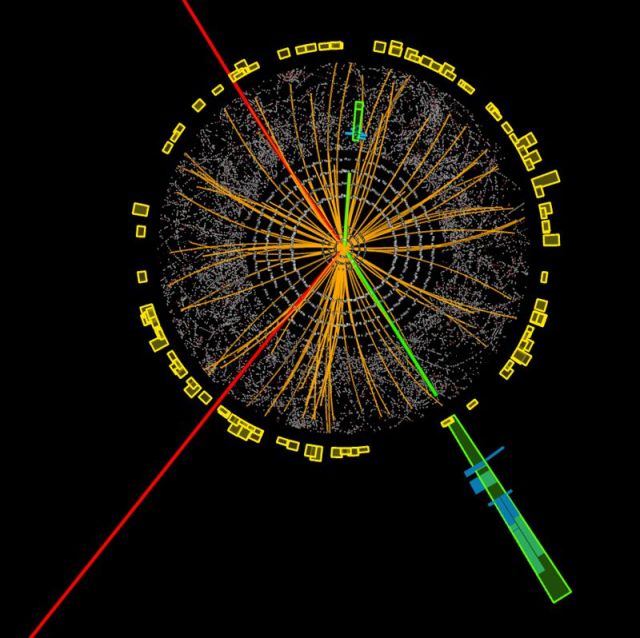
Higgs candidate LHC event trace
Electrons (green) and muons (red) exiting the event

~~ Rich Olcott

Neutral

It’s that kind of an afternoon. Finished up one project, don’t feel much like starting another. Spring rain outside so instead of walking to Al’s for coffee I take the elevator down to Pizza Eddie’s on 2. Looks like other folks have the same feeling. “Afternoon, all. What’s the current topic of conversation?”

“Well, Sy, it started out as Star Wars versus Star Trek but then Jim said he could care less and Susan said that meant he did care and he said no, he’s ambivalent and she said that still meant he cared, and—”

“I get it, Eddie. Susan, why does ‘ambivalent‘ mean Jim cares?”

“Chemistry, Sy. ‘Valence‘ means ‘bonding‘ and ‘ambi-‘ means ‘both‘ so ‘ambi‑valent‘ means ‘bonded to both‘.”

“But Susan, ambidextrous means able to use both hands, not unable to use either hand. I want to say I don’t particularly like or dislike either one.”

“It’s like trying to decide between fire ants or hornets. You could say ‘No‑win,’ right?”

“No, that’s not it, either, Eddie. That’s ‘everybody loses.’ I’m smack in the middle.”

“Sounds like absolute neutrality. Hard to get there.”

“Don’t look at Chemistry. If I take an acid solution and add just enough base to get to neutral pH, there’s still tenth‑micromolar concentrations of acid and base in there. I guess we could call that ambivalent.”

“Neutrality’s hard for humans and chemicals, yeah, but that’s where the Universe is.”

“Why do you say that, Jim?”

“Because we’ve got proof right in front of us. Look, planets and stars and people exist as distinct objects, right? They’re not a finely-divided mist.”

“So?”

“So if the Universe were not exactly electrically neutral, then opposite charges repelling would split everything apart.”
 ”Wait, nothing would have a chance to form in the first place.”
   ”Wait, couldn’t you have lumps of like 99 positives and 100 negatives or whatever that just cancel out?”

“Eddie, when you say ‘cancel out’ you’re still talking about being absolutely neutral at the lump level. It’s like this table salt that has positive sodium ions and negative chlorides but the crystals are neutral or we’d get sparks when I pour some out like this.”
 ”Hey, don’t waste the salt. Costs money.”

“I still think it’s weird how all electrons have the same charge and it’s exactly the same as the proton charge. Protons are made of quarks, right, and electrons aren’t. So how can you take three of something and have that add up to exactly one of something different?”

“I can give you Feynman and Wheeler’s answer to part of that, Susan. The electron has an anti‑partner, the positron, which is exactly like the electron in every way except it has the opposite charge. When electron and positron meet they annihilate to produce a burst of high‑energy photons. But there’s a flip side — high‑energy photons sometimes interact to make an electron‑positron pair. Feynman and Wheeler were both jokers. They suggested that a positron could be an electron traveling backward in time. Wheeler said, ‘Maybe they’re all the same electron,’ zig‑zagging across eternity. But that doesn’t account for the quarks. A proton has two up‑quarks, each with a charge of negative 2/3 electron, and one down‑quark with a charge of positive 1/3 electron. Add ’em up — you exactly neutralize one electron. Fun, huh?”

“Fun, Jim, but I’m a chemist. On a two-pan balance I can weigh out equal quantities of molasses and rock dust but I don’t expect them to interact with any simple mathematical relationship. Why should the quark’s charge be any exact multiple or divisor of the electron’s? And why is the electron charge the size it is instead of some other number?”

“Well, there you’ve got me. The quantum chromodynamics Standard Model has been amazingly successful for quantitative predictions, but not so good for explaining things outside of its own terms. The math lays out the relationship between quark and electron charge, but doesn’t give us a physical ‘why.’ The theory has 19 ‘adjustable constants’ but no particular reason why they should have the specific values that fit the observations. Also, the theory doesn’t include gravity. It’s a little embarrassing.”

“Sounds like you’re ambivalent about the theory.”

~~ Rich Olcott

Space Potatoes

“Uncle Sy, what’s the name of the Moon face that’s just a sliver?”

“It’s called a crescent, Teena, and it’s ‘phase,’ not ‘face’. Hear the z-sound?”

“Ah-hah, one of those spelling things, huh?”

“I’m afraid so. What brought that question up?”

“I was telling Bratty Brian about the Moon shadows and he said he saw a cartoon about something that punched a hole in the Moon and left just the sliver.”

“Not going to happen, Sweetie. Anything as big as the Moon, Mr Newton’s Law of Gravity says that it’ll be round, mostly, except for mountains and things.”

“Cause there’s something really heavy in the center?”

“No, and that’s probably what shocked people the most back in those days. They had Kings and Emperors, remember, and a Pope who led all the Christians in Europe. People expected everything to have some central figure in charge. That’s why they argued about whether the center of the Universe was the Earth or the Sun. Mr Newton showed that you don’t need anything at all at the center of things.”

“But then what pulls the things together?”

“The things themselves and the rules they follow. Remember the bird murmuration rules?”

“That was a long time ago, Uncle Sy. Umm… wasn’t one rule that each bird in the flock tries to stay about the same distance from all its neighbors?”

“Good memory. That was one of the rules. The others were to fly in the same general direction as everybody else and to try stay near the middle of the flock. Those three rules pretty much kept the whole flock together and protected most of the birds from predators. Mr Newton had simpler rules for rocks and things floating in space. His first rule was. ‘Keep going in the direction you’ve been going unless something pulls you in another direction.’ We call that inertia. The second rule explained why rocks fly differently than birds do.”

“Rocks don’t fly, Uncle Sy, they fall down.”

“Better to think of it as flying towards other things. Instead of the safe‑distance rule, Mr Newton said, ‘The closer two things are, the harder they pull together.’ Simple, huh?”

“Oh, like my magnet doggies.”

“Yes, exactly like that, except gravity always attracts. There’s no pushing away like magnets do when you turn one around. Suppose that back when the Solar System was being formed, two big rocks got close. What would happen?”

“They’d bang together.”

“And then?”

“They’d attract other rocks and more and more. Bangbangbangbang!”

“Right. What do you suppose happens to the energy from those bangs? Remember, we’re out in space so there’s no air to carry the sound waves away.”

“It’d break the rocks into smaller rocks. But the energy’s still there, just in smaller pieces, right?”

“The most broken-up energy is heat. What does that tell you?”

“The rock jumble must get … does it get hot enough to melt?”

“It can So now suppose there’s a blob of melted rock floating in space, and every atom in the melted rock is attracted to every other atom. Pretend you’re an atom out at one end of the blob.”

“I see as many atoms to one side as to the other so I’m gonna pull in towards the middle.”

“And so will all the other atoms. What shape is that going to make the blob?”

“Ooooh. Round like a planet. Or the Sun. Or the Moon!”

“So now tell me what would happen if someone punched a hole in the Moon?”

“All the crumbles at the crescent points would get pulled in towards the middle. It wouldn’t be a crescent any more!”

“Exactly. Mind you, if it doesn’t melt it may not be spherical. Melted stuff can only get round because molten atoms are free to move.”

“Are there not-round things in space?”

“Lots and lots. Small blobs couldn’t pull themselves spherical before freezing solid. They could be potato‑shaped, like the Martian moons Phobos and Deimos. Some rocks came together so gently that they didn’t melt. They just stuck together, like Asteroid Bennu where our OSIRIS-REx spacecraft sampled.”

“Space has surprising shapes, huh?”

“Space always surprises.”

~~ Rich Olcott

  • Thanks to Xander and Alex who asked the question.

Chutes And Landers

From: Robin Feder <rjfeder@fortleenj.com>
To: Sy Moire <sy@moirestudies.com>
Subj: Questions

Hello again, Mr Moire. Kalif and I have a question. We were talking about falling out of stuff and we wondered how high you have to fall out of to break every bone in your body. We asked our science teacher Mr Higgs and he said it was something that you or Randall Munroe could answer and besides he (Mr Higgs) had to get ready for his next online. Can you tell us? Sincerely, Robin Feder


From: Sy Moire <sy@moirestudies.com>
To: Robin Feder <rjfeder@fortleenj.com>
Subj: Re: Questions

Hello again, Robin. You do take after your Dad, don’t you? Please give my best to him and to Mr Higgs, who has a massive job. Mr Munroe may already have answered your question somewhere, but I’ll give it a shot.

You’ve assumed that the higher the fall, the harder the hit and the more bones broken. It’s not that simple. Suppose, for instance, that your fall is onto the Moon, whose gravity is 1/6 that of Earth. For any amount of impact, however high the fall would have been on Earth, it’d be six times higher on the Moon. So the answer depends where you’re falling.

But the Moon doesn’t have an atmosphere worth paying attention to. That’s important because atmospheres impose a speed limit, technically known as terminal velocity, that depends on a whole collection of things

  • the Mass of the falling object
  • the local strength of Gravity
  • the Density of the atmosphere
  • the object’s cross‑sectional Area in the direction of fall

The first two produce the downward pull of gravity, the others produce the upward push of air resistance. Fun fact — in Galileo’s “All things fall alike” experiments, he always used spheres in order to cancel the effects of air resistance in his comparisons.

Let’s put some numbers to it. Suppose someone’s at Earth’s “edge of space” 100 kilometers up. From the PE=m·g·h formula for gravitational potential energy and dividing out their mass which I don’t know, they have 9.8×10⁵ joules/kilogram of potential energy relative to Earth’s surface. Now suppose they convert that potential to kinetic energy by falling to the surface with no air resistance. Using KE=m·v² I calculate they’d hit at about 1000 meters/second. But in real life, the terminal velocity of a falling human body is about 55 meters/second.

That Area item is why parachutes work. Make a falling object’s area larger and it’ll have to push aside more air molecules on its way down. Anyone wanting to survive a fall wants as much area as they can get. A parachute’s fabric canopy gives them a huge area and a big help. Parachute drops normally hit at about 5 meters/second. Trained people walk away from that all the time. Mostly.

Which gets to the matter of how you land. Parachute training schools and martial arts dojos give you the same advice — don’t try to stop your fall, just tuck in your chin and twist to convert vertical kinetic energy to rolling motion. Rigid limbs lead to bones breaking, ligaments tearing and joints going out of joint.

So let’s talk bones. Adults have about 210 of them, about 90 fewer than when they were a kid. Bones start out as separate bony patches embedded in cartilage. The patches eventually join together as boney tissue and the cartilage proportion decreases with age. Bottom line — kid bones are bendy, old bones snap more easily. For your question, breaking “every bone in your body” is a bigger challenge if you’re young.

But all bones aren’t equal — some are more vulnerable than others. Sesamoid bones, like the ones at the base of your thumb, are millimeter‑sized and embedded in soft tissue that protects them. The tiny “hammer, anvil and stirrup” ear bones are buried deep in hard bony tissue that protects them, too. Thanks to bones and soft tissues that would absorb nearly all the energy of impact, these small bones are almost invulnerable.

To summarize, no matter how high up from Earth you fall from, you can’t fall fast enough to hit hard enough to break every bone in your body. Be careful anyhow.

Regards,
Sy Moire.

~~ Rich Olcott

  • Thanks to Xander and Lucas for their input.

Rotation, Revolution and The Answer

“Sy, I’m startin’ to think you got nothin’. Al and me, we ask what’s pushing the Moon away from us and you give us angular momentum and energy transfers. C’mon, stop dancin’ around and tell us the answer.”

“Yeah, Sy, gravity pulls things together, right, so how come the Moon doesn’t fall right onto us?”

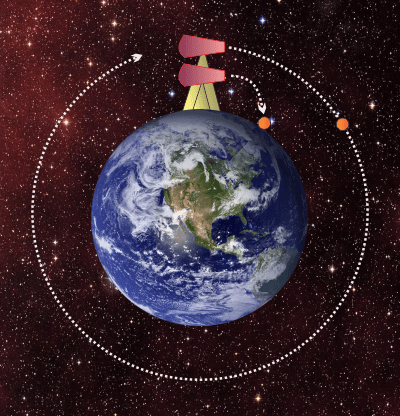
“Not dancing, Vinnie, just laying some groundwork for you. Newton answered Al’s question — the Moon is falling towards us, but it’s going so fast it overshoots. That’s where momentum comes in, Vinnie. Newton showed that a ball shot from a cannon files further depending on how much momentum it gets from the initial kick. If you give it enough momentum, and set your cannon high enough that the ball doesn’t hit trees or mountains, the ball falls beyond the planet and keeps on falling forever in an elliptical orbit.”

“Forever until it hits the cannon.”

“hahaha, Al. Anyway, the ball achieves orbit by converting its linear momentum to angular momentum with the help of gravity. The angular momentum pretty much defines the orbit. In Newton’s gravity‑determined universe, momentum and position together let you predict everything.”

“Linear and angular momentum work the same way?”

“Mostly. There’s only one kind of linear momentum — straight ahead — but there are two kinds of angular momentum — rotation and revolution.”

“Aw geez, there’s another pair of words I can never keep straight.”

“You and lots of people, Vinnie. They’re synonyms unless you’re talking technicalese. In Physics and Astronomy, rotation with the O gyrates around an object’s own center, like a top or a planet rotating on its axis. Revolution with the E gyrates around some external location, like the planet revolving around its sun. Does that help?”

“Cool, that may come in handy. So Newton’s cannon ball got its umm, revolution angular momentum from linear momentum so where does rotation angular momentum come from?”

“Subtle question, Vinnie, but they’re actually all just momentum. Fair warning, I’m going to avoid a few issues that’d get us too far into the relativity weeds. Let’s just say that momentum is one of those conserved quantities. You can transfer momentum from one object to another and convert between forms of momentum, but you can’t create momentum in an isolated system.”

“That sounds a lot like energy, Sy.”

“You’re right, Al, the two are closely related. Newton thought that momentum was THE conserved quantity and all motion depended on it. His arch‑enemy Leibniz said THE conserved quantity was kinetic energy, which he called vis viva. That disagreement was just one battle in the Newton‑Leibniz war. It took science 200 years to understand the momentum/kinetic energy/potential energy triad.”

“Wait, Sy, I’ve seen NASA steer a rocketship and give it a whole different momentum. I don’t see no conservation.”

“You missed an important word, Vinnie — isolated. Momentum calculations apply to mechanical systems — no inputs of mass or non‑mechanical energy. Chemical or nuclear fuels break that rule and get you into a different game.”

“Ah-hahh, so if the Earth and Moon are isolated…”

“Exactly, and you’re way ahead of me. Like we said, no significant net forces coming from the Sun or Jupiter, so no change to our angular momentum.”

“Hey, wait, guys. Solar power. I know we’ve got a ton of sunlight coming in every day.”

“Not relevant, Al. Even though sunlight heats the Earth, mass and momentum aren’t affected by temperature. Anyhow, we’re finally at the point where I can answer your question.”

“About time.”

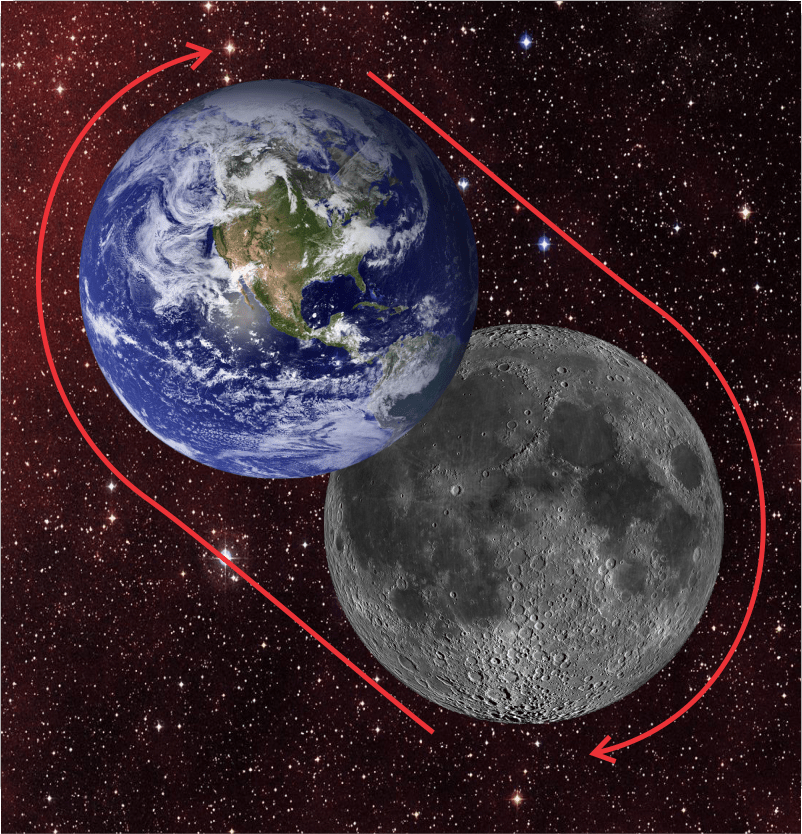
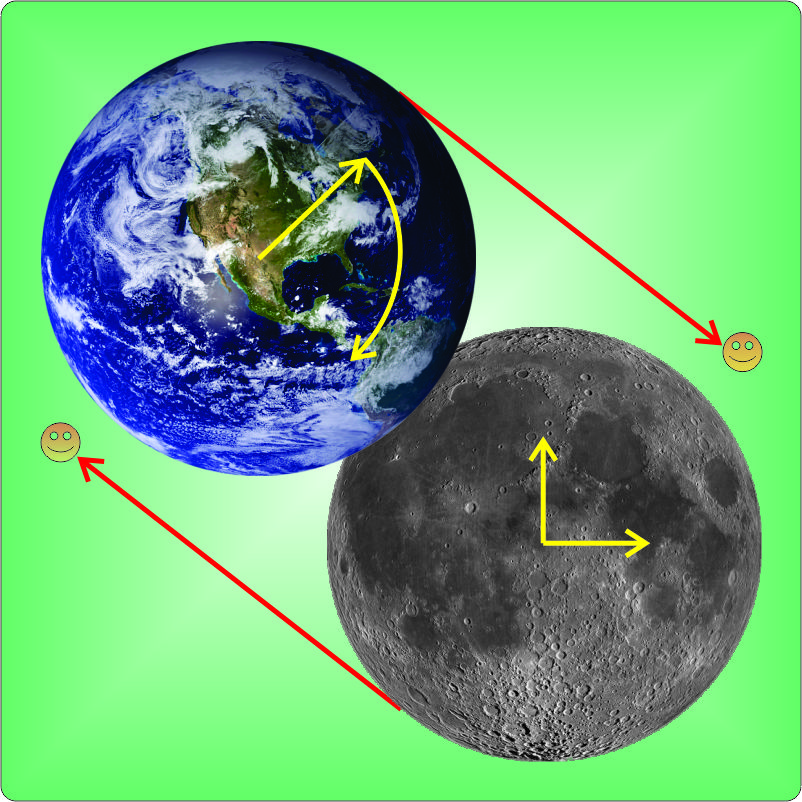
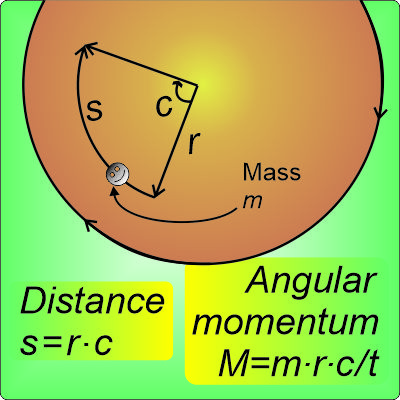
“Hush. OK, here’s the chain. Earth rotates beneath the Moon and gets its insides stirred up by the Moon’s gravity. The stirring is kinetic energy extracted from the energy of the Earth‑Moon system. The Moon’s revolution or the Earth’s rotation or both must slow down. Remember the M=m·r·c/t equation for angular momentum? The Earth‑Moon system is isolated so the angular momentum M can’t change but the angular velocity c/t goes down. Something’s got to compensate. The system’s mass m doesn’t change. The only thing that can increase is distance r. There’s your answer, guys — conservation of angular momentum forces the Moon to drift outward.”

“Long way to the answer.”

“To the Moon and back.”

~~ Rich Olcott

Here’s a Different Angle

“OK, Sy, so there’s a bulge on the Moon’s side of the Earth and the Earth rotates but the bulge doesn’t and that makes the Moon’s orbit just a little bigger and you’ve figured out that the energy it took to lift the Moon raised Earth’s temperature by a gazillionth of a degree, I got all that, but you still haven’t told Al and me how the lifting works.”

“You wouldn’t accept it if I just said, ‘The Moon lifts itself by its bootstraps,’ would you?”

“Not for a minute.”

“And you don’t like equations. <sigh> OK, Al, pass over some of those paper napkins.”

“Aw geez, Sy.”

“You guys asked the question and this’ll take diagrams, Al. Ante up. … Thanks. OK, remember the time Cathleen and I caught Vinnie here at Al’s shop playing with a top?”

“Yeah, and he was spraying paper wads all over the place.”

“I wasn’t either, Al, it was the top sending them out with centri–…, some force I can never remember whether it’s centrifugal or centripetal.”

“Centrifugal, Vinnie, –fugal– like fugitive, outward‑escaping force. It’s one of those ‘depends on how you look at itfictitious forces. From where you were sitting, the wads looked like they were flying outward perpendicular to the top’s circle. From a wad’s point of view, it flew in a straight line tangent to the circle. It’s like we have two languages, Room and Rotor. They describe the same phenomena but from different perspectives.”

“Hey, it’s frames again, ain’t it?”

“Newton’s inertial frames? Sort‑of but not quite. Newton’s First Law only holds in the Room frame — no acceleration, motion is measured by distance, objects at rest stay put. Any other object moves in a straight line unless its momentum is changed by a force. You can tackle a problem by considering momentum and force components along separate X and Y axes. Both X and Y components work the same way — push twice as hard in either direction, get twice the acceleration in that direction. Nice rules that the Rotor frame doesn’t play by.”

“I guess not. The middle’s the only place an object can stay put, right?”

“Exactly, Al. Everything else looks like it’s affected by weird, constantly‑varying forces that’re hard to describe in X‑Y terms.”

“So that breaks Newton’s physics?”

“Of course not. We just have to adapt his F=m·a equation (sorry, Vinnie!) to Rotor conditions. For small movements we wind up with two equations. In the strict radial direction it’s still F=m·a where m is mass like we know it, a is acceleration outward or inward, and F is centrifugal or centripetal, depending. Easy. Perpendicular to ‘radial‘ we’ve got ‘angular.’ Things look different there because in that direction motion’s measured by angle but Newton’s Laws are all about distances — speed is distance per time, acceleration is speed change per time and so forth.”

“So what do you do?”

“Use arc length. Distance along an arc is proportional to the angle, and it’s also proportional to the radius of the arc, so just multiply them together.”

“What, like a 45° bend around a 2-foot radius takes 90 feet? That’s just wrong!”

“No question, Al. You have to measure the angle in the right units. Remember the formula for a circle’s circumference?”

“Sure, it’s 2πr.”

“Which tells you that a full turn’s length is times the radius. We can bridge from angle to arc length using rotational units so that a full turn, 360°, is units. We’ll call that unit a radian. Half a circle is π radians. Your 45° angle in radians is π/4 or about ¾ of a radian. You’d need about (¾)×(2) or 1½ feet of whatever to get 45° along that 2-foot arc. Make sense?”

“Gimme a sec … OK, I’m with you.”

“Great. So if angular distance is radius times angle, then angular momentum which is mass times distance per time becomes mass times radius times angle per time.”

“”Hold on, Sy … so if I double the mass I double the momentum just like always, but if something’s spinning I could also double the angular momentum by doubling the radius or spinning it twice as fast?”

“Couldn’t have put it better myself, Vinnie.”

~~ Rich Olcott

Moon Shot

<chirp, chirp> “Moire here.”

“Hi, Mr Moire, it’s Jeremy. Hey, I’ve been reading through some old science fiction stories and I ran across some numbers that just don’t look right.”

“Science fiction can be pretty clunky. Some Editors let their authors play fast and loose on purpose, just to generate Letters to The Editor. Which author and what story?”

“This is Heinlein, Mr Moire. I know his ideas about conditions on Mars and Venus were way off but that was before we had robot missions that could go there and look. When he writes about space navigation, though, he’s always so specific it looks like he’d actually done the calculations.”

“OK, which story and what numbers?”

“This one’s called, let me check, Gentlemen, Be Seated. It’s about these guys who get trapped in a tunnel on the Moon and there’s a leak letting air out of the tunnel so they seal the leak when one of the guys —”

“I know the story, Jeremy. I’ve always wondered if it was Heinlein or his Editor who got cute with the title. Anyway, which numbers bothered you?”

“I kinda thought the title came first. Anyway, everybody knows that the Earth’s gravity is six times the Moon’s, but he says that the Earth’s mass is eighty times the Moon’s and that’s why the Earth raises tides on the Moon except they’re rock tides, not water tides, and the movement makes moonquakes and one of them might have caused the leak. So why isn’t the Earth’s gravity eighty times the Moon’s, not six?”

“Read me the sentence about eighty.”

“Umm … here it is, ‘Remember, the Earth is eighty times the mass of the Moon, so the tidal stresses here are eighty times as great as the Moon’s effect on Earth tides.‘ I checked the masses in Wikipedia and eighty is about right.”

“I hadn’t realized the ratio was that large, I mean that the Moon is that small. One point for Heinlein. Anyway, you’re comparing north and east. The eighty and the six both have to do with gravity but they’re pointing in different directions.”

“Huh? I thought gravity’s pull was always toward the center.”

“It is, but it makes a difference where you are and which center you’re thinking about. You’re standing on the Earth so the closest center to you is Earth’s and most of the gravity you feel is the one-gravity pull from there. Suppose you’re standing on the Moon —”

“One-sixth, I know, Mr Moire, but why isn’t it one‑eightieth?”

“Because on the Moon you’re a lot closer to the center of the Moon than you were to the center of the Earth back on Earth. Let’s put some numbers to it. Got a calculator handy?”

“Got my cellphone.”

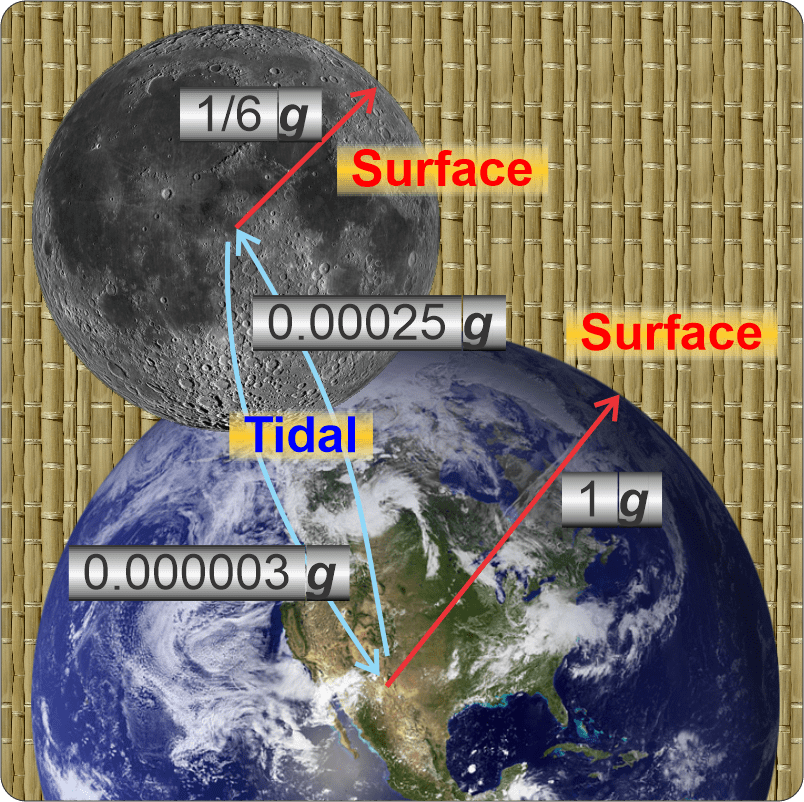
“Duh. OK, Newton showed us that an object’s gravitational force is proportional to the object’s mass divided by the square of the distance to the center. Earth’s radius is about 4000 miles and the Moon’s is about a quarter of that, so take the mass as 1/80 and divide by 1/4 squared. What do you get?”

“Uhh … 0.2 gravities.”

“One-fifth g. Close enough to one-sixth. If we used accurate numbers we’d be even closer. See how distance makes a difference?”

“Mm-hm. What about Heinlein’s tidal stuff?”

“Ah, now that’s looking in the other direction, where the distance is a lot bigger. Earth-to-Moon is about 250,000 miles. Standing on the Moon, you’d feel Earth’s one‑g gravity diminished by a factor of 4000/250000 squared. What’s that come to?”

“Umm… the distance factor is (4000/250000)² … I get 250 microgravities. Not much. Heinlein made a good bet with his characters deciding that the leak was caused by a nearby rocket crash instead of a moonquake.”

“How about Heinlein’s remark about the Moon’s effect on Earth?”

“Same distance but one eightieth the mass so I divide by 80 — three microgravities. Wow! That can’t possibly be strong enough to raise tides here.”

“It isn’t, though that’s the popular idea. What really happens is that the Moon’s field pulls water sideways from all directions towards the sub‑Lunar point. Sideways motion doesn’t fight Earth’s gravity, it just makes the water pile up in the center.”

“Hah, piled-up water. Weird. Well, I feel better about Heinlein now.”

~~ Rich Olcott

The Latte Connection

An early taste of Spring’s in the air so Al’s set out tables in front of his coffee shop. I’m enjoying my usual black mud when the Chemistry Department’s Susan Kim passes by carrying her usual mocha latte. “Hi, Sy, mind if I take the socially distant chair at your table?”

“Be my guest, Susan. What’s going on in your world?”

“I’ve been enjoying your hysteresis series. It took me back to Physical Chemistry class. I’m intrigued by how you connected it to entropy.”

“How so?”

“I think of hysteresis as a process, but entropy is a fixed property of matter. If I’m holding twelve grams of carbon at room temperature, I know what its entropy is.”

“Mmm, sorta. Doesn’t it make a difference whether the carbon’s a 60‑carat diamond or just a pile of soot?”

“OK, I’ll give you that, the soot’s a lot more random than the diamond so its entropy is higher. The point remains, I could in principle measure a soot sample’s heat capacity at some convenient temperature and divide that by the temperature. I could repeat that at lower and lower temperatures down to near absolute zero. When I sum all those measurements I’ll have the entropy content of the sample at my starting temperature.”

“A classical definition, just what I’d expect from a chemist. But suppose your soot spills out of its test tube and the breeze spreads it all over the neighborhood. More randomness, higher entropy than what you measured, right?”

“Well, yes. I wouldn’t have a clue how to calculate it, but that goes way beyond Carnot’s and Clausius’ original concept.”

“So entropy has at least a thin linkage with history and hysteresis. To you chemists, though, an element or compound is timeless — lead or water have always been lead or water, and their physical constants are, well, constant.”

“Not quite true, Sy. Not with really big molecules like proteins and DNA and rubber and some plastics. Squirt a huge protein like catalase through a small orifice and its properties change drastically. It might not promote any reaction, much less the one Nature designed it for. Which makes me think — Chemistry is all about reactions and they take time and studying what makes reactions run fast or slow is a big part of the field. So we do pay attention to time.”

“Nice play, Susan! You’re saying small molecules aren’t complex enough to retain memories but big ones are. I’ll bet big molecules probably exhibit hysteresis.”

“Sure they do. Rubber molecules are long-chain polymers. Quickly stretch a rubber band to its limit, hold it there a few seconds then let go. Some of the molecular strands lock into the stretched configuration so the band won’t immediately shrink all the way down to its original size. There’s your molecular memory.”

“And a good example it is — classic linear Physics. How much force you exert, times the distance you applied it through, equals the energy you expended. Energy’s stored in the rubber’s elasticity when you stretch it, and the energy comes back out on release.”

“Mostly right, Sy. You actually have to put in more energy than you get out — Second Law of Thermodynamics, of course — and the relationship’s not linear. <rummaging into purse> Thought I had a good fat rubber band somewhere … ah‑hah! Here, stretch this out while you hold it against your forehead. Feel it heat up briefly? Now keep checking for heat while you relax the band.”

“Hey, it got cold for a second!”

“Yep. The stretched-out configuration is less random so its entropy and heat capacity are lower than the relaxed configuration’s. The stretched band had the same amount of heat energy but with less heat required per degree of temperature, that amount of energy made the band hotter. Relaxing the band let its molecules get less orderly. Heat capacity went back up. temperature went back down.”

“Mmm-HM. My hysteresis diagram’s upward branch is stretch energy input and the downward branch is elastic energy output. The energy difference is the area inside the hysteresis curve, which is what’s lost to entropy in each cycle and there we have your intriguing entropy‑hysteresis connection. Still intrigued?”

“Enough for another latte.”

~~ Rich Olcott

Hysteresis Everywhere

“We’ve known each other for a long time, ain’t we, Sy?”

“That we have, Vinnie.”

“So I get suspicious when we’ve specific been talking about a magnetic field making something else magnetic and you keep using general words like ‘driver‘ and ‘deviation‘. You playing games?”

“You caught me. The hysteresis idea spreads a lot farther than magnetism. It addresses an entire dimension Newton was too busy to think about — time.”

“Wait a minute. Newton was all about velocity and acceleration and both of them are something‑per‑time. It’s right there in the units. Twice for acceleration.”

“True, but each is really about brief time intervals. Say you’re riding a roller‑coaster. Your velocity and acceleration change second‑by‑second as forces come at you. Every force changes your net acceleration immediately, not ten minutes from now. Hysteresis is about change that happens because of a cause some time in the past. Newton didn’t tackle time‑offset problems, I suppose mostly because the effects weren’t detectable with the technology of his time.”

“They had magnets.”

“Permanent ones, not electromagnets they could control and measure the effects of. Electromagnetic hysteresis generates effects that Newton couldn’t have known about. Fahrenheit didn’t invent temperature measurement until two years before Newton died, so science hadn’t yet discovered temperature‑dependent hysteresis effects. The microscope had been around for a half‑century or so but in Newton’s day people were still arguing about whether cells were a necessary part of a living organism. Newton’s world didn’t have an inkling of cellular biophysics, much less biophysical hysteresis. At human scale, country‑level economic data if it existed at all was a military secret — not a good environment for studying cases of economic hysteresis.”

“So what you’re saying is that Newton couldn’t have tackled those even if he’d wanted to. Got it. But that’s a pretty broad list of situations. How can you say they’re all hystereseseses, … loopy things?”

“They’ve all got a set of characteristics that you can fit into similar mathematical models. They’re all about some statistical summary of a complex system. The system is under the influence of some outside driver, could be a physical force or something more abstract. The driver can work in either of two opposing directions, and the system can respond to the driver to change in either of two opposing ways. Oh, and a crucial characteristic is that the system has a buffer of some sort that saves a memory of what the driver did and serves it up some time later.”

“Wait, lemme see if I can match those pieces to my magnetic nail. OK, the driver is the outside magnetic field, that’s easy, the system is the magnetic iron atoms, and the summary is the nail’s field. The driver can point north‑to‑south or south‑to‑north and the atoms can, too. Ah, and the memory is the domains ’cause the big ones hold onto the direction the field pointed last. How’d I do?”

“Perfect.”

“Goody for me. So why are those guys on the radio saying the economy is hysterical, ‘scuse, has hysteresis? What’s which part?”

“Economies are complex beasts, with a lot of separate but interacting hysteresis loops. These guys, what were they discussing at the time?”

“Unemployment, if I remember right. They said the job market is sticky, whatever that means.”

“Good example. Here’s our basic hysteresis loop with some relabeling. Running across we’ve got our driver, the velocity of money, which claims to measure all the buying and selling. Up‑and‑down we’ve got total employment. The red dot is the initial equilibrium, some intermediate level where there’s just enough cash flowing around that some but not all people have jobs. Then a new industry, say cellphones, comes in. Suddenly there’s people making cellphones, selling cellphones, repairing cellphones –“

“I get the idea. More activity, money flows faster, more jobs and people are happy. OK, then the pandemic comes along, money slows down, jobs cut back and around we go. But where’s the stickiness?”

“In people’s heads. If they get into Depression thinking, everyone holds onto cash even if there’s a wonderful new cellphone out there. People have to start thinking that conditions will improve before conditions can improve. That’s the delay factor.”

“Hysterical, all right.”

~~ Rich Olcott
Elephant And Pengy

(a hat-tip to Mo Willems, whose Elephant and Piggy books helped my grandkids discover reading)

“Hey, Sy, how come my magnetized nail’s hysteresis loop is so wide? It makes sense that the end‑case magnetizing happens because all the iron atoms get lined up in one direction or the other. But why ain’t the blue up‑curve right on top of the down‑curve?”

“Why do you think it should be, Vinnie?”

“Well, the red curve’s different because you got the outside field herding the iron atoms into domains where they all point the same way and that makes the nail’s magnetism grow from zero, and then the domains that agree with the outside magnetic field eat up the other domains until like I said they saturate. But on both sides of the blue loop the domains already exist, right, so the herding’s all done. Up or down it’s only domains growing and shrinking. Seems to me that the curves oughta be the same.”

“They are, near as I could draw them. You’re just not looking at them right. Rotate it 180°, see how they match up.”

“How ’bout that, they do, mostly. What’s going on?”

“You picked up that the vertical axis represents strength and direction, but you missed that the horizontal axis also represents strength and direction. Neither axis starts at zero, they’re both centered on zero. The driver is the outside magnetic field. No strength in the middle, increasing north‑bound strength to the right, south‑bound strength to the left. Start at the head‑end‑north corner and go down branch 2. The north‑bound driver strength decreases. That relaxes some of those north‑pointing domains and the nail’s net magnetism decreases just a bit. When the outside field’s strength gets down to neutral, about at the upper arrow, the nail’s still strongly magnetized. Most of the domains remember which way they were pointing. That’s the history that makes this hysteresis. The domains stay there until the outside field gets strong enough south‑bound to make a difference. That grows the south‑bound domains at the expense of northbound ones. All that goes on until we get to saturation at head‑end‑south corner and then we run exactly the reverse sequence. For most materials, the two extreme fields have the same strength, just opposite directions.”

“Wait, you said ‘for most materials.’ Different materials have different widths on that picture?”

“Good catch. Yes, there’s ‘hard‘ ones like rare earth magnets. They have a really wide hysteresis loop you can’t demagnetize without a really strong field. That’s good for where you want a permanent magnet that you don’t want to have to recalibrate, like on a spacecraft bound for Jupiter. You’d want a ‘soft magnet‘ with a narrow hysteresis loop for something like a transformer core that has to switch polarity sixty times a second.”

<longish contemplative silence> “Sy, I just got a great idea! And it uses that entropy elephant stuff you wrote about.”

“All right, out with it.”

“OK. When the nail is magnetized, it’s got all or at least most of its iron atoms pointing in the same direction, right? And when the outside field demagnetizes it, the atoms point all over the place, right? So the not‑magnetized nail has randomness, that’s entropy, and the magnetized one doesn’t. Where did the entropy come from? Gotta be from the outside, right? Can we use this to like suck entropy out of things?”

“Right, right and sorta right. I’m not happy with the idea of pumping entropy around. What’s really in play is energy, sometimes as magnetic field energy and sometimes as heat. You’ve got the core idea for a magnetic refrigerator. Put a field‑magnetized transfer material in contact with what you want to cool, then turn off the outside field. Heat from the target flows into the material, jiggles the atoms and scrambles the magnetization. Break the contact, cool and re‑magnetize the material and repeat. The idea’s been around since the late 1800s. The problem has been finding the right material to make it work. The best stuff has a tall, narrow hysteresis loop so it can be strongly magnetized yet forget it easily. Researchers have finally found some good candidates.”

“Too late to the party, huh?”

“Sorry.”

~~ Rich Olcott