Gentle pressure in the dark

“C’mon in, the door’s open.”

Vinnie clomps in and he opens the conversation with, “I don’t believe that stuff you wrote about LIGO.  It can’t possibly work the way they say.”

“Well, sir, would you mind telling me why you have a problem with those posts?”  I’m being real polite, because Vinnie’s a smart guy and reads books.  Besides, he’s Vinnie.

“I’m good with your story about how Michelson’s interferometer worked and why there’s no æther.  Makes sense, how the waves mess up when they’re outta step.  Like my platoon had to walk funny when we crossed a bridge.  But the gravity wave thing makes no sense.  When a wave goes by maybe it fiddles space but it can’t change where the LIGO mirrors are.”

“Gravitational wave,” I murmur, but speak up with, “What makes you think that space can move but not the mirrors?”

“I seen how dark energy spreads galaxies apart but they don’t get any bigger.  Same thing must happen in the LIGO machine.”

“Not the same, Vinnie.  I’ll show you the numbers.”

“Ah, geez, don’t do calculus at me.”de-vs-gravity

“No, just arithmetic we can do on a spreadsheet.” I fire up the laptop and start poking in  astronomical (both senses) numbers.  “Suppose we compare what happens when two galaxies face each other in intergalactic space, with what happens when two stars face each other inside a galaxy.  The Milky Way’s my favorite galaxy and the Sun’s my favorite star.  Can we work with those?”

“Yeah, why not?”

“OK, we’ll need a couple of mass numbers.  The Sun’s mass is… (sound of keys clicking as I query Wikipedia) … 2×1030 kilograms, and the Milky Way has (more key clicks) about 1012 stars.  Let’s pretend they’re all the Sun’s size so the galaxy’s mass is (2×1030)×1012 = 2×1042 kg. Cute how that works, multiplying numbers by adding exponents, eh?”

“Cute, yeah, cute.”  He’s getting a little impatient.

“Next step is the sizes.  The Milky Way’s radius is 10×104 lightyears, give or take..  At 1016 meters per lightyear, we can say it’s got a radius of 5×10²⁰ meters.  You remember the formula for the area of a circle?”

“Sure, it’s πr2.” I told you Vinnie’s smart.

“Right, so the Milky Way’s area is 25π×1040 m2.  Meanwhile, the Sun’s radius is 1.4×10⁹ m and its cross-sectional area must be 2π×1018 m2.  Are you with me?”

“Yeah, but what’re we doing playing with areas?  Newton’s gravity equations just talk about distances between centers.”  I told you Vinnie’s smart.

“OK, we’ll do gravity first.  Suppose we’ve got our Milky Way facing another Milky Way an average inter-galactic distance away.  That’s about 60 galaxy radii,  about 300×1020 meters.  The average distance between stars in the Milky Way is about 4 lightyears or 4×10¹⁶ meters.  (I can see he’s hooked so I take a risk)  You’re so smart, what’s that Newton equation?”

Force or potential energy?”

“Alright, I’m impressed.  Let’s go for force.”

“Force equals Newton’s G times the product of the masses divided by the square of the distance.”

“Full credit, Vinnie.  G is about 7×10-11 newton-meter²/kilogram², so we’ve got a gravity force of (typing rapidly) (7×10-11)×(2×1042)×(2×1042)/(300×1020)² = 3.1×1029 N for the galaxies, and (7×10-11)×(2×1030)×(2×1030)/(4×1016)² = 1.75×10¹⁷ N for the stars.  Capeesh?”

“Yeah, yeah.  Get on with it.”

“Now for dark energy.  We don’t know what it is, but theory says it somehow exerts a steady pressure that pushes everything away from everything.  That outward pressure’s exerted here in the office, out in space, everywhere.  Pressure is force per unit area, which is why we calculated areas.

“But the pressure’s really, really weak.  Last I saw, the estimate’s on the order of 10-9 N/m².  So our Milky Way is pushed away from that other one by a force of (10-9)×(25π×1040) ≈ 1031 N, and our Sun is pushed away from that other star by a force of (10-9)×(2π×1018) ≈ 1010 N with rounding.  Here, look at the spreadsheet summary…”

 Force, newtons Between Galaxies Between stars
Gravity 3.1×1029 1.75×10¹⁷
Dark energy 1031 1010
Ratio 3.1×10⁻² 17.5×10⁶

“So gravity’s force pulling stars together is 18 million times stronger than dark energy’s pressure pushing them apart.  That’s why the galaxies aren’t expanding.”

“Gotta go.”

(sound of door-slam )

“Don’t mention it.”

~~ Rich Olcott

Here we LIGO again…

I suddenly smelled mink musk, vintage port, and warm honey on fresh-baked strawberry scones.

“C’mon in, Ramona, the door’s open.”

She oscillated in with a multi-dimensional sinusoidal motion that took my breath away and a smile that brought it back.

“Hi, Sy.  I came right over as soon as I got the news.”

“What news is that, Sugar Lumps?”

“LEGO, Sy, they’ve switched LEGO to science mode!”

“That’s LIGO, sweetheart, Laser Interferometer Gravitational-wave Observatory.”  She means well, but she’s Ramona.  “LEGOs are designed to hurt your feet, LIGO’s designed to look at the Universe.”

“Whatever.  I knew you wrote a . whole . series . of . posts . about . it so I thought you’d want to know.”

“It’s worth chasin’ down, doll-face.  Thanks.”symoire

So I headed over to the campus coffee shop.  It just happens to be located between the Astronomy building and the Physics building so I figured it as a good source.  Al was in his usual place at the cash register.

“Hi, Sy.  Haven’t seen you in a while.”

“Been busy, Al.  Lotsa science going on these days.”

“Good, good.   Say, have you heard about LEGO goin’ live?”

“That’s LIGO, Al.  Yeah, Ramona told me.  So what’s the word?”

“OK, you know all about how when they first turned it on for engineering tests back in September, it blew everyone’s mind that they caught a signal almost immediately?”

“Yeah, that’s when I started writing about it.  Two 30-solar-mass black holes collided and jolted the gravitational field of the Universe.  When the twin LIGOs detected that jolt, it confirmed three predictions that came out of Einstein’s General Relativity theory.”

“Had you heard about the second signal they caught the day after Christmas, from a couple of smaller black holes?”

“I bet you sold a lot of coffee that week.”

“You couldn’t believe.  Those guys had so much caffeine in ’em they didn’t even notice New Years.”

“So what came out of that?”

“Like I said, these were smaller black holes, about 10 solar masses each instead of 30, and that’s really got the star-modelers scratching their heads.”

“How so?”

“Well, we pretty much know how to make a black hole that’s just a bit heavier than the Sun.  Say a star’s between 1.3 and 3 solar masses.  When it burns enough of its fuel that its heat energy can’t keep it puffed up against gravity the whole thing collapses down to a black hole.”

“What happens if it’s bigger than that?  Wouldn’t you just get a bigger black hole?”

“That’s the thing.  If it’s above that threshold, the outermost infalling matter meets the outgoing explosion and makes an even bigger explosion, a supernova.  So much matter gets blown away that what’s left is too small to be a black hole.  You just get a white dwarf star or a neutron star, depending.”

“But these signals came from black holes 3-10 times that upper limit.  Where did they come from?”

“That’s why the head-scratching, Sy.  I mean, no-one knows how to make even one and yet they seem to be so common that two pairs of ’em found each other and collided less than four months apart.  The whole theory is up for grabs now.”

“So we got all that just from the engineering test phase, eh?  What’ve they done since that?”

“Oh, the usual tinkering and tweaking.  The unit down in Livingston LA is about 25% more sensitive now, especially in the lower-frequency range.  That’s mostly because they found and plugged some light-leaks and light-scattering hot-spots here and there along its five miles of steel pipe.  LIGO doesn’t look at incoming light, but it does use laser light to detect the gravitational variation.  The Hanford WA unit boosted the power going to its laser and they’ve improved stability in its detectors, made ’em more robust against wind and low-frequency seismic activity.  You know, engineer stuff.  So now they say they’re ready to do science.”

“I can’t write that the tweaks’ll let us look deeper into the Universe, ’cause LIGO doesn’t pick up light waves.  How about I say we get a better feel for things?”

“Sounds ’bout right, Sy.”

“Oh, and give me one of those strawberry scones.  For some reason they look really good today.”

~~ Rich Olcott

The Solar System is in gear

Pythagoras was onto far more than he knew.  He discovered that a stretched string made a musical tone, but only when it was plucked at certain points.  The special points are those where the string lengths above and below the point are in the ratio of small whole numbers — 1:1, 1:2, 2:3, ….  Away from those points you just get a brief buzz.  All of Western musical theory grew out of that discovery.

sinesThe underlying physics is straightforward.  The string produces a stable tone only if its motion has nodes at both ends, which means the vibration has to have a whole number of nodes, which means you have to pluck halfway between two of the nodes you want.  If you pluck it someplace like 39¼:264.77 then you excite a whole lot of frequencies that fight each other and die out quickly.

That notion underlies auditorium acoustics and aircraft design and quantum mechanics.  In a way, it also determines where objects reside in the Solar System.

If you’ve got a Sun with only one planet, that planet can pick any orbit it wants — circular or grossly elliptical, close approach or far, constrained only by the planet’s kinetic energy.

If you toss in a second planet it probably won’t last long — the two will smash together or one will fall into the Sun or leave the system.  There are half-a-dozen Lagrange points, special configurations like “all in a straight line” where things are stable.  Other than those, a three-body system lives in chaos — not even a really good computer program can predict where things will be after a few orbits.

geared-saturnAdd a few more planets in a random configuration and stability goes out the window — but then something interesting happens.  It’s the Chladni effect all over again.  Planets and dust and everything go rampaging around the system.  After a while (OK, a billion years or so) sweet-spot orbits start to appear, special niches where a planet can collect small stuff but where nothing big comes close enough to break it apart.  It’s not like each planet seeks shelter, but if it finds one it survives.
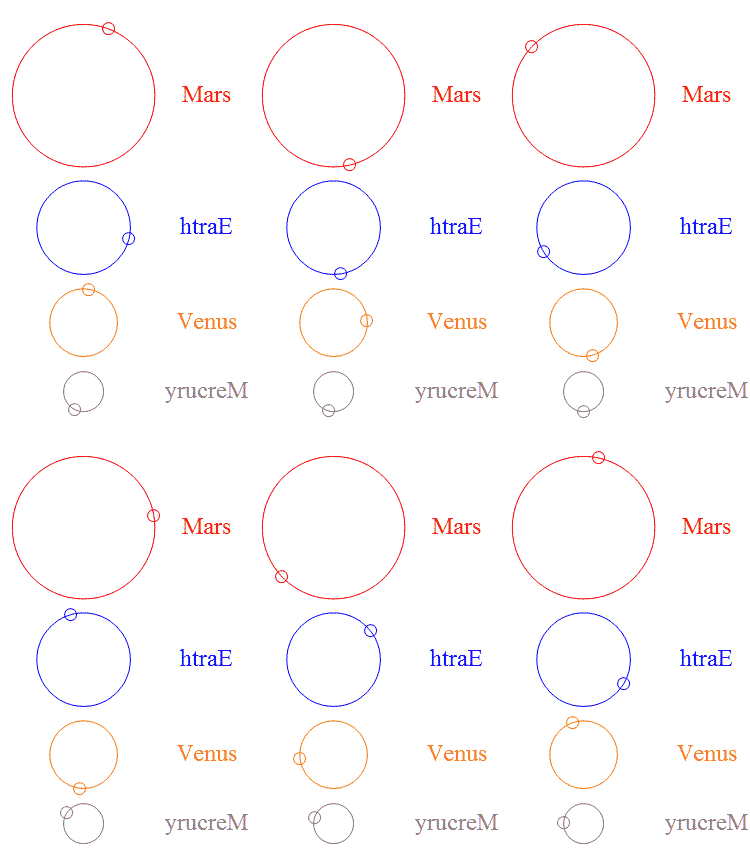
It’s a matter of simple arithmetic and synchrony.  Suppose you’re in a 600-day orbit.  Neighbor Fred looking for a good spot to occupy could choose your same 600-day orbit but on the other side of the Sun from you.  But that’s a hard synchrony to maintain — be off by a few percent and in just a few years, SMASH!

The next safest place would be in a different orbit but still somehow in synchrony with yours.  Inside your orbit Fred has to go faster and therefore has a shorter orbital period than yours.  Suppose Fred’s year is exactly 300 days (a 2:1 period ratio, like a 2:1 gear ratio).  Every six months he’s sort-of close to you but the rest of the time he’s far away.

Our Solar System does seem to have developed using gear-year logic.  Adjacent orbital years are very close to being in whole-number ratios.  Mercury, for instance, circles the Sun in about 88 days.  That’s just 2% away from 2/5 of Venus’s 225¾ days.

This table shows year-lengths for the Sun’s most prominent hangers-on, along with ratios for adjacent objects.  For the “ideal” ratios I arbitrarily picked nearby whole-number multiples of 2.  I calculated how long each object’s year “should” be compared to its lower neighbor — the average inaccuracy across all ten objects is only 0.18%.

Object
Period, years
2 × shorter / longer period
“Ideal” ratio
“Ideal” period, years
Real/”Ideal”
Mercury
0.24
0.24
Venus
0.62
5.11
5 : 2
0.60
102%
Earth
1.00
3.25
3 : 2
0.92
108%
Mars
1.88
3.76
4 : 2
2.00
94%
Ceres
4.60
4.89
5 : 2
4.70
98%
Jupiter
11.86
5.16
5 : 2
11.50
103%
Saturn
29.46
4.97
5 : 2
29.65
99%
Uranus
84.02
5.70
6 : 2
88.37
95%
Neptune
164.80
3.92
4 : 2
168.04
98%
Pluto
248.00
3.01
3 : 2
247.20
100%

gears-2The usual rings-around-the-Sun diagram doesn’t show the specialness of the orbits we’ve got.  This chart shows the four innermost planets in their “ideal” orbits, properly scaled and with approximately the right phases.  I used artistic license to emphasize the gear-like action by reversing Earth’s and Mercury’s direction.   Earth and Mars are never near each other, nor are Earth and Venus.
It doesn’t show up in this video’s time resolution, but Venus and Mercury demonstrate another way the gears can work.  Mercury nears Venus twice in each full 5-year cycle, once leading and once trailing.  The leading pass slows Mercury down (raising it towards Venus), but the trailing pass speeds it up again.  Net result — safe!

~~ Rich Olcott

Gettin’ kinky in space

Things were simpler in the pre-Enlightenment days when we only five planets to keep track of.  But Haley realized that comets could have orbits, Herschel discovered Uranus, and Galle (with Le Verrier’s guidance) found Neptune.  Then a host of other astronomers detected Ceres and a host of other asteroids, and Tombaugh observed Pluto in 1930.whirlpool-44x100-reversed

Astronomers relished the proliferation — every new-found object up there was a new test case for challenging one or another competing theory.

Here’s the currently accepted narrative…  Long ago but quite close-by, there was a cloud of dust in the Milky Way galaxy.  Random motion within it produced a swirl that grew into a vortex dozens of lightyears long.

Consider one dust particle (we’ll call it Isaac) afloat in a slice perpendicular to the vortex.  Assume for the moment that the vortex is perfectly straight, the dust is evenly spread across it, and all particles have the same mass.  Isaac is subject to two influences — gravitational and rotational.

making-a-solar-nebula
A kinked galactic cloud vortex,
out of balance and giving rise
to a solar system.

Gravity pulls Isaac towards towards every other particle in the slice.  Except for very near the slice’s center there are generally more particles (and thus more mass) toward and beyond the center than back toward the edge behind him.  Furthermore, there will generally be as many particles to Isaac’s left as to his right.  Gravity’s net effect is to pull Isaac toward the vortex center.

But the vortex spins.  Isaac and his cohorts have angular momentum, which is like straight-line momentum except you’re rotating about a center.  Both of them are conserved quantities — you can only get rid of either kind of momentum by passing it along to something else.  Angular momentum keeps Isaac rotating within the plane of his slice.

An object’s angular momentum is its linear momentum multiplied by its distance from the center.  If Isaac drifts towards the slice’s center (radial distance decreases), either he speeds up to compensate or he transfers angular momentum to other particles by colliding with them.

But vortices are rarely perfectly straight.  Moreover, the galactic-cloud kind are generally lumpy and composed of different-sized particles.  Suppose our vortex gets kinked by passing a star or a magnetic field or even another vortex.  Between-slice gravity near the kink shifts mass kinkward and unbalances the slices to form a lump (see the diagram).  The lump’s concentrated mass in turn attracts particles from adjacent slices in a viscous cycle (pun intended).

After a while the lumpward drift depletes the whole neighborhood near the kink.  The vortex becomes host to a solar nebula, a concentrated disk of dust whirling about its center because even when you come in from a different slice, you’ve still got your angular momentum.  When gravity smacks together Isaac and a few billion other particles, the whole ball of whacks inherits the angular momentum that each of its stuck-together components had.  Any particle or planetoid that tries to make a break for it up- or down-vortex gets pulled back into the disk by gravity.

That theory does a pretty good job on the conventional Solar System — four rocky Inner Planets, four gas giant Outer Planets, plus that host of asteroids and such, all tightly held in the Plane of The Ecliptic.

How then to explain out-of-plane objects like Pluto and Eris, not to mention long-period comets with orbits at all angles?outer-orbits-1

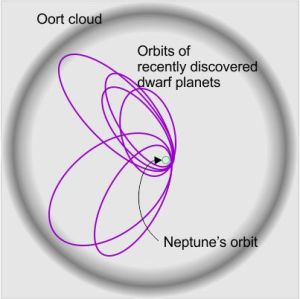
We now know that the Solar System holds more than we used to believe.  Who’s in is still “objects whose motion is dominated by the Sun’s gravitational field,” but the Sun’s net spreads far further than we’d thought.  Astronomers now hypothesize that after its creation in the vortex, the Sun accumulated an Oort cloud — a 100-billion-mile spherical shell containing a trillion objects, pebbles to planet-sized.

At the shell’s average distance from the Sun (see how tiny Neptune’s path is in the diagram) Solar gravity is a millionth of its strength at Earth’s orbit.  The gravity of a passing star or even a conjunction of our own gas giants is enough to start an Oort-cloud object on an inward journey.

These trans-Neptunian objects are small and hard to see, but they’re revolutionizing planetary astronomy.

~~ Rich Olcott

Superluminal Superman

Comic book and movie plotlines often make Superman accelerate up to lightspeed and travel backward in time.  Unfortunately, well-known fundamental Physics principles forbid that.  But suppose Green Lantern or Dr Strange could somehow magic him past the Lightspeed Barrier.  Would that let him do his downtimey thing?

Light_s hourglass
Light’s Hourglass

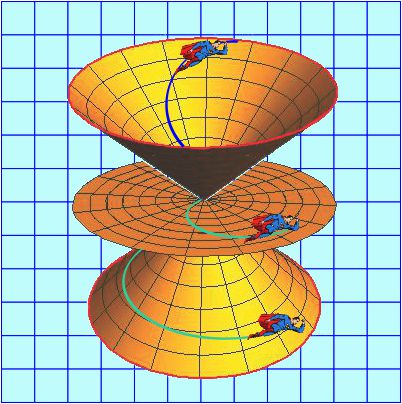
A quick review of Light’s Hourglass.  According to Einstein we live in 4D spacetime.  At any moment you’re at a specific time t relative to some origin time t=0 and a specific 3D location (x,y,z) relative to a spatial origin (0,0,0).  Your spacetime address is (ct,x,y,z) where c is the speed of light.  This diagram shows time running vertically into the future, plus two spatial coordinates x and y.  Sorry, I can’t get z into the diagram so pretend it’s zero.

The two cones depict all the addresses which can communicate with the origin using a flash of light.  Any point on either cone is at just the right distance d=√(++) to match the distance that light can travel in time t.  The bottom cone is in the past, which is why we can see the light from old stars.  The top cone is in the future, which is why we can’t see light from stars that aren’t born yet.

If he obeys the Laws of Physics as we know them, Superman can travel anywhere he wants to inside the top cone.  He goes upward into the future at the rate of one second per second, just like anybody.  On the way, he can travel in space as far from (ct,0,0,0) as he likes so long as it’s not farther than the distance that light can travel the same route at his current t.

From our perspective, the Hourglass is a stack of circles (spheres in 3D space) centered on (ct,0,0,0).  From Supey’s perspective at time t he’s surrounded by a figure with radius ct that Physics won’t let him break through.  That’s his Lightspeed Barrier, like the Sonic Barrier but 900,000 times faster.

Suppose Green Lantern has magicked Supey up to twice lightspeed along the x-axis.  At moment t, he’s at (ct,2ct,0,0), twice as far as light can get.  In the diagram he’s outside the top cone but above the central disk.

Now GL pours on the power to accelerate Superman.  Each increment gets the Man of Steel closer to that disk.  He’s always “above” it, though, because he’s still moving into the future.  Only if he were to get to infinite speed could he reach the disk.

However, at infinite speed he’d go anywhere/everywhere instantaneously which would be confusing to even his Kryptonian intellect.  On the way he might run into things (stars, black holes,…) with literally zero time to react.

But the plotlines have Tall-Dark-and-Muscular flying into the past, breaching that disk and traveling downwards into the bottom cone.  Can GL make that happen?

Enter the Lorentz correction.  If you have rest mass m0 and you’re traveling at speed v, your effective mass is m=m0/√[1-(v/c)²]. That raises a couple of issues when you exceed lightspeed.

Suppose GL decelerates Superluminal Supey down towards lightspeed.  The closer he approaches c from higher speeds, the smaller that square root gets and the greater the effective mass.  It’s the same problem Superman faced when accelerating up to lightspeed.  That last mile per second down to c requires an infinite amount of braking energy — the Lightspeed Barrier is impermeable in both directions.

The other problem is that if v>c there’s a negative number inside that square root.    Above lightspeed, your effective mass becomes Bombelli-imaginary.  Remember Newton’s famous F=m·a?  Re-arrange it to a=F/m.  A real force applied to an object with imaginary mass produces an imaginary acceleration.  “Imaginary” in Physics generally means “perpendicular in some sense” and remember we’re in 4D here with time perpendicular to space.

GL might be able to shove Superman downtime, but he’d have to

  1. squeeze inward at hiper-lightspeed with exactly the same force along all three spatial dimensions, to make sure that “perpendicular” is only along the time axis
  2. start Operation Squish at some time in his own future to push towards the past.

Nice trick.  Would Superman buy in?

~~ Rich Olcott

Superman flying at lightspeed? Umm… no

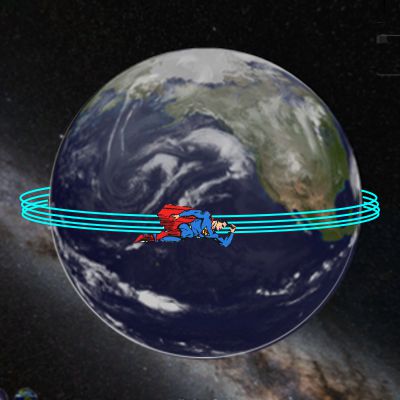
Back when I was in high school I did a term paper for some class (can’t remember which) ripping the heck out of Superman physics.  Yeah, I was that kind of kid.  If I recall correctly, I spent much of it slamming his supposed vision capabilities — they were fairly ludicrous even to a HS student and that was many refreshes of the DC universe ago.FTL SupermanBut for this post let’s consider a trope that’s been taken off the shelf again and again since those days, even in the movies.  This rendition should get the idea across — Our Hero, in a desperate effort to fix a narrative hole the writers had dug themselves into, is forced to fly around the Earth at faster-than-light speeds, thereby reversing time so he can patch things up.

So many problems…  Just for starters, the Earth is 8000 miles wide, Supey’s what, 6’6″?, so on this scale he shouldn’t fill even a thousandth of a pixel.  OK, artistic license.  Fine.

Second problem, only one image of the guy.  If he’s really passing us headed into the past we should see two images, one coming in feet-first from the future and the other headed forward in both space and time.  Oh, and because of the Doppler effect the feet-first image should be blue-shifted and the other one red-shifted.

Of course both of those images would be the wrong shape.  The FitzGerald-Lorentz Contraction makes moving objects appear shorter in the direction of motion.  In other words, if the Man of Steel were flying just shy of the speed of light then 6’6″ tall would look to us more like a disk with a short cape.

Tall-Dark-And-Muscular has other problems to solve on his way to the past.  How does he get up there in the first place?  Back in the day, DC explained that he “leaped tall buildings in a single bound.”   That pretty much says ballistic high-jump, where all the energy comes from the initial impulse.  OK, but consider the rebound effects on the neighborhood if he were to jump with as much energy as it would take to orbit a 250-lb man.  People would complain.

Remember Einstein’s famous E=mc²?  That mass m isn’t quite what most people think it is.  Rather, it’s an object’s rest mass m0 modified by a Lorentz correction to account for the object’s kinetic energy.   In our hum-drum daily life that correction factor is basically 1.00000…   When you get into the lightspeed ballpark it gets bigger.

Here’s the formula with the Lorentz correction in red: m=m0/√[1-(v/c)2].  The square root nears zero as Superman’s velocity v approaches lightspeed c.  When the divisor gets very small the corrected mass gets very large.  If he got to the Lightspeed Barrier (where v=c) he’d be infinitely massive.

So you’ve got an infinite mass circling the Earth about 7 times a second — ocean tides probably couldn’t keep up, but the planet would be shaking enough to fracture the rock layers that keep volcanoes quiet.  People would complain.

Of course, if he had that much mass, Earth and the entire Solar System would be orbiting him.

On the E side of Einstein’s equation, Superman must attain that massive mass by getting energy from somewhere.  Gaining that last mile/second on the way to infinity is gonna take a lot of energy.

But it’s worse.  Even at less than lightspeed, the Kryptonian isn’t flying in a straight line.  He’s circling the Earth in an orbit.  The usual visuals show him about as far out as an Earth-orbiting spacecraft.  A GPS satellite’s stable 24-hour orbit has a 26,000 mile radius so it’s going about 1.9 miles/sec.  Superman ‘s traveling about 98,000 times faster than that.  Physics demands that he use a powered orbit, continuously expending serious energy on centripetal acceleration just to avoid flying off to Vega again.

The comic books have never been real clear on the energy source for Superman’s feats.  Does he suck it from the Sun?  I sure hope not — that’d destabilize the Sun and generate massive solar flares and all sorts of trouble.

Not even the DC writers would want Superman to wipe out his adopted planet just to fix up a plot point.

~~ Rich Olcott

Light’s hourglass

Terry Pratchett’s anthropomorphic character Death (who always speaks in UPPER CASE with a voice that sounds like tombstones falling) has a thing about hourglasses.  So do physicists, but theirs don’t have sand in them.  And they don’t so much represent Eternity as describe it.  Maybe.

The prior post was all about spacetime events (an event is the combination of a specific (x,y,z) spatial location with a specific time t) and how the Minkowski diagram divides the Universe into mutually exclusive pieces:

  • “look but don’t touch” — the past, all the spacetime events which could have caused something to happen where/when we are
  • “touch but don’t look” — the future, the events where/when we can cause something to happen
  • “no look, no touch” — the spacelike part that’s so far away that light can’t reach us and we can’t reach it without breaching Einstein’s speed-of-light constraint
  • “here and now” — the tiny point in spacetime with address (ct,x,y,z)=(0,0,0,0)

Light_s hourglassLast week’s Minkowski diagram was two-dimensional.  It showed time running along the vertical axis and Pythagorean distance d=√(x²+y²+z²) along the horizontal one.  That was OK in the days before computer graphics, but it  loaded many different events onto the same point on the chart.  For instance, (0,1,0,0), (0,-1,0,0), (0,0,1,0) and (0,0,0,1) (and more) are all at d=1.

This chart is one dimension closer to what the physicists really think about.  Here we have x and y along distinct axes.  The z axis is perpendicular to all three, and if you can visualize that you’re better at it than I am.  The xy plane (and the xyz cube if you’re good at it) is perpendicular to t.

That orange line was in last week’s diagram and it means the same thing in this one.  It contains events that can use light-speed somehow to communicate with the here-and-now event.  But now we see that the line into the future is just part of a cone (or a hypercone if you’re good at it).

If we ignite a flash of light at time t=0, at any positive time t that lightwave will have expanded to a circle (or bubble) with radius d=c·t. The circles form the “future” cone.

Another cone extends into the past.  It’s made up of all the events from which a flash of light at time at some negative t would reach the here-and-now event.

The diagram raises four hotly debated questions:

  • Is the pastward cone actually pear-shaped?  It’s supposed to go back to The Very Beginning.  That’s The Big Bang when the Universe was infinitesimally small.  Back then d for even the furthest event from (ct,0,0,0) should have been much smaller than the nanometers-to-lightyears range of sizes we’re familiar with today.  But spacetime was smaller, too, so maybe everything just expanded in sync once we got past Cosmic Inflation.  We may never know the answer.
  • What’s outside the cones?  You think what you see around you is right now?  Sorry.  If the screen you’re reading this on is a typical 30 inches or so distant, the light you’re seeing left the screen 2½ nanoseconds ago.  Things might have changed since then.  We can see no further into the Universe than 14 billion lightyears, and even that only tells us what happened 14 billion years ago.  Are there even now other Earth-ish civilizations just 15 billion lightyears away from us?  We may never know the answer.
  • How big is “here-and-now”?  We think of it as a size=zero mathematical point, but there are technical grounds to think that the smallest possible distance is the Planck length, 1.62×10⁻³⁵ meters.  Do incidents that might affect us occur at a smaller scale than that?  Is time quantized?  We may never know the answers.
  • Do the contents of the futureward cone “already” exist in some sense, or do we truly have free will?  Einstein thought we live in a block universe, with events in future time as fixed as those in past time.  Other thinkers hold that neither past not future are real.  I like the growing block alternative, in which the past is real and fixed but the future exists as maybes.  We may never know the answer.

~~ Rich Olcott

You can’t get there from here

In this series of posts I’ve tried to get across several ideas:

  • By Einstein’s theories, in our Universe every possible combination of place and time is an event that can be identified with an “address” like (ct,x,y,z) where t is time, c is the speed of light, and x, y and z are spatial coordinates
  • The Pythagorean distance between two events is d=√[(x1-x2)2+(y1-y2)2+(z1-z2)2]
  • The Minkowski interval between two events is √[(ct1-ct2)2 d2]
  • When i=√(-1) shows up somewhere, whatever it’s with is in some way perpendicular to the stuff that doesn’t involve i

That minus sign in the third bullet has some interesting implications.  If the time term is bigger then the spatial term, then the interval (that square root) is a real number.  On the other hand, if the time term is smaller, the interval is an imaginary number and therefore is in some sense perpendicular to the real intervals.

We’ll see what that means in a bit.  But first, suppose the two terms are exactly equal, which would make the interval zero.  Can that happen?

Sure, if you’re a light wave.  The interval can only be zero if d=(ct1-ct2).  In other words, if the distance between two events is exactly the distance light would travel in the elapsed time between the same two events.

In this Minkowski diagram, we’ve got two number lines.  The real numbers (time) run vertically (sorry, I know we had the imaginary line running upward in a previous post, but this is the way that Minkowski drew it).  Perpendicular to that, the line of imaginary numbers (distance) runs horizontally, which is why that starscape runs off to the right.Minkowski diagram
The smiley face is us at the origin (0,0,0,0).  If we look upwards toward positive time, that’s the future at our present locationLooking downward to negative time is looking into the past.  Unless we move (change x and/or y and/or z), all the events in our past and future have addresses like (ct,0,0,0).

What about all those points (events) that aren’t on the time axis?  Pick one and use its address to figure the interval between it and us.  In general, the interval will be a complex number, part real and part imaginary, because the event you picked isn’t on either axis.

The two orange lines are special.  Each of them is drawn through all the events for which the distance is equal to ct.  All the intervals between those events and us are zero.  Those are the events that could be connected to us by a light beam.

The orange connections go one way only — someone in our past (t less than zero) can shine a light at us that we’ll see when it reaches us.  However, if someone in our future tried to shine a light our way, well, the passage of time wouldn’t allow it (except maybe in the movies).  Conversely, we can shine a light at some spatial point (x,y,z) at distance d=√(x2+y2+z2) from us, but those photons won’t arrive until the event in our future at (d,x,y,z).

space VennThe rest of the Minkowski diagram could do for a Venn diagram.  We at (0,0,0,0) can do something that will cause something to happen at (ct,x,y,z) to the left of the top orange line.  However, we won’t be able to see that effect until we time-travel forward to its t.  That region is “reachable but not seeable.”

Similarly, events to the left of the bottom orange line can affect us (we can see stars, for instance) but they’re in our past and we can’t cause anything to happen then/there.  The region is “seeable but not reachable.”

Then there’s the overlap, the segment between the two orange lines.  Events there are so far away in spacetime that the intervals between them and us are imaginary (in the mathematical sense).  To put it another way, light can’t get here from there.  Neither can cause and effect.

Physicists call that third region space-like, as opposed to the two time-like regions.  Without a warp drive or some other way around Einstein’s universal speed limit, the edge of “space-like” will always be The Final Frontier.

~~ Rich Olcott

Does a photon experience time?

My brother Ken asked me, “Is it true that a photon doesn’t experience time?”  Good question.  As I was thinking about it I wondered if the answer could have implications for Einstein’s bubble.

When Einstein was a grad student in Göttingen, he skipped out on most of the classes given by his math professor Hermann Minkowski.  Then in 1905 Einstein’s Special Relativity paper scooped some work that Minkowski was doing.  In response, Minkowski wrote his own paper that supported and expanded on Einstein’s.  In fact, Minkowski’s contribution changed Einstein’s whole approach to the subject, from algebraic to geometrical.

But not just any geometry, four-dimensional geometry — 3D space AND time.  But not just any space-AND-time geometry — space-MINUS-time geometry.  Wait, what?Pythagoras1

Early geometer Pythagoras showed us how to calculate the hypotenuse of a right triangle from the lengths of the other two sides. His a2+b2 = c2 formula works for the diagonal of the enclosing rectangle, too.

Extending the idea, the body diagonal of an x×y×z cube is √(x2+y2+z2) and the hyperdiagonal  of a an ct×x×y×z tesseract is √(c2t2+x2+y2+z2) where t is time.  Why the “c“?  All terms in a sum have to be in the same units.  x, y, and z are lengths so we need to turn t into a length.  With c as the speed of light, ct is the distance (length) that light travels in time t.

But Minkowski and the other physicists weren’t happy with Pythagorean hyperdiagonals.  Here’s the problem they wanted to solve.  Suppose you’re watching your spacecraft’s first flight.  You built it, you know its tip-to-tail length, but your telescope says it’s shorter than that.  George FitzGerald and Hendrik Lorentz explained that in 1892 with their length contraction analysis.

What if there are two observers, Fred and Ethel, each of whom is also moving?  They’d better be able to come up with the same at-rest (intrinsic) size for the object.

Minkowski’s solution was to treat the ct term differently from the others.  Think of each 4D address (ct,x,y,z) as a distinct event.  Whether or not something happens then/there, this event’s distinct from all other spatial locations at moment t, and all other moments at location (x,y,z).

To simplify things, let’s compare events to the origin (0,0,0,0).  Pythagoras would say that the “distance” between the origin event and an event I’ll call Lucy at (ct,x,y,z) is √(c2t2+x2+y2+z2).

Minkowski proposed a different kind of “distance,” which he called the interval.  It’s the difference between the time term and the space terms: √[c2t2 + (-1)*(x2+y2+z2)].

If Lucy’s time is t=0 [her event address (0,x,y,z)], then the origin-to-Lucy interval is  √[02+(-1)*(x2+y2+z2)]=i(x2+y2+z2).  Except for the i=√(-1) factor, that matches the familiar origin-to-Lucy spatial distance.

Now for the moment let’s convert the sum from lengths to times by dividing by c2.  The expression becomes √[t2-(x/c)2-(y/c)2-(z/c)2].  If Lucy is at (ct,0,0,0) then the origin-to-Lucy interval is simply √(t2)=t, exactly the time difference we’d expect.

Finally, suppose that Lucy departed the origin at time zero and traveled along x at the speed of light.   At any time t, her address is (ct,ct,0,0) and the interval for her trip is √[(ct)2-(ct)2-02-02] = √0 = 0.  Both Fred’s and Ethel’s clocks show time passing as Lucy speeds along, but the interval is always zero no matter where they stand and when they make their measurements.

Feynman diagramOne more step and we can answer Ken’s question.  A moving object’s proper time is defined to be the time measured by a clock affixed to that object.  The proper time interval between two events encountered by an object is exactly Minkowski’s spacetime interval.  Lucy’s clock never moves from zero.

So yeah, Ken, a photon moving at the speed of light experiences no change in proper time although externally we see it traveling.

Now on to Einstein’s bubble, a lightwave’s spherical shell that vanishes instantly when its photon is absorbed by an electron somewhere.  We see that the photon experiences zero proper time while traversing the yellow line in this Feynman diagram.  But viewed from any other frame of reference the journey takes longer.  Einstein’s objection to instantaneous wave collapse still stands.

~~ Rich Olcott

The question Newton couldn’t answer

250 years ago, when people were getting used to the idea that the planets circle the Sun and not the other way around, they wondered how that worked.  Isaac Newton said, “I can explain it with my Laws of Motion and my Law of Gravity.”

The first Law of Motion is that an object will move in a straight line unless acted upon by a force.  If you’re holding a ball by a string and swing the ball in a circle, the reason the ball doesn’t fly away is that the string is exerting a force on the ball.  Using Newton’s Laws, if you know the mass of the ball and the length of the string, you can calculate how fast the ball moves along that circle.

Newton said that the Solar System works the same way.  Between the Sun and each planet there’s an attractive force which he called gravity.  If you can determine three points in a planet’s orbit, you can use the Laws of Motion and the Law of Gravity to calculate the planet’s speed at any time, how close it gets to the Sun, even how much the planet weighs.

Astronomers said, “This is wonderful!  We can calculate the whole Solar System this way, but… we don’t see any strings.  How does gravity work?”

Newton was an honest man.  His response was, “I don’t know how gravity works.  But I can calculate it and that should be good enough.”

And that was good enough for 250 years until Albert Einstein produced his Theories of Relativity.  This graphic shows one model of Einstein’s model of “the fabric of space.”  According to the theory, light (the yellow threads) travels at 186,000 miles per second everywhere in the Universe.

Fabric of Space 4a

As we’ve seen, the theory also says that space is curved and compressed near a massive object.  Accordingly, the model’s threads are drawn together near the dark circle, which could represent a planet or a star or a black hole.  If you were standing next to a black hole (but not too close). you’d feel fine because all your atoms and the air you breathe would shrink to the same scale.  You’d just notice through your telescope that planetary orbits and other things in the Universe appear larger than you expect.FoS wave

This video shows how a massive object’s space compression affects a passing light wave.  The brown dot and the blue dot both travel at 186,000 miles per second, but “miles are shorter near a black hole.”  The wave’s forward motion is deflected around the object because the blue dot’s miles are longer than the miles traveled by the brown dot.

When Einstein presented his General Theory of Relativity in 1916, his calculations led him to predict that this effect would cause a star’s apparent position to be altered by the Sun’s gravitational field. Fabric of Space 4b

An observer at the bottom of this diagram can pinpoint the position of star #1 by following its light ray back to the star’s location.  Star #2, however, is so situated that its light ray is bent by our massive object.  To the observer, star #2’s apparent position is shifted away from its true position.

In 1919, English physicist-astronomer Arthur Eddington led an expedition to the South Atlantic to test Einstein’s prediction.  Why the South Atlantic?  To observe the total eclipse of the sun that would occur there.  With the Sun’s light blocked by the Moon, Eddington would be able to photograph the constellation Taurus behind the Sun.

Sure enough, in Eddington’s photographs the stars closest to the Sun were shifted in their apparent position relative to those further way.  Furthermore, the sizes of the shifts were almost embarrassingly close to Einstein’s predicted values.

Eddington presented his photographs to a scientific conference in Cambridge and thus produced the first public confirmation of Einstein’s theory of gravity.

Wait, how does an object bending a light ray connect with that object’s pull on another mass?  Another piece of Einstein’s theory says that if a light ray and a freely falling mass both start from the same point in spacetime, both will follow the same path through space.  American physicist John Archibald Wheeler said, “Mass bends space, and bent space tells mass how to move.”


~~ Rich Olcott