Three ways to look at things

A familiar shadow loomed in from the hallway.

“C’mon in, Vinnie, the door’s open.”

“I brought some sandwiches, Sy.”

“Oh, thanks, Vinnie.”

“Don’t mention it.    An’ I got another LIGO issue.”

“Yeah?”

“Ohh, yeah.  Now we got that frame thing settled, how does it apply to what you wrote back when?  I got a copy here…”

The local speed of light (miles per second) in a vacuum is constant.  Where space is compressed, the miles per second don’t change but the miles get smaller.  The light wave slows down relative to the uncompressed laboratory reference frame.

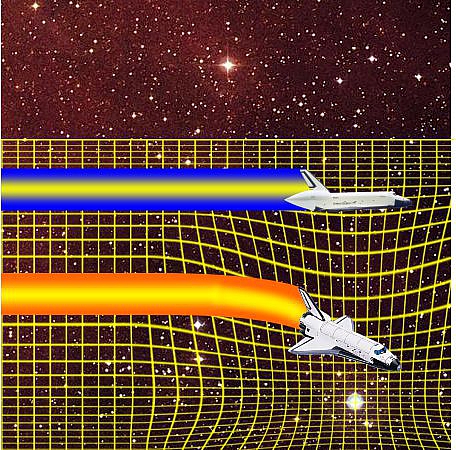
“Ah, I admit I was a bit sloppy there.  Tell you what, let’s pretend we’re piloting a pair of space shuttles following separate navigation beams that are straight because that’s what light rays do.  So long as we each fly a straight line at constant speed we’re both using the same inertial frame, right?”

“Sure.”

“And if a gravity field suddenly bent your beam to one side, you’d think you’re still flying straight but I’d think you’re headed on a new course, right?”

“Yeah, because now we’d have different inertial frames.  I’d think your heading has changed, too.”two-shuttles
“So what does the guy running the beams see?”

“Oh, ground-pounders got their own inertial frame, don’t they?  Uhh… He sees me veer off and you stay steady ’cause the gravity field bent only my beam.”

“Right — my shuttle and the earth-bound observer share the same inertial frame, for a while.”

“A while?”

“Forever if the Earth were flat because I’d be flying straight and level, no threat to the shared frame.  But the Earth’s not flat.  If I want to stay at constant altitude then I’ve got to follow the curve of the surface rather than follow the light beam straight out into space.  As soon as I vector downwards I have a different frame than the guy on the ground because he sees I’m not in straight-line motion.”

“It’s starting to get complicated.”

“No worries, this is as bad as it gets.  Now, let’s get back to square one and we’re flying along and this time the gravity field compresses your space instead of bending it.  What happens?  What do you experience?”

“Uhh… I don’t think I’d feel any difference.  I’m compressed, the air molecules I breath are compressed, everything gets smaller to scale.”

“Yup.  Now what do I see?  Do we still have the same inertial frame?”

“Wow.  Lessee… I’m still on the beam so no change in direction.  Ah!  But if my space is compressed, from your frame my miles look shorter.  If I keep going the same miles per second by my measure, then you’ll see my speed drop off.”

“Good thinking but there’s even more to it.  Einstein showed that space compression and time dilation are two sides of the same phenomenon.  When I look at you from my inertial frame, your miles appear to get shorter AND your seconds appear to get longer.”

“My miles per second slow way down from the double whammy, then?”

“Yup, but only in my frame and that other guy’s down on the ground, not in yours.”

“Wait!  If my space is compressed, what happens to the space around what got compressed?  Doesn’t the compression immediately suck in the rest of the Universe?”

“Einstein’s got that covered, too.  He showed that gravity doesn’t act instantaneously.  Whenever your space gets compressed, the nearby space stretches to compensate (as seen from an independent frame, of course).  The edge of the stretching spreads out at the speed of light.  But the stretch deformation gets less intense as it spreads out because it’s only offsetting a limited local compression.”

“OK, let’s get back to LIGO.  We got a laser beam going back and forth along each of two perpendicular arms, and that famous gravitational wave hits one arm broadside and the other arm cross-wise.  You gonna tell me that’s the same set-up as me and you in the two shuttles?”

“That’s what I’m going to tell you.”

“And the guy on the ground is…”

“The laboratory inertial reference.”

“Eat your sandwich, I gotta think about this.”

(sounds of departing footsteps and closing door)

“Don’t mention it.”

~~ Rich Olcott
A Defective Story

It was an interesting knock at my office door — aggressive but feminine, with a hint of desperation.

“C’mon in, the door’s open.”

She wore a business suit that must have cost a month’s rent.  It fit her like it had been sewn on, and she had all the right sizes.  There was a button missing from the left sleeve.  On the other hand her left lapel bore a Star Trek badge, Security Section.

“What can I do for you, Miss…?”

“My name’s Victoria Baird, Mr Moire.  I’m CEO of ADastra, ‘media relations for the stars.’  I’ve been reading your posts, put two and two together, and thought I’d better drop in.”

“Well, it’s nice to know I’ve got readers.  Which posts caught your attention?”

“Several of them, but mostly this one,” pointing to a Web page on her smartphone.  It was my Breathing Space video.  “You show how gravitational waves fluctuate as they polarize local space.  They induce varying curvatures in different directions.  Curved space is mass, Mr Moire, but this curvature moves at lightspeed.  Hadn’t you noticed that?”

“It crossed my mind, yes, but when I thought about surfing a gravitational wave like ocean surfers do, I realized you’d have to get up to the wave’s speed to ride it.”

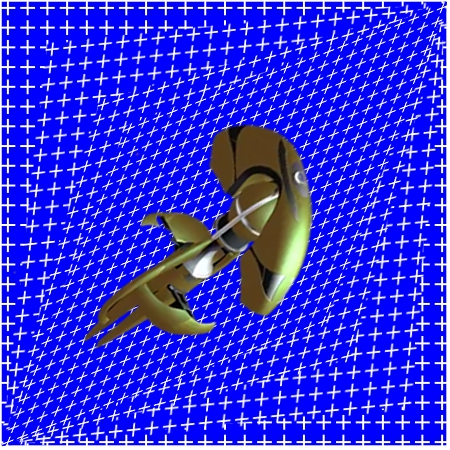
jellyfish-starcraft
Spock’s Jellyfish starcraft,
as seen in the 2009 Star Trek film
(image from the video by Rob Morey)

“There’s more.  Are you familiar with that one-man starcraft that Ambassador Spock used in the 2009 Star Trek film?  The ship with the rotating after-section?”

“I did see ‘Baby Star Trek,’ yes.”

“Did you know that the starcraft’s official design designation is Jellyfish?”

“No, I hadn’t heard that.”

“Well, it is.  And you’ve written about Earth jellyfish, haven’t you, Mr Moire, and how their propulsion system is so efficient?”

I was getting a little tired of her aggressive questions, so I challenged her with one of my own.  “And you see a connection?”

“I do, and that’s why you have to help me, Mr Moire.  Can I trust you?”

“Secrets are my business, Miss Baird.  Uncovering them or covering them up, it’s all the same to me.”

“Maybe I need to let my hair down.”  She removed her cloche cap and her pointed ears sprang free.  “I need you to get me back to my crew.”

“Can’t you just call them on that communicator badge?”

“This is costume jewelry.  The spectrum here on Earth is so crowded that my real badge is useless at long range.  I’ve been looking for subtle signals in the media.  I thought your posts were just such a signal … but I can see you’re a local.”

“Guilty as charged.  I take it the connection you saw resembled the signal you sought?”

“Yes.  You’ve published two of the essential principles of the LaForge Drive.  The first was your displays of spatial curvature in motion.  The second was your description of how jellyfish move by stepping along a ladder of seawater vortices.

jellyfish-2“That’s what the LaForge Drive does, Mr Moire.  The counter-rotating blades are an osmium-hassium alloy, the densest substance known, and under tremendous compression.  Together their mass creates a complex pilot wave in the gravity field.  The spacecraft surfs on that waveform the way a jellyfish surfs on the eddies it creates.
“The wave’s phase velocity exceeds lightspeed by some enormous factor we’ve never been able to measure.  In fact, I’m here on Earth because I was on a research cruise to find if there’s a limit.  We … ran into a problem and I’m part of an away team sent to procure … something we need.”

“That trope’s been done to death, Miss Baird.  And besides, that design wouldn’t be practical.  What’s your real story?”

“What do you mean it’s not practical?”

“You can’t steer.  Pilot waves follow the most intense local spatial curvature, which means the craft will always home like a torpedo on the nearest large mass.”

Suddenly that badge chirped.  “We’ve recovered the detonator, Lieutenant.  Have you kept him from looking out the window?”

“Yes, his eyes have been on me the whole time.  Ready for beam-up.  Goodbye, Mr Moire, that was fun.”

Her form began to shimmer, twinkle … and disappeared.

“Don’t mention it.”

~~ Rich Olcott

Breathing Space

It was December, it was cold, no surprise.  I unlocked my office door, stepped in and there was Vinnie, standing at the window.  He turned to me, shrugged a little and said, “Morning, Sy.”  That’s Vinnie for you.

“Morning, Vinnie.  What got you onto the streets this early?”

“I ain’t on the streets, I’m up here where it’s warm and you can answer my LIGO question.”

“And what’s that?”

“I read your post about gravitational waves, how they stretch and compress space.  What the heck does that even mean?”

gravwave
An array of coordinate systems
floating in a zero-gravity environment,
each depicting a local x, y, and z axis

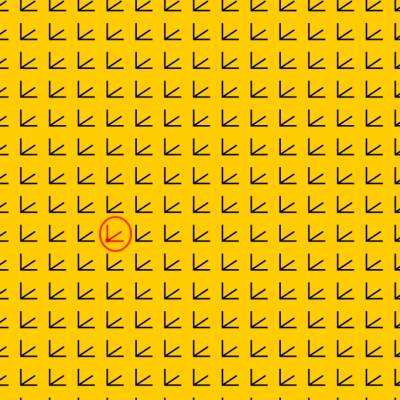
“Funny thing, I just saw a paper by Professor Saulson at Syracuse that does a nice job on that.  Imagine a boxful of something real light but sparkly, like shiny dust grains.  If there’s no gravitational field nearby you can arrange rows of those grains in a nice, neat cubical array out there in empty space.  Put ’em, oh, exactly a mile apart in the x, y, and z directions.  They’re going to serve as markers for the coordinate system, OK?”

“I suppose.”

“Now it’s important that these grains are in free-fall, not connected to each other and too light to attract each other but all in the same inertial frame.  The whole array may be standing still in the Universe, whatever that means, or it could be heading somewhere at a steady speed, but it’s not accelerating in whole or in part.  If you shine a ray of light along any row, you’ll see every grain in that row and they’ll all look like they’re standing still, right?”

“I suppose.”

“OK, now a gravitational wave passes by.  You remember how they operate?”

“Yeah, but remind me.”

(sigh)  “Gravity can act in two ways.  The gravitational attraction that Newton identified acts along the line connecting the two objects acting on each other.  That longitudinal force doesn’t vary with time unless the object masses change or their distance changes.  We good so far?”
long-and-transverse-grav
“Sure.”

“Gravity can also act transverse to that line under certain circumstances.  Suppose we here on Earth observe two black holes orbiting each other.  The line I’m talking about is the one that runs from us to the center of their orbit.  As each black hole circles that center, its gravitational field moves along with it.  The net effect is that the combined gravitational field varies perpendicular to our line of sight.  Make sense?”

“Gimme a sec…  OK, I can see that.  So now what?”

“So now that variation also gets transmitted to us in the gravitational wave.  We can ignore longitudinal compression and stretching along our sight line.  The black holes are so far away from us that if we plug the distance variation into Newton’s F=m1m2/r² equation the force variation is way too small to measure with current technology.

“The good news is that we can measure the off-axis variation because of the shape of the wave’s off-axis component.  It doesn’t move space up-and-down.  Instead, it compresses in one direction while it stretches perpendicular to that, and then the actions reverse.  For instance, if the wave is traveling along the z-axis, we’d see stretching follow compression along the x-axis at the same time as we’d see compression following stretching along the y-axis.”

gravwave-2“Squeeze in two sides, pop out the other two, eh?”

“Exactly.  You can see how that affects our grain array in this video I just happen to have cued up.  See how the up-down and left-right coordinates close in and spread out separately as the wave passes by?”

“Does this have anything to do with that ‘expansion of the Universe’ thing?”

“Well, the gravitational waves don’t, so far as we know, but the notion of expanding the distance between coordinate markers is exactly what we think is going on with that phenomenon.  It’s not like putting more frosting on the outside of a cake, it’s squirting more filling between the layers.  That cosmological pressure we discussed puts more distance between the markers we call galaxies.”

“Um-hmm.  Stay warm.”

(sound of departing footsteps and door closing)

“Don’t mention it.”

~~ Rich Olcott

Gentle pressure in the dark

“C’mon in, the door’s open.”

Vinnie clomps in and he opens the conversation with, “I don’t believe that stuff you wrote about LIGO.  It can’t possibly work the way they say.”

“Well, sir, would you mind telling me why you have a problem with those posts?”  I’m being real polite, because Vinnie’s a smart guy and reads books.  Besides, he’s Vinnie.

“I’m good with your story about how Michelson’s interferometer worked and why there’s no æther.  Makes sense, how the waves mess up when they’re outta step.  Like my platoon had to walk funny when we crossed a bridge.  But the gravity wave thing makes no sense.  When a wave goes by maybe it fiddles space but it can’t change where the LIGO mirrors are.”

“Gravitational wave,” I murmur, but speak up with, “What makes you think that space can move but not the mirrors?”

“I seen how dark energy spreads galaxies apart but they don’t get any bigger.  Same thing must happen in the LIGO machine.”

“Not the same, Vinnie.  I’ll show you the numbers.”

“Ah, geez, don’t do calculus at me.”de-vs-gravity

“No, just arithmetic we can do on a spreadsheet.” I fire up the laptop and start poking in  astronomical (both senses) numbers.  “Suppose we compare what happens when two galaxies face each other in intergalactic space, with what happens when two stars face each other inside a galaxy.  The Milky Way’s my favorite galaxy and the Sun’s my favorite star.  Can we work with those?”

“Yeah, why not?”

“OK, we’ll need a couple of mass numbers.  The Sun’s mass is… (sound of keys clicking as I query Wikipedia) … 2×1030 kilograms, and the Milky Way has (more key clicks) about 1012 stars.  Let’s pretend they’re all the Sun’s size so the galaxy’s mass is (2×1030)×1012 = 2×1042 kg. Cute how that works, multiplying numbers by adding exponents, eh?”

“Cute, yeah, cute.”  He’s getting a little impatient.

“Next step is the sizes.  The Milky Way’s radius is 10×104 lightyears, give or take..  At 1016 meters per lightyear, we can say it’s got a radius of 5×10²⁰ meters.  You remember the formula for the area of a circle?”

“Sure, it’s πr2.” I told you Vinnie’s smart.

“Right, so the Milky Way’s area is 25π×1040 m2.  Meanwhile, the Sun’s radius is 1.4×10⁹ m and its cross-sectional area must be 2π×1018 m2.  Are you with me?”

“Yeah, but what’re we doing playing with areas?  Newton’s gravity equations just talk about distances between centers.”  I told you Vinnie’s smart.

“OK, we’ll do gravity first.  Suppose we’ve got our Milky Way facing another Milky Way an average inter-galactic distance away.  That’s about 60 galaxy radii,  about 300×1020 meters.  The average distance between stars in the Milky Way is about 4 lightyears or 4×10¹⁶ meters.  (I can see he’s hooked so I take a risk)  You’re so smart, what’s that Newton equation?”

Force or potential energy?”

“Alright, I’m impressed.  Let’s go for force.”

“Force equals Newton’s G times the product of the masses divided by the square of the distance.”

“Full credit, Vinnie.  G is about 7×10-11 newton-meter²/kilogram², so we’ve got a gravity force of (typing rapidly) (7×10-11)×(2×1042)×(2×1042)/(300×1020)² = 3.1×1029 N for the galaxies, and (7×10-11)×(2×1030)×(2×1030)/(4×1016)² = 1.75×10¹⁷ N for the stars.  Capeesh?”

“Yeah, yeah.  Get on with it.”

“Now for dark energy.  We don’t know what it is, but theory says it somehow exerts a steady pressure that pushes everything away from everything.  That outward pressure’s exerted here in the office, out in space, everywhere.  Pressure is force per unit area, which is why we calculated areas.

“But the pressure’s really, really weak.  Last I saw, the estimate’s on the order of 10-9 N/m².  So our Milky Way is pushed away from that other one by a force of (10-9)×(25π×1040) ≈ 1031 N, and our Sun is pushed away from that other star by a force of (10-9)×(2π×1018) ≈ 1010 N with rounding.  Here, look at the spreadsheet summary…”

 Force, newtons Between Galaxies Between stars
Gravity 3.1×1029 1.75×10¹⁷
Dark energy 1031 1010
Ratio 3.1×10⁻² 17.5×10⁶

“So gravity’s force pulling stars together is 18 million times stronger than dark energy’s pressure pushing them apart.  That’s why the galaxies aren’t expanding.”

“Gotta go.”

(sound of door-slam )

“Don’t mention it.”

~~ Rich Olcott

Here we LIGO again…

I suddenly smelled mink musk, vintage port, and warm honey on fresh-baked strawberry scones.

“C’mon in, Ramona, the door’s open.”

She oscillated in with a multi-dimensional sinusoidal motion that took my breath away and a smile that brought it back.

“Hi, Sy.  I came right over as soon as I got the news.”

“What news is that, Sugar Lumps?”

“LEGO, Sy, they’ve switched LEGO to science mode!”

“That’s LIGO, sweetheart, Laser Interferometer Gravitational-wave Observatory.”  She means well, but she’s Ramona.  “LEGOs are designed to hurt your feet, LIGO’s designed to look at the Universe.”

“Whatever.  I knew you wrote a . whole . series . of . posts . about . it so I thought you’d want to know.”

“It’s worth chasin’ down, doll-face.  Thanks.”symoire

So I headed over to the campus coffee shop.  It just happens to be located between the Astronomy building and the Physics building so I figured it as a good source.  Al was in his usual place at the cash register.

“Hi, Sy.  Haven’t seen you in a while.”

“Been busy, Al.  Lotsa science going on these days.”

“Good, good.   Say, have you heard about LEGO goin’ live?”

“That’s LIGO, Al.  Yeah, Ramona told me.  So what’s the word?”

“OK, you know all about how when they first turned it on for engineering tests back in September, it blew everyone’s mind that they caught a signal almost immediately?”

“Yeah, that’s when I started writing about it.  Two 30-solar-mass black holes collided and jolted the gravitational field of the Universe.  When the twin LIGOs detected that jolt, it confirmed three predictions that came out of Einstein’s General Relativity theory.”

“Had you heard about the second signal they caught the day after Christmas, from a couple of smaller black holes?”

“I bet you sold a lot of coffee that week.”

“You couldn’t believe.  Those guys had so much caffeine in ’em they didn’t even notice New Years.”

“So what came out of that?”

“Like I said, these were smaller black holes, about 10 solar masses each instead of 30, and that’s really got the star-modelers scratching their heads.”

“How so?”

“Well, we pretty much know how to make a black hole that’s just a bit heavier than the Sun.  Say a star’s between 1.3 and 3 solar masses.  When it burns enough of its fuel that its heat energy can’t keep it puffed up against gravity the whole thing collapses down to a black hole.”

“What happens if it’s bigger than that?  Wouldn’t you just get a bigger black hole?”

“That’s the thing.  If it’s above that threshold, the outermost infalling matter meets the outgoing explosion and makes an even bigger explosion, a supernova.  So much matter gets blown away that what’s left is too small to be a black hole.  You just get a white dwarf star or a neutron star, depending.”

“But these signals came from black holes 3-10 times that upper limit.  Where did they come from?”

“That’s why the head-scratching, Sy.  I mean, no-one knows how to make even one and yet they seem to be so common that two pairs of ’em found each other and collided less than four months apart.  The whole theory is up for grabs now.”

“So we got all that just from the engineering test phase, eh?  What’ve they done since that?”

“Oh, the usual tinkering and tweaking.  The unit down in Livingston LA is about 25% more sensitive now, especially in the lower-frequency range.  That’s mostly because they found and plugged some light-leaks and light-scattering hot-spots here and there along its five miles of steel pipe.  LIGO doesn’t look at incoming light, but it does use laser light to detect the gravitational variation.  The Hanford WA unit boosted the power going to its laser and they’ve improved stability in its detectors, made ’em more robust against wind and low-frequency seismic activity.  You know, engineer stuff.  So now they say they’re ready to do science.”

“I can’t write that the tweaks’ll let us look deeper into the Universe, ’cause LIGO doesn’t pick up light waves.  How about I say we get a better feel for things?”

“Sounds ’bout right, Sy.”

“Oh, and give me one of those strawberry scones.  For some reason they look really good today.”

~~ Rich Olcott

The question Newton couldn’t answer

250 years ago, when people were getting used to the idea that the planets circle the Sun and not the other way around, they wondered how that worked.  Isaac Newton said, “I can explain it with my Laws of Motion and my Law of Gravity.”

The first Law of Motion is that an object will move in a straight line unless acted upon by a force.  If you’re holding a ball by a string and swing the ball in a circle, the reason the ball doesn’t fly away is that the string is exerting a force on the ball.  Using Newton’s Laws, if you know the mass of the ball and the length of the string, you can calculate how fast the ball moves along that circle.

Newton said that the Solar System works the same way.  Between the Sun and each planet there’s an attractive force which he called gravity.  If you can determine three points in a planet’s orbit, you can use the Laws of Motion and the Law of Gravity to calculate the planet’s speed at any time, how close it gets to the Sun, even how much the planet weighs.

Astronomers said, “This is wonderful!  We can calculate the whole Solar System this way, but… we don’t see any strings.  How does gravity work?”

Newton was an honest man.  His response was, “I don’t know how gravity works.  But I can calculate it and that should be good enough.”

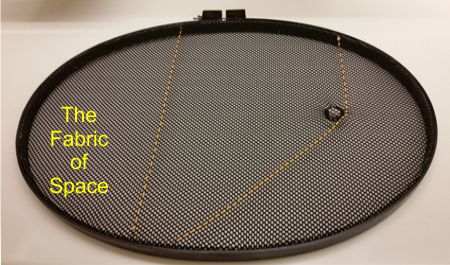
And that was good enough for 250 years until Albert Einstein produced his Theories of Relativity.  This graphic shows one model of Einstein’s model of “the fabric of space.”  According to the theory, light (the yellow threads) travels at 186,000 miles per second everywhere in the Universe.

Fabric of Space 4a

As we’ve seen, the theory also says that space is curved and compressed near a massive object.  Accordingly, the model’s threads are drawn together near the dark circle, which could represent a planet or a star or a black hole.  If you were standing next to a black hole (but not too close). you’d feel fine because all your atoms and the air you breathe would shrink to the same scale.  You’d just notice through your telescope that planetary orbits and other things in the Universe appear larger than you expect.FoS wave

This video shows how a massive object’s space compression affects a passing light wave.  The brown dot and the blue dot both travel at 186,000 miles per second, but “miles are shorter near a black hole.”  The wave’s forward motion is deflected around the object because the blue dot’s miles are longer than the miles traveled by the brown dot.

When Einstein presented his General Theory of Relativity in 1916, his calculations led him to predict that this effect would cause a star’s apparent position to be altered by the Sun’s gravitational field. Fabric of Space 4b

An observer at the bottom of this diagram can pinpoint the position of star #1 by following its light ray back to the star’s location.  Star #2, however, is so situated that its light ray is bent by our massive object.  To the observer, star #2’s apparent position is shifted away from its true position.

In 1919, English physicist-astronomer Arthur Eddington led an expedition to the South Atlantic to test Einstein’s prediction.  Why the South Atlantic?  To observe the total eclipse of the sun that would occur there.  With the Sun’s light blocked by the Moon, Eddington would be able to photograph the constellation Taurus behind the Sun.

Sure enough, in Eddington’s photographs the stars closest to the Sun were shifted in their apparent position relative to those further way.  Furthermore, the sizes of the shifts were almost embarrassingly close to Einstein’s predicted values.

Eddington presented his photographs to a scientific conference in Cambridge and thus produced the first public confirmation of Einstein’s theory of gravity.

Wait, how does an object bending a light ray connect with that object’s pull on another mass?  Another piece of Einstein’s theory says that if a light ray and a freely falling mass both start from the same point in spacetime, both will follow the same path through space.  American physicist John Archibald Wheeler said, “Mass bends space, and bent space tells mass how to move.”


~~ Rich Olcott

Throwing a Summertime curve

All cats are gray in the dark, and all lines are straight in one-dimensional space.  Sure, you can look at a garden hose and see curves (and kinks, dammit), but a short-sighted snail crawling along on it knows only forward and backward.  Without some 2D notion of sideways, the poor thing has no way to sense or cope with curvature.

Up here in 3D-land we can readily see the hose’s curved path through all three dimensions.  We can also see that the snail’s shell has two distinct curvatures in 3D-space — the tube has an oval cross-section and also spirals perpendicular to that.

But Einstein said that our 3D-space itself can have curvature.  Does mass somehow bend space through some extra dimension?  Can a gravity well be a funnel to … somewhere else?

No and no.  Mathematicians have come up with a dozen technically different kinds of curvature to fit different situations.  Most have to do with extrinsic non-straightness, apparent only from a higher dimension.  That’s us looking at the hose in 3D.

Einstein’s work centered on intrinsic curvature, dependent only upon properties that can be measured within an object’s “natural” set of dimensions.Torus curvature

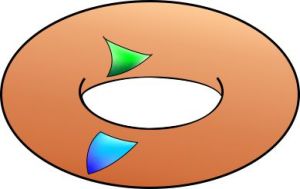
On a surface, for instance, you could draw a triangle using three straight lines.  If the figure’s interior angles sum up to exactly 180°, you’ve got a flat plane, zero intrinsic curvature.  On a sphere (“straight line” = “arc from a great circle”) or the outside rim of a doughnut, the sum is greater than 180° and the curvature is positive.
Circle curvatures
If there’s zero curvature and positive curvature, there’s gotta be negative curvature, right?  Right — you’ll get less-than-180° triangles on a Pringles chip or on the inside rim of a doughnut.

Some surfaces don’t have intersecting straight lines, but you can still classify their curvature by using a different criterion.  Visualize our snail gliding along the biggest “circle” he/she/it (with snails it’s complicated) can get to while tethered by a thread pinned to a point on the surface. Divide the circle’s circumference by the length of the thread.  If the ratio’s equal to 2π then the snail’s on flat ground.  If the ratio is bigger than ,  the critter’s on a saddle surface (negative curvature). If it’s smaller, then he/she/it has found positive curvature.

In a sense, we’re comparing the length of a periphery and a measure of what’s inside it.  That’s the sense in which Einsteinian space is curved — there are regions in which the area inside a circle (or the volume inside a sphere) is greater than or less than what would be expected from the size of its boundary.

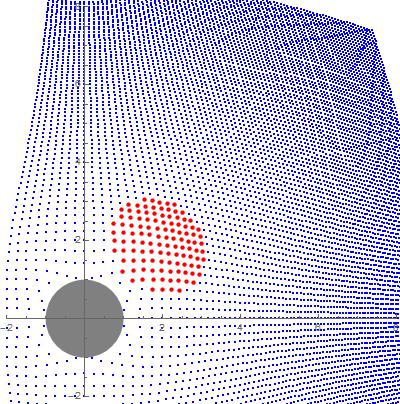
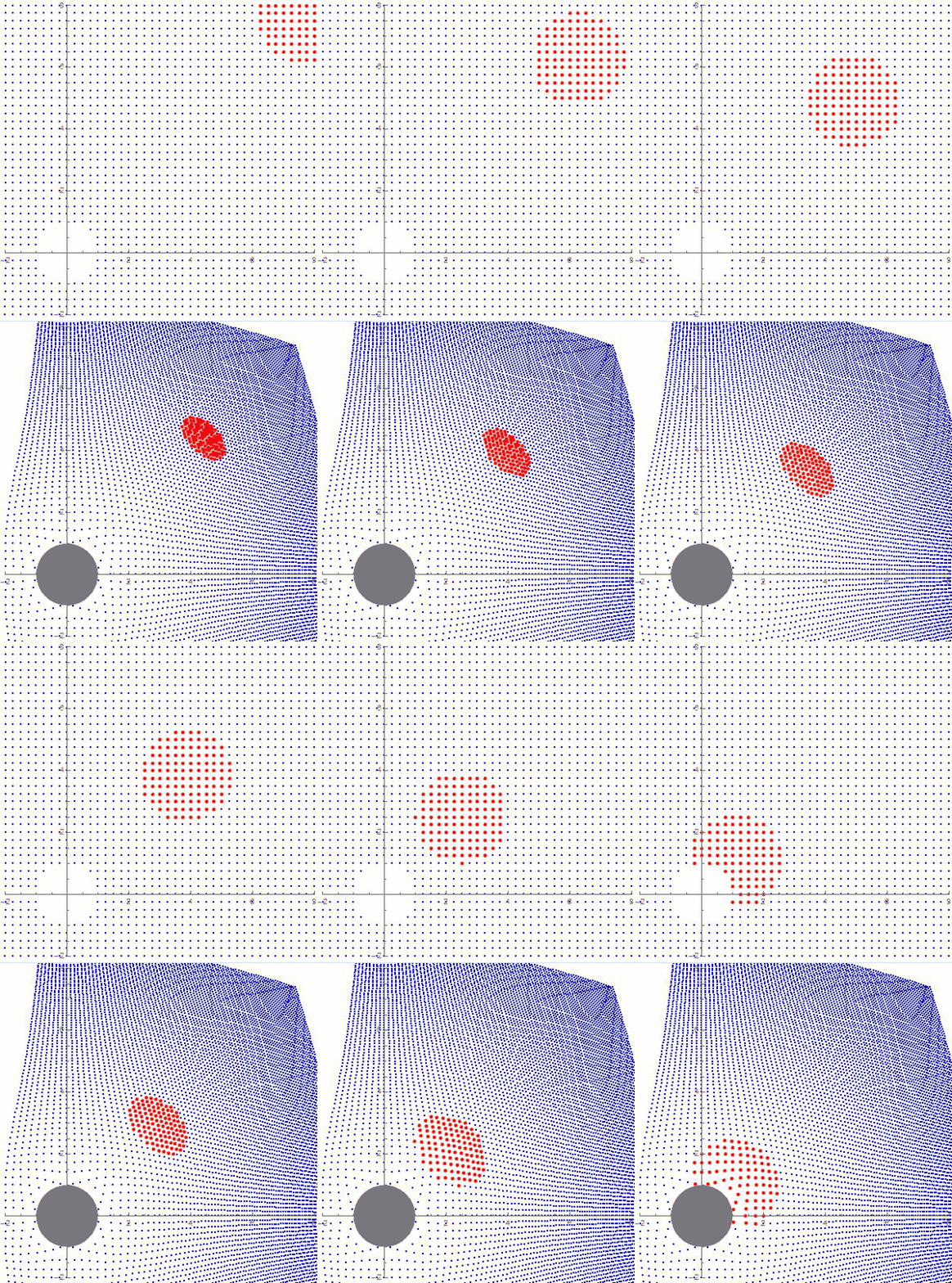
Here’s an example.  The upper panel’s dotted grid represents a simple flat space being traversed by a “disk.”  See how the disk’s location has no effect on its size or shape.  As a result, dividing its circumference by its radius always gives you 2π.Curvature 3

In the bottom panel I’ve transformed* the picture to represent space in the neighborhood of a black hole (the gray circle is its Event Horizon) as seen from a distance.  Close-up, every row of dots would appear straight.  However, from afar the disk’s apparent size and shape depend on where it is relative to the BH.

By the way, the disk is NOT “falling” into the BH.  This is about the shape of space itself — there’s no gravitational attraction or distortion by tidal spaghettification.

Visually, the disk appears to ooze down one of those famous 3D parabolic funnels.  But it doesn’t — all of this activity takes place within the BH’s equatorial plane, a completely 2D place.  The equations generate that visual effect by distorting space and changing the local distance scale near our massive object.  This particular distortion generates positive curvature — at 90% through the video, the disk’s C/r ratio is about 2% less than 2π.

As I tell Museum visitors, “miles are shorter near a black hole.”

~~ Rich Olcott

* – If you’re interested, here are the technical details.  A Schwarzchild BH, distances as multiples of the EH radius.  The disk (diameter 2.0) is depicted at successive time-free points in the BH equatorial plane.  The calculation uses Flamm’s paraboloid to convert each grid point’s local (r,φ) coordinates to (w,φ) to represent the spatial configuration as seen from r>>w.

Reflections in Einstein’s bubble

There’s something peculiar in this earlier post where I embroidered on Einstein’s gambit in his epic battle with Bohr.  Here, I’ll self-plagiarize it for you…

Consider some nebula a million light-years away.  A million years ago an electron wobbled in the nebular cloud, generating a spherical electromagnetic wave that expanded at light-speed throughout the Universe.

Last night you got a glimpse of the nebula when that lightwave encountered a retinal cell in your eye.  Instantly, all of the wave’s energy, acting as a photon, energized a single electron in your retina.  That particular lightwave ceased to be active elsewhere in your eye or anywhere else on that million-light-year spherical shell.

Suppose that photon was yellow light, smack in the middle of the optical spectrum.  Its wavelength, about 580nm, says that the single far-away electron gave its spherical wave about 2.1eV (3.4×10⁻¹⁹ joules) of energy.  By the time it hit your eye that energy was spread over an area of a trillion square lightyears.  Your retinal cell’s cross-section is about 3 square micrometers so the cell can intercept only a teeny fraction of the wavefront.  Multiplying the wave’s energy by that fraction, I calculated that the cell should be able to collect only 10-75 joules.  You’d get that amount of energy from a 100W yellow light bulb that flashed for 10-73 seconds.  Like you’d notice.

But that microminiscule blink isn’t what you saw.  You saw one full photon-worth of yellow light, all 2.1eV of it, with no dilution by expansion.  Water waves sure don’t work that way, thank Heavens, or we’d be tsunami’d several times a day by earthquakes occurring near some ocean somewhere.

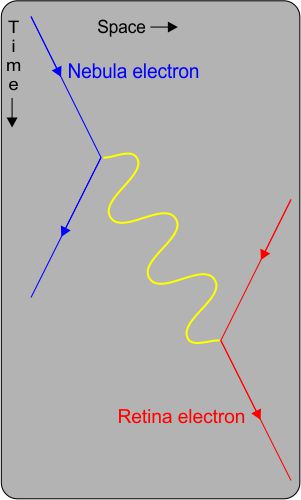
Feynman diagramHere we have a Feynman diagram, named for the Nobel-winning (1965) physicist who invented it and much else.  The diagram plots out the transaction we just discussed.  Not a conventional x-y plot, it shows Space, Time and particles.  To the left, that far-away electron emits a photon signified by the yellow wiggly line.  The photon has momentum so the electron must recoil away from it.

The photon proceeds on its million-lightyear journey across the diagram.  When it encounters that electron in your eye, the photon is immediately and completely converted to electron energy and momentum.

Here’s the thing.  This megayear Feynman diagram and the numbers behind it are identical to what you’d draw for the same kind of yellow-light electron-photon-electron interaction but across just a one-millimeter gap.

It’s an essential part of the quantum formalism — the amount of energy in a given transition is independent of the mechanical details (what the electrons were doing when the photon was emitted/absorbed, the photon’s route and trip time, which other atoms are in either neighborhood, etc.).  All that matters is the system’s starting and ending states.  (In fact, some complicated but legitimate Feynman diagrams let intermediate particles travel faster than lightspeed if they disappear before the process completes.  Hint.)

Because they don’t share a common history our nebular and retinal electrons are not entangled by the usual definition.  Nonetheless, like entanglement this transaction has Action-At-A-Distance stickers all over it.  First, and this was Einstein’s objection, the entire wave function disappears from everywhere in the Universe the instant its energy is delivered to a specific location.  Second, the Feynman calculation describes a time-independent, distance-independent connection between two permanently isolated particles.  Kinda romantic, maybe, but it’d be a boring movie plot.

As Einstein maintained, quantum mechanics is inherently non-local.  In QM change at one location is instantaneously reflected in change elsewhere as if two remote thingies are parts of one thingy whose left hand always knows what its right hand is doing.

Bohr didn’t care but Einstein did because relativity theory is based on geometry which is all about location. In relativity, change here can influence what happens there only by way of light or gravitational waves that travel at lightspeed.

In his book Spooky Action At A Distance, George Musser describes several non-quantum examples of non-locality.  In each case, there’s no signal transmission but somehow there’s a remote status change anyway.  We don’t (yet) know a good mechanism for making that happen.

It all suggests two speed limits, one for light and matter and the other for Einstein’s “deeper reality” beneath quantum mechanics.

~~ Rich Olcott

Another slice of π, wrapped up in a Black Hole crust

Last week a museum visitor wondered, “What’s the volume of a black hole?”  A question easier asked than answered.

Let’s look at black hole (“BH”) anatomy.  If you’ve seen Interstellar, you saw those wonderful images of “Gargantua,” the enormous BH that plays an essential role in the plot.  (If you haven’t seen the movie, do that.  It is so cool.)

A BH isn’t just a blank spot in the Universe, it’s attractively ornamented by the effects of its gravity on the light passing by:

Gargantua 2c
Gargantua,
adapted from Dr Kip Thorne’s book, The Science of “Interstellar”

Working from the outside inward, the first decoration is a background starfield warped as though the stars beyond had moved over so they could see us past Gargantua.  That’s because of gravitational lensing, the phenomenon first observed by Sir Arthur Eddington and the initial confirmation of Einstein’s Theory of General Relativity.

No star moved, of course.  Each warped star’s light comes to us from an altered angle, its lightwaves bent on passing through the spatial compression Gargantua imposes on its neighborhood.  (“Miles are shorter near a BH” — see Gravitational Waves Are Something Else for a diagrammatic explanation.)

Moving inward we come to the Accretion Disc, a ring of doomed particles destined to fall inward forever unless they’re jostled to smithereens or spat out along one of the BH’s two polar jets (not shown).  The Disc is hot, thanks to all the jostling.  Like any hot object it emits light.

Above and below the Disc we see two arcs that are actually images of the Accretion Disc, sent our way by more gravitational lensing.  Very close to a BH there’s a region where passing light beams are bent so much that their photons go into orbit.  The disc’s a bit further out than that so its lightwaves are only bent 90o over (arc A) and under (arc B) before they come to us.

By the way, those arcs don’t only face in our direction.  Fly 360o around Gargantua’s equator and those arcs will follow you all the way.  It’s as though the BH were embedded in a sphere of lensed Disclight.

Which gets us to the next layer of weirdness.  Astrophysicists believe that most BHs rotate, though maybe not as fast as Gargantua’s edge-of-instability rate.  Einstein’s GR equations predict a phenomenon called frame dragging — rapidly spinning massive objects must tug local space along for the ride.  The deformed region is a shell called the Ergosphere.

Frame dragging is why the two arcs are asymmetrical and don’t match up.  We see space as even more compressed on the right-hand side where Gargantua is spinning away from us.  Because the effect is strongest at the equator, the shell should really be called the Ergospheroid, but what can you do?

Inside the Ergosphere we find the defining characteristic of a BH, its Event Horizon, the innermost bright ring around the central blackness in the diagram.  Barely outside the EH there may or may not be a Firewall, a “seething maelstrom of particles” that some physicists suggest must exist to neutralize the BH Information Paradox.  Last I heard, theoreticians are still fighting that battle.

The EH forms a nearly spherical boundary where gravity becomes so intense that the escape velocity exceeds the speed of light.  No light or matter or information can break out.  At the EH, the geometry of spacetime becomes so twisted that the direction of time is In.  Inside the EH and outside of the movies it’s impossible for us to know what goes on.

Finally, the mathematical models say that at the center of the EH there’s a point, the Singularity, where spacetime’s curvature and gravity’s strength must be Infinite.  As we’ve seen elsewhere, Infinity in a calculation is Nature’s was of saying, “You’ve got it wrong, make a better model.”

So we’re finally down to the volume question.  We could simply measure the EH’s external diameter d and plug that into V=(πd3)/6.  Unfortunately, that forthright approach misses all the spatial twisting and compression — it’s a long way in to the Singularity.  Include those effects and you’ve probably got another Infinity.

Gargantua’s surface area is finite, but its volume may not be.

~~ Rich Olcott

Gravitational Waves Are Something Else

gravitational-gif.0

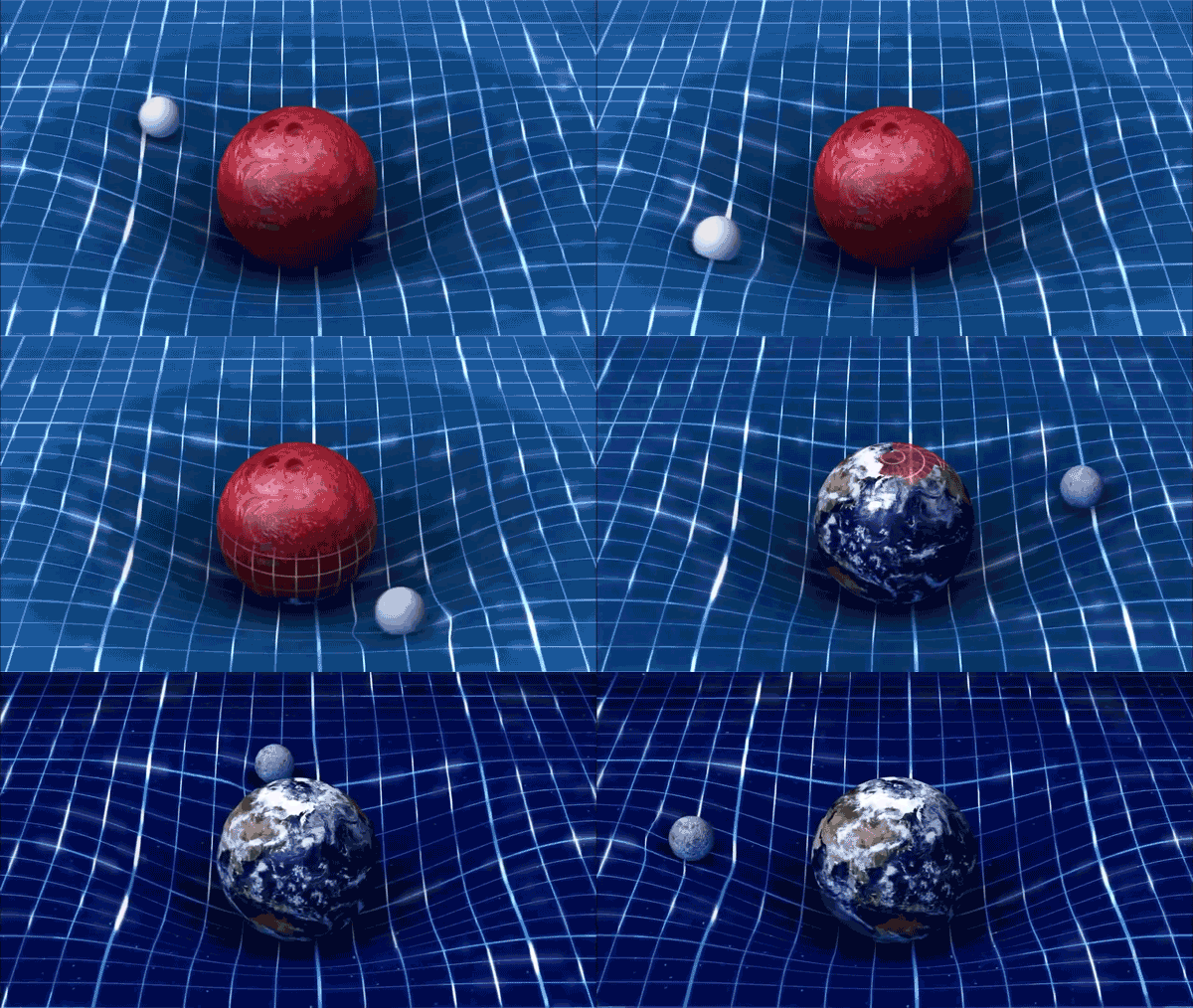
If you’re reading this post, you’ve undoubtedly seen at least one diagram like the above — a black hole or a planet or a bowling ball makes a dent in a rubber sheet and that’s supposed to explain Gravity.  But it doesn’t, and neither does this spirally screen-grab from Brian Greene’s presentation on Stephen Colbert’s Late Show:rubber-sheet waves_post

<Blush> I have to admit that the graphic I used a couple of weeks ago is just as bad.

Gravitational waves don’t make things go up and down like ocean waves, and they’re definitely not like that planet on a trampoline — after all, there’s nothing “below” to pull things downward so there can’t be a dent.  And gravitational waves don’t do spirals, much.

soundwaveOf all the wave varieties we’re familiar with, gravitational waves are most similar to (NOT identical with!!) sound waves.  A sound wave consists of cycles of compression and expansion like you see in this graphic.  Those dots could be particles in a gas (classic “sound waves”) or in a liquid (sonar) or neighboring atoms in a solid (a xylophone or marimba).

Contrary to rumor, there can be sound in space, sort of.  Any sizable volume of “empty” space contains at least a few atoms and dust particles.  A nova or similar sudden event can sweep particles together and give rise to successive waves that spread as those local collections bang into particles further away.  That kind of activity is invoked in some theories of spiral galaxy structure and the fine details of Saturn’s rings.

In a gravitational wave, space itself is compressed and stretched.  A particle caught in a gravitational wave doesn’t get pushed back and forth.  Instead, it shrinks and expands in place.  If you encounter a gravitational wave, you and all your calibrated measurement gear (yardsticks, digital rangers, that slide rule you’re so proud of) shrink and expand together.  You’d only notice the experience if you happened to be comparing two extremely precise laser rangers set perpendicular to each other (LIGO!).  One would briefly register a slight change compared to the other one.

Light always travels at 186,000 miles per second but in a compressed region of space those miles are shorter.  bent lightEinstein noticed that implication of his Theory of General Relativity and in 1916 predicted that the path of starlight would be bent when it passed close to a heavy object like the Sun.  The graphic shows a wave front passing through a static gravitational structure.  Two points on the front each progress at one graph-paper increment per step.  But the increments don’t match so the front as a whole changes direction.  Sure enough, three years after Einstein’s prediction, Eddington observed just that effect while watching a total solar eclipse in the South Atlantic.

Unlike the Sun’s steady field, a gravitational wave is dynamic. Gravitational waves are generated by changes in a mass configuration.  The wave’s compression and stretching forces spread out through space.

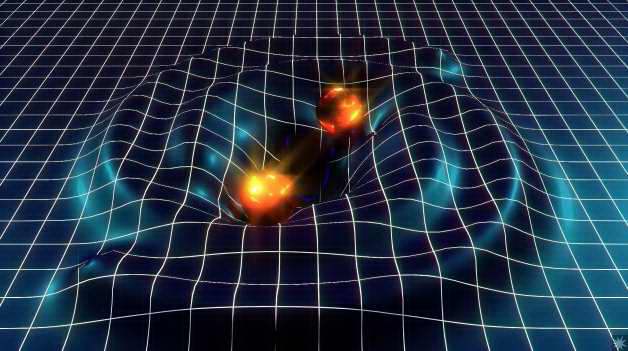
Here’s a simulation of the gravitational forces generated by two black holes orbiting into a collision.  The contours show the net force felt at each point in the region around the pair.
2 black holesWe’re being dynamic here, so the simulation has to include the fact that changes in the mass configuration aren’t felt everywhere instantaneously.  Einstein showed that space transmits gravitational waves at the speed of light, so I used a scaled “speed of light” in the calculation.  You can see how each of the new features expands outward at a steady rate.

Even near the violent end, the massive objects move much more slowly than light speed.  The variation in their nearby field quickly smooths out to an oval and then a circle about the central point, which is why the calculated gravity field generates no spiral like the ones in the pretty pictures.

Oh, and those “gravity well” pictures?  They’re not showing gravitational fields, they’re really gravitational potential energy diagrams, showing how hard it’d be to get away from somewhere.  In the top video, for example, the satellite orbits the planet because it doesn’t have enough kinetic energy to get out of the well.  The more massive the attractor, the tighter it curves space around itself and the deeper the well.

~~ Rich Olcott