The Decade Isn’t Over Yet

My father was a man of firmly held opinions, although he would be quick to say they were conclusions. Trained as a physicist, he lived a career in chemistry because in the Depression you took what you could get. Never hesitating to carry his sciences into the public forum, he wrote many Letters to The Editor on topics from the chemical hazards of powering automobile air bags with sodium azide, to the optimal size of a wine glass, to the historical connection between Hitler’s Navy sowing the North Sea with mines and the rise of industrial vitamin D production in the US.

He once suggested that the best location for highly radioactive nuclear waste would be the already-radioactive Chernobyl reserve in the thenSoviet Ukraine. Obvious when you think about it, except for the geopolitical part.

Dad enjoyed tweaking the bureaucrats. When he mustered out of the Navy at the end of WWII, he was given a letter stating that because of his extensive top-secret radar know-how, he was to hold himself in readiness should the nation have to call him back to duty. Many years later and in his eighties, he wrote a letter to the Secretary of the Navy. In it he said that his technical skills had deteriorated over the decades and therefore he requested relief from the obligation. He never told me whether or not he’d heard back.

A frequent target of his disdain was the herd of natural foods enthusiasts who abhor “ingesting chemicals.” “We are made of chemicals.” he wrote. “The only thing that is free of chemicals is a perfect vacuum.” He held that the phrase “organic salt” is an oxymoron when applied to any preparation of sodium chloride. I can only imagine his reaction to the displays that advertise gluten-free water.

Dad and I worked on different aspects of the Y2K Problem. From mid-1996 through the first month of January 2000 I and lots of other IT colleagues spent most of our working hours making sure that the wheels of our society wouldn’t grind to a halt because the various gears failed to mesh properly. All that work worked, but because we were successful the rest of society decided Y2K had been no big deal. If only they knew.

Meanwhile, my Dad had a different Y2K concern. He expressed it in this note which appeared in multiple publications:

To The Editor:
 There seems to be friction about naming the final year of the current century and/or the first year of the next decade.
 Those who affirm that 2001 is the beginning of the new century are absolutely correct. There was no year 0.
 Also, there is a substantial group who want to celebrate the year 2000.
 OK, the year twenty-naught-naught is the end of the present decade, century, millennium. We can and should have celebrations for the end of world wars, the end of holocausts, the end of homelessness, the end (hopefully) of drugs, reckless driving, etc.
 Even 1999 has been headlined. Let it be the year of preparation for the next two celebratory years. Those who want to capitalize on the final year of the present decade and the first year of the coming century can use 1999 for planning, organizing and even rehearsing the functions anticipated.
 The three-year spectacle will satisfy a substantial majority of those who seem to be unhappily vocal, one way or the other. Let’s make peace.

  • 1999: On your marks.
  • 2000: Get set.
  • 2001: Go.

~~ Irwin Olcott

Just to show how firmly he held to his calendrical conclusion — despite a medical condition that would have felled a less-determined man, Dad held on until Jan 10, 2001 because he wanted to live into the 21st Century. His initials, “I.O.,” drew his attention on the number ten. We in the family think that’s why he stayed with us until the tenth of the month, although there was some mention of waiting that long for tax purposes. Knowing him, it could have been some of both.

In my opinion, Dad had the right of it. The year 2020 will not be the start of the 21st Century’s second third decade, it will be the end of its first second. May the year and the following ones go well with you.

~~ Rich Olcott

How To Wave A Camel

“You’re sayin’, Sy, no matter what kind of wave we got, we can break it down by amplitude, frequency and phase?”

“Right, Vinnie. Your ears do that automatically. They grab your attention for the high-amplitude loud sounds and the high-frequency screechy ones. Goes back to when we had to worry about predators, I suppose.”

“I know about music instruments and that, but does it work for other kinds of waves?”

“It works for waves in general. You can match nearly any shape with the right combination of sine waves. There’s a few limitations. The shape has to be single-valued — no zig-zags — and it has to be continuous — no stopping over here and starting over there..”

“Ha! Challenge for you then. Use waves to draw a camel. Better yet– make it a two-humped camel.”

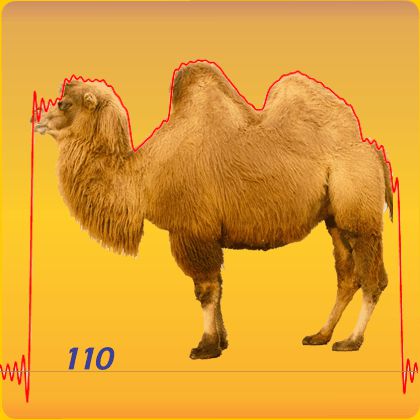
“A Bactrian camel, eh? OK, there’s pizza riding on this, you understand. <keys clicking> All right, image search for Bactrian camel … there’s a good one … scan for its upper profile … got that … tack on some zeroes fore and aft … dump that into my Fourier analysis engine … pull the coefficients … plot out the transform — wait, just for grins, plot it out in stages on top of the original … here you are, Vinnie, you owe me pizza.”

“OK, what is it?”

“Your Bactrian camel.”

“Yeah, I can see that, but what’s with the red line and the numbers?”

“OK, the red line is the sum of a certain number of sine waves with different frequencies but they all start and end at the same places. The number says how many waves were used in the sum. See how the ‘1‘ line is just a single peak, ‘3‘ is more complicated and so on? But I can’t just add sine waves together — that’d give the same curve no matter what data I use. Like in a church choir. The director doesn’t want everyone to sing at top volume all the time. Some passages he wants to bring out the alto voices so he hushes the men and sopranos, darker passages he may want the bases and baritones to dominate. Each section has to come in with its own amplitude.”

“So you give each sine wave an amplitude before you add ’em together. Makes sense, but how do you know what amplitudes to give out?”

“That gets into equations, which I know you don’t like. In practice these days you get all the amplitudes in one run of the Fast Fourier Transform algorithm, but it’s easier to think of it as the stepwise process that they used before the late 1960s. You start with the lowest-frequency sine wave that fits between the start- and end-points of your data.”

“Longest wavelength to match the data length, gotcha.”

“Mm-hm. So you put in that wave with an amplitude near the average value of your data in the middle art of the range. That’s picture number 1.”

“Step 2 is to throw in the next shorter wavelength that fits, right? Half the wavelength, with an amplitude to match the differences between your data and wave 1. And then you keep going.”

“You got the idea. Early physicists and their grad students used up an awful lot of pencils, paper and calculator time following exactly that strategy. Painful. The FFT programs freed them up to do real thinking.”

“So you get a better and better approximation from adding more and more waves. What stopped you from getting it perfect?”

“Two things — first, you can’t use more waves than about half the number of data points. Second, you see the funny business at his nose? Those come from edges and sudden sharp changes, which Fourier doesn’t handle well. That’s why edges look flakey in JPEG images that were saved in high-compression mode.”

“Wait, what does JPEG have to do with this?”

“JPEG and most other kinds of compressed digital image, you can bet that Fourier-type transforms were in play. Transforms are crucial in spectroscopy, astronomy, weather prediction, MP3 music recordings –“

Suddenly Vinnie’s wearing a big grin. “I got a great idea! While that Klingon ship’s clamped in our tractor beam, we can add frequencies that’d make them vibrate to Brahms’ Lullaby.”

“Bad idea. They’d send back Klingon Opera.”

~~ Rich Olcott

How To Phase A Foe

“It’s Starfleet’s beams against Klingon shields, Vinnie. I’m saying both are based on wave phenomena.”

“What kind of wave, Sy?”

“Who knows? They’re in the 24th Century, remember. Probably not waves in the weak or strong nuclear force fields — those’d generate nuclear explosions. Could be electromagnetic waves or gravitational waves, could be some fifth or sixth force we haven’t even discovered yet. Whatever, the Enterprise‘s Bridge crew keeps saying ‘frequency’ so it’s got to have some sort of waveishness.”

“OK, you’re sayin’ whatever’s waving, if it’s got frequency, amplitude and phase then we can talk principles for building a weapon system around it. I can see how Geordi’s upping the amplitude of the Enterprise‘s beam weapons would help Worf’s battle job — hit ’em harder, no problem. Jiggling the frequencies … I sort of see that, it’s what they always talk about doing anyway. But you say messing with beam phase can be the kicker. What difference would it make if a peak hits a few milliseconds earlier or later?”

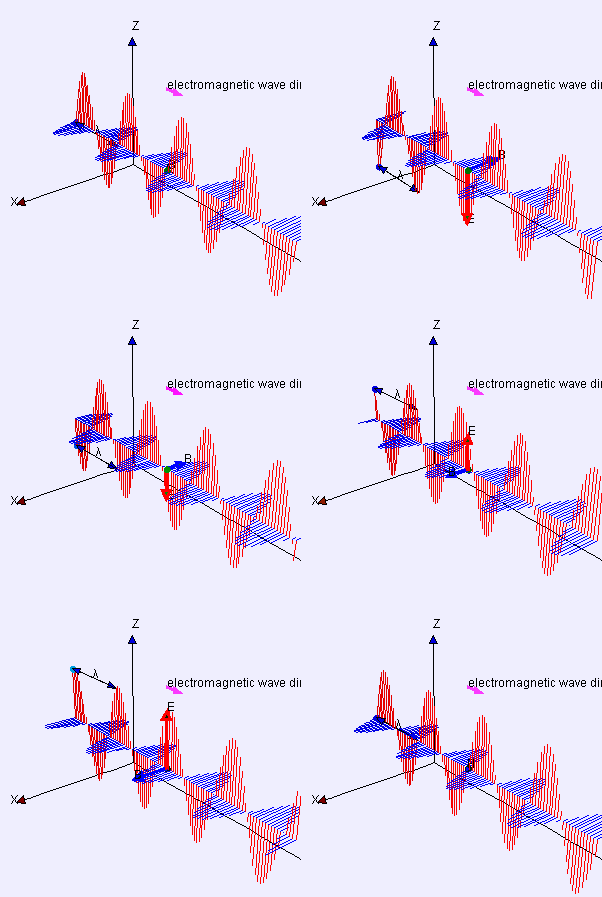
“There’s more than one wave in play. <keys clicking> Here’s a display of the simplest two-beam interaction.”

“I like pictures, but this one’s complicated. Read it out to me.”

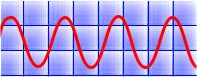
“Sure. The bottom line is our base case, a pure sine wave of some sort. We’re looking at how it’s spread out in space. The middle line is the second wave, traveling parallel to the first one. The top line shows the sum of the bottom two at each point in space. That nets out what something at that point would feel from the combined influence of the two waves. See how the bottom two have the same frequency and amplitude?”

“Sure. They’re going in the same direction, right?”

“Either that or exactly the opposite direction, but it doesn’t matter. Time and velocity aren’t in play here, this is just a series of snapshots. When I built this video I said, ‘What will things look like if the second beam is 30° out of phase with the first one? How about 60°?‘ and so on. The wheel shape just labels how out-of-phase they are, OK?”

“Give me a sec. … OK, so when they’re exactly in sync the angle’s zero and … yup, the top line has twice the amplitude of the bottom one. But what happened to the top wave at 180°? Like it’s not there?”

“It’s there, it’s just zero in the region we’re looking at. The two out-of-phase waves cancel each other in that interval. That’s how your noise-cancelling earphones work — an incoming sound wave hits the earphone’s mic and the electronics generate a new sound wave that’s exactly out-of-phase at your ear and all you hear is quiet.”

“I’ve wondered about that. The incoming sound has energy, right, and my phones are using up energy. I know that because my battery runs down. So how come my head doesn’t fry with all that? Where does the energy go?”

“A common question, but it confuses cause and effect. Yes, it looks like the flatline somehow swallows the energy coming from both sides but that’s not what happens. Instead, one side expends energy to counter the other side’s effect. Flatlines signal success, but you generally get it only in a limited region. Suppose these are sound waves, for example, and think about the molecules. When an outside sound source pushes distant molecules toward your ear, that produces a pressure peak coming at you at the speed of sound, right?”

“Yeah, then…”

“Then just as the pressure peak arrives to push local molecules into your ear, your earphone’s speaker acts to pull those same molecules away from it. No net motion at your ear, so no energy expenditure there. The energy’s burned at either end of the transmission path, not at the middle. Don’t worry about your head being fried.”

“Well that’s a relief, but what does this have to do with the Enterprise?”

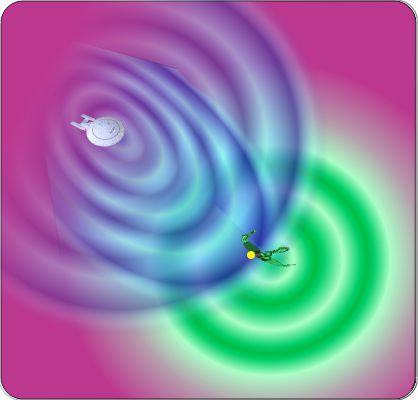
“Here’s a sketch where I imagined an unfriendly encounter between a Klingon cruiser and the Enterprise after Geordi upgraded it with some phase-sensitive stuff. Two perpendicular force disks peaked right where the Klingon shield troughed. The Klingon’s starboard shield generator just overloaded.”

“That’ll teach ’em.”

“Probably not.”

~~ Rich Olcott

Three Ploys to Face A Foe

Run done, Vinnie and I head upstairs to my office to get out of the windchill. My Starship Enterprise poster reminds me. “Geez, it’s annoying.”

“Now what, Sy?”

“I’ve been binge-watching old Star Trek:Next Generation TV programs and the technobabble’s gotten annoying.”

“What’s the problem this time?”

“Well, whenever the Enterprise gets into a fix where it’s their phaser beam or tractor beam or shields against some new Borg technology or something, Geordi or Worf get busy making adjustments and it’s always the frequency. ‘Modulate to a lower frequency!‘ or ‘Raise the frequency!‘ or even ‘Randomize the frequency!‘ At one point Dr Crusher was fiddling with someone’s ‘biophysical frequency.’ They miss two-thirds of the options, and especially they miss the best one when you’re trying to mess up your opponent’s stuff.”

“Wait, I thought we said frequency’s what waves are all about. There’s more?”

“Oh, yeah. The fact that they’re saying ‘frequency’ says their beams and shields and such are probably based on some kind of wave phenomenon. The good guys should be fiddling with amplitude and phase, too. Especially phase.”

“OK, I’ll bite. What’re those about?”

I poke a few keys on my computer and bring this up on the wall screen.

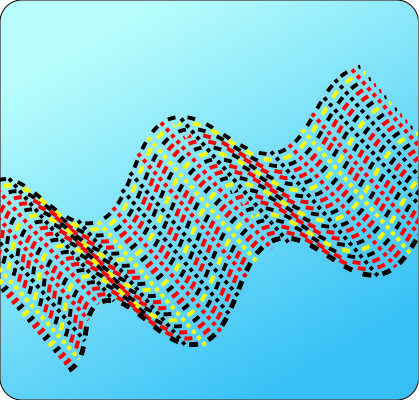
“OK, we’ve talked about frequency, the distance or time between peaks. Frequency’s the difference between a tuba and a piccolo, between infra-red and X-rays. That top trace is an example of modulating the frequency, somehow varying the carrier wave’s peak-to-peak interval. See the difference between the modulated wave and the dotted lines where it would be if the modulation were turned off?”

“Modulation means changing?”

“Mm-hm. The important thing is that only the piece within the box gets altered.”

“Got it. OK, you’ve labelled the middle line ‘Amplitude‘ and that’s gotta be about peak height because they’re taller inside the modulation box than the dotted line. I’m guessing here, but does the bigger peak mean more energy?”

“Good guess, but it depends on the kind of wave. Sound waves, yup, that’s exactly what’s going on. Light waves are different, because a photon’s energy is is determined by its frequency. You can’t pump up a photon’s amplitude, but you can pump up the number of photons in the beam.”

“Hey, Sy, I just realized. Your amplitude modulation and frequency modulation must be the AM and FM on my car radio. So in AM radio they sit on the station’s frequency, right, and make a signal by tweaking the amount of power going to the antenna?”

“That’s the basic idea, though engineers chasing efficiency have improved things a lot in the century since they started experimenting with radio. Implementing FM is more complicated so took a few more decades to make that competitive with AM.”

“So what’s the story with, um, ‘phase modulation‘? My radio’s got no PM dial.”

<poking more keys> “Here’s the way I think of a sine wave — it’s what you’d see looking at a mark on the edge of a rolling wheel. The size of the wheel sets the wave’s amplitude, the wheel’s rotation speed sets the wave’s frequency, and the phase is where it is in the rotation cycle. Modulating the phase would be like jerking the wheel back and forth while it’s rotating.”

“So that’s why there’s hiccups in your bottom red Phase line — things don’t match up across a phase shift.. Hmm… I’m still thinking about my radio. AM sound tends to have more static, especially during thunderstorms. That’d be because my radio amplifies any electromagnetic wave amplitudes at the frequency I’d set it for and that includes waves from the lightning. FM sound’s a lot clearer. Is that because frequency shifts don’t happen much?”

“Exactly.”

“PM broadcasts ought to be even safer against noise. How come I never see them?”

“You do. WiFi uses it, precisely because it works well even at extremely low power levels. OK, challenge question — why do you think I think PM would be better than FM against Borg tech?”

“It’d be like in fencing or martial arts. Frequency’s jab, jab, jab, regular-like. Shifting your wave phase would be mixing it up, they wouldn’t know when the next peak’s coming.”

“Yup. Now tell Geordi.”

~~ Rich Olcott

Disentangling 3-D Plaid

Our lake-side jog has slowed to a walk and suddenly Mr Feder swerves off the path to thud onto a park bench. “I’m beat.”

Meanwhile, heavy footsteps from behind on the gravel path and a familiar voice. “Hey, Sy, you guys talking physics?”

“Well, we were, Vinnie. Waves, to be exact, but Feder’s faded and anyway his walk wasn’t fast enough to warm me up.”

“I’ll pace you. What’d I miss?”

“Not a whole lot. So many different kinds of waves but physicists have abstracted them down to a common theme — a pattern that moves through space.”

“Haw — flying plaid.”

“That image would work if each fiber color carried specific values of energy and momentum and the cross-fibers somehow add together and there’s lots of waves coming from all different directions so it’s 3-D.”

“Sounds complicated.”

“As complicated as the sound from a symphony.”

“I prefer dixieland.”

“Same principle. Trumpet, trombone, clarinet, banjo — many layers of harmony but you can choose to tune in on just one line. That’s a clue to how physicists un-complicate waves.”

“How so?”

“Back in the early 19th century, Fourier showed that you can think about any continuous variation stream, no matter how complicated, in terms of a sum of very simple variations called sine waves. You’ve seen pictures of a sine wave — just a series of Ss laid on their sides and linked together head-to-tail.”

“Your basic wiggly line.”

“Mm-hm, except these wiggles are perfectly regular — evenly spaced peaks, all with the same height. The regularity is why sine waves are so popular. Show a physicist something that looks even vaguely periodic and they’ll immediately start thinking sine wave frequencies. Pythagoras did that for sound waves 2500 years ago.”

“Nah, he couldn’t have — he died long before Fourier.”

“Good point. Pythagoras didn’t know about sine waves, but he did figure out how sounds relate to spatial frequencies. Pluck a longer bowstring, get a lower note. Pinch the middle of a vibrating string. The strongest remaining vibration in the string sounds like the note from a string that’s half as long. Pythagoras worked out length relationships for the whole musical scale.”

“You said ‘spacial frequency’ like there’s some other kind.”

“There is, though they’re closely related. Your ear doesn’t sense the space frequency, the distance between peaks. You sense the time between peaks, the time frequency, which is the space frequency, peaks per meter, times how fast the wave travels, meters per second. See how the units work out?”

“Cute. Does that space frequency/time frequency pair-up work for all kinds of waves?”

“Mostly. It doesn’t work for standing waves. Their energy’s trapped between reflectors or some other way and they just march in place. Their time frequency is zero peaks per second whatever their peaks per meter space frequency may be. Interesting effects can happen if the wave velocity changes, say if the wave path crosses from air to water or if there’s drastic temperature changes along the path.”

“Hah! Mirages! Wait, that’s light getting deflected after bouncing off a hot surface into cool air. Does sound do mirages, too?”

“Sure. Our hearing’s not sharp enough to notice sonic deflection by thermal layering in air, but it’s a well-known issue for sonar specialists. Echoes from oceanic cold/warm interfaces play hob with sonar echolocation. I’ll bet dolphins play games with it when the cold layer’s close enough to the surface.”

“Those guys will find fun in anything. <pause> So Pythagoras figured sound frequencies playing with a bow. Who did it for light?”

“Who else? Newton, though he didn’t realize it. In his day people thought that light was colorless, that color was a property of objects. Newton used the rainbow images from prisms to show that color belonged to light. But he was a particle guy. He maintained that every color was a different kind of particle. His ideas held sway for over 150 years until Fresnel convinced the science community that lightwaves are a thing and their frequencies determine their color. Among other things Fresnel came up with the math that explained some phenomena that Newton had just handwaved past.”

“Fresnel was more colorful than Newton?”

“Uh-uh. Compared to Newton, Fresnel was pastel.”

~~ Rich Olcott

Wave As You Go By

A winter day, a bit nippy and windy enough to raise scattered whitecaps on the park lake. Apparently neither the geese nor Mr Richard Feder (of Fort Lee, NJ) enjoy that — the geese are standing on the shore and he’s huddled down on a bench as I pass. “Hey Moire, I gotta question.”

“Mr Feder. I’m trying to keep warm. If you want answers you’ll have to jog along.”

“Oh, alright <oof>. OK, watching those waves got me thinking. They keep going because the wind pushes on ’em, right? So what pushes on sound waves and light waves? If something pushes hard enough on a sound wave does it speed up enough to be a light wave?”

“So many questions. Are you sure you’ve got enough wind?”

“Ha, ha. I’ve been working out a little.”

“We’ll see. Well, first, nothing needs to push on a wave once it’s started. They travel on their own momentum.”

“Then why do these waves die away when the wind stops?”

“You’ve got two things going on there, on different time scales. When the wind stops blowing it stops making new waves. Actually, winds rarely stop all at once, they taper off. It looks like waves are dying away but really you just see smaller and smaller waves. Inside a single wave, though, friction takes its toll.”

“Friction? Waves rub against each other? That’s not what’s going on here — they keep their distance unless different groups run crosswise and then they all just keep going.”

Turbulence in a water wave

“Not friction between waves, friction within a wave. There’s a lot of turbulence inside a water wave — the wind piles up surface molecules on one side, gravity and surface tension move the other side’s molecules downward, and the ones inside are pulled in every direction. All that helter-skelter motion randomizes the wave’s momentum and converts the wave’s energy to heat. When that’s gone, the wave’s gone.”

“So how’s sound different from that?”

“Lots of ways. To begin with, wind and gravity move molecules up and down perpendicular to the wave’s direction of travel. Sound waves aren’t affected by gravity. They move molecules back and forth parallel to the wave’s direction.”

“But they still die out, right? Turn to heat and all that?”

“Absolutely, Mr Feder. How fast a wave dies out depends on what heat-conversion processes are in play. In a water wave gravity and surface tension work together to smooth things out. Neither’s active in sound waves. The only way a sound wave can lose energy is through random collisions between molecules that aren’t in sync with the wave. Could be the wave hits a mushy object or maybe it just gets buried in other waves.”

“Like at a football game, when everyone’s shouting but all you hear is the roar.”

“Pretty good example, Mr Feder.”

“So how’s a light wave different?”

“Light waves don’t even need molecules. The electromagnetic field near a particle is the net effect of all the attractions and repulsions it feels from all other charged particles everywhere in the Universe. When some charged particle somewhere moves, that changes the field. The change is transmitted throughout the field as a wave traveling at the speed of light.”

“What makes it die away?”

“It doesn’t. On a dark, clear night your eyes can see stars a quintillion miles away. Astronomers with their instruments can detect objects millions of times further away.”

“No smoothing out? How come?”

“That’s a very deep question, Mr Feder, one that really bothered Einstein. You’d think a photon’s wave would get fainter the further it spreads. In fact, it delivers all its energy to the first charged particle it can interact with, no matter how far it had traveled. Weird, huh?”

“Weird, all right. So we got these three very different things — they start different, they push different, they got different speeds, they die different, but we call them all waves. Why’s that?”

“They’re all waves because they’re all patterns that transmit energy and momentum across space. Physicists have found general rules that apply to the patterns, whatever the wave type. Equations that work for one kind work for many others, too.”

Gravity waves?”

“And gravitational waves.”

~~ Rich Olcott

A Mole’s Tale

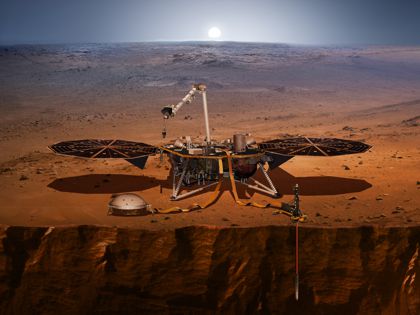
Chilly days are always good for a family trip to the science museum. Sis is interested in the newly unearthed dinosaur bones, but Teena streaks for the Space Sciences gallery. “Look, Uncle Sy, it’s a Mars rover. No, wait — it doesn’t have wheels — it’s a lander!”

Artist’s depiction of InSight — credit NASA/JPL-Caltech

A nearby museum docent catches that. “Good observing, young lady. You’re right, it’s NASA’s Insight lander. It touched down on Mars last Thanksgiving Day. While you were having turkey and dressing, we were having a party over here.”

“Is this the real one? How’d you get it back?”

“No, it’s just a model, but it’s full-size, 19½ feet across. We’re never going to get the real one back — those little bitty landing rockets you see around the electronics compartment are too small to get it off the planet.”

“Tronics compartment? You mean the pretty gold box underneath the flat part? Why’d they make it gold?”

“That gold is just the outside layer of a dozen layers of Mylar insulation. It helped to keep the computers in there cool during the super-hot minutes when the lander was coming down through Mars atmosphere. The insulation also keeps the electronics warm during the cold martian night. A thin gold coating on the outermost layer reflects the bad part of sunlight that would crumble the Mylar.”

“Computers like Mommie’s laptop? I don’t see any screens.”

“They don’t need any. No-one’s on Mars to look at them. The instructions all come in from Earth by radio.”

Sis is getting into it. “Look, Sweetie, the platform in the middle’s about the same size as our kitchen table.”

“Yeah, but it’s got butterfly wings. A flying kitchen table, whee!”

“Those wings are solar panels. They turn sunlight into the electricity Insight needs to run things and keep warm. They make enough power for three households here on Earth.”

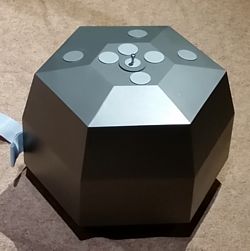
“What’s the cake box about?”

SEIS —
Seismic Experiment for Interior Structure

“Cake box?”

“Yeah, down there on the floor.”

“Ah. That’s for … have you ever experienced an earthquake?”

“Yes! Suddenly all the dishes in the cupboard went BANG! It was weird but then everything was fine.”

“I’m glad. OK, an earthquake is when vibrations travel through the Earth. Vibrations can happen on Mars, too, but they’re called…”

“Marsquakes! Ha, that’s funny!”

“Mm-hm. Well, that ‘cake box’ is something called a seismometer. It’s an extremely sensitive microphone that listens for even the faintest vibrations. When scientists were testing the real seismometer in Boulder, Colorado it recorded a steady pulse … pulse … pulse … that they finally traced back to ocean waves striking the coast of California, 1200 miles away. Insight took it to Mars and now it’s listening for marsquakes. It’s already heard a couple dozen. They’ve given the scientists lots of new information about Mars’ crust and insides.”

“Like an X-ray?”

“Just like that. We’ll be able to tell if the planet’s middle is molten–“

“Hot lava! Hot lava!”

“Maybe. Earth has a lot of underground lava, but we think that Mars has cooled off and possibly doesn’t have any. That other device on the ground is supposed to help find out.”

HP3 — Heat Flow and
Physical Properties Package

“It looks like The Little Engine That Could.”

“It does, a little, but this one maybe can’t. We’re still waiting to see. That chimney-looking part held The Mole, a big hollow spike with something like a thermometer at its pointy tip. Inside The Mole there’s a hammer arrangement. The idea was that the hammer would bang The Mole 15 feet into the ground so we could take the planet’s temperature.”

“Did the banging work?”

“It started to, but The Mole got stuck only a foot down. The engineers have been working and working, trying different ways to get it down where we want it but so far it’s still stuck.”

“Aww, poor Mole.”

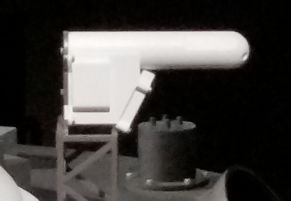
TWINS – Temperature
and Wind for InSight

“Yes. But there’s another neat instrument up on the platform. Here, I’ll shine my laser pointer at it. See the grey thingy?”

“Uh-huh.”

“That’s a weather station for temperature and wind. You can check its readings on the internet. Here, my phone’s browser’s already set to mars.nasa.gov/insight/weather. Can you read the high and low temperatures?”

“Way below zero! Wow, Mars is chilly! I’d need a nice, warm spacesuit there.”

“For sure.”

~~ Rich Olcott

A Wheel in A Wheel

The conversation’s gotten a little dry so I carry our mugs over to Al’s coffee tap for refills. Vinnie’s closest so he gets the first one. “Thanks, Sy. So you say that a black hole has all these other things on the outside — the photon sphere and that weird belt if it’s rotating and the accretion disk and the jets which is what I asked about in the first place.”

Astrophysicist-in-training Newt Barnes gets the second mug. “My point, Vinnie, is they all act together. You can’t look at just one thing. Thanks, Sy. You know, you should’ve paid more attention to the ergosphere.”

“Ergosphere?”

“Yeah, Vinnie, that pumpkin-shaped layer Sy described — actually, more a pumpkin shell. The event horizon and photon sphere take up space inside of it and the accretion disk’s inner edge grazes its equator. The pumpkin is fatter for a more rapidly rotating black hole, but its boundary still dips down to meet the event horizon at the rotational poles. Diagrams usually show it just sitting there but that’s not quite true.”

“It wobbles?”

“No, the shape stays in place, locked to the event horizon just like the diagrams show. What’s inside it, though, is moving like mad. That’s what we’d see from a far-away frame, anyhow.”

Frames again, I knew it. The pumpkin’s got frames?”

“With extreme-gravity situations it’s always frames, Vinnie. The core’s gravity pulls in particles from the accumulation disk. They think they’re going straight. From an outsider’s perspective everything swerves spinwise at the ergosphere’s boundary. Even if a high-speed particle had been aimed in the other direction, it’s going spinwise once it’s inside the ergosphere.”

“Who’s making it do that?”

“Frame-dragging on steroids. We’ve known for a century that gravity from any massive body compresses the local space. ‘Kilometers are shorter near a black hole,’ as the saying goes. If the body is rotating, that counts too, at least locally — space itself joins the spin. NASA’s Gravity B probe detected micromicrodegree-level frame rotation around Earth. The ergosphere, though, has space is twisted so far that the direction of time points spinwise in the same way that it points inwards within the event horizon. Everything has to travel along time’s arrow, no argument.”

“You said ‘local‘ twice there. How far does this spread?”

“Ah, that’s an important question. The answer’s ‘Not as far as you think.’ Everything scales with the event horizon’s diameter and that scales with the mass. If the Sun were a non-rotating black hole, for instance, its event horizon would be only about 6 kilometers across, less than 4 miles. Its photon sphere would be 4.5 kilometers out from the center and the inner edge of its accretion disk would be a bit beyond that. Space compression dies out pretty quick on the astronomical scale — only a millionth of the way out to the orbit of Mercury the effect’s down to just 3% of its strength at the photosphere.”

“How about if it’s rotating?”

“The frame-dragging effect dies out even faster, with the cube of the distance. At the same one-millionth of Mercury’s orbit, the twist-in-space factor is 0.03% of what it is at the photosphere. At planet-orbit distances spin’s a non-player. However, in the theory I’m researching, spin’s influence may go much further.”

“Why’s that?”

“Seen from an outside frame, what’s inside the ergosphere rotates really fast. Remember that stuff coming in from the accretion disk’s particle grinder? It ought to be pretty thoroughly ionized, just a plasma of negative electrons and positive particles like protons and atomic nuclei. The electrons are thousands of times lighter than the positive stuff. Maybe the electrons settle into a different orbit from the positive particles.”

“Further in or further out?”

“Dunno, I’m still calculating. Either way, from the outside it’d look like two oppositely-charged disks, spinning in the same direction. We’ve known since Ørsted that magnetism comes from a rotating charge. Seems to me the ergosphere’s contents would generate two layers of magnetism with opposite polarities. I think what keeps the jets confined so tightly is a pair of concentric cylindrical magnetic fields extruded from the ergosphere. But it’s going to take a lot of math to see if the idea holds water.”

“Or jets.”

~~ Rich Olcott

The Jet and The Plane

“OK, Sy, I get your point about a black hole being more than a mystical event horizon hiding whatever’s inside it. I’ll give you it’s a structure with a trapped-light shell and a pumpkin-donut belt around that –“

“… if it’s rotating, Vinnie…”

“– if it’s rotating, but what does all that have to do with those huge jets coming out of the poles instead of the equator where they belong?”

Suddenly Newt Barnes, astrophysicist in training, is standing by our table. “You guys are talking my research topic, just the hottest thing in astrophysics these days. Those jets were the subject of over a thousand papers last year. Mind if I sit in?”

“Of course not.” “We’re all ears.”

“Well, there’s a couple more layers to peel before we can make a maybe connection. Vinnie, what’s the weirdest thing about those jets?”

“Like I said, they’re huge — millions of lightyears long.”

“True, but other structures are huge, too — galaxy superclusters, for instance. The real weirdness is how narrow the jets are — less than a degree wide, and they’ve maintained that tight geometry while they’ve grown for millions of years. We still don’t know what’s in a jet. If it’s a beam of charged particles you’d think they’d repel each other and spread out almost immediately. If the particles are uncharged they’d bang into each other and into the prevailing interstellar medium. Random collisions would spread the beam out maybe a little slower than a charged-particle beam but still. A photon beam would be more stable but you’d need a really good collimating mechanism at the jet’s base to get the waves all marching so precisely.”

“What’s left, dark matter?”

“Almost certainly not. Many jets emit huge quantities of electromagnetic radiation at all frequencies from radio up through X-rays and beyond. Dark matter doesn’t do electromagnetism. No, jets are somehow created from normal stuff. The question is, how is it kept under such tight control?”

“The other question is, where’s all that stuff coming from if nothing can escape outta the event horizon?”

“Ah, that has to do with yet another part of the structure — the accretion disk.”

“What they got that orange picture of, right? Big ring like Saturn’s.”

“Well, similar shape, but different origin, different composition and very different dynamics. Saturn’s rings are mostly water-ice, built up from the debris of ice-moons that collided or were pulled apart by tidal forces. A black hole’s accretion disk is made up of planets, dust particles, atoms, whatever junk was unfortunate enough to be too close when the black hole passed by. Pick any incoming object and call it Freddie. Unless Freddie and the event horizon’s core are on an exact collision course, Freddie gets swept up by the disk.”

“Then what happens?”

“Freddie collides with something already in the disk. Lots of somethings. Each collision does two things. One, Freddie and the something break into smaller pieces. Two, some of Freddie’s gravitational potential energy relative to the core is converted to heat, making the collision debris package hotter than Freddie and the something were to begin with. After a while, Freddie gets ground down to atoms or smaller and they’re all really hot, radiating intensely just like Planck and Einstein said they would.”

“So we got a ring like Saturn’s, like I said.”

“Only sort of. Saturn has half-a-dozen distinct rings. They shine by reflected sunlight, the middle ring is brightest and broadest, and the innermost ring is dark and skinny. Our only direct accretion disk image so far is a one blurry view, but the object shines with its own light and in theory the disk isn’t segmented. There should be just one ring and it’d be brightest at a sharp inner edge.”

“Why’s that?”

“The light’s produced by hot particles. Heat generation’s most intense where the gravity well is steepest. That’s nearest the core. For a non-spinning black hole the threshold is one-sixth of the horizon’s diameter. If Freddie gets knocked the slightest bit closer than that it’s doomed to fall the rest of the way in. The edge is closer-in if the hole’s rotating but then Freddie has an interesting time. Relatively.”

“Gonna be frames again, right?”

“Yeah.”

~~ Rich Olcott

Beyond The Shadow of A…?

“Alright, Vinnie, what’s the rest of it?”

“The rest of what, Sy?”

“You wouldn’t have hauled that kid’s toy into Al’s shop here just to play spitballs with it. You’re building up to something and what is it?”

“My black hole hobby, Sy. The things’re just a few miles wide but pack more mass than the Sun. A couple of my magazines say they give off jets top and bottom because of how they spin. That just don’t fit. The stuff ought to come straight out to the sides like the paper wads did.”

“Well, umm… Ah. You know the planet Saturn.”

“Sure.”

“Are its rings part of the planet?”

“No, of course not, they go around it. I even seen an article about how the rings probably came from a couple of collided moons and how water from the Enceladus moon may be part of the outside ring. Only thing Saturn does for the rings is supply gravity to keep ’em there.”

“But our eyes see planet and rings together as a single dot of light in the sky. As far as the rest of the Solar System cares, Saturn consists of that big cloudy ball of hydrogen and the rings and all 82 of its moons, so far. Once you get a few light-seconds away, the whole collection acts as a simple point-source of gravitational attraction.”

“I see where you’re going. You’re gonna say a black hole’s more than just its event horizon and whatever it’s hiding inside there.”

“Yup. That ‘few miles wide’ — I could make a case that you’re off by trillions. A black hole’s a complicated beast when we look at it close up.”

“How can you look at a thing like that close up?”

“Math, mostly, but the observations are getting better. Have you seen the Event Horizon Telescope’s orange ring picture?”

“You mean the one that Al messed with and posted for Hallowe’en? It’s over there behind his cash register. What’s it about, anyway?”

“It’s an image of M87*, the super-massive black hole at the center of the M87 galaxy. Not the event horizon itself, of course, that’s black. The orange portion actually represents millimeter-radio waves that escape from the accretion disk circling the event horizon. The innermost part of the disk is rotating around the hole at near-lightspeed. The arc at the bottom is brighter because that’s the part coming toward us. The photons get a little extra boost from Special Relativity.”

Frames again?”

“With black holes it’s always frames. You’ll love this. From the shell’s perspective, it spits out the same number of photons per second in every direction. From our perspective, time is stretched on the side rotating away from us so there’s fewer photons per one of our seconds and it’s dimmer. In the same amount of our time the side coming toward us emits more photons so it’s brighter. Neat demonstration, eh?”

“Cute. So the inner black part’s the hole ’cause it can’t give off light, right?”

“Not quite. That’s a shadow. Not a shadow of the event horizon itself, mind you, but of the photon sphere. That’s a shell about 1½ times the width of the event horizon. Any photon that passes exactly tangent to the sphere is doomed to orbit there forever. If the photon’s path is the slightest bit inward from that, the poor particle heads inward towards whatever’s in the center. The remaining photons travel paths that look bent to a distant observer, but the point is that they keep going and eventually someone like us could see them.”

“The shadow and the accretion disk, that’s what the EHT saw?”

“Not exactly.”

“There’s more?”

“Yeah. M87* is a spinning black hole, which is more complicated than one that’s sitting still. Wrapped around the photon sphere there’s an ergosphere, as much as three times wider than the event horizon except it’s pumpkin-shaped. The ergosphere’s widest at the rotational equator, but it closes in to meet the event horizon at the two poles. Anything bigger than a photon that crosses its boundary is condemned to join the spin parade, forever rotating in sync with the object’s spin.”

“When are you gonna get to the jets, Sy?”

~~ Rich Olcott