The Speeds of Light

“I don’t give up easy, Sy.”

“I know that, Vinnie.  Still musing about lightwaves and how they’re all an electron’s fault?”

“Yeah.  Hey, can your OVR app on Old Reliable grab a shot from this movie running on my smartphone?”

“We can try … got it.  Now what?”

“I wanna try mixing that with your magnetic field picture.”

“I’ll bring that up … Here, have at it.”

“Umm … Nice app, works very intuitive-like …  OK, see this?”Electrons and lightwave

“Ah.  It’s a bit busy, walk me through what’s in there.”

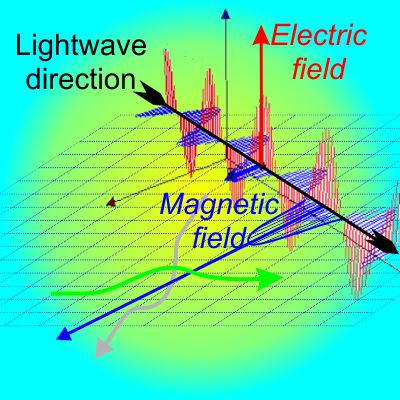
“OK. First we got the movie’s lightwave.  The ray’s running along that black arrow, see?  Some electron back behind the picture is going up and down to energize the ray and that makes the electric field that’s in red that makes other electrons go up and down, right?”

“That’s the red arrow, hmm?”

“Yeah, that electron got goosed ’cause it was standing in the way.  It follows the electric field’s direction.  Now help me out with the magnetic stuff.”

“Alright.  The blue lines represent the lightwave’s magnetic component.  A lightwave’s magnetic field lines are always perpendicular to its electric field.  Magnetism has no effect on uncharged particles or motionless charged particles.  If you’re a moving charged particle, say an electron, then the field deflects your trajectory.”

“This is what I’m still trying to wrap my head around.  You say that the field’s gonna push the particle perpendicular to the field and to the particle’s own vector.”

“That’s exactly what happens.  The green line, for instance, could represent an electron that crossed the magnetic field.  The field deflected the electron’s path upwards, crossways to the field and the electron’s path.  Then I suppose the electron encountered the reversed field from the lightwave’s following cycle and corrected course again.”

“And the grey line?”

“That’d be an electron crossing more-or-less along the field.  According to the Right Hand Rule it was deflected downward.”

“Wait.  We’ve got two electrons on the same side of the field and they’re deflected in opposite directions then correct back.  Doesn’t that average out to no change?”

“Not quite.  The key word is mostly.  Like gravity fields, electromagnetic fields get weaker with distance.  Each up or down deflection to an electron on an outbound path will be smaller than the previous one so the ‘course corrections’ get less correct.  Inbound electrons get deflected ever more strongly on the way in, of course, but eventually they become outbound electrons and get messed up even more.  All those deflections produce an expanding cone of disturbed electrons along the path of the ray.”

“Hey, but when any electron moves that changes the fields, right?  Wouldn’t there be a cone of disturbed field, too?”

“Absolutely.  The whole process leads to several kinds of dispersion.”

“Like what?”

“The obvious one is simple geometry.  What had been a simple straight-line ray is now an expanding cone of secondary emission.  Suppose you’re an astronomer looking at a planet that’s along that ray, for instance.  Light’s getting to you from throughout the cone, not just from the straight line.  You’re going to get a blurred picture.”

“What’s another kind?”

“Moving those electrons around extracts energy from the wave.  Some fraction of the ray’s original photons get converted to lower-energy ones with lower frequencies.  The net result is that the ray’s spectrum is spread and dispersed towards the red.”

“You said several kinds.”

“The last one’s a doozy — it affects the speeds of light.”

“‘Speeds,’ plural?”ripples in a wave

“There’s the speed of field’s ripples, and there’s the speed of the whole signal, say when a star goes nova.  Here’s a picture I built on Old Reliable.  The gold line is the electric field — see how the ripples make the red electron wobble?  The green dots on the axis give you comparison points that don’t move.  Watch how the ripples move left to right just like the signal does, but at their own speed.”

“Which one’s Einstein’s?”

“The signal.  Its speed is called the group velocity and in space always runs 186,000 mph.  The ripple speed, technically it’s the phase velocity, is slower because of that extracted-and-redistributed-energy process.  Different frequencies get different slowdowns, which gives astronomers clues about the interstellar medium.”

“Clues are good.”

~~ Rich Olcott

They Went That-away. But Why?

“It’s worse than that, Vinnie.”  I pull out Old Reliable, my math-monster tablet.  “Let me scan in that three-electron drawing of yours.”3 electrons in B-field

“Good enough to keep a record of it?”

“Nope, I want to exercise a new OVR app I just bought.”

“You mean OCR.”

“Uh-uh, this is Original Vector Reconstruction, not Optical Character Recognition.    OCR lets you read a document into a word processor so you can modify it.  OVR does the same thing but with graphics.  Give me a sec … there.  OK, look at this.”3 electrons in B-field revisited

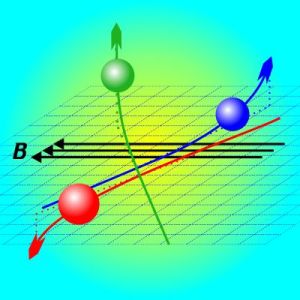
“Cool, you turned my drawing 180°, sort of.  Nice app.  Oh, and you moved the red electron’s path so it’s going opposite to the blue electron instead of parallel to the magnetic field.  Why’d you bother?”

“See the difference between blue and red?”

“Well, yeah, one’s going up, one’s going down.  That’s what I came to you about and you shot down my theory.  Those B-arrows in the magnetic field are going in completely the wrong direction to push things that way.”

“Well, actually, they’re going in exactly the right direction for that, because a magnetic field pushes along perpendiculars.  Ever hear of The Right Hand Rule?”

“You mean like ‘lefty-loosey, righty-tighty’?”

“That works, too, but it’s not the rule I’m talking about.  If you point your thumb in the direction an electron is moving, and your index finger in the direction of the magnetic field, your third finger points in the deflection direction.  Try it.”

“Hurts my wrist when I do it for the blue one, but yeah, the rule works for that.  It’s easier for the red one.  OK, you got this rule, fine, but why does it work?”

“Part of it goes back to the vector math you don’t want me to throw at you.  Let’s just say that there are versions of a Right Hand Rule all over physics.  Many of them are essentially definitions, in the same way that Newton’s Laws of Motion defined force and mass.  Suppose you’re studying the movements directed by some new kind of force.  Typically, you try to define some underlying field in such a way that you can write equations that predict the movement.  You haven’t changed Nature, you’ve just improved our view of how things fit together.”

“So you’re telling me that whoever made that drawing I copied drew the direction those B-arrows pointed just to fit the rule?”

“Almost.  The intensity of the field is whatever it is and the lines minus their pointy parts are wherever they are.  The only thing we can set a rule for is which end of the line gets the arrowhead.  Make sense?”Spiraling electron

“I suppose.  But now I got two questions instead of the one I come in here with.  I can see the deflection twisting that electron’s path into a spiral.  But I don’t see why it spirals upward instead of downward, and I still don’t see how the whole thing works in the first place.”

“I’m afraid you’ve stumbled into a rabbit hole  we don’t generally talk about.  When Newton gave us his Law of Gravity, he didn’t really explain gravity, he just told us how to calculate it.  It took Einstein and General Relativity to get a deeper explanation.  See that really thick book on my shelf over there?  It’s loaded with tables of thermodynamic numbers I can use to calculate chemical reactions, but we didn’t start to understand those numbers until quantum mechanics came along.  Maxwell’s equations let us calculate electricity, magnetism and their interaction — but they don’t tell us why they work.”

“I get the drift.  You’re gonna tell me it goes up because it goes up.”

“That’s pretty much the story.  Electrons are among the simplest particles we know of.  Maxwell and his equations gave us a good handle on how they behave, nothing on why we have a Right Hand Rule instead of a Left Hand Rule.  The parity just falls out of the math.  Left-right asymmetry seems to have something to do with the geometry of the Universe, but we really don’t know.”

“Will string theory help?”

“Physicists have spent 50 years grinding on that without a testable result.  I’m not holding my breath.”

~~ Rich Olcott

Three off The Plane

Rumpus in the hallway.  Vinnie dashes into my office, tablet in hand and trailing paper napkins.  “Sy! Sy! I figured it out!”

“Great!  What did you figure out?”

“You know they talk about light and radio being electromagnetic waves, but I got to wondering.  Radio antennas don’t got magnets so where does the magnetic part come in?”

“19th-Century physicists struggled with that question until Maxwell published his famous equations.  What’s your answer?”

“Well, you know me — I don’t do equations, I do pictures.  I saw a TV program about electricity.  Some Danish scientist named Hans Christian Anderson—”

“Ørsted.”

“Whoever.  Anyway, he found that magnetism happens when an electric current starts or stops.  That’s what gave me my idea.  We got electrons, right, but no magnetrons, right?”

“Mmm, your microwave oven has a vacuum tube called a magnetron in it.”

“C’mon, Sy, you know what I mean.  We got no whatchacallit, ‘fundamental particle’ of magnetism like we got with electrons and electricity.”

“I’ll give you that.  Physicists have searched hard for evidence of magnetic monopoles — no successes so far.  So why’s that important to you?”

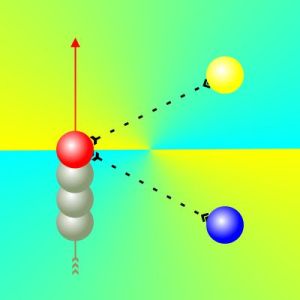
3 electrons moving north“It told me that the magnetism stuff has to come from what electrons do.  And that’s when I came up with this drawing.”  <He shoves a paper napkin at me.>  “See, the three balls are electrons and they’re all negative-negative pushing against each other only I’m just paying attention to what the red one’s doing to the other two.  Got that?”

“Sure.  The arrow means the red electron is traveling upward?”

“Yeah.  Now what’s that moving gonna do to the other two?”

“Well, the red’s getting closer to the yellow.  That increases the repulsive force yellow feels so it’ll move upward to stay away.”

“Uh-huh.  And the force on blue gets less so that one’s free to move upward, too.  Now pretend that the red one starts moving downward.”

“Everything goes the other way, of course.  Where does the magnetism come in?”

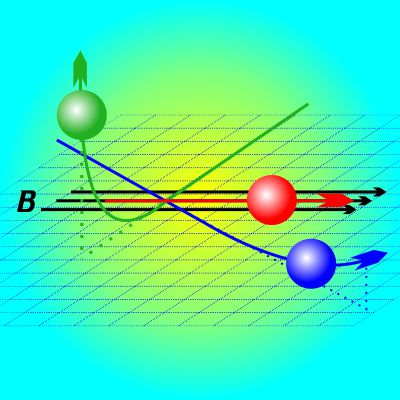
3 electrons in B-field“Well, that was the puzzle.  Here’s a drawing I copied from some book.  The magnetic field is those B arrows and there’s three electrons moving  in the same flat space in different directions.  The red one’s moving along the field and stays that way.  The blue one’s moving slanty across the field and gets pushed upwards.  The green one’s going at right angles to B and gets bent way up.  I’m looking and looking — how come the field forces them to move up?”
“Good question.  To answer it those 19th Century physicists developed vector analysis—”

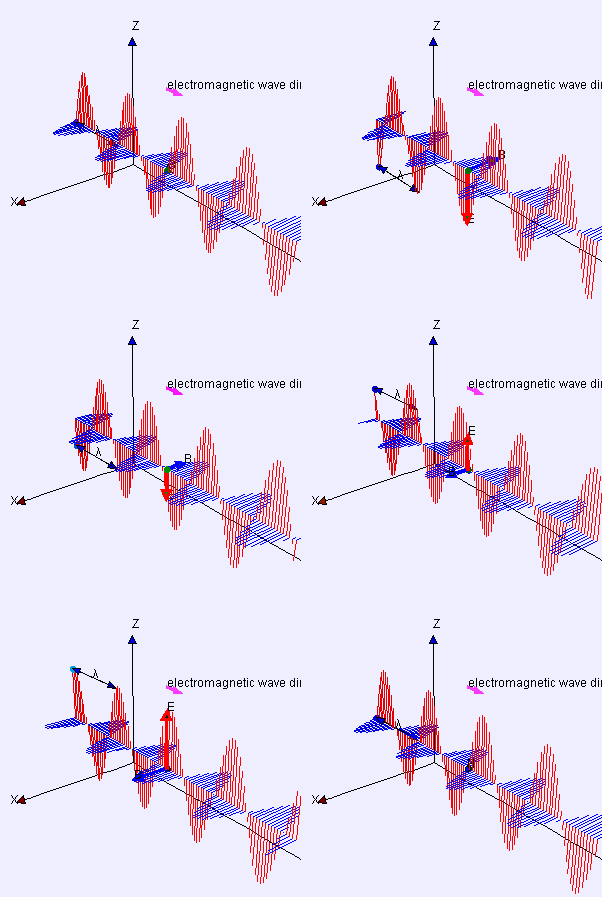
Electromagneticwave3D
Plane-polarized electromagnetic wave
Electric (E) field is red
Magnetic (B) field is blue
(Image by Loo Kang Wee and Fu-Kwun Hwang from Wikimedia Commons)

“Don’t give me equations, Sy, I do pictures.  Anyway, I figured it out, and I did it from a movie I got on my tablet here.  It’s a light wave, see, so it’s got both an electric field and a magnetic field and they’re all sync’ed up together.”

“I see that.”

“What the book’s picture skipped was, where does the B-field come from?  That’s what I figured out.  Actually, I started with where the the light wave came from.”

“Which is…?”

“Way back there into the page, some electron is going up and down, and that creates the electric field whose job is to make other electrons go up and down like in my first picture, right?”

“OK, and …?”

“Then I thought about some other electron coming in to meet the wave.  If it comes in crosswise, its path is gonna get bent upward by the E-field.  That’s what the blue and green electrons did.  So what I think is, the magnetic effect is really from the E-field acting on moving electrons.”

“Nice try, but it doesn’t explain a couple of things.  For instance, there’s the difference between the green and blue paths.  Why does the amount of deflection depend on the angle between the B direction and the incoming path?”

“Dunno.  What’s the other thing?”

“Experiment shows that the faster the electron moves, the greater the magnetic deflection.  Does your theory account for that?”

“Uhh … my idea says less deflection.”

“Sorry, another beautiful theory stumbles on ugly facts.”

~~ Rich Olcott

Far out, man

Egg in the UniverseThe thing about Al’s coffee shop is that there’s generally a good discussion going on, usually about current doings in physics or astronomy.  This time it’s in the physicist’s corner but they’re not writing equations on the whiteboard Al put up over there to save on paper napkins.  I step over there and grab an empty chair.

“Hi folks, what’s the fuss about?”

“Hi, Mr Moire, we’re arguing about where the outer edge of the Solar System is.  I said it’s Pluto’s orbit, like we heard in high school — 325 lightminutes from the Sun.”

The looker beside him pipes up.  “Jeremy, that’s just so bogus.”  Kid keeps scoring above his level, don’t know how he does it.  “Pluto doesn’t do a circular orbit, it’s a narrow ellipse so average distance doesn’t count.  Ten percent of the time Pluto’s actually closer to the Sun than Neptune is, and that’s only 250 lightminutes out.”

Then the looker on his other side chimes in.  Doing good, kid.  “How about the Kuiper Belt?  A hundred thousand objects orbiting the Sun out to maybe twice Neptune’s distance, so it’s 500 lightminutes.”

Third looker, across the table.  You rock, Jeremy.  “Hey, don’t forget the Scattered Disk, where the short-period comets drop in from.  That goes out to 100 astronomical units, which’d be … 830 lightminutes.”

One of Cathleen’s Astronomy grad students can’t help diving in despite he’s only standing nearby, not at the table.  “Nah, the edge is at the heliopause.”

<several voices> “The what?”

“You know about the solar wind, right, all the neutral and charged particles that get blown out of the Sun?  Mass-density-wise it’s a near-vacuum, but it’s not nothing.  Neither is the interstellar medium, maybe a few dozen hydrogen and helium atoms per cubic meter but that adds up and they’re not drifting on the same vector the Sun’s using.  The heliopause is the boundary where the two flows collide.  Particles in the solar wind are hot, relatively speaking, compared to the interstellar medium.  Back in 2012, our outbound spacecraft Voyager 1 detected a sharp drop in temperature at 121 astronomical units.  You guys are talking lightminutes so that’d be <thumb-pokes his smartphone> how about that? almost exactly 1000 lightminutes out.  So there’s your edge.”

Now Al’s into it.  “Hold on, how about the Oort Cloud?”

“Mmm, good point.  Like this girl said <she bristles at being called ‘girl’>, the short-period comets are pretty much in the ecliptic plane and probably come in from the Scattered Disk.  But the long-period comets seem to come in from every direction.  That’s why we think the Cloud’s a spherical shell.  Furthermore, the far points of their orbits generally lie in the range between 20,000 and 50,000 au’s, though that outer number’s pretty iffy.  Call the edge at 40,000 au’s <more thumb-poking> that’d be 332,000 lightminutes, or 3.8 lightdays.”

“Nice job, Jim.”  Cathleen speaks up from behind him.  “But let’s think a minute about why that top number’s iffy.”

“Umm, because it’s dark out there and we’ve yet to actually see any of those objects?”

“True.  At 40,000 au’s the light level is 1/40,000² or 1/1,600,000,000 the sunlight intensity we get on Earth.  But there’s another reason.  Maybe that ‘spherical shell’ isn’t really a sphere.”

I have to ask.  “How could it not be?  The Sun’s gravitational field is spherical.”

“Right, but at these distances the Sun’s field is extremely weak.  The inverse-square law works for gravity the same way it does for light, so the strength of the Sun’s gravitational field out there is also 1/1,600,000,000 of what keeps the Earth on its orbit.  External forces can compete with that.”

“Yeah, I get that, Cathleen, but 3.8 lightdays is … over 400 times closer than the 4½ lightyear distance to the nearest star.  The Sun’s field at the Cloud is stronger than Alpha Centauri’s by at least a factor of 400 squared.”

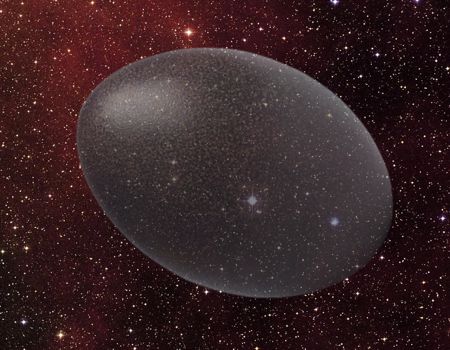
“Think bigger, Sy.  The galactic core is 26,000 lightyears away, but it’s the center of 700 billion solar masses.  I’ve run the numbers.  At Jim’s Oort-Cloud ‘edge’ the Galaxy’s field is 11% as strong as the Sun’s.  Tidal forces will pull the outer portion of the Cloud into an egg shape pointed to the center of the Milky Way.”

Jeremy’s agog.  “So the edge of the Solar System is 1,000 times further than Pluto?  Wow!”

“About.”

“Maybe.”

~~ Rich Olcott

RIP, Dr Hawking

Today I depart from my normal schedule and the current story line and science line.  A giant has left us and I want to pay proper tribute.

Dr Stephen Hawking enjoyed telling people of his fortunate birth date, exactly 300 years after Galileo Galilei passed away.  He liked a good joke, and I think he’d be tickled with this additional connection to the man whose work made Hawking’s work possible:
RIP Hawking

The equation in the center of this cut is Hawking’s favorite result, which he wanted to be carved on his gravestone.  It links a black hole’s entropy (S) to its surface area (A).  The other letters denote a collection of constants that have been central to the development of theoretical Physics over the past century and a half:

  • k is Boltzmann’s constant, which links temperature with kinetic energy
  • c is the speed of light, the invariance of which led Einstein to Relativity
  • G is Newton’s universal gravitational constant
  • h is Planck’s constant, the “quantum of action”

Hawking spent much of his career thinking deeply about the implications of Einstein’s concepts.  Newton’s equations support excellent descriptions of everyday physical motions, from the fall of raindrops to the orbits of solar systems.  Einstein’s equations led to insights about conditions at the most extreme — velocities near lightspeed, masses millions of times the Sun’s but packed into a volume only a few dozen miles wide.

But Hawking also pondered extremes of the ultimately large and the ultimately small — the edge of the Universe and distances far smaller than atomic nuclei.  Because his physical condition prohibited speech or quick jottings, he was forced to develop extraordinary powers of concentration and visualization that enabled him to encapsulate in a few phrases insights that would take others books to develop and communicate.

Hawking wrote books, too, of course, of a quality and clarity that turned his name and Science into watchwords for the general public as well as the physics community.  By his life and how he lived it he was an inspiration to many, abled and otherwise.  Science needs its popularizers, though some in the field deprecate them as hangers-on.  Hawking managed to bridge that gap with ease and grace, a giant with standing on either side.

Requiescat in pace, Dr Hawking.  Thank you.

~~ Rich Olcott

Three atop A Crosshatch

“Hey, Sy, what you said back there, ‘three and a fraction‘ ways to link atoms together…”

“Yeah, Vinnie?”

“What’s that about?  How do fractions come in when you’re counting?”

“Well, I was thinking about how atoms in separate molecules can interact short of reacting and forming new molecular orbitals.  I figure that as a fraction.”

Charge sharing ain’t the whole story?”

“It would be except that sharing usually isn’t equal.  It depends on where the atoms are in the Periodic Table.”

“What’s it got to do with the Periodic Table?”

“The Table’s structure reflects atom structures — how many shells are active in a base-state atom of each element and how many units of charge are in its outermost shell.  Hydrogen and Helium are in Row 1 because the 1-node shell is the only active one in those atoms.  The atoms from Lithium to Neon in Row 2 have charge activating both the 1-node shell and the 2-node shell, and so on.”

“What’s that get us?”

“It gets us a feel for how the atoms behave.  You know I’m all about dimensions, right?”

“Ohhh, yeah.”

“OK, we’ve got a two-dimensional table here.  Going across, each atom’s nucleus has one more proton than its buddy to the left.  What’s that going to do to the electronic charge?”

“Gonna pull it in closer.”

“Wait, Vinnie, there’s an extra electron in there, too.  Won’t that cancel out the proton, Sy?”

“Good thinking, Eddie.  Yes, it does, but only partially.  The atoms do get smaller as you go across, but it’s irregular because negative-negative repulsion within a shell works to expand it almost as much as negative-positive attraction contracts it.”

“Bet things get bigger as you go down the Table, though.”

“Mostly, Vinnie, because each row down adds a shell that’s bigger than the shrinking inner shells.”

“Mostly?”

“The bigger shells with more nodes have more complex charge patterns than just balls and dumbbells.  Those two rows below the main table actually squinch into the lowest two boxes in the third column.  In those elements, some of the activated patterns barely shield the nucleus.  The atoms to their right in the main table are almost identical in size to the elements above them.”

“So I can guess an atom’s size.  So what?”

“So that and the charge give you a handle on the element’s properties and chemistry.  Up there in the top right corner you’ve got the atoms with the highest ratio of nuclear charge to size.  If given the opportunity to pull charge from atoms to their left and below them, what do you suppose happens?”

“You get lop-sided bonds, I guess.”

“Exactly.  In water, for instance, the Oxygen pulls charge towards itself and away from the Hydrogen atoms.  That makes each O-H bond a little dipole, positive-ish at the hydrogen end and negative-ish at the oxygen end.”

“Won’t the positive-ish ends pull on the negative-ish parts of next-door molecules?”

“You’ve just invented hydrogen bonding, Eddie.  That’s exactly what happens in liquid water.  Each molecule can link up like that with many adjacent ones and build a huge but floppy structure.  It’s floppy because hydrogen bonds are nowhere near as strong as orbital-sharing bonds.  Even so, the energy required to move through liquid H2O or to vaporize it is much greater than for liquid methane (CH4), ammonia (NH3) or any similar molecule.”

“Can that pull-away action go all the way?”

“You’ve just invented ionic bonding, Vinnie.  The elements in the Oxygen and Fluorine columns can extract charge completely away from many of those far to the left and below them.  Fluorine steals charge from Lithium, for instance.  Fluoride ions are net negative, lithium ions are net positive.  Opposites attract, same as always, but now it’s  entire ions that attract each other and you get crystals.”

“That’s your and-a-fraction?”

“Not quite, Vinnie.  There’s one more, Van der Waals forces.  They come from momentary polarizations as electron chaos sloshes back and forth in neighboring molecules.  They’re why solids are solid even without ionic or hydrogen bonding.”

“Geez, look at the time.  Rosalie’s got my dinner waiting.  Bye, guys, everybody out!”

~~ Rich Olcott

The Mastery of The Pyramids

“Hard to believe, Sy.”

“What’s hard to believe, Vinnie?”

“What you said back there, about all molecules being tetrahedron-shaped.”

“Whoa, that’s not what I said.  What I did say was that the tetrahedron is the fundamental structural building block for most of the Universe’s molecules. To put a finer point on it, it’s the building block for most kinds of molecules.”

“What kinds are you leaving out?”

“Molecular hydrogen, for instance.  It’s probably the most common molecule in the Universe but it’s got only two atoms and two electrons and it doesn’t do tetrahedra.  I was talking about almost all the other flavors.  Molecules can have all kinds of shapes, from spherical to long and skinny.  Say, Eddie, do your kids play with Legos?”

“Geez, yes.  My feet find blocks all over the house.  Only thing worse is glitter.”

“You can build just about any shape from those rectangular blocks, right?  Pegs on one block plug into holes on other blocks and pretty soon you’ve got a rocket ship or something.  Atoms can work the same way.  Four bonding orbitals pointing out to those pyramid corners, ready to share with whatever comes along.”

“Not just with hydrogen like with that CH4 stuff?”

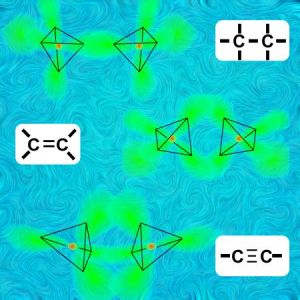
“Depends on the atom, but in general, yeah.  Except for the outermost columns of the Periodic Table, most of the elements in the upper rows can be persuaded to share at least one bond with most of the others.  Carbon’s the champ that links with practically everything.”Tetrahedral bonding

“Even carbon?”

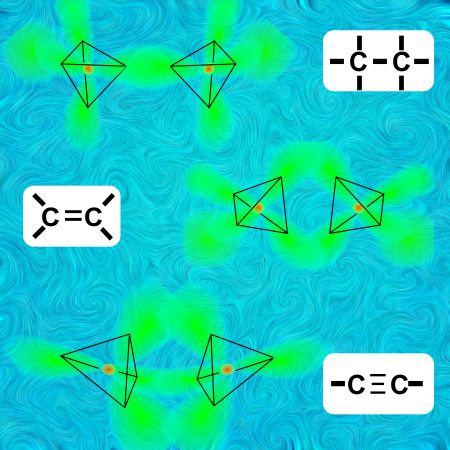
“Especially carbon, Vinnie.  Linking to carbon is carbon’s best thing.  It’s even got three and a fraction different ways to do it.  Here’s a sketch.  It boils down to the different ways you can have two tetrahedra match up points.”

“Lemme look at this for a minute… OK, that point-to-point one at the top —”

“It’s called a single bond.”

“Whatever, you’re saying that could be like two –CH3 pieces tied together.”

“Mm-hm.  The –CH3‘s are methyl groups, and with two of them you’ve got ethane.  Or link a methyl to a –CH2CH3 and you’ve got propane, or link it to an –OH to get methyl alcohol.  At least in principle you can pop a methyl onto any other atom or molecule that started off with only one unit of charge in an unshared orbital.”

“So it’s like my daughter’s bead necklace where she can pop it apart and add all different kinds of beads.”

“Exactly, Eddie, except her beads probably have their two links in a straight line.  These atoms support four links at 109° angles to each other.”

“That picture reminds me of one of my kids’ toys that’s like a top spinning on top of another top.  Is there anything that locks the two sides together so they can’t do that?”

“One way is if the two sides are each linked to bulky groups that get in each other’s way.  Hydrogens don’t much.  Scientists have measured methyl group rotation rates above 10 million cycles per second.”

“Hey, I’m still looking over here.  These other diagrams say that the tetrahedron things can link along an edge —”

“That’d be a double bond, Vinnie.”

“Looks to me like those double-bond shapes are locked in.  No rotation there, right?”

“Right.  In fact, rotational stability across a double bond is so strong that different arrangements operate like different compounds.  Switching A\B:C\D to A\B:D\C can be the difference between a useful med and something that’s inert or even toxic.”

“And I suppose when they match up whole triangles that’s a triple bond?”

“You got it.”

“Well, that can’t spin, for sure.”

“Nah, Vinnie, that’s like the atom-in-a-field thing, no difference between x- and y- axes.  Spinning like crazy except you can’t see it.”

“Eddie’s right, Vinnie.  The four atoms in a triple-bond structure are in a line.  The charge of three electron pairs mushes into a barrel-shaped region between the two carbons.”

“All that pent-up charge, I bet it’s reactive as hell.”

“Uh-huh.  With hydrogen atoms at both ends that’s acetylene gas.  Let that stuff touch copper and you get explosive decomposition.”

“So that’s why they say don’t run acetylene through copper tubing or brass fittings.”

“Believe it, Vinnie.  Believe it.”

~~ Rich Olcott

The Shape of Water

Amazing what you can do with mozzarella drips and crumbled pizza edges.  Vinnie’s rolling his crumbs into decent-sized marbles.  (Pizza-maker Eddie’s giving him a look.)  He adds a fourth ball to his triangle to make a square.  “So anyway, what you’re telling us is that Bohr’s 8-electron shell isn’t that far off.”

“Oh, it is far off.  Bohr put his electrons in a plane like your square there.  Try putting that fourth ball on top of the others to make a triangular pyramid.  See that?  Counting the bottom it’s a four-sided figure called a tetrahedron.  It’s the fundamental structural building block for most of the Universe’s molecules.”Water molecule“Hey, that’s the alpha-particle shape that the protons and neutrons get themselves into.”

“Good point, Vinnie.  Mind you, though, an alpha particle doesn’t have a central attractor, and it’s a quarter-million times smaller than an atom’s electron cloud.  Got that pyramid shape in mind?”

“Sure.”

“OK, put those balls back in your square. … Put a finger on the north ball and another on the south one.  Now roll them both up into contact on top of the line between the east and west ones.”

“Hey, it’s that tetra-thing again.”

“Right, Eddie.  Any time you have four objects each the same distance from all the others, you’ve got a tetrahedron.  If the ‘objects’ are clouds of electron charge all attracted to the nucleus and all repelled by the other clouds, that’s the shape they’ll take.  It’s no accident that an equal mix of an atom’s spherical and three dumbbell orbitals in a shell makes four equivalent orbitals pointing to the corners of a tetrahedron.”

“Cute, but what’s it get us?”

“It gets us to the chemists’ trick for thinking about molecular structures without doing all the quantum mechanics.  The key is that 8-electron shell.  Forget electrons racing in a ring or electron pairs in a square.  When you see a chemical diagram with four lines coming out of a central atom, think of them in a tetrahedron.  Here’s an example.  Guess what’s the commonest atom in the Universe.”

“Helium.”

“Hydrogen.”

“Eddie’s win with hydrogen — 923,000 atoms out of a million.  Carbon’s the fourth most common, 480 atoms per million.  Think of a carbon atom, floating around in space with four of its six units of electronic charge in its 2-shell.  And it’s surrounded by hydrogen atoms with electrons just begging to pair up with something.  No surprise, there’s suddenly a lot of electron pairing and you’ve got a molecule of methane, CH4.  What’s its shape?  Any hydrogen-hydrogen chains in there?”

“With this build-up, I gotta guess they’re all on the carbon and that they’re splayed out tetrahedron-like, hydrogen centers trying to get away from the other ones and shared charge clouds trying to get away from each other, too.”

“Couldn’t put it better myself, Vinnie.”

“Hey, water’s H2O, right?  You can’t make a tetrahedron from only three atoms.”

“True, Eddie, but an oxygen atom comes with two more electrons than carbon has.  We’ve still got a tetrahedron, but only two of its corners carry a hydrogen.  The other two orbitals stick out their own directions, each loaded with negative charge.  The chemists call that unshared kind of orbital a lone pair.  They often show it as a double-dot on the structure diagram. That’s basically just a bookkeeping device to keep track of electron counts.  All the charge is really spread around throughout all the molecular orbitals just like with atomic orbitals, only it’s not spread evenly.”

“Why do they bother to keep track like that?”

“Lone pairs affect the molecule’s structure.  If it weren’t for them, the water molecule would be a straight line.  In fact, a lone pair orbital crowds the space a bit more than a bonding pair — the H–O–H angle is about 5º smaller than a perfect tetrahedron.”

“Makes sense when you think about it, like you can wave a stick all over the place unless someone grabs the other end.”

“Mm-hm.  The big reason chemists care, though, is that lone pairs can be active centers during a chemical reaction.  All that negative charge just waiting for something positive-ish to come along.”

“Like a really good tip,” grumbles Eddie.

~~ Rich Olcott


To Bond Or Not To Bond, That Is The Question

Vinnie’s pushing pizza crumbs around his plate, watching them clump together.  “These molecular orbitals gotta be pretty complicated.  How do you even write them down?”

“Combinations.  There’s a bunch of different strategies, but they all go back to Laplace’s spherical harmonics.  Remember, he showed that every possible distribution around a central attractor could be described as a combination of his patterns.  Turn on a field, like from another atom, and you just change what combination is active.  Here’s a sketch of the simplest case, two hydrogen atoms — see how the charge on each one bulges toward the other?  The bulge is a combination of a spherical orbital and a dumbbell one.  The molecular orbitals are combinations of orbitals from both atoms, describing how the charges overlap, or not.”Hydrogen molecule

“What’s that blue in the other direction?”

“Another possible combination.  You can combine atomic orbitals with pluses or minuses.  The difference is that the minus combination will always have an additional node in between.  Extra nodes mean higher energy, harder to activate. When the molecule’s in the lowest energy state, charge will be between the atoms where that extra node isn’t.”

“So the overlapped charge here is negative, right, and it pulls the two positive nucleusses —”

“Nuclei”

“Whatever, it pulls ’em together.  Why don’t they just merge?”

“Positive-positive repulsion counts, too.  At the equilibrium bond distance, the nuclei repel each other exactly as much as the shared charge pulls them together.”

Eddie’s still hovering by our table.  “You said that there’s this huge number of possible atomic orbitals.  Wouldn’t there be an even huger number of molecular orbitals?”

“Sure.  The trick is in figuring out which of them are lowest-energy and activated and how that relates to the molecule’s configuration.  Keep track of your model’s total energy as you move the atoms about, for instance, and you can predict the equilibrium distance where the energy is a minimum.  In principle you can calculate configuration changes as two molecules approach each other and react.”

“Looks like a lot of work.”

“For sure, Eddie.  Even a handful of atoms has lots of atomic orbitals to keep track of.  That can burn up acres of compute time.”

Vinnie pushes three crumbs into a triangle.  “You got three distances, you can figure their angles.  So you got the whole shape of the thing.”

“Right, but like Eddie said, that’s a lot of computer work.  Chemists had to come up with shortcuts.  As a matter of fact, they had the shortcuts way before the computers came along.”

“They used, like, abacuses?”

“Funny, Vinnie.  No, no math at all.  And it’s why they still show school-kids those Bohr diagrams.”

“Crazy Eights.”

“Eddie, you got games on the brain.  But yeah, eights.  Or better, quartets of pairs.  One thing I’ve not mentioned yet is that even though they’ve got the same charge, electrons are willing to pair up.”

“How come?”

“That’s the thing of it, Vinnie.  There’s a story about Richard Feynman, probably the foremost physicist of the mid-20th Century.  Someone asked him to explain the pairing-up without using math.  Feynman went into his office for a week, came back out and said he couldn’t do it.  The math demands pairing-up, but outside of the math all we can say is experiments show that’s how it works.”

“HAH, that’s the reason for the ‘two charge units per orbital’ rule!”

“Exactly, Eddie.  It’s how charge can collect in that bonding molecular orbital in the first place.  It’s also the reason that helium doesn’t form molecules at all.  Imagine two helium atoms, each with two units of charge.  Suppose they come close to each other like those hydrogens did.  Where would the charge go?”

“OK, you got two units going into that in-between space, ahh, and the other two activating that blue orbital and pulling the two atoms apart.  So that adds up to zero?”

“Uh-huh.  They just bounce off and away.”

“Cool.”

“Hey, I got a question.  Your sketch has a ball orbital combining with a dumbbell.  But they’ve got different node counts, one and two.  Can you mix things from different shells?”

“Sure, Vinnie, if there’s enough energy.  The electron pair-up can release that much.”

“Cool.”

~~ Rich Olcott

  • A friend pointed out that I’m doing my best to avoid saying the word “electron.” He’s absolutely right.  At least in this series I’m taking Bohr’s side in his debate with Einstein — electrons in atoms don’t act like little billiard balls, they act like statistical averages, smeared-out ones at that.  It’s closer to reality to talk about where the charge is so that’s how I’m writing it.

The Shell You Say

Everyone figures Eddie started his pizza place because he likes to eavesdrop.  No surprise, he wanders over to our table.  “I heard you guys talking about atoms and stuff and how Sy here don’t like Bohr’s model of electrons in atoms even though Bohr’s model and the shell model both account for hydrogen’s spectrum.  Why’s the shell model better?”

Vinnie comes back quick.  “Because it’s not physically impossible, for one thing.”

I’m on it.  “Because the shell model extends smoothly to atoms and ions in an electric or magnetic field.  Better yet, shell methods can be applied to molecules.”

“What do fields have to do with it?”

“It’ll help to know that some of those electron patterns come in sets.  The 2-node shell has three dumbbell shapes, for instance — one each along the x, y and z axes. Think about an atom all alone in space with no fields around.  How does it know which way z goes?””

“It don’t.  Everything’s gotta be in all directions, like spherical.”

Vinnie’s back in.  “I’m seeing an atom in an electric field, say up-to-down, it’s going to pull charge in one direction, say down.  So now the atom don’t look like no ball no more, right?”

orbital in a field
Vertical field on the right

“Right.  Once the atom’s got a special direction, those three dumbbells stop being equivalent.  We say that the field mixes together the spherical pattern (in atoms we’d call it an s-orbital) with that direction’s dumbbell (we’d call it a p-orbital) to make two combination orbitals.  One combination has a lump of charge stretched downwards and the other combination has a bowl of diminished charge stretched upwards.  The stronger the field, the wider the energy split between those two.”

“What about the other two dumbbells?”

“They’re still equivalent, Eddie.  If there’s charge in them it’s spread evenly around the equator like a doughnut.  Energy-wise they’re in between the two s±p combinations.”

IF there’s charge, like maybe there ain’t?”

“Ever suspicious, eh, Vinnie?  You’re right, and that’s a good point.  Orbitals are only a way to describe the chaos inside the atom, like notes are a way to describe music.  There are 3-node orbitals and 47-node orbitals, all the way up, but most of the time they’re not charge-activated just like a piano’s top note hardly ever gets played.”

“How do we know whether an orbital’s activated?”

“We’ve got rules for that, Eddie.  Maximum of two units of charge per orbital, lowest energy first.  Unless some light wave has deactivated a deeper orbital and activated a higher one.”

“You’re being careful again, not saying an electron’s here or an electron’s there.”

“Darn right, Vinnie.  It’s that chaos thing — charge is smeared all over the atom like air molecules jiggle all over the place to carry a sound wave.  Chemists and physicists may talk about ‘the electron in the 2s-orbital’ but that’s shorthand.  They know it’s really not like that.”

“I’m doing arithmetic over here.  So there’s two electrons, OK, call it two units of charge for that 1-node ball orbital, plus two units for the 2-node ball, plus two units each for the three dumbbells, uses up five orbitals.  That’s the same 2+8 stable mix that Bohr came up with.”

“Yeah, Eddie, but that field Sy talked about could be any strength.  Run the energy  equations backwards and the astronomers get a way to check a star’s fields.”

“Exactly, Vinnie.  Transitions involving combination orbitals have slightly different energy jumps than the ones we see in isolated atoms.  Electric and magnetic fields split each line in an element’s spectrum into multiplets.  Measure their splittings and you can work back to the field strengths that caused them.  The shell theory offers more predictions and more scientific insights than Bohr’s model ever dreamed of.”

“You said shell theory can handle molecules, too.  How’s that work?”

“Same as that electric field, but a lot messier.  Every nucleus exerts a field, mostly electric, on the rest of the molecule.  So does all the electron charge, but it’s more diffuse and includes more magnetism.  Molecular orbitals span the whole thing.  Works like atoms but much harder to calculate.”

“Figuring tips is easier,” hints Eddie.

~~ Rich Olcott