Again with the fizzing sound. Her white satin still looked good. A little travel-worn, but on her that looked even better. Her voice still sounded like molten silver — “Hello.”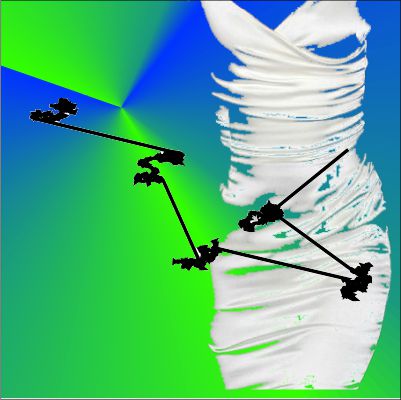
“Hello, Anne. Where you been?”
“You wouldn’t believe. I don’t believe. I’ve got to get some control over this.”
“What’s the problem?”
“I never know where I’ll be next. Or when. Or even how it’ll look when I get there. We’ve met before, haven’t we?”
“Yes, we have, and you told me your memory works in circles. We figured out that when you ‘push,’ you relocate to a reality with a different probability.”
“But it could also be a different time. Future, past, it’s so confusing. Sometimes I meet myself and I don’t know whether I’m coming or going. We never know what to say to each other. It’s horrible way to be.”
“It sounds awful. Here, have a tissue. So, how can I help you?”
“You do theory stuff. Can you physics a way to let me steer through all this?”
<fizzing sound> Another Anne appeared, next to my file cabinet on the far side of the office. “Don’t mind me, just passing through.” <more fizzing> She flickered away. My ears itched a little.
“See? And she always knows more than I do, except when I know more than she does.”
“I’m beginning to get the picture. Mind if I ask you a few questions?”
“Anything, if it’ll help solve this.”
“When you time-hop, do you use the same kind of ‘push’ feeling that sends you to different probabilities?”
“No-o, it’s a little different, but not much.”
“We found that you have to ‘push’ harder to get to a less-probable reality. Is there the same kind of difference between past and future hopping?”
“Now you mention it, yes! It’s always easier to jump to the future. I have to struggle sometimes when I get too far ahead of myself.”
“Can you do time and probability together?”
“Hard to say. When I hop I mostly just try to work out when I am, much less whether things are odd.”
“Give it a shot. Try a couple of ‘nearby places’ and come back here/now. Just use tiny ‘pushes.’ I don’t want you to get lost again.”
“Me neither. OK, here I go.” <prolonged flickering and fizzing> “Is this the right place? I tried a couple of hops here in your office, and <charming blush> stole some of your papers. Here.”
“Perfect, Anne, objective evidence is always best. Let’s see… Yep, this report is one I finished a week ago, looks OK, and this one … I recognize the name of a client I’ve not yet hooked, but the spelling! The letter ‘c’ isn’t there at all — ‘rekognize,’ ‘sirkle,’ ‘siense’ — that’s low probability for sure.”
“Actually, it felt like higher probability.”
“Whatever. One more question. I gather that most of your hops are more-or-less good ones but every once in a while you drop into a complete surprise, something you’re totally not used to.”
“Uh-huh.”
“I’ll bet the surprises happen when you’re in a jam and do a get me out of here jump.”
“Huh! I’d not made that connection, but you’re right.”
“I think I’ve got the picture. When you ‘push,’ you somehow displace yourself on a surface that has two dimensions — time and probability. You move around in those two dimensions independently from how you move in 3-D space. I take it you’re comfortable dong that but you want more control over it, right?”
“Mmm, yeah. It’s kind of my special superpower, you know? I don’t want to give it up entirely.”
“Good, because I wouldn’t know how to make that happen for you. Best I can do is give you some strategy coaching, OK?”
“That’d be a big help.”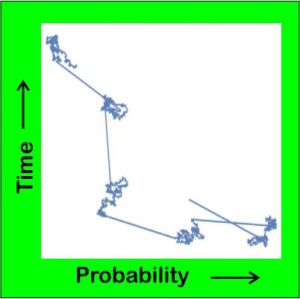
“Stay calm.”
“That’s it? Where’s the physics in that?”
“Ever hear of the Drunkard’s Walk?”
“I’ve seen a few.”
“Well, you’re doing one.”
“Beg pardon?”
“It’s math talk for a stepwise process where every step goes in a random direction. Your problem is that some of the steps are way too big. Keep the steps small and you’ll stay in familiar territory.”
<molten silver, coming closer> “Like … here?”
“Stay calm.”
~~ Rich Olcott








 “You’ll have to unravel that for me.”