


Pythagoras was onto far more than he knew. He discovered that a stretched string made a musical tone, but only when it was plucked at certain points. The special points are those where the string lengths above and below the point are in the ratio of small whole numbers — 1:1, 1:2, 2:3, …. Away from those points you just get a brief buzz. All of Western musical theory grew out of that discovery.
 The underlying physics is straightforward. The string produces a stable tone only if its motion has nodes at both ends, which means the vibration has to have a whole number of nodes, which means you have to pluck halfway between two of the nodes you want. If you pluck it someplace like 39¼:264.77 then you excite a whole lot of frequencies that fight each other and die out quickly.
That notion underlies auditorium acoustics and aircraft design and quantum mechanics. In a way, it also determines where objects reside in the Solar System.
If you’ve got a Sun with only one planet, that planet can pick any orbit it wants — circular or grossly elliptical, close approach or far, constrained only by the planet’s kinetic energy.
If you toss in a second planet it probably won’t last long — the two will smash together or one will fall into the Sun or leave the system. There are half-a-dozen Lagrange points, special configurations like “all in a straight line” where things are stable. Other than those, a three-body system lives in chaos — not even a really good computer program can predict where things will be after a few orbits.
 Add a few more planets in a random configuration and stability goes out the window — but then something interesting happens. It’s the Chladni effect all over again. Planets and dust and everything go rampaging around the system. After a while (OK, a billion years or so) sweet-spot orbits start to appear, special niches where a planet can collect small stuff but where nothing big comes close enough to break it apart. It’s not like each planet seeks shelter, but if it finds one it survives.
It’s a matter of simple arithmetic and synchrony. Suppose you’re in a 600-day orbit. Neighbor Fred looking for a good spot to occupy could choose your same 600-day orbit but on the other side of the Sun from you. But that’s a hard synchrony to maintain — be off by a few percent and in just a few years, SMASH!
The next safest place would be in a different orbit but still somehow in synchrony with yours. Inside your orbit Fred has to go faster and therefore has a shorter orbital period than yours. Suppose Fred’s year is exactly 300 days (a 2:1 period ratio, like a 2:1 gear ratio). Every six months he’s sort-of close to you but the rest of the time he’s far away.
Our Solar System does seem to have developed using gear-year logic. Adjacent orbital years are very close to being in whole-number ratios. Mercury, for instance, circles the Sun in about 88 days. That’s just 2% away from 2/5 of Venus’s 225¾ days.
This table shows year-lengths for the Sun’s most prominent hangers-on, along with ratios for adjacent objects. For the “ideal” ratios I arbitrarily picked nearby whole-number multiples of 2. I calculated how long each object’s year “should” be compared to its lower neighbor — the average inaccuracy across all ten objects is only 0.18%.
Object |
Period, years |
2 × shorter / longer period |
“Ideal” ratio |
“Ideal” period, years
|
Real/”Ideal” |
Mercury |
0.24 |
0.24 |
|||
Venus |
0.62 |
5.11 |
5 : 2 |
0.60 |
102% |
Earth |
1.00 |
3.25 |
3 : 2 |
0.92 |
108% |
Mars |
1.88 |
3.76 |
4 : 2 |
2.00 |
94% |
Ceres |
4.60 |
4.89 |
5 : 2 |
4.70 |
98% |
Jupiter |
11.86 |
5.16 |
5 : 2 |
11.50 |
103% |
Saturn |
29.46 |
4.97 |
5 : 2 |
29.65 |
99% |
Uranus |
84.02 |
5.70 |
6 : 2 |
88.37 |
95% |
Neptune |
164.80 |
3.92 |
4 : 2 |
168.04 |
98% |
Pluto |
248.00 |
3.01 |
3 : 2 |
247.20 |
100% |
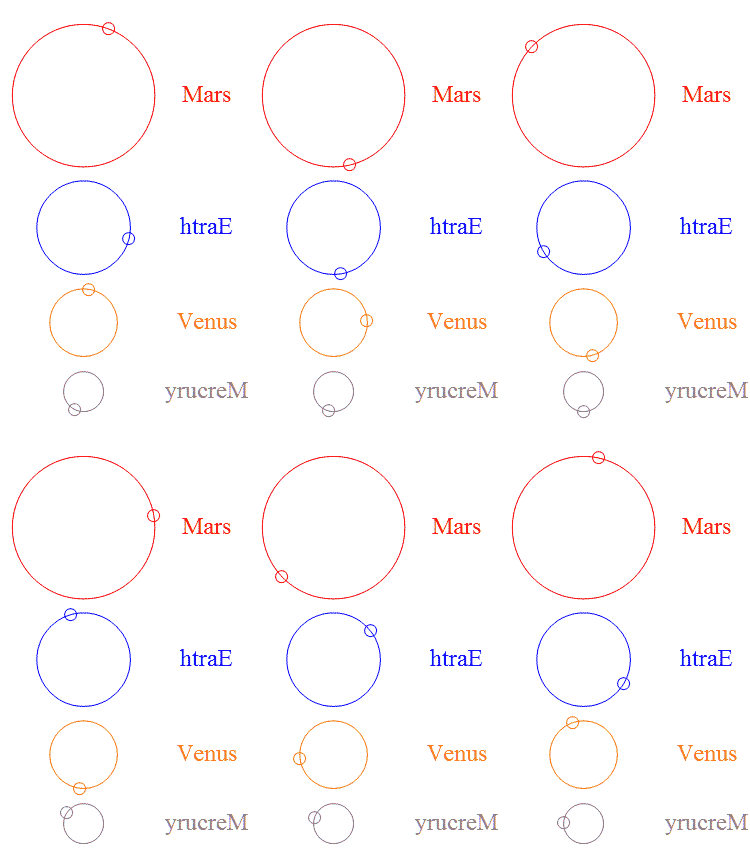 The usual rings-around-the-Sun diagram doesn’t show the specialness of the orbits we’ve got. This chart shows the four innermost planets in their “ideal” orbits, properly scaled and with approximately the right phases. I used artistic license to emphasize the gear-like action by reversing Earth’s and Mercury’s direction. Earth and Mars are never near each other, nor are Earth and Venus.
It doesn’t show up in this video’s time resolution, but Venus and Mercury demonstrate another way the gears can work. Mercury nears Venus twice in each full 5-year cycle, once leading and once trailing. The leading pass slows Mercury down (raising it towards Venus), but the trailing pass speeds it up again. Net result — safe!
~~ Rich Olcott




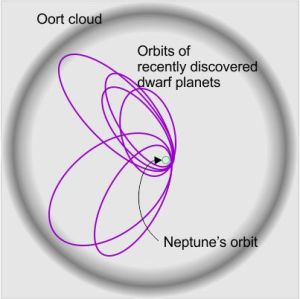


 This video, from an Orbits Table display at the Denver Museum of Nature and Science, shows a different Plutonian weirdness. We’re circling the Solar System at about 50 times Earth’s distance from the Sun (50 AU). Reading inward, the white lines represent the orbits of Neptune, Uranus, Saturn and Jupiter. The Asteroid Belt is the small greenish ring close to the Sun. The four terrestrial planets are even further in. The Kuiper Belt is the greenish ring that encloses the lot.
 Before you get any further in this post, follow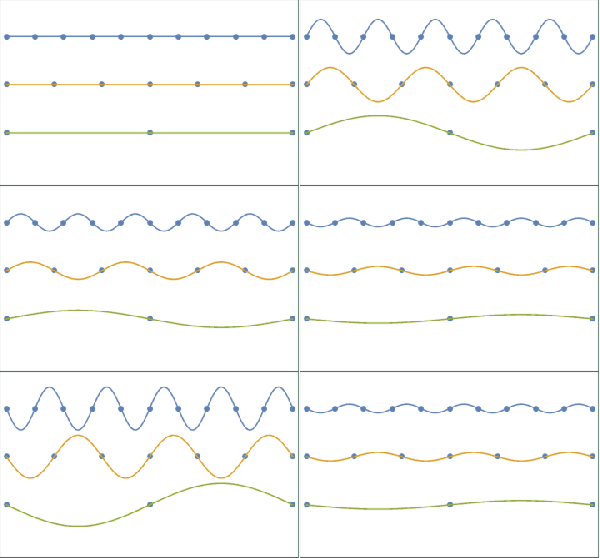
 This photo, part of the LAMP exhibit at the Denver Museum of Nature and Science, shows why. It’s a model of a cratered Moon lit by sunlight.







 Long ago in a far-away career, I taught a short-course about then-current theories on the origin of life. The lab portion of the course centered on the 1952

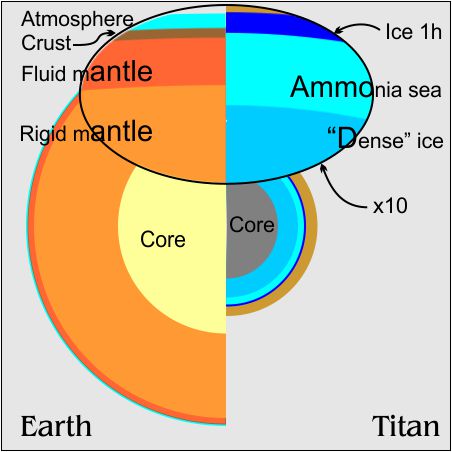

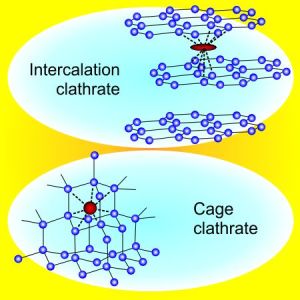 The primary reason we think Titan is so wet is that Titan’s density is about halfway between rock and water. We know there are other light molecules on Titan — ammonia, methane, etc. We don’t know how much of each. Those compounds don’t have water’s complex phase behavior but many can dissolve in it. That’s why that hypothetical “Ammonia sea” is in the top diagram.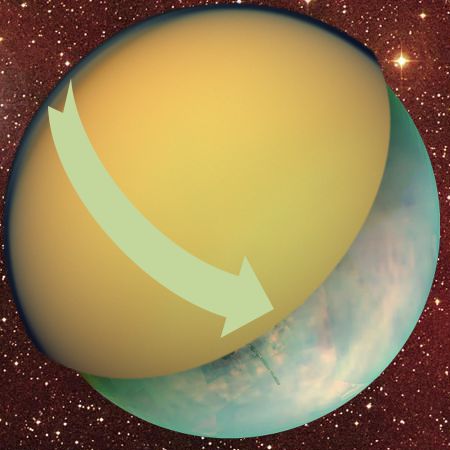

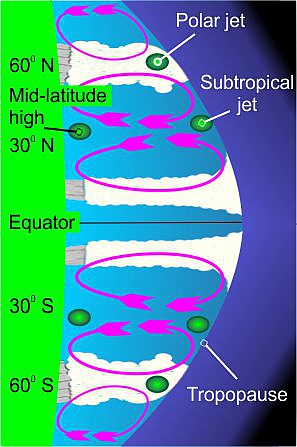 Air warmed by the equatorial Sun rises, only to sink as it heads poleward. Our packet loops between the Equator and about 30ºN (see the diagram).


