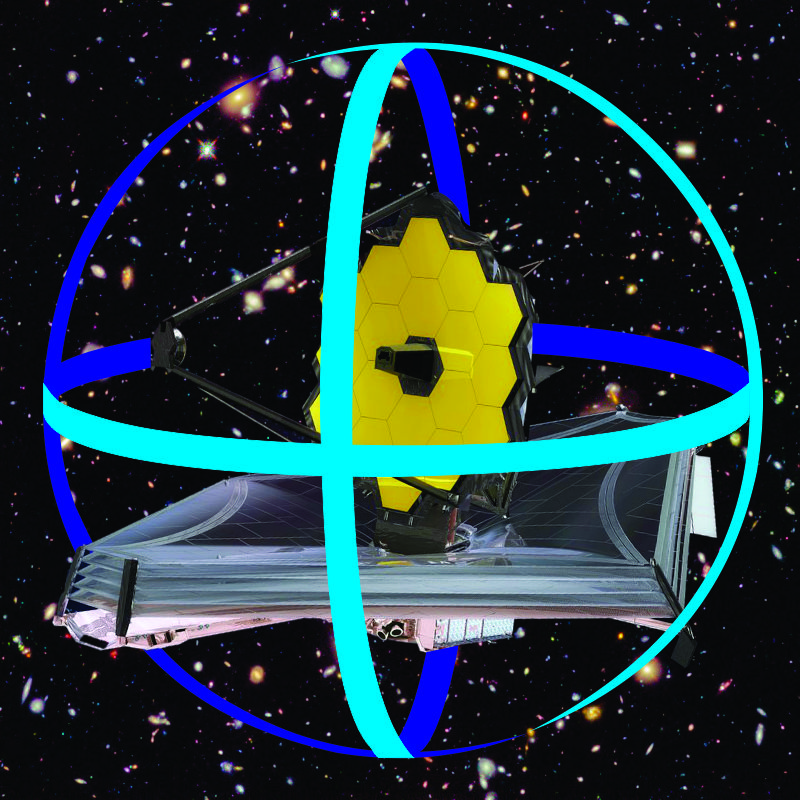
Constant’s Companion

“It’s like Mark Twain said, Jeremy — ‘History may not repeat itself, but it rhymes.‘ Newton identified gravity as a force; Einstein proposed the Cosmological Constant. Newton worked the data to develop his Law of Gravity; Friedmann worked Einstein’s theory to devise his model of an exponentially expanding Universe. Newton was uncomfortable with gravity’s ability to act at a distance; Einstein called the Cosmological Constant ‘his greatest blunder.’ The parallels go on.”

“Why didn’t Einstein like the Constant if it explains how the Universe is expanding?”

“It wasn’t supposed to. Expanding Universes weren’t in fashion a century ago when Einstein wrote that paper. At the time everyone including Einstein thought we live in a steady state universe. His first cut at a General Relativity field equation implied a contracting universe so he added a constant term to balance out the contraction even though it made the dynamics look unstable — the Constant had to have just the right value for stability. A decade later Hubble’s data pointed to expansion and Friedman’s equations showed how that can happen.”

“I guess Einstein was embarrassed about that, huh, Mr Moire?”

“Well, he’d thought all along that the Constant was mathematically inelegant. Besides, the Constant isn’t just a number or a term in an equation, it’s supposed to represent a real process in operation. Like Newton’s problem with gravity, Einstein couldn’t identify a mechanism to power the Constant.”

“Power it to do what?”

“Think about universal constants, like the speed of light or the electron charge. Doesn’t matter where you are or how fast you’re traveling in which inertial frame, they’ve got the same values. If the Constant is indeed a constant, it contributes equally to cosmological dynamics from every position in space, whether inside a star or millions of lightyears from any galaxy. Every point must exert the same outward force in every direction or there’d be swirling. And it multiplies — every instant of general expansion makes new points in between the old points and they’ll exert the same force, too.”

“That’s what makes it exponential, right?”

“Good insight. It’s a pretty weak force per unit volume, weaker than gravity. We know that because galaxies and galaxy cluster structures maintain integrity even as they’re drifting apart from each other. Even so, a smidgeon of force from each unit volume in space adds up to a lot of force. Multiply force by distance traveled — that’s a huge amount of energy spent against gravity. The big puzzle is, what’s the energy source? Most of the astrophysics community nominates dark energy to power the Cosmological Constant but that’s not much help.”

“As Dr Prather says in class, Mr Moire, ‘You sound tentative. Please expound.‘ Why wouldn’t dark energy be the power source?”

“In Physics we use the word ‘energy‘ with a very specific meaning. Yes, it gets heavy use with sloppy meanings in everything from show business to crystal therapy, but in hard science nearly every serious research program since the 18th Century has entailed quantitative energy accounting. The First Law of Thermodynamics is conservation of energy. Whenever we see something heating up, a chemical reaction running or a force being applied along a distance, physicists automatically think about the energy being expended and where that energy is coming from. Energy’s got to balance out. But the Constant breaks that rule — we have no idea what process provides that energy. Calling the source ‘dark energy‘ just gives it a name without explaining it.”

“Isn’t the missing energy source evidence against Friedmann’s and Einstein’s equations?”

“That’s a tempting option and initially a lot of researchers took it. Unfortunately, it seems that dark energy is a thing. Or maybe a lot of little things. Several different lines of evidence say that the Constant constitutes twice as much mass‑energy as all normal and dark matter combined. Worse yet, as the Universe expands that share will increase.”

“Wait, will the dark energy invade normal matter and break us up?”

“People argue about that. Normal matter’s held together by electromagnetic forces which are 1038 times stronger than gravity, far stronger yet than dark energy. Dark matter’s gravity helps to hold galaxies together, but who knows what holds dark matter together?”

~~ ROlcott

Three Phases of Ever

“So if the Universe isn’t in a steady state and it’s not heading for a Big Crunch, I guess it’s getting bigger forever, huh?”

“Careful, Jeremy, the Universe expansion could maybe reach a stopping point if it happened to hold exactly the right amount of mass‑energy. The expansion could just stop when forces balance out.”

“What forces, Mr Moire? There’s gravity pulling everything together so what’s pushing them apart?”

“That is an excellent question, one that we don’t yet have an answer for. We’re about where Newton was with gravity. There was a lot of observational evidence, he had a name for it and knew how to calculate its effects, but he didn’t know how it worked. That’s us with Einstein’s Cosmological Constant.”

“Observational evidence — we can actually see things accelerate?”

“Not any one object speeding up. Human lifetimes are too short to measure acceleration in galaxies a hundred thousand lightyears across. No, we use the same strategy that Hubble used — measure many galaxies at different distances from us and graph recession speed against distance. During the century since Hubble we’ve greatly improved our estimates of astronomical speeds and distances. Dividing the known speed of light into a galaxy’s measured distance tells us time since it emitted the photons we see. Our findings confirm Hubble’s general conclusion — on average, older photons come from galaxies that fly away faster. Hubble thought that the relation was linear but our fine‑tuned numbers show otherwise. The data says that after the first few seconds the Universe stretched at a steady rate for only the first ⅔ of its life. The stretch has been accelerating since then.”

“Why wasn’t it accelerating since the beginning? Did someone cut in the afterburner?”

“More like turned one off. The evidence and theory we have so far indicate the Universe has seen a succession of phases dominated by different processes. You’ve probably heard of inflation—”

“Have I? You should see what they want for a burger these days!”

“Not that sort of inflation, but I know how you feel. No, I’m referring to cosmic inflation, very early in the Big Bang sequence, when the Universe expanded by a factor of 1026 within a tiny fraction of a second. It was driven by enormously powerful radiation‑linked effects we don’t understand that finally ran out of steam and let lower‑energy processes take over.”

“How’d that happen?”

“We don’t know. The general principle is that one process so dominates what’s going on in a phase that nothing else matters, until for some reason it stops mattering and we’re in a new phase with a different dominant process. The early Universe was controlled by radiative processes until things cooled off enough for particles to form and persist. That changed the game. Gravity dominated the next 8 billion years. Particles clumped together, atoms then dust then solar systems into larger and larger structures with bigger spaces between them. About 5 billion years ago the game changed again.”

“So early on there weren’t even atoms, huh? Wow. What was the next game‑changer?”

“Thanks to Einstein and Friedmann’s work we’ve got at least a guess.”

“Friedmann?”

“Alexander Friedmann. He was a Russian physicist, used Einstein’s General Relativity results to derive three equations that together model the dynamics of the overall scale of the Universe using just a few estimates for current conditions. His equations give acceleration as the difference of two terms. The positive term is simply proportional to Einstein’s Constant. The negative term depends on both average mass density and pressure. Take a moment to think.”

“Umm… Positive is acceleration, negative is deceleration, density and pressure go down … If the negative term gets smaller than the positive one, acceleration increases, right?”

“It does, and we think the constant term has been increasingly dominant for 5 billion years. Something else to consider — the equation’s result is in terms of scale change divided by current scale. What’s it mean if that ratio’s a positive constant?”

“Change by a constant positive percentage … that’s exponential growth!”

“I thought you’d recognize it. Einstein’s Constant implies the scale of the Universe grows at an exponentially accelerating rate. We’re now in the Cosmological Constant phase.”

In Russian, Aleksandr Aleksandrowitsch Fridman

~~ Rich Olcott

Time Is Where You Find It

A familiar footstep in the hall outside my office, “C’mon in, Vinnie, the door’s open.”

“Got a few minutes, Sy?”

More than just “a minute.” This sounds serious so I push my keyboard aside. “Sure, what’s up?”

“I’ve been thinking about different things, putting ’em together different ways. I came up with something, sorta, that I wanted to run past you before I brought it to one of Cathleen’s ‘Crazy Theories‘ parties.”

“Why, Vinnie, you’re being downright diffident. Spill it.”

“Well, it’s all fuzzy. First part goes way back to years ago when you wrote that there’s zero time between when a photon gets created and when it gets used up. But that means that create and use-up are simultaneous and that goes against Einstein’s ‘No simultaneity‘ thing which I wonder if you couldn’t get around it using time tick signals to sync up two space clocks.”

“That’s quite a mix and I see why you say it’s fuzzy. Would you be surprised if I used the word ‘frame‘ while clarifying it?”

“I’ve known you long enough it wouldn’t surprise me. Go ahead.”

“Let’s start with the synchronization idea. You’re not the first to come up with that suggestion. It can work, but only if the two clocks are flying in formation, exactly parallel course and speed.”

“Hah, that goes back to our first talk with the frame thing. You’re saying the clocks have to share the same frame like me and that other pilot.”

“Exactly. If the ships are zooming along in different inertial frames, each will measure time dilation in the other. How much depends on their relative velocities.”

“Wait, that was another conversation. We were pretending we’re in two spaceships like we’re talking about here and your clock ran slower than mine and my clock ran slower than yours which is weird. You explained it with equations but I’ve never been good with equations. You got a diagram?”

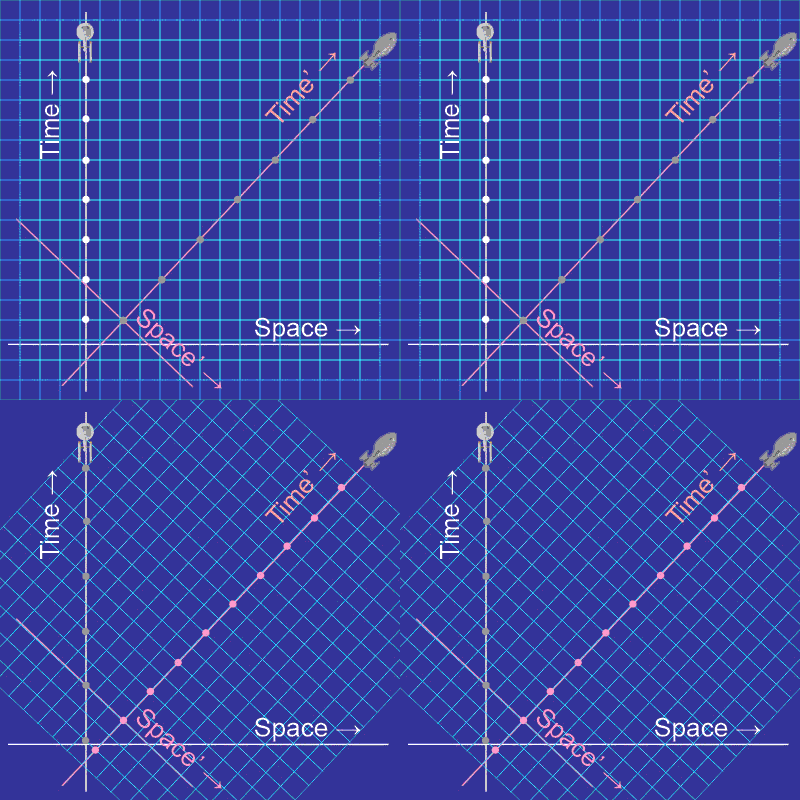
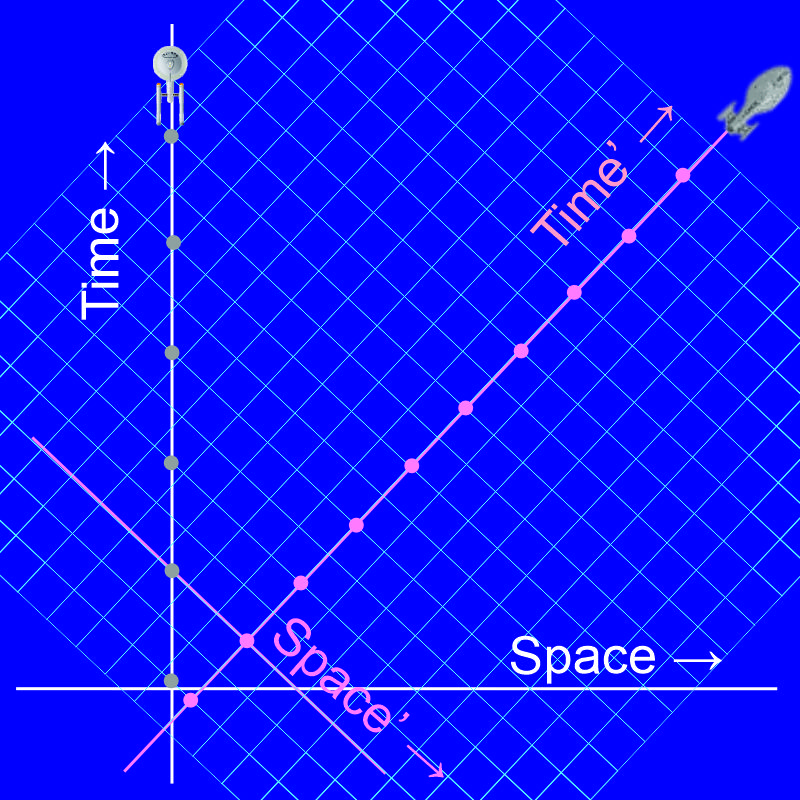
“Better than that, I’ve got a video. It flips back and forth between inertial frames for Enterprise and Voyager. We’ll pretend that they sync their clocks at the point where their tracks cross. I drew the Enterprise timeline vertical because Enterprise doesn’t move in space relative to Enterprise. The white dots are the pings it sends out every second. Meanwhile, Voyager is on a different course with its own timeline so its inertial frame is rotated relative to Enterprise‘s. The gray dots on Voyager‘s track show when that ship receives the Enterprise pings. On the Voyager timeline the pings arrive farther apart than they are on the Enterprise timeline so Voyager perceives that Enterprise is falling farther and farther behind.”

“Gimme a sec … so Voyager says Enterprise‘s timer is going slow, huh?”

“That’s it exactly. Now look at the rotated frame. The pink dots show when Voyager sends out its pings. The gray dots on Enterprise‘s track show when the pings arrive.”

“And Enterprise thinks that Voyager‘s clock is slow, just backwards of the other crew. OK, I see you can’t use sync pulses to match up clocks, but it’s still weird.”

“Which is where Lorentz and Minkowski and Einstein come into the picture. Their basic position was that physical events are real and there should be a way to measure them that doesn’t depend on an observer’s frame of reference. Minkowski’s ‘interval‘ metric qualifies. After converting time and location measurements to intervals, both crews would measure identical spacetime separations. Unfortunately, that wouldn’t help with clock synchronization because spacetime mixes time with space.”

“How about the photons?”

“Ah, that’s a misquotation. I didn’t say the time is zero, I said ‘proper time‘ and that’s different. An object’s proper time is measured by its clock in its inertial frame while traveling time t and distance d between two events. Anyone could measure t and d in their inertial frame. Minkowski’s interval is defined as s=[(ct)²‑d²]. Proper time is s/c. Intuitively I think of s/c as light’s travel time after it’s done traversing distance d. In space, photons always travel at lightspeed so their interval and proper time are always zero.”

“Photon create and use-up aren’t simultaneous then.”

“Only to photons.”

~~ Rich Olcott

The Tops of Time

Mr Feder doesn’t let go of a topic. He’s still stewing about Time. “Moire or somebody said the Big Bang is the Bottom of Time because there wasn’t any time before then. I guess I gotta buy that, but bottoms gotta have tops. What’s the Top of Time?”

“Whoa, Mr Feder, that’s a fuzzy question with a lot of answers, most of which are guesses.”

“No theories?”

“Not really, A few used to be called theories but people started muttering about testability so the theories got downgraded to hypotheses and now they’re guesses except for the ones that’ve been dropped altogether.”

“Like what?”

“Steady State, for one — the idea that Time has no end. That used to be popular, mostly because it was simple. Problem was, Edwin Hubble showed that other galaxies are separate from the Milky Way and in fact they’re receding from us. That clashed with the Cosmological Principle, the idea that on a large scale things are pretty much the same everywhere. Galaxies moving away from each other leave behind empty space that isn’t ‘pretty much the same.’ For the Steady State model to work, new matter would have to spring into existence between the departing galaxies.”

“Nature hates a vacuum, eh?”

“Apparently she doesn’t. Evidence has piled up against the Steady State model and in favor of the Big Bang. We still think the Cosmological Principle is a good assumption, but only on scales bigger than a few hundred million lightyears.”

“So Time has a Top, then.”

“Depends on how you define ‘Top.’ We’re now into Metaphysics territory, where theories come cheap and flimsy. It’s conceivable, for instance, that the Universe curves back onto itself along one or more of its dimensions. If it loops back along the time dimension then we’d be in an oscillating universe that cycles from Big Bang to Big Crunch and back out again. Time would have no Top or Bottom. Crosswise to time, some thinkers like the idea that the Universe circles back along a space dimension. If that’s true and we could see far enough we could inspect the back of our heads.”

“Wait, we’ve got lots of black holes. If their singularities are in the infinite future like you said, that’d stymie the circling.”

“Good point, Vinnie. As I understand the math, connectivity like that is possible if our 4D spacetime is embedded in a ‘bulk‘ with five or more dimensions. But that’s more complicated than I’m willing to accept without at least some evidence which no-one’s shown me yet. The endings of the 2001 and Interstellar movies don’t count.”

“What else you got?”

“What other theories, Mr Feder? How about block universes? Maybe the space dimensions are solid but only part of the time dimension is real. Some people opine that the only reality is ‘NOW,’ an infinitely thin slice of time evolving towards the future. A memory would only be a surviving imprint of things that stopped existing when Time was done with them.”

“I don’t like that one. For one thing, it doesn’t jibe with the ‘everyone’s got their own NOW‘ thing from relativity.”

“Einstein didn’t like it either. The easiest way to reconcile all those different versions of NOW is to assume that they all co‑exist permanently. I call that notion the closed block model. The idea is that all reality — past, present and future — is real and rigid. We perceive time as flowing only because consciousness floats upward along the time coordinate. The Top of Time is way up there, just waiting for us to arrive.”

“Why no sinking downward?”

“Good question, no good answer that I’ve seen. Besides, the closed block model doesn’t allow for free will. I like having free will.”

“Me, too. OK, if there’s closed block, what’s open block?”

“The future doesn’t exist yet. Picture the open block model as our 4D spacetime being a bowl with the Big Bang at the bottom. Time progressively fills the bowl like water. NOW is the Top of Time. Those relativity‑shifted NOWs only show up when we compare records of past observations.”

“Cheap and flimsy, but a pretty picture.”

Adapted from a public domain image,
Credit: NASA/WMAP Science Team

~~ Rich Olcott

Why I Never Know What Time It Is

It’s always fun watching Richard Feder (of Fort Lee, NJ) as he puts two and two together. He gets a gleam in his eye and one corner of his mouth twitches. On a good day with the wind behind him I’ve seen his total get as high as 6½. “I wanna get back to that ‘everybody has their own time‘ monkey‑business where if you’re moving fast your clock slows down. What about the stardates on Star Trek? Those guys go zooming through space at all different angles and speeds. How do they keep their calendars in synch?”

Trekkie and Astronomy fan Al takes the bait. “Artistic license, Mr Feder. The writers can make anything happen, subject to budgets and producer approval. The first Star Trek series, they just used random four‑digit numbers for stardates. That was OK because the network aired the episodes in random order anyway so no‑one cared about story arc continuity. Things were more formal on Captain Picard’s Enterprise, as you’d expect — five‑digit stardates, first digit always ‘4‘ for 24th Century, thousands digit was ‘1‘ for season one, ‘2‘ for season two and so on. Working up the other way, the digit right of the decimal point was tenths of a standard day, the units place counted days within an episode and the tens and hundreds they just picked random numbers.”

“I suppose that’s what they did, but how could they make it work? You guys yammer on about time dilation. Say a ship’s running at Warp Whoop‑de‑doo, relativity should slow its calendar to a crawl. You couldn’t get a whole fleet into battle position when some of the ships had to get started years ahead of time. And that’s just the dilation slow-down, travel time’s on top of that.”

“Travel time measured how, Mr Feder, and from where?”

“Well, there you go, Cathleen, that’s what I’m talking about!”

“You know that Arthur C Clarke quote, ‘Any sufficiently advanced technology is indistinguishable from magic‘? The Enterprise crew’s always communicating with ‘sub‑space radio’, which sure looks like magic to me. They could send sync pulses through there along with chatter. When you drop out of warp space, your clocks catch the pulses and sync up, I suppose.”

“There’s a deeper issue than that, guys.”

“What’s that, Sy?”

“You’re talking like universal time is a thing, which it isn’t. Hasn’t been since Einstein’s Special Relativity used Minkowski’s math to stir space and time together. General Relativity scrambles things even worse, especially close to a strong gravity center. You remember about gravity forcing spacetime to curve, right? The curvature inside a black hole’s event horizon gets so tight that time rotates toward the geometric center. No, I can’t imagine what that looks like, either. The net of it, though, is that a black hole is a funnel into its personal future. Nothing that happens inside one horizon can affect anything inside another one so different holes could even have different time rates. We’ve got something like 25000 or more stellar black holes scattered through the Milky Way, plus that big one in the center, and that’s just one galaxy out of billions. Lots of independent futures out there.”

“What about the past, Sy? I’d think the Big Bang would provide a firm zero for time going forward and it’s been one second per second since then.”

“Nup. Black holes are an extreme case. Any mass slows down time in its vicinity, the closer the slower. That multi‑galaxy gravitational lens that lets us see Earendel? It works because the parts of Earth‑bound light waves closest to the center of mass see more time dilation than the parts farther away and that bends the beam toward our line of sight.”

“Hey, that reminds me of prisms bending light waves.”

“Similar effect, Vinnie, but the geometry’s different. Prisms and conventional lenses change light paths abruptly at their surfaces. Gravitational lenses bend light incrementally along the entire path. Anyhow, time briefly hits light’s brakes wherever it’s near a galaxy cluster, galaxy or anything.”

“So a ship’s clock can fidget depending on what gravity it’s seen recently?”

“Mm-hm. Time does ripples on its ripples. ‘Universal Time‘ is an egregious example of terminology overreach.”

~~ Rich Olcott

When The Stars Are Aligned Right

Cathleen and I are chatting when Vinnie bursts into the coffee shop waving a newspaper. “New news, guys, they’ve just announced Hubble spotted the farthest‑away star. How about that? Think what JWST will be able to do!”

Cathleen raises an eyebrow. “Sounds like press release science. What else do they say?”

“Not a whole lot. Lessee… These guys went through old Hubble data and found a piece of an Einstein ring which I don’t know what that is and partway along the ring is a star and somehow they figured out it’s 50 times heavier than the Sun and 12 billion years old and it’s the farthest star they’ve ever seen and that’s why NASA’s all excited.”

“Do you believe all that?”

“Maybe the NASA PR people do?”

“Maybe. I just read the technical paper behind that announcement. The authors themselves aren’t absolutely sure. The paper’s loaded with supporting evidence and ‘how we did it‘ details but it’s also loaded with caveats. The text includes a string of alternative explanations for their observations, winding up with a typical ‘we await further evidence from JWST‘ statement. Reads a lot more like real science. Besides, we’ve already seen more distant stars but they’re all jumbled together inside their very distant galaxies.”

“Unpack it for me. Start with what’s an Einstein ring?”

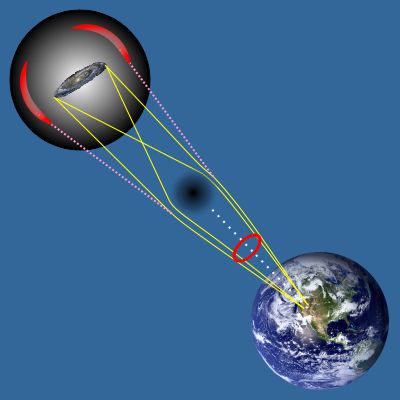
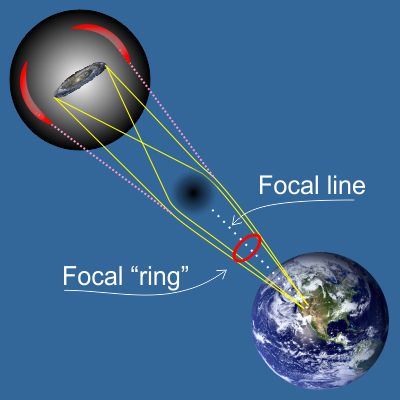
“It’s a gravitational lensing effect. Sy, does Old Reliable still have a copy of that graphic you did about gravitational lensing?”

“That was years ago. Let me check… Uh‑huh, here it is.”

“Thanks. Vinnie, you know how a prism changes light’s direction.”

“Sy and me, we talked about how a prism bends light when light crosses from air to glass or the other way ’cause of the different speed it goes in each material. Uhh, if I remember right the light bends toward the slower speed, and you get more bend with shorter wavelengths.”

“Bingo, Vinnie. Gravitational lensing also bends light, but the resemblance ends there. The light’s just going through empty space, not different media. What varies is the shape of spacetime itself. Say an object approaches a heavy mass. Because of relativity the space it moves through appears compressed and its time is dilated. Compressed distance divided by dilated time means reduced velocity. Parts of a spread‑out lightwave closest to the mass slow down more than parts further way so the whole wave bends toward the heavy mass. Okay?”

“Hold on. Umm, so in your picture light coming towards us from that galaxy doesn’t get blocked by that black thingy, the light bends around it on both sides and focuses in on us?”

“Exactly. Now carry it further. The diagram cuts a flat 2D slice along round 3D spatial reality. Those yellow lines really are cones. Three‑sixty degrees around the black blob, the galaxy’s light bends by the same amount towards the line between us and the blob. Your Einstein ring is a cut across the cone, assuming that the galaxy, the blob and Earth are all exactly on the same straight line. If the galaxy’s off‑center the picture isn’t as pretty — you only get part of a ring, like those red arcs in Sy’s diagram.”

“A galactic rainbow. That ought to be awesome!”

“Well it would be, but there’s another difference between prisms and blobs. Rainbows happen because prisms and raindrops bend short‑wavelength colors more than longer ones, like you said. Gravitational lensing doesn’t care about wavelength. Wavelengths do shift as light traverses a gravitational well but the outbound red shift cancels the inbound blue shift.. Where gravity generates an Einstein ring, all wavelengths bend through the same angle. Which is a good thing for bleeding‑edge astronomy researchers.”

“Why’s that, Cathleen?”

“If the effect were wavelength‑dependent we’d have aberration, the astronomer’s nemesis. Images would be smeared out. As it is, all the photons from a point hit the same spot on the sensor and we’ve got something to see.”

“Tell him about amplification, Cathleen.”

“Good point, Sy. Each galactic star emits light in every direction. In effect, the blob collects light over its entire surface area and concentrates that light along the focal line. We get the brightest image when the stars are aligned right.”

~~ Rich Olcott

Now And Then And There

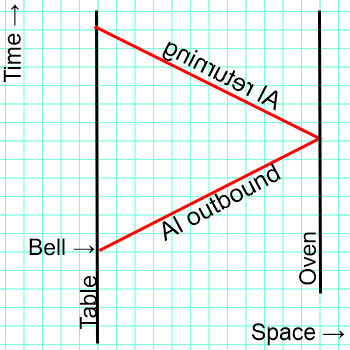
Still at our table in Al’s otherwise empty coffee shop. We’re leading up to how Physics scrambled Now when a bell dings behind the counter. Al dashes over there. Meanwhile, Cathleen scribbles on a paper napkin with her colored pencils. She adds two red lines just as Al comes back with a plate of scones. “Here, Sy, if you’re going to talk Minkowski space this might be useful.”

“Hah, you’re right, Cathleen, this is perfect. Thanks, Al, I’ll have a strawberry one. Mmm, I love ’em fresh like this. OK, guys, take a look at Cathleen’s graphy artwork.”

“So? It’s the tile floor here.”

“Not even close, Mr Feder. Check the labels. The up‑and‑down label is ‘Time’ with later as higher. The diagram covers the period we’ve been sitting here. ‘Now‘ moves up, ‘Here’ goes side‑to‑side. ‘Table‘ and ‘Oven‘, different points in space, are two parallel lines. They’re lines because they both exist during this time period. They’re vertical because neither one moves from its relative spatial position. Okay?”

“Go on, Moire.”
  ”Makes sense to me, Sy.”

“Good. ‘Bell‘ marks an event, a specific point in spacetime. In this case it’s the moment when we here at the table heard the bell. I said ‘spacetime‘ because we’re treating space and time as a combined thing. Okay?”

“Go on, Moire.”
  ”Makes sense to me, Sy.”

“So then Al went to the oven and came back to the table. He traveled a distance, took some time to do that. Distance divided by time equals velocity. ‘Table‘ has zero velocity and its line is vertical. Al’s line would tilt down more if he went faster, okay?”

“Mmmm, got it, Sy.”
  ”Cute how you draw the come-back label backwards, lady. Go on, Moire.”

“I do my best, Mr Feder.”

“Fine, you’ve got the basic ideas. Now imagine all around us there’s graph paper like this — except there’s no paper and it’s a 4‑dimensional grid to account for motion in three spatial dimensions while time proceeds. Al left and returned to the same space point so his spacetime interval is just the time difference. If two events differ in time AND place there’s special arithmetic for calculating the interval.”

“So where’s that get us, Moire?”

“It got 18th and 19th Century Physics very far, indeed. Newton and everyone after him made great progress using math based on a nice stable rectangular space grid crossed with an orderly time line. Then Lorentz and Poincaré and Einstein came along.”

“Who’s Poincaré?”

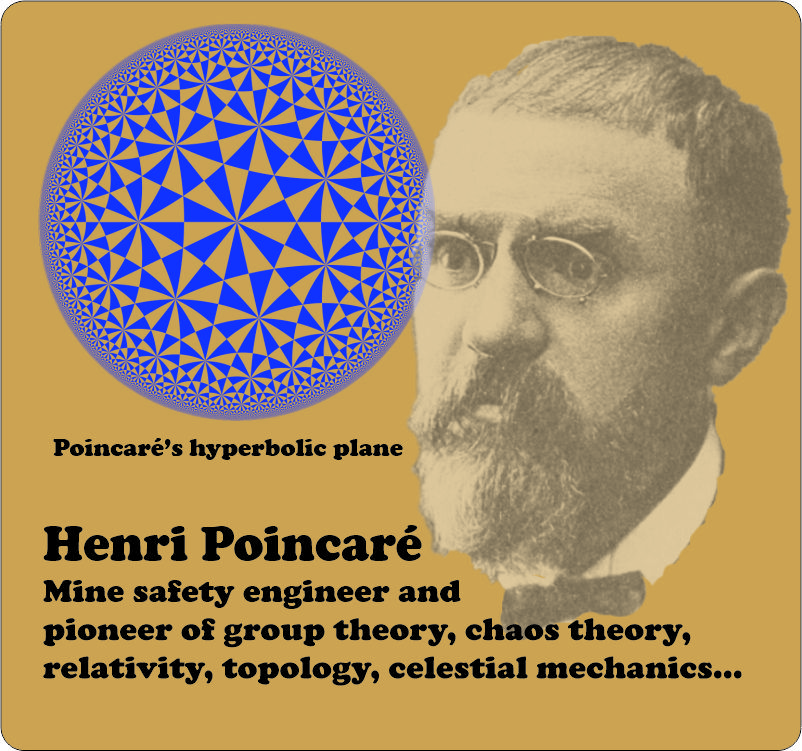
“The foremost mathematician of nineteenth Century France. A mine safety engineer most days and a wide‑ranging thinker the rest of the time — did bleeding‑edge work in many branches of physics and math, even invented a few branches of his own. He put Lorentz’s relativity work on a firm mathematical footing, set the spacetime and gravity stage for Minkowsky and Einstein. All that and a long list of academic and governmental appointments but somehow he found the time to have four kids.”

“A ball of fire, huh? So what’d he do to Newton’s jungle gym?”

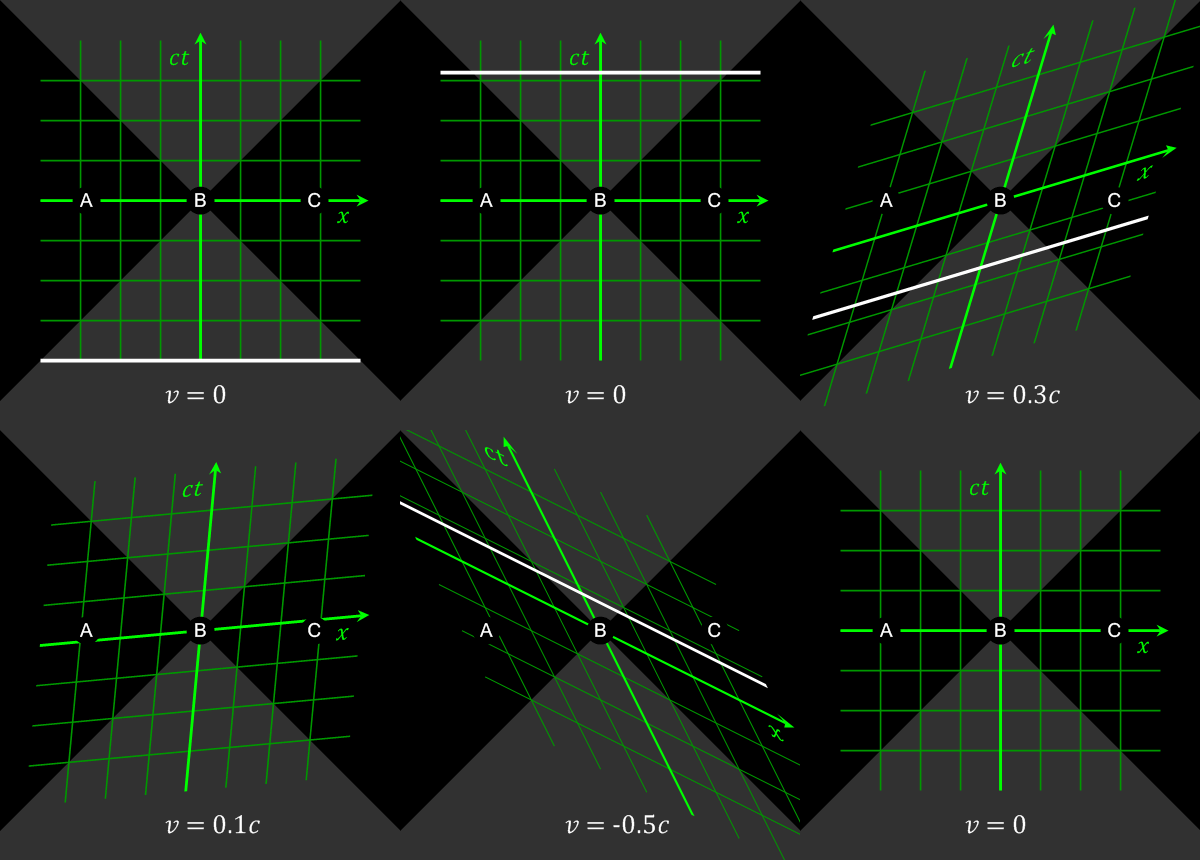
“Turned its steel rod framework into jello. Remember how Cathleen’s Minkowski diagram connected slope with velocity? Einstein showed how Lorentz’s relativity factor sets a speed limit for our Universe. On the diagram, that’d be a minimum slope. Going vertical is okay, that’s standing still in space. Going horizontal isn’t, because that’d be instantaneous travel. This animation tells the ‘Now‘ story better than words can.”

“Whah?”
  ”Whah?”

“We’re looking down on three space travelers and three events. Speeds below lightspeed are within the gray hourglass shape. The white line perpendicular to each traveler’s time line is their personal ‘Now‘. The travelers go at different velocities relative to us so their slopes and ‘Now‘ lines are different. From our point of view, time goes straight up. One traveler is sitting still relative to us so its timeline is marked ‘v=0‘ and parallels ours. We and the v=0 traveler see events A, B and C happening simultaneously. The other travelers don’t agree. ‘Simultaneous‘ is an illusion.”

~~ Rich Olcott

Now And Then

“Alright, I suppose there’s no going down below the Universe’s Year Zero, but what about the other direction? Do you physics guys have a handle on Time’s Top?”

“That’d be Cosmology, Mr Feder. We physicists avoid theorizing about stuff we can’t check against data. Well, except for string theory. The far past leaves clues that astronomers like Cathleen can gather. Sad to say, though, we barely have a handle on Now.”

Cathleen grins. Al and Mr Feder go, “Whaaat?”

“No, really. One of Einstein’s insights was that two observers randomly and independently flying through space won’t be able to agree on whether two external events occurred simultaneously. They can’t even agree on what time it is now.”

“Oh, yeah, I know about that. I’ve read about how the GPS system needs to make corrections to account for what relativity does to the satellite timings.”

“You’re right, Al, but that’s a different issue. Some of that relativistic correction has to do with space compression because of Earth’s mass. The simultaneity problem is strictly about rapid motion and geometry.”

“Wait — geometry?”

“Relativistic geometry, which is a bit different from the kind that Descartes built.”

“Whoa, Sy, slow down there. Descartes was the ‘I think therefore I am‘ guy, right? What’s that got to do with geometry?”

“I guess I got a little ahead of myself there, didn’t I? OK. Yeah, Al, same Descartes. Grew up Catholic in France, was a professional mercenary soldier in the Thirty Years War, wound up fighting first on the Catholic French side and later on fought on the Protestant Dutch side but cross‑over was common, both directions. He realized he was in an ostensibly religious war that was really about who ruled over whom. That may have had something to do with him becoming a professional philosopher who rejected all religious dogmas in favor of what he could learn solely from logic and his own senses. That’s where his famous mantra came from — he started by proving to himself that he existed.”

“Logic led to geometry, I suppose.”

“Indeed, but a new kind, one that required a few innovations that Descartes developed. On the one hand, mathematicians traditionally expressed algebraic problems in words and some of them were doozies, like saying ‘the zenzizenzizenzic‘ where we’d just say x8. We got that simple but <ahem> powerful notation from Descartes. On the geometry side, he’d ditch all the confusing line-ending markers in a diagram like this one. Instead, he’d label the whole line representing a known quantity with a front-of-the-alphabet letter like a or b or c. A line representing an unknown quantity would get its label from the alphabet-trailers like x, y and z. Then he used the same character conventions and his new power notation to write and manipulate algebraic expressions. Those notational inventions were foundational for his bridge between algebraic and geometrical problems. Draw your problem with lines and curves, transform it to algebraic equations, solve that problem exactly, transform it back to geometry and you’re done. Or vice-versa.”

The mesolabe instrument (in red).

“That goes back to Descartes, huh?”

“Mm-hm. His big innovation, though, arose from a borrow from an early Greek gadget called a mesolabe. He proposed an idealized version that would let someone break a line into exact fractions or compare a length against a unit length. That broke the rules of classical Geometry but setting his mesolabe’s Y‑angle to 90° prompted him to name points by their distance along the x– and y‑axes. That’s the nub of the Cartesian coordinate system — a rectangular grid of numbered straight lines that go on forever. Graph paper, right? Wrap the grid around the Earth and you’ve got latitudes and longitudes. Add more numbered grid lines perpendicular to either grid and you’ve got z‑axis coordinates. Three coordinates let you name any point in space. Newton and all the physicists who came after him until the dawn of the 20th Century assumed Descartes’ nice, stable coordinate system.”

“20th Century — that’s when Einstein came on the scene. He broke that system?”

“Sure did. You’ve heard about bent space?”

“Who hasn’t?”

“Well, fasten your seat belts, it’s going to be a fun ride.”

~~ Rich Olcott

The Bottom of Time

“Cathleen, one of my Astronomy magazines had an article, claimed that James Webb Space Telescope can see back to the Big Bang. That doesn’t seem right, right?”

“You’re right, Al, it’s not quite right. By our present state of knowledge JWST‘s infrared perspective goes back only 98% of the way to the Bang. Not quite the Bottom of Time, but close.”

“Whaddaya mean, ‘Bottom of Time‘? I’ve heard people talking about how weird it musta been before the Big Bang. And how can JWST see back in time anyway? Telescopes look across space, not time.”

“So many questions, Mr Feder, and some hiding behind others. That’s his usual mode, Cathleen. Care to tag-team?”

“You’re on, Sy. Well, Mr Feder. The ‘look back in time‘ part comes from light not traveling infinitely fast. We’ve known that for three centuries, ever since Rømer—”

“Roamer?”

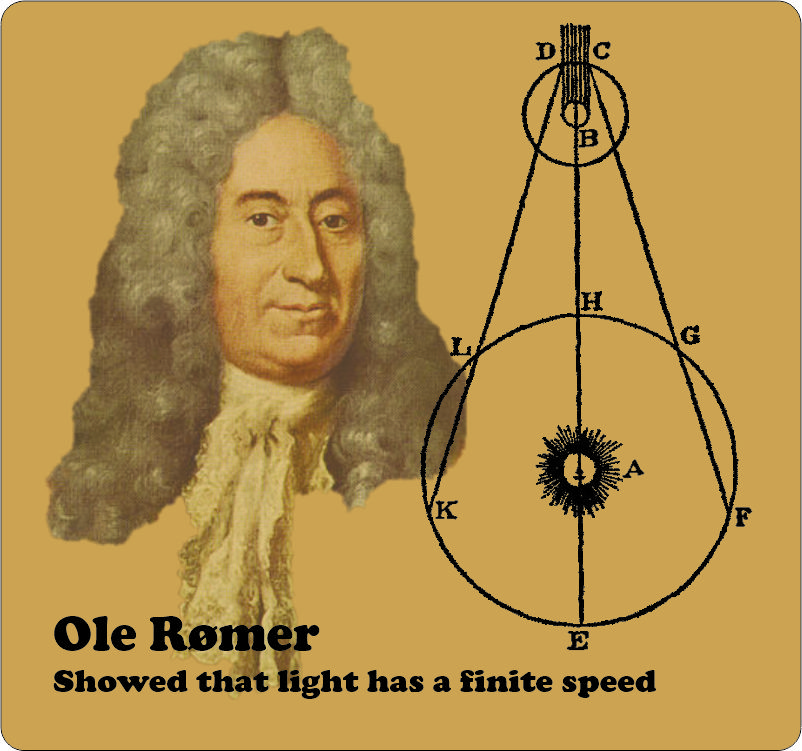
“Ole Rømer, a Danish scientist who lived in Newson’s time. Everyone knew that Jupiter’s innermost large moon Io had a dependably regular orbit, circling Jupiter every 49½ hours like clockwork. Rømer was an astronomer when he wasn’t tutoring the French King’s son or being Copenhagen’s equivalent of Public Safety Commissioner. He watched Io closely, kept notes on exactly when she ducked behind Jupiter and when she reappeared on the other side. His observed timings weren’t quite regular, generally off by a few minutes. Funny thing was, the irregularities correlated with the Earth‑Jupiter distance — up to 3½ minutes earlier than expected when Earth in its orbit was closest to Jupiter, similarly late when they were far apart. There was a lot of argument about how that could be, but Rømer, Huygens, even Newton, all agreed that the best explanation was that we only see Io’s passage events after light has taken its time to travel from there to here.”

“Seems reasonable. Why should people argue about that?”

“The major sticking point was the speed that Huygens calculated from Rømer’s data. We now know it’s 186000 miles or 300000 kilometers or one lightsecond per second. Different ways of stating the same quantity. Huygens came up with a somewhat smaller number but still. The establishment pundits had been okay with light transmission being instantaneous. Given definite numbers, though, they had trouble accepting the idea that anything physical could go that fast.”

“Tag, my turn. Flip that distance per time ratio upside down — for every additional lightsecond of distance we’re looking at events happening one second farther into the past. That’s the key to JWST‘s view into the long‑ago. Al, you got that JWST‘s infrared capabilities will beat Hubble‘s vis‑UV ones for distance. Unless there’s something seriously wrong with Einstein’s assumption that lightspeed’s an absolute constant throughout spacetime, we expect JWST to give us visibility to the oldest free photons in the Universe, just 379000 years upward from the Big Bang.”

“Wait, I heard weaseling there. Free photons? Like you gotta pay for the others?”

“Ha, ha, Mr Feder. During those first 379000‑or‑so years, we think the Universe was so hot and so dense that no photon’s wave had much of a chance to spread out before it encountered a charged something and got absorbed. At last, things cooled down enough for atoms to form and stay in one piece. Atoms are neutral. Quantum rules restrict their interaction to only photons that have certain wavelengths. The rest of the photons, and there’s a huge number of them, were free to roam the expanding Universe until they happen to find a suitable absorber. Maybe someone’s eye or if we’re lucky, a sensor on JWST or some other telescope.”

Thanks for this to George Derenburger

“What about before the 300‑and‑something thousand years? Like, before Year Zero? Musta been weird, huh?”

“Well, there’s a problem with that question. You’re assuming there was a Year Minus‑One, but that’s just not the case.”

“Why not? Arithmetic works that way.”

“But the Universe doesn’t. Stephen Hawking came up with a good way to think about it. What on Earth is south of the South Pole?”

“Eeayahh … nope. Can’t get any further south than that.”

“Well, there you are, so to speak. Time’s bottom is Year Zero and you can’t get any further down than that. We think.”

~~ Rich Olcott

Turn This Way to Turn That Way

“I don’t understand, Sy. I get that James Webb Space Telescope uses its reaction wheels like a ship uses a rudder to change direction by pushing against something outside. Except the rudder pushes against water but the reaction wheels push against … what, the Universe?”

“Maybe probably, Al. We simply don’t know how inertia works. Newton just took inertia as a given. His Laws of Motion say that things remain at rest or persist in linear motion unless acted upon by some force. He didn’t say why. Einstein’s General Relativity starts from his Equivalence Principle — gravitational inertia is identical to mechanical inertia. That’s held up to painstaking experimental tests, but why it works is still an open question. Einstein liked Mach’s explanation, that we experience these inertias because matter interacts somehow with the rest of the Universe. He didn’t speculate how that interaction works because he didn’t like Action At A Distance. The quantum field theory people say that everything’s part of the universal field structure, which sounds cool but doesn’t help much. String theory … ’nuff said.”

“Hey, Moire, what’s all that got to do with the reaction wheel thing? JWST can push against one all it wants but it won’t go anywhere ’cause the wheel’s inside it. What’s magic about the wheels?”

JWST doesn’t want to go anywhere else, Mr Feder. We’re happy with it being in its proper orbit, but it needs to be able to point to different angles. Reaction wheels and gyroscopes are all about angular momentum, not about the linear kind that’s involved with moving from place to place.”

“HAH! JWST is moving place to place, in that orbit! Ain’t it got linear momentum then?”

Newton’s Principia, Proposition II, Theorem II

“In a limited way, pun intended. Angular momentum is linear momentum plus a radial constraint. This goes back to Newton and his Principia book. I’ve got a copy of his basic arc‑splitting diagram here in Old Reliable. The ABCDEF line is a section of some curve around point S. He treated it as a succession of short line segments ABc, BCd, CDe and so on. If JWST is at point B, for instance, Newton would say that it’s traveling with a certain linear momentum along the BCd line. However, it’s constrained to move along the arc so it winds up at D instead d. To account for the constraint Newton invented centripetal force to pull along the Sd line. He then mentally made the steps smaller and smaller until the sequence of short lines matched the curve. At the limit, a sequence of little bits of linear momentum becomes angular momentum. By the way, this step‑reduction process is at the heart of calculus. Anyway, JWST uses its reaction wheels to swing itself around, not to propel itself.”

“And we’re back to my original question, Sy. What makes that swinging happen?”

“Oh, you mean the mechanical reality. Easy, Al. Like I said, three pairs of motorized wheels are mounted on JWST‘s frame near the center of mass. Their axles are at mutual right angles. Change a wheel’s angular momentum, you get an equal opposing change to the satellite’s. Suppose the Attitude Control System wants the satellite to swing to starboard. That’d be clockwise viewed from the cold side. ACS must tell a port/starboard motor to spin its wheel faster counterclockwise. If it’s already spinning clockwise, the command would be to put on the brakes, right? Either way, JWST swings clockwise. With the forward/aft motors and the hot‑side/cold‑side motors, the ACS is equipped to get to any orientation. See how that works?”

“Hang on.” <handwaving ensues> “Yeah, I guess so.”

“Hey, Moire. What if the wheel’s already spinning at top speed in the direction the ACS wants more of?”

“Ah, that calls for a momentum dump. JWST‘s equipped with eight small rocket engines called thrusters. They convert angular momentum back to linear momentum in rocket exhaust. Suppose we need a further turn to starboard but a port/starboard wheel is nearing threshold spin rate. ACS puts the brakes on that wheel, which by itself would turn the satellite to port. However, ACS simultaneously activates selected thrusters to oppose the portward slew. Cute, huh?”

~~ Rich Olcott