The Neapolitan Particle

“Welcome back, Jennie.  Why would anyone want to steer an ice cube?

“Thanks, Jeremy, it’s nice to be back..  And the subject’s not an ice cube, it’s IceCube, the big neutrino observatory in the Antarctic.”

“Then I’m with Al’s question.  Observatories have this big dome that rotates and inside there’s a lens or mirror or whatever that goes up and down to sight on the night’s target.  OK, the Hubble doesn’t have a dome and it uses gyros but even there you’ve got to point it.  How does IceCube point?”

“It doesn’t.  The targets point themselves.”

“Huh?”

“Ever relayed a Web-page?”

“Sure.”

“Guess what?  You don’t know where the page came from, you don’t know where it’s going to end up.  But it could carry a tracking bug to tell someone at some call-home server when and where the page had been opened.  IceCube works the same way, sort of.  It has a huge 3D array of detectors to record particles coming in from any direction.  A neutrino can come from above, below, any side, no problem — the detectors it touches will signal its path.”

IceCube architecture
Adapted from a work by Francis Halzen, Department of Physics, University of Wisconsin

“How huge?”

“Vastly huge.  The instrument is basically a cubic kilometer of ultra-clear Antarctic ice that’s ages old.  The equivalent of the tracking bugs is 5000 sensors in a honeycomb array more than a kilometer wide.  Every hexagon vertex marks a vertical string of sensors going down 2½ kilometers into the ice.  Each string has a couple of sensors near the surface but the rest of them are deeper than 1½ kilometers.  The sensors are looking for flashes of light.  Keep track of which sensor registered a flash when and you know the path a particle took through the array.”

icecube event 3“Why should there be flashes? I thought neutrinos didn’t interact with matter.”

“Make that, they rarely interact with matter.  Even that depends on what particle the neutrino encounters and what flavor neutrino it happens to be at the moment.”

That gets both Al and me interested.  His “Neutrinos come in flavors?” overlaps my “At the moment?”

“I thought that would get you into this, Sy.  Early experiments detected only 1/3 of the neutrinos we expected to come from the Sun.  Unwinding all that was worth four Nobel prizes and counting.  The upshot’s that there are three different neutrino flavors and they mutate.  The experiments caught only one.”

Vinnie’s standing behind us.  “You’re going to tell us the flavors, right?”

“Hoy, Vinnie, Jeremy’s question was first, and it bears on the others.  Jeremy, you know that blue glow you see around water-cooled nuclear fuel rods?”

“Yeah, looks spooky.  That’s neutrinos?”

“No, that’s mostly electrons, but it could be other charged particles.  It has to do with exceeding the speed of light in the medium.”

“Hey, me and Sy talked about that.  A lightwave makes local electrons wiggle, and how fast the wiggles move forward can be different from how fast the wave group moves.  Einstein’s speed-of-light thing was about the wave group’s speed, right, Sy?”

“That’s right, Vinnie.”

“So anyhow, Jeremy, a moving charged particle affects the local electromagnetic field.  If the particle moves faster than the surrounding atoms can adjust, that generates light, a conical electromagnetic wave with a continuous spectrum.  The light’s called Cherenkov radiation and it’s mostly in the ultra-violet, but enough leaks down to the visible range that we see it as blue.”

“But you said it takes a charged particle.  Neutrinos aren’t charged.  So how do the flashes happen in IceCube?”

“Suppose an incoming high-energy neutrino transfers some of its momentum to a charged particle in the ice — flash!  Even better, the flash pattern provides information for distinguishing between the neutrino flavors.  Muon neutrinos generate a more sharp-edged Cherenkov cone than electron neutrinos do.  Taus are so short-lived that IceCube doesn’t even see them.”Leptons

“I suppose muon and tau are flavors?”

“Indeed, Vinnie.  Any subatomic reaction that releases an electron also emits an electron-flavored neutrino.  If the reaction releases the electron’s heavier cousin, a muon, then you get a muon-flavored neutrino.  Taus are even heavier  and they’ve got their own associated neutrino.”

“And they mutate?”

“In a particularly weird way.”

~~ Rich Olcott

Trio for Rubber Ruler

“It’s all about how lightwaves get generated and then what happens.”

Sy and me talked about that, Cathleen.  Lightwaves come from jiggling electrons, right?”

“Any kind of charged particles, Vinnie, but there’s different ways that can happen.  Each leads to its own kind of spectrum.”

“Different kinds of spectrum?  Do you mean like visible versus infrared and ultraviolet, Cathleen?”

“No, I don’t, Sy.  I’m referring to the thing’s overall appearance in every band.  A hundred and fifty years ago Kirchoff pointed out that light from a source can have lines of color, lines without color, or a smooth display without lines.”

“Like that poster that Al put up between the physicist and astronomer corners?”  (We’re still chatting at a table in Al’s coffee shop.  I’m on my fourth scone.)

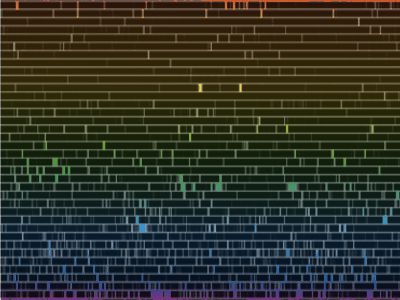
Astroruler with solar spectrum
Based on N.A.Sharp, NOAO/NSO/Kitt Peak FTS/AURA/NSF

“Kind of.  That’s based on a famous image created at Kitt Peak Observatory.  In the background there you see a representation of what Kirchoff called a continuous or black-body spectrum, where all the colors fade smoothly into each other in classic rainbow order.  You’re supposed to ignore the horizontal dark lines.”

“And the vertical lines?”

“They form what Kirchoff called an absorption spectrum.  Each dark vertical represents an isolated color that we don’t get from the Sun.”

“You’re saying we get all the other colors but them, right?”

“Exactly, Vinnie.  The Sun’s chromosphere layer filters those specific wavelengths before they get from the deeper photosphere out into space.”

“Complicated filter.”

“Of course.  The Sun contains most of the elements lighter than nickel.  Each kind of atom absorbs its own collection of frequencies.”

“Ah, that’s the quantum thing that Sy and me talked about, right, Sy?”

“Mm-hm.  We only did the hydrogen atom, but the same principles apply.  An electromagnetic wave tickles an atom.  If the wave delivers exactly the right amount of energy, the atom’s chaotic storm of electrons resonates with the energy and goes a different-shaped storm.  But each kind of atom has a limited set of shapes.  If the energy doesn’t match the energy difference between a pair of levels, there’s no absorption and the wave just passes by.”

“But I’ll bet the atom can’t hold that extra energy forever.”

“Good bet, Vinnie.  The flip side of absorption is emission.  I expect that Cathleen has an emission spectrum somewhere on her laptop there.”Emission spectrum“You’re right, Sy.  It’s not a particularly pretty picture, but it shows that nice strong sodium doublet in the yellow and the broad iron and hydrogen lines down in the green and blue.  I’ll admit it, Vinnie, this is a faked image I made to show my students what the solar atmosphere would look like if you could turn off the photosphere’s continuous blast of light.  The point is that the atoms emit exactly the same sets of colors that they absorb.”
“You do what you gotta do, Cathleen.  But tell me, if each kind of atom does only certain colors, where’s that continuous rainbow come from?  Why aren’t we only getting hydrogen colors?”

“Kirchoff didn’t have a clue on that, Vinnie.  It took 50 years and Einstein to solve it.  Not just where the light comes from but also its energy-wavelength profile.”

“So where does the light come from?”

“Pure heat.  You can get a continuous spectrum from a hot wire, molten lava, a hole through the wall of a hot oven, even the primordial chaos of the Big Bang.  It doesn’t matter what kind of matter you’re looking at, the profile just depends on the temperature.  You know that temperature measures the kinetic energy stored in particle random motion, Vinnie?”

“Well, I wouldn’t have put it that way, but yeah.”

“Well, think about the Sun, just a big ball of really hot atoms and electrons and nuclei, all bouncing off each other in frantic motion.  Every time one of those changes direction it affects the electromagnetic field, jiggles it as you say.  The result of all that jiggling is the continuous spectrum.  Absorption and emission lines come from electrons that are confined to an atom, but heat motion is unconfined.”

“How about hot metal?”

“The atoms are locked in their lattice, but heat jiggles the whole lattice.”

~~ Rich Olcott

The Biggest Telescope in The Universe

Vinnie rocks back in his chair.  “These gravitational lenses, Cathleen.  How do you figure their apertures and f-numbers, space being infinite and all?”

She takes a breath to answer, but I cut in.  “Whoa, I never got past a snapshot camera.  How about you explain Vinnie’s question before you answer it?”Bird and lenses

“You’re right, Sy, most people these days just use their cellphone camera and have no clue about what it does inside.  Apertures and f-numbers are all just simple geometry.  Everything scales with the lens’ focal length.”

“That’s how far away something is that you’re taking a picture of?”

“No, it’s a characteristic of the lens itself.  It’s the distance between the midpoint of the lens and its focal plane, which is where you’d want to put the sensor chip or film in a camera.  The aperture is the diameter of the light beam entering the lens.  The optimal aperture, the image size, even the weight of the lens, all scale to the lens focal length.”

“I can see image size thing — the further back the focal plane, the bigger the image by the the time it gets there.  It’s like a lever.”

“Sort of, Vinnie, but you’ve got the idea.”

“The aperture scales to focal length?  I’d think you could make a lens with any diameter you like.”

“Sure you could, Sy, but remember you’d be using a recording medium of some sort and it’s got an optimum input level.  Too much light and you over-expose, too little and you under-expose.  To get the right amount of light when you take the shot the aperture has to be right compared to the focal length.”

“Hey, so that’s the reason for the old ‘Sunny 16‘ rule.  Didn’t matter if I had a 35mm Olympus or a big ol’ Rollei, if it was a sunny day I got good pictures with an f/16 aperture.  ‘Course I had to balance the exposure time with the film’s speed rating but that was easy.”

“Exactly, Vinnie.  If I remember right, the Rollei’s images were about triple the size of the little guy’s.  Tripled focal length meant tripled lens size.  You could use the same speed-rated film in both cameras and use the same range of f-stops.  The rule still works with digital cameras but you need to know your sensor’s ISO rating.”

“Ya got this, Sy?  Can we move on to Cathleen’s gravity lenses?”

“Sure, go ahead.”

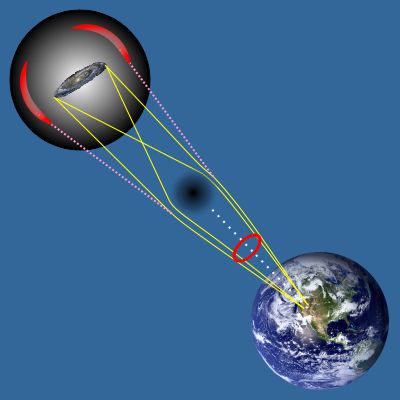
“Well, they’re completely different from … I’ll call them classical lenses. That kind has a focal plane and a focal length and an aperture and only operates along one axis.  Gravitational lenses have none of that, but they have an infinite number of focal lines and rings.”

Gravitational lens and galaxy“Infinite?”

“At least in principle.  Any observation point in the Universe has a focal line running to a massive object’s center of gravity.  At any point along the line, you could look toward an object and potentially see all or part of a ring composed of light from some bright object behind it.  Einstein showed that a completed ring’s  visual angle depends on the deflector’s mass and the three distances between the observer, the deflector and the bright object.”

“The way you said that, there could be a bunch of rings.”

“Sure, one for each bright object shining onto the lens.  For that matter, the deflector itself could be complex — the gravity of a whole cluster of galaxies rather than the single black hole we’ve been assuming as an example.”

“That diagram reminds me of Galileo’s telescope, just a three-foot tube with an objective lens at the far end and an eyepiece lens to look through.  But it was enough to show him the rings of Saturn and the moons of Jupiter.”

“Right, Sy.  His objective lens was maybe a couple of inches across.  If its focal point was halfway down the tube, his scope’s light-gathering power would match an f/9 camera lens.  Gravitational lenses don’t have apertures so not an issue.”

“So here we are like Galileo, with a brand new kind of telescope.”

“Poetic, Vinnie, and so right.  It’s already shown us maybe the youngest galaxy, born 13 billion years ago.  We’re just getting started.”

~~ Rich Olcott

The Fellowship of A Ring

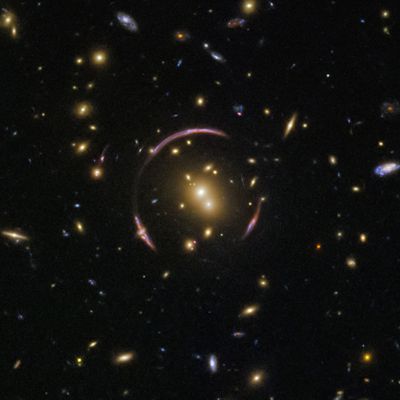
Einstein ring 2018
Hubble photo from NASA’s Web site

Cathleen and I are at a table in Al’s coffee shop, discussing not much, when Vinnie comes barreling in.  “Hey, guys.  Glad I found you together.  I just saw this ‘Einstein ring’ photo.  They say it’s some kind of lensing phenomenon and I’m thinking that a lens floating out in space to do that has to be yuuuge.  What’s it made of, and d’ya think aliens put it there to send us a message?”

Astronomer Cathleen rises to the bait.  I sit back to watch the fun.  “No, Vinnie, I don’t.  We’re not that special, the rings aren’t signals, and the lenses aren’t things, at least not in the way you’re thinking.”

“There’s more than one?”

“Hundreds we know of so far and it’s early days because the technology’s still improving.”

“How come so many?”

“It’s because of what makes the phenomenon happen.  What do you know about gravity and light rays?”

Me and Sy talked about that a while ago.  Light rays think they travel in straight lines past a heavy object, but if you’re watching the beam from somewhere else you think it bends there.”

I chip in.  “Nice summary, good to know you’re storing this stuff away.”Gravitational lens 1

“Hey, Sy, it’s why I ask questions is to catch up.  So go on, Cathleen.”

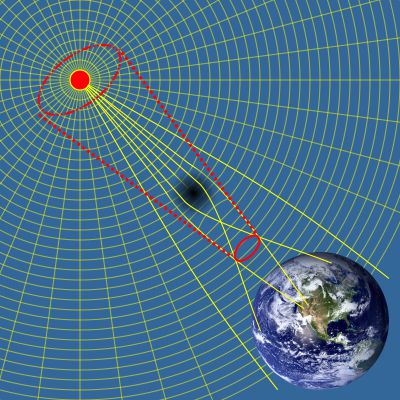
She swings her laptop around to show us a graphic.  “So think about a star far, far away.  It’s sending out light rays in every direction.  We’re here in Earth and catch only the rays emitted in our direction.  But suppose there’s a black hole exactly in the way of the direct beam.”

“We couldn’t see the star, I get that.”

“Well, actually we could see some of its light, thanks to the massive black hole’s ray-bending trick. Rays that would have missed us are bent inward towards our telescope.  The net effect is similar to having a big magnifying lens out there, focusing the star’s light on us.”

“You said, ‘similar.’  How’s it different?”Refraction lens

“In the pattern of light deflection.  Your standard Sherlock magnifying lens bends light most strongly at the edges so all the light is directed towards a point.  Gravitational lenses bend light most strongly near the center.  Their light pattern is hollow.  If we’re exactly in a straight line with the star and the black hole, we see the image ‘focused’ to a ring.”

“That’d be the Einstein ring, right?”

“Yes, he gets credit because he was the one who first set out the equation for how the rays would converge.  We don’t see the star, but we do see the ring.  His equation says that the angular size of the ring grows as the square root of the deflecting object’s mass.  That’s the basis of a widely-used technique for measuring the masses not only of black holes but of galaxies and even larger structures.”

“The magnification makes the star look brighter?”

“Brighter only in the sense that we’re gathering photons from a wider field then if we had only the direct beam.  The lens doesn’t make additional photons, probably.”

Suddenly I’m interested.  “Probably?”

“Yes, Sy, theoreticians have suggested a couple of possible effects, but to my knowledge there’s no good evidence yet for either of them.  You both know about Hawking radiation?”

“Sure.”

“Yup.”

“Well, there’s the possibility that starlight falling on a black hole’s event horizon could enhance virtual particle production.  That would generate more photons than one would expect from first principles.  On the other hand, we don’t really have a good handle on first principles for black holes.”

“And the other effect?”

“There’s a stack of IFs under this one.  IF dark matter exists and if the lens is a concentration of dark matter, then maybe photons passing through dark matter might have some subtle interaction with it that could generate more photons.  Like I said, no evidence.”

“Hundreds, you say.”

“Pardon?”

“We’ve found hundreds of these lenses.”

“All it takes is for one object to be more-or-less behind some other object that’s heavy enough to bend light towards us.”

“Seein’ the forest by using the trees, I guess.”

“That’s a good way to put, it, Vinnie.”

~~ Rich Olcott

The Speeds of Light

“I don’t give up easy, Sy.”

“I know that, Vinnie.  Still musing about lightwaves and how they’re all an electron’s fault?”

“Yeah.  Hey, can your OVR app on Old Reliable grab a shot from this movie running on my smartphone?”

“We can try … got it.  Now what?”

“I wanna try mixing that with your magnetic field picture.”

“I’ll bring that up … Here, have at it.”

“Umm … Nice app, works very intuitive-like …  OK, see this?”Electrons and lightwave

“Ah.  It’s a bit busy, walk me through what’s in there.”

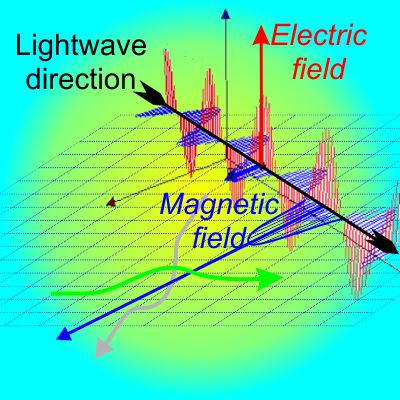
“OK. First we got the movie’s lightwave.  The ray’s running along that black arrow, see?  Some electron back behind the picture is going up and down to energize the ray and that makes the electric field that’s in red that makes other electrons go up and down, right?”

“That’s the red arrow, hmm?”

“Yeah, that electron got goosed ’cause it was standing in the way.  It follows the electric field’s direction.  Now help me out with the magnetic stuff.”

“Alright.  The blue lines represent the lightwave’s magnetic component.  A lightwave’s magnetic field lines are always perpendicular to its electric field.  Magnetism has no effect on uncharged particles or motionless charged particles.  If you’re a moving charged particle, say an electron, then the field deflects your trajectory.”

“This is what I’m still trying to wrap my head around.  You say that the field’s gonna push the particle perpendicular to the field and to the particle’s own vector.”

“That’s exactly what happens.  The green line, for instance, could represent an electron that crossed the magnetic field.  The field deflected the electron’s path upwards, crossways to the field and the electron’s path.  Then I suppose the electron encountered the reversed field from the lightwave’s following cycle and corrected course again.”

“And the grey line?”

“That’d be an electron crossing more-or-less along the field.  According to the Right Hand Rule it was deflected downward.”

“Wait.  We’ve got two electrons on the same side of the field and they’re deflected in opposite directions then correct back.  Doesn’t that average out to no change?”

“Not quite.  The key word is mostly.  Like gravity fields, electromagnetic fields get weaker with distance.  Each up or down deflection to an electron on an outbound path will be smaller than the previous one so the ‘course corrections’ get less correct.  Inbound electrons get deflected ever more strongly on the way in, of course, but eventually they become outbound electrons and get messed up even more.  All those deflections produce an expanding cone of disturbed electrons along the path of the ray.”

“Hey, but when any electron moves that changes the fields, right?  Wouldn’t there be a cone of disturbed field, too?”

“Absolutely.  The whole process leads to several kinds of dispersion.”

“Like what?”

“The obvious one is simple geometry.  What had been a simple straight-line ray is now an expanding cone of secondary emission.  Suppose you’re an astronomer looking at a planet that’s along that ray, for instance.  Light’s getting to you from throughout the cone, not just from the straight line.  You’re going to get a blurred picture.”

“What’s another kind?”

“Moving those electrons around extracts energy from the wave.  Some fraction of the ray’s original photons get converted to lower-energy ones with lower frequencies.  The net result is that the ray’s spectrum is spread and dispersed towards the red.”

“You said several kinds.”

“The last one’s a doozy — it affects the speeds of light.”

“‘Speeds,’ plural?”ripples in a wave

“There’s the speed of field’s ripples, and there’s the speed of the whole signal, say when a star goes nova.  Here’s a picture I built on Old Reliable.  The gold line is the electric field — see how the ripples make the red electron wobble?  The green dots on the axis give you comparison points that don’t move.  Watch how the ripples move left to right just like the signal does, but at their own speed.”

“Which one’s Einstein’s?”

“The signal.  Its speed is called the group velocity and in space always runs 186,000 mph.  The ripple speed, technically it’s the phase velocity, is slower because of that extracted-and-redistributed-energy process.  Different frequencies get different slowdowns, which gives astronomers clues about the interstellar medium.”

“Clues are good.”

~~ Rich Olcott

They Went That-away. But Why?

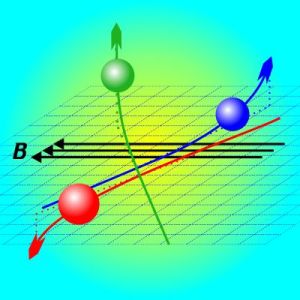
“It’s worse than that, Vinnie.”  I pull out Old Reliable, my math-monster tablet.  “Let me scan in that three-electron drawing of yours.”3 electrons in B-field

“Good enough to keep a record of it?”

“Nope, I want to exercise a new OVR app I just bought.”

“You mean OCR.”

“Uh-uh, this is Original Vector Reconstruction, not Optical Character Recognition.    OCR lets you read a document into a word processor so you can modify it.  OVR does the same thing but with graphics.  Give me a sec … there.  OK, look at this.”3 electrons in B-field revisited

“Cool, you turned my drawing 180°, sort of.  Nice app.  Oh, and you moved the red electron’s path so it’s going opposite to the blue electron instead of parallel to the magnetic field.  Why’d you bother?”

“See the difference between blue and red?”

“Well, yeah, one’s going up, one’s going down.  That’s what I came to you about and you shot down my theory.  Those B-arrows in the magnetic field are going in completely the wrong direction to push things that way.”

“Well, actually, they’re going in exactly the right direction for that, because a magnetic field pushes along perpendiculars.  Ever hear of The Right Hand Rule?”

“You mean like ‘lefty-loosey, righty-tighty’?”

“That works, too, but it’s not the rule I’m talking about.  If you point your thumb in the direction an electron is moving, and your index finger in the direction of the magnetic field, your third finger points in the deflection direction.  Try it.”

“Hurts my wrist when I do it for the blue one, but yeah, the rule works for that.  It’s easier for the red one.  OK, you got this rule, fine, but why does it work?”

“Part of it goes back to the vector math you don’t want me to throw at you.  Let’s just say that there are versions of a Right Hand Rule all over physics.  Many of them are essentially definitions, in the same way that Newton’s Laws of Motion defined force and mass.  Suppose you’re studying the movements directed by some new kind of force.  Typically, you try to define some underlying field in such a way that you can write equations that predict the movement.  You haven’t changed Nature, you’ve just improved our view of how things fit together.”

“So you’re telling me that whoever made that drawing I copied drew the direction those B-arrows pointed just to fit the rule?”

“Almost.  The intensity of the field is whatever it is and the lines minus their pointy parts are wherever they are.  The only thing we can set a rule for is which end of the line gets the arrowhead.  Make sense?”Spiraling electron

“I suppose.  But now I got two questions instead of the one I come in here with.  I can see the deflection twisting that electron’s path into a spiral.  But I don’t see why it spirals upward instead of downward, and I still don’t see how the whole thing works in the first place.”

“I’m afraid you’ve stumbled into a rabbit hole  we don’t generally talk about.  When Newton gave us his Law of Gravity, he didn’t really explain gravity, he just told us how to calculate it.  It took Einstein and General Relativity to get a deeper explanation.  See that really thick book on my shelf over there?  It’s loaded with tables of thermodynamic numbers I can use to calculate chemical reactions, but we didn’t start to understand those numbers until quantum mechanics came along.  Maxwell’s equations let us calculate electricity, magnetism and their interaction — but they don’t tell us why they work.”

“I get the drift.  You’re gonna tell me it goes up because it goes up.”

“That’s pretty much the story.  Electrons are among the simplest particles we know of.  Maxwell and his equations gave us a good handle on how they behave, nothing on why we have a Right Hand Rule instead of a Left Hand Rule.  The parity just falls out of the math.  Left-right asymmetry seems to have something to do with the geometry of the Universe, but we really don’t know.”

“Will string theory help?”

“Physicists have spent 50 years grinding on that without a testable result.  I’m not holding my breath.”

~~ Rich Olcott

RIP, Dr Hawking

Today I depart from my normal schedule and the current story line and science line.  A giant has left us and I want to pay proper tribute.

Dr Stephen Hawking enjoyed telling people of his fortunate birth date, exactly 300 years after Galileo Galilei passed away.  He liked a good joke, and I think he’d be tickled with this additional connection to the man whose work made Hawking’s work possible:
RIP Hawking

The equation in the center of this cut is Hawking’s favorite result, which he wanted to be carved on his gravestone.  It links a black hole’s entropy (S) to its surface area (A).  The other letters denote a collection of constants that have been central to the development of theoretical Physics over the past century and a half:

  • k is Boltzmann’s constant, which links temperature with kinetic energy
  • c is the speed of light, the invariance of which led Einstein to Relativity
  • G is Newton’s universal gravitational constant
  • h is Planck’s constant, the “quantum of action”

Hawking spent much of his career thinking deeply about the implications of Einstein’s concepts.  Newton’s equations support excellent descriptions of everyday physical motions, from the fall of raindrops to the orbits of solar systems.  Einstein’s equations led to insights about conditions at the most extreme — velocities near lightspeed, masses millions of times the Sun’s but packed into a volume only a few dozen miles wide.

But Hawking also pondered extremes of the ultimately large and the ultimately small — the edge of the Universe and distances far smaller than atomic nuclei.  Because his physical condition prohibited speech or quick jottings, he was forced to develop extraordinary powers of concentration and visualization that enabled him to encapsulate in a few phrases insights that would take others books to develop and communicate.

Hawking wrote books, too, of course, of a quality and clarity that turned his name and Science into watchwords for the general public as well as the physics community.  By his life and how he lived it he was an inspiration to many, abled and otherwise.  Science needs its popularizers, though some in the field deprecate them as hangers-on.  Hawking managed to bridge that gap with ease and grace, a giant with standing on either side.

Requiescat in pace, Dr Hawking.  Thank you.

~~ Rich Olcott

To Bond Or Not To Bond, That Is The Question

Vinnie’s pushing pizza crumbs around his plate, watching them clump together.  “These molecular orbitals gotta be pretty complicated.  How do you even write them down?”

“Combinations.  There’s a bunch of different strategies, but they all go back to Laplace’s spherical harmonics.  Remember, he showed that every possible distribution around a central attractor could be described as a combination of his patterns.  Turn on a field, like from another atom, and you just change what combination is active.  Here’s a sketch of the simplest case, two hydrogen atoms — see how the charge on each one bulges toward the other?  The bulge is a combination of a spherical orbital and a dumbbell one.  The molecular orbitals are combinations of orbitals from both atoms, describing how the charges overlap, or not.”Hydrogen molecule

“What’s that blue in the other direction?”

“Another possible combination.  You can combine atomic orbitals with pluses or minuses.  The difference is that the minus combination will always have an additional node in between.  Extra nodes mean higher energy, harder to activate. When the molecule’s in the lowest energy state, charge will be between the atoms where that extra node isn’t.”

“So the overlapped charge here is negative, right, and it pulls the two positive nucleusses —”

“Nuclei”

“Whatever, it pulls ’em together.  Why don’t they just merge?”

“Positive-positive repulsion counts, too.  At the equilibrium bond distance, the nuclei repel each other exactly as much as the shared charge pulls them together.”

Eddie’s still hovering by our table.  “You said that there’s this huge number of possible atomic orbitals.  Wouldn’t there be an even huger number of molecular orbitals?”

“Sure.  The trick is in figuring out which of them are lowest-energy and activated and how that relates to the molecule’s configuration.  Keep track of your model’s total energy as you move the atoms about, for instance, and you can predict the equilibrium distance where the energy is a minimum.  In principle you can calculate configuration changes as two molecules approach each other and react.”

“Looks like a lot of work.”

“For sure, Eddie.  Even a handful of atoms has lots of atomic orbitals to keep track of.  That can burn up acres of compute time.”

Vinnie pushes three crumbs into a triangle.  “You got three distances, you can figure their angles.  So you got the whole shape of the thing.”

“Right, but like Eddie said, that’s a lot of computer work.  Chemists had to come up with shortcuts.  As a matter of fact, they had the shortcuts way before the computers came along.”

“They used, like, abacuses?”

“Funny, Vinnie.  No, no math at all.  And it’s why they still show school-kids those Bohr diagrams.”

“Crazy Eights.”

“Eddie, you got games on the brain.  But yeah, eights.  Or better, quartets of pairs.  One thing I’ve not mentioned yet is that even though they’ve got the same charge, electrons are willing to pair up.”

“How come?”

“That’s the thing of it, Vinnie.  There’s a story about Richard Feynman, probably the foremost physicist of the mid-20th Century.  Someone asked him to explain the pairing-up without using math.  Feynman went into his office for a week, came back out and said he couldn’t do it.  The math demands pairing-up, but outside of the math all we can say is experiments show that’s how it works.”

“HAH, that’s the reason for the ‘two charge units per orbital’ rule!”

“Exactly, Eddie.  It’s how charge can collect in that bonding molecular orbital in the first place.  It’s also the reason that helium doesn’t form molecules at all.  Imagine two helium atoms, each with two units of charge.  Suppose they come close to each other like those hydrogens did.  Where would the charge go?”

“OK, you got two units going into that in-between space, ahh, and the other two activating that blue orbital and pulling the two atoms apart.  So that adds up to zero?”

“Uh-huh.  They just bounce off and away.”

“Cool.”

“Hey, I got a question.  Your sketch has a ball orbital combining with a dumbbell.  But they’ve got different node counts, one and two.  Can you mix things from different shells?”

“Sure, Vinnie, if there’s enough energy.  The electron pair-up can release that much.”

“Cool.”

~~ Rich Olcott

  • A friend pointed out that I’m doing my best to avoid saying the word “electron.” He’s absolutely right.  At least in this series I’m taking Bohr’s side in his debate with Einstein — electrons in atoms don’t act like little billiard balls, they act like statistical averages, smeared-out ones at that.  It’s closer to reality to talk about where the charge is so that’s how I’m writing it.

Water, Water Everywhere — How Come?

Lunch time, so I elbow my way past Feder and head for the elevator.  He keeps peppering me with questions.

“Was Einstein ever wrong?”

“Sure. His equations pointed the way to black holes but he thought the Universe couldn’t pack that much mass into that small a space.  It could.  There are other cases.”

We’re on the elevator and I punch 2.  “Where you going?  I ain’t done yet.”

“Down to Eddie’s Pizza.  You’re buying.”

“Awright, long as I get my answers.  Next one — if the force pulling an electron toward a nucleus goes as 1/r², when it gets to where r=0 won’t it get stuck there by the infinite force?”

“No, because at very short distances you can’t use that simple force law.  The electron’s quantum wave properties dominate and the charge is a spread-out blur.”

The elevator stops at 7.  Cathleen and a couple of her Astronomy students get on, but Feder just peppers on.  “So I read that everywhere we look in the Solar System there’s water.  How come?”

I look over at Cathleen.  “This is Mr Richard Feder of Fort Lee, NJ.  He’s got questions.  Care to take this one?  He’s buying the pizza.”

“Well, in that case.  It all starts with alpha particles, Mr Feder.”

The elevator door opens on 2, we march into Eddie’s, order and find a table.  “What’s an alpha particle and what’s that got to do with water?”

Alpha particle
Two protons and two neutrons, assembled as an alpha particle

“An alpha particle’s a fragment of nuclear material that contains two protons and two neutrons.  99.999% of all helium atoms have an alpha particle for a nucleus, but alphas are so stable relative to other possible combinations that when heavy atoms get indigestion they usually burp alpha particles.”

“And the water part?”

“That goes back to where our atoms come from — all our atoms, but in particular our hydrogen and oxygen.  Hydrogen’s the simplest atom, just a proton in its nucleus.  That was virtually the only kind of nucleus right after the Big Bang, and it’s still the most common kind.  The first generation of stars got their energy by fusing hydrogen nuclei to make helium.  Even now, that’s true for stars about the size of the Sun or smaller.  More massive stars support hotter processes that can make heavier elements.  Umm, Maria, do you have your class notes from last Tuesday?”

“Yes, Professor.”

“Please show Mr Feder that chart of the most abundant elements in the Universe.  Do you see any patterns in the second and fourth columns, Mr Feder?”

Element Atomic number Mass % *103 Atomic weight Atom % *103
Hydrogen 1 73,900 1 92,351
Helium 2 24,000 4 7,500
Oxygen 8 1,040 16 81
Carbon 6 460 12 48
Neon 10 134 20 8
Iron 26 109 56 2
Nitrogen 7 96 14 <1
Silicon 14 65 32 <1

“Hmm…  I’m gonna skip hydrogen, OK?  All the rest except nitrogen have an even atomic number, and all of ’em except nitrogen the atomic weight is a multiple of four.”

“Bravo, Mr Feder.  You’ve distinguished between two of the primary reaction paths that larger stars use to generate energy.  The alpha ladder starts with carbon-12 and adds one alpha particle after another to go from oxygen-16 on up to iron-56.  The CNO cycle starts with carbon-12 and builds alphas from hydrogens but a slow step in the cycle creates nitrogen-14.”

“Where’s the carbon-12 come from?”

“That’s the third process, triple alpha.  If three alphas with enough kinetic energy meet up within a ridiculously short time interval, you get a carbon-12.  That mostly happens only while a star’s going nova, simultaneously collapsing its interior and spraying most of its hydrogen, helium, carbon and whatever out into space where it can be picked up by neighboring stars.”

“Where’s the water?”

“Part of the whatever is oxygen-16 atoms.  What would a lonely oxygen atom do, floating around out there?  Look at Maria’s table.  Odds are the first couple of atoms it runs across will be hydrogens to link up with.  Presto!  H2O, water in astronomical quantities.  The carbon atoms can make methane, CH4; the nitrogens can make ammonia, NH3; and then photons from Momma star or somewhere can help drive chemical reactions  between those molecules.”

“You’re saying that the water astronomers find on the planets and moons and comets comes from alpha particles inside stars?”

“We’re star dust, Mr Feder.”

~~ Rich Olcott

Rockin’ Round The Elephant

<continued…>  “That’s what who said?  And why’d he say that?”

“That’s what Hawking said, Al.  He’s the guy who first applied thermodynamic analysis to black holes.  Anyone happen to know the Three Laws of Thermodynamics?”

Vinnie pipes up from his table by the coffee shop door.  “You can’t win.  You can’t even break even.  But you’ll never go broke.”

“Well, that’s one version, Vinnie, but keep in mind all three of those focus on energy.  The First Law is Conservation of Energy—no process can create or destroy energy, only  transform it, so you can’t come out ahead.  The Second Law is really about entropy—”

“Ooo, the elephant!”white satin and black hole 2

“Right, Anne.  You usually see the Second Law stated in terms of energy efficiency—no process can convert energy to another form without wasting some of it. No breaking even.  But an equivalent statement of that same law is that any process must increase the entropy of the Universe.”

“The elephant always gets bigger.”

“Absolutely.  When Bekenstein and Hawking thought about what would happen if a black hole absorbed more matter, worst case another black hole, they realized that the black hole’s surface area had to follow the same ‘Never decrease‘ rule.”

“Oh, that Hawking!  Hawking radiation Hawking!  The part I didn’t understand, well one of the parts, in that “Black Holes” Wikipedia article!  It had to do with entangled particles, didn’t it?”

“Just caught up with us, eh, Jeremy?  Yes, Stephen Hawking.  He and Jacob Bekenstein found parallels between what we can know about black holes on the one hand and thermodynamic quantities on the other.  Surface area and entropy, like we said, and a black hole’s mass acts mathematically like energy in thermodynamics.  The correlations were provocative ”

“Mmm, provocative.”

“You like that word, eh, Anne?  Physicists knew that Bekenstein and Hawking had a good analogy going, but was there a tight linkage in there somewhere?  It seemed doubtful.”

“Nothin’ to count.”

“Wow, Vinnie.  You’ve been reading my posts?”

“Sure, and I remember the no-hair thing.  If the only things the Universe can know about a black hole are its mass, spin and charge, then there’s nothing to figure probabilities on.”

“Exactly.  The logic sequence went, ‘Entropy is proportional to the logarithm of state count, there’s only one state, log(1) equals zero,  so the entropy is zero.’  But that breaks the Third Law.  Vinnie’s energy-oriented Third Law says that no object can cool to absolute zero temperature.  But an equivalent statement is that no object can have zero entropy.”

“So there’s something wrong with black hole theory, huh?”

“Which is where our guys started, Vinnie.  Being physicists, they said, ‘Suppose you were to throw an object into a black hole.  What would change?’

“Its mass, for one.”

“For sure, Jeremy.  Anything else?”

“It might not change the spin, if you throw right.”

“Spoken like a trained baseball pitcher.  Turns out its mass governs pretty much everything about a black hole, including its temperature but not spin or charge.  Once you know the mass you can calculate its entropy, diameter, surface area, surface gravity, maximum spin, all of that.  Weird, though, you can’t easily calculate its volume or density — spatial distortion gets in the way.”

“So what happens to all those things when the mass increases?”

“As you might expect, they change.  What’s interesting is how each of them change and how they’re linked together.  Temperature, for instance, is inversely proportional to the mass and vice-versa.  Suppose, Jeremy, that you threw two big rocks, both the same size, into a black hole.  The first rock is at room temperature and the other’s a really hot one, say at a million degrees.   What would each do?”

“The first one adds mass so from what you said it’d drop the temperature.  The second one has the same mass, so I don’t see, wait, temperature’s average kinetic energy so the hot rock has more energy than the other one and Einstein says that energy and mass are the same thing so the black hole gets more mass from the hot rock than from the cold one so its temperature goes down … more?  Really?”

“Yup.  Weird, huh?”

“How’s that work?”

“That’s what they asked.”

~~ Rich Olcott