


 Gargh, proto-humanity’s foremost physicist 2.5 million years ago, opened a practical investigation into how motion works. “I throw rock, hit food beast, beast fall down yes. Beast stay down no. Need better rock.” For the next couple million years, we put quite a lot of effort into making better rocks and better ways to throw them. Less effort went into understanding throwing.
There seemed to be two kinds of motion. The easier kind to understand was direct contact — “I push rock, rock move yes. Rock stop move when rock hit thing that move no.” The harder kind was when there wasn’t direct contact — “I throw rock up, rock hit thing no but come back down. Why that?”
Gargh was the first but hardly the last physicist to puzzle over the Action-At-A-Distance problem (a.k.a. “AAAD”). Intuition tells us that between pusher and pushee there must be a concrete linkage to convey the push-force. To some extent, the history of physics can be read as a succession of solutions to the question, “What linkage induces this apparent case of AAAD?”
Most of humanity was perfectly content with AAAD in the form of magic of various sorts. To make something happen you had to wish really hard and/or depend on the good will of some (generally capricious) elemental being.
 Aristotle wasn’t satisfied with anything so unsystematic. He was just full of theories, many of which got in each other’s way. One theory was that things want to go where they’re comfortable because of what they’re made of — stones, for instance, are made of earth so naturally they try to get back home and that’s why we see them fall downwards (no concrete linkage, so it’s still AAAD).
Unfortunately, that theory didn’t account for why a thrown rock doesn’t just fall straight down but instead goes mostly in the direction it’s thrown. Aristotle (or one of his followers) tied that back to one of his other theories, “Nature hates a vacuum.” As the rock flies along, it pushes the air aside (direct contact) and leaves a vacuum behind it. More air rushes in to fill the vacuum and pushes the rock ahead (more direct contact).
We got a better (though still AAAD) explanation in the 17th Century when physicists invented the notions of gravity and inertia.
Newton made a ground-breaking claim in his Principia. He proposed that the Solar System is held together by a mysterious AAAD force he called gravity. When critics asked how gravity worked he shrugged, “I do not form hypotheses” (though he did form hypotheses for light and other phenomena).
Inertia is also AAAD. Those 17th Century savants showed that inertial forces push mass towards the Equator of a rotating object. An object that’s completely independent of the rest of the Universe has no way to “know” that it’s rotating so it ought to be a perfect sphere. In fact, the Sun and each of its planets are wider at the equator than you’d expect from their polar diameters. That non-sphere-ness says they must have some AAAD interaction with the rest of the Universe. A similar argument applies to linear motion; the general case is called Mach’s Principle.
The ancients knew of the mysterious AAAD agents electricity and its fraternal twin, magnetism. However, in the 19th Century James Clerk Maxwell devised a work-around. Just as Newton “invented” gravity, Maxwell “invented” the electromagnetic field. This invisible field isn’t a material object. However, waves in the field transmit electromagnetic forces everywhere in the Universe. Not AAAD, sort of.
It wasn’t long before someone said, “Hey, we can calculate gravity that way, too.” That’s why we now speak of a planet’s gravitational field and gravitational waves.
But the fields still felt like AAAD because they’re not concrete. Some modern physicists stand that objection on its head. Concrete objects, they say, are made of atoms which themselves are nothing more than persistent fluctuations in the electromagnetic and gravitational fields. By that logic, the fields are what’s fundamental — all motion is by direct contact.
Einstein moved resolutely in both directions. He negated gravity’s AAAD-ness by identifying mass-contorted space as the missing linkage. On the other hand, he “invented” quantum entanglement, the ultimate spooky AAAD.
~~ Rich Olcott
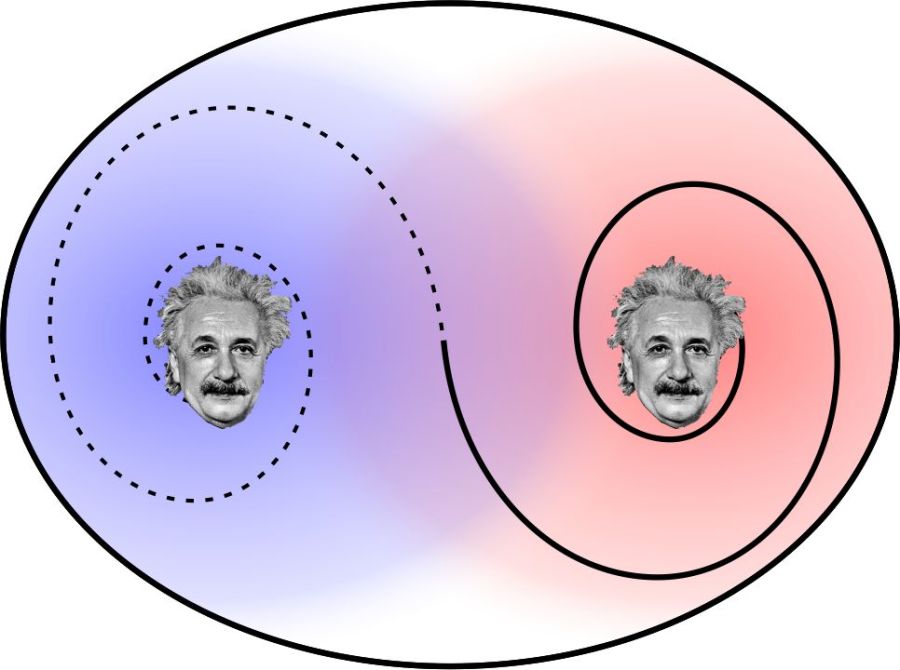
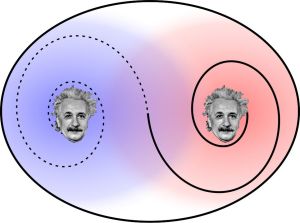 Information transfer at infinite speed? Of course not, because neither hungry person knows what’s in either box until they open one or until they exchange information. Even Skype operates at light-speed (or slower).




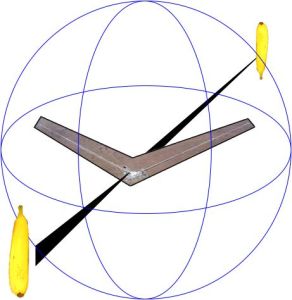 The second question is harder. The best the aLIGO team could do was point to a “banana-shaped region” (their words, not mine) that covers about 1% of the sky. The team marshaled a world-wide collaboration of observatories to scan that area (a huge search field by astronomical standards), looking for electromagnetic activities concurrent with the event they’d seen. Nobody saw any. That was part of the evidence that this collision involved two black holes. (If one or both of the objects had been something other than a black hole, the collision would have given off all kinds of photons.)
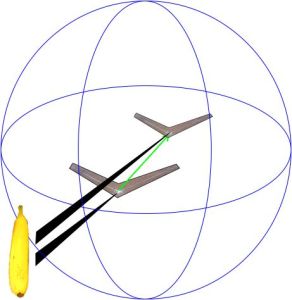 In contrast, a LIGO facility is (roughly speaking) omni-directional. When a LIGO installation senses a gravitational pulse, it could be coming down from the visible sky or up through the Earth from the other hemisphere — one signal doesn’t carry the “which way?” information. The diagram above shows that situation. (The “chevron” is an image of the LIGO in Hanford WA.) Models based on the signal from that pair of 4-km arms can narrow the source field to a “banana-shaped region,” but there’s still that 180o ambiguity.
 The great “if only” is that the VIRGO installation in Italy was not recording data when the Hanford WA and Livingston LA saw that September signal. With three recordings to reconcile, the aLIGO+VIRGO combination would have had enough information to slice that banana and localize the event precisely.

 We can investigate things that take longer than an instrument’s characteristic time by making repeated measurements, but we can’t use the instrument to resolve successive events that happen more quickly than that. We also can’t resolve events that take place much closer together than the instrument’s characteristic length.

 Almost a century later, James Clerk Maxwell (the bearded fellow at left) wrote down his electromagnetism equations that explain how light works. Half a century later, Einstein did the same for gravity.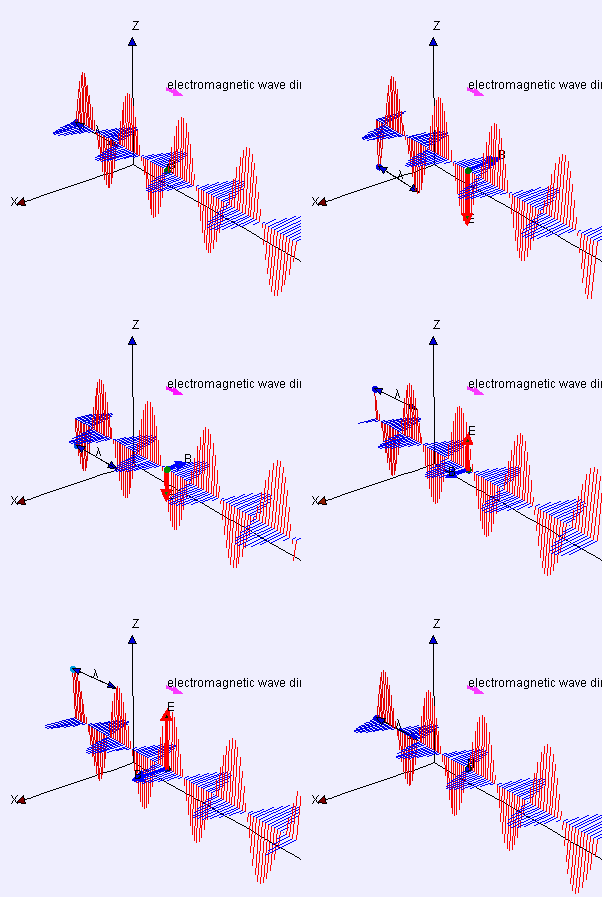
 Gravitodynamics is completely unlike electrodynamics. Gravity’s transverse “force” doesn’t act to move a whole mass up and down like Maxwell’s picture at left. Instead, as shown by Einstein’s picture, gravitational waves stretch and compress while leaving the center of mass in place. I put “force” in quotes because what’s being stretched and compressed is space itself. See
 The experiment consists of shooting laser beams out along both arms, then comparing the returned beams.

