A Million Times Weaker Than Moonlight

Big Vinnie’s getting downright antsy, which is something to behold. “C’mon, Sy. We get it that sonication ain’t sonification and molecules bumping into each other can carry a sound wave across space if the frequency’s low enough and that can maybe account for galaxies having spiral arms, but you said the Cosmic Hum is a sound, too. That’s a gravity thing, not molecules, right?”

“Not quite what I said, Vinnie. The Hum’s sound‑related, but it’s not ‘sound’ even by our extended definition.”

“Then what’s the connection?”

“Waves.”

“Not frames like always?”

“Not frames, for a change.”

“So it’s waves, but they go though empty space. Can’t happen like sound waves from molecules bumping into each other ’cause molecules are too small to have enough gravity do that when they’re so far apart. What’s carrying the waves?”

“Good question. Einstein figured out one answer. A whole cohort of mid‑20th‑century theoreticians came to a slightly different conclusion.”

“Okay, I’ll bite. What was Einstein’s answer?”

“Relativity, of course. Gravity’s the effect we see from mass deforming nearby space. Moving a mass drives corresponding changes in the shapes of space where it was and where it has moved to. The shape‑changes generate follow‑on gravitational effects that propagate outward over time. Einstein even showed that the gravitational propagation speed is equal to lightspeed.”

“Gimme a sec … Okay, that black hole collision signal LIGO picked up back in 2015, the holes lost a chunk of their combined mass all of a sudden. Quick drop in the gravity thereabouts. You’re saying it took time for the missing gravity strength to get noticed where we’re at. If I remember right, the LIGO people said the event was something like a billion lightyears away so that tells me it happened about a billion years ago and what the LIGO gadget picked up was space waves, right?”

“Right, but it wasn’t just the mass loss, it was the rapid and intense waggles in the gravitational field as those two enormous bodies, each 30 times as massive as the Sun, whirled around each other multiple times per second. The ever‑faster whirling shook the field with a frequency that swept upward to the ‘POP‘ when your mass‑loss happened. LIGO eventually picked up that signal. Einstein would say there’s no ‘action at a distance‘ in the collision‑LIGO interaction, because the objects acted on the gravitational field which acted on the LIGO system.”

“Like using a towel to pop someone in the locker room. The towel’s just transmi– ulp.”
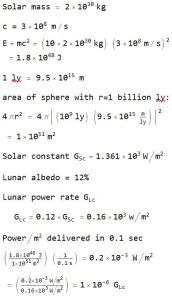
“An admission of guilt if I ever heard one. Yes, like that, except a towel pop carries all the initial energy to its final destination. Gravitational waves spread their energy across the surface of an expanding sphere. The energy per unit area goes down as the square of the distance.” <keying a calculation on Old Reliable> “Suppose the collision releases 10 solar masses worth of energy, we’re a billion lightyears away, and the ‘POP‘ signal is delivered in a tenth of a second. We’d see a signal power … about a millionth as strong as moonlight.”

“Not much there.”

“Right, which is why LIGO and its kin have been such pernickety instruments to build and run. LIGO’s sensors are mirrors roughly a meter across. You get a million times more power sensitivity if your detector’s diameter is a mile across. That was part of the NANOGrav team’s strategy, but they went much bigger.”

“Yeah, that’s the multi-telescope thing, so NANOGrav faked a receiver the size of the Earth, like the Event Horizon Telescope.”

“Much bigger. Their receiver is the entire Milky Way. Instead of LIGO’s mirrors, NANOGrav’s signal generators are neutron stars a dozen or more miles wide scattered across the galaxy.”

“Gotcha, Sy. Two ways. Neutron stars are billions heavier than a LIGO mirror so they’d be less power‑sensitive, not more. Then, power is about moving stuff closer or farther but if I got you right these space waves don’t really do that anyway, right?”

“Right and right, Vinnie, but not relevant. What NANOGrav’s been watching for is pulsar beams being twitched by a gravitational wave. A waltzing black hole pair should generate years‑long or decades‑long wavelengths. NANOGrav may have found one.”

~~ Rich Olcott
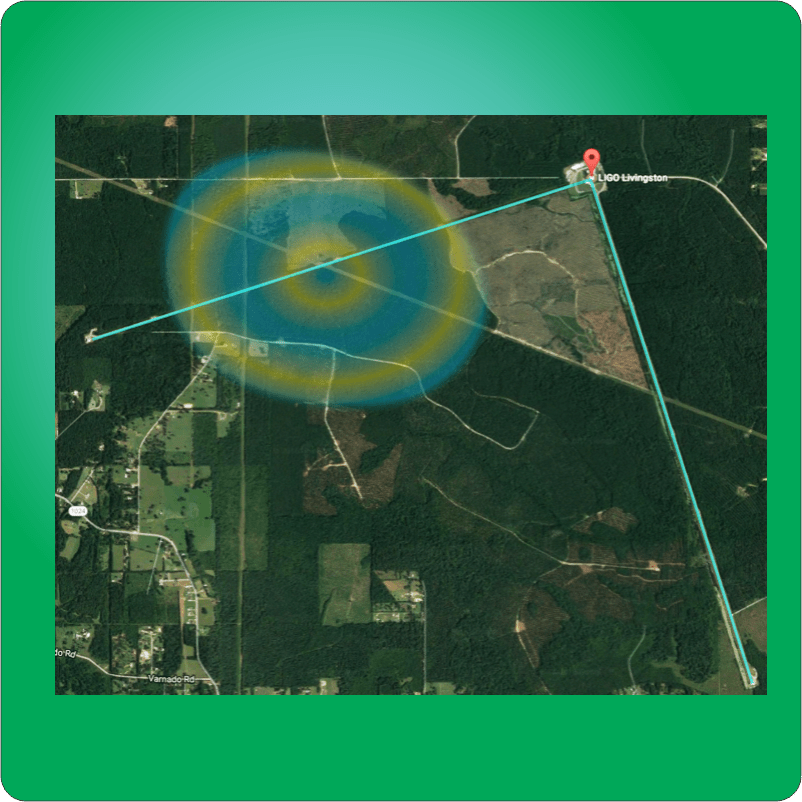

LIGO And NANOGrav

Afternoon coffee time, but Al’s place is a little noisier than usual. “Hey, Sy, come here and settle this.”

“Settle what, Al? Hi, Vinnie.”

<waves magazine> “This NANOGrav thing, they claim it’s a brand‑new kind of gravity wave. What’s that about?”

“Does it really say, ‘gravity wave‘? Let me see that. … <sigh> Press release journalism at its finest. ‘Gravity waves’ and ‘gravitational waves’ are two entirely different things.”

“I kinda remember you wrote about that, but it was so long ago I forget how they’re different.”

“Gravity waves happen in a fluid, like air or the ocean. Some disturbance, like a heat spike or an underwater landslide, pushes part of the fluid upward relative to a center of gravity. Gravity acts to pull that part down again but in the meantime the fluid’s own internal forces spread the initial up‑shift outwards. Adjacent fluid segments pull each other up and down and that’s a gravity wave. The whole process keeps going until friction dissipates the energy.”

“Gravitational waves don’t do that?”

“No, because gravitational waves temporarily modify the shape of space itself. The center doesn’t go up and down, it…” <showing a file on Old Reliable> “Here, see for yourself what happens. It’s called quadrupolar distortion. Mind you, the effects are tiny percentagewise which is why the LIGO apparatus had to be built kilometer‑scale in order to measure sub‑femtometer variations. The LIGO engineers took serious precautions to prevent gravity waves from masquerading as gravitational waves.”

“Alright, so now we’ve almost got used to LIGO machines catching these waves from colliding black holes and such. How are NANOGrav waves different?”

“Is infrared light different from visible light?”

“The Hubble sees visible but the Webb sees infrared.”

“Figures you’d have that cold, Al. What I think Sy’s getting at is they’re both electromagnetic even though we only see one of them. You’re gonna say the same for these new gravitational waves, right, Sy?”

“Got it in one, Vinnie. There’s only one electromagnetic field in the Universe but lots of waves running through it. Visible light is about moving charge between energy levels in atoms or molecules which is how the visual proteins in our eyes pick it up. Infrared can’t excite electrons. It can only waggle molecule parts which is why we feel it as heat. Same way, there’s only one gravitational field but lots of waves running through it. The LIGO devices are tuned to pick up drastic changes like the <ahem> massive energy release from a black hole collision.”

“You said ‘tuned‘. Gravitational waves got frequencies?”

“Sure. And just like light, high frequencies reflect high‑energy processes. LIGO detects waves in the kilohertz range, thousands of peaks per second. NANOGrav’s detection range is sub‑nanohertz, where one cycle can take years to complete. Amazingly low energy.”

“How can they detect anything that slow?”

“With really good clocks and a great deal of patience. The new reports are based on fifteen years of data, half a billion seconds counted out in nanoseconds.”

“Hey, wait a minute. LIGO’s only half‑a‑dozen years old. Where’d they get the extra data from, the future?”

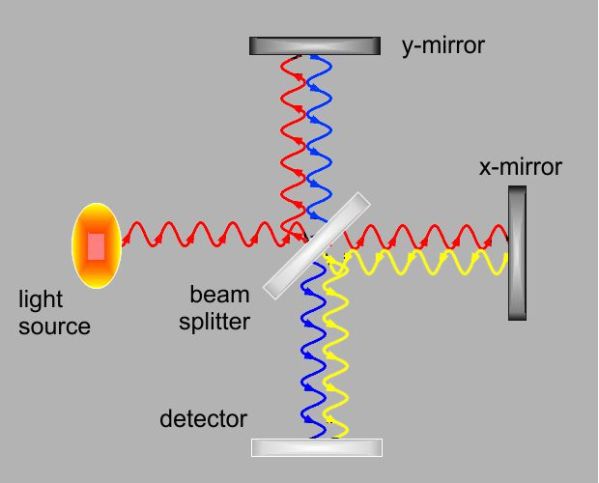
“Of course not. Do you remember us working out how LIGO works? The center sends out a laser pulse along two perpendicular arms, then compares the two travel times when the pulse is reflected back. Light’s distance‑per‑time is constant, right? When a passing gravitational wave squeezes space along one arm, the pulse in that arm completes its round trip faster. The two times don’t match any more and everyone gets excited.”

“Sounds familiar.”

“Good. NANOGrav also uses a timing‑based strategy, but it depends on pulsars instead of lasers. Before you ask, a pulsar is a rotating neutron star that blasts a beam of electromagnetic radiation. What makes it a pulsar is that the beam points away from the rotation axis. We only catch a pulse when the beam points straight at us like a lighthouse or airport beacon. Radio and X‑ray observatories have been watching these beasts for half a century but it’s only in the past 15 years that our clocks have gotten good enough to register timing hiccups when a gravitational wave passes between us and a pulsar.”

~ Rich Olcott

A Three-dog Night Would Be So Cool

“So we’ve got three fundamentally different messengers from the stars, Mr Feder.  The past couple of years have given us several encouraging instances of receiving two messengers from the same event.  If we ever receive all three messengers from the same event, that might give us what we need to solve the biggest problem in modern physics.”

“That’s a pretty deep statement, Moire.  Care to unpack it?  The geese here would love to hear about it.”

“Lakeside is a good place for thoughts like this.  The first messenger was photons.  We’ve been observing starlight photons for tens of thousand of years.  Tycho Brahe and Galileo took it to a new level a few centuries ago with their careful observation, precision measurements and Galileo’s telescope.”

“That’s done us pretty good, huh?”

“Oh sure, we’ve charted the heavens and how things move, what we can see of them.  But our charts imply there’s much we can’t see.  Photons only interact with electric charge.  Except for flat-out getting absorbed if the wavelength is right, photons don’t care about electrically neutral material and especially they don’t care about dark matter.”

“So that’s why we’re interested in the other messengers.”

“Exactly.  Even electrically neutral things have mass and interact with the gravitational field.  You remember the big news a few years ago, when our brand-new LIGO instruments caught a gravitational wave signal from a couple of black holes in collision.  Black holes don’t give off photons, so the gravitational wave messenger was our only way of learning about that event.”

“No lightwave signal at all?”

“Well, there was a report of a possible gamma-ray flare in that patch of sky, but it was borderline-detectable.  No observatory using lower-energy light saw anything there.  So, no.”

“You’re gonna tell me and the geese about some two-messenger event now, right?”

“That’s where I’m going, Mr Feder.  Photons first.  Astronomers have been wondering for decades about where short, high-energy gamma-ray bursts come from.  They seem to happen randomly in time and space.  About a year ago the Fermi satellite’s gamma-ray telescope detected one of those bursts and sent out an automated ‘Look HERE’ alert to other observatories.  Unfortunately, Fermi‘s resolution isn’t wonderful so its email pointed to a pretty large patch of sky.  Meanwhile back on Earth and within a couple of seconds of Fermi‘s moment, the LIGO instruments caught an unusual gravitational wave signal that ran about a hundred times slower than the black-hole signals they’d seen.  Another automated ‘Look HERE’ alert went out.  This one pointed to a small portion of that same patch of sky.  Two messengers.”

“Did anyone find anything?”

“Seventy other observatories scrutinized the overlap region at every wavelength known to Man.  They found a kilonova, an explosion of light and matter a thousand times brighter than typical novae.  The gravitational wave evidence indicated a collision between two neutron stars, something that had never before been recorded.  Photon evidence from the spewed-out cloud identified a dozen heavy elements theoreticians hadn’t been able to track to an origin.  Timing details in the signals gave cosmologists an independent path to resolving a problem with the Hubble Constant.  And now we know where those short gamma-ray bursts come from.”

“Pretty good for a two-messenger event.  Got another story like that?”

“A good one.  This one’s neutrinos and photons, and the neutrinos came in first.  One neutrino.”

One neutrino?”

“Yup, but it was a special one, a super-high-powered neutrino whose incoming path our IceCube observatory could get a good fix on.  IceCube sent out its own automated ‘Look HERE’ alert.  The Fermi team picked up the alert and got real excited because the alert’s coordinates matched the location of a known and studied gamma-ray source.  Not a short-burster, but a flaring blazar.  That neutrino’s extreme energy is evidence for blazars being one of the long-sought sources of cosmic rays.”

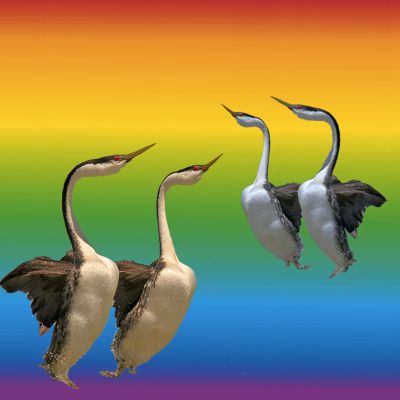
“Puzzle solved, maybe.  Now what you said about a three-messenger signal?”grebe messenger pairs“Gravitational waves are relativity effects and neutrinos are quantum mechanical.  Physicists have been struggling for a century to bridge those two domains.  Evidence from a three-messenger event could provide the final clues.”
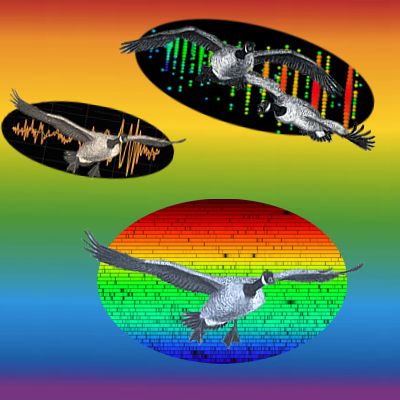
“I’ll bet the geese enjoyed hearing all that.”

“They’re grebes, Mr Feder.”

~~ Rich Olcott

Heavenly Messengers

A gorgeous Fall day, a little bit cool-ish, perfect for a brisk walk in the park.  I’m striding along the lake-bound path when there’s a breathless shout behind me.  “Hey, Moire, wait up!  I got questions!”

“Hello, Mr Feder.  What’s the topic this time?  And keep up, please, I’ve got geese to watch.”

“I been reading in the business pages <puff, puff> about all the money different countries are putting into ‘multi-messenger astronomy.’  <puff>  What’s that about, anyway?  Who’s sending messages and ain’t the Internet good enough?”

“It’s not who, Mr Feder, it’s what — stars, galaxies, black holes, the Universe.  And the messages are generally either ‘Here I am‘ or ‘Something interesting just happened‘.  The Internet just doesn’t reach that far and besides, no kitten pictures.”

“Pretty simple-sounding messages, so why the big bucks for extra message-catchers?”

“Fair question.  It has to do with what kind of information each messenger carries.  Photons, for instance.”

“Yeah, light-waves, the rainbow.”

“Way more than the rainbow.  Equating light-waves to just the colors we see is like equating sound-waves to just the range from A4 through F4# on a piano.”

“Hey, that’s less than an octave.”

“Yup, and electromagnetism’s scale is hugely broader than that.  Most of the notes, or colors, are way out of our range.  A big tuba makes a deep, low-frequency note but a tiny piccolo makes a high note.  Photon characteristics also scale with the size of where they came from.  Roughly speaking, the shorter the light’s wave-length, the smaller the process it came out of and the smaller its target will be.  Visible light, for instance, is sent and received by loosely-held charge sloshing inside an atom or molecule.  Charge held tight to a nucleus gives rise to higher-energy photons, in the ultra-violet range or beyond.”

“Like how beyond?”

“X-rays can rip electrons right out of a molecule.  Gamma rays are even nastier and involve charge activity inside a nucleus, like during a nuclear reaction.”

“How about in the other direction?  Nothing?”

“Hardly.  Going that way is going to bigger scales.  Infra-red is about parts of molecules vibrating against each other, microwave is about whole molecules rotating.  When your size range gets out to feet-to-miles you’re looking at radio waves that probably originated from free electrons or ions slammed back and forth by electric or magnetic fields.”

“So these light ranges are like messengers that clue us in on what’s going on out there?  Different messengers, different kindsa clues?”

“You got the idea.  Add in that what happens to the light on the way here is also important.  Radio and microwave photons with their long wavelengths swerve around dust particles that block out shorter-wavelength ones.  Light that traversed Einstein-bent space lets us measure the masses of galaxies.  Absorption and polarization at specific wavelengths tell us what species are out there and what they’re doing.  Blue-shifts and red-shifts tell us how fast things are moving towards and away from us.  And of course, atmospheric distortions tell us we’ve got to put satellite observatories above the atmosphere to see better.”

“One messenger, lots of effects.”

“Indeed, but in the past few years we’ve added two more, really important messengers.  Photons are good, but they’re limited to just one of the four fundamental forces.”

“Hey, there’s gotta be more than that.  This is a complicated world.”

“True, but physicists can account for pretty much everything at the physical and chemical level with only four — electromagnetism, gravity, the strong force that holds nuclei together and the weak force that’s active in nuclear transformation processes.  Photons do electromagnetism and that’s all.”

“So you’re saying we’ve got a line on two of the others?”

“Exactly.  IceCube and its kin record the arrival of high-energy neutrinos.  In a sense they are to the weak force what photons are to electromagnetism.  We don’t know whether gravitation works through particles, but LIGO and company are sensitive to changes in the gravitational field that’s always with us.  Each gives us a new perspective on what’s happening out there.”

“So if you get a signal from one of the new messengers at the same time you get a photon signal…”

“Oh, look, the geese are coming in.”

Heavenly messengers

~~ Rich Olcott

Schrödinger’s Elephant

Al’s coffee shop sits right between the Astronomy and Physics buildings, which is good because he’s a big Science fan.  He and Jeremy are in an excited discussion when Anne and I walk in.  “Two croissants, Al, and two coffees, black.”

“Comin’ up, Sy.  Hey, you see the news?  Big days for gravitational astronomy.”

Jeremy breaks in.  “There’s a Nobel Prize been announced —”

“Kip Thorne the theorist and Barry Barish the management guy —”

“and Rainer Weiss the instrumentation wizard —”

“shared the Physics prize for getting LIGO to work —”

“and it saw the first signal of a black hole collision in 2015 —”

“and two more since —”

“and confirmed more predictions from relativity theory —”

“and Italy’s got their Virgo gravitational wave detector up and running —”

“And Virgo and our two LIGOs, —”

“Well, they’re both aLIGOs now, being upgraded and all —”

“all three saw the same new wave —”

“and it’s another collision between black holes with weird masses that we can’t account for.  Who’s the lady?”

“Al, this is Anne.  Jeremy, close your mouth, you’ll catch a fly.”  (Jeremy blushes, Anne twinkles.)  “Anne and I are chasing an elephant.”

“Pleased to meetcha, Anne.  But no livestock in here, Sy, the Health Department would throw a fit!”

I grin.  “That’s exactly what Eddie said.  It’s an abstract elephant, Al.  We’ve been discussing entropy. Which is an elephant because it’s got so many aspects no-one can agree on what it is.  It’s got something to do with heat capacity, something to do with possibilities you can’t rule out, something to do with signals and information.  And Hawking showed that entropy also has something to do with black holes.”

“Which I don’t know much about, fellows, so someone will have to explain.”

Jeremy leaps in.  “I can help with that, Miss Anne, I just wrote a paper on them.”

“Just give us the short version, son, she can ask questions if she wants a detail.”

“Yessir.  OK, suppose you took all the Sun’s mass and squeezed it into a ball just a few miles across.  Its density would be so high that escape velocity is faster than the speed of light so an outbound photon just falls back inward and that’s why it’s black.  Is that a good summary, Mr Moire?”

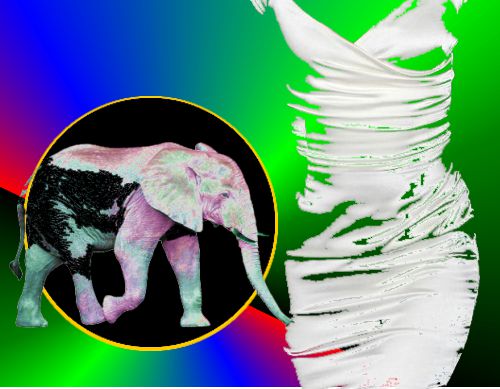
“Well, it might be good enough for an Internet blog but it wouldn’t pass inspection for a respectable science journal.  Photons don’t have mass so the whole notion of escape velocity doesn’t apply.  You do have some essential elements right, though.  Black holes are regions of extreme mass density, we think more dense than anywhere else in the Universe.  A black hole’s mass bends space so tightly around itself that nearby light waves are forced to orbit its region or even spiral inward.  The orbiting happens right at the black hole’s event horizon, its thin shell that encloses the space where things get really weird.  And Anne, the elephant stands on that shell.”white satin and black hole“Wait, Mr Moire, we said that the event horizon’s just a mathematical construct, not something I could stand on.”
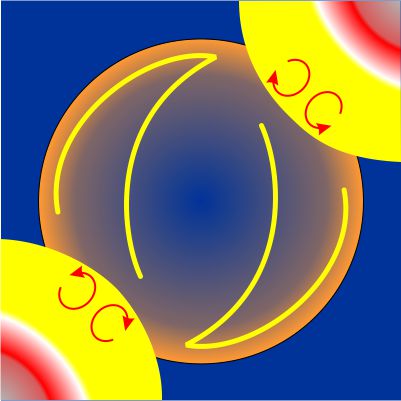
“And that’s true, Jeremy.  But the elephant’s an abstract construct, too.  So abstract we’re still trying to figure out what’s under the abstraction.”

“I’m trying to figure out why you said the elephant’s standing there.”

“Anne, it goes back to the event horizon’s being a mathematical object, not a real one.  Its spherical surface marks the boundary of the ultimate terra incognita.  Lightwaves can’t pass outward from it, nor can anything material, not even any kind of a signal.  For at least some kinds of black hole, physicists have proven that the only things we can know about one are its mass, spin and charge.  From those we can calculate some other things like its temperature, but black holes are actually pretty simple.”

“So?”

“So there’s a collision with Quantum Theory.  One of QT’s fundamental assumptions is that in principle we can use a particle’s current wave function to predict probabilities for its future.  But the wave function information disappears if the particle encounters an event horizon.  Things are even worse if the particle’s entangled with another one.”

“Information, entropy, elephant … it’s starting to come together.”

“That’s what he said.”

~~ Rich Olcott

Gozer, The Stay Puft Black Hole

We’re downstairs at Eddie’s Pizza.  Vinnie orders his usual pepperoni.  In memory of Sam Panapoulos, I order a Hawaiian.  Then we’re back to talking black holes.

“I been thinking, Sy.  These regular-size black holes, the ones close to the Sun’s mass, we got a lot of ’em?”

“I’ve seen an estimate of 50,000 in the Milky Way Galaxy so you could say they’re common.  That’s one way to look at it.  The other way is to compare 50,000 with the 250 billion stars in the galaxy.  One out of 5,000,000 is a black hole, so they’re rare.  Your choice, Vinnie.”

“But all three confirmed LIGO signals were the next bigger size range, maybe 10 to 30 solar masses; two of ’em hittin’ each other and they’ve all been more than a billion lightyears away.  How come LIGO doesn’t see the little guys that are close to us?”

“Darn good question.  Lessee… OK, I’ve got several possibilities.  Maybe the close-in little guys do collide, but the signal’s too weak for us to detect.  But we can put numbers to that.  In each LIGO event we’ve seen, the collision released about 10% of their 40-to-60-Sun total mass-energy in the form of gravitational waves.  LIGO’s just barely able to detect that, right?”

“They were excited they could, yeah.”

“So if a pair of little-guy black holes collided they’d release about 10% of two makes 0.2 solar masses worth of energy.  That’d be way below our detection threshold if the collision is a billion light-years away.  But we’re asking about collisions inside the Milky Way.  Suppose the collision happened near the center, about 26,000 lightyears from us.  Signal strength grows as the square of how close the source is, so multiply that ‘too weak to detect’ wave by (1 billion/26000)² =15×1012, fifteen quadrillion.  LIGO’d be deafened by a signal that strong.”

“But LIGO’s OK, so we can rule that out.  Next guess.”

“Maybe the signal’s coming in at the wrong frequency.  The equations say that just before a big-guy collision the two objects circle each other hundreds of times a second.  That frequency is in the lower portion of the 20-20,000 cycles-per-second human audio range.  LIGO’s instrumentation was tuned to pick up gravitational waves between 30 and 7,000.  Sure enough, LIGO recorded chirps that were heard around the world.”

“So what frequency should LIGO be tuned to to pick up little-guy collisions?”

“We can put numbers to that, too.  Physics says that at a given orbit radius, revolution frequency varies inversely with the square root of the mass.   The big-guy collisions generated chirps between 100 and 400 cps.  Little guy frequencies would be f2/f50=√(50/2)=5 times higher, between 500 and 2000 cps.  Well within LIGO’s range.”

“We don’t hear those tweets so that idea’s out, too.  What’s your third try?”

“Actually I like this one best.  Maybe the little guys just don’t collide.”

“Why would you like that one?”

“Because maybe it’s telling us something.  It could be that they don’t collide simply because they’re surrounded by so many other stars that they never meet up.  But it also could be that binary black holes, the ones that are fated to collide with each other, are the only ones that can grow beyond 10 solar masses.  And I’ve got a guess about how that could happen.”

“Alright, give.”

“Let’s start with how to grow a big guy.  Upstairs we talked about making little guys.  When a star’s core uses up one fuel, like hydrogen, there’s an explosive collapse that sets off a hotter fuel, like helium, until you get to iron which doesn’t play.  At each step, unburnt fuel outside the core gets blown away.  If the final core’s mass is greater than about three times the Sun’s you wind up with a black hole.  But how about if you don’t run out of fuel?”

“How can that happen?  The star’s got what it’s got.”Binary protoBHs

“Not if it’s got close neighbors that also expel unburnt fuel in their own burn-collapse cycles.  Grab their cast-off fuel and your core can get heavier before you do your next collapse.  Not impossible in a binary or cluster where all the stars are roughly the same age.  Visualize kids tossing marshmallows into each other’s mouths.”

“Or paying for each other’s pizzas.  And it’s your turn.”

~~ Rich Olcott

Prelude to A Waltz

An excited knock, but one I recognize.  In comes Vinnie, waving his fresh copy of The New York Times.

LIGO‘s done it again!  They’ve seen another black hole collision!”

“Yeah, Vinnie, I’ve read the Abbott-and-a-thousand paper.  Three catastrophic collisions detected in less than two years.  The Universe is starting to look like a pretty busy place, isn’t it?”

“And they all involve really big black holes — 15, 20, even 30 times heavier than the Sun.  Didn’t you once say black holes that size couldn’t exist?”

“Well, apparently they do.  Of course the physicists are busily theorizing how that can happen.  What do you know about how stars work, Vinnie?”

“They get energy from fusing hydrogen atoms to make helium atoms.”

“So far, so good, but then what happens when the hydrogen’s used up?”

“They go out, I guess.”

“Oh, it’s a lot more exciting than that. Does the fusion reaction happen everywhere in the star?”

“I woulda said, ‘Yes,’ but since you’re asking I’ll bet the answer is,  ‘No.'”

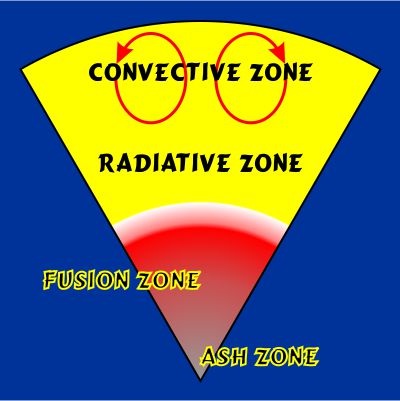
“Properly suspicious, and you’re right.  It takes a lot of heat and pressure to force a couple of positive nuclei close enough to fuse together despite charge repulsion.  Pressures near the outer layers are way too low for that.  For our Sun, for instance, you need to be 70% of the way to the center before fusion really kicks in.  So you’ve got radiation pressure from the fusion pushing everything outward and gravity pulling everything toward the center.  But what’s down there?  Here’s a hint — hydrogen’s atomic weight is 1, helium’s is 4.”

“You’re telling me that the heavier atoms sink to the center?”

“I am.”

“So the center builds up a lot of helium.  Oh, wait, helium atoms got two protons in there so it’s got to be harder to mash them together than mashing hydrogens, right?”Star zones
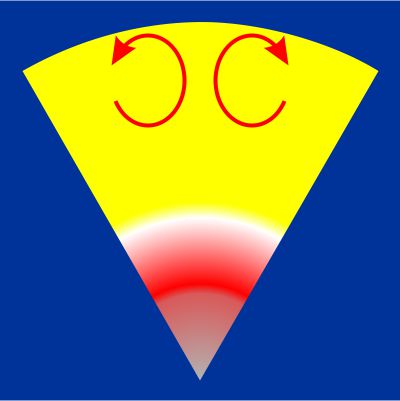
“And that’s why that region’s marked ash zone in this sketch.  Wherever conditions are right for hydrogen fusion, helium’s basically inert.  Like ash in a campfire it just sinks out of the way.  Now the fire goes out.  What would you expect next?”

“Radiation pressure’s gone but gravity’s still there … everything must slam inwards.”

Slam is an excellent word choice, even though the star’s radius is measured in thousands of miles.  What’s the slam going to do to the helium atoms?”

“Is it strong enough to start helium fusion?”

“That’s where I’m going.  The star starts fusing helium at its core.  That’s a much hotter reaction than hydrogen’s.  When convective zone hydrogen that’s still falling inward meets fresh outbound radiation pressure, most of the hydrogen gets blasted away.”

“Fusing helium – that’s a new one on me.  What’s that make?”

“Carbon and oxygen, mostly.  They’re as inert during the helium-fusion phase as helium was when hydrogen was doing its thing.”

“So will the star do another nova cycle?”

“Maybe.  Depends on the core’s mass.  Its gravity may not be intense enough to fuse helium’s ashes.  In that case you wind up with a white dwarf, which just sits there cooling off for billions of years.  That’s what the Sun will do.”

“But suppose the star’s heavy enough to burn those ashes…”

“The core’s fresh light-up blows away infalling convective zone material.  The core makes even heavier atoms.  Given enough fuel, the sequence repeats, cycling faster and faster until it gets to iron.  At each stage the star has less mass than before its explosion but the residual core is more dense and its gravity field is more intense.  The process may stop at a neutron star, but if there was enough fuel to start with, you get a black hole.”

“That’s the theory that accounts for the Sun-size black holes?”

“Pretty much.  I’ve left out lots of details, of course.  But it doesn’t account for black holes the size of 30 Suns — really big stars go supernova and throw away so much of their mass they miss the black-hole sweet spot and terminate as a neutron star or white dwarf.  That’s where the new LIGO observation comes in.  It may have clued us in on how those big guys happen.”

“That sketch looks like a pizza slice.”

“You’re thinking dinner, right?”

“Yeah, and it’s your turn to buy.”

~~ Rich Olcott

Gravity’s Real Rainbow

Some people are born to scones, some have scones thrust upon them.  As I stepped into his coffee shop this morning, Al was loading a fresh batch onto the rack.  “Hey, Sy, try one of these.”

“Uhh … not really my taste.  You got any cinnamon ones ready?”

“Not much for cheddar-habañero, huh?  I’m doing them for the hipster trade,” waving towards all the fedoras on the room.  “Here ya go.  Oh, Vinnie’s waiting for you.”

I navigated to the table bearing a pile of crumpled yellow paper, pulled up a chair.  “Morning, Vinnie, how’s the yellow writing tablet working out for you?”

“Better’n the paper napkins, but it’s nearly used up.”

“What problem are you working on now?”

“OK, I’m still on LIGO and still on that energy question I posed way back — how do I figure the energy of a photon when a gravitational wave hits it in a LIGO?  You had me flying that space shuttle to explain frames and such, but kept putting off photons.”

“Can’t argue with that, Vinnie, but there’s a reason.  Photons are different from atoms and such because they’ve got zero mass.  Not just nearly massless like neutrinos, but exactly zero.  So — do you remember Newton’s formula for momentum?”

“Yeah, momentum is mass times the velocity.”

“Right, so what’s the momentum of a photon?”

“Uhh, zero times speed-of-light.  But that’s still zero.”

“Yup.  But there’s lots of experimental data to show that photons do carry non-zero momentum.  Among other things, light shining on an an electrode in a vacuum tube knocks electrons out of it and lets an electric current flow through the tube.  Compton got his Nobel prize for that 1923 demonstration of the photoelectric effect, and Einstein got his for explaining it.”

“So then where’s the momentum come from and how do you figure it?”

“Where it comes from is a long heavy-math story, but calculating it is simple.  Remember those Greek letters for calculating waves?”

(starts a fresh sheet of note paper) “Uhh… this (writes λ) is lambda is wavelength and this (writes ν) is nu is cycles per second.”

“Vinnie, you never cease to impress.  OK, a photon’s momentum is proportional to its frequency.  Here’s the formula: p=h·ν/c.  If we plug in the E=h·ν equation we played with last week we get another equation for momentum, this one with no Greek in it:  p=E/c.  Would you suppose that E represents total energy, kinetic energy or potential energy?”

“Momentum’s all about movement, right, so I vote for kinetic energy.”

“Bingo.  How about gravity?”

“That’s potential energy ’cause it depends on where you’re comparing it to.”

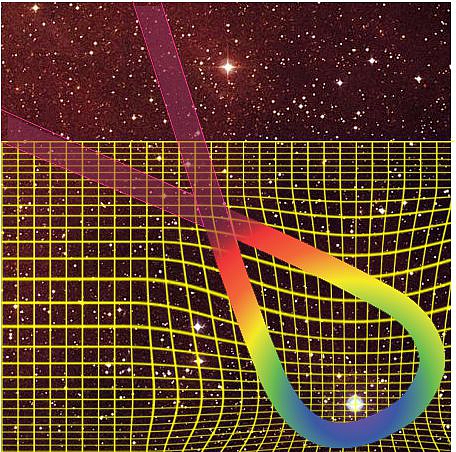
light-in-a-gravity-well“OK, back when we started this whole conversation you began by telling me how you trade off gravitational potential energy for increased kinetic energy when you dive your airplane.  Walk us through how that’d work for a photon, OK?  Start with the photon’s inertial frame.”

“That’s easy.  The photon’s feeling no forces, not even gravitational, ’cause it’s just following the curves in space, right, so there’s no change in momentum so its kinetic energy is constant.  Your equation there says that it won’t see a change in frequency.  Wavelength, either, from the λ=c/ν equation ’cause in its frame there’s no space compression so the speed of light’s always the same.”

“Bravo!  Now, for our Earth-bound inertial frame…?”

“Lessee… OK, we see the photon dropping into a gravity well so it’s got to be losing gravitational potential energy.  That means its kinetic energy has to increase ’cause it’s not giving up energy to anything else.  Only way it can do that is to increase its momentum.  Your equation there says that means its frequency will increase.  Umm, or the local speed of light gets squinched which means the wavelength gets shorter.  Or both.  Anyway, that means we see the light get bluer?”

“Vinnie, we’ll make a physicist of you yet.  You’re absolutely right — looking from the outside at that beam of photons encountering a more intense gravity field we’d see a gravitational blue-shift.  When they leave the field, it’s a red-shift.”

“Keeping track of frames does make a difference.”

Al yelled over, “Like using tablet paper instead of paper napkins.”

~~ Rich Olcott

LIGO and lambda and photons, oh my!

I was walking my daily constitutional when Al waved me into his coffee shop.  “Sy, he’s at it again with the paper napkins.  Do something!”

I looked over.  There was Vinnie at his table, barricaded behind a pile of crumpled-up paper.  I grabbed a chair.

“Morning, Vinnie.  Having fun?”

“Greek letters.  Why’d they have to use Greek letters?”

The question was both rhetorical and derivative so I ignored it.  There were opened books under the barricade — upper-level physics texts.  “How come you’re chasing through those books?”

“I wanted to follow up on how LIGO operates with photons after we talked about all that space shuttle stuff.  But geez, Sy!”

“You’re a brave man, Vinnie.  So,  which letters are giving you trouble?”

“These two, that look kinda like each other upside down.” He pointed to one equation, λ=c.

“Ah, wavelength equals the speed of light divided by the frequency.”

“How do you do that?”

“Some of those symbols go way back.  You just get used to them.  Most of them make sense when you learn the names for the letters — lambda (λ) is the peak-to-peak length of a lightwave, and nu (ν) is the number of peaks per second.  If it makes you feel any better, I’ve yet to meet a physicist who can write a zeta (ζ) — they generally just draw a squiggle and move on.”

“And there’s this other equation,” pointing to E=h·ν.  “What’s that about?”

“Good eye.  You just picked two equations that are fundamental to LIGO’s operation.  If a lightwave has frequency ν, the equations tell us two things about it — its energy is h·ν (h is Planck’s constant, 6.6×10⁻³⁴ Joule-seconds), and its wavelength is c (c is the speed of light).  For instance, yellow light has a frequency near 520×1012/sec.  One photon carries 3.8×10-40 Joules of energy.  Not much, but it adds up when a light beam contains lots of photons.  The same photon has a wavelength near 580×10-9 meters traveling through free space.”

“So what happens when one of those photons is in a LIGO beam?  Won’t a gravitational wave’s stretch-and-squeeze action mess up its wave?”

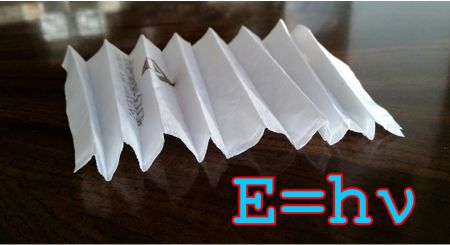
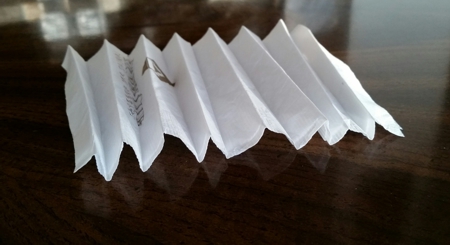
paper-napkin-waveI smoothed out one of Vinnie’s crumpled napkins. As I folded it into pleats and scooted it along the table I said, “Doesn’t mess up the wave so much as change the way we think about it.  We’re used to graphing out a spatial wave as an up-and-down pattern like this that moves through time, right?”
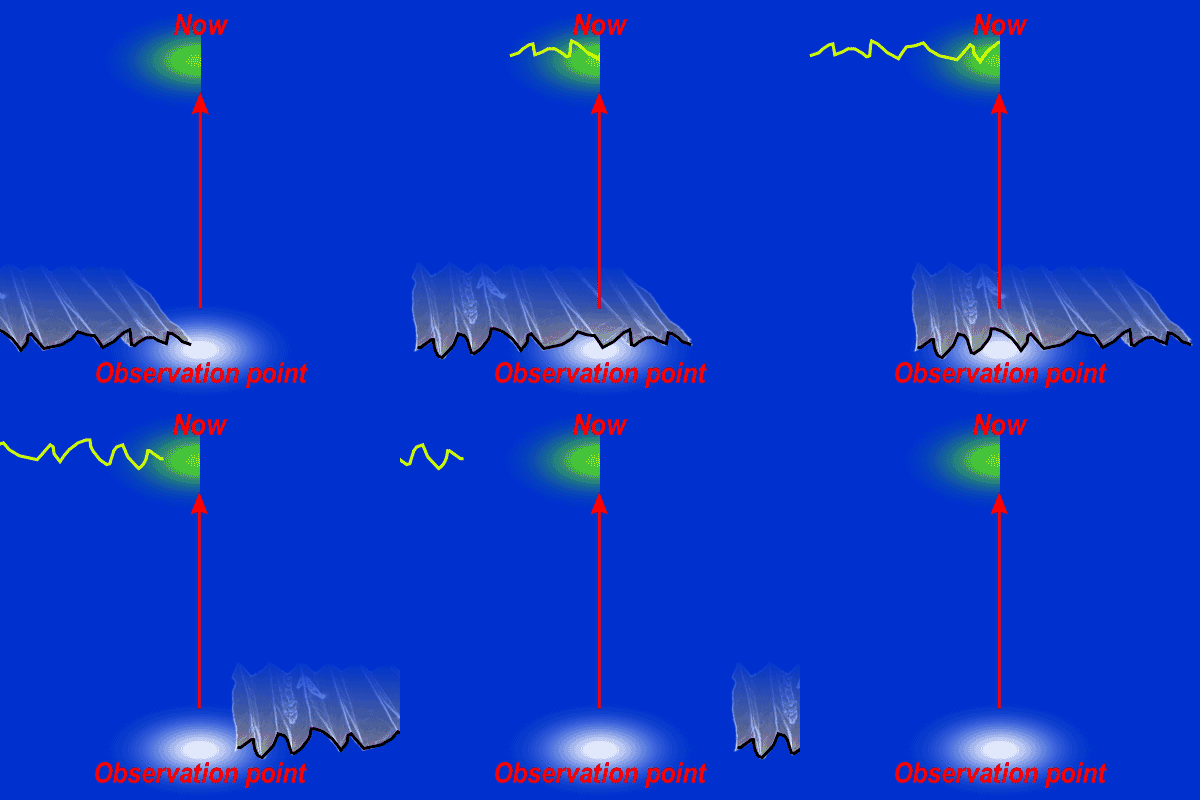
“That’s a lousy-looking wave.”

time-and-space-and-napkin
As the napkin moves through space,
the upper graph shows the height of its edge
above the observation point.

“It’s a paper napkin, f’pitysake, and I’m making a point here. Watch close.  If you monitor a particular point along the wave’s path in space and track how that point moves in time, you get the same profile except we draw it along the t-axis instead of along a space-axis.  See?”

“Hey, the time profile is the space profile going backwards.  Oh, right, it’s goin’ into the past ’cause it’s a memory.”

“That’s one of those things that people miss.  If you only draw sine waves, they’re the same in either direction.  The important point is that although timewaves and spacewaves have the same shape, they’ve got different meanings.  The timewave is directly connected to the wave’s energy by that E equation.  The spacewave is indirectly connected, because your other equation there scales it by the local speed of light.”

“Come again?  Local speed of light?  I thought it was 186,000 miles per second everywhere.”

“It is, but some of those miles are shorter than others.  Near a heavy mass, for instance, or in the compression phase of a gravitational wave, or inside a transparent material.  If you’re traveling in the lightwave’s inertial frame, you see no variation.  But if you’re watching from an independent inertial frame, you see the lightwave hit a slow patch.  Distance per cycle gets shorter.  Like that lambda-nu equation says, when c gets smaller the wavelength decreases.”

Al walked over.  “Gotcha a present, Vinnie.  Here’s a pad of yellow writing paper.  No more napkins, OK?”

“Uhh, thanks.”

“Don’t mention it.”

~~ Rich Olcott

Scone but not forgotten

Al grabbed me as I stepped into his coffee shop.  “Sy, you gotta help me!”

“What’s the trouble, Al?”

“It’s Vinnie.  He’s over there, been scribbling on paper napkins all morning.  I’m running out of napkins, Sy!”

I grabbed a cinnamon scone from the rack and a chair at Vinnie’s table.  “What’s keeping you so busy, Vinnie?”  As if I didn’t know.

LIGO, of course.  Every time I think I understand how the machine works something else occurs to me and it slips outa my hands.”

“How about you explain it to me.  Sometimes the best way to find an answer is to describe the problem to someone else.”

Interferometer 1
Vinnie’s paper napkin

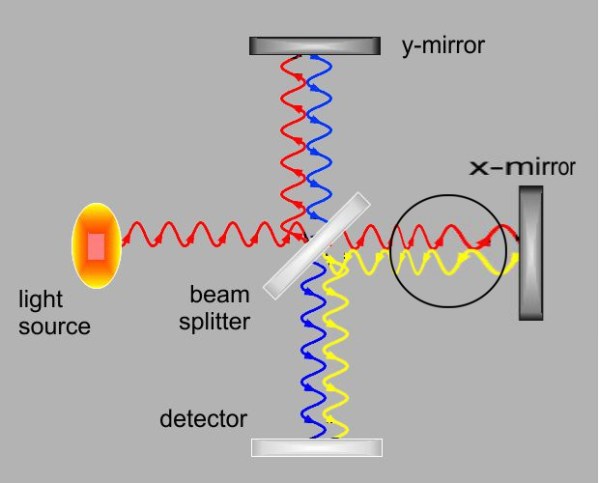
(grabbing a napkin near the bottom of one stack) “All right, Sy, I sketched the layout here.  You got these two big L-shaped machines out in the middle of two nowheres 2500 miles apart.  Each L is a pair of steel pipes 2½ miles long.  At the far end of each arm there’s a high-tech stabilized mirror.  Where the two arms meet there’s a laser rigged up to shoot beams down both arms.  There’s also a detector located where the reflected beams join up and cancel each other out unless there’s a gravity wave going past.  Am I good so far?”

“Yeah, that’s pretty much the diagram you see in the books, except it’s gravitational waveGravity waves are something else.”

interferometer-4
Paper napkin

“Whatever.  So, here’s a sketch of where I was at when I asked you that first question.  See, I copied my original sketch onto another napkin and stretched it a little where the black circle is to show what a gravitational wave would do in stretch phase.  Ignore the little rips.”

“What rips?”

“Uh, thanks.  Anyway, I was thinking the gravitational wave that stretches the x-beam would also stretch the x-pipe so they couldn’t use the light wave to measure the pipe it’s in.  But LIGO works so that’s wrong thinkin’.

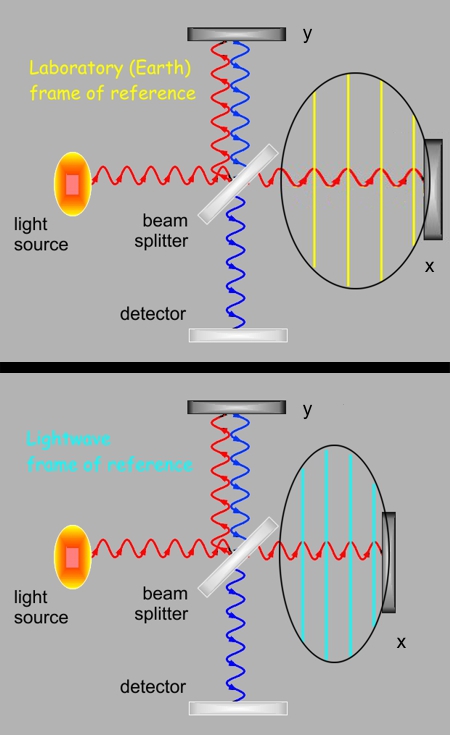
“OK, next is for after we talked about inertial frames.  Took me a few tries to get it like I want it and I wound up having to do two sketches, one for each frame.”  He grabbed a couple more napkins from different stacks.

interferometer-5lp
Paper napkins and

“I didn’t do the yellow wiggles ’cause that got confusing and besides I don’t do wiggly lines so good.  Point is, the space-stretch only shows up in the laboratory inertial frame.  The light waves move with space so they don’t notice the difference, right?”

“Well, I wouldn’t want to put it that way in court, Vinnie, but it’s a pretty good description.”

“So the light waves bop along at 186,000 miles per second in their frame, but from the machine’s perspective those are stretched miles so the guy running the machine thinks those photons are faster than the ones in the other pipe.  And that difference in speed gets the yellow lines out of phase with the blue ones and the detector rings a bell or something, right?”

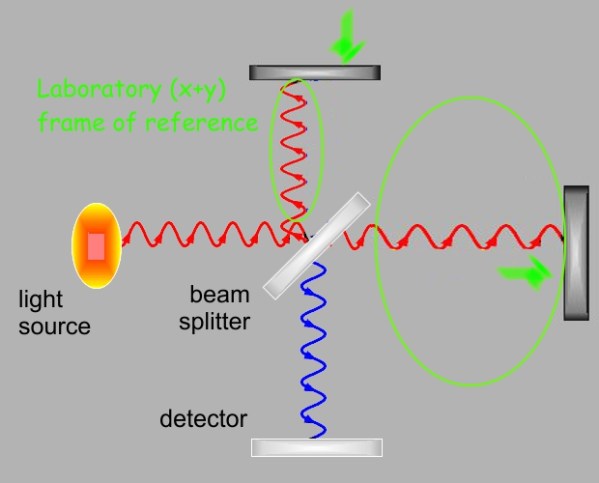
“It’s even better than that.” I reached for another napkin, caught Al’s eye on me and grabbed an envelope from my coat pocket instead. “Remember how a gravitational wave works in two directions perpendicular to the wave’s line of travel?”

interferometer-5d
On the back of an envelope

“Yeah, so?”

“So at the same moment that the wave is stretching space in the x-direction, it’s squeezing space in the y-direction.  LIGO’s detection scheme monitors the difference between the two returning beams.  As I’ve drawn it here using the detector’s inertial frame, the x-beam is going fast AND the y-beam is going slow so the detector sees twice the phase difference. A few milliseconds later they’ll switch because the x-direction will get squeezed while the y-direction gets stretched.  And yeah, a bell does ring but only after some computers munch on the data and subtract out environmental stuff like temperature swings and earthquakes and the janitor’s footsteps.”

“Uh-huh, I think I got it.” Turning in his chair, “Hey, Al, bring Sy here another scone, on me.  And put the one he’s got on my tab, too.”

“Thanks, Vinnie.”

“Don’t mention it.”

~~ Rich Olcott