A Spherical Bandstand

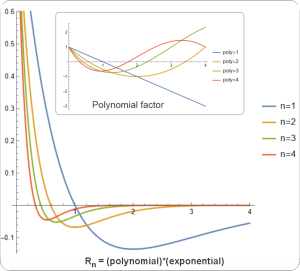
“Whoa, Sy, something’s not right. Your zonal harmonics — I can see how latitudes go from pole to pole and that’s all there are. Your sectorial harmonic longitudes start over when they get to 360°, fine. But this chart you showed us says that the radius basically disappears crazy close to zero. The radius should keep going forever, just like x, y and z do.”

“Ah, I see the confusion, Susan. The coordinate system and the harmonic systems and the waves are three different things, um, groups of things. You can think of a coordinate system as a multilevel stage where chords of harmonic musicians can interact to play a composition of wave signals. The spherical system has latitude and longitude levels for the brass and woodwind players, plus one in back for the linear percussion section. Whichever direction the brass and woodwinds point, that’s where the signals go out, but it’s the percussion that determines how far they get. Sure, radius lines extend to infinity but except for R0 radial harmonics damp out pretty quickly.”

“Signals… Like Kaski’s team interpreted Juno‘s orbital twitches as a signal about Jupiter’s gravitational unevenness. Good thing Juno got close enough to be inside the active range for those radial harmonics. How’d they figure that?”

“They probably didn’t, Cathleen, because radial harmonics don’t fit easily into real situations. First problem is scale — what units do you measure r in? There’s an easy answer if the system you’re working with is a solid ball, not so easy if it’s blurry like a protein blob or galaxy cluster.”

“What makes a ball easy?”

“Its rigid surface that doesn’t move so it’s always a node. Useful radial harmonics must have a node there, another node at zero and an integer number of nodes between. Better yet, with the ball’s radius as a natural length unit the r coordinate runs linearly between zero at the center and 1.0 at the surface. Simplifies computation and analysis. In contrast, blurries usually don’t have convenient natural radial units so we scrabble around for derived metrics like optical depth or mixing length. If we’re forced into doing that, though, we probably have worse challenges.”

“Like what?”

“Most real-world spherical systems aren’t the same all the way through. Jupiter, for instance, has separate layers of stratosphere, troposphere, several chemically distinct cloud‑phases, down to helium raining on layers of hydrogen in liquid, maybe slushy or even solid form. Each layer has its own suite of physical properties that put kinks into a radial harmonic’s smooth curve. Same problem with the Sun.”

“How about my atoms? The whole Periodic Table is based on atoms having a shell structure. What about the energy level diagrams for atomic spectra? They show shells.”

“Well, they do and they don’t, Susan. Around the turn of the last Century, Lyman, Balmer, Paschen, Brackett and Pfund—”

“Sounds like a law firm.”

“<ironically> Ha, ha. No, they were experimental physicists who gave the theoreticians an important puzzle. Over a 40‑year period first Balmer and then the others, one series at a time, measured the wavelengths of dozens of lines in hydrogen’s spectrum. ’Okay, smarties, explain those!‘ So the theoreticians invented quantum mechanics. The first shot did a pretty good job for hydrogen. It explained the lines as transitions between discrete states with different energy levels. It then explained the energy levels in terms of charge being concentrated at different distances from the nucleus. That’s where the shell idea came from. Unfortunately, the theory ran into problems for atoms with more than one electron.”

“Give us a second… Ah, I get why. If one electron avoids a node, another one dives in there and that radius isn’t a node any more.”

“Got it in one, Cathleen. Although I prefer to think of electrons as charge clouds rather than particles. Anyhow, when an atom has multiple charge concentrations their behavior is correlated. That opens the door to a flood of transitions between states that simply aren’t options for a single‑electron system. That’s why the visible spectrum of helium, with just one additional electron, has three times more lines than hydrogen does.”

“So do we walk away from spherical harmonics for atoms?”

“Oh, no, Susan, your familiar latitude and longitude harmonics fit well into the quantum framework. These days, though, we mostly use combinations of radial fade‑aways like my Sn00 example.”

~~ Rich Olcott

Completing The Triad

Walt’s mustache bristles as he gives me the eye. ”You claim three harmonics control how the Sun’s gravity could affect spacecraft orbits around a target planet like Jupiter. You said we don’t have to care about Jupiter’s gravitational zones and isolating the sectors probably isn’t doable. What’s the third?”

Time to twist the screws. ”Three harmonic systems, Walt, all working together and you’ve got their names wrong. They control nothing, they’re a framework for analysis. And Jupiter’s special. Solar gravity doesn’t affect its zonal harmonic arcs but that’s only because Jupiter’s polar axis is nearly perpendicular to its orbital plane. Zonal‑effect N‑S twisting at Jupiter is pennies on a C‑note. Any mission we send to Mars, Saturn or Uranus we’ll care a lot about their zonal harmonics because their axes have more tilt. An 82° tilt for Uranus, can’t get much more tilted than that. Sectorial harmonics may still help us navigate there because Uranus probably has a lot less magnetism than Jupiter.”

That rocks him but he comes back strong. ”The third kind of harmonic?!! C’mon, give!”

“Radial, the center‑out dimension. The gravitational force between bodies depends on center‑to‑center distances so yeah, your people would be interested.”

“I presume radial harmonics have numbers like Jn and Cm do?”

“They do. Sorry, this’ll get technical again but I’ll go as light as I can. Each radial harmonic is the product of two factors. You know about factors, right?”

“Sure, force multipliers.”

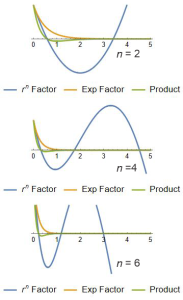
“You would know that kind. More generally, factors are things that get multiplied together. I’ll call the general radial harmonic Rn. It’s the product of two factors. The first is a sum of terms that begin with rn, where r is the distance. For instance, R3‘s first factor would look like a*r³+b*r²+c*r+d, where the a,b,c,d are just some numbers. Different radial harmonics have different exponents in their lead terms. You still with me?”

“Polynomials from high school algebra. Tell me something new.”

“The second factor decreases exponentially with n*r. No matter how large rn gets, when you multiply an rn polynomial by something that decreases exponentially, the (polynomial)×(exponential) product eventually gets really small.”

“Give me a second. … So what you’re saying is, at a big enough distance these radial harmonics just die away.”

“That’s where I was going.”

“How far is ‘enough’?”

“Depends on n. Higher values of n shut down faster.”

“So these Cms and Jns and Rns just add together?” <pauses, squints at me suspiciously> “Is there some reason you used n for both Jn and Rn?”

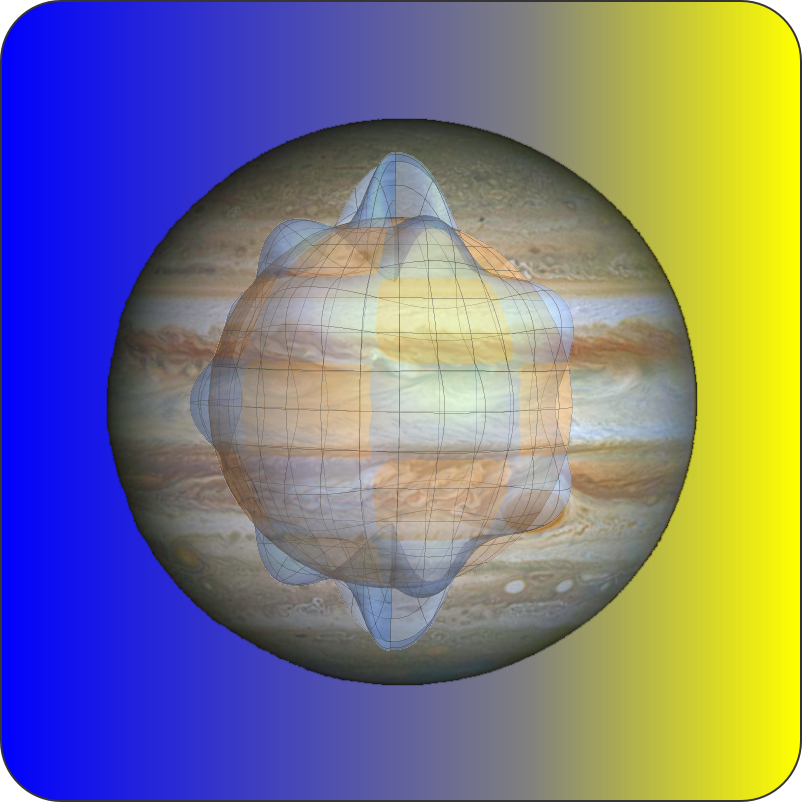
“No but yes, and yes. You combine a C, a J and an R using multiplication to get a full harmonic F, except there are rules. The J and R must belong to the same n. The m can’t be larger than n. From far away we’d model Jupiter’s gravity as F000=R0×J0×C0, which is an infinite sphere — R0 never dies away and J0×C0 says ‘no angular dependence.’ The Sun’s gravity acts along R0 and that’s what keeps Jupiter in orbit. If the problem demands combining full harmonics, you use addition.” <rousing a display on Old Reliable> “Here’s how a particular pair of harmonics combine to increase or decrease spherical gravity in specific directions.”

“But Juno doesn’t see those gravity lumps until it gets close‑in. How close?”

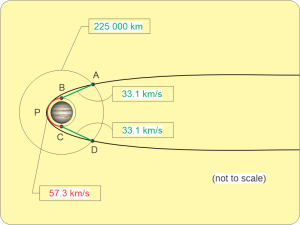
R2‘s down to less than a part per thousand at three planetary radii, call it 225 000 kilometers away from the planet’s center.”

“How much time is it closer than that distance?”

“Complicated question. A precise answer requires some calculus — is your smart phone set up for elliptic integrals?”

“Of course not. A good estimate will do.”

“Okay, here’s the plan. What we’d like is total time spent while Juno travels along the ellipsoidal arc between points A and D where the orbit crosses the 225 000‑km circle. Unfortunately, Juno speeds up approaching point P, slows down going away — calculating the A‑D time is tricky. I’ll assume Juno travels straight lines AB and CD at the A-speed. I’ll also approximate the orbit’s close pass as a semicircle at P‑speed.” <tapping> “I get a 3.6-hour duration, less than 0.3% of the full 53-day orbit. Will that satisfy your people?”

“You’ll know if it doesn’t.”

~~ Rich Olcott

Not Silly-Season Stuff, Maybe

“Keep up the pace, Mr Feder, air conditioning is just up ahead.”

“Gotta stop to breathe, Moire, but I got just one more question.”

“A brief pause, then. What’s your question?”

“What’s all this about LK99 being a superconductor? Except it ain’t? Except maybe it is? What is LK99, anyway, and how do superconductors work? <puffing>”

“So many question marks for just one question. Are you done?”

“And why do news editors care?”

“There’s lots of ways we’d put superconductivity to work if it didn’t need liquid‑helium temperatures. Efficient electric power transmission, portable MRI machines, maglev trains, all kinds of advances, maybe even Star Trek tricorders.”

“Okay, I get how zero‑resistance superconductive wires would be great for power transmission, but how do all those other things have anything to do with it?”

“They depend on superconductivity’s conjoined twin, diamagnetism.”

Dia—?”

“Means ‘against.’ It’s sort of an application of Newton’s Third Law.”

“That’s the one says, ‘If you push on the Universe it pushes back,’ right?”

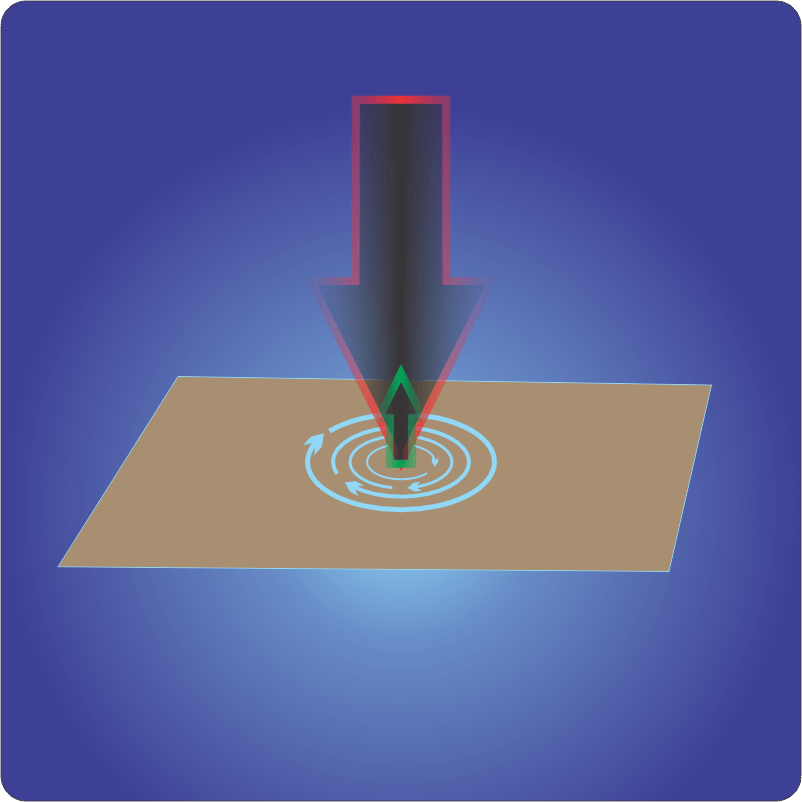
“Very good, Mr Feder. In electromagnetism that’s called Lenz’ Law. Suppose you bring a magnet towards some active conductor, say a moving sheet of copper. Or maybe it’s already carrying an electric current. Either way, the magnet’s field makes charge carriers in the sheet move perpendicular to the field and to the prevailing motion. That’s an eddy current.”

“How come?”

“Because quantum and I’m not about to get into that in this heat. Emil Lenz didn’t propose a mechanism when he discovered his Law in 1834 but it works. What’s interesting is what happens next. The eddy current generates its own magnetic field that opposes your magnet’s field. There’s your push‑back and it’s called diamagnetism.”

“I see where you’re going, Moire. With a superconductor there’s zero resistance and those eddy currents get big, right?”

“In theory they could be infinite. In practice they’re exactly strong enough to cancel out any external magnetic field, up to a limit that depends on the material. A maglev train’s superconducting pads would float above its superconducting track until someone loads it too heavily.”

“What about portable MRI you said? It’s not like someone’s gonna stand on one.”

“A portable MRI would require a really strong magnet that doesn’t need plugging in. Take that superconducting sheet and bend it into a doughnut. Run your magnet through the hole a few times to start a current. That current will run forever and so will the magnetic field it generates, no additional power required. You can make the field as strong as you like, again within a limit that depends on the material.”

“Speaking of materials, what’s the limit for that LK99 stuff?”

“Ah, just in time! Ahoy, Susan! Out for a walk yourself, I see. We’re on our way to Al’s for coffee and air conditioning. Mr Feder’s got a question that’s more up your Chemistry alley than my Physics.”

“LK99, right? It’s so newsy.”

“Yeah. What is it? Does it superconduct or not?”

“Those answers have been changing by the week. Chemically, it’s basically lead phosphate but with copper ions replacing some of the lead ions.”

“They can do that?”

“Oh yes, but not as neatly as we’d like. Structurally, LK99’s an oxide framework in the apatite class — a lattice of oxygens with phosphorus ions sitting in most of the holes in the lattice, lead ions in some of the others. Natural apatite minerals also have a sprinkling of hydroxides, fluorides or chlorides, but the reported synthesis doesn’t include a source for any of those.”

“Synthesis — so the stuff is hand‑made?”

“Mm‑hm, from a series of sold‑state reactions. Those can be tricky — you grind each of your reactants to a fine powder, mix the powders, seal them in a tube and bake at high temperature for hours. The heat scrambles the lattices. The atoms can settle wherever they want, mostly. I think that’s part of the problem.”

“Like maybe they don’t?”

“Maybe. There are uncontrollable variables — grinding precision, grain size distribution, mixing details, reaction tube material, undetected but critical impurities — so many. That’s probably why other labs haven’t been able to duplicate the results. Superconductivity might be so structure‑sensitive that you have to prepare your sample j‑u‑s‑t right.”

~~ Rich Olcott

Not A Hum, A Rumble

Vinnie taps on the magazine. “Sy, you’ve done it again. We ask you one question, you spend a lot of time talking about something else entire. They got this article here” <tap> “says the NANOGrav team captured the hum of the Universe. Al and me, we ask you about that and you get us discussing pulsars. Seems to me,” <tap tap> “that if you got a pulsar and the pulses got only a 3% duty cycle they’d sound more like clicks and,” <taptaptaptap> “if it’s a 10 millisecond pulsar that’s a hundred per second and they’d be more like a low‑pitched buzz, nothing like a hum.”

“One more short detour, Vinnie, sorry. Remember when we discussed the VLA, the Very Large Array of radio telescopes in northern New Mexico?”

“Sorta. I do remember visiting the place, out in the desert miles away from anywhere. They’ve got a couple dozen dish antennas each as wide as a four‑lane road, all spread out along railroad tracks. Big dishes for catching weak signals I understand, but I forget why there’s lots of dishes instead of one huge one or how that even works.”

“One reason is simple mechanics. A huge dish would try to sail away in the desert wind. VLA admins even have to safe‑mount those 25‑meter ones when things get gusty. But the real reason goes to how the array works as one big instrument. Here’s a hint — the dishes can be miles apart and lightspeed isn’t infinite.”

“Ah, that joggled my memory. It’s about when a signal comes in from some nova or something, each dish registers it with a slightly different arrival time and then the computers play match‑up games with all the time differences to figure exactly what angle the signal came from, right?”

“Roughly. The VLA’s multi‑dish design is about being able to resolve signal sources that are close together in the sky so yeah, slightly different angles. The Event Horizon Telescope team used the same strategy and a collection of radio dishes all over the world to produce those orange‑ring images of supermassive black holes. NANOGrav and the other Pulsar Timing Arrays sort of the flip the strategy.”

“At last we get to NANOGrav. Wait, they use lots of antennas to send signals to a star?”

“Nothing like that, Al. No, they use just a few antennas but they track the timing of many pulsars. About 70 at last count.”

“But we know what the timing is, to nanoseconds you said.”

“One word, Vinnie. ‘Frames‘.”

“Aw geez, Sy. Again?”

“Mm-hm. In the pulsar’s frame, it’s majestically rotating at a steady pace, tens or hundreds of times per second relative to its neighbors. Its beam proudly announces its presence on an absolutely regular schedule save for a small but steady slow‑down. In our frame, though, things can happen to a pulse as it heads our way.”

“Like what?”

“It might pass through a molecular cloud. We know those exist. Photons in the right wavelength ranges could interact with cloud components. That’d delay them, stretch the pulse, might even create interference between successive pulses. On the theory side, some cosmologists think the Universe may hold objects like cosmic strings or curvature‑induced domain walls that could delay, deflect or otherwise mess up a pulse. The best possibility, though, is that a gravitational wave could cross the path of a pulse en route to us.”

“Why is that a good thing?”

“Because they’d interact to alter that pulse’s timing. Gravitational waves stretch and squeeze time as they squeeze and stretch space. If a wave crosses a traveling pulse, the pulse will get here either early or late depending. Better yet, if we track enough pulsars scattered across the sky we might even see a parade of offset timings as the wave encounters different pulse beams. Hasn’t happened yet, though. The NANOGrav reports so far are about the background variation as waves from everywhere traverse the paths we’re watching.”

“The article says a hum.”

“Hum sounds come in waves per second. The gravitational background happens in waves per decade, such a low frequency even elephants couldn’t hear it.”

“OK, it’s rumble, not a hum. But why either one?”

~~ Rich Olcott

Time And The Egg

I unlock my office door and there’s Vinnie in the client chair flipping a coin from hand to hand. If my building ever switches to digital locks he’d take it as a challenge. “Morning, Vinnie.”

“Morning, Sy. Been reading your multiverse series and something you said bothered me.”

“What’s that?”

“Back when you wrote up your anti-Universe idea that some other group had come up with first—”

“Don’t remind me.”

“—you mentioned how time going backwards makes for negative energy, like that’s obvious. It ain’t obvious to me.”

“Okay … Ah. What word keeps coming up in our black hole discussions?”

“Geez, frames again? Universes ain’t black holes.”

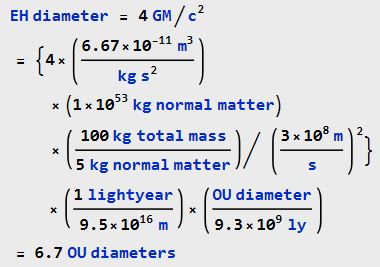
“Don’t be so sure. Suppose there’s a black hole Event Horizon that encloses our entire Observable Universe. An Event Horizon’s diameter depends on how much mass it has inside. Astronomy’s given us an estimate of how much normal matter our Observable Universe contains. I adjusted that number upward to account for the expected quantity of dark matter plus dark energy’s equivalent mass. When I plugged that grand total into Schwarzchild’s formula for the diameter of an Event Horizon, the result was about seven times wider than what we can observe. We could be inside a huge black hole but we’ll never know either way.”

“Whoa! Wouldn’t we notice a drift towards the singularity at its middle?”

“Not if we’re reasonably far out or if the drift rate is tiny compared to the slow chaos of intergalactic space. Mind you, it took us centuries to develop the technology that told us we’re inside the Milky Way and two‑thirds of the way out from the core.”

“We used frames for thinking about going really fast or being outside a black hole. Now we’re inside one or maybe not. How’s frames gonna help us with that?”

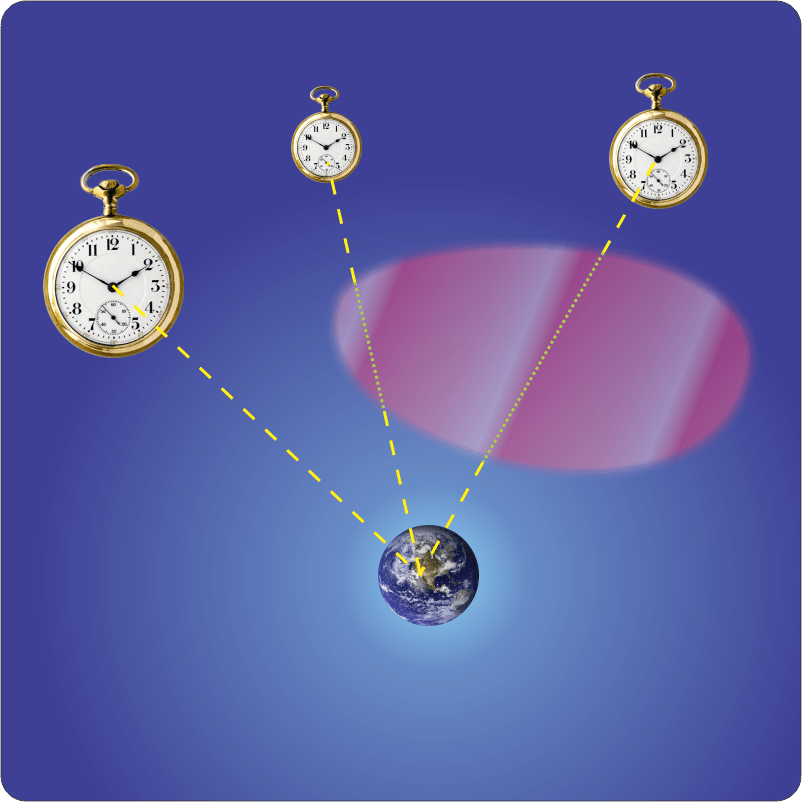
“Well, not the inertial frames where we compared relativistic observers, but the idea is similar. A traveler in an intense gravity field experiences slower time in its inertial frame than a distant partner does in theirs. Clocks appear to run weirdly if they’re compared between separate frames whose relative velocities are near lightspeed.”

“Yeah, that’s what we said.”

“Now picture two observational frames, one here in our Universe and one in the anti‑Universe if there is one. Time in the two frames flows in opposite directions away from the Big Bang between them. The two‑frames notion is a convenient way to think about consequences. Negative energy is one.”

“Now we’re getting somewhere. So give.”

“Well, what does energy do?”

“It makes things happen.”

“Negative energy does, too, considered from inside its frame. Looking from our frame, though, negative energy makes things unhappen. This spoon on our table has gravitational potential energy relative to the floor, right?”

“Yeah, you push it over the edge it’ll fall down.”

“But looking from our frame at a similar situation in the anti‑Universe running on anti‑time, an anti‑spoon on its floor has negative gravitational potential energy. We’d see it fall up to its table. Make sense?”

“Gimme a minute.” <pause> “Kinda hard to visualize but I’m starting to get there.” <longer pause> “Alright, you know I hate equations but even I know about Einstein’s E=mc². That is a square so it’s always positive so if E is negative then the mass gotta be negative, too.”

“From our frame all mass in the anti‑Universe looks negative. Negative mass would attract negative mass just like positive mass attracts positive mass here. Gravity in the anti‑Universe would work exactly the same way as our gravity does, so where’s the problem?”

“Gimme another minute.” <more pausing> “Suppose that spoon was an anti‑egg. You’re sayin’ when it goes splat over there, we’re gonna see it unsplat? Unsplatting uses up entropy. How about the ‘Entropy always increases‘ rule?”

“Right on the unsplat, wrong on the other. The full statement of Thermodynamics’ Second Law says that entropy never decreases in an isolated system. You can’t get much more isolated than being a separate Universe — no inputs of energy or matter from our Universe or anywhere else, right? From our frame, it looks like the anti‑Universe flipped the Second Law but that’s only because we’re using the wrong clock.”

~~ Rich Olcott

Noodles or A Sandwich?

“Wait, Sy, your anti-Universe idea says there are exactly two um, sub‑Universes. Even the word ‘multiverse‘ suggests more than that.”

“You’re right, Susan, most of the multiverse proposals go to the other extreme. Maybe the most extreme version grew in reaction to one popular interpretation of quantum theory. Do you know about the ‘Many Worlds‘ notion?”

“Many Worlds? Is that the one about when I decide between noodles for lunch or a sandwich, the Universe splits and there’s one of me enjoying each one?”

“That’s the popular idea. The physics idea is way smaller, far bigger and even harder to swallow. Physicists have been arguing about it for a half‑century.”

“Come again? Smaller AND bigger?”

“Smaller because it’s a quantum‑based idea about microscopic phenomena. Doesn’t say anything about things big enough to touch. Remember how quantum calculations predict statistics, not exact values? They can’t give you anything but averages and spreads. Einstein and Bohr had a couple of marquee debates about that back in the 1930s. Bohr maintained that our only path to understanding observations at the micro‑scale was to accept that events there are random and there’s no point discussing anything deeper than statistics. Einstein’s position was that the very fact that we’re successfully using an average‑based strategy says that there must be finer‑grained phenomena to average over. He called it ‘the underlying reality.’ The string theory folks have chased that possibility all the way down to the Planck‑length scale. They’ve found lots of lovely math but not much else. Hugh Everett had a different concept.”

“With that build‑up, it’d better have something to do with Many Worlds.”

“Oh, it does. Pieces of the idea have been lying around for centuries, but Everett pulled them all together and dressed them up in a quantum suit. Put simply, in his PhD thesis he showed how QM’s statistics can result from averaging over Universes. Well, one Universe per observation, but you experience a sequence of Universes and that’s what you average over.”

“How can you show something like that?”

“By going down the rabbit hole step by step and staying strictly within the formal QM framework. First step was to abstractify the operation of observing. He said it’s a matter of two separate systems, an observer A and a subject B. The A could be a person or electronics or whatever. What’s important is that A has the ability to assess and record B‘s states and how they change. Given all that, the next step is to say that both A and B are quantized, in the sense that each has a quantum state.”

“Wait, EACH has a quantum state? Even if A is a human or a massive NMR machine?”

“That’s one of the hard‑to‑swallows, but formally speaking he’s okay. If a micro‑system can have a quantum state then so can a macro‑system made up of micro‑systems. You just multiply the micro‑states together to get the macro‑state. Which gets us to the next step — when A interrogates B, the two become entangled. We then can only talk about the combined quantum state of the A+B system. Everett referred to an Einstein quote when he wrote that a mouse doesn’t change the Moon by looking at it, but the Moon changes the mouse. The next step’s a doozy so take a deep breath.”

“Ready, I suppose.”

B could have been in any of its quantum states, suppose it’s . After the observation, A+B must be an entangled mixture of whatever A was, combined with each of B‘s possible final states. Suppose B might switch to . Now we can have A+B(#42), separate from a persisting A+B(#10), plus many other possibles. As time goes by, A+B(#42) moves along its worldline independent of whatever happens to A+B(#10).”

“If they’re independent than each is in its own Universe. That’s the Many Worlds thing.”

“Now consider just how many worlds. We’re talking every potential observing macro‑system of any size, entangled with all possible quantum states of every existing micro‑system anywhere in our Observable Universe. We’re a long way from your noodles or sandwich decision.”

“An infinity of infinities.”

“Each in its own massive world.”

“Hard to swallow.”

~~ Rich Olcott

The Frame Game

A familiar footstep outside my office, “C’mon in, Vinnie, the door’s open.”

“Hi, Sy, how ya doin’?”

“Can’t complain. Yourself?”

“Fine, fine. Hey, I been thinking about something you said while Al and us were talking about rockets and orbits and such. You remember that?”

“We’ve done that in quantity. What statement in particular?”

“It was about when you’re in the ISS, you still see like 88% of Earth’s gravity. But I seen video of those astronauts just floating around in the station. Seems to me those two don’t add up.”

“Hah! We’re talking physics of motion here. What’s the magic word?”

“You’re saying it’s frames? I thought black holes did that.”

“Black holes are an extreme example, but frame‑thinking is an essential tool in analyzing any kind of relative motion. Einstein’s famous ‘happy thought‘ about a man in a free‑falling elevator—”

“Whoa, why is that a happy thought? I been nervous about elevators ever since that time we got stuck in one.”

“At least it wasn’t falling, right? Point is, the elevator and whoever’s in it agree that Newton’s First Law of Motion is valid for everything they see in there.”

“Wait, which Law is that?”

“‘Things either don’t move or else they move at a steady pace along a straight line.’ Suppose you’re that guy—”

“I’d rather not.”

“… and the elevator is in a zero‑gravity field. You take something out of your pocket, put it the air in front of you and it stays there. You give it a tap and it floats away in a straight line. Any different behavior means that your entire frame — you, the elevator and anything else in there — is being accelerated by some force. Let’s take two possibilities. Case one, you and the elevator are resting on terra firma, tightly held by the force of gravity.”

“I like that one.”

“Case two, you and the elevator are way out in space, zero‑gravity again, but you’re in a rocket under 1-g acceleration. Einstein got happy because he realized that you’d feel the same either way. You’d have no mechanical way to distinguish between the two cases.”

“What’s that mean, mechanical?”

“It excludes sneaky ways of outside influence by magnetic fields and such. Anyhow, Einstein’s insight was key to extending Newton’s First Law to figuring acceleration for an entire frame. Like, for instance, an orbiting ISS.”

“Ah, you’re saying that floating astronauts in an 88% Earth-gravity field is fine because the ISS and the guys share the frame feeling that 88% but the guys are floating relative to that frame. But down here if we could look in there we’d see how both kinds of motion literally add up.”

“Exactly. It’s just much easier to think about only one kind at a time.”

“Wait. You said the ISS is being accelerated. I thought it’s going a steady 17500 miles an hour which it’s got to do to stay 250 miles up.”

“Is it going in a straight line?”

“Well, no, it’s going in a circle, mostly, except when it has to dodge some space junk.”

“So the First Law doesn’t apply. Acceleration is change in momentum, and the ISS momentum is constantly changing.”

“But it’s moving steady.”

“But not in a straight line. Momentum is a vector that points in a specific direction. Change the direction, you change the momentum. Newton’s Second Law links momentum change with force and acceleration. Any orbiting object undergoes angular acceleration.”

“Angular acceleration, that’s a new one. It’s degrees per second per second?”

“Yup, or radians. There’s two kinds, though — orbiting and spinning. The ISS doesn’t spin because it has to keep its solar panels facing the Sun.”

“But I’ve seen sci-fi movies set in something that spins to create artificial gravity. Like that 2001 Space Odyssey where the guy does his running exercise inside the ship.”

“Sure, and people have designed space stations that spin for the same reason. You’d have a cascade of frames — the station orbiting some planet, the station spinning, maybe even a ballerina inside doing pirouettes.”

“How do you calculate all that?”

“You don’t. You work with whichever frame is useful for what you’re trying to accomplish.”

“Makes my head spin.”

~~ Rich Olcott

Imagine A Skyrocket Inside A Black Hole

Vinnie’s never been a patient man. “We’re still waiting, Sy. What’s the time-cause-effect thing got to do with black holes and information?”

“You’ve got most of the pieces, Vinnie. Put ’em together yourself.”

“Geez, I gotta think? Lessee, what do I know about black holes? Way down inside there’s a huge mass in a teeny singularity space. Gravity’s so intense that relativity theory and quantum mechanics both give up. That can’t be it. Maybe the disk and jets? No, ’cause some holes don’t have them, I think. Gotta be the Event Horizon which is where stuff can’t get out from. How’m I doing, Sy?”

“You’re on the right track. Keep going.”

“Okay, so we just talked about how mass scrambles spacetime, tilts the time axis down to point towards where mass is so axes stop being perpendicular and if you’re near a mass then time moves you even closer to it unless you push away and that’s how gravity works. That’s part of it, right?”

“As rain. So mass and gravity affect time, then what?”

“Ah, Einstein said that cause‑and‑effect runs parallel with time ’cause you can’t have an effect before what caused it. You’re saying that if gravity tilts time, it’ll tilt cause‑and‑effect?”

“So far as we know.”

“That’s a little weasel-ish.”

“Can’t help it. The time‑directed flow of causality is a basic assumption looking for counter‑examples. No‑one’s come up with a good one, though there’s a huge literature of dubious testimonials. Something called a ‘closed timelike curve‘ shows up in some solutions to Einstein’s equations for extreme conditions like near or inside a black hole. Not a practical concern at our present stage of technology — black holes are out of reach and the solutions depend on weird things like matter with negative mass. So anyhow, what happens to causality where gravity tilts time?”

“I see where you’re going. If time’s tilted toward the singularity inside a black hole, than so is cause‑and‑effect. Nothing in there can cause something to happen outside. Hey, bring up that OVR graphics app on Old Reliable, I’ll draw you a picture.”

“Sure.”

“See, way out in space here this circle’s a frame where time, that’s the red line, is perpendicular to the space dimensions, that’s the black line, but it’s way out in space so there’s no gravity and the black line ain’t pointing anywhere in particular. Red line goes from cause in the middle to effect out beyond somewhere. Then inside the black hole here’s a second frame. Its black line is pointing to where the mass is and time is tilted that way too and nothing’s getting away from there.”

“Great. Now add one more frame right on the border of your black hole. Make the black line still point toward the singularity but make the red line tangent to the circle.”

“Like this?”

“Perfect. Now why’d we put it there?”

“You’re saying that somewhere between cause-effect going wherever and cause-effect only going deeper into the black hole there’s a sweet spot where it doesn’t do either?”

“Exactly, and that somewhere is the Event Horizon. Suppose we’re in a mothership and you’re in our shuttlecraft in normal space. You fire off a skyrocket. Both spacecraft see sparks going in every direction. If you dive below an Event Horizon and fire another skyrocket, in your frame you’d see a normal starburst display. If we could check that from the mothership frame, we’d see all the sparks headed inward but we can’t because they’re all headed inward. All the sparkly effects take place closer in.”

“How about lighting a firework on the Horizon?”

“Good luck with that. Mathematically at least, the boundary is infinitely thin.”

“So bottom line, light’s trapped inside the black hole because time doesn’t let the photons have an effect further outward than they started. Do I have that right?”

“For sure. In fact, you can even think of the hole as an infinite number of concentric shells, each carrying a causality sign reading ‘Abandon hope, all ye who enter here‘. So what’s that say about information?”

“Hah, we’re finally there. Got it. Information can generate effects. If time can trap cause‑effect, then it can trap information, too.”

~~ Rich Olcott

Tilting at Black Holes

“What’s the cause-effect-time thing got to do with black holes and information?”

“We’re getting there, Al. What happens to spacetime near a black hole?”

“Everybody knows that, Sy, spacetime gets stretched and squeezed until there’s infinite time dilation at the Event Horizon.”

“As usual, Vinnie, what everybody knows isn’t quite what is. Yes, Schwarzschild’s famous solution includes that Event Horizon infinity but it’s an artifact of his coordinate system. Al, you know about coordinate systems?”

“I’m a star-watcher, Sy. Sure, I know about latitude and longitude, declination and right ascension, all that stuff no problem.”

“Good. Well, Einstein wrote his General Relativity equations using generalized coordinates, like x,y,z but with no requirement that they be straight lines or at right angles. Schwarzschild solved the equations for a non‑rotating sphere so naturally he used spherical coordinates — radius, latitude and longitude. Since then other people have solved the equations for more complicated cases using more complicated coordinate systems. Their solutions don’t have that infinity.”

“No infinity?”

“Not that one, anyhow. The singularity at the hole’s geometric center is a real thing, not an artifact. So’s a general Event Horizon, but it’s not quite where Schwarzschild said it should be and it doesn’t have quite the properties that everybody thinks they know it has. It’s still weird, though.”

“How so?”

“First thing you have to understand is that when you get close to a black hole, you don’t feel any different. Except for the spaghettification, of course.”

“It’s frames again, ain’t it?”

“With black holes it’s always frames, Vinnie. If you’re living in a distorted space you won’t notice it. Whirl a meter‑long sword around, you’d always see it as a meter long. A distant observer would see you and everything around you as being distorted right along with your space. They’ll see that sword shrink and grow as it passes through different parts of the distortion.”

“Weird.”

“We’re just getting started, Al. Time’s involved, too. <grabbing a paper napkin and sketching> Here’s three axes, just like x,y,z except one’s time, the G one points along a gravity field, and the third one is perpendicular to the other two. By the way, Al, great idea, getting paper napkins printed like graph paper.”

“My location’s between the Physics and Astronomy buildings, Sy. Gotta consider my clientele. Besides, I got a deal on the shipment. What’s the twirly around that third axis?”

“It’s a reminder that there’s a couple of space dimensions that aren’t in the picture. Now suppose the red ball is a shuttlecraft on an exploration mission. The blue lines are its frame. The thick vertical red line shows it’s not moving because there’s no spatial extent along G. <another paper napkin, more sketching> This second drawing is the mothership’s view from a comfortable distance of the shuttlecraft near a black hole.”

“You’ve got the time axis tilted. What’s that about?”

“Spacetime being distorted by the black hole. You’ve heard Vinnie and me talk about time dilation and space compression like they’re two different phenomena. Thing is, they’re two sides of the same coin. On this graph that shows up as time tilted to mix in with the BH direction.”

“How about those twirly directions?”

“Vinnie, you had to ask. In the simple case where everything’s holding still and you’re not too close to the black hole, those two aren’t much affected. If the big guy’s spinning or if the Event Horizon spans a significant amount of your sky, all four dimensions get stressed. Let’s keep things simple, okay?”

“Fine. So the time axis is tilted, so what?”

“We in the distant mothership see the shuttlecraft moving along pure tilted time. The shuttlecraft doesn’t. The dotted red lines mark its measurements in its blue‑line personal frame. Shuttlecraft clocks run slower than the mothership’s. Worse, it’s falling toward the black hole.”

“Can’t it get away?”

“Al, it’s a shuttlecraft. It can just accelerate to the left.”

“If it’s not too close, Vinnie. The accelerative force it needs is the product of both masses, divided by the distance squared. Sound familiar?”

“That’s Newton’s Law of Gravity. This is how gravity works?”

“General Relativity cut its teeth on describing that tilt.”

~~ Rich Olcott

Holes in A Hole?

Mid-afternoon coffee break time so I head over to Al’s coffee shop. Vinnie’s at his usual table by the door, fiddling with some spilled coffee on the table top. I notice he’s pulled some of it into a ring around a central blob. He looks at it for a moment. His mental gears whirl then he looks up at me. “Hey Sy! Can you have a black hole inside another black hole?”

“That’s an interesting question. Quick answer is, ‘No.’ Longer answer is, ‘Sort of, maybe, but not the way you’re thinking.’ You good with that, Vinnie?”

“You know me better than that, Sy. Pull up a chair and give.”

I wave at Al, who brings me a mug of my usual black mud. “Thanks, Al. You heard Vinnie’s question?”

“Everyone on campus did, Sy. Why the wishy-washy?”

“Depends on your definition of black hole.”

Sky-watcher Al is quick with a response. “It’s a star that collapsed denser than a neutron star.”

Vinne knows me and black holes better than that. “It’s someplace where gravity’s so strong that nothing can get out, not even light.”

“Both right, as far as they go, but neither goes deep enough for Vinnie’s question.”

“You got a better one, I suppose?”

“I do, Vinnie. My definitition is that a black hole is a region of spacetime with such intense gravitation that it wraps an Event Horizon around itself. Al’s collapsed star is one way to create one, but that probably doesn’t account for the Event Horizons around supermassive black holes lurking in galactic cores. Your ‘nothing escapes‘ doesn’t say anything about conditions inside.”

“Thought we couldn’t know what happens inside.”

“Mostly correct, which is why your question is as problematical as you knew it was. Best I can do is lay out possibilities, okay? First possibility is that the outer black hole forms around a pre-existing inner one.”

“Can they do that?”

“In principle. What makes a black hole is having enough mass gathered in close proximity. Suppose you have a black hole floating our there in space, call it Fred, and a neutron star comes sidling by. If the two bodies approach closely enough, the total amount of mass could be large enough to generate a second Event Horizon shell enclosing both of them. How long that’d last is another matter.”

“The outer shell’d go away?”

“No chance of that. Once the shell’s created, the mass is in there and the star is doomed … unless the star’s closest approach matches Fred’s ISCO. That’s Innermost Stable Circular Orbit, about three times Fred’s Event Horizon’s half-diameter if Fred’s not rotating. Then the two bodies might go into orbit around their common center of gravity.”

“How’s rotation come into this?”

“If the mass is spinning, then you’ve got a Kerr black hole, frame-dragging and an ISCO each along and against the spin direction. Oh, wait, I forgot about tidal effects.”

“Like spaghettification, right.”

“Like that but it could be worse. Depending on how tightly neutronium holds itself together, which we don’t know, that close approach might be inside the Roche limit. Fred’s gravity gradient might simply shred the star to grow the black hole’s accretion disk.”

“Grim. You said there’s other possibilities?”

“Sorta like the first one, but suppose the total mass comes from two existing black holes, like the collision that LIGO picked up accidentally back in 2014. Suppose each one is aimed just outside the other’s ISCO. Roche fragmentation wouldn’t happen, I think, because each body’s contents are protected inside its own personal Event Horizon. Uhh … darn, that scheme won’t work and neither will the other one.”

“Why not?”
 ”Why not?”

“Because the diameter of an Event Horizon is proportional to the enclosed mass. The outer horizon’s diameter for the case with two black holes would be exactly the sum of the diameters of the embedded holes. If they’re at ISCO distances apart they’re can’t be close enough to form the outer horizon. For the same reason, I don’t think a neutron star could get close enough, either.”

“No hole in a hole, huh?”

“I’m afraid not.”

~~ Rich Olcott

  • Thanks to Alex and Xander, who asked the question.