Red And Blue Enigmas

“All that cloud stuff goes on in Jupiter’s tissue-paper outer layer. What’s the rest of the planet doing, Cathleen?”

“You’re not going to like this, Vinnie, but all we’ve got so far is broad‑brush averages. The Galileo atmosphere probe penetrated less than 0.2% of the way to the center. The good news is that the Juno probe has been sending us oodles of data about Jupiter’s gravity and magnetic fields. That’s great for planet‑wide theorizing, not quite as useful for weather prediction.”

“Can the data explain the Great Red Spot?”

“Well, it ruled out some ideas. Back in the day we thought the Spot was a deep whirlpool opening a view into the interior. Nope. Juno‘s measurements revealed that the Spot is actually a dome rising hundreds of kilometers above the white cloud‑tops. When one window closes, another one opens, I suppose. The fact that the Spot’s a dome says down below there’s an immense energy source lifting the gases above it. We don’t know what it is or why it’s there or how for two centuries it’s mostly held position in a completely fluid environment.”

“Weird. You’d expect something like that at a special location, like at one of the poles, but the Spot isn’t even on the planet’s equator.”

“Right, Sy. Its latitude is 22° south.”

“Hey, that’s the Tropic of Capricorn.”

“Almost, Vinnie, but not relevant. Earth’s two Tropics are at 23½° north and south. If the Earth’s rotational axis were perpendicular to its solar orbit, the Sun’s highest position would always be directly over the Equator. But Earth’s axis is tilted at 23½° to our orbital plane. To see the noon Sun at the zenith you’d have to be 23½° north of the Equator in June, 23½° south of the Equator in December. Jupiter’s rotational axis is tilted, too, but by only 3°. That rules out significant seasonality on Jupiter, but it also says that on Jupiter there’s nothing special about 22° except that it’s where the Spot hangs out.”

“How about longitude?”

“Longitude on Jupiter is an embarrassing topic. Zero longitude on Earth, our Prime Meridian, runs through Greenwich Observatory in London, right? I don’t want to get into the history behind that. On a completely gaseous planet like Jupiter, there’s no stable physical object to tag with a zero. Jupiter’s cloud‑tops rotate faster near its equator than at its poles. Neither rotation syncs with Jupiter’s magnetic field which is like Earth’s except it’s much more intense and it points in the opposite direction. Oh, and it’s offset from the center of the planet and it’s lumpy. For lack of a better alternative, astronomers arbitrarily thumbtacked Jupiter’s Prime Meridian to its magnetic field. They selected the magnetic longitudinal line that pointed directly towards Earth at a particular moment in 1965. Given a good clock and the field’s rate of rotation you can calculate where that line will be at any other time.”

“Sounds like that ephemeris strategy Sy told me about in our elevator adventure. Why’s that embarrassing?”

“Well, back in 1965 the tool of choice for studying Jupiter’s rotating magnetic field was radio spectroscopy. Technology wasn’t as good as we have now and they … didn’t get a completely accurate rate of rotation. We’re stuck with a standard coordinate system where the Prime Meridian slips about 3° every year relative to the magnetic field. Even the Great Red Spot slips a little.”

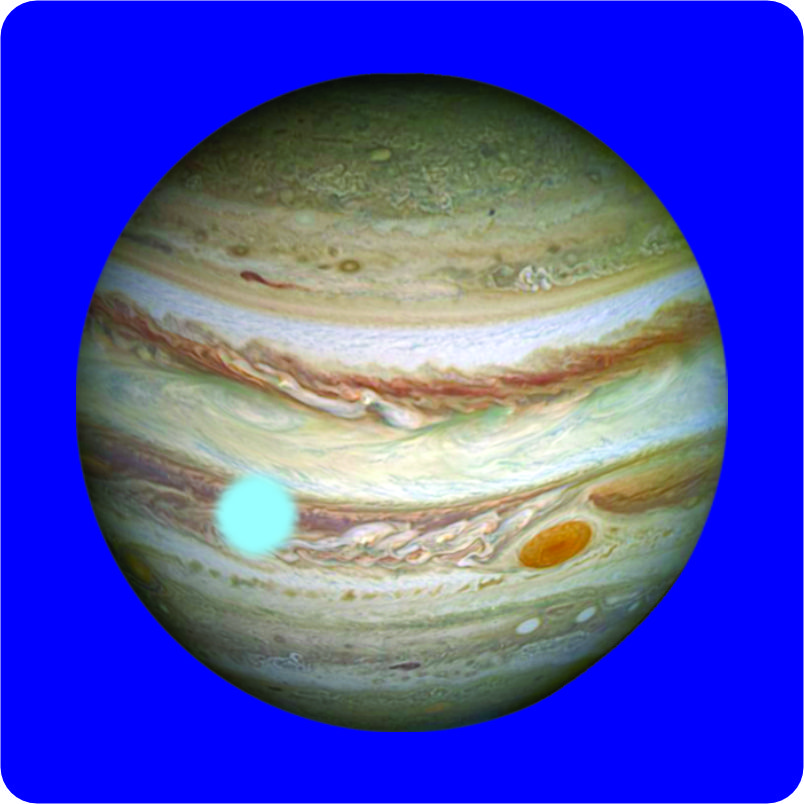
“Cathleen, I’ve read that Juno uncovered a region of particularly intense magnetic activity they’re calling Jupiter’s Great Blue Spot. Does it have any connection to the Red Spot?”
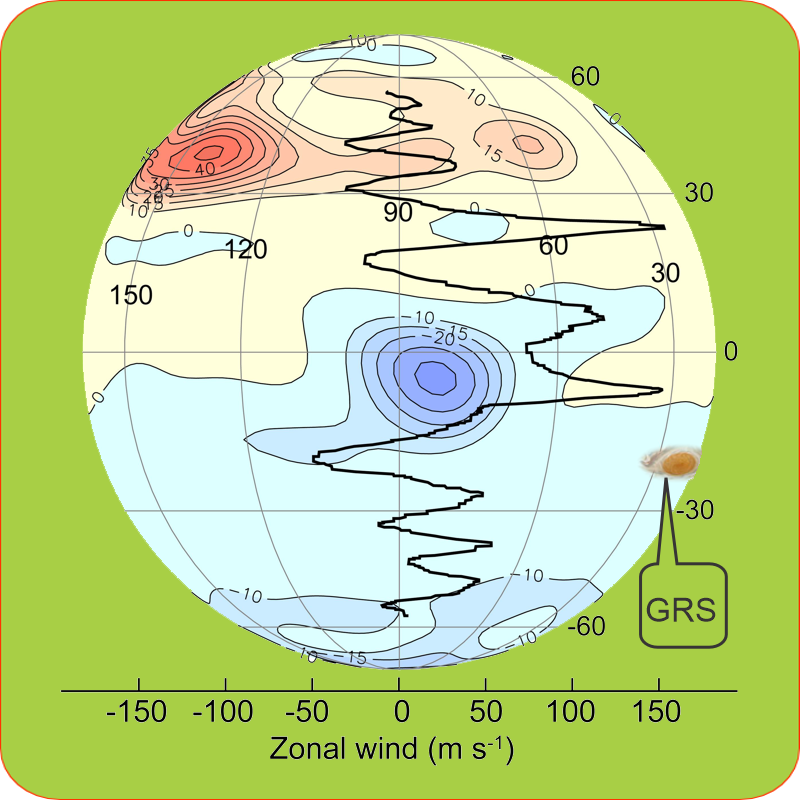
Magnetism and wind map by NASA/JPL-Caltech/SwRI/John E. Connerney. Great Red Spot image added by the author.

“Probably not, Sy, the Red Spot’s 15° south and 60° east of the Blue. But with Jupiter who knows?”

“Got any other interesting averages?”

“Extreme wind speeds. There’s a jet stream between each pair of Jupiter’s stripes, eastbound on the poleward side of a white zone, westbound in the other side. Look at the zig‑zag graph on this chart. 75 meters/second is 167 miles per hour is a Category 5 hurricane here on Earth. At latitudes near Jupiter’s equator average winds are double that.”

~~ Rich Olcott
Clouds From Both Sides Now

I don’t usually see Vinnie in a pensive mood. Moody, occasionally, but there he is at his usual table by the door, staring at the astronomy poster behind Al’s cash register. “Have a scone, Vinnie. What’s on your mind?”

“Thanks, Sy. Welcome back, Cathleen. What’s bugging me is the hard edges on that picture of Jupiter. It looks like those stripes are painted on. Everyone says Jupiter’s not really solid so how come the planet looks so smooth?”

“Cathleen, this is definitely in your astronomer baliwick.”

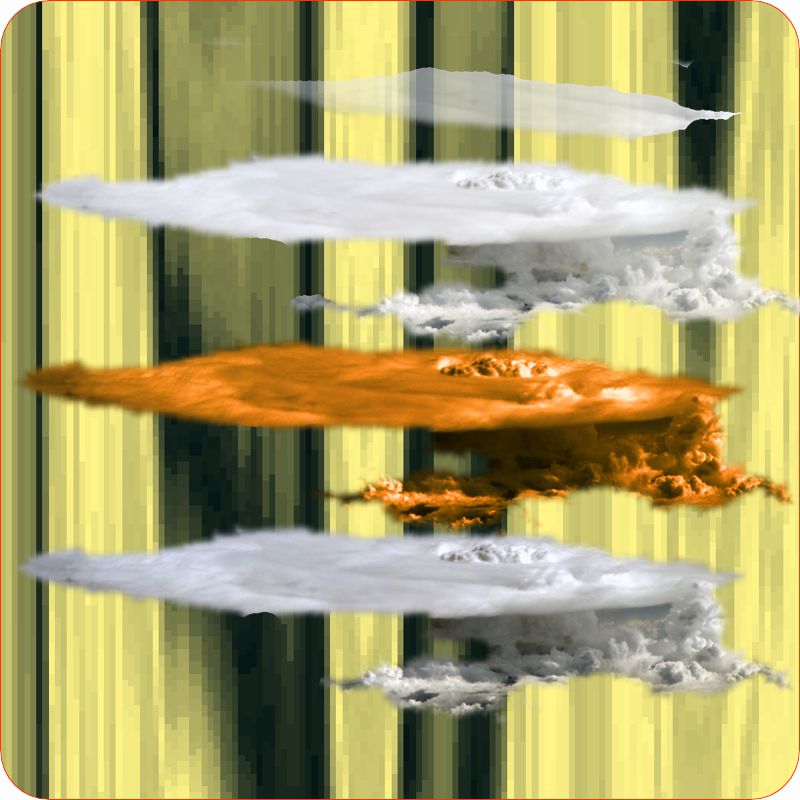
“I suppose. It’s a matter of scale, Vinnie. The white zones mark updrafts. The whiteness is clouds that rise a couple hundred kilometers above a brownish lower layer. The downdraft belts on either side are transparent enough to let us see the next lower layer. ‘A couple hundred kilometers‘ sounds like a lot, but that’s only a tenth of a percent of Jupiter’s radius. If Jupiter were a foot‑wide ball floating in front of us, the altitude difference would be as thin as a piece of tissue paper. You might be able to feel the ridges and valleys but you’d have a hard time seeing them.”

“But why does the updraft stop so sharp? Is there like a cap on the atmosphere?”

“The clouds stop, but the updrafts don’t. The cloud tops aren’t even close to the top of Jupiter’s atmosphere, any more than Earth clouds reach the top of ours. C’mon, Vinnie, you’re a pilot. Surely you’ve noticed that most thunderheads top out at about the same altitude. Isn’t the sky still blue above them?”

“That’s higher than the planes I fly are cleared for, but I wouldn’t want to get above one anyway. I know a guy who flew over one that was just getting started. He said it’s a bumpy ride but yeah, there’s still kind of a dark blue sky above.”

“All of that makes my point — our atmosphere doesn’t stop at the tropospheric boundary where the clouds do. Beyond that you’ve got another 40‑or‑so kilometers of stratosphere. Jupiter’s the same way, clouds go up only partway. For that matter, Jupiter has at least four separate cloud decks.”

“Wait, Cathleen — four? I know how Earth clouds work. Warm humid air rises, expanding and cooling as it goes. When its temperature falls below the dew point or freezing point, its humidity condenses to water droplets or ice crystals and that’s the cloud. I suppose if that same bucketful of air keeps rising far enough the pressure gets so low the water evaporates again and that’s the top of the cloud. How can that happen multiple times?”

“It doesn’t, Sy. In Jupiter’s complicated atmosphere each deck is formed from a different gas. Top layer is a wispy white hydrocarbon fog. The white zone clouds next down are ices of ammonia, which has to get a lot colder than water before it condenses. Water ice probably has a layer much farther down.”

“What’s the brownish layer?”

“There’s one or maybe two of them, each a complex mixture of ammonium ions with various sulfide species. The variety of colors in there make the visible light spectroscopy an opaque muddle.”

“Hey, if the brownish layers block what we can see, how do we even know lower layers are a thing?”

“Good question, Vinnie. Actually, we can do spectroscopy in the middle infrared. That gives us some clues. We’d hoped that the Galileo mission’s deep‑diver probe would sense the lower layers directly but unfortunately it dove into a hot spot where the upwelling heat messes up the layering. Our last resort is modeling. We have an inventory of lab data on thousands of compounds containing the chemical elements we’ve detected on Jupiter. We also have a pretty good temperature‑pressure profile of the atmosphere from the planet’s stratosphere down nearly to the core. Put the two together and we can paint a broad‑brush picture of what compounds should be stable in what physical state at every altitude.”

“Those ‘broad‑brush‘ and ‘should‘ weasel‑words say you’re working with averages like Einstein didn’t like with quantum mechanics. Those vertical winds mix things up pretty good, I’ll bet.”

“Fair objection, Vinnie, but we do what we can.”

~~ Rich Olcott

Why Is Io Hot, Europa Not?

The Acme Pizza and Science Society is back in session at Eddie’s circular table. Al won the last pot so he gets to pick the next topic. “I been reading about Jupiter’s weird moon Io.”

“How’s it any weirder than Ganymede that’s bigger than Mercury?”
  ”Or Europa that’s got geysers and maybe life?”

“Guys, it’s the only yellow moon in the Solar System. You can’t any weirder than that! We got lots of stony moons that are mostly gray, a few water‑ice moons that are white like snow and then there’s Io by itself covered with sulfur.”

“Yellow?”

“Mostly yellow, except where it’s red or dark brown. Or white. They’re all sulfur colors.”

“I’ve seen yellow sulfur, but red?”

“It’s like carbon can be diamond or graphite. Sulfur can be different colors depending on how hot it was when it froze. The article said the white’s probably frozen sulfur dioxide that smells like burning matches.”

“Where’d all that sulfur come from?”

“From inside Io. It’s got like 400 volcanoes that blast out sulfur and stuff. Some of it falls back and that’s why Io is yellow, but a lot gets all the way into space. The article said Io loses a tonne per second. Nothin’ else in the Solar System is that active. Or that dense, probably ’cause it blasted away all its light stuff a long time ago. Anyway, I got a theory.”

“Don’t stop there. What’s the theory?”

“Jupiter’s stripes got all those colors, right, and Sy here wrote astronomers think the brownish bands have sulfur. My theory is that Jupiter got its sulfur from Io. Whaddaya think, Sy?”

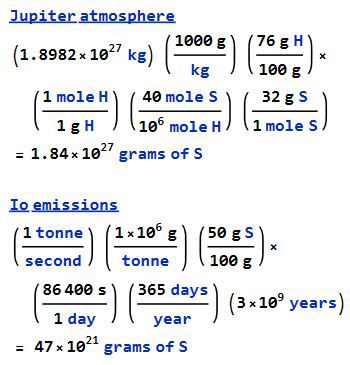
“Interesting idea.” <drawing Old Reliable from its holster> “We need numbers before we can upgrade that to a conjecture.” <screen‑tapping> “So, how much sulfur does Jupiter have, and how much could Io have supplied? … Ah, here’s a chart to get us started. Says for every million hydrogen atoms in Jupiter’s atmosphere there’s 40 sulfurs. This Wikipedia article says that the planet masses 1.898×1027 kilograms. 76% of that is hydrogen which calculates to … 1.8×1027 grams of sulfur.”

“That’s a lot of sulfur.”

“Mm-hm. Now, using your tonne per second loss rate and guessing it’s 50% sulfur and that’s been going on for ¾ of the system’s life so far, I get that Io may have shed about 5×10²² grams of sulfur. That’s short by 4½ powers of 10. Sorry, Al, Io contributed a little to Jupiter’s sulfur stash but not enough to promote your idea to a conjecture.”

Jim tosses some chips into the pot. “It’s worse than that, Sy. Galileo‘s probe fell into a clear hotspot so it sampled Jupiter’s gaseous atmosphere but it totally missed the sulfur tied up in those brown clouds. Jupiter’s got even more sulfur than your calculation shows. But there’s still an open question.”

“What’s open?”

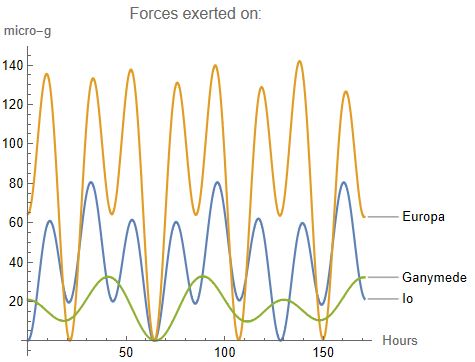
Animation by WolfmanSF, CC0, via Wikimedia Commons

“The inner three Galilean moons are locked into resonant orbits. Laplace explained how their separate gravitational fields continually nudge each other to stay in sync. A 1979 paper supported that explanation but then claimed that the moon‑moon nudges produced enough tidal friction within Io to power volcanoes.”

“What’s wrong with that?”

“It doesn’t tell us why Io’s the only one hot enough to boil off all its water.”

“Io had water?”

“Probably, long ago. All three share the same orbital plane and probably formed from the same disk of gas and dust. Both Europa and Ganymede are water worlds, covered by kilometers of water ice. Io should be wet or the other two would be dry by now. Something’s different with Io and it’s not inter‑moon gravitation.”

“Why not?”

“Numbers. Those moon‑moon interactions are measured in microgravities. Such light impulses can synchronize effectively if repeated often enough, but these just aren’t energetic enough to boil a moon. Besides, Europa stays cool even though it feels a lot more action than Io does.”

“You got a theory?”

“A hypothesis. I’m betting on magnetism. Io’s deep in Jupiter’s lumpy magnetic field which must generate eddy currents in Io’s mostly iron core. I think Io heats up like a pot on an induction stove.”

~~ Rich Olcott

Icing on The Brownie

“So what you’re saying, Sy, is that Jupiter’s white stripes are ammonia snow clouds that go way up above a lower layer of brown clouds like the white icing stripes I put on my brownies.”

“That’s what I’m saying, Al.”

“But why stripes? We got white clouds here on Earth and sometimes they’re in layers but they don’t make stripes.”

“Well, actually they do, but you need the long-term picture to see it. Ever notice that Earth’s forests and deserts make stripes?”

“How ’bout that? I guess they do, sorta. How’s that work?”

“It took us five hundred years to figure out the details. Quick summary. Sunlight does its best year-round heating job at the Equator, where the oceans humidify the air. Warm air rises. Rising warm air cools, releases its moisture as rain, and you get a rainforest belt. The cooled, dried air spreads out until it sinks at about the 30th parallels north and south. Dry air sucks moisture out of the land as it returns to the Equator and you get desert belts. Repeat the cycle. More loops like that center around both 60th parallels. The pattern’s not completely uniform because of things like mountain ranges that block some of the flows. Basically, though, as the years accumulate you get stripes.”

“Jupiter does that, too, huh?”

“On steroids. In one way it’s simpler — no underlying continents mess things up. On the other hand, Jupiter’s got more than a hundred times Earth’s surface area so there’s room for more loops. Also, Jupiter’s interior is still shedding a lot of heat, almost as much as the planet gets from the Sun. Here’s a diagram on Old Reliable.”

“So you’re saying that the upward loops push Jupiter’s atmosphere to where it’s colder and those white ammonia snow clouds form. Then the downward loops move the clouds to where it’s warmer and the ammonia evaporates to show us the brown stuff. Makes sense. But what’re those side-to-side arrows about? We got anything like those on Earth?”

“Sort of, a little bit. Remember the Coriolis force?”

“Uhh, that’s what makes hurricanes go round and round, right? Something to do with the Equator running faster than places further north or south?”

“That’s the start of it. The Earth as a whole rotates 360° eastward in 24 hours, but how many miles per hour that is depends on where you are. The Equator’s about 25000 miles long so Quito, Ecuador on the Equator does a bit more than 1000 miles per hour. Forty-five degrees away, the 45th parallels are only 70% as long as that, so Salem, Oregon and Queenstown, New Zealand circle 70% slower in miles per hour. Suppose a balloon from Salem travels south as seen from space. As seen from the Equator, the balloon appears in the northeast rather than straight north. Winds work the way that balloon would. All around the world, winds between 10° and 30° north and south come from an east-ish direction most of the time.”

“What about the winds right at the Equator? You’d think the northerly part and the southerly part would cancel each other out.”

“That’s exactly what happens, Al. We’ve got a more-or-less equatorial belt of thunderstorms from humid air cooling off as it goes straight up, but not much of a prevailing wind in any direction — that’s why the old sea captains called the region ‘the doldrums’.”

“An equator belt like Jupiter’s, eh?”

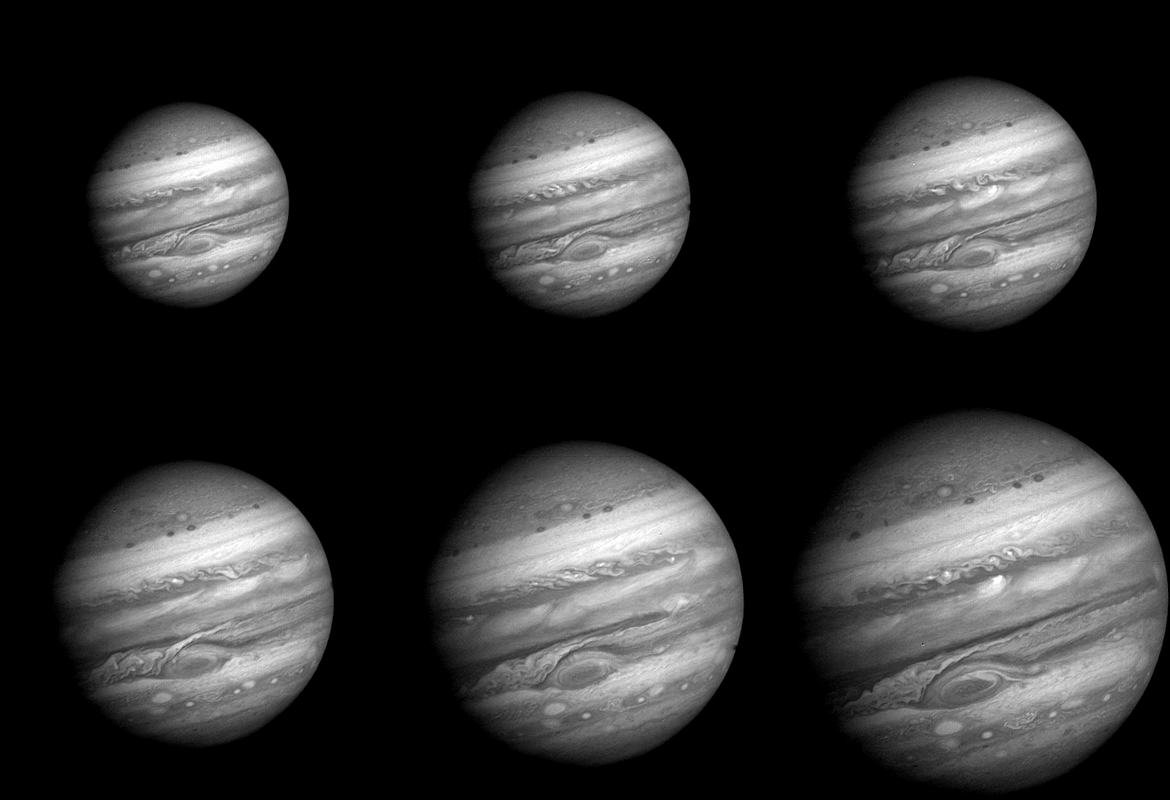
“Not quite. Jupiter has a lovely white equatorial zone all right, but that one doesn’t stand still. It roars eastward, 300 miles per hour faster than the equator’s own 28000 miles per hour. All Jupiter’s white zones move east at a pretty good clip. Its dark belts sprint westward at their own hundred-mile pace. Then there’s the jet streams that run between neighboring bands, and lots of big and little vortices carried along for the ride. The planet’s way too segmented and violent for Coriolis forces to build up enough to play a part. The scientists have a couple of heavily-simplified models, but nowhere near enough data or computer time to fill them in.”

“Earth’s atmosphere is messy enough, thanks. My brain’s hurting.”

Voyager I video of Jupiter, processed by JPL,
from Wikimedia Commons

~~ Rich Olcott

Lemon, Vanilla, Cinnamon

Al claims that lemon’s a Summertime flavor, which is why his coffee shop’s Scone Flavor of the Month in July is lemon even though it doesn’t go well with his coffee. “Give me one of those lemon scones, Al, and an iced tea. It’s a little warm out there this morning.”

“Sure thing, Sy. Say, what’s the latest science-y thing up in the sky?”

“Oh, there’s a bunch, Al. The Japanese Hayabusa-2 spacecraft collected another sample from asteroid Ryugu. NASA’s gravity-sniffer GRAIL lunar orbiter found evidence for a huge hunk of metallic material five times larger than the Big Island of Hawai’i buried deep under the Moon’s South Pole-Aitken Basin. The Insight Mars lander’s seismometer heard its first Marsquake —“

“Quit yanking my chain, Sy. Anything about Jupiter?”

“Gotcha, Al. I know Jupiter’s your favorite planet. As it happens I do have some Jupiter news for you.”

“The Juno orbiter’s still working, I hope.”

“Sure, sure, far as I know. It’s about to make its 13th close flyby of Jupiter, and NASA administrators have green-lighted the mission to continue until July 2021. Lots of data for the researchers to work on for years. Here’s a clue — what’re the top three things that everyone knows about Jupiter?”

“It’s the biggest planet, of course, and it’s got those stripes and the Great Red Spot. Has the planet gotten smaller somehow?”

“No, but the stripes and the Red Spot are acting weird. Had you heard about that?”

“No, just that the Spot’s huge and red and been there for 400 years.”

“Mmm, we’re not sure about the 400 years. But yes, it’s huge.”

“Four times wider than Earth, right?”

“Hasn’t been that big for a long time. Back in the 1870s telescope technology gave the astronomers that ‘four Earths wide‘ estimate. But the Spot’s shrunk in the last 150 years.”

“A whole lot?”

“Last measurement I saw, it’s just barely over one Earth wide. Seems to have gotten a bit taller, though, and maybe deeper.”

“Taller and deeper? Huh, that’s a new one. I always thought of the Spot as just this big oval ring on Jupiter’s surface.”

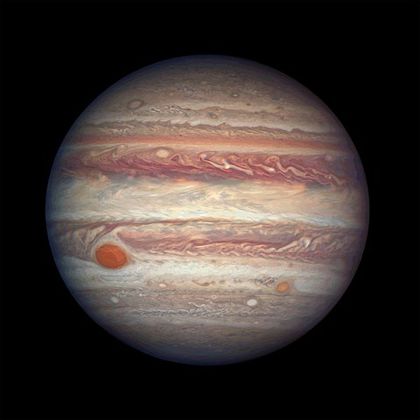
“Everyone has that bogus idea of Jupiter as a big smooth sphere with stripes and ovals and swirls painted on it. Don’t forget, we’re looking down at cloud tops, like those satellite pictures we get looking down at a storm system on Earth. From space, one of our hurricanes looks like a spirally disk centered on a dark spot. That dark spot isn’t in the clouds, it’s actually the top of the ocean, miles below the clouds. If you were a Martian working with photos from a telescope on Phobos, you’d be hard-put to figure that out. You need 3-D perspective to get planets right.”

Jupiter image courtesy ESA/Hubble

“Those stripes and stuff aren’t Jupiter’s surface?”

“As far as we can tell, Jupiter doesn’t have a surface. The hydrogen-helium atmosphere just gets denser and denser until it acts like a liquid. There’s a lot of pressure down there. Juno recently gave us evidence for a core that’s a fuzzy mix of stony material and maybe-metallic maybe-solid hydrogen but if that mush is real it’s only 3% of the planet’s mass. Whatever, it’s thousands of miles below what we see. Jupiter’s anything but smooth.”

“Lumps and bumps like this bubbly scone, huh?”

“More organized than that, more like corduroy or a coiled garden hose. The white stripes are hundreds of miles higher-up than the brown stripes so north-to-south it’s like a series of extreme mountain ranges and valleys. The Great Red Spot reaches up maybe 500 miles further.”

“Does that have to do with what they’re made of?”

“It has everything to do with that, we think. You know Earth’s atmosphere has layers, right?”

“Yeah, the stratosphere’s on top, then you got the weather layer where the clouds are.”

“Close enough. Jupiter has all that and more. Thanks to the Galileo probe we know that Jupiter’s ‘weather layer’ has a topmost blue-white cloud layer of ammonia ice particles, a middle red-to-brown layer containing compounds of ammonia and sulfur, and a bottommost white-ish layer of water clouds. The colors we see depend on which layer is exposed where.”

“But why’re they stripey?”

~~ Rich Olcott

A Recourse to Pastry

There’s something wrong about the displays laid out on Al’s pastry counter — no symmetry.  One covered platter holds eight pinwheels in a ring about a central one, but the other platter’s central pinwheel has only a five-pinwheel ring around it.  I yell over to him.  “What’s with the pastries, Al?  You usually balance things up.”

“Ya noticed, hey, Sy?  It’s a tribute to the Juno spacecraft.  She went into orbit around Jupiter on the 5th of July 2016 so I’m celebrating her anniversary.”

“Well, that’s nice, but what do pinwheels have to do with the spacecraft?”

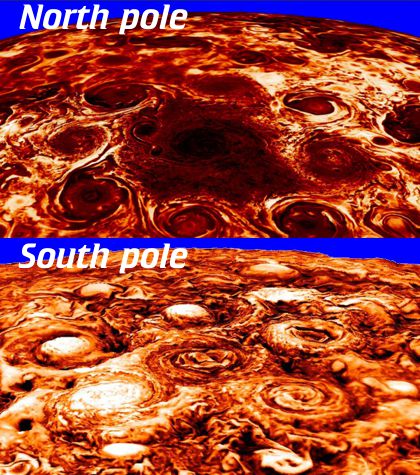
“Haven’t you seen the polar pictures she sent back?  Got a new poster behind the cash register.  Ain’t they gorgeous?”Jupiter both poles“They’re certainly eye-catching, but I thought Jupiter’s all baby-blue and salmon-colored.”
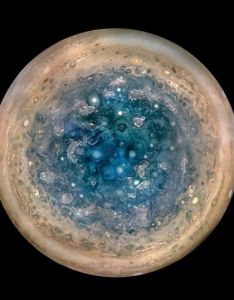
Astronomer Cathleen’s behind me in line.  “It is, Sy, but only in photographs using visible sunlight.  These are infrared images, right, Al?”

“Yeah, from … lemme look at the caption … Juno‘s JIRAM instrument.”

“Right, the infrared mapper.  It sees heat-generated light that comes from inside Jupiter.  It’s the same principle as using blackbody radiation to take a star’s temperature, but here we’re looking at a planet.  Jupiter’s way colder than a star so the wavelengths are longer, but on the other hand it’s close-up so we don’t have to reckon with relativistic wavelength stretching.  At any rate, infrared wavelengths are too long for our eyes to see but they penetrate clouds of particulate matter like interstellar dust or the frigid clouds of Jupiter.”

Jupiter south pole 1
NASA mosaic view of Jupiter’s south pole by visible light

“So this red hell isn’t what the poles actually look like?”

“No, Al,  the visible light colors are in the tops of clouds and they’re all blues and white.  These infrared images show us temperature variation within the clouds.  Come to think of it, that Hell’s frozen over — if I recall correctly, the temperature range in those clouds runs from about –10°C to –80°C.  In Fahrenheit that’d be from near zero to crazy cold.”

“Those aren’t just photographs in Al’s poster?”

“Oh, no, Sy, there’s a lot of computer processing in between Juno‘s wavelength numbers and what the public sees.  The first step is to recode all the infrared wavelengths to visible colors.  In that north pole image I’d say that they coded red-to-black as warm down to white as cool.  The south pole image looks like warmest is yellow-to-white, coolest is red.”

“How’d you figure that?”

“The programs fake the apparent heights.  The warmest areas are where we can see most deeply into the atmosphere, which would be at the center or edge of a vortex.  The cooler areas would be upper-level material.  The techs use that logic to generate the perspective projection that we interpret as a 3-D view.”

Vinnie’s behind us in line and getting impatient.  “I suppose there’s Science in those pretty pictures?”

“Tons of it, and a few mysteries.  JIRAM by itself is telling the researchers a lot about where and how much water and other small molecules reside in Jupiter’s atmosphere.  But Juno has eight other sensors.  Scientists expect to harvest important information from each of them.  Correlations between the data streams will give us exponentially more.”

He’s still antsy.  “Such as?”

“Like how Jupiter’s off-axis magnetic field is related to its lumpy gravitational field.  When we figure that out we’ll know a lot more about how Jupiter works, and that’ll help us understand Saturn and gas-giant exoplanets.”GRS core

Al breaks in.  “What about the mysteries, Cathleen?”

“Those storms, for instance.  They look like Earth-style hurricanes, driven by upwelling warm air.  They even go in the right direction.  But why are they crammed together so and how can they stay stable like that?  Adjacent gears have to rotate in opposite directions, but these guys all go in the same direction.  I can’t imagine what the winds between them must be like.”

“And how come there’s eight in the north pole ring but only five at the other pole?”

“Who knows, Vinnie?  The only guess I have is that Jupiter’s so big that one end doesn’t know what the other end’s doing.”

“Someone’s gonna have to do better than that.”

“Give ’em time.”

~~ Rich Olcott

Planetary Pastry, Third Course

The Al’s Coffee Shop Astronomy gang is still discussing Jupiter’s Great Red Spot.  Cathleen‘s holding court, which is natural because she’s the only for-real Astronomer in the group…  “So here’s what we’ve got.  The rim of the Great Red Spot goes hundreds of miles an hour in the wrong direction compared to hurricanes on Earth.  An Earth hurricane’s eye is calm but the Jupiter Spot’s rim encloses a complex pattern of high winds.  Heat transport and cloud formation on Earth are dominated by water, but Jupiter’s atmospheric dynamic has two active players — water and ammonia.”

“Here’s your pastries, Cathleen.  I brought you a whole selection.  Don’t nobody sneeze on ’em, OK?”

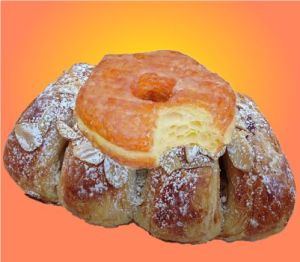
“Oh, they’re perfect, Al.  Thanks.  Let’s start with this bear claw.  We’ll pretend it’s the base of the weather column.  On Earth that’d be mostly ocean, some land surface and some ice.  They’re all rough-ish and steer air currents, which is why there’s a rain shadow inland of coastal mountain ranges.”pastries 2

“Jupiter doesn’t have mountains?”

“We’re virtually certain it doesn’t, Sy.  The planet’s density is so low that it can’t have much heavy material.  It’s essentially an 88,000-mile-wide ball of helium-diluted liquid hydrogen topped by a 30-mile-high weather column.  Anything rocky sank to the core long ago.  The liquid doesn’t even have a real surface.”

<Al and Sy> “Huh?”

“Jovian temps are so low that even at moderate pressures there’s no boundary between gaseous and liquid phases.  Going downward you dive through clear ‘air,’ then progress through an increasingly opalescent haze until you realize you’re swimming.  Physicists just define the ‘surface’ to be the height where the pressure is one atmosphere.  That level’s far enough down that water and ammonia freeze to form overlying cloud layers but hydrogen and helium are still gases.  It could conceivably look like home there except the sky would be weird colors and you don’t see a floor.”

“If the boundary is that blurry, it’s probably pretty much frictionless — weather passes over it without slowing down or losing energy, right?”

“Yup.”

“So there’s way too much slivered almonds and stuff on that bear claw. On this scale it ought to have a mirror finish.”

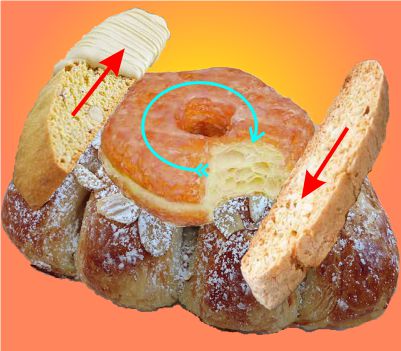
“Good point.  But now we can start stacking weather onto it.  Here’s my doughnut, to represent the Great Red Spot or any of the other long-lived anticyclones.”

“Auntie who?”

“A-n-t-i-cyclone, Al.  Technical term for a storm that disobeys the Coriolis theory.”

“Uh-HUH. So why’s it do that?”

“Well, at this point we can only go up one level in the cause-and-effect chain.  <pulling out smartphone>  NASA’s Voyager 1 spacecraft sent back data for this this wonderful video

790106-0203_Voyager_58M_to_31M_reduced
Jupiter seen by Voyager 1 probe with blue filter in 1979. One image was taken every Jupiter day (approximately 10 hours).  Credit: NASA

“Basically, the Spot is trapped between two jet streams, one going westward at 135 mph and the other going eastward at 110 mph.  I’ll use these biscotti to represent them.pastries with arrows

“Hey, that’s like a rack-and-pinion gear setup, with two racks and an idler, except the idler gear’s four times as wide as the Earth.”

“A bit less than that these days, Sy.  The Spot’s been shrinking and getting rounder.  Every year since 1980 it’s lost about 300 miles east-west and about 60 miles north-south.  As of 2014 it was about 2.8 Earth-widths across.  And no, we don’t know why.  Theories abound, though.”

“What’s one of them?”

“Believe it or not, climate change.  On Jupiter, not Earth.  One group of scientists at Berkeley tackled a couple of observations

  • Unlike Earth, which is much hotter near the Equator than near the poles, Jupiter’s Equator is only a few degrees warmer than its poles.
  • Three persistent White Ovals near the Great Red Spot merged to form a single White Oval that recently turned red but only around the edges.

Their argument is long, technical and still controversial.  However, their proposal is that merging the three ovals disrupted the primary heat transport mechanism that had been evening out Jupiter’s temperature.  IF that’s true, and if it’s the case that Jupiter’s jet streams are powered by heat transport, then maybe disrupted heat patterns are interfering with  the Great Red Spot’s rack-and-pinion machine.  And maybe more.”

“Big changes ahead for the Big Planet.”

“Maybe.”

~~ Rich Olcott

Planetary Pastry, Second Course

We’re still sitting in Al’s coffee shop.  “OK, Cathleen, so Jupiter’s Great Red Spot acts like a hurricane turned inside-out.  Where’s the problem?”

“Just that it goes completely against all the computer models we’ve built to understand and predict hurricane activity.  It’ll take a whole new generation of even more complicated models for Jupiter-like planets.”

“Here’s the doughnuts you asked for, Cathleen.”

“Thanks, Al.  Perfect timing. <drawing on a paper napkin>  Let’s look at hurricanes first, OK, Sy?”

“Sure.”

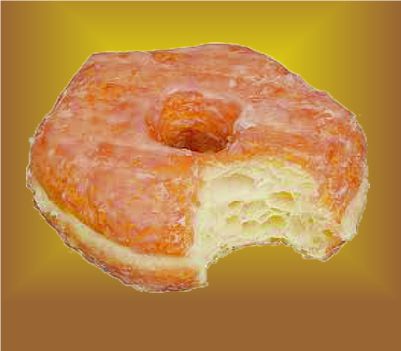
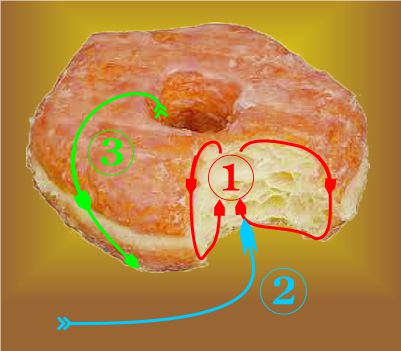
“We’ll start with this doughnut that I’ve just taken a bite out of.  First thing that happens is that warm ocean water heats up the overlying air.  Warmed air rises, so we’ve got an updraft.”

“And then?”

“The rising air is humid (ocean air, remember?).  As it rises it cools and forces moisture to condense out.  Upward flow stops when the warmed air hits the top of the troposphere.  But there’s still more warm air pushing up the plume.  The cooled air has to go somewhere so it spreads out.  That’s where these red arrows on my paper napkin go horizontal.  The cooled air, loaded with water droplets, is heavy so it starts sinking which is why the red arrows turn downward.  They move back across that ocean water again ’cause they’re caught in the inflow.  Full cycle and that’s number 1 here, got it?”

“Yeah.”

“Hey, Cathleen,  are you gonna need more paper napkins?”Donuts 1
“A couple should be enough, Al, thanks.  Now we get to number 2, the Coriolis thing. That’s always tough to talk students through but let’s try.  The Earth rotates once every 24 hours, right, and its circumference at the Equator is 25,000 miles, so relative to the Sun anything at the Equator is flying eastward at about 1,000 miles per hour.  Any place north of the Equator has to be going slower than that, and further north, even slower.  With me, Sy?”

“Gimme a minute … OK, I suppose.”

“Good.  Now suppose a balloon is floating in the breeze somewhere south of that rising plume.  Relative to the plume, it’ll have eastward momentum.  Now the balloon’s caught in the plume’s inflow but it doesn’t go straight in because of that eastward momentum.  Instead it’s going to arc around the plume.  See how I’ve got it coming in off-center?  Al, would that be clockwise or counterclockwise if you’re looking down from a satellite or something?”

“Umm … counterclockwise, yeah?”

“Mm-hm.  What about a balloon that starts out north of the plume?”

“Uhh … It’ll be going slower than the plume, so the plume gets ahead of it and it’ll arc … hey, counterclockwise again!”

“How ’bout that?  Anywhere in the northern hemisphere, air flowing into a low-pressure region will turn it counterclockwise.  As the inflow draws from greater distances, there’s a greater speed difference to drive the counterclockwise spin.  So that’s number 2 here.  Add those two cycles together and you’ve got number 3, which spirals all around the doughnut.  And there’s your hurricane.”

“Cool.  So how does that model not account for the Great Red Spot?”

“To begin with, the Spot’s in Jupiter’s southern hemisphere so it ought to be going clockwise which it definitely is not.  And there’s no broad band of surrounding clouds — just a lot of structure inside the ring, not outside.  There’s something else going on that swamps Coriolis.”

“So how’s Jupiter different from Earth?  Besides being bigger, of course.”

“Lots of ways, Sy.  You know how labels on healthcare products divide the contents into active ingredients and inert ingredients?  The inert ones just carry or modify the effects of the active ones.  Atmospheres work the same way.  On Earth the inert ingredients are nitrogen and oxygen…”

“Hey, oxygen’s important!”

“Sure, Al, but not when you’re modeling air movement.  The important active ingredient is water — it transports a lot of heat when it evaporates from one place and condenses somewhere else.  The biggest outstanding problem in Earth meteorology is accounting for clouds.”

“You’re gonna tell us that Jupiter’s inactive ingredients are hydrogen and helium, I suppose.”

“Precisely, Sy.  Jupiter has two active ingredients, water and ammonia, plus smaller amounts of sulfur and phosphorus compounds.  Makes for a crazy complicated modeling problem.  I’m going to need more pastries.”

“Comin’ up.”


~~ Rich Olcott

Planetary Pastry, First Course

“Morning, Al.  What’s the scone of the day?”

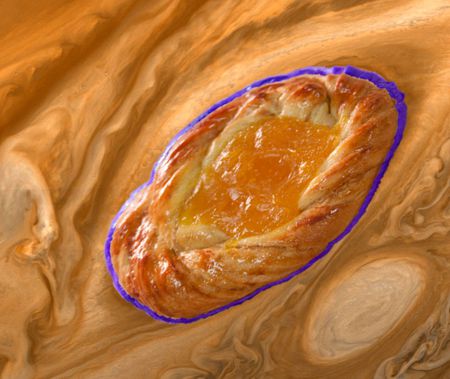
“No scones today, Sy.  Cathleen and one of her Astronomy students used my oven to do a whole batch of these orange-and-apricot Danishes.  Something to do with Jupiter.  Try one.”Great Apricot Spot 1
Cathleen was standing behind me.  “They’re in honor of NASA’s Juno spacecraft.  She just completed a close-up survey of Jupiter’s famous cloud formation, the Great Red Spot.  Whaddaya think?”

“Not bad.  Nice bright color and a good balance of sweetness from the apricot against tartness from the orange.”

“You noticed that, hey?  We had to do a lot of balancing — flavors, colors, the right amount of liquid.  Too juicy and the pastry part comes out gummy, too dry and you break a tooth.  Notice something else?”

“The structure, right?  Like the Spot’s collar around a mushed-up center.”

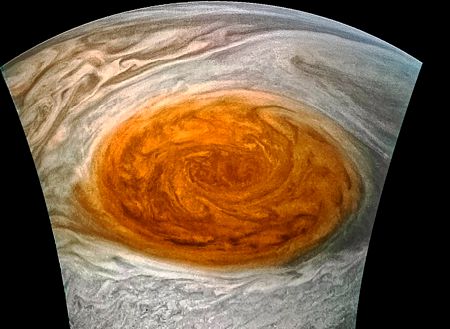
“Close, but Juno showed us that center’s anything but mushed-up.  <pulls out her smartphone>  Here’s what she sent back.”

GRS 1 @400
Credits: NASA/JPL-Caltech/SwRI/MSSS/Jason Major

“See, it’s swirls within swirls. We tried stirring the filling to look like that but it mostly smoothed out in the baking.”

“Hey, is it true what I heard that the Great Red Spot has been there for 400 years?”

“We think so, Al, but nobody knows for sure.  When Galileo published his telescopic observations of Jupiter in 1610 he didn’t mention a spot.  But that could be because he’d already caught flak from the Church by describing mountains and craters on the supposedly perfect face of the Moon.   Besides, the Jovian moons he saw were much more exciting for the science of the time.  A planet with satellites was a direct contradiction to Aristotle’s Earth-centered Solar System.”

“OK, but what about after Galileo?”

“There are records of a spot between 1665 and 1713 but then no reports of a spot for more than a century.  Maybe it was there and nobody was looking for it, maybe it had disappeared.  But Jupiter’s got one now and it’s been growing and shrinking for the past 185 years.”

“So what is it, what’s it made of and why’s it been there so long?”

“Three questions, one of them easy.”

“Which is easy, Sy?”

“The middle one.  The answer is, no-one knows what it’s made of.  That’s part of Juno‘s mission, to do close-up spectroscopy and help us wheedle what kinds of molecules are in there.  We know that Jupiter’s mostly hydrogen and helium, just like the Sun, but both of those are colorless.  Why some of the planet’s clouds are blue and some are pink — that’s a puzzle, right, Cathleen?”

“Well, we know a little more than that, especially since the Galileo probe dove 100 miles into the clouds in 1995.  The white clouds are colder and made of ammonia ice particles.  The pink clouds are warmer and … ok, we’re still working on that.”

“What about my other two questions, Cathleen?”

“People often call it a hurricane, but that’s a misnomer.  On Earth, a typical hurricane is a broad, complex ring of rainstorms with wind speeds from 75 to 200 mph.  Inside the ring wall people say it’s eerily calm.  The whole thing goes counterclockwise in the northern hemisphere, clockwise in the southern one.”

“So how’s the Great Red Spot different?”

“Size, speed, complexity, even direction.  East-to-west, the Spot is eight times wider than the biggest hurricanes.  Its collar winds run about 350 mph and it rotates counterclockwise even though it’s in Jupiter’s southern hemisphere.  It’s like a hurricane inside-out.”

“It’s not calm inside?”

“Nope, take another look at that Juno image.  There’s at least three very busy bands wrapped around a central structure that looks like it holds three distinct swirls.  That’s the part that’s easiest to understand.” GRS core

“Why so?”

“Geometry.  Adjacent segments of separate swirls have to be moving in the same direction or they’ll cancel each other out.  <scribbles diagram on a paper napkin>  Suppose I’ve got just one inside another one.  If they go in the same direction the faster one speeds up the slower one and they merge.  If they go in opposite directions, one of them disappears.  If there’s more than one inner swirl, there has to be an odd number, see?”

“So if it’s not a hurricane, what is it?”

“Got any donuts, Al?”

~~ Rich Olcott