A Cosmological Horse Race

A crisp Fall day, perfect for a brisk walk around the park. I see why the geese are huddled at the center of the lake — Mr Feder, not their best friend, is on patrol again. Then he spots me. “Hey, Moire, I gotta question!”

“Of course you do, Mr Feder. What is it?”

“Some guy on TV said Einstein proved gravity goes at the speed of light and if the Sun suddenly went away it’d take eight minutes before we went flying off into space. Did Einstein really say that? Why’d he say that? Was the TV guy right? And what would us flying across space feel like?”

“I’ll say this, Mr Feder, you’re true to form. Let’s see… Einstein didn’t quite prove it, the TV fellow was right, and we’d notice being cold and in the dark well before we’d notice we’d left orbit. As to why, that’s a longer story. Walk along with me.”

“Okay, but not too fast. What’s not quite about Einstein’s proving?”

“Physicists like proofs that use dependable mathematical methods to get from experimentally-tested principles, like conservation of energy, to some result they can trust. We’ve been that way since Galileo used experiments to overturn Aristotle’s pure‑thought methodology. When Einstein linked gravity to light the linkage was more like poetry. Beautiful poetry, though.”

“What’s so beautiful about something like that?”

“All the rhymes, Mr Feder, all the rhymes. Both gravity and light get less intense with the square of the distance. Gravity and light have the same kinds of symmetries—”

“What the heck does that mean?”

“If an object or system has symmetry, you can execute certain operations on it yet make no apparent difference. Rotate a square by 90° and it looks just the same. Gravity and light both have spherical symmetry. At a given distance from a source, the field intensity’s the same no matter what direction you are from the source. Because of other symmetries they both obey conservation of momentum and conservation of energy. In the late 1890s researchers found Lorentz symmetry in Maxwell’s equations governing light’s behavior.”

“You’re gonna have to explain that Lorentz thing.”

Lorentz symmetry has to do with phenomena an observer sees near an object when their speed relative to the object approaches some threshold. Einstein’s Special Relativity theory predicted that gravity would also have Lorentz symmetry. Observations showed he was right.”

“So they both do Lorentz stuff. That makes them the same?”

“Oh, no, completely different physics but they share the same underlying structure. Maxwell’s equations say that light’s threshold is lightspeed.”

“Gravity does lightspeed, too, I suppose.”

“There were arguments about that. Einstein said beauty demands that both use the same threshold. Other people said, ‘Prove it.’ The strongest argument in his favor at the time was rough, indirect, complicated, and had to do with fine details of Earth’s orbit around the Sun. Half a century later pulsar timing data gave us an improved measurement, still indirect and complicated. This one showed gravity’s threshold to be with 0.2% of lightspeed.”

“Anything direct like I could understand it?”

“How about a straight‑up horse race? In 2017, the LIGO facility picked up a gravitational signal that came in at the same time that optical and gamma ray observatories recorded pulses from the same source, a colliding pair of neutron stars in a galaxy 130 million lightyears away. A long track, right?”

“Waves, not horses, but how far apart were the signals?”

“Close enough that the measured speed of gravity is within 10–15 of the speed of light.”

“A photo-finish.”

“Nice pun, Mr Feder. We’re about 8½ light-minutes away from the Sun so we’re also 8½ gravity-minutes from the Sun. As the TV announcer said, if the Sun were to suddenly dematerialize then Earth would lose the Sun’s orbital attraction 8½ minutes later. We as individuals wouldn’t go floating off into space, though. Earth’s gravity would still hold us close as the whole darkened, cooling planet leaves orbit and heads outward.”

“I like it better staying close to home.”
~ Rich Olcott
The Time Is Out of Joint

Vinnie galumphs over to our table. “Hi, guys. Hey, Sy, I just read your Confluence post. I thought that we gave up on things happening simultaneous because of Einstein and relativity but I guess that wasn’t the reason.”

“Oh, things do happen simultaneously, no‑one claims they don’t, it’s just that it’s impossible for two widely‑separated observers to have evidence that two widely‑separated events happened simultaneously. That’s a very different proposition.”

“Ah, that makes me feel better. The ‘nothing is simultaneous‘ idea was making me itchy ’cause I know for sure that a good juggler lets go with one hand just as they’re catching with the other. How’s Einstein involved then?”

“Lightspeed’s a known constant. Knowing distance and lightspeed lets you calculate between‑event time, right? The key to simultaneity was understanding why lightspeed is a constant. We’d known lightspeed wasn’t infinite within the Solar System since Rømer’s time, but people doubted his number applied everywhere. Maxwell’s theory of electromagnetism derived lightspeed from the properties of space itself so it’s universal. Only in Newton’s Universe was it possible for two distant observers to agree that two also‑distant events were simultaneous.”

“Why was Newton’s Universe special?

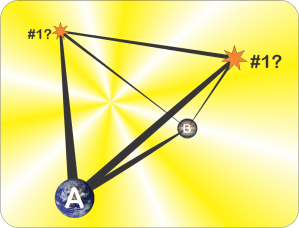
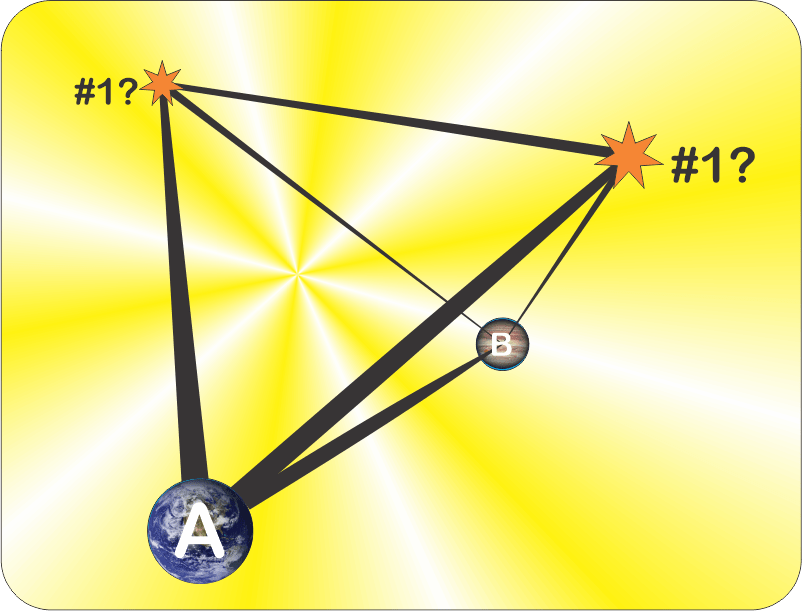
“Space held still and didn’t bend. Astronomers A and B had a stable baseline between them. After measuring the baseline with light they could measure the angles each observed between the events. Some trigonometry let them send each other congratulatory messages on seeing a simultaneous pair of incidents. After Einstein’s work, they knew better.”

“It’s frames again, ain’t it?”

“Of course, Vinnie. A‘s frame is almost certainly moving relative to B‘s frame. Motion puts the Lorentz relativity factor into the game, making each astronomer’s clock run faster than the other’s. Worse, each astronomer sees that the other’s yardsticks are too short.”

Jeremy gives me a confused look.

Space compression goes along with time dilation, Jeremy. Professor Hanneken will explain it all when your class gets to that unit. Bottom line, things can happen simultaneously in Einstein’s Universe, but no‑one can agree on which things.”

“Wait, if every frame has its own time‑rate, how can two spaceships rendezvous for an operation?”

“Good question, Jeremy. Einstein had an answer but complications hide under the covers. He suggested that A start a timer when sending a light pulse to a mirror at B. A waits for the reflection. B starts a timer when they see A‘s pulse. A measures the pulse’s round‑trip time. Each creates a clock that advances one tick for half of the round-trip time. B sets their clock back by one tick. That done, they agree to meet some number of ticks later.”

“Hmm… That should work, but you said there are complications.”

“There are always complications. For instance, suppose B is slingshotting around a black hole so that pulse and reflection travel different pathlengths. Or suppose one frame is rotating edge‑on to the other. In practice the ships would re‑sync repeatedly while approaching the rendezvous point.”

Vinnie erupts. “HAW! Successive approximation again!”

“Indeed. If we could extend the method to more than two participants we’d have a true Universal Coordinated Time.”

“Don’t we have that, Mr Moire? The Big Bang happened 14 billion years ago. Couldn’t we measure time from that?”

“Sort of. Last I looked the number was 13.787 plus‑or‑minus 20 million years. Too much slop for an instantaneous fleet‑level rendezvous like the final battle scene in StarTrek:Picard. But you’ve brought up an interesting question for a Crazy Theories seminar. One of Cosmology’s deepest unsolved questions is, ‘How does inertia work?’ Do you remember Newton’s First Law?”

<closes eyes> “In an inertial reference frame, an object either remains at rest or continues to move at a constant velocity, unless acted upon by a net force.

“Right. In other words, every object resists change to its current steady motion along a geodesic. Why is that? There’s no coherent, well‑founded, well‑tested theory. Einstein liked Mach’s Principle, which says inertia exists because every object is attracted through space to all the mass in the Universe. Suppose there’s a Mach’s Principle for Time, saying that objects squirt up the Time axis because they’re repelled by all the mass in the Universe.”

Vinnie hoots, “Bo-o-o-ohh-GUS!”

~ Rich Olcott

The Beaming Beacon

“So, Vinnie, that first article’s bogus. Blobs in M87’s supermassive black hole’s jet don’t travel faster than light. Your second article — is it also about M87*?”

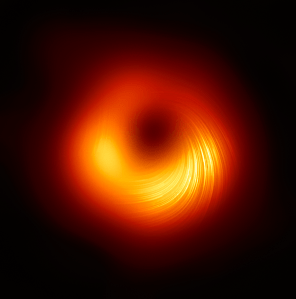
“Yeah, Cathleen. It’s got this picture which a while ago Sy explained looks like a wrung‑out towel because that’s the way the thing’s magnetic field forces electrons to line up and give off polarized light.”

“As always, Vinnie, your memory impresses.”

“Thanks, I work at it. Anyhow, this one‑paragraph article says they figured out from the picture that everything’s spinning around as fast as it’s possible to spin. How fast is that, and how’d they get the spin speed if they only used one frequency so redshift/blueshift doesn’t apply?”

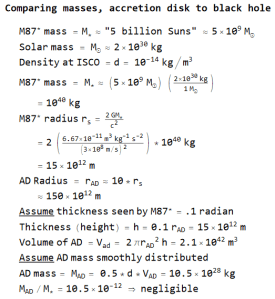
Cathleen’s been poking at her tablet. “HAH! Found the real paper behind your pop‑sci article, Vinnie. Give me a minute…” <pause, with mumbling> “Wow, not much there in the disk. They estimate even at the crowded innermost orbit, they call it ISCO, the density’s about 10-14 kg/m3 which would be one nanopascal of pressure. Most labs consider that ultrahigh vacuum. They get angular momentum from something called ‘Doppler beaming’, which I’m not familiar with.” <passes tablet to me> “Your turn, Sy.”

“ISCO’s the Innermost Stable Circular Orbit. ISCO’s radius depends on the black hole’s mass and spin.” <pause, with mumbling> “Doppler beaming’s a velocity‑dependent brightness shift from outbound to inbound sides of ISCO. They connected brightness range within the images to ISCO velocity, multiplied that by ISCO radius and the black hole’s mass to get the disk’s angular momentum, J. The lightspeed rotation angular momentum Jmax comes from theory. The paper puts a number to M87*’s J/Jmax.

“My article says it’s near 100%.”

“That’s not what the paper says, Vinnie. ‘…our value of 0.8 would appear to be a lower limit,’ in other words, something above 80% but definitely not 100%. Like I said, pop‑sci journalism. So what’s Doppler beaming, Sy?”

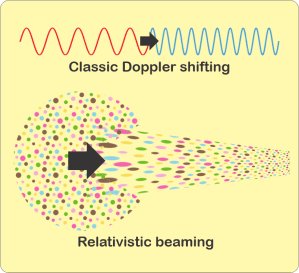
“Classical Doppler shifts happen when a wave source moves relative to us. Motion toward us crams successive wave peaks into decreasing distance. Motion away increases wavelength. The same principle applies to light waves, sound waves, even ocean waves.”

“Blueshifting.”

“Mm‑hm. By contrast, beaming is about how a source’s motion affects the photon count we receive per second. Imagine a beacon steadily sending us photons as it whips at near‑lightspeed around M87*. When the beacon screams towards us its motion crams more photons into one of our seconds than when it dashes away.”

“More blueshifting.”

“Not quite. Photon‑count compression sort‑of resembles the blueshifting process but wavelength isn’t relevant. It combines with the other part of beaming, Special Relativity space compression, which concentrates a moving beacon’s photons in the direction of motion. It’s like focusing a fancy flashlight, narrowing the beam to concentrate it. The faster the beacon travels in our direction, the greater proportion of its photons are sent towards us.”

Vinnie looks up and to the left. “If ISCO’s going near lightspeed, won’t the disk’s inertia drag on the black hole?”

“Sure, within limits. M87* and Sagittarius-A* both have magnetic fields; most black holes probably do. Accretion disk plasma must be frozen into the field. The whole structure would rotate like a spongy wheel with a fuzzy boundary. The lightspeed limit could cut in at the wheel’s rim, much farther out than the Event Horizon’s sphere.”

Count on Vinnie to jump on vagueness. “Spongy? Fuzzy?”

“Because nothing about a black hole’s extended architecture is rigid. It’s a messy mix of gravitational, electric and magnetic fields, all randomly agitated by transients from inbound chunks of matter and feeding outbursts from inside ISCO. The disk’s outer boundary is the raggedy region where the forces finally give way as centrifugal force works to fling particles out into the Universe. I don’t know how to calculate where the boundary is, but this image suggests it’s out about 10 times the Horizon’s radius. The question is, how does the boundary’s speed limit affect spin?” <tapping rapidly on Old Reliable’s screen>

“And the answer is…?”

“Disk particles driven close to lightspeed do push back. They lightly scramble those mushy fields but much too feebly to slow the central spin.”

~ Rich Olcott

Look, Look Again, Then Think

Cathleen and I are sharing scones and memories when Vinnie trundles up to our table. “Glad I got you two together. I just ran across a couple news items and I need some explanations.”

“Astronomy AND Physics in the same news items? Do tell.”

“They’re only one paragraph each and read like someone wrote ’em before their morning coffee. They’re both about that big black hole they’ve been taking pictures of.”

“The one in our galaxy or the M87* supermassive black hole in the Messier‑87 galaxy?”

“The second one, Cathleen. This item says it shot out a jet traveling faster than light.”

<sigh> “Pop‑sci journalism at its worst, right, Sy? I know the work that’s based on and the academic reports don’t say that. Good observations leading to less flamboyant conclusions.”

“Maybe it was supposed to be a bigger article but the editors cut it down badly. That happens. I’m sure it’s not really a superluminal jet—”

“Superluminal’s faster‑than‑light, right?”

“Right, Vinnie. Sorry to get technical. Anyway, it’s an illusion.”

“Ah geez, it’ll be frames again, right?” <eyes suddenly open wide> “Wait, I got it! I betcha it’s about the time difference. Take a blob in that jet, it’s flying out at near lightspeed. Time dilation happens when relativity’s in the game, me and Sy talked about that, so blob‑frame seconds look like they take longer than ours do. We see the blob cramming a lightsecond of distance traveled into less than one of our seconds and that’s superluminal. Am I right, Sy?”

“Right answer to a different question, I’m afraid. You’re straight on the time dilation but it doesn’t apply to this situation. Something happening within the blob’s frame, maybe a star blowing up or something weird metabolizing in there, Special Relativity’s time distortion hijinks would show us that action taking place in slow motion. But this superluminal blob claim hinges on how the blob’s whole frame moves relative to ours. That motion isn’t superluminal but it can look that way if conditions are right. As I understand it, the M87* jet qualifies. Your bailiwick rather than mine, Cathleen.”

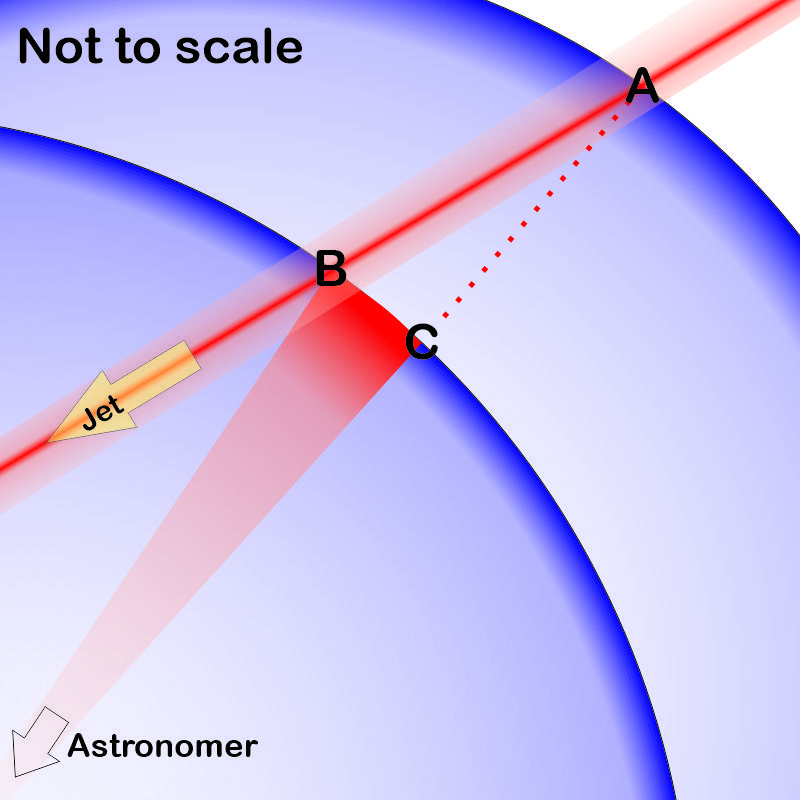
“Actually it is a frames thing, Vinnie, but timeframes, not spacetime. Those blobs move too slowly in our sky to watch in real time. We take snapshot A and then maybe a few years later we take snapshot B and compare. Speed is the ratio of distance to time. We need the A‑B distance in 3‑D space to compare to the known time between snapshots. But we can’t see the blob’s trajectory in 3‑D. All we can capture is its 2‑D arc C‑B across an imaginary spherical shell we call the sky. If the M87* jet were perpendicular to our line of sight the C‑B image on the sky‑sphere would match the 3‑D path. Multiply the image’s angle in radians by the distance to M87* and we’re done.”

“We’re not done?”

“Nope. This jet points only 20° away from our direct line of sight. I’ll spare you the trigonometry and just say that distance A‑B is about 3 times longer than C‑B.”

“So we measure C‑B, triple the angle and multiply by the M87* distance. No problem.”

“Problem. That tripling is what makes the blob’s A‑B journey appear to go faster than light. Three times 0.4c equals 1.2c. But you missed something important. Your arithmetic assumed you could use a simple ‘M87* distance’. Not in this case, because the blob moves towards us at close to lightspeed. Visualize two concentric sky‑spheres. The outer one’s radius runs from us to the blob’s location at A‑time. The inner sphere’s radius runs to the blob’s location at B‑time. The B‑sphere is our reference frame. The light we saw at A‑time had to travel from the outer sphere to the inner one before we could register the C‑B image.”

“Can’t be very far.”

“We’re talking years at lightspeed, so lightyears, so significant. A properly illusion‑free A‑B travel calculation must include the A‑C travel time in the denominator of the distance/time ratio. The true kilometers per second come out well below lightspeed. Oh, and relativity’s not involved.”

“Dang, Cathleen, it was such a cool illusion.”

~ Rich Olcott

Cause, Effect And Time

We’re still at Vinnie’s table by the door of Al’s coffee shop. “Long as we’re talking about black holes, Sy, I read in one of my astronomy magazines that an Event Horizon traps information the same way it traps light. I understand how gravity makes escape velocity for photons go beyond lightspeed, but how does that trap information?”

“Well, to start with, Al, you understand wrong. The whole idea of escape velocity applies to massive objects like rockets that feel the force of gravity. Going up they trade kinetic energy for potential energy; given enough kinetic energy they escape. Photons have zero mass — the only way gravity influences them is by bending the spacetime they fly through.”

“Does the bending also affect information or is that something else?”

Minkowski’s spacetime diagram…

“Fair question, but it’ll take some background to answer it. Good thing I’ve got Old Reliable and my graphics files along. Let’s start with this one. Vinnie’s seen a lot of spacetime graphs like this, Al, but I don’t think you have. Time runs upward, distance runs sideward, okay? Naming a specific time and location specifies an event, just like a calendar entry. Draw a line between two events; the slope is the speed you have to go to get from one to the other.”

“Just the distance, you’re not worrying about direction?”

“Good question. You’re thinking space is 3D and this picture shows only one space dimension. Einstein’s spacetime equations take account of all four dimensions mixing together, which is one reason they’re so hard to solve except in special cases. For where we’re going, distance will be enough, okay?”

“Not gonna argue.”

… compartmentalized by Einstein’s speed limit …

“Now we roll in Einstein’s speed limit. Relativity says that nothing can go faster than light. On a Minkowski diagram like this we draw the lightspeed slope at a 45″ angle. Any physical motion has a slope more vertical than that.”

“Huh?”

“See, Al, you’re going one second per second along time, right? If you’re not making much progress distance‑wise, you don’t do much on Sy’s sideways axis. You move mostly up.”

“Exactly, Vinnie. The bottom and top sections are called ‘timelike‘ because, well, they’re mostly like time.”

“Are the other two sections spacelike?”

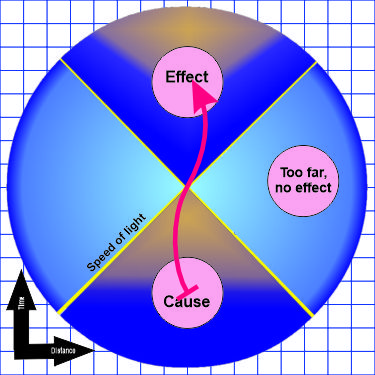
“Absolutely. You can’t get from ‘Here & Now‘ to the ‘Too far to see‘ event without going faster than light. Einstein said that’s a no‑no. Suppose that event’s a nova, ‘Now‘ but far away. Astronomers will have to just wait until the nova’s light reaches them at ‘Here‘ but at a later ‘Now.’ Okay, Vinnie, here’s a graphic you haven’t seen yet.”

… and re-interpreted in terms of causality.

“Looks pretty much the same, except for that arrow. What’s cause and effect got to do with time?”

“I don’t want to get into the metaphysical weeds here. There’s a gazillion theories about time — the Universe is expanding and that drives time; entropy always increases and that drives time; time is an emergent property of the underlying structure of the Universe, whatever that means. From an atomic, molecular, mechanical physics point of view, time is the result of causes driving effects. Causes always come first. Your finger bleeds after you cut it, not before. Cause‑effect runs along the time axis. Einstein showed us that cause‑effect can’t travel any faster than lightspeed.”

“That’s a new one. How’d he figure that?”

“Objects move objects to make things happen. They can’t move faster than lightspeed because of the relativity factor.”

“What if the objects are already touching?”

“Your hand and that cup are both made of atoms and it’s really their electric fields that touch. Shifting fields are limited by lightspeed, too.”

“So you’re saying that cause-effect is timelike.”

“Got it in one. Einstein would say causality is not only timelike, but exactly along the time axis. That’s one big reason he was so uncomfortable about action at a distance — a cause ‘Here‘ having an effect ‘There‘ with zero time elapsed would be a horizontal line, pure spacelike, on Minkowski’s graph. Einstein invented the principle of entanglement as a counterexample, thinking it impossible. He’d probably be shocked and distressed to see that today we have experimental proof of entanglement.”

~~ Rich Olcott

Now And Then And There

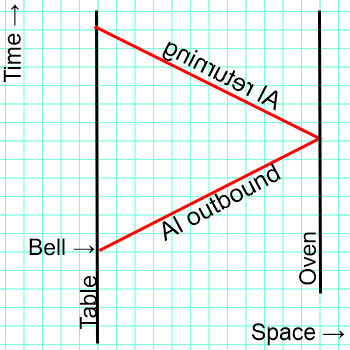
Still at our table in Al’s otherwise empty coffee shop. We’re leading up to how Physics scrambled Now when a bell dings behind the counter. Al dashes over there. Meanwhile, Cathleen scribbles on a paper napkin with her colored pencils. She adds two red lines just as Al comes back with a plate of scones. “Here, Sy, if you’re going to talk Minkowski space this might be useful.”

“Hah, you’re right, Cathleen, this is perfect. Thanks, Al, I’ll have a strawberry one. Mmm, I love ’em fresh like this. OK, guys, take a look at Cathleen’s graphy artwork.”

“So? It’s the tile floor here.”

“Not even close, Mr Feder. Check the labels. The up‑and‑down label is ‘Time’ with later as higher. The diagram covers the period we’ve been sitting here. ‘Now‘ moves up, ‘Here’ goes side‑to‑side. ‘Table‘ and ‘Oven‘, different points in space, are two parallel lines. They’re lines because they both exist during this time period. They’re vertical because neither one moves from its relative spatial position. Okay?”

“Go on, Moire.”
  ”Makes sense to me, Sy.”

“Good. ‘Bell‘ marks an event, a specific point in spacetime. In this case it’s the moment when we here at the table heard the bell. I said ‘spacetime‘ because we’re treating space and time as a combined thing. Okay?”

“Go on, Moire.”
  ”Makes sense to me, Sy.”

“So then Al went to the oven and came back to the table. He traveled a distance, took some time to do that. Distance divided by time equals velocity. ‘Table‘ has zero velocity and its line is vertical. Al’s line would tilt down more if he went faster, okay?”

“Mmmm, got it, Sy.”
  ”Cute how you draw the come-back label backwards, lady. Go on, Moire.”

“I do my best, Mr Feder.”

“Fine, you’ve got the basic ideas. Now imagine all around us there’s graph paper like this — except there’s no paper and it’s a 4‑dimensional grid to account for motion in three spatial dimensions while time proceeds. Al left and returned to the same space point so his spacetime interval is just the time difference. If two events differ in time AND place there’s special arithmetic for calculating the interval.”

“So where’s that get us, Moire?”

“It got 18th and 19th Century Physics very far, indeed. Newton and everyone after him made great progress using math based on a nice stable rectangular space grid crossed with an orderly time line. Then Lorentz and Poincaré and Einstein came along.”

“Who’s Poincaré?”

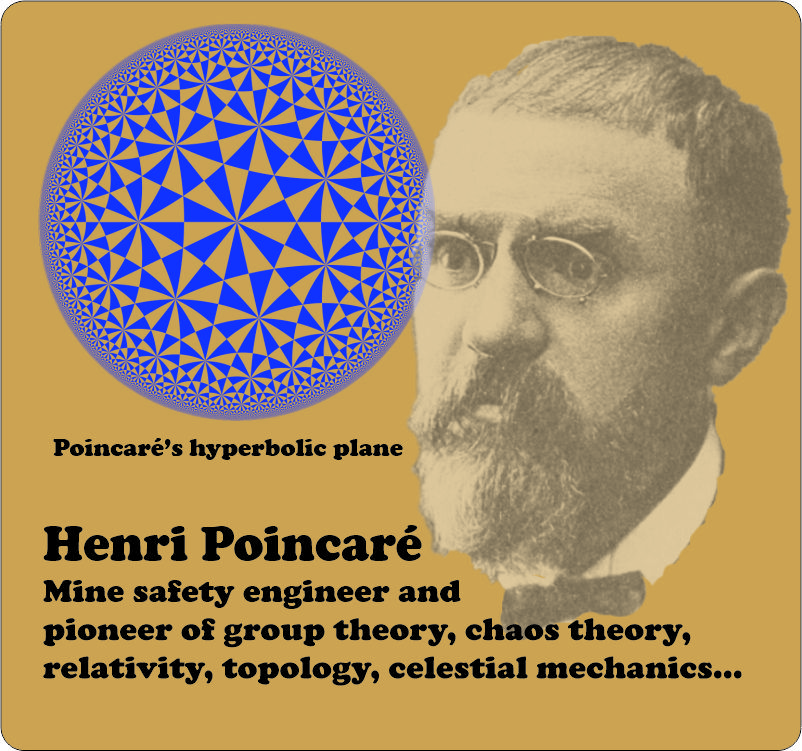
“The foremost mathematician of nineteenth Century France. A mine safety engineer most days and a wide‑ranging thinker the rest of the time — did bleeding‑edge work in many branches of physics and math, even invented a few branches of his own. He put Lorentz’s relativity work on a firm mathematical footing, set the spacetime and gravity stage for Minkowsky and Einstein. All that and a long list of academic and governmental appointments but somehow he found the time to have four kids.”

“A ball of fire, huh? So what’d he do to Newton’s jungle gym?”

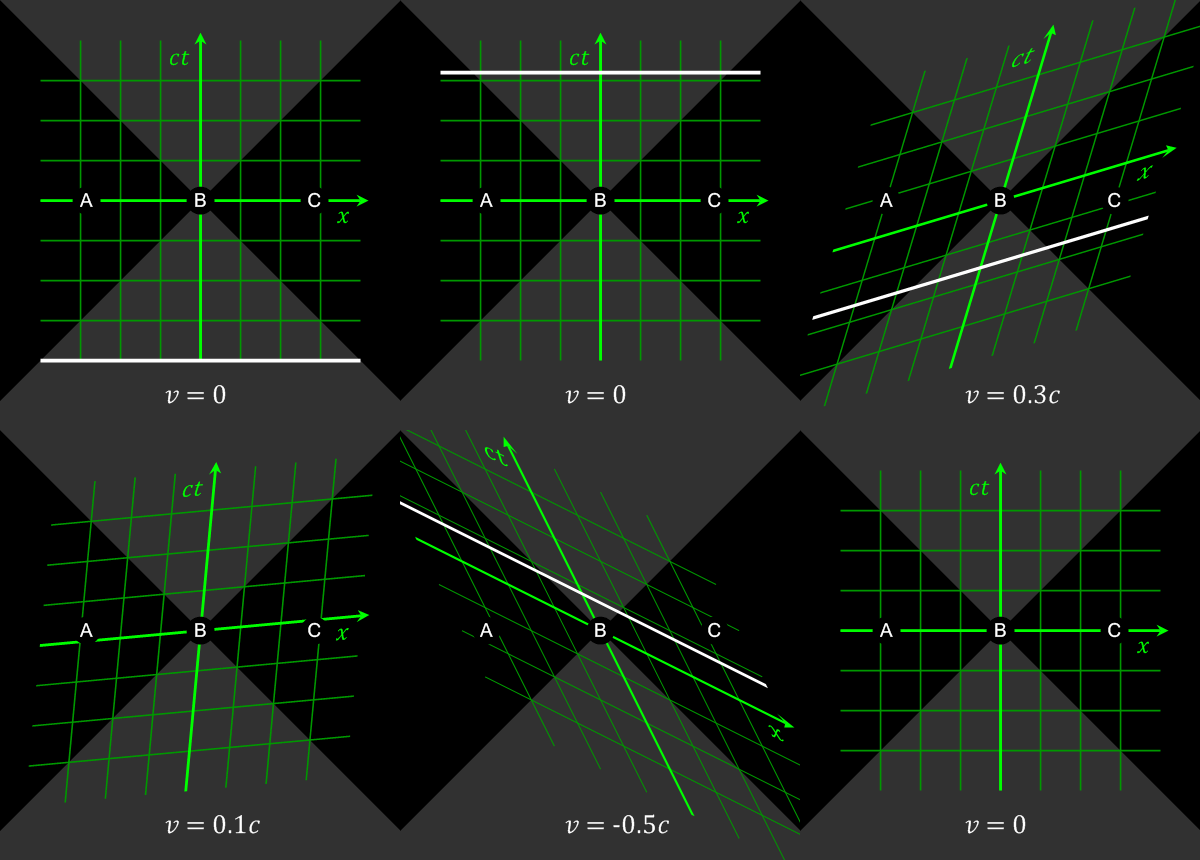
“Turned its steel rod framework into jello. Remember how Cathleen’s Minkowski diagram connected slope with velocity? Einstein showed how Lorentz’s relativity factor sets a speed limit for our Universe. On the diagram, that’d be a minimum slope. Going vertical is okay, that’s standing still in space. Going horizontal isn’t, because that’d be instantaneous travel. This animation tells the ‘Now‘ story better than words can.”

“Whah?”
  ”Whah?”

“We’re looking down on three space travelers and three events. Speeds below lightspeed are within the gray hourglass shape. The white line perpendicular to each traveler’s time line is their personal ‘Now‘. The travelers go at different velocities relative to us so their slopes and ‘Now‘ lines are different. From our point of view, time goes straight up. One traveler is sitting still relative to us so its timeline is marked ‘v=0‘ and parallels ours. We and the v=0 traveler see events A, B and C happening simultaneously. The other travelers don’t agree. ‘Simultaneous‘ is an illusion.”

~~ Rich Olcott

The Bottom of Time

“Cathleen, one of my Astronomy magazines had an article, claimed that James Webb Space Telescope can see back to the Big Bang. That doesn’t seem right, right?”

“You’re right, Al, it’s not quite right. By our present state of knowledge JWST‘s infrared perspective goes back only 98% of the way to the Bang. Not quite the Bottom of Time, but close.”

“Whaddaya mean, ‘Bottom of Time‘? I’ve heard people talking about how weird it musta been before the Big Bang. And how can JWST see back in time anyway? Telescopes look across space, not time.”

“So many questions, Mr Feder, and some hiding behind others. That’s his usual mode, Cathleen. Care to tag-team?”

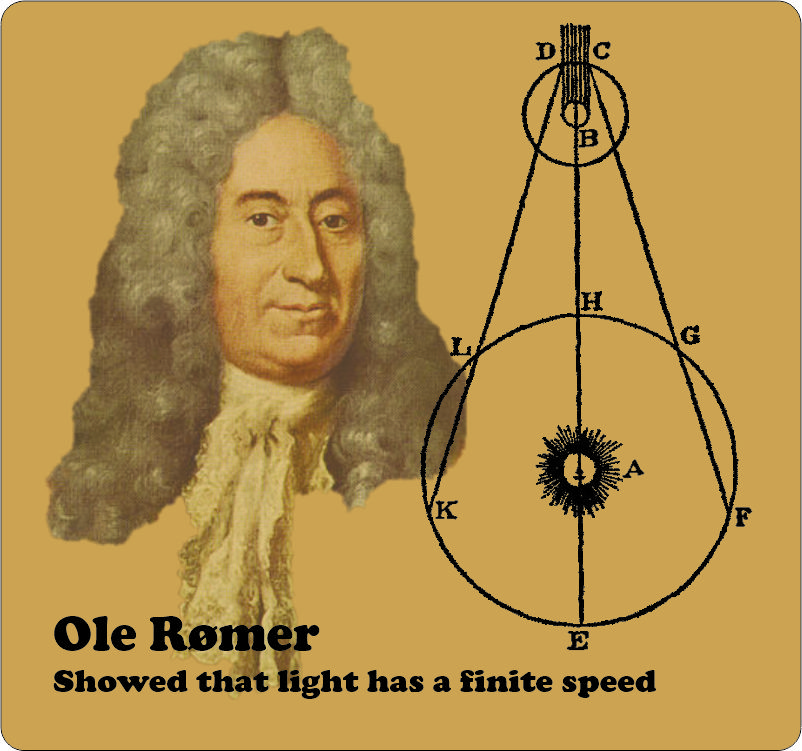
“You’re on, Sy. Well, Mr Feder. The ‘look back in time‘ part comes from light not traveling infinitely fast. We’ve known that for three centuries, ever since Rømer—”

“Roamer?”

“Ole Rømer, a Danish scientist who lived in Newson’s time. Everyone knew that Jupiter’s innermost large moon Io had a dependably regular orbit, circling Jupiter every 49½ hours like clockwork. Rømer was an astronomer when he wasn’t tutoring the French King’s son or being Copenhagen’s equivalent of Public Safety Commissioner. He watched Io closely, kept notes on exactly when she ducked behind Jupiter and when she reappeared on the other side. His observed timings weren’t quite regular, generally off by a few minutes. Funny thing was, the irregularities correlated with the Earth‑Jupiter distance — up to 3½ minutes earlier than expected when Earth in its orbit was closest to Jupiter, similarly late when they were far apart. There was a lot of argument about how that could be, but Rømer, Huygens, even Newton, all agreed that the best explanation was that we only see Io’s passage events after light has taken its time to travel from there to here.”

“Seems reasonable. Why should people argue about that?”

“The major sticking point was the speed that Huygens calculated from Rømer’s data. We now know it’s 186000 miles or 300000 kilometers or one lightsecond per second. Different ways of stating the same quantity. Huygens came up with a somewhat smaller number but still. The establishment pundits had been okay with light transmission being instantaneous. Given definite numbers, though, they had trouble accepting the idea that anything physical could go that fast.”

“Tag, my turn. Flip that distance per time ratio upside down — for every additional lightsecond of distance we’re looking at events happening one second farther into the past. That’s the key to JWST‘s view into the long‑ago. Al, you got that JWST‘s infrared capabilities will beat Hubble‘s vis‑UV ones for distance. Unless there’s something seriously wrong with Einstein’s assumption that lightspeed’s an absolute constant throughout spacetime, we expect JWST to give us visibility to the oldest free photons in the Universe, just 379000 years upward from the Big Bang.”

“Wait, I heard weaseling there. Free photons? Like you gotta pay for the others?”

“Ha, ha, Mr Feder. During those first 379000‑or‑so years, we think the Universe was so hot and so dense that no photon’s wave had much of a chance to spread out before it encountered a charged something and got absorbed. At last, things cooled down enough for atoms to form and stay in one piece. Atoms are neutral. Quantum rules restrict their interaction to only photons that have certain wavelengths. The rest of the photons, and there’s a huge number of them, were free to roam the expanding Universe until they happen to find a suitable absorber. Maybe someone’s eye or if we’re lucky, a sensor on JWST or some other telescope.”

Thanks for this to George Derenburger

“What about before the 300‑and‑something thousand years? Like, before Year Zero? Musta been weird, huh?”

“Well, there’s a problem with that question. You’re assuming there was a Year Minus‑One, but that’s just not the case.”

“Why not? Arithmetic works that way.”

“But the Universe doesn’t. Stephen Hawking came up with a good way to think about it. What on Earth is south of the South Pole?”

“Eeayahh … nope. Can’t get any further south than that.”

“Well, there you are, so to speak. Time’s bottom is Year Zero and you can’t get any further down than that. We think.”

~~ Rich Olcott

Yardsticks

“Hi, Cathleen, meet Mr Richard Feder, of Fort Lee NJ. He’s got a question that’s more in your Astronomy bailiwick than mine. Have a strawberry scone.”

“Mmm, still warm from Al’s oven. Thanks, Sy. Hello and what’s your question, Mr Feder?”

“Hiya. So if the James Webb Space Telescope is gonna be a million miles behind the Moon, won’t the Moon block its signals to us?”

“Oh dear, he said ‘miles.’ Sy, you’d better get out Old Reliable to look up numbers and do unit conversions. Mr Feder, I don’t think in miles.”

“Huh? What do you use instead, like paces or something?”

“Depends on what objects I’m considering and why I’m thinking about them. There are so many useful ratios out there it’s often easier to use ratios than huge numbers one can’t wrap one’s head around. Jupiter’s radius, for instance, is eleven times Earth’s, and the Sun is ten times wider still. Diameter and circumference follow the same ratios, of course. Square those ratios for relative surface area, cube them for relative volume. Who needs miles or kilometers?”

“Those numbers right, Moire?”

“Mmm … 6371 kilometers or 3959 miles for Earth, 71492 kilometers or 42441 miles for Jupiter, 695700 kilometers or 432300 miles for the Sun. The Jupiter/Earth ratio’s 11.2, the Sun/Jupiter ratio’s 9.73. The lady knows what she’s talking about.”

“Here’s a few fun factoids. The Moon’s distance is 10 times Earth’s Equator which is 100 times the International Space Station’s altitude. For that matter, if you wrapped a string around Earth’s Equator, it’d be just long enough to reach up to a GPS satellite and back. But all those are near‑Earth measurements where it makes sense to think in miles or kilometers. That’s too cumbersome for the bigger picture.”

“What else you got?”

“Within the Solar System I generally use one or the other of two convenient yardsticks. They measure the same distances, of course, but they have different applications. One is the nominal radius of Earth’s orbit, about 150 million kilometers.’

“That’s 93 million miles, Mr Feder.”

“I knew that one, Moire.”

“Anyway, we call that distance an Astronomical Unit. It’s handy for locating bodies relative to the Sun. Parker Solar Probe has gotten within a tenth of an AU of the Sun, for instance, and Neptune’s about 30 AU out. The Oort Cloud begins near 2000 AU and may extend a hundred times as far.”

“I ain’t even gonna ask what the Oort‐thing is, but I’m glad it’s a long way away.”

“We think it’s where long‑period comets come from.”

“Far away is good then. So what’s your other yardstick?”

“Lightspeed.”

“186 thousand miles per second, Mr Feder.”

“Yeah, yeah.”

“It’s also 300 thousand kilometers per second, and one light‑second per second, and one light‑year per year. Within the Solar System my benchmarks are that Earth is 500 light-seconds from the Sun, and Pluto was 4½ light-hours away from us when New Horizons sent back those marvelous images. The Sun’s nearest star system, Alpha Centauri, is 4⅓ light‑years away, and when you compare hours to years that gives you an idea of how small we are on the interstellar scale.”

“Cathleen, when you mentioned New Horizons that reminded me of the JWST. We’ve gotten off the track from Mr Feder’s question. Why isn’t the Moon going to block those signals?”

“Because it’ll never be in the way.” <sketching on a paper napkin> “There’s a bunch of moving parts here so hold on. The Earth orbits the Sun and the Moon orbits the Earth once a month, right? The L2 point doesn’t orbit the Earth. It orbits the Sun, staying exactly behind Earth so yeah, once a month the Moon could maybe get between Earth and L2. But JWST won’t be at L2, it’ll be in a wide orbit around that point and mostly perpendicular to the orbits of the Earth and Moon.”

“How wide?”

“It’ll vary depending on what they need, but it’s big enough to keep the spacecraft’s solar panels in the sunlight.”

“Solar panels? I thought the IR sensors needed cold cold cold.”

“They do. JWST protects its cold side with a hot side featuring a pretty pink Kapton parasol.”

~~ Rich Olcott

Things That Won’t Work

Vinnie gets a far-away look in his eye. I wait. “Ya know, Sy, there oughtta be a way.”

“A way to what?”

“I ain’t giving up on this faster-than-light communication stuff. I know Einstein said it couldn’t happen because it’d flip cause and effect and he didn’t like that, but that feels too much like philosophy books I’ve read that boil down to, ‘This thing can’t be true because I don’t want it to be.’ Maybe there’s something we ain’t thought of yet.”

“Lots of people have played with that challenge for decades. Do you have any fresh ideas?”

“A couple possibles. Lessee if I’ve got this straight. We’ve got two separate message channels going — one that works instant-like for information between entangled quantum thingies, and one for everything else that’s stuck at lightspeed or less. Suppose I’ve got two entangled pizzas— nah, we’re really talking quantum stuff like electrons and photons so I’ll just say particles. Suppose I’ve got two entangled particles that are some ugly mix of red and green but we know when they’re de-linked they’ll be opposite. I send one to you the regular way but they’re still linked. I look at the one I still got and it’s red, say. The same moment, yours instantly went green but you don’t know that yet until you look or you get status information from me through the not‑instant channel. So the problem is getting information to leak between the two channels, right?”

“That’s about the size of it.”

“OK, try this one. How about I use a magnetic field or something to force mine to red? And maybe a set time later I make it green to confirm I’m in control and it’s a real signal.”

“Sorry, as soon as you manipulate properties in part of an entangled system you break the entanglement and the other part is free to do whatever it wants to. Next?”

“Uhh … time synchronization. How about you and me set a certain time for me to look at mine? You can watch yours and when it flips or not you’ll know.”

“All that does is move the manipulation to the other end of the setup. Me looking at my particle resets yours to whatever color mine isn’t and that breaks the entanglement. Next?”

“Maybe something with a bunch of particles all entangled together? How about—”

“Nup, can’t base a strategy on that. Like everything else quantum, entanglement is statistical. There’s no guarantee that even in our two‑particle system I’ll see green if you see red — the odds are high but not 100%. There’s a proven theorem that says if two particles are ‘maximally entangled,’ adding a third to the system reduces the odds that any two will coordinate their behaviors. A bunch of particles would be even less stable. It’s called the monogamy theorem, care to guess why?”

“Physics fun with metaphors again, cute, but I can see this is a good one. You got anything?”

“Not having to do with entanglement, but I have been playing with a different idea, sort of a blank‑sky approach.”

“You mean blue‑sky.”

“Uh-uh, blank. Think about a sky made of dark matter. Dark matter’s subject to gravity but so far as we know it has absolutely no interaction with electromagnetism of any kind — doesn’t play with electrons, light waves, nothing. Einstein based part of his relativity work on Maxwell’s electromagnetism equations. In fact, that’s where the idea came from that ‘c‘ was the speed limit for the Universe. It was a good idea and there’s a huge amount of evidence that he was right. Everything in our Standard Model except the photon is subject to the Lorentz factor. Both light and gravity acting on normal matter travel at c‑speed. Well, maybe the value of c has something to do with how quarks work. Dark matter doesn’t have quarks. What if dark matter has a different speed limit, maybe a lot higher than c or even no limit at all? Maybe we could exploit that property somehow. How about a dark‑matter telegraph?”

“I’m thinking of my Grampa’s recipe for rabbit stew. ‘First you gotta catch your rabbit,’ he used to say,”

~~ Rich Olcott

Three-speed Transmission

“Have I got this straight, Sy? You’re saying that prisms throw rainbows because light goes slower through glass than in air and that bends the beam, but every frequency lightwave bends a different amount. Also you’re saying all the bending happens when speeds switch at the glass face, not inside the glass. Am I right so far?”

“Perfect, Vinnie, but you skipped an important detail.”

“Which one?”

“Snell’s ‘index of refraction‘, the ratio of wave speed in vacuum to wave speed in the medium. The higher the frequency, the higher the speed in the medium so the index decreases towards 1.0. The definition lets us calculate wave speed in the medium from that frequency’s refraction index. For most materials the index is usually greater than 1.0, meaning that the speed inside the material is usually slower than in space.”

“Still using those ‘most‘ and ‘usually‘ weasel‑words.”

“Guilty as charged, because we’ve finally gotten to the ‘multiple speeds of light‘ thing. Which means I need more precise wording. The wave speed we’ve been talking about so far applies to a specific part of the wave, say the peak or trough. Those are wave phases, so I’m going to call that speed the ‘phase speed‘, OK?”

“Fine with me.”

“Good, because the second speed is different. Among his many important contributions, Lord Rayleigh pointed out that you can’t have a pulse that’s one pure frequency. A single‑frequency wave never starts and never ends. Do you remember the time I combined waves to draw a camel?”

“You did, mostly, but there was funny stuff at his nose and butt.”

“Because I only included about a hundred component waves. It’d take many more to kill those boundary zig‑zags. Any finite wave has the same issue. Rayleigh said that an individual wave has a phase speed, but any ‘peculiarity,’ like a pulse rise or fall, could only be created by a group of waves. The peculiarity could travel at a different speed from the component waves, like a pair of scissors where the cutting point moves faster than either blade.”

“Sounds like carrier wave and sidebands on my ham radio. But if different frequencies have different speeds they’d get all out of sync with each other. How does a photon stay in one piece?”

“The vacuum is non-dispersive — the photon’s component waves all travel at the same speed and stay together. If a medium absorbs some frequency, that makes it dispersive and that changes things.”

“Ah, that’s why you hedged about transparency.”

“Exactly. Throw in a few absorbing atoms, like cobalt that absorbs red or gold that absorbs blue, and you get interesting effects from your sideband components interacting. Skipping some math, the bottom line is simple and cute. The group speed’s equation is just like the phase speed’s except there’s a positive or negative correction term in the denominator.”

“Sy, I don’t like equations, remember? I suppose f is frequency in your correction term but what’s slope?”

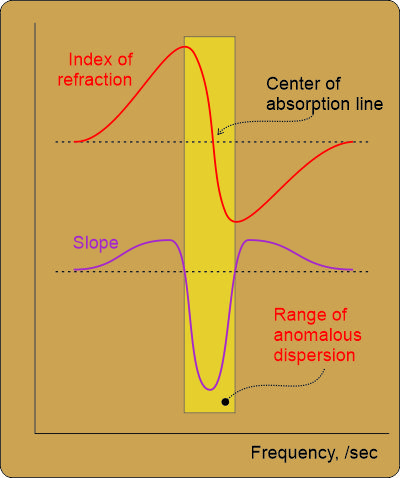
“That’s a measure of how rapidly the index changes as the frequency changes. For most frequencies and most media, the slope is very slightly negative because the index slowly descends towards 1.0 at high energies. The vg fraction’s denominator stays just less than nf so the group goes slightly faster than the phase. Near an absorption line, though, things get sloppy. Waves that are just a little off the absorber’s favorite frequency can still interact with it. That changes their speed and the ‘corrected’ refraction index.”

“Gimme a sec … guess I’m OK with the positive slopes but there’s that yellow part where the slope is negative. Wouldn’t that make the fraction’s bottom smaller and the group speed higher?”

“Certainly. In fact, under the right conditions the denominator can be less than 1.0. That pushes the group speed above c — faster than light in vacuum, even though the component waves all run slower than vacuum lightspeed. It’s only the between‑component out‑of‑syncness relationship that scissors along beyond c.”

“You said there’s a third speed?”

“Signals. In a dispersive medium those sideband waves get chaotic and can’t carry information. Wave theory and Einstein agree — chaos may be able to travel faster than light, but information can’t.”

~~ Rich Olcott