


Al’s coffee shop, the usual mid-afternoon crowd of chatterers and laptop-tappers. Al’s walking his refill rounds, but I notice he’s carrying a pitcher rather than his usual coffee pot. “Hey, Al, what’s with the hardware?”
“Got iced coffee here, Sy. It’s hot out, people want to cool down. Besides, this is in honor of IceCube.”
“Didn’t realize you’re gangsta fan.”
“Nah, not the rapper, the cool experiment down in the Antarctic. It was just in the news.”
“Oh? What did they say about it?”
“It’s the biggest observatory in the world, set up to look for the tiniest particles we know of, and it uses a cubic mile of ice which I can’t think how you’d steer it.”
A new voice, or rather, a familiar one. “One doesn’t, Al.”
 “Hello, Jennie. Haven’t seen you for a while.”
“I flew home to England to see my folks. Now I’m back here for the start of the Fall term. I’ve already picked a research topic — neutrinos. They’re weird.”
“Hey, Jennie, why are they so tiny?”
“It’s the other way to, Al. They’re neutrinos because they’re so tiny. Sy would say that for a long time they were simply an accounting gimmick to preserve the conservation laws.”
“I would?”
“Indeed. People had noticed that when uranium atoms give off alpha particles to become thorium, the alpha particles always have about the same amount of energy. The researchers accounted for that by supposing that each kind of nucleus has some certain quantized amount of internal energy. When one kind downsizes to another, the alpha particle carries off the difference.”
“That worked well, did it?”
“Oh, yes, there are whole tables of nuclear binding energy for alpha radiation. But when a carbon-14 atom emits a beta particle to become nitrogen-14, the particle can have pretty much any amount of energy up to a maximum. It’s as though the nuclear quantum levels don’t exist for beta decay. Physicists called it the continuous beta-spectrum problem and people brought out all sorts of bizarre theories to try to explain it. Finally Pauli suggested maybe something we can’t see carries off energy and leaves less for the beta. Something with no charge and undetectable mass and the opposite spin from what the beta has.”
“Yeah, that’d be an accounting gimmick, alright. The mass disappears into the rounding error.”
“It might have done, but twenty years later they found a real particle. Oh, I should mention that after Pauli made the suggestion Fermi came up with a serious theory to support it. Being Italian, he gave the particle its neutrino name because it was neutral and small.”
“But how small?”
“We don’t really know, Al. We know the neutrino’s mass has to be greater than zero because it doesn’t travel quite as fast as light does. On the topside, though, it has to be lighter than than a hydrogen atom by at least a factor of a milliard.”
“Milliard?”
“Oh, sorry, I’m stateside, aren’t I? I should have said a billion. Ten-to-the-ninth, anyway.”
“That’s small. I guess that’s why they can sneak past all the matter in Earth like the TV program said and never even notice.”
This gives me an idea. I unholster Old Reliable and start to work.
“Be right with you… <pause> … Jennie, I noticed that you were being careful to say that neutrinos are light, rather than small. Good careful, ’cause ‘size’ can get tricky at this scale. In the early 1920s de Broglie wrote that every particle is associated with a wave whose wavelength depends on the particle’s momentum. I used his formula, together with Jennie’s upper bound for the neutrino’s mass, to calculate a few wavelength lower bounds. Momentum is velocity times mass. These guys fly so close to lightspeed that for a long time scientists thought that neutrinos are massless like photons. They’re not, so I used several different v/c ratios to see what the relativistic correction does. Slow neutrinos are huge, by atom standards. Even the fastest ones are hundreds of times wider than a nucleus.”
“With its neutrino-ness spread so thin, no wonder it’s so sneaky.”
“That may be part of it, Al.”
“But how do you steer IceCube?”
~~ Rich Olcott



 “OK,
“OK, 


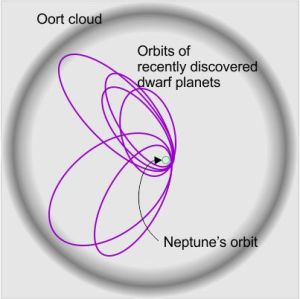


 This video, from an Orbits Table display at the Denver Museum of Nature and Science, shows a different Plutonian weirdness. We’re circling the Solar System at about 50 times Earth’s distance from the Sun (50 AU). Reading inward, the white lines represent the orbits of Neptune, Uranus, Saturn and Jupiter. The Asteroid Belt is the small greenish ring close to the Sun. The four terrestrial planets are even further in. The Kuiper Belt is the greenish ring that encloses the lot.
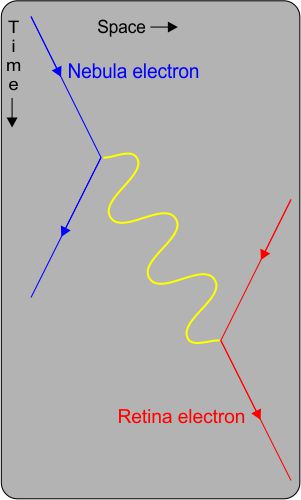 Here we have a Feynman diagram, named for the Nobel-winning (1965) physicist who invented it and much else. The diagram plots out the transaction we just discussed. Not a conventional x-y plot, it shows Space, Time and particles. To the left, that far-away electron emits a photon signified by the yellow wiggly line. The photon has momentum so the electron must recoil away from it.
 It would have been awesome to watch Dragon Princes in battle (from a safe hiding place), but I’d almost rather have witnessed “The Tussles in Brussels,” the two most prominent confrontations between Albert Einstein and Niels Bohr.
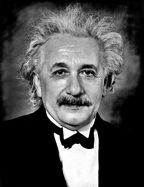 Like Newton, Einstein was a particle guy. He based his famous thought experiments on what his intuition told him about how particles would behave in a given situation. That intuition and that orientation led him to paradoxes such as entanglement, the
  Bohr was six years younger than Einstein. Both Bohr and Einstein had attained Directorship of an Institute at age 35, but Bohr’s has his name on it. He started out as a particle guy — his first splash was a trio of papers that treated the hydrogen atom like a one-planet solar system. But that model ran into serious difficulties for many-electron atoms so Bohr switched his allegiance from particles to Schrödinger’s wave theory. Solve a Schrödinger equation and you can calculate statistics like
  Here’s where Ludwig Wittgenstein may have come into the picture. Wittgenstein is famous for his telegraphically opaque writing style and for the fact that he spent much of his later life disagreeing with his earlier writings. His 1921 book, Tractatus Logico-Philosophicus (in German despite the Latin title) was a primary impetus to the Logical Positivist school of philosophy. I’m stripping out much detail here, but the book’s long-lasting impact on QM may have come from its Proposition 7: “Whereof one cannot speak, thereof one must be silent.“

 Hard Science Ain't Hard