Imagine A Skyrocket Inside A Black Hole

Vinnie’s never been a patient man. “We’re still waiting, Sy. What’s the time-cause-effect thing got to do with black holes and information?”

“You’ve got most of the pieces, Vinnie. Put ’em together yourself.”

“Geez, I gotta think? Lessee, what do I know about black holes? Way down inside there’s a huge mass in a teeny singularity space. Gravity’s so intense that relativity theory and quantum mechanics both give up. That can’t be it. Maybe the disk and jets? No, ’cause some holes don’t have them, I think. Gotta be the Event Horizon which is where stuff can’t get out from. How’m I doing, Sy?”

“You’re on the right track. Keep going.”

“Okay, so we just talked about how mass scrambles spacetime, tilts the time axis down to point towards where mass is so axes stop being perpendicular and if you’re near a mass then time moves you even closer to it unless you push away and that’s how gravity works. That’s part of it, right?”

“As rain. So mass and gravity affect time, then what?”

“Ah, Einstein said that cause‑and‑effect runs parallel with time ’cause you can’t have an effect before what caused it. You’re saying that if gravity tilts time, it’ll tilt cause‑and‑effect?”

“So far as we know.”

“That’s a little weasel-ish.”

“Can’t help it. The time‑directed flow of causality is a basic assumption looking for counter‑examples. No‑one’s come up with a good one, though there’s a huge literature of dubious testimonials. Something called a ‘closed timelike curve‘ shows up in some solutions to Einstein’s equations for extreme conditions like near or inside a black hole. Not a practical concern at our present stage of technology — black holes are out of reach and the solutions depend on weird things like matter with negative mass. So anyhow, what happens to causality where gravity tilts time?”

“I see where you’re going. If time’s tilted toward the singularity inside a black hole, than so is cause‑and‑effect. Nothing in there can cause something to happen outside. Hey, bring up that OVR graphics app on Old Reliable, I’ll draw you a picture.”

“Sure.”

“See, way out in space here this circle’s a frame where time, that’s the red line, is perpendicular to the space dimensions, that’s the black line, but it’s way out in space so there’s no gravity and the black line ain’t pointing anywhere in particular. Red line goes from cause in the middle to effect out beyond somewhere. Then inside the black hole here’s a second frame. Its black line is pointing to where the mass is and time is tilted that way too and nothing’s getting away from there.”

“Great. Now add one more frame right on the border of your black hole. Make the black line still point toward the singularity but make the red line tangent to the circle.”

“Like this?”

“Perfect. Now why’d we put it there?”

“You’re saying that somewhere between cause-effect going wherever and cause-effect only going deeper into the black hole there’s a sweet spot where it doesn’t do either?”

“Exactly, and that somewhere is the Event Horizon. Suppose we’re in a mothership and you’re in our shuttlecraft in normal space. You fire off a skyrocket. Both spacecraft see sparks going in every direction. If you dive below an Event Horizon and fire another skyrocket, in your frame you’d see a normal starburst display. If we could check that from the mothership frame, we’d see all the sparks headed inward but we can’t because they’re all headed inward. All the sparkly effects take place closer in.”

“How about lighting a firework on the Horizon?”

“Good luck with that. Mathematically at least, the boundary is infinitely thin.”

“So bottom line, light’s trapped inside the black hole because time doesn’t let the photons have an effect further outward than they started. Do I have that right?”

“For sure. In fact, you can even think of the hole as an infinite number of concentric shells, each carrying a causality sign reading ‘Abandon hope, all ye who enter here‘. So what’s that say about information?”

“Hah, we’re finally there. Got it. Information can generate effects. If time can trap cause‑effect, then it can trap information, too.”

~~ Rich Olcott

Footprints in The Glasses

I think he sometimes lies in wait for me like a cheetah crouching to ambush prey. No, more like a frog. Today I’m on my daily walk when suddenly — “Hey Moire, I got questions!”

Yeah, more like a frog. “Morning, Mr Feder. Out early today, aren’t you?”

“It’s gonna be hot today so I figured you’d walk the park early. I like it down here by the lake.”

Yup, definitely a frog. “Well, what can I do for you?”

“I’m wearing these new glasses, okay?”

“I can see that. Very … stylish.”

“So I read what you wrote about how light slows down when it goes through stuff and I wonder, does the light slow down enough going through these glasses that I might not see a bus in time? And how does stuff slow down light anyway?”

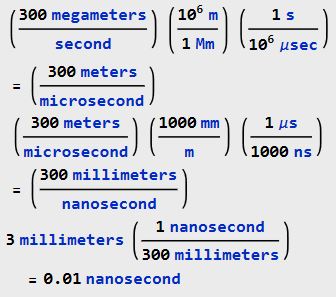
<drawing Old Reliable from its holster> “That first question is quantitative so let’s gather the numbers. The speed of light in vacuum is about 186 000 miles per second, that’s 300 megameters per second or 300 millimeters per nanosecond. Metric system conversions are kinda fun, aren’t they?”

“Hang on — megameters per second is meters per microsecond, take it down another thousand top and bottom…. I guess that’s okay.”

“Old Reliable doesn’t lie. Alright, your eyeglass lenses look like they’re a couple of millimeters thick. I’ll call it three millimeters to make the numbers pretty. If your lenses were vacuum space a short light pulse would pass through in 0.01 nanosecond, okay?”

“Not that thick, but go on.”

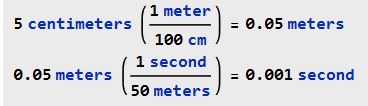
“The slow‑down factor is technically called the refractive index. Old Reliable says that eyeglass refractive indexes typically run about 1.5 so with the slow‑down our light pulse would take 0.015 nanosecond instead of 0.01. Is that enough increase to affect your rection time significantly? Let’s see … Says here that a typical nerve impulse travels at about 50 meters per second. Keeping the numbers pretty I’ll guess that between your eye and the vision centers in the back of your brain is about 2 inches or 5 centimeters. You good with that?”

“Not that short, but anything for pretty numbers. Go on.”

“Five centimeters is 0.05 meters, at 50 meters per second comes to 0.001 second. Slowing down that pulse lengthens your reaction time from 0.001 second to 0.001 000 000 015 second. Not enough of a difference to worry about.”

“But how come it slows at all seeing as I’ve heard it’s mostly empty space between the atoms?”

“There’s empty and there’s empty. You’re thinking of little solar‑system atoms, aren’t you, with particle electrons orbiting the nucleus and what space is left is vacuum. We’ve known for a century that it’s not that way. The electrons aren’t particles, they’re fuzzy blobs, and the volume around them is chock full of lumpy electric field. The incoming lightwave, really an electromagnetic wave, doesn’t see one electron here and another one way over there and free passage in between. Nope, it interacts with the whole field and that’s where the slow‑down happens.”

“Lots of quantum jumps and like that, huh?”

“No quantum jumps unless your glasses are tinted. Mmm… You ever run along the seashore?”

“I’m from Jersey. Of course I have.”

 Time periodicity at a point,
 space periodicity at a moment.

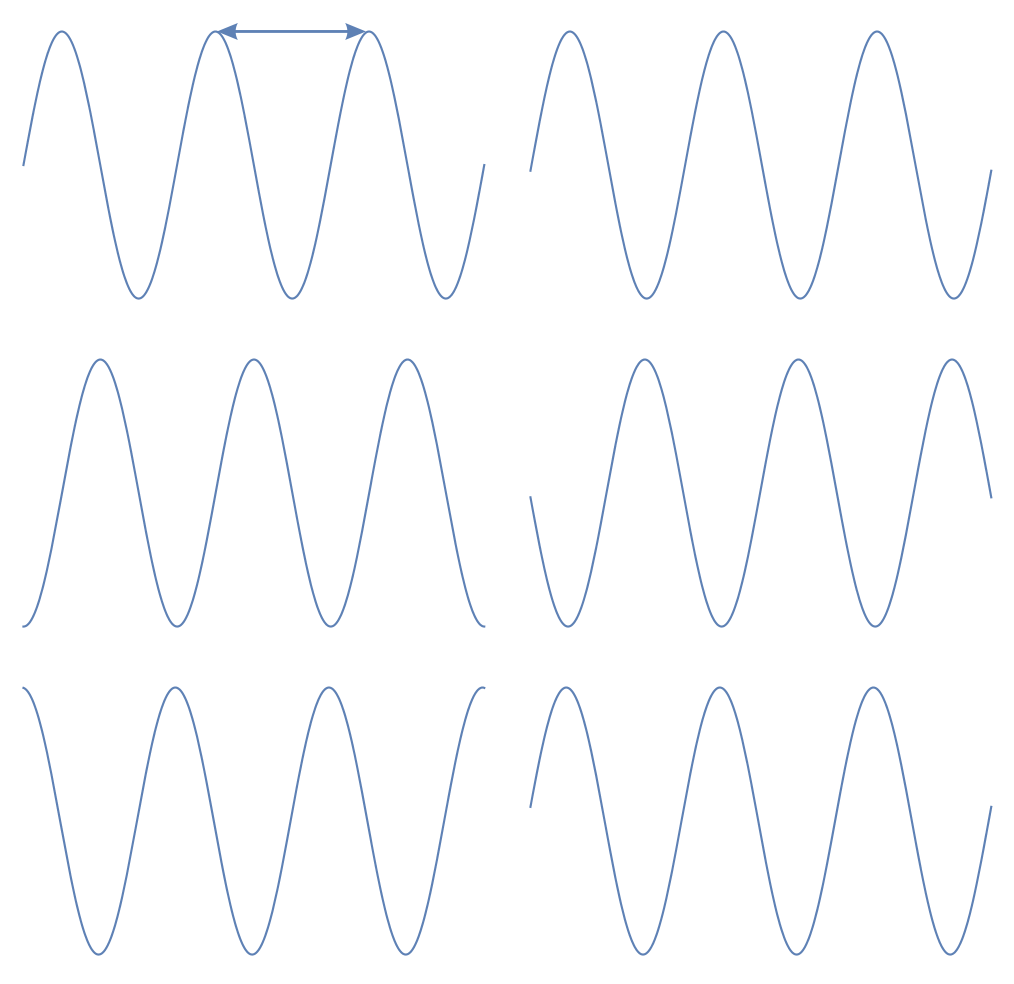
“Visualize running across hard sand and suddenly you hit a patch of soft sand. You keep your feet oscillating up and down at the same rate, but you make less progress along the beach. Your footprints get closer together, right?”

“Sometimes I fall down. So?”

“Something similar happens with a lightwave. It repeats in time like your foot going up and down and it repeats in space like your footprints in the sand. The wave’s energy changes with repeat time. When light passes through an electric field like the one inside clear, colorless glass, the field doesn’t absorb energy — no change in repeat time. What does happen is the field squeezes the peak‑to‑peak distance. The wave acts like your footprints getting closer together. Less distance divided by the same time means lower speed. The wave slows down inside the glass.”

“Does light ever fall down?”

“Only if its energy quantum matches an absorber’s gap.”

~~ Rich Olcott

In vacuo veritas?

“Let’s see if my notes are complete, Mr Moire. We’re crossed off two possible Universe finales — falling into a Big Crunch or expanding forever while making new matter between the galaxies to keep itself in a steady state. Or the Universe might expand to some critical density and then stay there but we mostly ruled that out because a twitch would push it to either crunching or expanding forever. Einstein’s Cosmological Constant might or might not be dark energy but either way, Friedmann’s equation predicts that the Universe will expand exponentially. Is that all the ways we could end?”

“Of course not, Jeremy. The far distant future’s like anything we humans don’t know much about, we make lots of guesses. Vacuum energy, for instance.”

“Anything to do with getting my roommate off the couch when it’s their turn to do the floors?”

“Very funny, but no. The notion of ‘vacuum‘ has a history. Aristotle said it’s empty space and that’s nothing and you can’t talk about nothing, but of course that’s exactly what he was doing. It wasn’t until Newton’s day that we developed dependable technologies for producing and investigating ‘nothing.’ Turns out that a good vacuum’s hard to find and even outer space is a lot busier than you might think.”

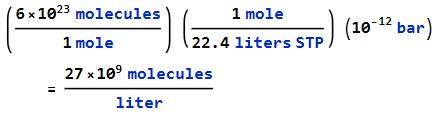
“Yeah, Jim in the Physics lab says he’s working with Ultra‑High Vacuum, a millionth of a millionth of an atmosphere, and the molecules left in the apparatus still cause problems.”

“Wonder how many molecules that is. Time for Old Reliable. <muttering> Avagadro’s Number, 22.4 liters, 10-12 atmospheres … Wow, there’s nearly 30 billion molecules per liter in his rig, a couple hundred times more if he chills it. <scrolling> This Wikipedia article says the solar wind runs only ten thousand protons per liter; interstellar medium’s about a tenth of that. But all those are physical vacuums. Theoretical vacuums are completely empty except they’re sort‑of not.”

“How could they be empty but not? Is that a Schrödinger joke?”

“No, but it does point up how the word has acquired multiple technical meanings. Newton’s concept of a vacuum was basically equivalent to Aristotle’s — simply a space with no matter in it. Two centuries later, Maxwell pointed the way to electric and magnetic fields which meant we needed to define a new vacuum with no such fields. Einstein added his proviso about the speed of light in a vacuum but that was okay. Then along came quantum and strings and several new kinds of vacuum.”

“Why would we need new definitions? Nothing’s nothing, isn’t it?”

“Not necessarily in theory, and that’s the point. For instance, you might use a Maxwell‑inspired theory to think about how a certain charged object behaves in a certain electromagnetic field. You can’t isolate the field’s effects unless you can add it to a theoretical space containing no objects or electromagnetic fields. Make sense?”

“And that’s a Maxwell vacuum? Seems reasonable. Then what?”

“Quantum theories go in the other direction. They start by assuming that Maxwellian vacuums can’t exist, that space itself continually produces virtual particles from their associated fields.”

“Um, conservation of mass?”

“Valid question. This may feel like dodging, but there’s math and experiment to back it up. What’s really conserved, we think, is mass‑energy. Particles, anti‑particles and energy fluctuations averaging to zero over finite time intervals. A dab of energy concentrated to create a particle’s mass? No problem, because that particle will be annihilated and release its energy equivalent almost immediately. To replace the Maxwellian vacuum, quantum theorists co‑opted the word to refer to a system’s lowest possible quantum state or maybe the lowest possible set of states, depending on which kind of calculation is underway. The cosmology people picked up that notion and that’s when the doom‑saying started.”

“Awright, now we’re getting somewhere. What’s their vacuum like?”

“From what I’ve seen, a tall stack of ‘if‘s and hand‑waving. The idea is that our Universe may not be in the lowest possible quantum state and if so, sometime in the next 188 billion years we could suddenly drop from false to true vacuum, in which case everything goes haywire. I’m not convinced that the Universe even has a quantum state. Don’t panic.”

~~ Rich Olcott

The Bottom of Time

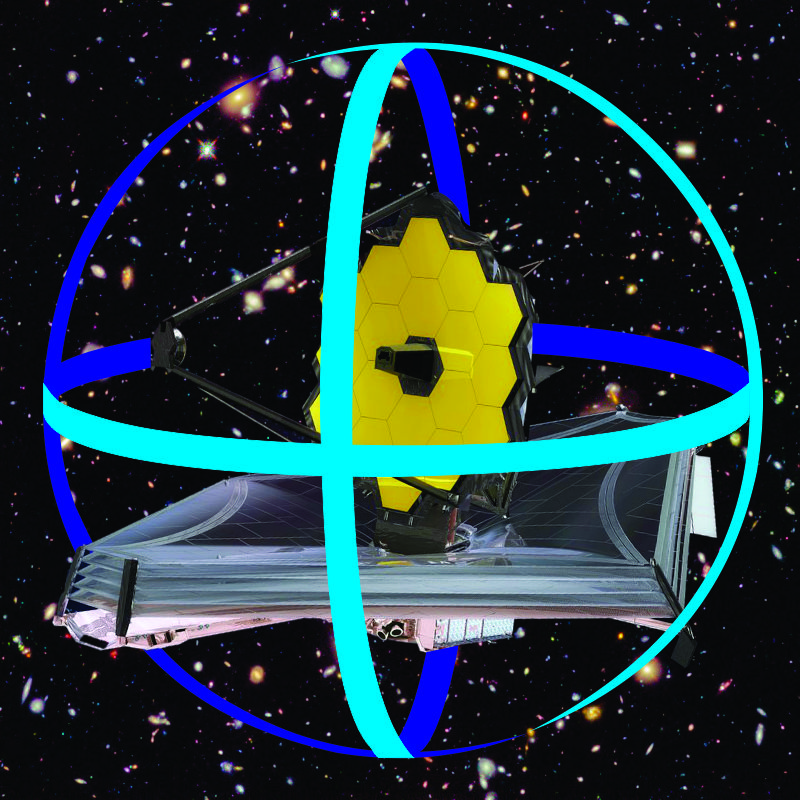
“Cathleen, one of my Astronomy magazines had an article, claimed that James Webb Space Telescope can see back to the Big Bang. That doesn’t seem right, right?”

“You’re right, Al, it’s not quite right. By our present state of knowledge JWST‘s infrared perspective goes back only 98% of the way to the Bang. Not quite the Bottom of Time, but close.”

“Whaddaya mean, ‘Bottom of Time‘? I’ve heard people talking about how weird it musta been before the Big Bang. And how can JWST see back in time anyway? Telescopes look across space, not time.”

“So many questions, Mr Feder, and some hiding behind others. That’s his usual mode, Cathleen. Care to tag-team?”

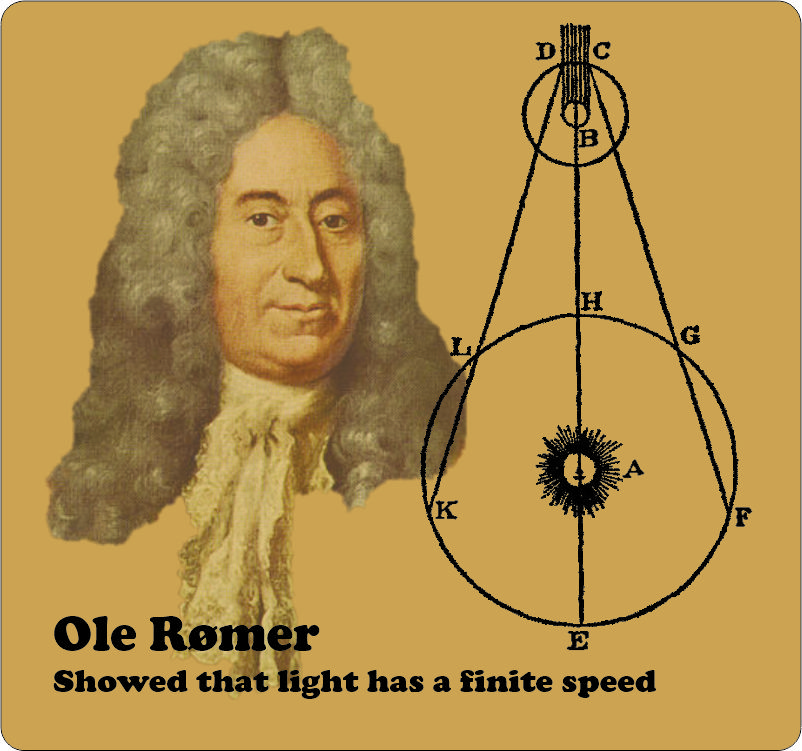
“You’re on, Sy. Well, Mr Feder. The ‘look back in time‘ part comes from light not traveling infinitely fast. We’ve known that for three centuries, ever since Rømer—”

“Roamer?”

“Ole Rømer, a Danish scientist who lived in Newson’s time. Everyone knew that Jupiter’s innermost large moon Io had a dependably regular orbit, circling Jupiter every 49½ hours like clockwork. Rømer was an astronomer when he wasn’t tutoring the French King’s son or being Copenhagen’s equivalent of Public Safety Commissioner. He watched Io closely, kept notes on exactly when she ducked behind Jupiter and when she reappeared on the other side. His observed timings weren’t quite regular, generally off by a few minutes. Funny thing was, the irregularities correlated with the Earth‑Jupiter distance — up to 3½ minutes earlier than expected when Earth in its orbit was closest to Jupiter, similarly late when they were far apart. There was a lot of argument about how that could be, but Rømer, Huygens, even Newton, all agreed that the best explanation was that we only see Io’s passage events after light has taken its time to travel from there to here.”

“Seems reasonable. Why should people argue about that?”

“The major sticking point was the speed that Huygens calculated from Rømer’s data. We now know it’s 186000 miles or 300000 kilometers or one lightsecond per second. Different ways of stating the same quantity. Huygens came up with a somewhat smaller number but still. The establishment pundits had been okay with light transmission being instantaneous. Given definite numbers, though, they had trouble accepting the idea that anything physical could go that fast.”

“Tag, my turn. Flip that distance per time ratio upside down — for every additional lightsecond of distance we’re looking at events happening one second farther into the past. That’s the key to JWST‘s view into the long‑ago. Al, you got that JWST‘s infrared capabilities will beat Hubble‘s vis‑UV ones for distance. Unless there’s something seriously wrong with Einstein’s assumption that lightspeed’s an absolute constant throughout spacetime, we expect JWST to give us visibility to the oldest free photons in the Universe, just 379000 years upward from the Big Bang.”

“Wait, I heard weaseling there. Free photons? Like you gotta pay for the others?”

“Ha, ha, Mr Feder. During those first 379000‑or‑so years, we think the Universe was so hot and so dense that no photon’s wave had much of a chance to spread out before it encountered a charged something and got absorbed. At last, things cooled down enough for atoms to form and stay in one piece. Atoms are neutral. Quantum rules restrict their interaction to only photons that have certain wavelengths. The rest of the photons, and there’s a huge number of them, were free to roam the expanding Universe until they happen to find a suitable absorber. Maybe someone’s eye or if we’re lucky, a sensor on JWST or some other telescope.”

Thanks for this to George Derenburger

“What about before the 300‑and‑something thousand years? Like, before Year Zero? Musta been weird, huh?”

“Well, there’s a problem with that question. You’re assuming there was a Year Minus‑One, but that’s just not the case.”

“Why not? Arithmetic works that way.”

“But the Universe doesn’t. Stephen Hawking came up with a good way to think about it. What on Earth is south of the South Pole?”

“Eeayahh … nope. Can’t get any further south than that.”

“Well, there you are, so to speak. Time’s bottom is Year Zero and you can’t get any further down than that. We think.”

~~ Rich Olcott

Turn This Way to Turn That Way

“I don’t understand, Sy. I get that James Webb Space Telescope uses its reaction wheels like a ship uses a rudder to change direction by pushing against something outside. Except the rudder pushes against water but the reaction wheels push against … what, the Universe?”

“Maybe probably, Al. We simply don’t know how inertia works. Newton just took inertia as a given. His Laws of Motion say that things remain at rest or persist in linear motion unless acted upon by some force. He didn’t say why. Einstein’s General Relativity starts from his Equivalence Principle — gravitational inertia is identical to mechanical inertia. That’s held up to painstaking experimental tests, but why it works is still an open question. Einstein liked Mach’s explanation, that we experience these inertias because matter interacts somehow with the rest of the Universe. He didn’t speculate how that interaction works because he didn’t like Action At A Distance. The quantum field theory people say that everything’s part of the universal field structure, which sounds cool but doesn’t help much. String theory … ’nuff said.”

“Hey, Moire, what’s all that got to do with the reaction wheel thing? JWST can push against one all it wants but it won’t go anywhere ’cause the wheel’s inside it. What’s magic about the wheels?”

JWST doesn’t want to go anywhere else, Mr Feder. We’re happy with it being in its proper orbit, but it needs to be able to point to different angles. Reaction wheels and gyroscopes are all about angular momentum, not about the linear kind that’s involved with moving from place to place.”

“HAH! JWST is moving place to place, in that orbit! Ain’t it got linear momentum then?”

Newton’s Principia, Proposition II, Theorem II

“In a limited way, pun intended. Angular momentum is linear momentum plus a radial constraint. This goes back to Newton and his Principia book. I’ve got a copy of his basic arc‑splitting diagram here in Old Reliable. The ABCDEF line is a section of some curve around point S. He treated it as a succession of short line segments ABc, BCd, CDe and so on. If JWST is at point B, for instance, Newton would say that it’s traveling with a certain linear momentum along the BCd line. However, it’s constrained to move along the arc so it winds up at D instead d. To account for the constraint Newton invented centripetal force to pull along the Sd line. He then mentally made the steps smaller and smaller until the sequence of short lines matched the curve. At the limit, a sequence of little bits of linear momentum becomes angular momentum. By the way, this step‑reduction process is at the heart of calculus. Anyway, JWST uses its reaction wheels to swing itself around, not to propel itself.”

“And we’re back to my original question, Sy. What makes that swinging happen?”

“Oh, you mean the mechanical reality. Easy, Al. Like I said, three pairs of motorized wheels are mounted on JWST‘s frame near the center of mass. Their axles are at mutual right angles. Change a wheel’s angular momentum, you get an equal opposing change to the satellite’s. Suppose the Attitude Control System wants the satellite to swing to starboard. That’d be clockwise viewed from the cold side. ACS must tell a port/starboard motor to spin its wheel faster counterclockwise. If it’s already spinning clockwise, the command would be to put on the brakes, right? Either way, JWST swings clockwise. With the forward/aft motors and the hot‑side/cold‑side motors, the ACS is equipped to get to any orientation. See how that works?”

“Hang on.” <handwaving ensues> “Yeah, I guess so.”

“Hey, Moire. What if the wheel’s already spinning at top speed in the direction the ACS wants more of?”

“Ah, that calls for a momentum dump. JWST‘s equipped with eight small rocket engines called thrusters. They convert angular momentum back to linear momentum in rocket exhaust. Suppose we need a further turn to starboard but a port/starboard wheel is nearing threshold spin rate. ACS puts the brakes on that wheel, which by itself would turn the satellite to port. However, ACS simultaneously activates selected thrusters to oppose the portward slew. Cute, huh?”

~~ Rich Olcott

Dark Glasses

My office door THUMPs as Richard Feder barrels in. Vinnie’s half out of his chair with his fists balled up but he settles back down when he sees who it is. “Moire, I gotta question.”

“Afternoon, Mr Feder. What brings you to the 12th floor of the Acme Building?”

“My dentist’s up here. They gave me these really dark glasses for when they aimed a bright light in my mouth to harden something in there so I wondered why’re they so dark an’ what about those glasses that can’t make up their minds?”

“Well, Mr Feder, as usual you’ve asked a jumbled question. Let’s see. The answers all boil down to what light is made of and what the glasses are made of.”

“I thought it was photon particles, Sy. The light, I mean.”

“It is, Vinnie, but photons only act like particles when they’re emitted and when they’re absorbed. In between, they act like waves. Dark glasses are all about photons as waves. The simplest case is the plain dark glasses.”

“Yeah, Moire, simple’s good.”

“They’re black because they’ve been doped with black chemicals. If your glasses are actually made of glass, the manufacturer probably dumped iron and sulfur into the melt. When heated those elements combine to form black iron sulfide particles spread throughout the mass. If the glasses are plastic, the manufacture mixed black dye into the formula. Either way, the more dopant added, the blacker the product and the fewer waves make it through the lens.”

“Great, Sy, but how come the black? I remember that Sun-spectrum poster that Al had up in his shop once. Lotsa sharp dark lines that Cathleen said were from different elements absorbing little slices of that rainbow background. But there were plenty of colors left over to make white.”

“Impressive memory, Vinnie. That was what, three years ago? Anyhow, those absorption lines come from separated atoms floating in the hot gas of the solar atmosphere. Quantum mechanics says that an isolated atom has a characteristic set of electron configurations, each with its own energy level. Say an incoming photon meets a gas atom. If the photon’s energy just matches the difference between the atom’s current configuration and some other configuration, suddenly the atom’s in the new configuration and no more photon. It has to match just right or no absorption. Those sharp lines come from that selectivity, OK?”

“So how do you get total black from selective atoms?”

“You don’t. You get black from less‑selective molecules and larger structures. Atoms right next to each other bring entanglement into the action — which electron is where on which atom? Many more configurations, many more differences between energy level pairs, many more lines that can overlap to make broad absorption bands. Suppose you’ve got some glass or plastic doped to have a single band sucking up everything between orange and green. Shine white light into it. Only red light and blue light come through. We see that as purple, a color that’s not even in the spectrum. Make that band even broader like it is with metals and rocks and iron sulfide; nothing gets through.”

“Then how do they do those glasses that get dark or light depending? The factory can’t put chemicals in but take ’em out temporary‑like when you walk inside.”

“Good point. In fact, the glass composition stays the same, sort of. The factory puts in chemicals that change their structure depending on the light level. If you dope optical glass with silver chloride crystallites, for instance, UV light can energize a chloride’s electron up to where it can leave the chloride and be captured by a silver ion. Do that with enough silver ions in the crystallite and you have a tiny piece of silver metal. Enough pieces and the glass looks gray, at least until heat energy joggles things back to the silver chloride ground state. For plastic lenses they use a subtler strategy — large‑ish molecules with spread‑out electron structures. UV light energizes an electron to another level and the molecule twitches to an opaque alternate form that relaxes when heat shakes it down.”

“Heat, huh? No wonder mine don’t work so good on the beach.”

~~ Rich Olcott

Things That Won’t Work

Vinnie gets a far-away look in his eye. I wait. “Ya know, Sy, there oughtta be a way.”

“A way to what?”

“I ain’t giving up on this faster-than-light communication stuff. I know Einstein said it couldn’t happen because it’d flip cause and effect and he didn’t like that, but that feels too much like philosophy books I’ve read that boil down to, ‘This thing can’t be true because I don’t want it to be.’ Maybe there’s something we ain’t thought of yet.”

“Lots of people have played with that challenge for decades. Do you have any fresh ideas?”

“A couple possibles. Lessee if I’ve got this straight. We’ve got two separate message channels going — one that works instant-like for information between entangled quantum thingies, and one for everything else that’s stuck at lightspeed or less. Suppose I’ve got two entangled pizzas— nah, we’re really talking quantum stuff like electrons and photons so I’ll just say particles. Suppose I’ve got two entangled particles that are some ugly mix of red and green but we know when they’re de-linked they’ll be opposite. I send one to you the regular way but they’re still linked. I look at the one I still got and it’s red, say. The same moment, yours instantly went green but you don’t know that yet until you look or you get status information from me through the not‑instant channel. So the problem is getting information to leak between the two channels, right?”

“That’s about the size of it.”

“OK, try this one. How about I use a magnetic field or something to force mine to red? And maybe a set time later I make it green to confirm I’m in control and it’s a real signal.”

“Sorry, as soon as you manipulate properties in part of an entangled system you break the entanglement and the other part is free to do whatever it wants to. Next?”

“Uhh … time synchronization. How about you and me set a certain time for me to look at mine? You can watch yours and when it flips or not you’ll know.”

“All that does is move the manipulation to the other end of the setup. Me looking at my particle resets yours to whatever color mine isn’t and that breaks the entanglement. Next?”

“Maybe something with a bunch of particles all entangled together? How about—”

“Nup, can’t base a strategy on that. Like everything else quantum, entanglement is statistical. There’s no guarantee that even in our two‑particle system I’ll see green if you see red — the odds are high but not 100%. There’s a proven theorem that says if two particles are ‘maximally entangled,’ adding a third to the system reduces the odds that any two will coordinate their behaviors. A bunch of particles would be even less stable. It’s called the monogamy theorem, care to guess why?”

“Physics fun with metaphors again, cute, but I can see this is a good one. You got anything?”

“Not having to do with entanglement, but I have been playing with a different idea, sort of a blank‑sky approach.”

“You mean blue‑sky.”

“Uh-uh, blank. Think about a sky made of dark matter. Dark matter’s subject to gravity but so far as we know it has absolutely no interaction with electromagnetism of any kind — doesn’t play with electrons, light waves, nothing. Einstein based part of his relativity work on Maxwell’s electromagnetism equations. In fact, that’s where the idea came from that ‘c‘ was the speed limit for the Universe. It was a good idea and there’s a huge amount of evidence that he was right. Everything in our Standard Model except the photon is subject to the Lorentz factor. Both light and gravity acting on normal matter travel at c‑speed. Well, maybe the value of c has something to do with how quarks work. Dark matter doesn’t have quarks. What if dark matter has a different speed limit, maybe a lot higher than c or even no limit at all? Maybe we could exploit that property somehow. How about a dark‑matter telegraph?”

“I’m thinking of my Grampa’s recipe for rabbit stew. ‘First you gotta catch your rabbit,’ he used to say,”

~~ Rich Olcott

The Pizza Connection

“Wait a minute, Sy. If Einstein’s logic proves we can’t have faster‑than‑light communication, what about all the entanglement hype I see in my science magazines?”

“Hype’s the right word, Vinnie. Entanglement’s a real effect, but it doesn’t play well as a communication channel.”

“OK, why not?”

“Let’s set the stage. We’re still in our personal spaceships and we’ve just ordered pizza from Eddie. The entanglement relationship is independent of time and distance so I’m going to skip over how fast we’re going and pretend that Eddie’s using transporter delivery technology, ok?”

“Fine with me,”

“Good. You order your usual double pepperoni with extra cheese, I ask for Italian sausage. Two pizza boxes suddenly appear on our respective mess tables. No reflection on Eddie, but suppose he has a history of getting orders crossed. The quantum formalism says because our orders were filled at the same time and in a single operation, the two boxes are entangled — we don’t know which is which. Before we open the boxes, each of us has a 50:50 shot of getting the right order. It’s like we’ve got a pair of Schrödinger pizzas, half one order and half the other until we look, right?”

“Won’t happen, Eddie’s a pro.”

“True, but stay with me here. I open my box and immediately I know which pizza you received, no matter how far away your ship is from mine. Is that instantaneous communication between us?”

“Of course not, I’m not gonna know which pizza either of us got until I open my own box. Then I’ll know what my meal’s gonna be and I’ll know what you’re having, too. Actually, I’m probably gonna know first because I get hungry sooner than you.”

“Good point. Anyway, entanglement doesn’t transmit human‑scale information. The only communication between us in our spaceships is still limited by Einstein’s rules. But this is a good setup for us to dig a little deeper into the quantum stuff. You rightly rejected the Schrödinger pizza idea because pizza’s human‑scale. One of those boxes definitely holds your pizza or else it definitely holds mine. There’s no in‑between mixtures with human‑scale pizzas. Suppose Eddie sent quantum‑scale nanopizzas, though. Now things get more interesting.”

“Eddie doesn’t mess up orders.”

<sigh> “Even Eddie can’t keep things straight if he sends out a pair of quantum‑scale pizzas. What’s inside a specific entangled box is called a local property. John Stewart Bell proved some statistical criteria for whether a quantum system’s properties are local or are somehow shared among the entangled objects. Scientists have applied his tests to everything from entangled photons up to little squares of diamond. They’ve tracked quantum properties from spin states to vibration modes. A lot of work went into plugging loopholes in Bell’s criteria.”

“What’d they find?”

“The results keep coming up non-local. Our quantum pizzas truly do not have separate characteristics hiding inside their boxes unless Eddie marked a box to destroy the symmetry. All the objects in an entanglement share all the applicable quantum property values until one object gets measured. Instantly, all the entangled objects snap into specific individual property values, like which box holds which pizza. They stop being entangled, too. That happens no matter how far apart they are. Those experimental results absolutely rule out the local‑property idea which was the most appealing version of the ‘underlying reality‘ that Einstein and Bohr argued over.”

“Wait, I can’t tell you anything faster than light, but these quantum thingies automatically do that instant‑like?”

“Annoying, isn’t it? But it’s a sparse form of messaging. My quantum pizza box can tell yours only two things, ‘I’ve been opened‘ and ‘I hold Italian sausage pizza.’ They’re one‑time messages at the quantum level and you as an observer can’t hear either one. Quantum theoreticians call the interaction ‘wave function collapse‘ but Einstein called it ‘spooky action at a distance.’ He hated even that limited amount of instantaneous communication because it goes directly against the first principle of Special Relativity. Relativity has been vigorously tested for over a century. It’s stood up to everything they’ve thrown at it — except for this little mouse nibbling at its base.”

~~ Rich Olcott

Neutral

It’s that kind of an afternoon. Finished up one project, don’t feel much like starting another. Spring rain outside so instead of walking to Al’s for coffee I take the elevator down to Pizza Eddie’s on 2. Looks like other folks have the same feeling. “Afternoon, all. What’s the current topic of conversation?”

“Well, Sy, it started out as Star Wars versus Star Trek but then Jim said he could care less and Susan said that meant he did care and he said no, he’s ambivalent and she said that still meant he cared, and—”

“I get it, Eddie. Susan, why does ‘ambivalent‘ mean Jim cares?”

“Chemistry, Sy. ‘Valence‘ means ‘bonding‘ and ‘ambi-‘ means ‘both‘ so ‘ambi‑valent‘ means ‘bonded to both‘.”

“But Susan, ambidextrous means able to use both hands, not unable to use either hand. I want to say I don’t particularly like or dislike either one.”

“It’s like trying to decide between fire ants or hornets. You could say ‘No‑win,’ right?”

“No, that’s not it, either, Eddie. That’s ‘everybody loses.’ I’m smack in the middle.”

“Sounds like absolute neutrality. Hard to get there.”

“Don’t look at Chemistry. If I take an acid solution and add just enough base to get to neutral pH, there’s still tenth‑micromolar concentrations of acid and base in there. I guess we could call that ambivalent.”

“Neutrality’s hard for humans and chemicals, yeah, but that’s where the Universe is.”

“Why do you say that, Jim?”

“Because we’ve got proof right in front of us. Look, planets and stars and people exist as distinct objects, right? They’re not a finely-divided mist.”

“So?”

“So if the Universe were not exactly electrically neutral, then opposite charges repelling would split everything apart.”
 ”Wait, nothing would have a chance to form in the first place.”
   ”Wait, couldn’t you have lumps of like 99 positives and 100 negatives or whatever that just cancel out?”

“Eddie, when you say ‘cancel out’ you’re still talking about being absolutely neutral at the lump level. It’s like this table salt that has positive sodium ions and negative chlorides but the crystals are neutral or we’d get sparks when I pour some out like this.”
 ”Hey, don’t waste the salt. Costs money.”

“I still think it’s weird how all electrons have the same charge and it’s exactly the same as the proton charge. Protons are made of quarks, right, and electrons aren’t. So how can you take three of something and have that add up to exactly one of something different?”

“I can give you Feynman and Wheeler’s answer to part of that, Susan. The electron has an anti‑partner, the positron, which is exactly like the electron in every way except it has the opposite charge. When electron and positron meet they annihilate to produce a burst of high‑energy photons. But there’s a flip side — high‑energy photons sometimes interact to make an electron‑positron pair. Feynman and Wheeler were both jokers. They suggested that a positron could be an electron traveling backward in time. Wheeler said, ‘Maybe they’re all the same electron,’ zig‑zagging across eternity. But that doesn’t account for the quarks. A proton has two up‑quarks, each with a charge of negative 2/3 electron, and one down‑quark with a charge of positive 1/3 electron. Add ’em up — you exactly neutralize one electron. Fun, huh?”

“Fun, Jim, but I’m a chemist. On a two-pan balance I can weigh out equal quantities of molasses and rock dust but I don’t expect them to interact with any simple mathematical relationship. Why should the quark’s charge be any exact multiple or divisor of the electron’s? And why is the electron charge the size it is instead of some other number?”

“Well, there you’ve got me. The quantum chromodynamics Standard Model has been amazingly successful for quantitative predictions, but not so good for explaining things outside of its own terms. The math lays out the relationship between quark and electron charge, but doesn’t give us a physical ‘why.’ The theory has 19 ‘adjustable constants’ but no particular reason why they should have the specific values that fit the observations. Also, the theory doesn’t include gravity. It’s a little embarrassing.”

“Sounds like you’re ambivalent about the theory.”

~~ Rich Olcott

Space Potatoes

“Uncle Sy, what’s the name of the Moon face that’s just a sliver?”

“It’s called a crescent, Teena, and it’s ‘phase,’ not ‘face’. Hear the z-sound?”

“Ah-hah, one of those spelling things, huh?”

“I’m afraid so. What brought that question up?”

“I was telling Bratty Brian about the Moon shadows and he said he saw a cartoon about something that punched a hole in the Moon and left just the sliver.”

“Not going to happen, Sweetie. Anything as big as the Moon, Mr Newton’s Law of Gravity says that it’ll be round, mostly, except for mountains and things.”

“Cause there’s something really heavy in the center?”

“No, and that’s probably what shocked people the most back in those days. They had Kings and Emperors, remember, and a Pope who led all the Christians in Europe. People expected everything to have some central figure in charge. That’s why they argued about whether the center of the Universe was the Earth or the Sun. Mr Newton showed that you don’t need anything at all at the center of things.”

“But then what pulls the things together?”

“The things themselves and the rules they follow. Remember the bird murmuration rules?”

“That was a long time ago, Uncle Sy. Umm… wasn’t one rule that each bird in the flock tries to stay about the same distance from all its neighbors?”

“Good memory. That was one of the rules. The others were to fly in the same general direction as everybody else and to try stay near the middle of the flock. Those three rules pretty much kept the whole flock together and protected most of the birds from predators. Mr Newton had simpler rules for rocks and things floating in space. His first rule was. ‘Keep going in the direction you’ve been going unless something pulls you in another direction.’ We call that inertia. The second rule explained why rocks fly differently than birds do.”

“Rocks don’t fly, Uncle Sy, they fall down.”

“Better to think of it as flying towards other things. Instead of the safe‑distance rule, Mr Newton said, ‘The closer two things are, the harder they pull together.’ Simple, huh?”

“Oh, like my magnet doggies.”

“Yes, exactly like that, except gravity always attracts. There’s no pushing away like magnets do when you turn one around. Suppose that back when the Solar System was being formed, two big rocks got close. What would happen?”

“They’d bang together.”

“And then?”

“They’d attract other rocks and more and more. Bangbangbangbang!”

“Right. What do you suppose happens to the energy from those bangs? Remember, we’re out in space so there’s no air to carry the sound waves away.”

“It’d break the rocks into smaller rocks. But the energy’s still there, just in smaller pieces, right?”

“The most broken-up energy is heat. What does that tell you?”

“The rock jumble must get … does it get hot enough to melt?”

“It can So now suppose there’s a blob of melted rock floating in space, and every atom in the melted rock is attracted to every other atom. Pretend you’re an atom out at one end of the blob.”

“I see as many atoms to one side as to the other so I’m gonna pull in towards the middle.”

“And so will all the other atoms. What shape is that going to make the blob?”

“Ooooh. Round like a planet. Or the Sun. Or the Moon!”

“So now tell me what would happen if someone punched a hole in the Moon?”

“All the crumbles at the crescent points would get pulled in towards the middle. It wouldn’t be a crescent any more!”

“Exactly. Mind you, if it doesn’t melt it may not be spherical. Melted stuff can only get round because molten atoms are free to move.”

“Are there not-round things in space?”

“Lots and lots. Small blobs couldn’t pull themselves spherical before freezing solid. They could be potato‑shaped, like the Martian moons Phobos and Deimos. Some rocks came together so gently that they didn’t melt. They just stuck together, like Asteroid Bennu where our OSIRIS-REx spacecraft sampled.”

“Space has surprising shapes, huh?”

“Space always surprises.”

~~ Rich Olcott

  • Thanks to Xander and Alex who asked the question.